Online Workshop | Lacing around the World

Decor la Dentelle, French, ca. 1725, silk, metallic-wrapped thread, gold, 51 × 29 cm
(Washington, DC: Cotsen Textile Traces Study Collection, T-0598)
◊ ◊ ◊ ◊ ◊
From The George Washington University Museum:
Lacing around the World and across Time
The Cotsen Textile Traces Global Roundtable
Online, 12–13 October 2022
The third annual virtual Cotsen Textile Traces Global Roundtable explores the rich traditions of lacemaking through examples from the Cotsen Textile Traces Study Collection at The George Washington University Museum and The Textile Museum in Washington, D.C., October 12 and 13.
The Cotsen Textile Traces Global Roundtable: Lacing around the World and across Time includes some fifteen international scholars, artists, and designers, who will present multiple dimensions of the global art, from its history and globalization to innovations, fashion, and artistic creativity. This program is a partnership with Bard Graduate Center, New York, and Textilmuseum St. Gallen, Switzerland, and is supported through the Cotsen Textile Traces Study Collection Endowment.
Those interested in attending the roundtable should register early in order to receive links and details for joining each day of the roundtable on Zoom, as well as a full program with the detailed schedule.
The Cotsen Textile Traces Study Collection represents a lifetime of collecting by business leader and philanthropist Lloyd Cotsen (1929–2017). Comprised of nearly 4,000 fragments from all over the world, the collection offers insights into human creativity from antiquity to the present. Cornerstones of the collection include fragments from Japan, China, pre-Hispanic Peru and 16th- to 18th-century Europe. The entire collection is available online.
W E D N E S D A Y , 1 2 O C T O B E R 2 0 2 2
Situating Lace: Traditions and Transmission
10.00 Introduction
• Lori Kartchner — Curator of education, The George Washington University Museum and The Textile Museum
• John Wetenhall — Director, The George Washington University Museum and The Textile Museum
• Emma Cormack — Associate curator, Bard Graduate Center
• Marie-Eve Celio-Scheurer — Art historian, academic coordinator, Cotsen Textile Traces Study Center, The George Washington University Museum and The Textile Museum
10.30 Panel 1 | Needle Lace, Bobbin Lace: Traditions and Transmissions
• Diana Greenwold — Lunder Curator of American Art, National Museum of Asian Art, Smithsonian Institution
• Cecilia Gunzburger — Lecturer, decorative arts and design history, the George Washington University and Smithsonian Institution
• Sarah Besson Coppotelli — Head of collections, Musée et château de Valangin, Switzerland
11.30 Panel 2 | Mimicking Lace
• Sumru Krody — Senior curator, The Textile Museum Collection, The George Washington University Museum and The Textile Museum
• Vaishnavi Kambadur — Assistant curator, Museum of Art & Photography (MAP), Bengaluru, India
T H U R S D A Y , 1 3 O C T O B E R 2 0 2 2
Exploring Global Traditions and Industrial Innovations in Contemporary Creativity
10.00 Keynote Opening
• Emma Cormack — Associate curator, Bard Graduate Center
• Ilona Kos — Curator, Textilmuseum St. Gallen, Switzerland
• Michel Majer — Professor emerita, Bard Graduate Center
10.30 Panel 3 | Handmade Lace Today
• Caroline Kipp — Curator of contemporary art, The George Washington University Museum and The Textile Museum
• Elena Kanagy-Loux — Collections specialist, Antonio Ratti Textile Center, The Metropolitan Museum of Art
• Nidhi Garg Allen — Founder and CEO, Marasim, New York/India
11.30 Panel 4 | Industrial Innovations
• Elena Kanagy-Loux — Collections specialist, Antonio Ratti Textile Center, The Metropolitan Museum of Art
• Jérémy Gobé — Artist, founder, Corail Artefact, France
• Rose-Lynn Fisher — Artist, United States
Public Lecture Course | Georgian Provocations, II

From PMC with registration at Eventbrite:
Georgian Provocations, II
In-person and Online, Paul Mellon Centre, London, 27 October — 8 December 2022
Organized by Martin Postle
The Paul Mellon Centre’s next public lecture course is entitled Georgian Provocations II, a sequel to the highly successful Georgian Provocations, which ran in the summer of 2020. Adopting a similar format, the present course will focus upon a series of provocative artworks from the Georgian era and investigate their contents, contexts, and impact. The series is convened by Martin Postle, Senior Research Fellow at the Paul Mellon Centre. The course runs from 27 October to 8 December 2022 and is in-person and live on Zoom weekly, 6.00–7.30pm GMT on Thursdays.
◊ ◊ ◊ ◊ ◊
Lecture 1 | 27 October 2022
Paris Spies-Gans — Establishing a Female Lineage at the Royal Academy’s Show: Eliza Trotter, Angelica Kauffman, and the Intrigues of Lady Caroline Lamb. Register here»
Lecture 2 | 3 November 2022
Martin Myrone — The Haunted Eighteenth Century: Fuseli’s The Nightmare. Register here»
Lecture 3 | 10 November 2022
Esther Chadwick — A Black King in Georgian London: British Art and Postrevolutionary Haiti. Register here»
Lecture 4 | 17 November 2022
Nicholas Robbins — George Romney in the Prison-World of Europe. Register here»
Lecture 5 | 24 November 2022
Nika Elder — John Singleton Copley’s Watson and the Shark and the Taste for Flesh. Register here»
Lecture 6 | 1 December 2022
Martin Postle — Joseph Wright of Derby: Self-portrait as an Experimental Artist. Register here»
Panel Discussion | 8 December 2022
Discussion with Series Speakers and Q&A. Register here»
Online Talk | Feng Schöneweiß on the Dragoon Vases
From The Wallace Collection:
Provenancing the Dragoon Vases: Porcelain, Architecture and Monumentality in German Antiquarianism, 1700–1933
Feng Schöneweiß, PhD Candidate, University of Heidelberg
Online, Wallace Collection Seminar in the History of Collecting, 26 September 2022, 17.30 BST
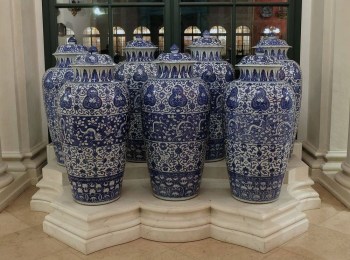
Seven of the Dragoon Vases on display in the Zwinger Palace, Dresden (Porzellansammlung, Staatliche Kunstsammlungen Dresden. Inv. Nos. PO1014/PO2064 (lid), PO1010, PO1011, PO1017, PO9130, PO9172, PO9448/ PO1013 (lid); photograph by Feng Schöneweiß, 2016).
Architects and artisans make monuments, but provenance frames monumentality in the history of collections. This seminar explores how emerging recognition of provenance shaped public perception of monumentality through a study of the transcultural biography of the Dragoon Vases (Dragonervasen).
Since 1900, generations of German antiquarians and museum professionals have celebrated what they have called Chinese monumental vases in their published writings, internal reports, and curatorial practices. Most notable are eighteen Dragoon Vases, which ‘enjoyed special fame without people actually being able to identify them’ in the early twentieth century. The name Dragoon Vases originated from the exchange of dragoon soldiers for porcelain objects between the Saxon and Prussian electors in 1717, but it took 150 years for the designation to emerge in German antiquarian and museological contexts.
Yet, another century later, the notorious Stasi of the German Democratic Republic confiscated Helmuth Meißner’s (1903–1998) art collections in Dresden, which included a large blue-and-white Chinese porcelain vase. With a Palace Number ‘N:2’ and a zigzag line incised on the reverse of its lid, the vase has a manifest provenance from the porcelain collection amassed by Augustus the Strong (1670–1733) in the Dutch Palace, the institutional predecessor of the current Porcelain Collection, Dresden State Art Collections (SKD). Despite the Stasi’s insistence on selling the vase for foreign currency, the SKD successfully claimed it by invoking its value as a ‘nationally valuable cultural property’, a legal category designating objects of national significance for Germany’s cultural heritage. How did Chinese porcelain become monumental in German antiquarian thoughts and practices? The author seeks to answer the question by ‘provenancing’ the vases in their transcultural, architectural, and local contexts during the formative phases of monumentality from 1700 to 1933.
Click here to register to view this talk via Zoom.
Click here to view this talk via YouTube.
Online Seminar | What Does It Mean to Curate a Historic House?

Kingston Lacy, Dorset, designed by Sir Roger Pratt, ca. 1663–65.
◊ ◊ ◊ ◊ ◊
From Eventbrite:
What Does It Mean to Curate a Historic House?
Online, Monday, 26 September 2022, 11.00–12.00 BST
This session will combine a short film and panel discussion based on a British Academy-funded research project led by Dr Tarnya Cooper and Dr Oliver Cox, which explores the contemporary issues and challenges with curating a historic house owned by a heritage organisation. The short film, shot at Kingston Lacy in the summer of 2022, explores the role of the curator in a publicly-accessible historic house, discussing how to prioritise sharing what is significant rather than what is left. Following the film, Cox and Cooper will convene a panel discussion featuring leading specialists from across Europe to discuss the future for historic house curation and interpretation.
Chairs
• Oliver Cox (Head of Academic Partnerships, V&A)
• Tarnya Cooper (Curatorial and Collections Director, National Trust)
Panellists
• Sarah McLeod (Chief Executive, Wentworth Woodhouse Preservation Trust)
• Jeffrey Haworth (Historian and former National Trust Curator)
• Alice Loxton (History Hit)
• John Orna-Ornstein (Director of Curation and Experience, National Trust)
This event is delivered by The National Trust as part of the Art History Festival (20–26 September 2022), presented by the Association for Art History. The full Festival programme is available here»
Material and Visual Culture Seminar Series, Fall 2022
From ArtHist.net:
Material and Visual Culture Seminar Series, 17th and 18th Centuries
Online, University of Edinburgh, 28 September — 7 December 2022
Each session we’ll hear from two speakers, sharing their research on, and approaches to, the study of 17th- and 18th-century material and visual culture. From reassessing how the work of female artists is read, to European visualisation of Latin America, and the exchange of objects, this year’s programme covers a broad range of topics. We aim to make a space in which these rich histories can be explored from varied disciplines to enhance our research practices. We’ll be meeting on Wednesdays, 5–6pm GMT, online using Zoom. See Eventbrite to register, view speaker abstracts, receive the joining link and reminders. Registration closes 40 minutes before seminar start time. Please contact materialcultureresearcheca@ed.ac.uk with any queries.
28 September | Approaching Identities
Chair: Georgia Vullinghs
• Emma Pearce
• Ailsa Maxwell
12 October | Patronage and Person under the Stuarts
Chair: Catriona Murray
• Sarah Hutcheson
• Megan Shaw
26 October | Baroque Devotional Visual Culture
Chair: Carol Richardson
• Lucía Jalón Oyarzun
• Sandra Costa Saldanha
9 November | Pasteboard and Printing Plates: Elusive Objects
Chair: Molly Ingham
• Chiara Betti
• Lucy Razzall
23 November | The Social Life of … Tea
Chair: Caroline McCaffrey-Howarth
• Anna Myers
• Lucy Powell
7 December | The Materiality of Making
Chair: Viccy Coltman
• Kerry Love
• Alejandro Octavio Nodarse
Online Workshop around Simon Burrows’ Oeuvre

From the Pamphlets and Patrons project:
18th-Century Libelles, Libellistes, and Book Trade
Workshop around Simon Burrows’ Oeuvre
Online and in-person, 22 September 2022
Organised by Damian Tricoire and the Pamphlets and Patrons (PAPA) project at the University of Trier
All times are Central European Time
13.00 Introduction — Damien Tricoire (Universität Trier)
13.15 Where’s Marie-Antoinette? Pamphlets, Politics, and French Enlightenment Print Culture — Simon Burrows (Western Sydney University)
14.00 The Palais-Royal Style of Revolution: Brissot, Secretary General of the Chancellery of the Duc d’Orléans — Damien Tricoire (Universität Trier)
14.45 Break
15.15 Political Pamphlets and Print Culture in Liège from the Triumph of Enlightenment to Revolution, 1764–1790 — Daniel Droixhe (Université de Liège)
16.00 Persecuting Printers in France before and after 1789 — Jane McLeod (Brock University)
16.45 Break
17.15 Round Table Discussion
• Simon Burrows (Western Sydney University)
• Edmond Dziembowski (Université de Franche-Comté)
• Olivier Ferret (Université de Lyon)
• Julian Swann (Birbeck University of London)
If you wish to attend online through Zoom or in person, please write to doering@uni-trier.de.
22 September 2022, 12.45pm Paris
Zoom-Meeting
https://uni-trier.zoom.us/j/87391514608?pwd=MlMxYzFsU1hUNFM0OUhndzMwZXBYUT09
Meeting-ID: 873 9151 4608
Passcode: dbjpxFg1
Online Talk | Kay Etheridge on Maria Sibylla Merian
Part of this fall’s offerings from Smithsonian Associates:
Kay Etheridge | Maria Sibylla Merian: A Biologist to the Bone
Online, Smithsonian Associates, Thursday, 17 November 2022, 6.45pm

Maria Sibylla Merian, Metamorphosis insectorum surinamensium (The Metamorphosis of the Insects of Suriname), plate 31 (Amsterdam, 1705).
The aesthetic appeal of the images created by Maria Sibylla Merian (1647–1717) has led history to label her as an artist who painted and etched natural history subjects. However, Merian was as passionate a naturalist (biologist in modern terms) as Charles Darwin or Carl Linnaeus, and like all scientists, she was impelled by her curiosity about nature. Merian was the first person to spend decades studying the relationships of insects and plants, and her work revolutionized what came to be the field of ecology. Kay Etheridge, professor emeritus of biology at Gettysburg College, draws on Merian’s own words to consider her motivations in the context of her time and place, and discusses Merian’s body of work in comparison to that of her near-contemporaries working in natural history. $20 (members) / $25 (nonmembers).
Book Discussion | Grafted Arts
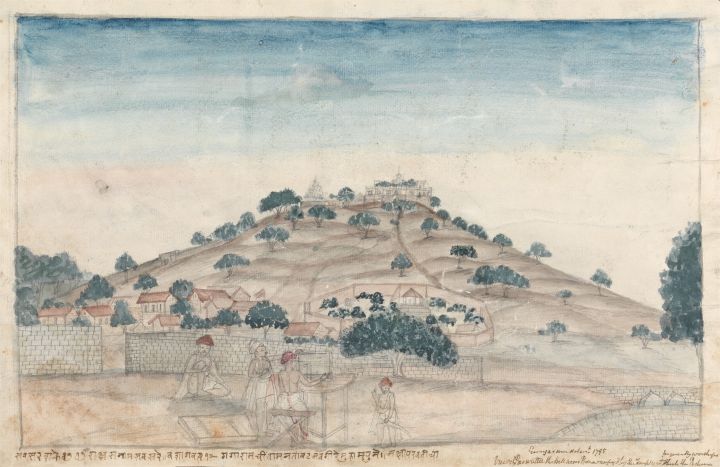
Gangaram Tambat, View of Parbati, a Hill near Poona Occupied by the Temples Frequented by the Peshwa, 1795, watercolor and graphite on paper
(New Haven: Yale Center for British Art, Paul Mellon Collection).
◊ ◊ ◊ ◊ ◊
From YCBA:
Grafted Arts: Art Making and Taking in the Struggle for Western India, 1760–1910
Virtual and in-person, Yale Center for British Art, New Haven, 7 September 2022, 4.00pm
Author Holly Shaffer, Assistant Professor of the History of Art and Architecture, Brown University, in conversation with Laurel Peterson, Assistant Curator of Prints and Drawings, Yale Center for British Art
 During the eighteenth century, Maratha military rulers and British East India Company officials used the arts to engage in diplomacy, wage war, compete for prestige, and generate devotion as they allied with (or fought against) each other to control western India. Shaffer’s book conceptualizes the artistic combinations that resulted as ones of ‘graft’—a term that acknowledges the violent and creative processes of suturing arts, and losing and gaining goods, as well as the shifting dynamics among agents who assembled such materials.
Holly Shaffer’s research focuses on art and architecture in Britain and South Asia across visual, material, and sensory cultures. Her book Grafted Arts: Art Making and Taking in the Struggle for Western India, 1760–1910 was awarded the Edward Cameron Dimock, Jr. Prize in the Indian Humanities by the American Institute of Indian Studies. Shaffer curated the exhibition Adapting the Eye: An Archive of the British in India, 1770–1830 at the Yale Center for British Art. She and Laurel Peterson, Assistant Curator of Prints and Drawings, are co-curators of an upcoming exhibition at the YCBA about artists and the British East India Company.
This program is presented through the generosity of the Terry F. Green 1969 Fund for British Art and Culture.
To watch the livestream on September 7 at 4.00pm, please click here»
◊ ◊ ◊ ◊ ◊
Note (added 15 August 2022) — The posting was updated with the new time (4.00).
Conference | Ales through the Ages
From the announcement (20 July 2022) and the conference website:
Ales through the Ages
Online and in-person, Colonial Williamsburg, 11–13 November 2022
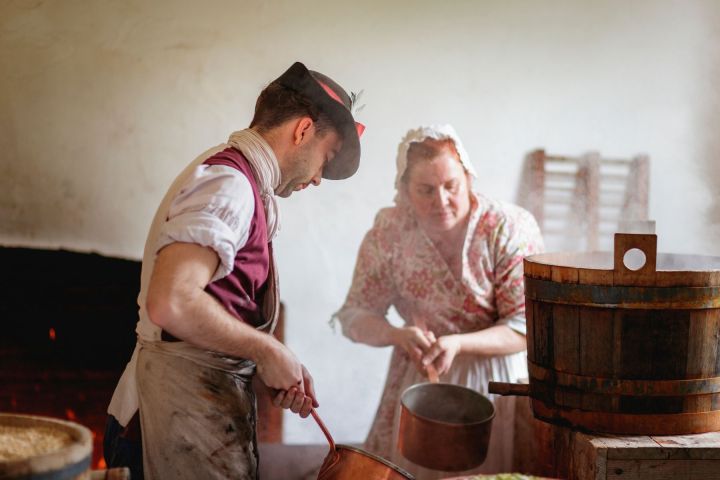
Craft beer may be enjoying a surge in popularity, but as participants in Colonial Williamsburg’s Ales through the Ages conference will discover, there’s nothing new about the beverage. In this one-of-a-kind history conference, offered both virtually and in-person November 11–13, participants will journey through time and space with some of the world’s top beer scholars to follow beer from its primitive roots to its modern form.
Register to reserve your opportunity to mingle with an international lineup of guests including maltsers, authors, brewery owners, social media influencers, and entrepreneurs. Speakers include
• Pete Brown, author, journalist, broadcaster, and consultant in food and drink, and 2020 recipient of Imbibe Magazine’s Industry Legend award, delivering the opening keynote, sponsored by the Virginia Beer Museum: The Highs and Lows of Researching Beer History
• Award-winning author and former journalist, Martyn Cornell, an authority on the history of British beer and the development of British beer styles, discussing the origins of Pale Ale
• George ‘Butch’ Heilshorn, co-founder of Earth Eagle Brewings and Talisman Spirits, going Back to the Future of Botanical Beers
• Food and drink historian Marc Meltonville on reconstructing a Tudor brewery and producing beer from a 16th-century recipe, the products of his venture with the FoodCult project
• Maltster Andrea Stanley on developments in malting technology in the 18th and 19th centuries
• Author Lee Graves exploring the connection between early American brewing and the West African beer traditions of enslaved populations
• Craig Gravina journeying through 400 Years of Beer and Brewing in New York’s Hudson Valley
• Journalist and author Stan Hieronymus providing insight into Breaking the Lupulin Code
• Ron Pattinson on the transformative story of UK brewing during World War I
• ‘The Beer Archaeologist’, Travis Rupp, sharing what he’s dug up most recently on ancient brewing
• Kyle Spears and Dan Lauro from Carillon Brewing Co. on operating a historic brewery in the modern world
The full program is available here»
In-person registrants will have the opportunity to enjoy a pint from the past with speakers and other attendees at an opening reception on Friday night sponsored by Aleworks Brewing Company that will feature their historic brew collaborations with Colonial Williamsburg; Saturday lunch accompanied by 18th-century theater and historically-based brews; and a post-conference gathering at Virginia Beer Company with guest speakers, Historians on Tap. Tickets for the event at Virginia Beer Company are available to in-person attendees for $20 and include beer samples from local breweries, including special brews developed in partnership with Colonial Williamsburg’s 18th master of historic foodways, Frank Clark. Attendees are also encouraged to bring and share homebrews for a truly unique taste-testing experience.
In-person registration is $275 per person and includes access to lectures, the welcome reception, and the Saturday lunch. Virtual-only registration is $100 per person and includes access to lectures through the conference streaming platform. Both in-person and virtual-only registration include a 7-day ticket voucher to Colonial Williamsburg’s Art Museums and Historic Area, valid for redemption through 31 May 2023. A limited number of virtual and in-person conference scholarships are available to students, museum or non-profit professionals, and emerging brewers with an application deadline of September 20. Special room rates at Colonial Williamsburg hotels are available for in-person conference registrants. All registrants will have access to the main conference lectures via the streaming platform through 31 December 2022.
This conference is made possible by the generosity of private and corporate sponsors including Virginia Beer Company, Virginia Beer Museum, and Aleworks Brewing Company.
Online Courses from the V&A, Autumn 2022
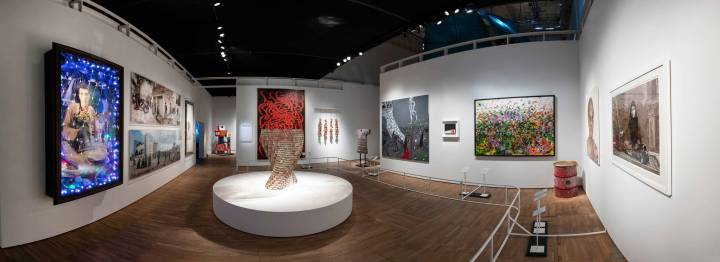
Installation view of the exhibition Epic Iran (London: V&A, 29 May 2021 — 12 September 2021).
◊ ◊ ◊ ◊ ◊
A selection of upcoming online courses from the V&A:
Principles of Exhibition Making
V&A Academy Online, Tuesdays, 13.00–16.30, 13 September — 18 October 2022
Working with the V&A’s expert staff and industry professionals, you will study the process and driving ideas behind V&A exhibition-making: from concept to build and design, you will get a 360-degree insight into the major considerations when putting on a show. Focusing on six key themes—mission, audience, research, experience design, project management, and collaboration—this course will give you the skills and knowledge you need to feel more confident about putting on an exhibition of your own.
The course is intended primarily for people who are early- or mid-career in the museum/heritage sector or people interested in working in exhibitions. It will be delivered online and will be made up of live presentations, tutorials, panel discussions, exclusive interviews, and small-group workshop sessions, designed to create an engaging and interactive experience whichever time zone you are joining from. Course fee: £365. More information»
Course director Matilda Pye is an independent curator, educator, and a V&A Research Institute, Paul Mellon, Public Engagement Fellow. Since 2004 she has worked with museums and galleries in the UK and internationally including Tate, the National Portrait Gallery, Royal Museums Greenwich, and the Baltic Centre for Contemporary Art.

François Boucher, Portrait of Madame de Pompadour, detail, 1758, oil on canvas, 29 × 22 inches (London: V&A, 487-1882).
◊ ◊ ◊ ◊ ◊
The Age of Revolutions: Art in 18th-Century Europe
V&A Academy Online, Thursdays, 10.30–16.30, 22 September — 8 December 2022
From Rococo to Romanticism, explore a remarkable period in the history of art. Expert lecturers will bring to life themes such as taste, patronage, and the art market, while you discover how artists and designers responded to an age of enlightenment and revolution.
The 18th-century art world was remarkable in its stylistic diversity, from the austere British Palladian style to the exuberance of continental Rococo. By the early nineteenth century, two leading cultural movements, Neo-classicism and Romanticism, co-existed to dynamic effect in the fields of art, design, and architecture. Throughout Europe, increasing wealth, together with better opportunities for travel, widened the market for both the fine and decorative arts. Drawing on the V&A’s collections, expert lecturers will trace stylistic developments within a wider political and cultural context, and in relation to themes such as taste, patronage and the art market. Course fee: £395. More information»
Course director Kathy McLauchlan is an art historian specialising in French painting and lecturer with the Arts Society, Morley College, and Oxford University. Guest lecturers include Justine Hopkins, specialist in 19th- and 20th-century art and design; Angela Cox, specialist in British painting; and Jacqueline Cockburn, Director of Art and Culture Andalucía and lecturer for the V&A and the Arts Society.
22 September | Introductions
• Introduction to the Course — Kathy McLauchlan
• Historical Background — Angela Cox
• Patrons and Markets — Kathy McLauchlan
• Introduction to the Museum: The Ceramic Staircase — Justine Hopkins
29 September | Institutions and Ideals
• Academies — Kathy McLauchlan
• Language of Architecture — Caroline Knight
• How to Look at a Painting — Angela Cox
• Meet and Greet
6 October | French Style
• Inventing the fête champêtre — Jeremy Howard
• Madame de Pompadour as Patron — Barbara Lasic
• Interiors — Barbara Lasic
• Spotlight Session: 18th-Century Bronzes — Kira d’Alburquerque
13 October | Fantasy and Imagination
• ‘All Spirit and Fire’: The Art of Giambattista Tiepolo — Catherine Parry-Wingfield
• Meissen and Sèvres — Susan Bracken
• Catholic Magnificence: Architecture of Germany and Central Europe — Clare Ford-Wille
• Spotlight Session: A Virtual Menagerie in Dresden 1732 — Susan Bracken
20 October | Capturing Life
• Hogarth’s Narratives — Justine Hopkins
• Painting with Feeling: The Art of Chardin — Clare Ford-Wille and Kathy McLauchlan
• French Sculptors from Pigalle to Houdon — Catherine Parry-Wingfield
27 October | Lure of Italy
• Grand Tour — Clare Ford-Wille
• Rome, Art Capital of the World — Kathy McLauchlan
• England’s Country Houses — Caroline Knight
• Spotlight Session. Palladio’s Quattro Libri — Caroline Knight
3 November | Business of Art
• Carriera, La Tour, Liotard: Masters of the Pastel Portrait — Clare Ford-Wille
• Images for All: London and the Print Market — Angela Cox
• Reynolds, Gainsborough, and the Business of Portraiture — Angela Cox
• Spotlight Session: Design for the Enlightenment — Caroline McCaffrey-Howarth
10 November | Town and Country
• The British Watercolour, from Cozens to Cotman — Angela Cox
• From Garden Architecture to Landscape Architecture: William Kent to Capability Brown — TBC
• London Entertainment and the Arts — Catherine Parry-Wingfield
• Spotlight Session: Canova’s Theseus — Justine Hopkins
17 November | Revolution
• Boullée, Visionary Architect — Barbara Lasic
• Jacques-Louis David: Revolution to Empire — Kathy McLauchlan
• Blake, Palmer, and Revolution — Justine Hopkins
24 November | Age of Napoleon
• Empire Style — Clare Ford-Wille
• Canova and the New Sculpture — Justine Hopkins
• Goya — Justine Hopkins
• Spotlight Session: Behind the Scenes at the Royal Collection, The Waterloo Chamber — Richard Williams
1 December | Romantics
• Pugin, Landseer, and the Revival of the Middle Ages — Justine Hopkins
• The Victorian Dream of Chivalry: Spectacle, Pageantry, and Bad Weather — Tobias Capwell
• The New Houses of Parliament — Justine Hopkins
• Spotlight Session: Behind the Scenes at the Wallace Collection — Tobias Capwell
8 December | Lure of the Past
• Friedrich and the Spirit of Longing — Justine Hopkins
• Géricault and Delacroix: Romantics at the Salon — Kathy McLauchlan
• Constable and Turner — Angela Cox

The Age of Glass, 1650 to Now
V&A Academy Online, Wednesdays, 14.00–16.30, 2 November — 7 December 2022
In celebration of the United Nations 2022 International Year of Glass, museum curators, historians, and artists will explore the global history of glass from 1650 to the present. This 6-week course follows a chronological structure, from the early modern methods of glassmaking in Venice, to experiments at 17th-century London glasshouses, and the celebrated Crystal Palace at the Great Exhibition of 1851. Bringing in historic and contemporary approaches to the study of glass, it shines a light on techniques, materials, makers, and markets and aims to celebrate the significant role played by glass in wider social, cultural, and historical contexts. Each week we will cover a range of themes, including materials and techniques, dining, industry, empire, historic recreation, women glass artists, and the role of gender in a largely male-dominated world. Course fee: £120. More information»
Course leader Dr Caroline McCaffrey-Howarth specialises in the histories of collecting and displaying European decorative arts, 1650–1900. She was previously V&A Curator, Ceramics and Glass, 1600–1800 and is now Lecturer in 18th- and 19th-Century Visual and Material Culture in the History of Art Department at the University of Edinburgh.
2 November | Materials, Makers, and Markets
• Introduction — Caroline McCaffrey Howarth
• Selling and Making Glass in 17th- and 18th-Century London — Caroline McCaffrey-Howarth
• Recorded Tour of V&A Glass Galleries, with live Q&A session — Reino Liefkes, Senior Curator, Ceramics and Glass
9 November | Glass Techniques
• Historic Recreation — TBC
• Live Studio Demonstration with Q&A — Bethany Wood, Glass Artist and Founder of Blowfish Gallery
16 November | The Global Story of Glass
• Transparency and Enlightenment, Race and Glass — Kerry Sinanan, University of Texas and Rakow Researcher, Corning Museum of Glass
• Artist Spotlight Session — Chris Day, Glass and Ceramics Artist
23 November | A Glassy Society
• Breaking the Ice with Glass, Canons, Blue Balls, Fountains, and Fantasy Animals in the National Glassmuseum in Leerdam — Kitty Laméris, Dutch Glass Expert
• Dining in Style in the 18th Century: The Age of Glass — Kit Maxwell, Curator of Applied Arts, Art Institute Chicago; curated the 2020–22 exhibition In Sparkling Company, Corning Museum of Glass
30 November | Glass and Industry
• Antonio Salviati and the 19th-Century Revival of Venetian Glass — Reino Liefkes, Senior Curator, Ceramics and Glass
• The New Stourbridge Glass Museum (opened April 2022) and the Growth of the British Glass Industry — Harrison Davies, Curator, Stourbirdge Glass Museum
7 December | Breaking the Glass Ceiling: Women and Glass
• Pioneer Women in 20th-Century Glass — Diane Wright, Curator of Glass, Toledo Art Museum
• Artist in Focus: Maria Bang-Espersen (Watch: Maria Bang Espersen WSKG Arts & Culture short)










 Enfilade
leave a comment