Seminar Session | Clémence Fort on ‘Porcelaines des Sauvages’
This month’s session from the GRHS series on the circulation of knowledge, with information on other GRHS seminar series available here:
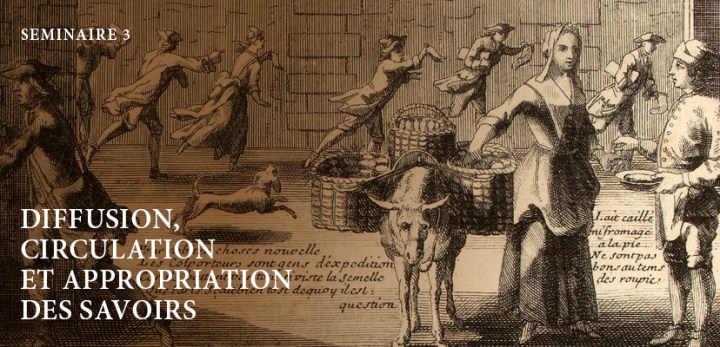
Clémence Fort | ‘Porcelaines des Sauvages’
Circulation, appropriation et représentation d’un objet emblème en France au XVIIIe siècle
Diffusion, circulation et appropriation des savoirs – Séminaire du Groupe de Recherche en Histoire des Sociabilités
In-person and online, Université du Québec, Montréal, 21 October 2022, 12.30pm
Avec l’essor du projet colonial en Amérique du Nord au 18e siècle, les « porcelaines des Sauvages » en provenance de Nouvelle-France et issues de la collecte apparaissent dans les collections françaises. Leur circulation engendre des représentations qui documentent les nombreux imprimés de cette époque allant des récits de voyages aux atlas historiques. Naturalistes et amateurs s’intéressent aussi à la manière dont les objets sont fabriqués et imités. Ils les incluent alors dans une culture visuelle scientifique et esthétique nouvelle. Cette présentation examinera la manière dont « les porcelaines des Sauvages » invitent à repenser la géopolitique du collectionnisme à partir des enjeux artistiques, scientifiques et économiques. Nous étudierons la façon dont les « porcelaines des Sauvages » participent à la diffusion esthétique, historique et scientifique de l’entreprise coloniale de la Nouvelle-France au 18e siècle.
Le séminaire privilégiera les circuits et les transmissions de l’imprimé sous toutes ses formes, sans pour autant exclure les autres productions (et marchandises) de la connaissance. Les séances se tiendront en comodal, au local R-4215 à l’UQAM et par visioconférence.
Clémence Fort est actuellement doctorante contractuelle en deuxième année au sein de l’université PSL (ENS) à Paris. Sa thèse intitulée : « Collecter les Americana : la Nouvelle-France dans les cultures visuelles et l’art des Lumières (v. 1700–1763) » est dirigée par Charlotte Guichard. Les recherches de Clémence s’inscrivent au croisement d’une histoire de l’art renouvelée par l’histoire de la collecte, des collections et des cultures visuelles et matérielles.
Conference | Rereading Constable
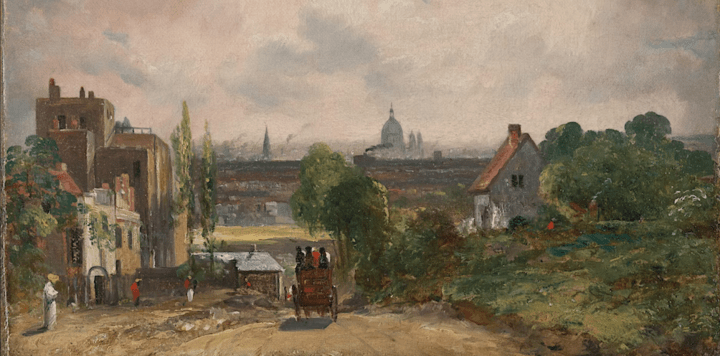
John Constable, Sir Richard Steele’s Cottage, Hampstead, 1831–32, oil on canvas, 21 × 29 cm
(New Haven: Yale Center for British Art, Paul Mellon Collection, B2001.2.25)
◊ ◊ ◊ ◊ ◊
From PMC:
Rereading Constable: Letters, Life, and Art
In-person and online, Paul Mellon Centre, London, 2 December 2022
Organized by Stephen Daniels and Mark Hallett
How do artists’ letters articulate professional and personal affiliations, embody networks, and forge allegiances? What role has letter writing played in artistic self-fashioning? In what ways do letters serve as a form of art-historical evidence, and help us understand works of art themselves?
R.B. Beckett’s multi-volume edition of Constable’s correspondence, published in six volumes by the Suffolk Records Society (1962–68), has long been recognised as an invaluable source for scholars working on the artist, and for all those interested in British art and culture in the late Georgian period. The published correspondence shows the painter to have been a shrewd, skilled writer, versed in a variety of literary, scientific, and biblical texts. His correspondents were, in turn, often highly articulate writers, including many family members, and many more with very different characters and backgrounds. Often utilised by art historians, the correspondence has more recently attracted the interest of scholars interested in the literary character and rhetorical conventions of nineteenth-century correspondence, who have subjected Constable’s letters to new kinds of critical scrutiny. This event will build on this important work, exploring Romantic art, culture, and society through the prism provided by the landscape painter’s correspondence.
The central structuring concept of this interdisciplinary conference is that speakers will focus on a single letter written by the artist, his correspondents, or other contemporary figures whose work, life, or letters can be understood in productive relation to Constable himself. These individual letters will be used to open up new questions and arguments about Constable’s life, practice, and identity as a painter, and about the wider artistic, literary, religious, and political cultures of his era.
Rereading Constable: Letters, Life, and Art has been organised as part of the PMC’s Generation Landscape research project. The conference is being convened by Stephen Daniels and Mark Hallett. Book tickets here.
We are offering up to five bursaries to support individuals who may not otherwise be able to attend the conference. Bursaries will cover the ticket price, travel, and some expenses, including childcare. If you would like to be considered for a bursary please email events@paul-mellon-centre.ac.uk with Rereading Constable Bursary in the subject field, outlining your request for a supported place by 10am, Friday, 4 November 2022.
P R O G R A M M E
9.30 Introduction by Mark Hallett (Paul Mellon Centre) and Stephen Daniels (University of Nottingham)
10.00 Session 1 | Chair: Stephen Daniels
• Alexandra Harris (University of Birmingham), New Friends, New Scenes: Constable in the Arun Valley
• Amy Concannon (University of York and Tate Britain), Strengthening Ties and Gaining Esteem: Constable Writes to Wordsworth, 15 June 1836
11.00 Tea and Coffee Break
11.30 Session 2 | Chair: Martin Postle (Paul Mellon Centre)
• Emma Roodhouse (Art Curator and Researcher), An Evening’s Amusement: Portraits, Writing, and Other Oddments from the Mason Family Album
• Sarah Cove (The Constable Research Project), A Regency ‘Nip-and-Tuck’: Constable’s Treslove Portraits Rediscovered
12.30 Lunch (provided by PMC)
Constable material available to view in the Public Study Room
1.30 Session 3 | Chair: Mark Hallett
• Morna O’Neill (Wake Forest University), John Constable, David Lucas, and Artistic Identity
• Katharine Martin (V&A and the University of Sussex), Translations and Fraught Relations: English Landscape and the Language of Collaboration
2.30 Break
2.45 Session 4 | Chair: Sarah Victoria Turner (Paul Mellon Centre)
• Gillian Forrester (Independent Scholar), ‘Solemnity, Not Gaiety’: Language and the Production of Meaning in Constable’s English Landscape Scenery
• Elenor Ling (The Fitzwilliam Museum), The ‘Definition of our Book’: John Constable, David Lucas, and their English Landscape
3.45 Tea and Coffee Break
4.15 Session 5 | Chair: Sria Chatterjee (Paul Mellon Centre)
• Rhian Addison McCreanor (University of York and Tate Britain), Repairing the House with a Thorough Painting: Reimagining 63 Charlotte Street
• Nicholas Robbins (University College London), The Life Academy and the Origins of Landscape
5.15 Panel Discussion
Stephen Daniels (University of Nottingham), Martin Myrone (Paul Mellon Centre), Trev Broughton (University of York), and Timothy Wilcox (Independent Scholar)
5.55 Closing Remarks by Mark Hallett
6.00 Drinks Reception
Online Lecture | Andrew Rudd on Print Philanthropy

Jonas Hanway, Thoughts on the Plan for a Magdalen-House for Repentant Prostitutes, second edition (London, 1759). The first edition was published anonymously in 1758.
◊ ◊ ◊ ◊ ◊
From Yale’s Lewis Walpole Library, in connection with the exhibition From ‘Knight Errant of the Distressed’: Horace Walpole and Philanthropy in Eighteenth-Century London:
Andrew Rudd | Print Philanthropy in the Age of Horace Walpole
Online, 28 October 2022, 12.00pm EST
Eighteenth-century England witnessed a remarkable flowering of philanthropic activity as society wrestled with problems such as poverty, disease, mental illness, vice, and suffering caused by war. Walpole boasted in 1760 of what he called “our noble national charity.” While many aspects of philanthropy remain similar today, this lecture will explore how the print culture of Walpole’s era was central in driving charitable behaviour, particularly in terms of creating philanthropic networks and framing relationships between donors and beneficiaries. The talk will showcase the sheer range of printed text and images—fundraising prospectuses, sermons, topographical views of hospitals, tickets to benefit concerts and dinners, and celebratory odes—mobilised in service of good causes during this period, as well as highlight examples of Walpole’s own support for, and portrayals of, philanthropic causes during his lifetime.
Andrew Rudd is Senior Lecturer in the English Department at the University of Exeter. He researches and teaches British literature of the eighteenth century and Romantic period. His monograph Sympathy and India in British Literature 1770–1830 (Palgrave Macmillan) was published in 2011, and he is currently writing a cultural history of charity in the eighteenth century. This builds on experience he acquired as Parliamentary Manager at the Charity Commission for England and Wales before joining Exeter in 2013. Dr. Rudd holds a PhD from the University of Cambridge, and he has studied at the University of Durham, Trinity College, Cambridge, and Yale University. He has held numerous fellowships—most recently at Yale’s Lewis Walpole Library and the School of Advanced Studies in English, University of Jadavpur. Since 2015, he has been a member of the Arts and Humanities Research Council’s Peer Review College.
HECAA Zoom Event | Transporting Culture
Transporting Culture
HECAA Zoom Event, Thursday, 20 October 2022
Please join us for our next HECAA Zoom Event, Transporting Culture. It’s open to HECAA members and non-members alike. Please register in advance here.
P R O G R A M M E
Welcome 12.00 (EST) / 17.00 (BST)
12.15 Panel One
Moderator: Lorne Darnell (Courtauld Institute)
• Practicalities of Bearing Diplomatic Gifts from Versailles to Isfahan in 1705 — Samantha Happe (Graduate Research Teaching Fellow and Postgraduate Student, University of Melbourne, and Research Officer, Australian National University)
• Crates, Boxes, and Cases: The Transport of Works of Sculpture and Silver between Rome and Lisbon in the 18th Century — Teresa Leonor M. Vale (Senior Assistant Professor School of Arts and Humanities and Researcher of the ARTIS-Institute of History of Art, University of Lisbon)
• Transporting America: The Politics of Import and Export in the New Indies Gobelins Tapestry Set — Carole Nataf (PhD Candidate, Courtauld Institute)
1.45 Break
2.00 Panel Two
Moderator: Harvey Shepherd (Courtauld Institute)
• ‘Fortuna favet Fortibus!’ Early Modern Art Insurance — Avigail Moss (Lecturer, American University of Paris)
• A Thumb on the Scale: Examining the Control of Art in Comanche Trade Networks — Carlos Littles (Johns Hopkins University, Alumni)
• ‘Truly Chinese’: Transporting Chinese Objects to Germany in the 19th Century — Emily Teo (Postdoctoral Researcher, Gotha Research Centre of the University of Erfurt)
Online Workshop | Lacing around the World

Decor la Dentelle, French, ca. 1725, silk, metallic-wrapped thread, gold, 51 × 29 cm
(Washington, DC: Cotsen Textile Traces Study Collection, T-0598)
◊ ◊ ◊ ◊ ◊
From The George Washington University Museum:
Lacing around the World and across Time
The Cotsen Textile Traces Global Roundtable
Online, 12–13 October 2022
The third annual virtual Cotsen Textile Traces Global Roundtable explores the rich traditions of lacemaking through examples from the Cotsen Textile Traces Study Collection at The George Washington University Museum and The Textile Museum in Washington, D.C., October 12 and 13.
The Cotsen Textile Traces Global Roundtable: Lacing around the World and across Time includes some fifteen international scholars, artists, and designers, who will present multiple dimensions of the global art, from its history and globalization to innovations, fashion, and artistic creativity. This program is a partnership with Bard Graduate Center, New York, and Textilmuseum St. Gallen, Switzerland, and is supported through the Cotsen Textile Traces Study Collection Endowment.
Those interested in attending the roundtable should register early in order to receive links and details for joining each day of the roundtable on Zoom, as well as a full program with the detailed schedule.
The Cotsen Textile Traces Study Collection represents a lifetime of collecting by business leader and philanthropist Lloyd Cotsen (1929–2017). Comprised of nearly 4,000 fragments from all over the world, the collection offers insights into human creativity from antiquity to the present. Cornerstones of the collection include fragments from Japan, China, pre-Hispanic Peru and 16th- to 18th-century Europe. The entire collection is available online.
W E D N E S D A Y , 1 2 O C T O B E R 2 0 2 2
Situating Lace: Traditions and Transmission
10.00 Introduction
• Lori Kartchner — Curator of education, The George Washington University Museum and The Textile Museum
• John Wetenhall — Director, The George Washington University Museum and The Textile Museum
• Emma Cormack — Associate curator, Bard Graduate Center
• Marie-Eve Celio-Scheurer — Art historian, academic coordinator, Cotsen Textile Traces Study Center, The George Washington University Museum and The Textile Museum
10.30 Panel 1 | Needle Lace, Bobbin Lace: Traditions and Transmissions
• Diana Greenwold — Lunder Curator of American Art, National Museum of Asian Art, Smithsonian Institution
• Cecilia Gunzburger — Lecturer, decorative arts and design history, the George Washington University and Smithsonian Institution
• Sarah Besson Coppotelli — Head of collections, Musée et château de Valangin, Switzerland
11.30 Panel 2 | Mimicking Lace
• Sumru Krody — Senior curator, The Textile Museum Collection, The George Washington University Museum and The Textile Museum
• Vaishnavi Kambadur — Assistant curator, Museum of Art & Photography (MAP), Bengaluru, India
T H U R S D A Y , 1 3 O C T O B E R 2 0 2 2
Exploring Global Traditions and Industrial Innovations in Contemporary Creativity
10.00 Keynote Opening
• Emma Cormack — Associate curator, Bard Graduate Center
• Ilona Kos — Curator, Textilmuseum St. Gallen, Switzerland
• Michel Majer — Professor emerita, Bard Graduate Center
10.30 Panel 3 | Handmade Lace Today
• Caroline Kipp — Curator of contemporary art, The George Washington University Museum and The Textile Museum
• Elena Kanagy-Loux — Collections specialist, Antonio Ratti Textile Center, The Metropolitan Museum of Art
• Nidhi Garg Allen — Founder and CEO, Marasim, New York/India
11.30 Panel 4 | Industrial Innovations
• Elena Kanagy-Loux — Collections specialist, Antonio Ratti Textile Center, The Metropolitan Museum of Art
• Jérémy Gobé — Artist, founder, Corail Artefact, France
• Rose-Lynn Fisher — Artist, United States
Public Lecture Course | Georgian Provocations, II

From PMC with registration at Eventbrite:
Georgian Provocations, II
In-person and Online, Paul Mellon Centre, London, 27 October — 8 December 2022
Organized by Martin Postle
The Paul Mellon Centre’s next public lecture course is entitled Georgian Provocations II, a sequel to the highly successful Georgian Provocations, which ran in the summer of 2020. Adopting a similar format, the present course will focus upon a series of provocative artworks from the Georgian era and investigate their contents, contexts, and impact. The series is convened by Martin Postle, Senior Research Fellow at the Paul Mellon Centre. The course runs from 27 October to 8 December 2022 and is in-person and live on Zoom weekly, 6.00–7.30pm GMT on Thursdays.
◊ ◊ ◊ ◊ ◊
Lecture 1 | 27 October 2022
Paris Spies-Gans — Establishing a Female Lineage at the Royal Academy’s Show: Eliza Trotter, Angelica Kauffman, and the Intrigues of Lady Caroline Lamb. Register here»
Lecture 2 | 3 November 2022
Martin Myrone — The Haunted Eighteenth Century: Fuseli’s The Nightmare. Register here»
Lecture 3 | 10 November 2022
Esther Chadwick — A Black King in Georgian London: British Art and Postrevolutionary Haiti. Register here»
Lecture 4 | 17 November 2022
Nicholas Robbins — George Romney in the Prison-World of Europe. Register here»
Lecture 5 | 24 November 2022
Nika Elder — John Singleton Copley’s Watson and the Shark and the Taste for Flesh. Register here»
Lecture 6 | 1 December 2022
Martin Postle — Joseph Wright of Derby: Self-portrait as an Experimental Artist. Register here»
Panel Discussion | 8 December 2022
Discussion with Series Speakers and Q&A. Register here»
Online Talk | Feng Schöneweiß on the Dragoon Vases
From The Wallace Collection:
Provenancing the Dragoon Vases: Porcelain, Architecture and Monumentality in German Antiquarianism, 1700–1933
Feng Schöneweiß, PhD Candidate, University of Heidelberg
Online, Wallace Collection Seminar in the History of Collecting, 26 September 2022, 17.30 BST
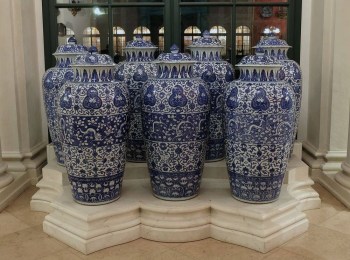
Seven of the Dragoon Vases on display in the Zwinger Palace, Dresden (Porzellansammlung, Staatliche Kunstsammlungen Dresden. Inv. Nos. PO1014/PO2064 (lid), PO1010, PO1011, PO1017, PO9130, PO9172, PO9448/ PO1013 (lid); photograph by Feng Schöneweiß, 2016).
Architects and artisans make monuments, but provenance frames monumentality in the history of collections. This seminar explores how emerging recognition of provenance shaped public perception of monumentality through a study of the transcultural biography of the Dragoon Vases (Dragonervasen).
Since 1900, generations of German antiquarians and museum professionals have celebrated what they have called Chinese monumental vases in their published writings, internal reports, and curatorial practices. Most notable are eighteen Dragoon Vases, which ‘enjoyed special fame without people actually being able to identify them’ in the early twentieth century. The name Dragoon Vases originated from the exchange of dragoon soldiers for porcelain objects between the Saxon and Prussian electors in 1717, but it took 150 years for the designation to emerge in German antiquarian and museological contexts.
Yet, another century later, the notorious Stasi of the German Democratic Republic confiscated Helmuth Meißner’s (1903–1998) art collections in Dresden, which included a large blue-and-white Chinese porcelain vase. With a Palace Number ‘N:2’ and a zigzag line incised on the reverse of its lid, the vase has a manifest provenance from the porcelain collection amassed by Augustus the Strong (1670–1733) in the Dutch Palace, the institutional predecessor of the current Porcelain Collection, Dresden State Art Collections (SKD). Despite the Stasi’s insistence on selling the vase for foreign currency, the SKD successfully claimed it by invoking its value as a ‘nationally valuable cultural property’, a legal category designating objects of national significance for Germany’s cultural heritage. How did Chinese porcelain become monumental in German antiquarian thoughts and practices? The author seeks to answer the question by ‘provenancing’ the vases in their transcultural, architectural, and local contexts during the formative phases of monumentality from 1700 to 1933.
Click here to register to view this talk via Zoom.
Click here to view this talk via YouTube.
Online Seminar | What Does It Mean to Curate a Historic House?

Kingston Lacy, Dorset, designed by Sir Roger Pratt, ca. 1663–65.
◊ ◊ ◊ ◊ ◊
From Eventbrite:
What Does It Mean to Curate a Historic House?
Online, Monday, 26 September 2022, 11.00–12.00 BST
This session will combine a short film and panel discussion based on a British Academy-funded research project led by Dr Tarnya Cooper and Dr Oliver Cox, which explores the contemporary issues and challenges with curating a historic house owned by a heritage organisation. The short film, shot at Kingston Lacy in the summer of 2022, explores the role of the curator in a publicly-accessible historic house, discussing how to prioritise sharing what is significant rather than what is left. Following the film, Cox and Cooper will convene a panel discussion featuring leading specialists from across Europe to discuss the future for historic house curation and interpretation.
Chairs
• Oliver Cox (Head of Academic Partnerships, V&A)
• Tarnya Cooper (Curatorial and Collections Director, National Trust)
Panellists
• Sarah McLeod (Chief Executive, Wentworth Woodhouse Preservation Trust)
• Jeffrey Haworth (Historian and former National Trust Curator)
• Alice Loxton (History Hit)
• John Orna-Ornstein (Director of Curation and Experience, National Trust)
This event is delivered by The National Trust as part of the Art History Festival (20–26 September 2022), presented by the Association for Art History. The full Festival programme is available here»
Material and Visual Culture Seminar Series, Fall 2022
From ArtHist.net:
Material and Visual Culture Seminar Series, 17th and 18th Centuries
Online, University of Edinburgh, 28 September — 7 December 2022
Each session we’ll hear from two speakers, sharing their research on, and approaches to, the study of 17th- and 18th-century material and visual culture. From reassessing how the work of female artists is read, to European visualisation of Latin America, and the exchange of objects, this year’s programme covers a broad range of topics. We aim to make a space in which these rich histories can be explored from varied disciplines to enhance our research practices. We’ll be meeting on Wednesdays, 5–6pm GMT, online using Zoom. See Eventbrite to register, view speaker abstracts, receive the joining link and reminders. Registration closes 40 minutes before seminar start time. Please contact materialcultureresearcheca@ed.ac.uk with any queries.
28 September | Approaching Identities
Chair: Georgia Vullinghs
• Emma Pearce
• Ailsa Maxwell
12 October | Patronage and Person under the Stuarts
Chair: Catriona Murray
• Sarah Hutcheson
• Megan Shaw
26 October | Baroque Devotional Visual Culture
Chair: Carol Richardson
• Lucía Jalón Oyarzun
• Sandra Costa Saldanha
9 November | Pasteboard and Printing Plates: Elusive Objects
Chair: Molly Ingham
• Chiara Betti
• Lucy Razzall
23 November | The Social Life of … Tea
Chair: Caroline McCaffrey-Howarth
• Anna Myers
• Lucy Powell
7 December | The Materiality of Making
Chair: Viccy Coltman
• Kerry Love
• Alejandro Octavio Nodarse
Online Workshop around Simon Burrows’ Oeuvre

From the Pamphlets and Patrons project:
18th-Century Libelles, Libellistes, and Book Trade
Workshop around Simon Burrows’ Oeuvre
Online and in-person, 22 September 2022
Organised by Damian Tricoire and the Pamphlets and Patrons (PAPA) project at the University of Trier
All times are Central European Time
13.00 Introduction — Damien Tricoire (Universität Trier)
13.15 Where’s Marie-Antoinette? Pamphlets, Politics, and French Enlightenment Print Culture — Simon Burrows (Western Sydney University)
14.00 The Palais-Royal Style of Revolution: Brissot, Secretary General of the Chancellery of the Duc d’Orléans — Damien Tricoire (Universität Trier)
14.45 Break
15.15 Political Pamphlets and Print Culture in Liège from the Triumph of Enlightenment to Revolution, 1764–1790 — Daniel Droixhe (Université de Liège)
16.00 Persecuting Printers in France before and after 1789 — Jane McLeod (Brock University)
16.45 Break
17.15 Round Table Discussion
• Simon Burrows (Western Sydney University)
• Edmond Dziembowski (Université de Franche-Comté)
• Olivier Ferret (Université de Lyon)
• Julian Swann (Birbeck University of London)
If you wish to attend online through Zoom or in person, please write to doering@uni-trier.de.
22 September 2022, 12.45pm Paris
Zoom-Meeting
https://uni-trier.zoom.us/j/87391514608?pwd=MlMxYzFsU1hUNFM0OUhndzMwZXBYUT09
Meeting-ID: 873 9151 4608
Passcode: dbjpxFg1







leave a comment