Online Talk | Disaster on the Spanish Main
From the Fraunces Tavern Museum:
Craig S. Chapman, The American Experience in the West Indies, 1740–42
Online, Fraunces Tavern Museum, New York, Thursday, 16 June 2022, 6.30pm (ET)
 Thirty-five years before the battles of Lexington and Concord, the British colonies in North America raised a regiment to serve in the British Army for an expedition to seize control of the Spanish West Indies. The expedition marked the first time American soldiers deployed overseas. In this lecture, Craig Chapman will discuss the Americans’ role in the conflict, their terrible suffering, and the awful results of the expedition. This lecture will be held via Zoom. Registration ends at 5.30pm on the day of the lecture.
The talk is based on the author’s recent book, published by Potomac, an imprint of the University of Nebraska Press:
Craig Chapman, Disaster on the Spanish Main: The Tragic British-American Expedition to the West Indies during the War of Jenkins’ Ear (Lincoln, Nebraska: Potomac Books, 2021), 426 pages, ISBN: 978-1640124318, $30.
Disaster on the Spanish Main unveils and illuminates an overlooked yet remarkable episode of European and American military history and a land-sea venture to seize control of the Spanish West Indies that ended in ghastly failure. Thirty-four years before the Battles of Lexington and Concord, a significant force of American soldiers deployed overseas for the first time in history. Colonial volunteers, 4,000 strong, joined 9,000 British soldiers and 15,000 British sailors in a bold amphibious campaign against the key port of Cartagena de Indias. From its first chapter, Disaster on the Spanish Main reveals a virtually unknown adventure, engrosses with the escalating conflict, and leaves the reader with an appreciation for the struggles and sacrifices of the 13,000 soldiers, sailors, and marines who died trying to conquer part of Spain’s New World empire. The book breaks new ground on the West Indies expedition in style, scope, and perspective and uncovers the largely untold American side of the story.
Craig S. Chapman spent thirty years managing dual careers in telecom network sales and the U.S. Army and National Guard. He is the author of Battle Hardened: An Infantry Officer’s Harrowing Journey from D-Day to VE Day and More Terrible Than Victory: North Carolina’s Bloody Bethel Regiment, 1861–65. Chapman lives and writes in Raleigh, North Carolina.
Online Symposium | Women and Religion in 18th-C France

After Magdeleine Horthemels, Burial of Nuns at the Abbey of Port-Royal-des-Champs (Musée de Port-Royal des Champs).
◊ ◊ ◊ ◊ ◊
From the conference website:
Women and Religion in Eighteenth-Century France: Ideas, Controversies, Representations
Online, Queen Mary, University of London, 24 June 2022
Organized by Marie Giraud and Cathleen Mair
From Catholics to Protestants, abbesses to lay sisters, or even artists and salonnières, religious women played an important role in the social, cultural, and political life of France during the eighteenth century. Drawing on new approaches and sources, this interdisciplinary symposium will consider the identities, controversies, ideas, experiences, and representations of religious women in the period. It will explore how women of faith navigated, adopted, challenged, or subverted the religious canon, cultural norms, and social conventions as the understanding of religion, politics, and power shifted rapidly throughout the eighteenth century.
The keynote address will be delivered by Professor Mita Choudhury (Vassar College), whose work on gender, sexuality, and the place of nuns within the larger political and intellectual world of pre-revolutionary France lays the groundwork for further studies of women religious in the period.
The symposium will take place online via Zoom and is free to attend. All times in BST. Please click here to register to attend. The Zoom link will be circulated with registered attendees 24 hours in advance. A PDF version of the programme is available to download here.
This event is generously supported by London Arts and Humanities Partnership and the Doctoral College Initiative Fund at Queen Mary University of London.
P R O G R A M M E
9.30 Welcome and Housekeeping
• Marie Giraud (QMUL) and Cathleen Mair (QMUL)
9.45 Panel 1 — Living Faith: Everyday Religion in Women’s Letters
Chair: Ben Jackson (Birmingham)
• Cormac Begadon (Durham University), Nuns and Their Confessors: Appeals, Emotions, and Gender in the English Convents
• Gemma Betros (Australian National University), Marie de Botidoux: Religion in the Life of a Young Woman in Late-Eighteenth-Century Paris
10.45 Panel 2 — Recovering Voices: Women Religious in Print Culture
Chair: Gemma Tidman (QMUL)
• Rebecca Short (University of Oxford), Posthumous Presence: Religious Authority in the Lettres à une illustre morte (1770)
• Sean Heath (Independent Scholar), Je ne suis qu’une femme: Madame de Lionne’s Intervention in the Chinese Rites Controversy, 1700–1705
11.45 Break
12.00 Panel 3 — Faith on Trial: Religious Sects and the State
Chair: Liesbeth Corens (QMUL)
• Sarah Barthélemy (Durham University / Université Saint-Louis – Bruxelles), Gender, Catholicism, and Dissimulation: The Trial of Adélaïde Champion de Cicé
• Otto Selles (Calvin University), Prophétesses de Sion: Women and the Multipliant Sect (Montpellier, 1720–1723)
13.00 Lunch Break
14.00 Panel 4 — Contested Meanings: Women Religious and Revolutionary Politics
Chair: Ben James (KCL)
• Corinne Gressang (Erskine College), What Does Liberty Mean to a Nun?
• Richard Yoder (Pennsylvania State University), Jacqueline-Aimée Brohon: Victim-Soul and Revolutionary Prophet
15.00 Panel 5 — Representing Faith: Spaces and Objects of Devotion
Chair: Hannah Williams (QMUL)
• Killian Harrer (University of Munich), Wellsprings of Devotion: Marian Apparitions and Female Pilgrims in Revolutionary France
• Samuel Weber (EHESS), Handmaids of the Sacred Heart: Nuns’ Production of Paraphernalia and the Making of Sentimental Catholicism in Eighteenth-Century France
16.00 Break
16.15 Keynote Lecture
Chair: Miri Rubin (QMUL)
• Mita Choudhury (Vassar College), Reflecting on Gender, Religion, and the Historian’s Craft
Online | Hogarth’s Topographies: Decolonizing Sámi Representations
This Thursday, from The Lewis Walpole, Yale Library:
Joar Nango and Mathias Danbolt | Decolonizing Sámi Representations and the Legacy of Colonial Topographies
William Hogarth’s Topographies: A Series of Conversations
Online, The Lewis Walpole Library, 2 June 2022, noon EST
 Topography is central to William Hogarth’s canonical progress series in which London settings play a decisive narrative role. Lesser-known works by the artist, however, also engage with topographical representation. Pierre Von-Ow’s online exhibition William Hogarth’s Topographies considers the artist’s illustrations of national and colonized geographies beyond the metropole. Among international topographical views are Hogarth’s illustrations of Sápmi in the Scandinavian north, referred to at the time as “Lapland.” Artist Joar Nango and art historian Mathias Danbolt will discuss the legacy of historical representations of the Sámi, and their reworking of colonial archives in the service of Indigenous Sámi self-determination. This is an online event, and registration is required.
Joar Nango (born 1979 in Alta, Norway) is a Sámi architect and indigenous artist, living in Norway. Nango’s work investigates the nomadic conception of space, territories, and ideas of the concept of home. He focuses on different ways of dealing with materiality, movement, and space. He has exhibited internationally both separately as an individual artist including at Documenta14 (2017), Chicago Architecture Biennial (2019), Institute for Modern art (Brisbane, 2019), National Museum of Canada (2019), Bergen Kunsthall (2021), and National Museum of Norway (2022). He is also involved in collective projects. In 2010 he established the architecture collective FFB which makes an architecture celebrating the failure of capitalism. Since 2020, he has been involved as a host and director of the ongoing TV production PCA-TV (Post-Capitalist Architecture TV) in which the 6th episode features a commissioned work for Toronto Biennial of Art in May 2022.
Mathias Danbolt is a Norwegian art historian who has a special focus on queer, feminist, and decolonial perspectives on art and visual culture. Danbolt is currently leading three collective research projects: “The Art of Nordic Colonialism: Writing Transcultural Art Histories” (2019–23), “Okta: Art and Social Communities in Sápmi” (2019–22), and “Moving Monuments: The Afterlife of Sculpture from the Danish Colonial Era” (2022–25). In 2017 Danbolt curated the visual culture exhibition Blind Spots: Images of the Danish West Indies Colony (2017–18), with Mette Kia Krabbe Meyer and Sarah Giersing at the Royal Danish Library. Danbolt is professor of art history at University of Copenhagen.
This program is organized by The Lewis Walpole Library in conjunction with the online exhibition William Hogarth’s Topographies, curated by Pierre Von-Ow, PhD candidate in Yale’s Department of The History of Art.
Online Lecture | Boettger’s Invention of Red Jasper Porcelain
From The French Porcelain Society:
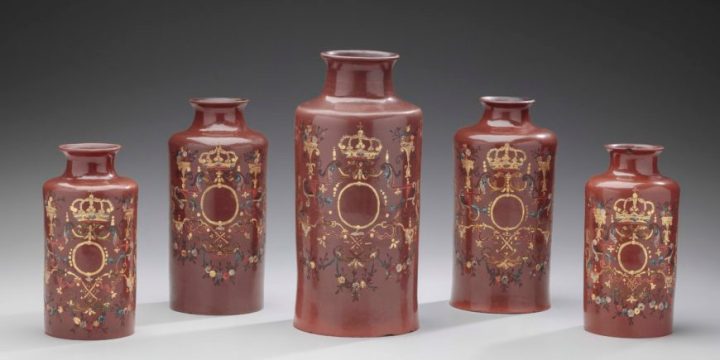
Angela Wallwitz | Ars Naturalis-Ars Artificialis: Boettger’s Invention of Red Jasper Porcelain in the Wake of the Early Enlightenment
FPS Living Room Lecture, Online, Sunday, 29 May 2022, 18.00 (BST)
Angela Wallwitz draws on her expertise in cataloguing ceramics as an art dealer, combined with her research skills as an independent scholar specialised in Meissen ware. In this lecture, she will delve into the subject of Plaue stoneware. We hope you can join us!
FPS members will receive an email invitation with instructions on how to join the online lecture. Please contact us for more details on FPSenquiries@gmail.com.
To achieve the artificial manufacture of gold, silver, and precious stone was the aim of man to re-create God’s creations since Renaissance times. The invention of Boettger stoneware, red jasper porcelain, and white porcelain played a significant historic role in this context. Ernst Zimmermann was the first to understand this after having spent years of research in the archives in Dresden and Meissen before they suffered losses and destruction during both world wars. However, his publication of 1908, Erfindung und Frühzeit des Meissner Porzellans, with 271 pages of small print and 721 invaluable footnotes, remains a hidden treasure for all non-German speakers. Researching a unique red jasper porcelain garniture of five apothecary vases, Angela Wallwitz discovered Ernst Zimmermann’s fascinating interpretations of the facts and the difference between stoneware made in Dresden from those manufactured in Meissen and the identity of a glassmaker, Boettger engraver and co-founder of the Prussian rival manufactory in Plaue. The garniture, published as an early diplomatic gift, was most probably Boettger’s gift to Augustus the Strong for his famous Royal apothecary in the Residenz of Dresden. This lecture, intends to serve as the guideline to illustrate the role of ceramics as ars naturalis and ars artificialis.
Conference | The Jesuits and the Arts
From UDIMA:
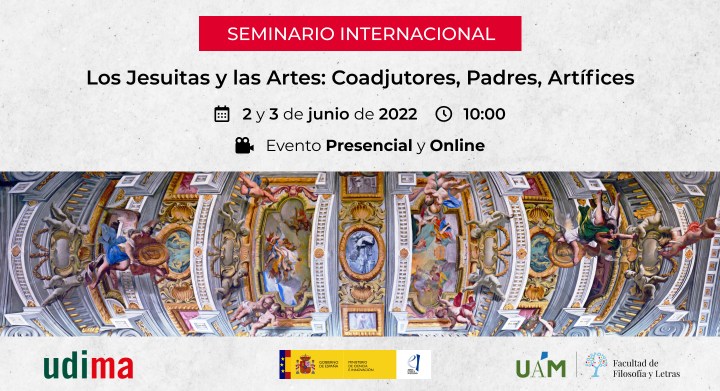
Los jesuitas y las artes: coadjutores, padres, artífices
Online and in-person, Universidad a distancia de Madrid, 2–3 June 2022
Coadjutores: artistas e ideas migrantes en la globalización ibérica estudia las redes de circulación de los artistas de la Compañía de Jesús durante la Edad Moderna, incluyendo tanto a los sacerdotes como a los miembros legos de la Orden o coadjutores. La obra de estos artistas (pintores, escultores y grabadores) y la recepción de las ideas que con ellos se extendieron a través de la docencia, la tratadística y la cultura visual, revela el alcance y complejidad de los movimientos migratorios que protagonizaron y va más allá de la mera difusión desde la Europa católica hasta los dominios hispano-portugueses a orillas del Atlántico, el Índico y el Pacífico. Frente al modelo centro-periferia, el proyecto analiza un amplio número de estudios de caso que permiten evidenciar cómo se llevaron a cabo los procesos de transculturación, negociación y mestizaje que dieron lugar a escuelas artísticas relevantes como las establecidas en Cuzco, Quito, Calera de Tango (Chile), Salvador de Bahía, Beijing, Macao o Nagasaki.
En esta primera actividad del proyecto CoMArtis, consistente en un Seminario Internacional titulado «Los jesuitas y las artes: coadjutores, padres, artífices» se presentan algunos de los rasgos característicos de la producción artística de la Compañía de Jesús. Exploraremos la identidad de los hermanos coadjutores y de los sacerdotes jesuitas dentro de la estructura de la Orden y su consideración, en tanto artífices, a la luz de la prosopografía; presentaremos una primera valoración de su labor como educadores de artistas y científicos y de su agencia en el sistema de las artes europeo y colonial; y avanzaremos su grado de intervención en las dinámicas de elaboración, difusión y consumo de cultura material. Este evento está dirigido a estudiantes universitarios, académicos y público culto interesado en la Compañía de Jesús y en el arte de la Edad Moderna.
J U E V E S , 2 J U N I O 2 0 2 2
10.00 Presentación
JUAN LUIS GONZÁLEZ GARCÍA, UAM / SARA FUENTES LÁZARO, UDIMA
10.15 SESIÓN 1
Modera: SARA FUENTES LÁZARO, UDIMA
• Los “coadjutores temporales” de la misión de la Compañía de Jesús, WENCESLAO SOTO ARTUÑEDO, ARSI
• Prosopografía: la construcción del relato sobre los coadjutores dentro y fuera de la Compañía, SARA FUENTES LÁZARO, UDIMA
• I collegi dei Gesuiti e la formazione dei pittori di architettura, FAUZIA FARNETI, Università degli Studi di Firenze
12.15 Pausa
12.45 SESIÓN 2
Modera: ESCARDIEL GONZÁLEZ ESTÉVEZ, Universidad de Sevilla
• Los biombos namban: jesuitas, arte y educación en Japón, ESTHER JIMÉNEZ PABLO, Universidad Complutense de Madrid
Procuradores Generales de las Indias Orientales: Francisco Sarmento (1637–1706) y Francisco da Fonseca (1668–1738). Dos jesuitas al servicio del arte, MARIA JOÃO PEREIRA COUTINHO, Universidad de Nova de Lisboa
14.15 Pausa
16.00 SESIÓN 3
Modera: LUISA ELENA ALCALÁ, UAM
• Sacerdotes y hermanos coadjutores jesuitas en las fronteras ibéricas: agentes de circulación y consumo de productos en Macao y Paraguay (ss. XVII–XVIII), PEDRO OMAR SVRIZ WUCHERER, Universidad de Sevilla
• “Que sea pintor para hacer los retablos de las Iglesias”. Actividad artística de los coadjutores jesuitas en la provincia de Paraguay, CORINNA GRAMATKE, Investigadora Independiente, Düsseldorf
V I E R N E S , 3 J U N I O 2 0 2 2
9:45 Desayuno de bienvenida para todos los asistentes
10:20 Apertura de la sesión de trabajo a cargo de la Decana de la Facultad de Ciencias Sociales y Humanidades ESTHER PASCUA ECHEGARAY, UDIMA
10.30 SESIÓN 4
Modera: JUAN LUIS GONZÁLEZ GARCÍA, UAM
• “La devoción en la mirada impulsa el fervor del corazón”: la pintura sagrada en la literatura artística de los jesuitas (ss. XVI–XVII), MACARENA MORALEJO ORTEGA, Universidad Complutense de Madrid
• El resplandor de san Ignacio de Loyola y el simbolismo de la luz en la Compañía de Jesús. De la génesis de su iconografía a los programas visuales en la Roma del siglo XVII, ENEKO ORTEGA MENTXAKA, Universidad del País Vasco / Euskal Herriko Unibertsitatea
• La identidad devocional de raíz italiana en la Compañía: imágenes desde Roma para la globalización ibérica, ESCARDIEL GONZÁLEZ ESTÉVEZ, Universidad de Sevilla
12.30 Presentación de la monografía Arte y localización de un culto global. La Virgen de Loreto en México (Madrid: Abada, 2022), LUISA ELENA ALCALÁ, UAM
13.00 Conclusiones y cierre, JUAN LUIS GONZÁLEZ GARCÍA, UAM
13.30 Almuerzo para todos los asistentes
Online Conference | Periodization of the History of Art
From ArtHist.net:
Le parole della periodizzazione della storia dell’arte: Epoche, stili, maniere nei testi di guidistica e storiografia del Seicento e del Settecento
Online / Palazzo Barberini, Roma, 25–27 May 2022
Le giornate di studio Le parole della periodizzazione della storia dell’arte: epoche, stili, maniere nei testi di guidistica e storiografia del Seicento e del Settecento si inseriscono all’interno delle attività di ricerca sulla storiografia artistica e sul lessico dell’arte che da molti anni sono condotte presso il Dipartimento di studi letterari, filosofici e di storia dell’arte dell’Università degli studi di Roma “Tor Vergata” sotto il coordinamento del prof. Carmelo Occhipinti. Questi incontri sono incentrati sull’esame di una o più parole, attestate negli scritti d’arte tra XVII e XVIII secolo, con particolare riguardo alla focalizzazione delle epoche della storia della pittura, scultura e architettura, ovvero alla percezione delle maniere e delle rispettive fasi di sviluppo, e alla caratterizzazione stilistica delle opere ad essa riferite.
Alle giornate di studio seguirà una tavola rotonda conclusiva e per l’occasione sarà presentato il progetto «Titi Online», edizione digitale delle guide romane di Filippo Titi (1639–1702) incluse nello scaffale elettronico di Horti Hesperidum, unitamente ad altri testi tra i quali si segnalano quelli di Francesco Scannelli, Luigi Scaramuccia, Giovan Battista Passeri e Lione Pascoli.
L’accesso è regolamentato nel rispetto delle norme di prevenzione del contagio disposte dalla legge. Per accedere è necessario indossare la mascherina. Per partecipare via TEAMS: https://bit.ly/3vKiQBe
2 5 M A G G I O 2 0 2 2
9.30 Carmelo Occhipinti (Università degli Studi di Roma Tor Vergata’), Saluti e introduzione alla giornata di studi
9.40 Damiano Delle Fave (Università degli Studi di Roma ‛Tor Vergata’), Presentazione
9.50 Carmelo Occhipinti (Università degli Studi di Roma Tor Vergata’), Periodizzazione e prospettive storiografiche tra Sei e Settecento
10.10 Session 1
Chair Maria Giulia Aurigemma
• Paolo Pastres (Storico dell’arte), Scuola pittorica: un concetto ambiguo
• Chiara Dominioni (Università degli studi di ‛Roma Tre’), Il lessico d’arte nel Discorso sopra la pittura (1776) di Giovanni Battista Giovio
• Daniela Caracciolo (Università degli Studi del Salento), «Le varie maniere de’ Pittori, o antichi, o moderni». Concetti di storia, origine e progresso nelle Vite di De Dominici
• Ilaria Serati (Fondazione 1563 per l’Arte e la Cultura della Compagnia di San Paolo), La periodizzazione storiografica delle Vite de’ pittori, scultori e architetti bergamaschi (1793) di Francesco Maria Tassi: cause metodologiche di un’assenza
• Francesca Daniele (Università degli Studi di Padova), Il concetto di “patina” pittorica nella letteratura artistica veneziana del Seicento
12.10 Pausa pranzo
13.10 Session 2
Chair Cristiano Giometti
• Mariaceleste Di Meo (Università degli Studi di Udine), Il concetto di “ordine” per Baldinucci: cronologia e storiografia nei primitivi delle Notizie
• Francesco Freddolini (Università degli Studi di Roma ‘La Sapienza’), Filippo Baldinucci, Gian Lorenzo Bernini e la “tenerezza” del marmo
• Chiara Carpentieri (Università degli Studi di Firenze), Il concetto di “pittoresque”: sfumature e usi nella letteratura artistica francese del XVIII secolo
• Violeta Kovalenko (Università degli Studi di Roma ‘La Sapienza’), “Vigor piccante da fissar lo sguardo”. Riflessioni sulla ricezione del rilievo in pittura nel Settecento
14.50 Coffee Break
15.10 Session 3
Chair Carmelo Occhipinti
• Eliana Monaca (Università degli Studi di Roma ‛Tor Vergata’), La nozione di “riforma” nella letteratura artistica di Sei e Settecento. Alcuni esempi a partire dal Microcosmo della pittura di Francesco Scannelli
• Maria Giulia Cervelli (Università degli Studi di Roma ‛Tor Vergata’), Un «mirabile giardino fiorito»: le epoche della storia dell’arte ne Le Finezze de’ pennelli italiani di Luigi Scaramuccia
• Marina Cafà (Università degli Studi di Roma ‛Tor Vergata’), La nozione del “ben inteso misto” nelle Vite di Lione Pascoli, con uno sguardo al passato
• Emanuela Marino (Università degli Studi di Roma ‛Tor Vergata’), Attestazioni e uso dei termini “barbaro” e “gotico” nella letteratura artistica di Sei e Settecento. Alcuni esempi
• Lucrezia Lucchetti (Università degli Studi di Roma ‛Tor Vergata’), Il “Gotico” nella storiografia inglese del Settecento tra Hogarth, Reynolds e Ramsay
2 6 M A G G I O 2 0 2 2
14.10 Session 4
Chair Francesco Grisolia
• Floriana Conte (Università degli Studi di Foggia), “Età”: la storia dell’arte in volgare coincide con la vita delle opere
• Marco Massoni (Scuola Normale Superiore di Pisa), Il lessico artistico nelle fonti giuridico-agiografiche: il caso delle Positiones dei Servi di Maria
• Nadia Raimo (Università degli Studi di Genova), L’evoluzione del linguaggio dell’arte nel patrimonio genovese: analisi delle guide e diari di viaggio
• Luca Pezzuto (Università degli Studi dell’Aquila), Stefania Ventra (Università ‘Ca’ Foscari’ di Venezia), Fachinademie e capoccioni «innalzati con non più intese iperboli alle stelle». La Roma di primo Settecento negli scritti polemici di Lodovico Antonio David pittore ticinese
15.50 Coffee Break
16.10 Session 5
Chair Claudio Castelletti
• Paolo Bertoncini Sabatini (Università degli Studi di Pisa), Il “carattere” dell’architettura secondo Quatremère de Quincy: il “più, il meno e il medio” dell’ordre nell’Encyclopédie Méthodique Architecture (1788)
• Elisa Bastianello (Bibliotheca Hertziana), «Della Basilica di Vicenza Opera moderna non inferiore all’antiche romane»: Vicenza romana e palladiana negli scritti di Ortensio Zago (1654–1737)
• Elena Granuzzo (Università ‘Ca’ Foscari’ di Venezia), “Gusto”, “manierismo” e “natura” nella periodizzazione della storia dell’architettura: Le Vite di Tommaso Temanza
2 7 M A G G I O 2 0 2 2
15.00 Tavola rotonda aperta al pubblico
Palazzo Barberini, Sala conferenze
Introduce
• Carmelo Occhipinti (Università degli Studi di Roma ‛Tor Vergata’)
Intervengono
• Damiano Delle Fave (Università degli Studi di Roma ‛Tor Vergata’)
• Eliana Monaca (Università degli Studi di Roma ‛Tor Vergata’)
• Maria Giulia Cervelli (Università degli Studi di Roma ‛Tor Vergata’)
• Stefano Pierguidi (Università degli Studi di Roma ‘La Sapienza’)
• Raffaella Morselli (Università degli Studi di Teramo)
• Maria Giulia Aurigemma (Università degli Studi ‛Gabriele d’Annunzio’ di Chieti-Pescara)
• Alessandro Zuccari (Università degli Studi di Roma ‘La Sapienza’)
• Marzia Faietti (Kunsthistorisches Institut in Florenz – Max-Planck-Institut)
Convegno promosso da
• Horti Hesperidum
• Università degli Studi di Roma ‛Tor Vergata’
• Gallerie Nazionali Barberini Corsini
• MANT (Nuove tecnologie per la comunicazione, il cultural management e la didattica della storia dell’arte: per una fruizione immersiva e multisensoriale dei Beni Culturali)
Curatela scientifica
• Damiano Delle Fave (Università degli Studi di Roma ‛Tor Vergata’)
Comitato scientifico
• Carmelo Occhipinti (Università degli Studi di Roma Tor Vergata’)
• Barbara Agosti (Università degli Studi di Roma Tor Vergata’)
• Eliana Carrara (Università degli Studi di Genova)
• Alessandro Zuccari (Università degli Studi di Roma ‘La Sapienza’)
• Marzia Faietti (Kunsthistorisches Institut in Florenz – Max-Planck-Institut)
Online Course | Furnishing the British Country House
From The Furniture History Society:
Furnishing the British Country House, 1700–1900
Online Course, BIFMO-FHS, 14–16 June 2022
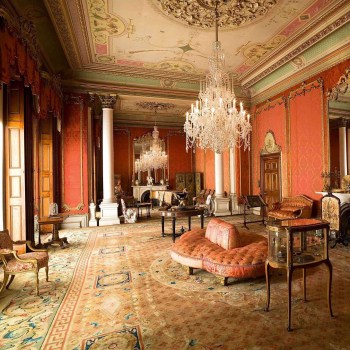
Restored Drawing Room at Brodsworth Hall, Doncaster, South Yorkshire, 1860s (Photo: Historic England Archive).
British and Irish Furniture Makers Online (BIFMO) is delighted to partner with the Furniture History Society (FHS) to offer an online course that looks at the evolution of the British country house from 1700 to 1900.
For two hours on three consecutive days, curators and historians will consider the furniture and designs commissioned for the interiors of specific country houses. They will touch upon the relationships between the architects and the craftsmen as well as the networks of furniture makers and the impact of the changing clientele. Over the course of these two centuries, the industrial revolution and social reform recast British society, creating new groups of wealthy property owners. By the nineteenth century the British stately home was no longer exclusively the domain of the aristocracy but a haven for the successful businessman and his family. The course speakers will consider the fashions and styles used to furnish these properties set against the backdrop of the changing role of the British country house.
The three sessions on 14th, 15th and 16th June, will be held on Zoom between noon and 14.00 GMT (7.00–9.00 EDT). All three days will be introduced by Dr Megan Aldrich who will provide an historic and stylistic context for the case studies of houses presented by the curators. These sessions will be recorded and links to the recordings will be sent to ticketholders shortly after the event.
Each day BIFMO will also offer the opportunity to participate in an additional online session in the form of a seminar where a much smaller group will be able to discuss the points raised by the presentations. These seminars will follow the course each day and will be guided by experts, who will also give further short presentations on a theme. Ticketholders for the seminars will be able to turn on their microphones and videos to fully participate in the discussion. Tickets for these seminars are available on the course Eventbrite page but must be bought in addition to the main session. Places are extremely limited and are allocated on a first come first served basis. These seminars will not be recorded.
To purchase tickets for this course and additional seminars on Eventbrite, please click here.
◊ ◊ ◊ ◊ ◊
Day 1: Tuesday, 14 June — Early 18th-Century Country Houses
Course
12.00 Introduction — Megan Aldrich
12.45 James Pascall in London and Temple Newsam — Tessa Murdoch
13.15 The Early Furnishing at Holkham Hall — Katherine Hardwick
13.45 Panel Discussion and Q&A
Seminar
14.20 The Country Seat: Researching the Country House: History, Architecture, and Furniture — Jeremy Musson with Adriana Turpin
Day 2: Wednesday, 15 June — Historicism and Revival in the British Country House
Course
12.00 Introduction — Megan Aldrich
12.45 Increasingly Aspirational: 18th-Century Nostell, Robert Adam and the Winn Family — Kerry Bristol
13.15 A Mid-Victorian Vision of a Comfortable Country House: The Furnishings of Brodsworth Hall by Lapworths of Bond Street — Eleanor Matthews
13.45 Panel Discussion and Q&A
Seminar
14.20 Looking at Furniture in the Context of the Country House — Peter Holmes with Adriana Turpin
Day 3: Thursday, 16 June — Tradition and Innovation: Different Approaches to Late 19th-Century Interior Design
Course
12.00 Introduction — Megan Aldrich
12.45 Furnishing the Arts and Crafts Interior: Morris & Co at Standen — Caroline Ikin
13.15 Mackintosh and the Design of Hill House — Joseph Sharples
13.45 Panel Discussion and Q&A
Seminar
14.20 Researching the Furniture Trade — Clarissa Ward with Adriana Turpin
◊ ◊ ◊ ◊ ◊
Megan Aldrich will introduce all three days of the course, setting out an outline for the two-hour session while providing an historical context. Dr Aldrich is a part-time tutor in the Department of Continuing Education, University of Oxford, and Hon. Editorial Secretary of the Furniture History Society. She researches aspects of antiquarian design and historicism across the areas of architecture, interiors, decorative art and design, and garden history, and has published widely in these areas. She is a Fellow of the Society of Antiquaries and formerly Academic Director, Sotheby’s Institute of Art, London
Information about the other speakers is available here»
Online Workshops | Egypt in Early-Modern Antiquarian Imagery
From the Antiquitatum Thesaurus research project:
Ägypten in der frühneuzeitlichen antiquarischen Bildwelt
Egypt in Early-Modern Antiquarian Imagery
Online Workshops, 5 May, 2 June, and 7 July 2022
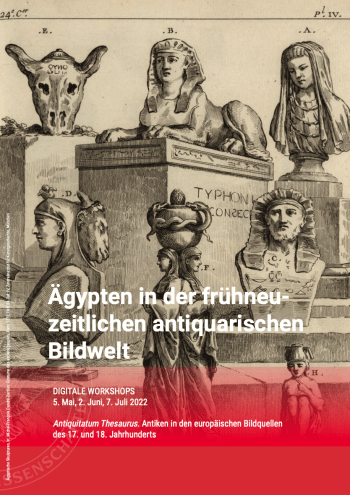 Antiquitatum Thesaurus: Antiquities in European Visual Sources from the Seventeenth and Eighteenth Centuries
On the occasion of this year’s anniversaries of important milestones in the recent reception of Egypt, the academy project Antiquitatum Thesaurus devotes three digital workshops in the summer semester of 2022 to the perception of the land on the Nile in the early modern period. The focus will be on various personal motivations of some of the protagonists, the antiquarian or scientific methods they used, and a broad spectrum of media in which the engagement with Egyptian or Egyptianizing artifacts and images was reflected from the 15th to the 18th century. In addition, current research projects present their perspectives on the reception of Egypt.
Thursday, 5 May 2022, 4pm
• Michail Chatzidakis (Berlin), „Ad summam sui verticem pyramidalem in figuram vidimus ascendentes […] anti quissimum Phoenicibus caracteribus epigramma conspeximus“. Bemerkungen zu den ägyptischen Reisen Ciriacos d’Ancona
• Catharine Wallace (West Chester), Pirro Ligorio and the Late Renaissance Memory of Egypt in Rome
• Stefan Baumann (Trier), Project Presentation: Early Egyptian Travel Accounts from Late Antiquity to Napoleon
Please register at: https://bit.ly/3LQWgMB
◊ ◊ ◊ ◊ ◊
Thursday, 2 June 2022, 4pm
• Maren Elisabeth Schwab (Kiel), Herodots Ägypten im Interessenshorizont italienischer Antiquare
• Alfred Grimm (München), Osiris cum capite Accipitris. Zu einem Objekt aus der Bellori-Sammlung und dem Barberinischen „Osiris“
• Florian Ebeling (München), Project Presentation: Handwörterbuch zur Geschichte der Ägyptenrezeption
Please register at: https://bit.ly/3O4dS9O
◊ ◊ ◊ ◊ ◊
Thursday, 7 July 2022, 4pm
• Guillaume Sellier (Montréal), Oldest Egyptian Artefacts in Canada: The Quebec Palace Intendant’s Amulets
• Valentin Boyer (Paris), „Sphinxomanie“ durch die Ikonographie ägyptisierender Exlibris
• Nils Hempel, Timo Strauch (BBAW), Project Presentation: Antiquitatum Thesaurus. Antiken in den europäischen Bildquellen des 17. und 18. Jahrhunderts
Please register at: https://bit.ly/3rd7T8z
Online Workshop | Making Masculinities

From ArtHist.net:
Making Masculinities: Material Culture and Gender in the 17th and 18th Centuries
Online and In-Person, University of Edinburgh, 6 May 2022
Research into the intersection of material culture and masculinity has steadily increased as scholars across disciplines choose to use material culture as a conceptual point of departure. The Material and Visual Culture in the Seventeenth and Eighteenth Centuries Research Cluster aims to provide a space to continue the conversation. The cluster will host a one-day workshop fostering interdisciplinary discussion on the material approaches to historic ideas about gender through material culture. The workshop is spread over a series of formats to diversify how participants may interrogate this material. All sessions, except for the 3.20 workshop, are hybrid. The link to join the sessions will be provided via email the day before. Contact materialcultureresearcheca@ed.ac.uk with questions.
Registration is available here»
Abstracts are available here»
P R O G R A M M E
(British Standard Time)
9:30 Welcome and Introduction
9:45 Fashioning Masculinity
Chair: Georgia Vullinghs (National Museums Scotland)
• Ben Jackson (University of Birmingham), Making a Figure in 18th-Century England: Elite Masculinity, Social Expectation, and Material Goods.
• Maria Gordusenko (Ural Federal University), Self-Representation through Artworks as a Way of Life: Count Gustav Adolf von Gotter (1692–1762)
11.00 Break
11.20 Making Masculinities Roundtable
Chair: Emily Taylor (National Museums Scotland)
• Timothy Somers (Newcastle University), The Materiality of Men’s Practical Jokes
• Alysée Le Druillenec (Université Paris 1 – Panthéon- Sorbonne/Université Catholique de Louvain), Carrying the Holy Child as a Depiction of Masculinity in Christian Counter-Reformation Materiality
• Élise Urbain Ruano (Université de Lille), How Does Softness Affect Masculinity? The Paradox of 18th-Century Dressing Gowns
• Alexandra Atkins (Birkbeck), The Classical Portrait Bust and Masculinity in 18th-Century Country Houses
• Nicholas Babbington (University College London), The Royal Family and Domestic Disorder: The Satirization of George III’s Patriarchal Virtues in British Caricature, c.1785–1795
12.50 Lunch Break
1.50 Keynote
Chair: Meha Priyadarshini (University of Edinburgh)
• Sarah Goldsmith (University of Edinburgh), Hercules Himself? Materiality, Masculinity, and the Body in the Long 18th Century
3.00 Break
3.20 PhD / ECR Workshop
Online Lecture | Tessa Murdoch on Huguenot Art and Culture
This afternoon from the YCBA:
Tessa Murdoch, Huguenot Refugee Art and Culture through the YCBA Collections
Online, Yale Center for British Art, New Haven, 21 April 2022, noon

William Hogarth, Mr. Garrick in the Character of Richard III, 1746, engraving (New Haven: Yale Center for British Art).
The Yale Center for British Art is pleased to present an online lecture on Thursday, 21 April 2022, at 12pm by Tessa Murdoch about Huguenot artistic production in early modern London. Focusing on the museum’s collections, Murdoch examines an array of paintings, prints, drawings, maps, and sculpture with notable examples including François Gasselin’s 1692 drawing View of the Royal Hospital, Chelsea, and William Hogarth and Charles Grignion’s 1746 engraving Mr. Garrick in the Character of Richard III. This talk is based on research completed for her recent book Europe Divided: Huguenot Refugee Art and Culture (V&A publishing, 2021), which traces the international networks and artistic products created by French Protestant artists and craftsman in the wake of the Huguenot diaspora in the late seventeenth century.
Registration is available here»
Tessa Murdoch PhD FSA worked at the Museum of London (1981–1990) and at the Victoria and Albert Museum (1990–2021) where she was the Rosalinde and Arthur Gilbert Research Curator from 2019. She is an adviser for the National Trust and the National Heritage Memorial Fund, a board member of the Idlewild Trust, and chair of trustees of the Huguenot Museum, Rochester. Murdoch’s most recent book, Europe Divided: Huguenot Refugee Art and Culture, was published by the V&A in 2021. She is currently consulting on the forthcoming publication Great Irish Households: Inventories from the Long Eighteenth Century (2022), and is co-editing, with Heike Zech, A Cultural History of Craft in the Age of Enlightenment (expected 2024).










leave a comment