Lecture | Hugh Roberts on Ince & Mayhew

Marquetry top of one of a pair of tables made by Ince and Mayhew for the Earl of Caledon, 1785.
◊ ◊ ◊ ◊ ◊
From the FHS:
Sir Hugh Roberts | Ince & Mayhew: Interpreting the Record
The Furniture History Society Annual Lecture
In-person and online, Society of Antiquaries, Burlington House, London, 7 November 2022
The lecture marks the publication by Philip Wilson in 2023 of Industry and Ingenuity: the Partnership of William Ince and John Mayhew by Hugh Roberts and Charles Cator. This book is the culmination of many years of research by both authors. It brings together for the first time a corpus of well documented or firmly attributed work by one of the leading metropolitan cabinet-making firms of the eighteenth century, a firm which was as well-known and successful in its day as that of Thomas Chippendale.
By the time furniture history had become established as a serious area of study in the 20th century, much of the furniture produced by this long-lived business had lost its identity and no clear picture of the firm’s output existed. The lecture will examine the process by which the authors have been able to retrieve evidence of some ninety-seven commissions, and to reconnect around three hundred pieces of furniture with patrons and documents.
Admission to the lecture is free for FHS members, but attendance is by ticket only, which must be acquired in advance. Please apply to the Events Secretary by email or post. Numbers are limited to 90. We plan to live-stream the event for those who cannot attend in person.
Sir Hugh Roberts, GCVO, FSA, is Surveyor Emeritus of The Queen’s Works of Art and former Director of The Royal Collection.
Online Talk | Janet Couloute on Black Presence in the Wallace Collection
From The Wallace Collection:
Janet Couloute, Black Presence in the Wallace Collection
Online, Thursday, 20 October 2022, 13.00 (BST)

Govaert Flinck, A Young Archer, ca. 1639–40, oil on oak panel, 66 × 51 cm (London: The Wallace Collection, P238).
To mark Black History Month in Britain, join Janet Couloute for a virtual African Heritage tour of the Wallace Collection. Spanning 400 years of European art, Dr Couloute will place the presumed peripheral and unimportant black male and female figure centre stage. Through a closer look at how artists have created iconographies of blackness and whiteness, Couloute will illustrate how museums such as the Wallace Collection, through more inclusive and open history telling, can encourage visitors to respond more imaginatively to such iconographies. This talk will be hosted online through Zoom and YouTube. Please click here to register for Zoom.
Janet Couloute is a social work academic and art historian interested in revising and expanding current British art-historical canons. With a particular interest in works that are rarely discussed as visual indexes of ‘race’, she is currently working on a research project entitled Renaissance ‘Whiteness’: Reimaging ‘Race’ through the Prism of Early Modern Portraiture. Dr Couloute has also been a Tate guide for twenty years, and has developed an expertise in encouraging gallery audiences to engage with the histories of the Black presence in Europe.
Symposium | Early Modern Global Political Art
From the Krannert Art Museum:
Early Modern Global Political Art
In-person and online, Krannert Art Museum, University of Illinois, Urbana-Champaign, 20–21 October 2022
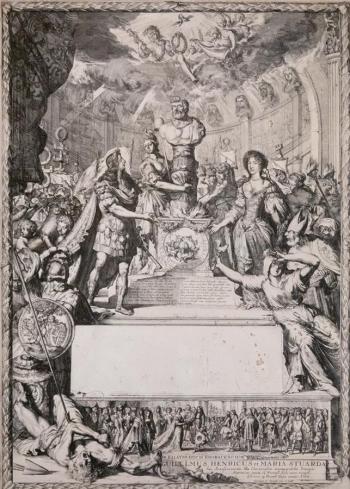
Romeyn de Hooghe, Marriage of William and Mary, 1677, etching (Krannert Art Museum, 2019.7.7).
Featuring emerging scholarship on the art of this period against the backdrop of the exhibition Fake News & Lying Pictures: Political Prints in the Dutch Republic, Krannert Art Museum hosts a symposium on Early Modern Global Political Art.
In the early modern period, nations, nobles, corporations, religious groups, and others found dynamic and innovative ways to use the visual arts for a wide range of political purposes. Nations dispatched elaborate diplomatic gifts to initiate and consolidate alliances. Aristocratic powers and individual collectors alike amassed collections to convey and enhance their political and economic power. Courts and cities produced ephemeral decorations to assert and display ideal political relations between nobility and their subjects, and between regional and outside authorities. Broadsheets addressing factional conflicts within and among institutions proliferated with the expansion of affordable print media. This symposium will investigate visual media that communicated political ideas, arguments, positions, and forms of resistance in the early modern period.
The event will be hybrid, blending in person presentations with online presentations via Zoom to facilitate greater accessibility and wider participation. All virtual components will be live captioned in English via Zoom. If you have a question or an accessibility request, please email us at kam-accessibility@illinois.edu. Registration is required for virtual and in-person components of the symposium.
Keynote Speakers
Dawn Odell (Lewis & Clark College) — Dr. Odell studies artistic exchange between China and northern Europe in the 17th and 18th centuries. She is currently writing a book on Andreas Everardus van Braam Houckgeest, an 18th-century Dutch Immigrant to the newly formed United States whose travelogues and Chinese porcelain collection were leveraged for social and political power.
Liza Oliver (Wellesley College) — Dr. Oliver’s research focuses on 18th- and 19th-century India, Europe, and the West Indies. Her current projects include the book Empire of Hunger: Representing Famine, Land, and Labor in Colonial India and work about British prints about abolition and the Haitian Revolution.
T H U R S D A Y , 2 0 O C T O B E R 2 0 2 2
9.00 Catholic Rulership around the World, Part One
• Moyun Zhou (PhD Candidate, University of Hong Kong), Can You Feel Me? The Global Space of St. Paul’s in Macao, 1592–1644
• Maria Vittoria Spissu (Senior Assistant Professor, University of Bologna and Marie Skłodowska-Curie Global Fellow), Bonds and Tenets in the Wider Iberian Catholic Universe: Fostering Political Unanimity by Means of Early Modern Altarpieces and Books
• Małgorzata Biłozór-Salwa (Curator of Old Master Drawings, University of Warsaw Library), Let’s Make A Crusade! Power of Images Under Louis XIII
10.20 Fashion, Part One
• Isabel Escalera (PhD Candidate, University of Valladolid), Jewelry as A Political Instrument: Renaissance Women and the Transmission of Their Power
• Diana Lucía Gómez-Chacón (Faculty, Complutense University of Madrid), Fashion as A Political Art: Gender, Monarchy, and Spectacle in Early Modern Castile
11.15 Negotiating Political Power in Republics
• Răzvan-Iulian Rusu (Graduate Student, Utrecht University), Global Gifts of Johan Maurits: Patronage, Image-Formation, Art & Material Culture
• Laura Blom (Postdoctoral Fellow, Dutch University Institute for Art History, Florence), Death as Dissent: The Macabre and the Medici in Renaissance Florence
5.30 Keynote Lecture
• Liza Oliver (Associate Professor of Art, Wellesley College), An Economy of Sentiment: The Shared Language of Abolitionists and the West India Interest in Late 18th-Century British Print Culture link»
This talk considers how spectatorial sympathy, a governing principle of 18th-century British art and literature, was deployed by opposing sides of the debate on Britain’s slave trade in the decades preceding its abolition. Considering broadsides, travel narratives, and caricatures, it argues for the ways in which sentiment became a common visual currency among both abolitionists and the pro-slavery lobby, with each side respectively seeking to sever or reaffirm the connection between morality on the one hand and self-interest and economic prosperity on the other.
F R I D A Y , 2 1 O C T O B E R 2 0 2 2
9.30 Coffee
10.00 Catholic Rulership around the World, Part Two
• Rachel Wise (2020 PhD in Art History, University of Pennsylvania), A Royal Devotion: Printed Habsburg Propaganda and the 80 Years’ War
• Angela Ho (Associate Professor, George Madison University), Risks and Payoffs: Ferdinand Verbiest’s World Map for Kangxi in Political Context
11.00 Fashion, Part Two
• Heather Hughes (Curator of Prints, Philadelphia Museum of Art), Recognizing the Enemy: The Spaniard in Dutch and Flemish Costume Prints
• Nancy Karrels (2022 PhD in Art History, University of Illinois Urbana-Champaign), Women for Bonaparte: Political Prints and Female Self-Fashioning in France’s Cultural Conquests
12.00 Lunch Break
1.30 Keynote
• Dawn Odell (Associate Professor of Art History, Lewis & Clark College), The Politics of Personhood in A.E. Van Braam Houckgeest’s China Memoir link»
Following his participation in the Dutch East India Company’s last embassy to the Chinese court (1794–95), A.E. van Braam Houckgeest moved to Philadelphia with an enormous personal collection of Chinese art. This talk explores van Braam’s self-fashioning through his collaboration with two unnamed Guangzhou artists and the French émigré printer and defender of race-based slavery, M.L.E. Moreau de Saint-Méry. The illustrated memoir these men produced places van Braam’s textual narrative within an expansive visual environment of Chinese landscape paintings and other works of Asian art, conjuring artistic presences as testaments to the author’s self-proclaimed virtue, prestige, and republican ideals.
3.00 Tour of Fake News and Lying Pictures: Political Prints in the Dutch Republic
◊ ◊ ◊ ◊ ◊
From the Krannert:
Fake News & Lying Pictures: Political Prints in the Dutch Republic
Krannert Art Museum, University of Illinois, Urbana-Champaign, 25 August — 17 December 2022
Curated by Maureen Warren
 Comedians, editorial cartoons, and memes harness the power of satire, parody, and hyperbole to provoke laughter, indignation—even action. These forms of expression are usually traced to eighteenth-century artists, such as William Hogarth, but they are grounded in the unprecedented freedom of artistic expression in the seventeenth-century Dutch Republic.
Maureen Warren, ed., with contributions by Wolfgang Cillessen, Meredith McNeill Hale, Daniel Horst, Maureen Warren, and Ilja Veldman, Paper Knives, Paper Crowns: Political Prints in the Dutch Republic (Champaign: Krannert Art Museum, 2022), 184 pages, ISBN: 978-1646570294, $40.
Symposium | The Fabric of the Spanish Americas

Domestic Landscape from Quito, in Jorge Juan and Antonio de Ulloa’s Relación histórica del viage a la América Meridional (Madrid: A. Marin, 1748). Benson Latin American Collection, LLILAS Benson Latin American Studies and Collections, The University of Texas at Austin.
◊ ◊ ◊ ◊ ◊
From the Blanton Museum of Art:
The Fabric of the Spanish Americas
Online, Friday, 21 October 2022
Organized in conjunction with the exhibition Painted Cloth: Fashion and Ritual in Colonial Latin America, on view at the Blanton Museum of Art at The University of Texas at Austin, this symposium will bring together scholars from Colombia, Mexico, the United Kingdom, and the United States to further explore the social role of textile arts in colonial Latin America. The keynote will be delivered by Dr. Elena Phipps, and speakers include historians Tamara Walker and Meha Priyadarshini, along with fashion historian James Middleton. The round table discussion will feature art historians Laura Beltrán-Rubio, Martha Sandoval, and Leslie Todd. Registration is available here.
P R O G R A M M E
Central Time
9.00 Keynote
• Elena Phipps (Independent Scholar), Garments and Identity: Textile Traditions in the Global World of Colonial Latin America
10.00 Morning Panel
• Tamara Walker (Barnard College), Fashioning Whiteness in Colonial Latin American Art
• James Middleton (Independent Scholar), They All Greatly Affect Fine Clothes: Textiles in Eighteenth-Century Lima-School Painting
• Meha Priyadarshini (University of Edinburgh), Global Trade, Local Fashion: The rebozo, piña and mantón de Manila
11.30 Q&A
12.00 Intermission
1.30 Round Table Discussion: Artifice in Fashion, Painting and Sculpture
• Laura Beltrán-Rubio (Universidad de los Andes), The Artifice of Fashion: Creating and Performing Identities through Clothing in Colonial Spanish America
• Martha Sandoval-Villegas (Instituto Tecnológico de Estudios Superiores de Occidente, ITESO), Habit Makes the Man… and the Woman: Portrait and New Spain Social ‘Fabric’
• Leslie Todd (Sewanee: The University of the South), The Brilliance and Brocateado of Eighteenth-Century Sculpture in Quito
Seminar Session | Clémence Fort on ‘Porcelaines des Sauvages’
This month’s session from the GRHS series on the circulation of knowledge, with information on other GRHS seminar series available here:
Clémence Fort | ‘Porcelaines des Sauvages’
Circulation, appropriation et représentation d’un objet emblème en France au XVIIIe siècle
Diffusion, circulation et appropriation des savoirs – Séminaire du Groupe de Recherche en Histoire des Sociabilités
In-person and online, Université du Québec, Montréal, 21 October 2022, 12.30pm
Avec l’essor du projet colonial en Amérique du Nord au 18e siècle, les « porcelaines des Sauvages » en provenance de Nouvelle-France et issues de la collecte apparaissent dans les collections françaises. Leur circulation engendre des représentations qui documentent les nombreux imprimés de cette époque allant des récits de voyages aux atlas historiques. Naturalistes et amateurs s’intéressent aussi à la manière dont les objets sont fabriqués et imités. Ils les incluent alors dans une culture visuelle scientifique et esthétique nouvelle. Cette présentation examinera la manière dont « les porcelaines des Sauvages » invitent à repenser la géopolitique du collectionnisme à partir des enjeux artistiques, scientifiques et économiques. Nous étudierons la façon dont les « porcelaines des Sauvages » participent à la diffusion esthétique, historique et scientifique de l’entreprise coloniale de la Nouvelle-France au 18e siècle.
Le séminaire privilégiera les circuits et les transmissions de l’imprimé sous toutes ses formes, sans pour autant exclure les autres productions (et marchandises) de la connaissance. Les séances se tiendront en comodal, au local R-4215 à l’UQAM et par visioconférence.
Clémence Fort est actuellement doctorante contractuelle en deuxième année au sein de l’université PSL (ENS) à Paris. Sa thèse intitulée : « Collecter les Americana : la Nouvelle-France dans les cultures visuelles et l’art des Lumières (v. 1700–1763) » est dirigée par Charlotte Guichard. Les recherches de Clémence s’inscrivent au croisement d’une histoire de l’art renouvelée par l’histoire de la collecte, des collections et des cultures visuelles et matérielles.
Conference | Rereading Constable
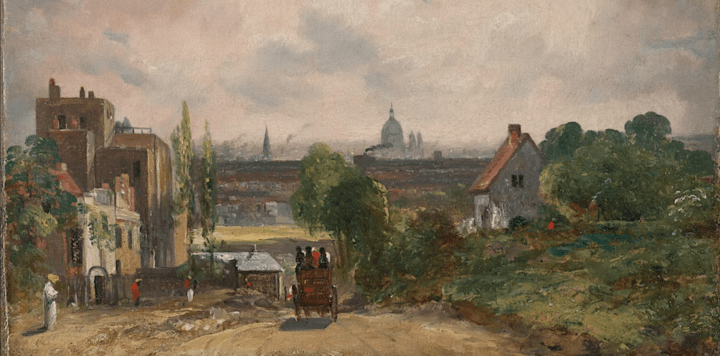
John Constable, Sir Richard Steele’s Cottage, Hampstead, 1831–32, oil on canvas, 21 × 29 cm
(New Haven: Yale Center for British Art, Paul Mellon Collection, B2001.2.25)
◊ ◊ ◊ ◊ ◊
From PMC:
Rereading Constable: Letters, Life, and Art
In-person and online, Paul Mellon Centre, London, 2 December 2022
Organized by Stephen Daniels and Mark Hallett
How do artists’ letters articulate professional and personal affiliations, embody networks, and forge allegiances? What role has letter writing played in artistic self-fashioning? In what ways do letters serve as a form of art-historical evidence, and help us understand works of art themselves?
R.B. Beckett’s multi-volume edition of Constable’s correspondence, published in six volumes by the Suffolk Records Society (1962–68), has long been recognised as an invaluable source for scholars working on the artist, and for all those interested in British art and culture in the late Georgian period. The published correspondence shows the painter to have been a shrewd, skilled writer, versed in a variety of literary, scientific, and biblical texts. His correspondents were, in turn, often highly articulate writers, including many family members, and many more with very different characters and backgrounds. Often utilised by art historians, the correspondence has more recently attracted the interest of scholars interested in the literary character and rhetorical conventions of nineteenth-century correspondence, who have subjected Constable’s letters to new kinds of critical scrutiny. This event will build on this important work, exploring Romantic art, culture, and society through the prism provided by the landscape painter’s correspondence.
The central structuring concept of this interdisciplinary conference is that speakers will focus on a single letter written by the artist, his correspondents, or other contemporary figures whose work, life, or letters can be understood in productive relation to Constable himself. These individual letters will be used to open up new questions and arguments about Constable’s life, practice, and identity as a painter, and about the wider artistic, literary, religious, and political cultures of his era.
Rereading Constable: Letters, Life, and Art has been organised as part of the PMC’s Generation Landscape research project. The conference is being convened by Stephen Daniels and Mark Hallett. Book tickets here.
We are offering up to five bursaries to support individuals who may not otherwise be able to attend the conference. Bursaries will cover the ticket price, travel, and some expenses, including childcare. If you would like to be considered for a bursary please email events@paul-mellon-centre.ac.uk with Rereading Constable Bursary in the subject field, outlining your request for a supported place by 10am, Friday, 4 November 2022.
P R O G R A M M E
9.30 Introduction by Mark Hallett (Paul Mellon Centre) and Stephen Daniels (University of Nottingham)
10.00 Session 1 | Chair: Stephen Daniels
• Alexandra Harris (University of Birmingham), New Friends, New Scenes: Constable in the Arun Valley
• Amy Concannon (University of York and Tate Britain), Strengthening Ties and Gaining Esteem: Constable Writes to Wordsworth, 15 June 1836
11.00 Tea and Coffee Break
11.30 Session 2 | Chair: Martin Postle (Paul Mellon Centre)
• Emma Roodhouse (Art Curator and Researcher), An Evening’s Amusement: Portraits, Writing, and Other Oddments from the Mason Family Album
• Sarah Cove (The Constable Research Project), A Regency ‘Nip-and-Tuck’: Constable’s Treslove Portraits Rediscovered
12.30 Lunch (provided by PMC)
Constable material available to view in the Public Study Room
1.30 Session 3 | Chair: Mark Hallett
• Morna O’Neill (Wake Forest University), John Constable, David Lucas, and Artistic Identity
• Katharine Martin (V&A and the University of Sussex), Translations and Fraught Relations: English Landscape and the Language of Collaboration
2.30 Break
2.45 Session 4 | Chair: Sarah Victoria Turner (Paul Mellon Centre)
• Gillian Forrester (Independent Scholar), ‘Solemnity, Not Gaiety’: Language and the Production of Meaning in Constable’s English Landscape Scenery
• Elenor Ling (The Fitzwilliam Museum), The ‘Definition of our Book’: John Constable, David Lucas, and their English Landscape
3.45 Tea and Coffee Break
4.15 Session 5 | Chair: Sria Chatterjee (Paul Mellon Centre)
• Rhian Addison McCreanor (University of York and Tate Britain), Repairing the House with a Thorough Painting: Reimagining 63 Charlotte Street
• Nicholas Robbins (University College London), The Life Academy and the Origins of Landscape
5.15 Panel Discussion
Stephen Daniels (University of Nottingham), Martin Myrone (Paul Mellon Centre), Trev Broughton (University of York), and Timothy Wilcox (Independent Scholar)
5.55 Closing Remarks by Mark Hallett
6.00 Drinks Reception
Online Lecture | Andrew Rudd on Print Philanthropy

Jonas Hanway, Thoughts on the Plan for a Magdalen-House for Repentant Prostitutes, second edition (London, 1759). The first edition was published anonymously in 1758.
◊ ◊ ◊ ◊ ◊
From Yale’s Lewis Walpole Library, in connection with the exhibition From ‘Knight Errant of the Distressed’: Horace Walpole and Philanthropy in Eighteenth-Century London:
Andrew Rudd | Print Philanthropy in the Age of Horace Walpole
Online, 28 October 2022, 12.00pm EST
Eighteenth-century England witnessed a remarkable flowering of philanthropic activity as society wrestled with problems such as poverty, disease, mental illness, vice, and suffering caused by war. Walpole boasted in 1760 of what he called “our noble national charity.” While many aspects of philanthropy remain similar today, this lecture will explore how the print culture of Walpole’s era was central in driving charitable behaviour, particularly in terms of creating philanthropic networks and framing relationships between donors and beneficiaries. The talk will showcase the sheer range of printed text and images—fundraising prospectuses, sermons, topographical views of hospitals, tickets to benefit concerts and dinners, and celebratory odes—mobilised in service of good causes during this period, as well as highlight examples of Walpole’s own support for, and portrayals of, philanthropic causes during his lifetime.
Andrew Rudd is Senior Lecturer in the English Department at the University of Exeter. He researches and teaches British literature of the eighteenth century and Romantic period. His monograph Sympathy and India in British Literature 1770–1830 (Palgrave Macmillan) was published in 2011, and he is currently writing a cultural history of charity in the eighteenth century. This builds on experience he acquired as Parliamentary Manager at the Charity Commission for England and Wales before joining Exeter in 2013. Dr. Rudd holds a PhD from the University of Cambridge, and he has studied at the University of Durham, Trinity College, Cambridge, and Yale University. He has held numerous fellowships—most recently at Yale’s Lewis Walpole Library and the School of Advanced Studies in English, University of Jadavpur. Since 2015, he has been a member of the Arts and Humanities Research Council’s Peer Review College.
HECAA Zoom Event | Transporting Culture
Transporting Culture
HECAA Zoom Event, Thursday, 20 October 2022
Please join us for our next HECAA Zoom Event, Transporting Culture. It’s open to HECAA members and non-members alike. Please register in advance here.
P R O G R A M M E
Welcome 12.00 (EST) / 17.00 (BST)
12.15 Panel One
Moderator: Lorne Darnell (Courtauld Institute)
• Practicalities of Bearing Diplomatic Gifts from Versailles to Isfahan in 1705 — Samantha Happe (Graduate Research Teaching Fellow and Postgraduate Student, University of Melbourne, and Research Officer, Australian National University)
• Crates, Boxes, and Cases: The Transport of Works of Sculpture and Silver between Rome and Lisbon in the 18th Century — Teresa Leonor M. Vale (Senior Assistant Professor School of Arts and Humanities and Researcher of the ARTIS-Institute of History of Art, University of Lisbon)
• Transporting America: The Politics of Import and Export in the New Indies Gobelins Tapestry Set — Carole Nataf (PhD Candidate, Courtauld Institute)
1.45 Break
2.00 Panel Two
Moderator: Harvey Shepherd (Courtauld Institute)
• ‘Fortuna favet Fortibus!’ Early Modern Art Insurance — Avigail Moss (Lecturer, American University of Paris)
• A Thumb on the Scale: Examining the Control of Art in Comanche Trade Networks — Carlos Littles (Johns Hopkins University, Alumni)
• ‘Truly Chinese’: Transporting Chinese Objects to Germany in the 19th Century — Emily Teo (Postdoctoral Researcher, Gotha Research Centre of the University of Erfurt)
Online Workshop | Lacing around the World

Decor la Dentelle, French, ca. 1725, silk, metallic-wrapped thread, gold, 51 × 29 cm
(Washington, DC: Cotsen Textile Traces Study Collection, T-0598)
◊ ◊ ◊ ◊ ◊
From The George Washington University Museum:
Lacing around the World and across Time
The Cotsen Textile Traces Global Roundtable
Online, 12–13 October 2022
The third annual virtual Cotsen Textile Traces Global Roundtable explores the rich traditions of lacemaking through examples from the Cotsen Textile Traces Study Collection at The George Washington University Museum and The Textile Museum in Washington, D.C., October 12 and 13.
The Cotsen Textile Traces Global Roundtable: Lacing around the World and across Time includes some fifteen international scholars, artists, and designers, who will present multiple dimensions of the global art, from its history and globalization to innovations, fashion, and artistic creativity. This program is a partnership with Bard Graduate Center, New York, and Textilmuseum St. Gallen, Switzerland, and is supported through the Cotsen Textile Traces Study Collection Endowment.
Those interested in attending the roundtable should register early in order to receive links and details for joining each day of the roundtable on Zoom, as well as a full program with the detailed schedule.
The Cotsen Textile Traces Study Collection represents a lifetime of collecting by business leader and philanthropist Lloyd Cotsen (1929–2017). Comprised of nearly 4,000 fragments from all over the world, the collection offers insights into human creativity from antiquity to the present. Cornerstones of the collection include fragments from Japan, China, pre-Hispanic Peru and 16th- to 18th-century Europe. The entire collection is available online.
W E D N E S D A Y , 1 2 O C T O B E R 2 0 2 2
Situating Lace: Traditions and Transmission
10.00 Introduction
• Lori Kartchner — Curator of education, The George Washington University Museum and The Textile Museum
• John Wetenhall — Director, The George Washington University Museum and The Textile Museum
• Emma Cormack — Associate curator, Bard Graduate Center
• Marie-Eve Celio-Scheurer — Art historian, academic coordinator, Cotsen Textile Traces Study Center, The George Washington University Museum and The Textile Museum
10.30 Panel 1 | Needle Lace, Bobbin Lace: Traditions and Transmissions
• Diana Greenwold — Lunder Curator of American Art, National Museum of Asian Art, Smithsonian Institution
• Cecilia Gunzburger — Lecturer, decorative arts and design history, the George Washington University and Smithsonian Institution
• Sarah Besson Coppotelli — Head of collections, Musée et château de Valangin, Switzerland
11.30 Panel 2 | Mimicking Lace
• Sumru Krody — Senior curator, The Textile Museum Collection, The George Washington University Museum and The Textile Museum
• Vaishnavi Kambadur — Assistant curator, Museum of Art & Photography (MAP), Bengaluru, India
T H U R S D A Y , 1 3 O C T O B E R 2 0 2 2
Exploring Global Traditions and Industrial Innovations in Contemporary Creativity
10.00 Keynote Opening
• Emma Cormack — Associate curator, Bard Graduate Center
• Ilona Kos — Curator, Textilmuseum St. Gallen, Switzerland
• Michel Majer — Professor emerita, Bard Graduate Center
10.30 Panel 3 | Handmade Lace Today
• Caroline Kipp — Curator of contemporary art, The George Washington University Museum and The Textile Museum
• Elena Kanagy-Loux — Collections specialist, Antonio Ratti Textile Center, The Metropolitan Museum of Art
• Nidhi Garg Allen — Founder and CEO, Marasim, New York/India
11.30 Panel 4 | Industrial Innovations
• Elena Kanagy-Loux — Collections specialist, Antonio Ratti Textile Center, The Metropolitan Museum of Art
• Jérémy Gobé — Artist, founder, Corail Artefact, France
• Rose-Lynn Fisher — Artist, United States
Public Lecture Course | Georgian Provocations, II

From PMC with registration at Eventbrite:
Georgian Provocations, II
In-person and Online, Paul Mellon Centre, London, 27 October — 8 December 2022
Organized by Martin Postle
The Paul Mellon Centre’s next public lecture course is entitled Georgian Provocations II, a sequel to the highly successful Georgian Provocations, which ran in the summer of 2020. Adopting a similar format, the present course will focus upon a series of provocative artworks from the Georgian era and investigate their contents, contexts, and impact. The series is convened by Martin Postle, Senior Research Fellow at the Paul Mellon Centre. The course runs from 27 October to 8 December 2022 and is in-person and live on Zoom weekly, 6.00–7.30pm GMT on Thursdays.
◊ ◊ ◊ ◊ ◊
Lecture 1 | 27 October 2022
Paris Spies-Gans — Establishing a Female Lineage at the Royal Academy’s Show: Eliza Trotter, Angelica Kauffman, and the Intrigues of Lady Caroline Lamb. Register here»
Lecture 2 | 3 November 2022
Martin Myrone — The Haunted Eighteenth Century: Fuseli’s The Nightmare. Register here»
Lecture 3 | 10 November 2022
Esther Chadwick — A Black King in Georgian London: British Art and Postrevolutionary Haiti. Register here»
Lecture 4 | 17 November 2022
Nicholas Robbins — George Romney in the Prison-World of Europe. Register here»
Lecture 5 | 24 November 2022
Nika Elder — John Singleton Copley’s Watson and the Shark and the Taste for Flesh. Register here»
Lecture 6 | 1 December 2022
Martin Postle — Joseph Wright of Derby: Self-portrait as an Experimental Artist. Register here»
Panel Discussion | 8 December 2022
Discussion with Series Speakers and Q&A. Register here»










leave a comment