Registration is open for a limited in-person audience. Bard Graduate Center requires proof of vaccination and photo identification to enter the building. Guests are required to wear masks regardless of vaccination status. This talk will also be available on Zoom (register here). A link will be circulated to registrants by 4pm on the day of the event. This event will be live with automatic captions.
Online Talk | Cabinet Cup and Stand by Thomas Baxter
From Rienzi:
Misty Flores | Worcester Cabinet Cup and Stand by Thomas Baxter
Online, Rienzi, MFAH, Houston, Tuesday, 19 April 2022, 1pm (Central Time)
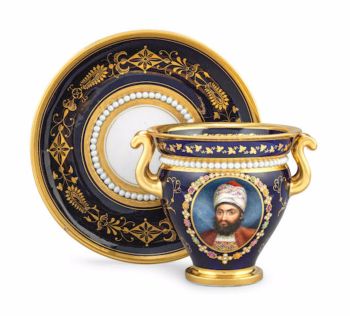
Worcester Porcelain Manufactory, Thomas Baxter, Cabinet Cup and Stand, ca. 1814–16, porcelain (Museum of Fine Arts, Houston / Photograph: Bonham, 2021).
This Worcester porcelain cup depicts Mirza Abu’l Hassan Khan (1776–1845), the Persian ambassador sent to the English court in 1809. A figure of much fascination while in England, he was the subject of prints and poetry and was even depicted on porcelain objects. Find out more about this Cabinet Cup and Stand, newly acquired by Rienzi, during this free 30-minute talk with assistant curator Misty Flores. Live via Zoom.
Registration is available here»
Online Panels | Museum Careers
Presented by the Yale Center for British Art:
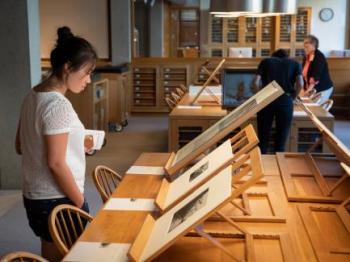
Visitors in the Study Room, YCBA (Photo by Harold Shapiro).
This two-part online discussion is for graduate students from any discipline who are interested in pursuing a professional career in museums. In each session, Yale alumni who work in the field share their personal experiences and professional opinions. The goal is to better equip individuals for a museum position by discussing the range of specialist professions that support museums and sharing information about how to be competitive in the job market. There will be opportunities to ask questions with the online Q&A feature.
Attendees must register to receive the link.
Yale Alumni Panels: Museum Careers and Trajectories
Friday, 8 April 2022, 11.00am (ET)
This session addresses personal career trajectories to highlight the diversity of pathways into museums and the range of positions related to audience outreach, curatorial practice, collections, and programming. Each panelist shares their current duties and responsibilities and how their position fits into their wider career goals and intellectual life. The discussion also touches on how to prioritize the skills and experience needed to be competitive in the job market, such as publishing scholarly research, gaining work experience, presenting at conferences, networking, interning, and applying to professional or fellowship positions.
Panelists
• Ashley James (Yale PhD 2021, English Literature, African American Studies, and Gender Studies), Associate Curator, Contemporary Art, Solomon R. Guggenheim Museum
• Elizabeth Mattison (Yale MA 2014, History of Art), Andrew W. Mellon Assistant Curator of Academic Programming, Hood Museum of Art
• Rebecca Peabody (Yale PhD 2006, History of Art and African American Studies), Head of Research Projects & Programs, Getty Research Institute
Moderator
• Laurel Peterson (Yale PhD 2018, History of Art), Assistant Curator of Prints and Drawings, Yale Center for British Art
To join us for this program, please register here»
◊ ◊ ◊ ◊ ◊
Yale Alumni Panels: Museums and the Hiring Process
Friday, 22 April 2022, 11.00am (ET)
This session focuses on the process of applying, interviewing, and securing a position within the museum field. Panelists reflect on their own successes and share insights into the recruitment process at their respective institutions. The conversation also covers some of the effective strategies that candidates have used and touches on resources and training options.
Panelists
• Desirée Gordon (Yale BA 2002, American Studies and Cultural Anthropology), Director of Programs and Strategy, Brooklyn Arts Council
• Megan Heuer (Yale BA 2000, Women’s and Gender Studies), Director of Public Programs and Public Engagement, Whitney Museum of American Art
• Julie Ludwig (Yale MA 1996), Associate Archivist, The Frick Collection
Moderator
• James Vanderberg, Educator, High School, College, University, and Community Engagement, Yale Center for British Art
To join us for this program, please register here»
Online Talk | Sarah Grandin on Drawings Engraved
This Thursday from The Clark:
Sarah Grandin | A Market for Imitation: Engraving Drawing in Eighteenth-Century France
Online, The Clark Art Institute, Williamstown, Massachusetts, 7 April 2022, noon (ET)
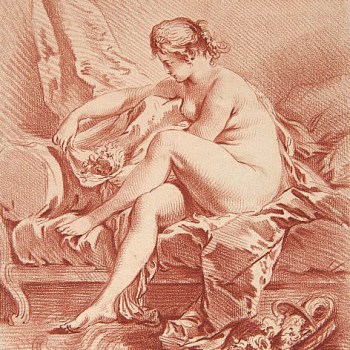
Gilles Antoine Demarteau, after François Boucher, Femme nue, after 1757, engraving in crayon manner with roulette on laid paper.
Sarah Grandin leads a virtual lunchtime talk exploring works on paper from the Clark’s collection, showcasing the role prints played in making drawing more accessible to the public in eighteenth-century France. After Grandin’s (recorded) presentation of a selection of works by Jean-Honoré Fragonard, François Boucher, Jean-Antoine Watteau, and others, she will join in a live Q&A session. Presented via Zoom and Facebook Live, the event is free, but advance registration for the Zoom transmission is required.
Sarah Grandin holds a PhD in the History of Art and Architecture from Harvard University (awarded in 2021) and is the Clark-Getty Paper Project Curatorial Fellow (2020–22) at The Clark Art Institute.
This program is made possible with support from the Getty Foundation through The Paper Project initiative.
Lecture | Anne Lafont, Making Ornamental Africa
From the BGC:
Anne Lafont, Making Ornamental Africa: An Enlightenment Process
The Iris Foundation Awards Lecture
Online and in-person, Bard Graduate Center, New York, 26 April 2022, 6pm
Could it be that in the geographical conception of art developed in Enlightenment Europe, the primary role and the function of the so-called Black Continent was one of ornament? Or, on the contrary, did the aesthetic conception elaborated by the European Enlightenment deprive Africa of artistic potentiality? These two opposing hypotheses coexist in eighteenth-century artworks and texts. The talk will focus on some objects whose material, form, argument, use and reception invite us not only to historicize the notion of African art, but also to identify the registers of categorization specific to this pivotal eighteenth-century moment, when both anthropology and aesthetics were invented. African objects, as well as European objects inspired by the African presence in Europe, rub up against the emergence of these two disciplines, which intersected around the importance of the senses and sight, in particular.
Registration is open for a limited in-person audience. Bard Graduate Center requires proof of vaccination and photo identification to enter the building. Guests are required to wear masks regardless of vaccination status. This talk will also be available on Zoom (registration is available here). A link will be circulated to registrants by 4pm on the day of the event. This event will be live with automatic captions.
Anne Lafont is an art historian and professor at the École des hautes études en sciences sociales. She is interested in the art, images, and material culture of France and its colonial empire in the modern era, as well as in historiographical questions related to the notion of African art. She has published on art and knowledge in an imperial context, on gender issues in the discourse on art in the 18th and 19th centuries, and her most recent book is entitled L’Art et la Race: L’Africain (tout) contre l’oeil des Lumières. It was awarded the 2019 Fetkann Maryse Condé Literary Prize and the 2020 Vitale and Arnold Blokh Prize. Anne Lafont participated, as a member of the scientific committee, in the Musée d’Orsay exhibition The Black Model (2019). In 2021, she was awarded a residential fellowship from the cultural services of the French Embassy in the United States, the Villa Albertine, and she serves, for the academic year 2021–22, as the Robert Sterling Clark Visiting Professor of Art History at Williams College (Massachusetts).
Online Talk | Caroline Stanford on Eleanor Coade
From The Royal Oak Foundation:
Caroline Stanford | Eleanor Coade and Her Remarkable Stone
Online, The Royal Oak Foundation, 30 March 2022, 2pm (ET)

Eleanor Coade (1733–1821) was a successful Georgian entrepreneur who created artificial stone for use in monuments, which she called Coade stone. Inventing the recipe and the firing technique, Mrs. Coade bought an existing artificial stone factory in South London in 1769 and turned out Coade stone architectural detailing, urns, tombs, and statues for the next 50 years. She combined artistic flair with successful marketing skills, and every architect of the time including Robert Adam, Sir John Soane, John Nash, and James and Samuel Wyatt commissioned her work for their projects. Her manufactory’s output was mostly classical in style but also produced wares in Gothic, Egyptian, and Chinese styles. Mrs. Coade’s genius lay in her entrepreneurship—convincing designers that her product was better than natural stone for its durability and weatherproof nature.
In an era, when successful businesswomen were far from typical, Eleanor Coade was exceptional. Many examples of Coade stone made during and after the inventor’s lifetime remain in the UK and beyond, including the South Bank lion at the east end of Westminster Bridge. The Landmark Trust’s historian, Caroline Stanford, will talk about this successful 18th-century business woman and her business practice, describing how Coade stone transformed late-Georgian architecture, including its use in America. Stanford will also feature Belmont, Coade’s own villa, rescued and restored by the Landmark Trust and available to rent.
Caroline Stanford read Modern History at Jesus College, Oxford and has two Masters in Early Modern History from Birbeck College London and in Historic Conservation at Oxford Brookes. She has been The Landmark Trust’s historian since 2001 and writes and speaks extensively about the Landmark Trust’s buildings. She was research historian for the Landmark Trust’s 2015 restoration of Eleanor Coade’s seaside villa, Belmont in Lyme Regis. A Fellow of the Society of Antiquaries, Stanford has also served on the committee of the Society of Architectural Historians of Great Britain. She co-authored Landmark: A History of Britain in 50 Buildings and has contributed to many television and radio programmes. She is currently working on a part time DPhil in Architectural History at Oxford University on “Fired Artificial Stone, 1650–1850” and is a leading Coade scholar.
Online via Zoom Webinar
Wednesday, 30 March 2022, 2.00 pm (ET)
$15 ROF members; $20 non-members
Recording Rental
Available between Thursday, 31 March and Monday, 11 April
Rent the recorded lecture to watch at your leisure
$15 ROF members; $20 non-members
Online Talk | Chinoiserie in the Reign of Elisabeth Petrovna

Chinoiserie Figures, Imperial Porcelain Factory, 1752–60
(Jordanville, New York: Russian History Museum)
◊ ◊ ◊ ◊ ◊
Sponsored by the museum:
Ekaterina Heath | Art in Chinese Style during the Reign of Elisabeth Petrovna
Online, Russian History Museum, Jordanville, New York, 9 April 2022, 1.00pm (EDT)
Empress Elisabeth Petrovna (1709–1762), second-eldest daughter of Peter the Great, was an unexpected ruler whose place on the throne was under constant threat. As a young child, she experienced the intrigue and mystery of the Chinese embassy’s visit to Empress Anna Ioannovna. This visit had a lasting effect. The fact that the Chinese desired a relationship with a European country was unique in international relations at the time; yet Russian Empire’s attitude towards China remained ambiguous throughout Elisabeth’s reign. The Empress oscillated between critiquing China and seeking good relations with the Chinese Emperor.
The malleability of art in Chinese style (chinoiserie) allowed to use it to reflect the changing meanings of the East. At the same time, Russian chinoiserie often reveals more about Russian court culture and politics than it does about Russia’s complex relationship with China. Chinoiserie’s multiple meanings also served Elizabeth Petrovna to challenge the norms of her gender to support her legitimacy to rule. Neither Chinese nor European, chinoiserie allowed the Imperial court to define and promote the values and interests of the empress and the Russian state. Join us as we explore this unique combination of diplomacy through decorative arts.
This virtual lecture will be presented live via Zoom. Registered users will be emailed a link to join. If you’re unable to watch the live stream, please fill out this form and we will send you a link to the recording.
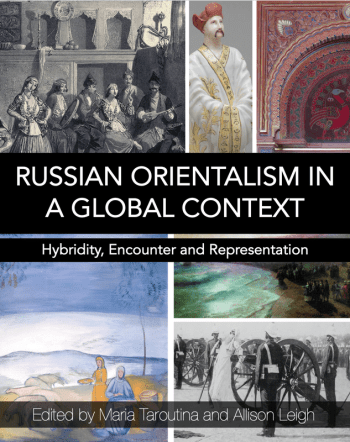 Dr. Ekaterina Heath is a Research Associate at the University of Sydney. She has published essays on Russian eighteenth-century art and gardens. Her recent articles include “Grand Tour Memories In Maria Feodorovna’s Pavlovsk Park, St Petersburg, 1782–1825” (with Emma Gleadhill), “Giving Women History: A History of Ekaterina Dashkova through Her Gifts to Catherine the Great and Others,” and “Sowing the Seeds for Strong Relations: Seeds and Plants as Diplomatic Gifts for the Russian Empress Maria Fedorovna.” She is finishing a book on Empress Maria Fedorovna’s use of Pavlovsk Park to influence Russian politics. This online talk is based on a chapter that Ekaterina Heath wrote with Professor Jennifer Milam, to be published shortly in the volume Russian Orientalism in a Global Context (edited by Maria Taroutina and Allison Leigh).
◊ ◊ ◊ ◊ ◊
Opened in 1984, the Russian History Museum in Jordanville, New York, 60 miles east of Syracuse, “promotes the understanding and appreciation of the rich history and culture of Russia and the Russian diaspora.” The museum’s history is closely associated with the Holy Trinity Monastery, founded in 1930. The monastery became “an important spiritual and cultural center for the Russian diaspora, [and] emigres from the former Russian Empire, displaced by revolution, civil war, and World War II, began to view the monastery as a trusted repository for the treasured artifacts and documents they brought with them from their homeland or had painstakingly collected abroad” (from the museum’s website). Responding to the Russian invasion of Ukraine, the museum’s ‘plea for peace’ is available here.
Online Talk | Gus Casely-Hayford on Crafting the New V&A East
From The Institute of Fine Arts:
Gus Casely-Hayford | Making a Museum: Crafting a New V&A for East London
Online, The Institute of Fine Arts, New York University, 21 March 2022, 2pm ET
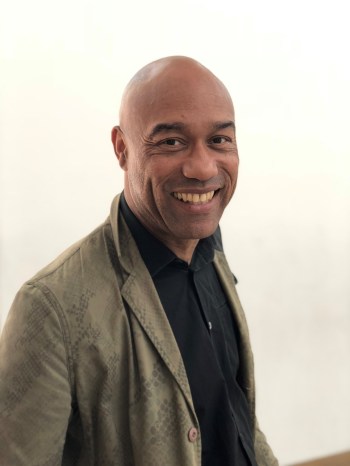 The Institute of Fine Arts invites you to a lecture by Dr. Gus Casely-Hayford, Director of the V&A East, a new museum and collection center in London. This virtual program takes place on Monday, 21 March 2022, at 2pm (Eastern Time).
Advanced registration is required–and available here.
A curator and historian who writes, lectures, and broadcasts widely on culture, Dr Gus Casely-Hayford, OBE, Prof by Practice, SOAS, University of London (the leading Higher Education institution in Europe specializing in the study of Asia, Africa, and the Near and Middle East), is the founding Director of V&A East, a museum and collection center presently under construction. He was previously the Director of the Smithsonian National Museum of African Art.
Over the course of his career, Casely-Hayford has been a constant champion for the arts. He has presented two television series of The Lost Kingdoms of Africa for the BBC (and wrote the companion book), two television series of Tate Britain: Great Art Walks for Sky, and has worked for every major British TV channel. His TED talk on Islamic culture has been viewed more than a million times. Former Executive Director of Arts Strategy, Arts Council England (Britain’s major arts funder) and ex-Director of the Institute of International Contemporary Art, he has offered leadership to both large and medium scale organizations. Dr Casely-Hayford has lectured widely on art and culture, including periods at Sotheby’s Institute, Goldsmiths, Birkbeck, City University, University of Westminster, and SOAS. He has advised national and international bodies on heritage and culture including the United Nations and the Canadian, Dutch, and Norwegian Arts Councils. In 2005 he deployed these leadership, curatorial, fundraising, and communications skills to organize the biggest celebration of Africa Britain has ever hosted with Africa 2005 when more than 150 organizations put on over 1000 exhibitions and events to showcase African culture.
Amongst a range of honors, he has been awarded a King’s College cultural fellowship for service to the arts and a SOAS Honorary Fellowship for service to Africa. He speaks widely, gave a SOAS Centenary lecture, judged the Art Fund’s British Museum of the Year award, advised the Royal Shakespeare Company on their production of Hamlet, and is a member of English Heritage’s ‘Blue Plaques Group’.
This program is made possible with generous funding from the Paul Lott Lectureship.

Internal render view of the central public collection hall in new V&A East Storehouse at Here East, designed by Diller Scofidio + Renfro. © Diller Scofidio + Renfro, 2018.
◊ ◊ ◊ ◊ ◊
From the V&A:
One of the world’s most significant new museum projects, V&A East will comprise two sister sites currently under construction in Queen Elizabeth Olympic Park, London. Opening at Here East in 2024, V&A East Storehouse offers a new immersive experience, taking visitors behind the scenes and providing unprecedented public access to V&A collections. A short walk across the park, opening in 2025, V&A East Museum celebrates global creativity and making relevant to today’s world. Both sites are part of East Bank, the Mayor of London’s £1.1 billion Olympic legacy project, which will create a new arts, innovation and education hub in Stratford’s Queen Elizabeth Olympic Park. . . .
Additional information is available here»
Online Lecture | Susan Lahey on Chinese Porcelain in Canada
From Events in the Field:
Susan Lahey | Chinese Porcelain in Canada in the 18th and 19th Centuries: Examples in Nova Scotia and Quebec Collections
Online, Canadian Society of Decorative Arts, 3 April 2022, 3pm (EDT)
 Did you know there are more than 69,000 fragments of Chinese blue and white porcelain in the archaeological collection of Nova Scotia’s Fortress of Louisbourg? Or that Chinese famille rose porcelains were imported to Canada from the famous Imperial kilns of Jingdezhen? Join Asian art expert Susan Lahey, MA, ISA CAPP, for a visually engaging presentation exploring Chinese porcelain in museum collections from Quebec and Nova Scotia. Not only will she examine the history of when and how these pieces arrived in Canada, but also provide a brief background on the development of blue and white in China. The significance of these porcelain wares and the symbolism of decoration depicted on them will be discussed in a way that is entertaining to a broad audience of both Western and Chinese porcelain connoisseurs alike. Sunday, 3 April 2022, 3pm (EDT).
Register here»
Susan Lahey, MA, ISA CAPP, is a certified, professional appraiser with more than two decades of experience, specializing in Chinese decorative and fine art. Ms. Lahey holds an Honours BA in Chinese Studies from the University of Toronto; an MA in Classical Chinese Literature from the University of British Columbia; and a Post-Graduate Diploma with Distinction in Asian Art from the School of Oriental & African Studies/Sotheby’s in London, England.
CSDA/CCAD Sundays are regular online events hosted by the Canadian Society of Decorative Arts (csda-ccad.org) featuring a wide range of makers, collectors and other topics of interest to lovers of the decorative arts and crafts.
Lecture | Charlotte Vignon on the Renovation of the Sèvres Museum

From the BGC:
Charlotte Vignon, Rebuilding the City of Ceramic: Projects for the Renovation of the Sèvres Museum
The Françoise and Georges Selz Lectures on 18th- and 19th-Century French Decorative Arts and Culture
Online and in-person, Bard Graduate Center, New York, 1 March 2022
Charlotte Vignon will be speaking in the Françoise and Georges Selz Lectures on Eighteenth- and Nineteenth-Century French Decorative Arts and Culture on Tuesday, March 1 at 6 pm. Her talk is entitled “Rebuilding the City of Ceramic: Projects for the Renovation of the Sèvres Museum.”
The Sèvres Museum was created in 1824 by Alexandre Brongniart (1770–1847), then the director of the Porcelain Manufactory of Sèvres. At its beginning, it was considered as a technical resource, a conservatory of materials and techniques intended to inspire craftsmen and artists working at the prestigious French manufactory by providing them with varied examples of ceramic from many periods and places. Thanks to further acquisitions from the second half of the nineteenth century, the collection gradually became an encyclopedic museum offering a comprehensive overview of the history of ceramics.
Today, the Sèvres Museum brings together a collection of more than 50,000 ceramic objects from prehistory to the present, principally from Europe but also including important examples from Asia, America, Africa, and Oceania. This lecture will unveil current plans for a major renovation of the museum, which will both transform its displays and highlight its historical and physical links to the Sèvres Porcelain Manufactory. A true national treasure, Sevres seeks to contribute to the world of tomorrow by balancing today’s quest for instantaneity and start-ups with a new art of living that affirms the values of artistic creativity, scientific experimentation, and cultural diversity.
Charlotte Vignon is Director of the French National Museum of Ceramics located at Sèvres, just outside Paris (Musée national de céramique de Sèvres). Previously, she was Curator of Decorative Arts at The Frick Collection in New York for more than ten years. She has held fellowships at The Metropolitan Museum of Art, The Cleveland Museum of Art, and The Frick Collection, where she was an Andrew W. Mellon Curatorial Fellow. Vignon organized several exhibitions at The Frick Collection: Exuberant Grotesques: Renaissance Maiolica from the Fontana Workshop (2009); Turkish Taste at the Court of Marie-Antoinette (2011); White Gold: Highlights from the Arnhold Collection of Meissen Porcelain (2011); Gold, Jasper, and Carnelian: Johann Christian Neuber at the Saxon Court (2012); Precision and Splendor: Clocks and Watches at The Frick Collection (2013); Pierre Gouthière: Virtuoso Gilder at the French Court (2016); Fired by Passion: Masterpieces of Du Paquier Porcelains from the Sullivan Collection (2017); Masterpieces of French Faience: Selections from the Sidney R. Knafel Collection (2018); and Elective Affinities: Edmund de Waal at The Frick Collection (2019). She is the author of numerous articles and essays on European decorative arts, including sixteenth- to nineteenth-century ceramics, tapestries, furniture, and architecture, as well as the history of the art market and collecting in the United States. Vignon is also the author of Duveen Brothers and the Market for Decorative Arts, 1880−1940, as well as Gouthière’s Candelabras, with Edmund de Waal, both published in 2019.
Online Symposium | Museum, Research, and Discovery
From the symposium flyer:
Museum, Research, and Discovery
Online, Masterpiece London, 15–16 February 2022
 Masterpiece London is delighted to host a programme of digital debate and discussion, co-organised by the Fair and writer and critic Thomas Marks, to bring together preeminent museum curators and conservators with the leading figures in the art and antiques trade, with the aim of encouraging constructive discussion, networking, and the exchange of knowledge and practical advice.
Museums, Research and Discovery is the sixth in a series of events that Masterpiece London launched in 2018—and which since 2020 have fully embraced the possibilities of digital discussion, with recent online events focusing on conservation, artistic materials, and the history of colour. This spring the focus is on museums as sites of discovery, exploring how research within museums can engender a greater understanding of their holdings; and how new forms of collaboration between museums, as well as between museums and the public, stand to bring new information about collections to light.
Over two days, experts will offer a range of perspectives on how museums and archives make art-historical discoveries possible—and how innovative collaborations and technologies are opening new pathways for collections-based research. What is the role of research in preparing exhibitions, conservation projects or making acquisitions, say, and how far does the potential for discovery motivate such activities? How are research findings in museums best communicated to the public? And how might the sharing of archives and digitised collections, and new modes of analysing them, give rise to fresh art-historical discoveries in the future?
As ever at the Masterpiece Symposium, attendees will be invited to participate in the discussion during the break-out sessions that follow the panels—with the aim of sharing knowledge and ideas. “This event builds on our online programme, which has aimed to foster better understanding of works of art,” says Philip Hewat-Jaboor, Chairman of Masterpiece London. “The sixth Masterpiece Symposium will continue this thread by celebrating how museums enable art-historical research and communicate it to the public—and how museum collections offer opportunities to develop new methods of research.”
Register for the Masterpiece Symposium here»
Knowing Collections
Tuesday, 15 February 2022
Panel Discussion: 5pm (BST), Break-out Sessions: 6pm–6.30pm (BST)
This session will explore how research within museums allows for the reconsideration of individual works or types of work, be that their facture, authorship, meaning, provenance or wider cultural significance. The conversation will cover the relationship between research and: display; conservation; exhibition-making; digitisation; and acquisitions. To what extent are collections rediscovered, in some sense, by successive generations of curators and conservators?
Panellists
Paola D’Agostino | Director, Musei del Bargello, Florence
Helen Jacobsen | Executive Director, The Attingham Trust
Francesca Whitlum-Cooper | Associate Curator, National Gallery, London
Katie Ziglar | Director, Ackland Art Museum, The University of North Carolina at Chapel Hill
Moderated by Thomas Marks | Associate Fellow, Warburg Institute, London
Modes of Discovery
Wednesday, 16 February 2022
Panel Discussion: 5pm (BST), Break-out Sessions: 6pm–6.30pm (BST)
This session will focus on how the sharing of objects, images and data between institutions, and between them and the public, can lead to types of discovery that might not otherwise be possible. The conversation will explore collaboration between collections; institutional transparency about provenance and other types of information; the possibilities for public participation in research; and how new technologies such as machine learning and computer vision might generate new ways of understanding museum collections. What might we discover in and about museum collections in the not-too-distant future?
Panellists
MacKenzie L. Mallon | Specialist, Provenance, The Nelson-Atkins Museum of Art, Kansas City
Rebecca Roberts | Project Coordinator, Arcadia MAHSA, and Research Associate, Fitzwilliam Museum, Cambridge
Pip Willcox | Head of Research, The National Archives, Kew
Louisa Wood Ruby | Head of Research, The Frick Art Reference Library, New York and
Chair, PHAROS: The International Consortium of Photoarchives
Moderated by Thomas Marks | Associate Fellow, Warburg Institute, London










 Enfilade
leave a comment