Working Wood in the 18th C. Conference at Colonial Williamsburg
From the press release for the 2026 Working Wood in the 18th Century Conference:
Working Wood in the 18th Century Conference at Colonial Williamsburg
Online and in-person, Williamsburg, Virginia 22–25 January 2026
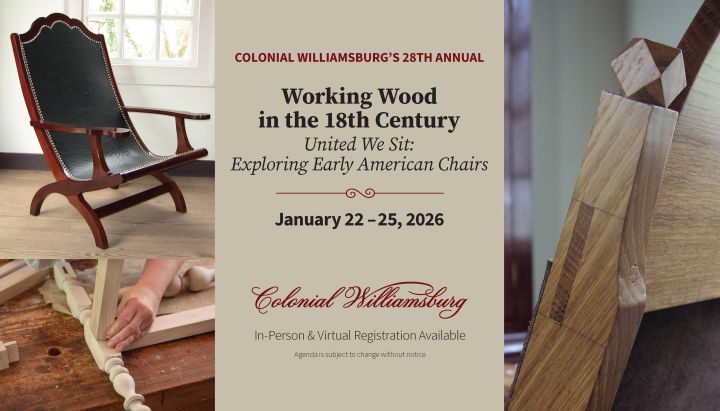
The Colonial Williamsburg Foundation will host its annual Working Wood in the 18th Century Conference January 22–25, 2026. Offered both virtually and in-person, this year’s conference, United We Sit: Exploring Early American Chairs, will center around six different chairs that spotlight a multitude of topics and techniques drawn from early America’s rich woodworking traditions. A limited number of in-person and virtual attendance scholarships are available to students and emerging professionals in relevant positions or programs.
Conference highlights include a presentation by esteemed chairmakers Elia Bizzarri and Curtis Buchanan on Windsor chairmaking techniques with a focus on hand-powered production rates and Elia’s research into early 19th-century Massachusetts chairmaker Samuel Wing. Celebrated cabinetmaker and carver Ray Journigan will demystify and recreate one of pre-Revolutionary Philadelphia’s rococo masterpieces, a heavily carved side chair made in Benjamin Randolph’s shop for the Cadwallader family. Historical interpreter and woodworker Jerome Bias will take us into the antebellum world of Thomas Day’s North Carolina shop where complex race relations intertwine with the collision of the handwork tradition and the coming machine age as he explores a curvaceous and veneered mahogany side chair. Scholar Daniel Ackermann, director of Bayou Bend Collection and Gardens, will deliver an opening keynote on a group of mid-18th-century Annapolis chairs.
From Colonial Williamsburg, master cabinetmaker Bill Pavlak will demonstrate the design and structure of Campeche chairs, a form with ancient roots that became fashionable on the east coast in the early 19th century by way of Mexico, New Orleans, and Thomas Jefferson’s Monticello. Master joiner Brian Weldy will explore a Boston baroque armchair with complex turnings, sculpted arms, and Russia leather upholstery. Conservator of upholstery Sarah Towers will walk attendees through the fundamentals of making a traditional slip seat. Apprentice joiner Laura Hollowood will demonstrate weaving a rush seat with traditional materials and senior curator of furniture Tara Chicirda will provide an overview of different period approaches to seats by showing off several examples from the Colonial Williamsburg collection. Journeyman cabinetmaker John Peeler will explore some of the planes and planecraft required for period chairmaking. Director of Historic Trades and Skills Ted Boscana will offer a banquet talk that pulls back the curtain on nine decades of Trades at Colonial Williamsburg to glimpse where we’ve been and where we’re headed.
The majority of conference activities will take place at the Art Museums of Colonial Williamsburg, located at 301 South Nassau Street. A variety of exclusive pre-conference activities are available for in-person registrants, as are special room rates at Colonial Williamsburg hotel properties. In-person registration is $400 per person through December 1 and includes presentations, opening reception, continental breakfasts on Friday, Saturday and Sunday, coffee and refreshment breaks, and a conference reception and dinner Saturday evening. Virtual-only registration is $150 per person and includes access to all presentations through the conference streaming platform. Both in-person and virtual-only registration include a seven-day ticket voucher to Colonial Williamsburg’s Art Museums and Historic Area, valid for redemption through December 31, 2026. Registration and payment in full are required by January 2 for in-person attendance and by January 22 for virtual attendance.
Details are available here»
Working Wood is sponsored by the Society of American Period Furniture Makers, Early American Industries Association, and Lie-Nielsen Toolworks, Inc.
Conference | Rethinking Carlo Maratti (1625–1713)
From ArtHist.net and KNIR:
Rethinking Carlo Maratti (1625–1713): Patronage, Practice, Reception
Royal Netherlands Institute, Rome, 20–21 November 2025
Organized by Giovan Battista Fidanza, Guendalina Serafinelli, and Laura Overpelt
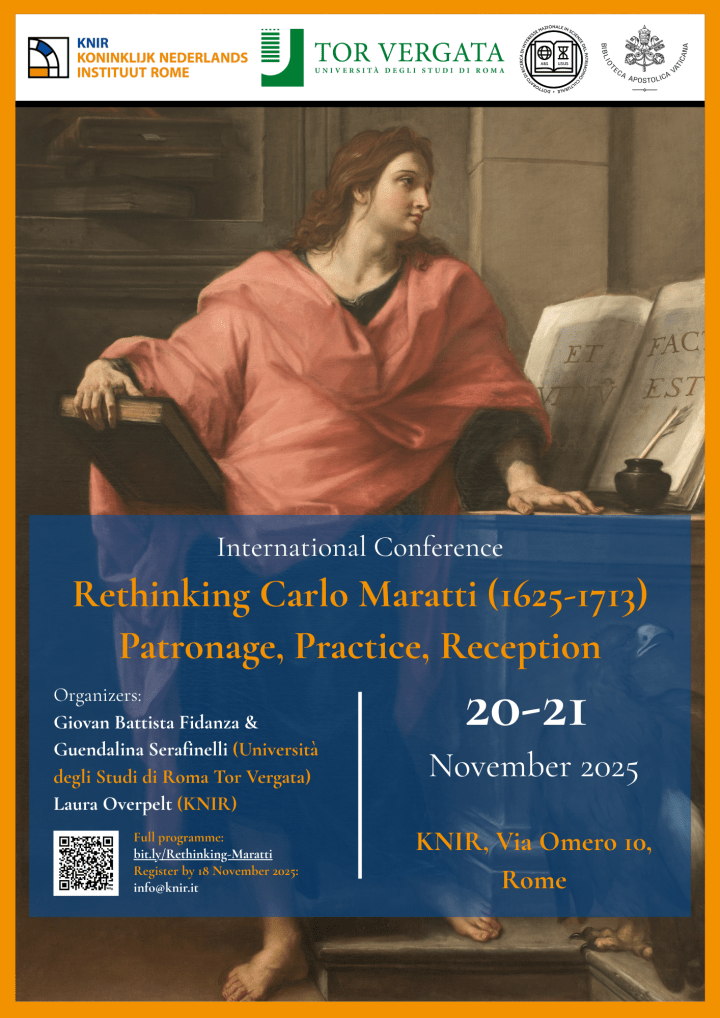 Carlo Maratti (1625–1713) stands as one of the most significant painters of late Baroque Rome—celebrated in his own time as the natural heir to Raphael and Carracci and the leading painter of the Eternal City. Maratti’s extraordinarily long and successful career linked the seventeenth and eighteenth centuries, shaping academic practice, taste, and artistic institutions well beyond his lifetime. His activity as painter, restorer, collector, ‘principe’ of the Academia di San Luca, and head of a large and international workshop placed him at the centre of Rome’s artistic and cultural networks.
Despite this prominence, Maratti’s reputation in art history has long oscillated between admiration and neglect. While traditional scholarship often portrayed him as the embodiment of academic classicism or as a symbol of stylistic decline after Bernini and Cortona, more recent research has begun to reassess the complexity of his artistic persona and his impact on the European art world. Yet, major questions remain regarding his patronage, his practices, his economic strategies, his workshop organisation, and his reception.
Marking the 400th anniversary of Carlo Maratti’s birth, this international conference seeks to offer a critical reassessment of the artist and his legacy. Bringing together established scholars and emerging researchers, it provides a forum for exploring new perspectives on Maratti’s art, practice, and influence. Special emphasis is placed on the study of unpublished archival materials, newly identified documents, and analytical approaches that shed light on the dynamics of patronage, artistic production, restoration, collecting, and reception.
The conference will take place in person at the Koninklijk Nederlands Instituut Rome (KNIR). Presentations will be given in English and Italian. A keynote lecture by Dr Arnold Witte (University of Amsterdam) will conclude the first day of the conference and can be attended remotely via Zoom. The conference is organized by Giovan Battista Fidanza and Guendalina Serafinelli (Università degli Studi di Roma Tor Vergata) and Laura Overpelt (Royal Netherlands Institute in Rome). It is supported by the Royal Netherlands Institute in Rome and the PhD Program of National Interest in Cultural Heritage at the Università degli Studi di Roma Tor Vergata, with the patronage of the Biblioteca Apostolica Vaticana.
In-person participation is free of charge, but places are limited. Please RSVP by 18 November 2025 by sending an email to info@knir.it. Kindly specify which part(s) of the conference you plan to attend, if not the entire programme. Zoom registration for the keynote lecture is available here.
t h u r s d a y , 2 0 n o v e m b e r
10.15 Welcome and Opening Remarks
• Susanna de Beer (Deputy Director of the Koninklijk Nederlands Instituut Rome); Lucia Ceci (Vice Chancellor for Communications and Head of the Dipartimento di Storia, Patrimonio culturale, Formazione e Società – Università degli Studi di Roma Tor Vergata); Tullia Iori (Vice Chancellor for Education – Università degli Studi di Roma Tor Vergata); Don Mauro Mantovani S.D.B. (Prefect of the Biblioteca Apostolica Vaticana)
• Introduction by Guendalina Serafinelli (Università degli Studi di Roma Tor Vergata) on behalf of the organizers
11.00 Session 1 | Barberini Patronage
Chair: Isabella Aurora (Biblioteca Apostolica Vaticana)
• Giovan Battista Fidanza (Università degli Studi di Roma Tor Vergata) — Carlo Maratti and His Workshop for Cardinal Carlo Barberini: Reconstructing the Significance of a Relationship
• Olga Arenga (Università degli Studi di Roma Tor Vergata) — Prince Maffeo Barberini and Carlo Maratti: New Documents in Microhistorical Perspective
• Sara Carbone (Università degli Studi di Roma Tor Vergata) — Francesco Reale in the Workshop of Carlo Maratti: Professional History in the Service of the Barberini Family
13.45 Session 2 | Transregional Patronage and Institutions
Chair: Loredana Lorizzo (Università degli Studi ‘G. d’Annunzio’ Chieti – Pescara)
• Andrea Spiriti (Università degli Studi dell’Insubria) — Maratti, the Omodei Family, and the Lombard National Church of SS. Ambrogio e Carlo al Corso in Rome: Problems and Reflections
• Laura Facchin (Università degli Studi dell’Insubria) — ‘Del signor Carlo Maratta, stimato da molti il primo che sia oggidì in quell’arte’: Reassessing the Master’s Relationship with Painting in the Savoy State
• Isabella Salvagni (Independent Scholar) — Carlo Maratti e l’ Accademia di San Luca
15.20 Session 3 | Reception and Historiography
Chair: Donatella Livia Sparti (Syracuse University)
• Guendalina Serafinelli (Università degli Studi di Roma Tor Vergata) — Niccolò Maria Pallavicini’s Ambition, the Cult of Carlo Maratti, and Bellori’s Legacy
• Laura Overpelt (Koninklijk Nederlands Instituut Rome) — A Netherlandish Perspective on Carlo Maratti: Hoogewerff and Beyond
17.00 Keynote available remotely via Zoom
Chair: Laura Overpelt (KNIR)
• Arnold A. Witte (Universiteit van Amsterdam) — Cardinals Commissioning Carlo Maratti: Shifts in Ecclesiastical Patronage around 1700
A recent biography of Maratti states that “at the turn of the century, political and economic factors caused official and aristocratic patronage to decline,” which reflects Francis Haskell’s more generic assumption of a general wane of the Roman artistic climate occurring around 1700. This keynote lecture will consider how this presumed downturn in ecclesiastical patronage in the late Seicento affected the artistic milieu in Rome and particularly how Maratti’s late career was determined by this shift.
f r i d a y , 2 1 n o v e m b e r
9.30 Session 4 | Maratti as Entrepreneur
Chair: Karin Wolfe (British School at Rome)
• Alessandro Agresti (Independent Scholar) — Nell’atelier di Carlo Maratti: Struttura, funzione e allestimento di una quadreria (con un inventario inedito del 1701)
• Adriano Amendola (Università degli Studi di Salerno) & Cristiano Giometti (Università degli Studi di Firenze) — Per un ampliamento dei committenti: Le finanze di Carlo Maratti
• Paolo Coen (Università degli Studi di Teramo) — Maratti and the Art Market: New Reflections
11.25 Session 5 | Restoration Practices
Chair: Maria Grazia D’Amelio (Università degli Studi di Roma Tor Vergata)
• Donatella Livia Sparti (Syracuse University) — The Restoration of the Loggia Farnesina Revisited (Without Bellori)
• Simona Rinaldi (Università degli Studi della Tuscia) — Materiali e tecniche nei restauri pittorici di Carlo Maratti
• Lotte van ter Toolen (Rijksuniversiteit Groningen) — From Restoring Reputations to Meddling with Memorials: Reflections on Carlo Maratti and the Pantheon
12.40 Concluding Remarks
Online Talk | Naming Rights: The Case of Mai/Omai from Polynesia
From YCBA:
Naming Rights: The Case of Mai/Omai from Polynesia
with Jessie Park, Catherine Roach, and Edward Town
Online and in-person, Yale Center for British Art, New Haven, Thursday, 13 November 2025, 12pm ET
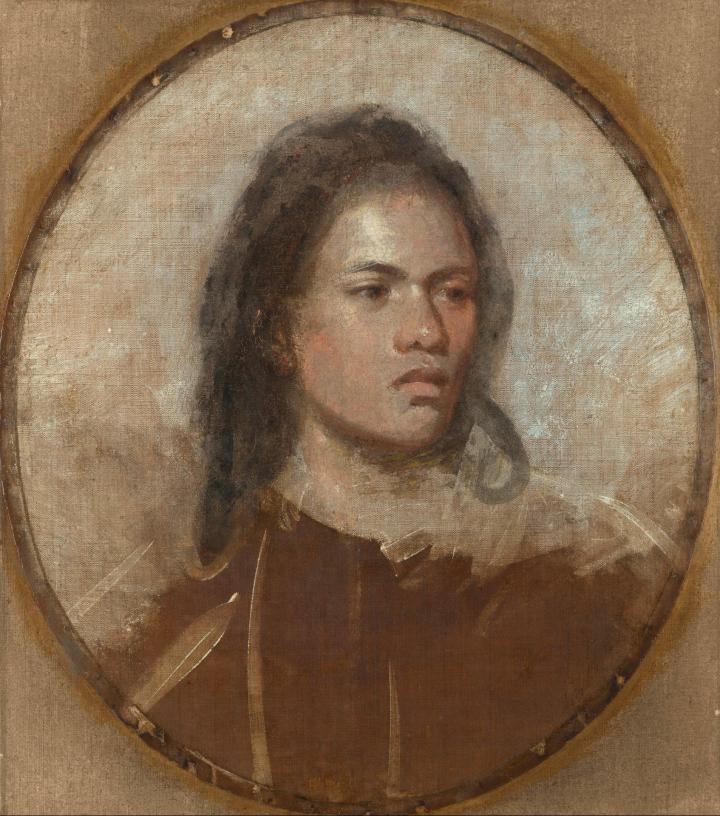
Sir Joshua Reynolds, Study for the Portrait of Mai (‘Omai’), ca. 1774, oil on canvas, 64 × 56 cm (New Haven: Yale University Art Gallery).
This event marks the return to public view of Sir Joshua Reynolds’s Study for the Portrait of Mai (‘Omai’), on loan from the Yale University Art Gallery. The first person from Polynesia to reach Britain, the sitter in Reynolds’s painting sought a military alliance and instead became a celebrity among Europeans, due in part to a public persona he crafted and enacted. The man now known as Mai bore many names over his lifetime. He came to fame in Britain as ‘Omai’ or ‘Omiah’, a British misunderstanding of a Tahitian honorific that he reportedly bestowed on himself. What should we call him, and his representations, today? Can this case study offer deeper insights into the ethics of naming pictures? And how might we thoughtfully narrate the stories of historical figures of color whose lives are known nearly exclusively through European visual and textual sources?
Join the livestream here»
Jessie Park is Nina and Lee Griggs Assistant Curator of European Art, YUAG. Catherine Roach is Graduate Program Director and Associate Professor of Art History in the School of the Arts, Virginia Commonwealth University. Edward Town is Assistant Curator of Paintings and Sculpture, YCBA.
Conference | Vico, Antiquity, and the Visual Arts
Starting today, from ArtHist.net and the conference programme:
Vico, l’Antiquité et les Arts Visuels
Online and in-person, Besançon, MSHE Ledoux, 3–4 November 2025
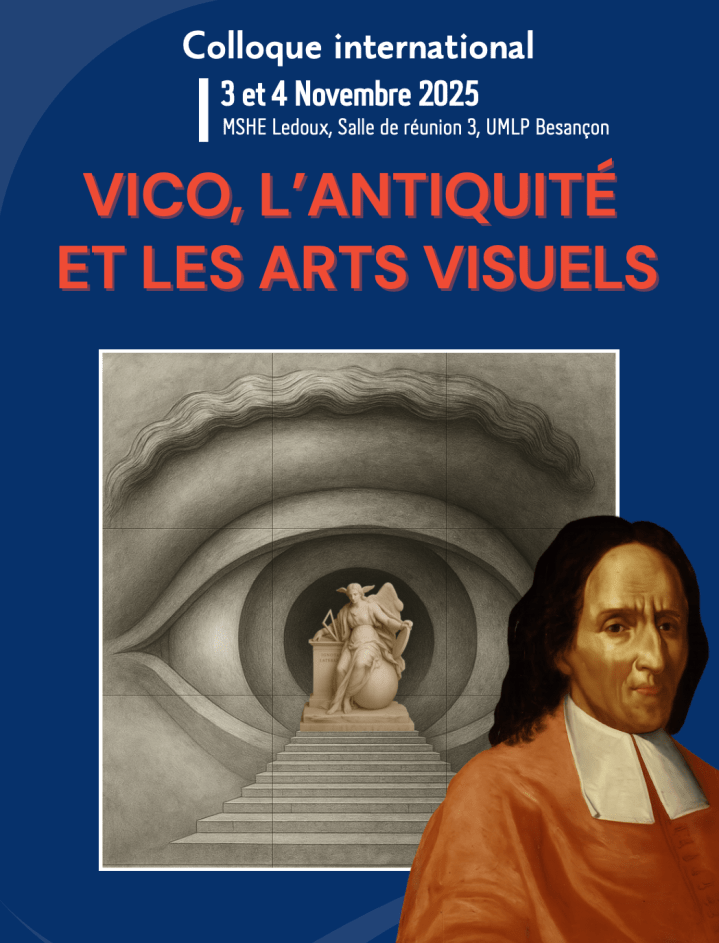 On the occasion of the tricentenary of the first edition of La Scienza Nuova (Naples, 1725), this international conference aims to analyze, in an innovative and interdisciplinary way, a central aspect of Giambattista Vico’s work: the importance he attributes to images and visual signs, which he considers the original language, historically prior to the development of spoken language. Although he rarely mentions the arts, Vico’s thought allows us to understand the visual artifact of ancient civilizations as an image-object (factum) that embodies the way in which humans perceive, experience, and interpret the world, thus constituting their reality (the historical verum).
The corpus of his ancient visual sources, as well as the influence of his thought on Antiquity and on the creative imagination of the first “universals of imagination” and “ornamental metaphors” within the disciplines of Visual Studies, have never been studied as such by specialists. The exploration of these themes raises numerous methodological challenges and requires a multidisciplinary approach. The three sessions will address theories and histories of art and collecting, literary theory, iconology, mythology, heraldry and emblem studies, the history and comparative study of law, architecture, archaeology, palaeography, anthropology, museology, semiotics, the geography of perception, as well as the psychology and sociology of art, extending to design and the pedagogy of the imagination. The symposium will be broadcast live.
Contact: anna_eleanor.signorini@umlp.fr
m o n d a y , 3 n o v e m b e r
Zoom link: https://us06web.zoom.us/j/85036141522?pwd=LJ4sv9sRfCIsrxMoSxTA1L9Oqlf2mG.1
9.00 Ouverture du colloque – Présentation par Anna E. Signorini
9.10 Session 1 | The Construction of Visual Knowledge from Antiquity to the Age of Vico
• Marcus Jan Bajema (Leyde) — Vico and the Longue Durée of Aegean Art (Vico et la longue durée de l’art égéen)
• Maurizio Harari (Université de Pavie) — Sul potente regno de’ toscani in Italia: architettura più antica, religione più tragica, arte militare più sapiente
• Italo Iasiello (Université de Naples Federico II) — Il contesto antiquario di Giambattista Vico: Napoli e l’Antichità nel primo Settecento
• Daniel Orrells (King’s College) — Vico and the Visual World of 18th-Century Antiquarianism
12.00 Déjeuner
14.30 Session 1 | The Construction of Visual Knowledge from Antiquity to the Age of Vico, continued
• Loredana Lorizzo (Université G. D’Annunzio de Chieti-Pescara) — Nella biblioteca di Giuseppe Valletta: Vico e la letteratura artistica
14.50 Session 2 | Semiotics, Law, Pedagogy, Design: Vico’s Iconic Thought
• Davide Luglio (Sorbonne) — La Scienza Nuova et la sémiotique figurale de G.B. Vico
• Osvaldo Sacchi (Université de la Campanie Luigi Vanvitelli) — Gli ‘universali fantastici’ di Vico e la ‘grande bellezza’ del diritto romano
• Donald Kunze (Pennsylvania State University) — Representing Nothing: Vico’s Induction and Inversion
• Marco Dallari (Bologne) — Disegno infantile e rappresentazione del mondo e di sè alla luce della théorie vichiana
• Oliver Reichenstein (Information Architects, Zurich) — (Inter)facing the Truth: Maker’s Knowledge in Human Centered Design
t u e s d a y , 4 n o v e m b e r
Zoom link: https://us06web.zoom.us/j/89987641547?pwd=r3qY5x1duD4qhYqIU77eMJCctqv2a3.1
9.00 Dora d’Auria (UMLP Besançon, ISTA) — La connaissance des antiquités du Cilento à l’époque de Vico
9.20 Session 3 | Modern and Contemporary Receptions of Vico in the Visual Arts and Visual Studies
• Silvia Davoli (Oxford et Strawberry Hill House, Londres) — Vico and Antiquarian Collecting in Milan during the 19th Century
• Paolo Heritier (Université de Turin) — Vico, les emblèmes et les Legal Visual Studies
• Frances S. Connelly (Université du Missouri-Kansas City) — Reimagining Culture: Vico’s Poetic Monsters in Contemporary Art
• Isabela Gaglianone (Université de São Paulo) — Vico et le regard philologique d’Aby Warburg
• Anna Eleanor Signorini (UMLP Besançon, ISTA) — Vico vu par les critiques d’art du XXe siècle
New Book | The People of Print: Eighteenth-Century England
From Cambridge UP, with an online book launch, together with a speed-pitching workshop, scheduled for Monday (see below) . . .
Adam James Smith, Rachel Stenner, and Kaley Kramer, eds., The People of Print: Eighteenth-Century England (Cambridge: Cambridge University Press, 2025), 124 pages, ISBN: 978-1009629454, $18.
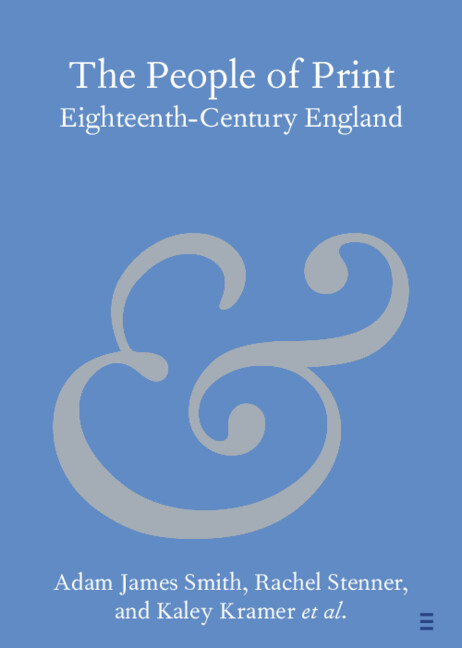 This collection profiles understudied figures in the book and print trades of the eighteenth century. With an explicit focus on intervening in the critical history of the trades, this volume profiles seven women and three men, emphasising the broad range of material, cultural, and ideological work these people undertook. It offers a biographical introduction to each figure, placing them in their social, professional, and institutional settings. The collection considers varied print trade roles including that of the printer, publisher, business-owner, and bookseller, as well as several specific trade networks and numerous textual forms. The biographies draw on extensive new archival research, with details of key sources for further study on each figure. Chronologically organised, this Element offers a primer both on individual figures and on the tribulations and innovations of the print trade in the century of national and print expansion.
c o n t e n t s
Preface
1 Introduction — Adam James Smith, Rachel Stenner, and Kaley Kramer
2 Elizabeth Nutt: Print Trade Matriarch (1666–1746) — Helen Williams
3 John Nicholson and the Auctioning of Copyright (d.1717) — Jacob Baxter
4 Catherine Sanger: Publisher in Bartholomew Close (1687–1716) — Kate Ozment
5 John White Junior: Printer in the North (1689–1769) — Sarah Griffin
6 Selling the Enlightenment: Mary Cooper and Print Culture (1707–1761) — Lisa Maruca
7 The ‘Indefatigable’ Ann Ward: Printer in York (1715/6–1789) — Kaley Kramer
8 Anne Fisher (1719–1778): Not Simply a Printer’s Wife — Barbara Crosbie
9 Sold at the Vestry: John Rippon (1751–1836) and the Hymnbook Trade — Dominic Bridge
10 Diversity in the Book Trades: Ann Ireland (1751–1843) of Leicester — John Hinks
11 ‘Laugh when you must, be candid when you can’: The Concealed Resistance of the Radical Printer Winifred Gales (1761–1839) — Adam James Smith
◊ ◊ ◊ ◊ ◊
From Eventbrite:
The People of Print: Eighteenth-Century England
Book Launch and Early Career Researcher Speed-pitching Workshop
Online, Monday, 3 November, 6.30pm GMT
All welcome! Please register by 2 November.
Join the Centre for Print Culture at the University of Sussex to celebrate the publication of this volume, the follow-on to The People of Print: Seventeenth-Century England, with an evening of lively talks and discussion. The People of Print: Eighteenth-Century England profiles understudied figures in the book and print trades, featuring new research and critical perspectives on this fascinating and rich cultural field. We will be joined by Dr Barbara Crosbie (Durham University), Dr Jacob Baxter (St Andrews), and Dr Lisa Maruca (Wayne State, Professor Emerita), who will discuss their research for the latest collection.
Following the launch, there will be a Speed-pitching workshop (7.30–8.15pm GMT) for early career researchers studying topics in the histories of the book, print, and publishing trades. Come with an idea you can explain in 3 minutes, and we will pair you with one of our publishing panel of journal, series, and book editors for feedback:
• Dr Helen Williams, The Printing Historical Society
• Dr Kaley Kramer and Dr Adam James Smith, editors The People of Print
• Professor Samantha Rayner, Commissioning Editor of Cambridge Elements, Publishing and Book Culture
• Dr Rachel Stenner, editor of Publishing History journal and The People of Print series
Journée d’études | Sculpture in Franche-Comté, 15th–20th Centuries
From ArtHist.net:
Actualité de la sculpture en Franche-Comté:
Circulations, Pratiques et Conservation, XVe–XXe siècle
Online and in-person, Université Marie et Louis Pasteur, Besançon, 4 November 2025
Organized by Hélène Zanin
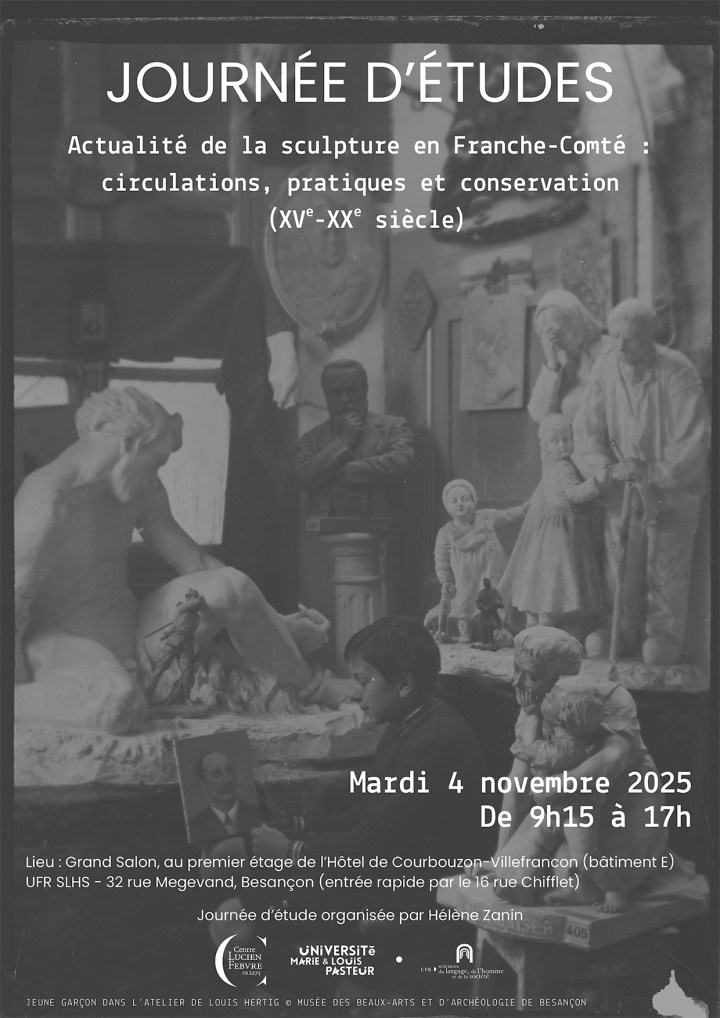 Inscription et lien de visioconférence disponible sur demande: helene.zanin@umlp.fr
9.15 Introduction, Hélène Zanin (Université Marie et Louis Pasteur / Centre Lucien Febvre)
9.30 Actualité de la sculpture des XVe et XVIe siècles
Modération: Sandra Bazin-Henry (Université Marie et Louis Pasteur / Centre Lucien Febvre)
• Matthieu Fantoni (musée Fabre), en visioconférence — Retour d’expérience sur la restauration de La Pietà de Conrad Meit à la cathédrale de Besançon, 2019–23
• Thomas Flum (Université Marie et Louis Pasteur / Centre Lucien Febvre) — La Pietà de Conrad Meit et l’originalité du choix iconographique
• Lola Fondbertasse (musées de Dijon) — Quelques réflexions sur la sculpture bourguignonne du XVe siècle: Le projet d’exposition du musée des Beaux-Arts de Dijon
11.00 Pause
11.15 Sculptures et monuments des XIXe et XXe siècles: études et protection
Modération: Sara Vitacca (Université Marie et Louis Pasteur / Centre Lucien Febvre)
• Justine Vigneres (DRAC Bourgogne-Franche-Comté) et Michaël Vottero (DRAC Bourgogne-Franche-Comté), en visioconférence — Découvertes et protections récentes au titre des monuments historiques de sculptures du XIXe siècle en Bourgogne-Franche-Comté
• Charlotte Leblanc (DRAC Occitanie), en visioconférence — La protection des statuaires monumentales de Belfort: étude du groupe Quand Même d’Antonin Mercié
12.45 Pause déjeuner
14.15 Sociabilités, circulation et carrière des artistes
Modération: Claire Maingon (université Bourgogne-Europe / LIR3S)
• Virginie Guffroy (musée du Louvre) — Les réseaux de sociabilités d’un sculpteur bisontin, l’exemple de Luc Breton (1731–1800)
• Grégoire Extermann (Haute école spécialisée de la Suisse Italienne – SUPSI / Fonds National Suisse pour la recherche scientifique) — Nul n’est prophète en son pays: James Pradier et la sculpture à Genève au XIXe siècle
15.20 Pause
15.30 Œuvres multiples et leurs usages
Modération: Hélène Zanin (Université Marie et Louis Pasteur / Centre Lucien Febvre)
• Emy Faivre (Université Marie et Louis Pasteur / ISTA) — Modèles pour apprendre: Circulation et réception des plâtres dans les écoles d’art de Franche-Comté, XIXe–XXIe siècles
• Virginie Frelin-Cartigny (Musée des Beaux-Arts et d’Archéologie de Besançon) — Louis Hertig: Découverte de l’œuvre d’un sculpteur à travers la photographie
Fin de la journée vers 17h
Conference | The Image of the Black Archive: Past, Present and Future
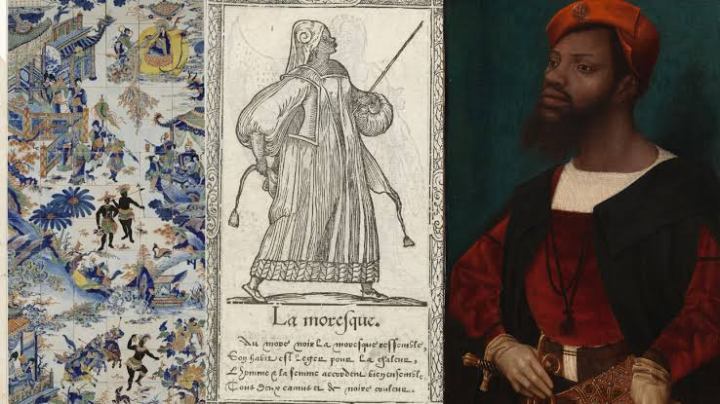
Anonymous (Delft), Tile panel with a Chinese landscape, ca. 1700; François Desprez, Illustration from Recueil de la diversité des habits‘, 1562; Jan Jansz Mostaert, Portrait of an African Man (Christophle le More?), 1525–30 (Rijksmuseum, Amsterdam).
◊ ◊ ◊ ◊ ◊
From The Warburg Institute:
The Image of the Black Archive: Past, Present, and Future
Online and in-person, The Warburg Institute, University of London, 7–8 November 2025
Organized by Hannah Lee and Maria Golovteeva
In 1960, Franco-American art collectors and philanthropists Jean and Dominique de Ménil initiated the Image of the Black archive. Originally begun in Paris and then expanded with an office in Houston, the research project was a response to the 1960s Civil Rights movement in the US. This two-day international conference brings together scholars who have contributed to the project over its history and those producing new research on the historic representation of African people in European and American art and culture. Attendance (online or in-person) is free with advance booking, though places are limited.
Keynote Speaker
Dr Adrienne L. Childs is an independent scholar, art historian, and curator. She is Senior Consulting Curator at The Phillips Collection. Her current book is an exploration of Black figures in European decorative arts entitled Ornamental Blackness: The Black Figure in European Decorative Arts, published by Yale University Press in 2025.
This conference is organised with the generous support of the Henry Moore Foundation, the Society for Renaissance Studies, and the Association for Art History.
f r i d a y , 7 n o v e m b e r
9.00 Registration
9.30 Opening Remarks
9.45 Panel 1
• Joaneath Spicer (Walters Art Museum), Balthazar, One of the Three Kings > Portrait: Prince Aniaba of Assinie as Balthazar, 1700
• Adam Sammut (University of York), Painted Black: Rubens’s ‘Mulay Ahmad’ after Jan Cornelisz. Vermeyen
• Edward Town (Yale Center for British Art), Framing the Black Presence in British Art: Research, Curation, and the Limits of the Archive
11.05 Tea and coffee break
11.30 Panel 2
• Najee Olya (William & Mary), The Contradictions of the Anthropological Gallery: Frank M. Snowden, Jr.’s Ethiopians and the Image of the Black in Western Art
• Jaqueline Lombard (University of New Hampshire), Coins on the Cutting Room Floor: Twelfth-Century Images of Saint Maurice in the Image of the Black Archives
• Paul Kaplan (Purchase College, SUNY), First Fruits
12.50 Lunch break
13.50 Panel 3
• Michael I. Ohajuru (Institute of Commonwealth Studies), The John Blanke Project: Artists and Historians Reimagine the Black Trumpeter to Henry VII and Henry VIII
• Sarah Thomas (Birkbeck), Facing the Inventory: WY Ottley and the Archive of Enslavement
• Nanfuka Joan Kizito (Makerere University), Decolonising the Archive: An Africanised Reflection on the History of the ‘Image of the Black in Western Art’ Project
15.10 Panel 4
• Isabel Raabe (Talking Objects) and Doreen Mende (Staatliche Kunstsammlung Dresden), Plural Histories of Networked Knowledge: Cross-Collections Research at the Staatliche Kunstsammlungen Dresden
• Sarah Okpokam (National Portrait Gallery), TBC
16.10 Tea and coffee break
16.30 David Bindman: In Memoriam
Drinks Reception
s a t u r d a y , 8 n o v e m b e r
9.30 Registration
10.00 Keynote
• Adrienne L. Childs, The Ornamentality of Blackness
11.00 Tea and coffee break
11.30 Panel 5
• Jacopo Gnisci (UCL), European Perceptions of Ethiopia’s Material Past in the Renaissance
• Patricia Simons (University of Michigan Ann Arbor \ University of Melbourne), Heat and Wind: Renaissance Representations of Black Men in Material Culture
• Riccardo Tonin (Ca’ Foscari University of Venice), Musi da porton: The Image of the Black on the Doors of Venice
12:50 Lunch break
13:50 Panel 6
• Amber Burbidge (European University Institute), Blackness and Bathing: The ‘Black Venus’ in the Image of the Black Archive
• Denva Gallant (Rice University), Afterlives of the Black Body: Dismemberment and the Black body in Matteo di Pacino’s Miracle of the Leg
• Nancy Ba (Sorbonne Université), Ethnographic Sculpture as Visual Archive? The Politics of Flesh, Complexion, and Scientific Image-Making in the Colonial Context, 1859-1931
15.10 Panel 7
• Borja Franco Llopis (Universidad Nacional de Educación a Distancia), Misconceptions and Silences: Black Representation and Slavery in Iberian Art
• Ekaterini Kepetzis (Rheinland-Pfälzische Technische Universität, Landau), ‘Only a lodger, and hardly that’: The Representation of Blacks on Eighteenth-Century English Trade Cards
• C.C. McKee (Bryn Mawr), Forms of Blackness from Fireburn to Sale: Painting Labor, Race, and the Environment in the Post-Emancipation Danish West Indies
16.30 Closing Remarks
Online Talks | Finding Moses Williams
Upcoming from The Library Company of Philadelphia:
Finding Moses Williams
Online, Wednesday, 19 November 2025, 1.00–3.30
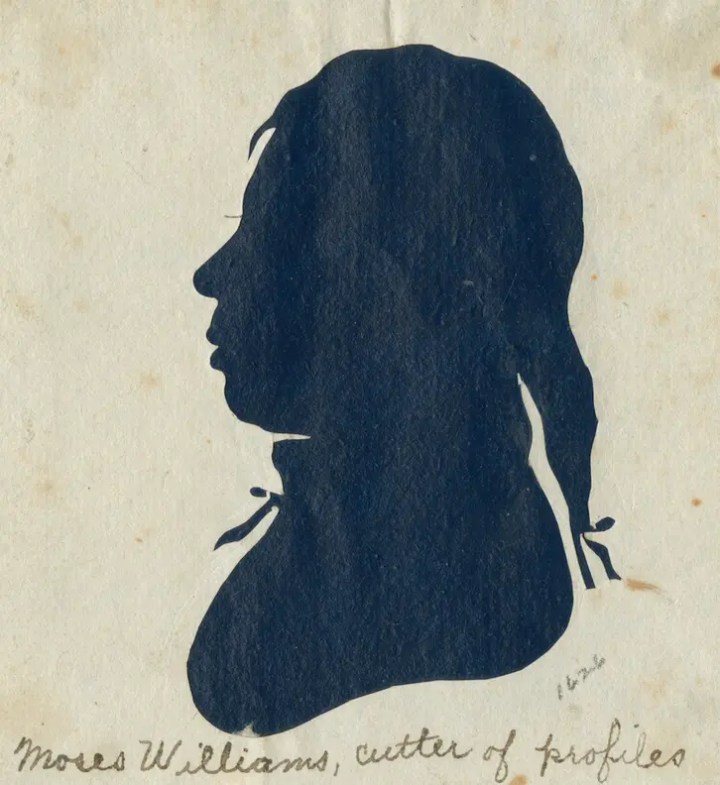
Silhouette of Moses Williams, perhaps by Raphaelle Peale or by Williams himself, after 1802, 9 × 8 cm (Library Company of Philadelphia).
This program of illustrated talks by five speakers will focus on the identification of the exceptional hollow-cut paper profiles created by Moses Williams (1776–1830) at Peale’s Philadelphia Museum and on presenting new historically accurate information about Williams’s life and family. Moses’s parents were manumitted by Peale in 1786 and Moses, who was born enslaved, was then indentured to Peale by his parents until age twenty-eight
Raised within the Peale family, Moses was literate and trained in skills for creating and installing the Museum’s displays of art and natural science. After the installation of a physiognotrace device for creating hollow-cut paper profiles in 1802, Moses was freed and given the concession to operate this new attraction. The popularity of this inexpensive form of portraiture and the highly accurate and elegant profiles Moses cut, made him financially independent.
Recent research into Moses’s life provides us with a clearer understanding of his artistry and other activities, as well as his death date and the identity of his descendants. And, the story of Williams’s birth family illuminates how the practice of indenture used by Free Black families, like the Williams family, was a strategy for seeking financial stability.
A small selection of Moses Williams’s profiles will be on display at the Library Company during November and December and in the Peale Gallery at the Philadelphia Museum of Art. The program is sponsored by the Library Company of Philadelphia’s Program in African American History and the Center for American Art at the Philadelphia Museum of Art.
Registration for this free virtual event is available here»
p r e s e n t a t i o n s
1.00 Welcome — Sarah Weatherwax (Senior Curator of Graphic Arts, The Library Company of Philadelphia)
1.05 Introduction to LCP’s Program in African American History — Wynn Eakins (Reference Librarian and African American History Subject Specialist, The Library Company of Philadelphia)
1.10 Finding Moses in the Peale-Sellers Family Album — Carol Soltis (Project Associate Curator, Philadelphia Museum of Art)
1.35 Presenting Moses at The Peale, Baltimore’s Community Museum — Nancy Proctor (Re-founding Director of The Peale)
2.00 ‘Not Yet Completely Free,’ Moses and His Family in the Context of the Gradual Manumission Act — Ellen Fernandez Sacco (Genealogist and Independent Scholar)
2.25 Locating Moses William in Philadelphia: New Information about Moses Williams’s Life and Death Based on a Re-examination of Philadelphia’s Primary Sources — Dean Krimmel (Creative Museum Services, Research Consultant to The Peale)
2.50 Moses Williams, A Technical View — Lauren Muney (Silhouette Artist and Researcher)
3.15 Final Q&A
Conference | 18th-C. Painting between Italy and the Hapsburg Empire
From the Department of Art History at the Universität Wien:
Settecento Malerei: Cultural Transfer between Italy and the Habsburg Territories
Online and in-person, Department of Art History of the University of Vienna, 23–24 October 2025
Organized by Eleonora Gaudieri and Erika Meneghini
Registration due by 19 October 2025
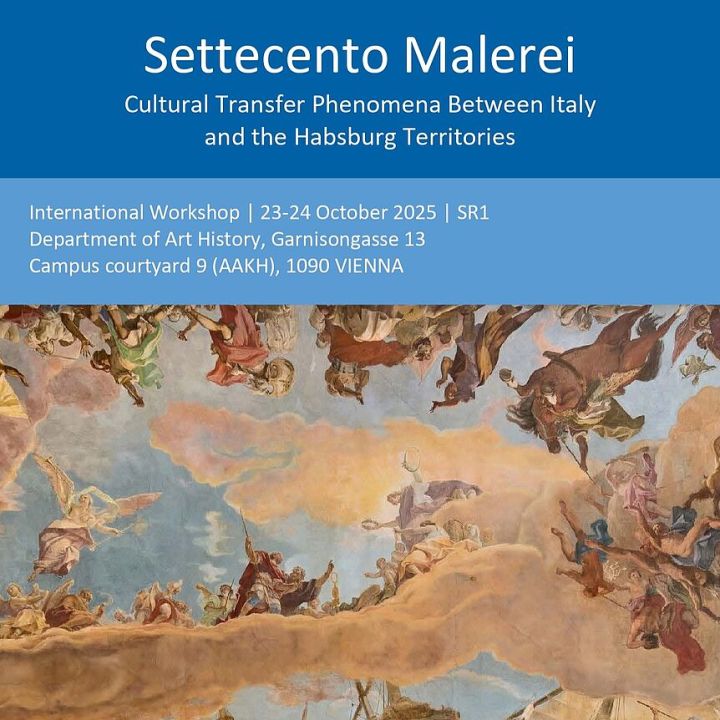 The beginning of the Settecento was characterised by a considerable expansion of the transalpine art market, driven by a strong interest in collecting Italian artworks. This phenomenon attracted numerous Italian artists, including many painters, to Vienna and its allies, the courts of the German prince-electors of Schönborn, Wittelsbach and others. At the same time, a number of Austrian painters were encouraged to further their training in Italy, where they were profoundly influenced by the local visual language. The high quality and renowned tradition of Italian painting, fostered by a dense network of international connections, enabled numerous artists of Italian origin, as well as Italians by adoption, to pursue successful careers at the Habsburg imperial court in Vienna. This phenomenon must be understood within the broader context of the diplomatic and artistic networks that connected Vienna with key centres on the Italian peninsula, such as Venice, Bologna, Rome, and Naples.
The two-day workshop will provide a wide-ranging exploration of 18th-century Italian painting as a focal point for transfer phenomena between the Italian peninsula and the domains of the Habsburg Empire, with a special focus on Vienna as the imperial capital. The proceedings will open with the keynote speech by Cecilia Mazzetti di Pietralata. The subsequent sixteen presentations have been organised into four sections, reflecting the variety of perspectives through which these historical and artistic phenomena can be approached: Collecting Italian Painting in the Habsburg Empire; Artworks and Material Objects as Vehicles of Cultural Transfer; Artists as Transregional Agents Between Italy and the Habsburg Regions; and The Role of Academies and Museums in the Transfer of Knowledge. The objective of this study day is on one hand to examine the meanings and functions of Italian painting within the socio-political and cultural context of the Habsburg imperial court in Vienna and its allied courts; and on the other hand, to explore the various dynamics that fostered the transfer of Italian painting and Italian artistic knowledge to Vienna and the territories of the then Habsburg Empire.
The conference languages are English, German, and Italian. A livestream of the event will be available. Please confirm your attendance in-person or online via email to settecentomalerei@gmail.com by 19 October. If you have any questions, please contact the organisers: Eleonora Gaudieri and Erika Meneghini.
Dr. Eleonora Gaudieri, eleonora.gaudieri@univie.ac.at
Postdoctoral Researcher (APART-GSK funding programme, ÖAW)
Department of Art History, University of Vienna
Erika Meneghini MA, erika.meneghini@univie.ac.at
PhD Candidate
Department of Art History, University of Vienna
The workshop is supported by the Department of Art History and the Vienna Center for the History of Collecting at the University of Vienna. Funding is provided by the Faculty of Historical and Cultural Studies at the University of Vienna, the City of Vienna, and the Austrian Academy of Sciences.
t h u r s d a y , 2 3 o c t o b e r
9.00 Welcome
9.30 Keynote
• Cecilia Mazzetti di Pietralata (University of Cassino and Southern Lazio) — Vienna italiana: Forme e attori dello scambio culturale tra Sei e Settecento, tra immigrazione artistica e vocazione internazionale dell’aristocrazia europea
10.30 Coffee Break
10.50 Section 1 | Collecting Italian Painting in the Habsburg Empire
Moderator: Silvia Tammaro
• Stefan Albl (Schloss Eggenberg & Alte Galerie, Graz) — Il dilemma della scelta: L’arrotino di Giacomo Francesco Cipper
• Ilaria Telesca (University of Naples ‘Federico II’) — Arte e potere: La committenza artistica dei viceré austriaci di Napoli
• Jiří Štefaňák (Masaryk University, Brno) — Non multa, sed multum: Italian Painting in the Collections of the Moravian Aristocracy at the End of the 18th Century
12.30 Lunch Break
14.00 Section 2 | Artworks and Materials Objects as Vehicles of Culture Transfer
Moderator: Eleonora Gaudieri
• Ada Berktay (Sakıp Sabancı Museum, Istanbul) — Lepanto as Material Allegory: Naval Triumph and the Politics of Display in Italian and Habsburg Visual Culture
• Tomáš Kowalski (Monuments Board of the Slovak Republic, Bratislava) — Baroque Illusion: Italian Settecento Frescoes in Slovakia
• Beatrice Bolandrini (Università e-Campus; Accademia del Lusso, Milan) — Anton Giorgio Clerici ed Annibale Visconti, ‘consiglieri intimi’ di Carlo VI e Maria Teresa, committenti di Giambattista Tiepolo e Mattia Bortoloni
• Tomáš Valeš (Masaryk University, Brno) — Shared, ‘Recycled’, Reinvented: Art of Venetian Settecento in the Hands of ‘Viennese’ 18th-Century Painters
• Erika Meneghini (University of Vienna) — From Naples to Vienna and the Habsburg Lands: The Artistic Reception of Francesco Solimena’s Oeuvre beyond the Alps
19.00 Conference Dinner
f r i d a y , 2 4 o c t o b e r
9.00 Section 3 | Artists and Transregional Agents between Italy and the Habsburg Regions
Moderator: Erika Meneghini
• Francesco Ceretti (University of Pavia) — Pietro Bellotti: Da Venezia alle corti mitteleuropee
• Eleonora Gaudieri (University of Vienna) — Daniele Antonio Bertoli: Traces of his Activity at the Habsburg Court in Vienna
• Enrico Lucchese (University of Campania ‘Luigi Vanvitelli’) — I soggiorni viennesi e nei territori asburgici di Antonio Pellegrini (1675–1741)
• Sanja Cvetnić (University of Zagreb) — Federico Bencovich as Transregional Artist
• Laura Facchin (University of Insubria, Varese) — Angelica Kauffmann: Painter of the Habsburg Court from Milan to Vienna
12.00 Lunch Break
13.30 Section 4 | The Role of Academies and Museums in the Transfer of Knowledge
Moderator: Stefan Albl
• Susanne Müller-Bechtel (University of Würzburg) — Figur–Pose–Wissen: Das akademische Aktstudium als epistemische Kunstpraxis in Rom, Wien und Mailand
• Lorenzo Giammattei (Sapienza University of Rome) — The Antique in the Drawings of Austrian Artists in Rome in the Second Half of the 18th Century
• Paolo Pastres (Independent Researcher, Udine) — Vienna e Firenze nel Settecento: Due modelli museali a confronto
15.00 Coffee Break
15.20 Final Discussion
16.45 Optional visit to the Schönbrunn Chapel and the Blue Staircase
Poster Image: Sebastiano Ricci, Allegory of the Princely Virtues, Blue Staircase, Schönbrunn Palace, 1702 (Vienna).
Cambridge Material Culture Workshop Fall 2025
This fall’s Material Culture Pre-1850 Workshop schedule:
Cambridge Material Culture Workshop
Michaelmas 2025
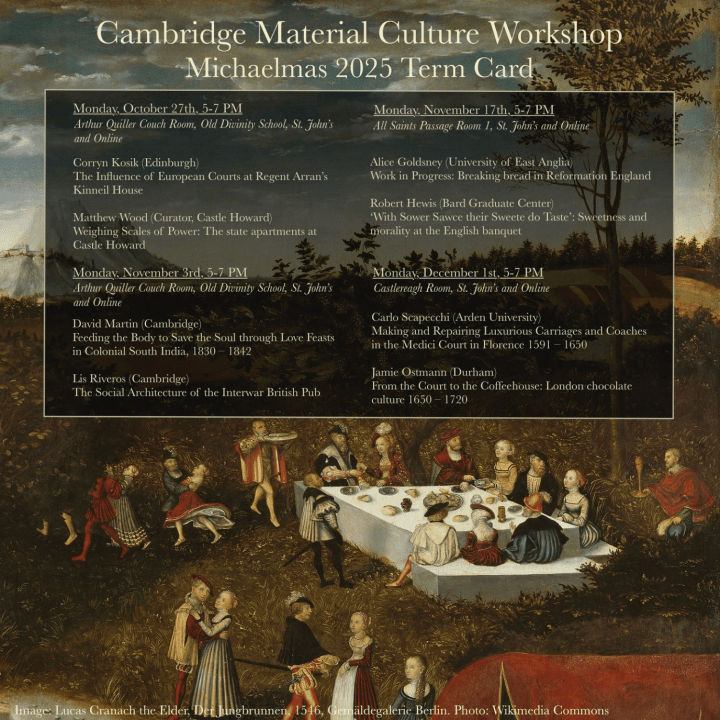 We’re excited to announce the term card for Michaelmas 2025. Each of the four sessions will meet online and in-person at St. John’s, Cambridge, starting at 5pm. For more information, please contact Tomas Brown (tbnb2@cam.ac.uk) or Sophia Feist (stcf2@cam.ac.uk).
27 October
• Corryn Kosik (Edinburgh), The Influence of European Courts at Regent Arran’s Kinneil House
• Matthew Wood (Curator, Castle Howard), Weighing Scales of Power: The State Apartments at Castle Howard
3 November
• David Martin (Cambridge), Feeding the Body to Save the Soul: Love Feasts in Colonial South India, 1830–1842
• Lis Riveros (Cambridge), The Social Architecture of the Interwar English Pub
17 November
• Alice Goldsney (University of East Anglia), Work in Progress: Breaking Bread in Reformation England
• Robert Hewis (Bard Graduate Center), ‘With Sower Sawce their Sweete do Taste’: Sweetness and Morality at the English Banquet
1 December
• Carlo Scapecchi (Arden University), Making and Repairing Luxurious Carriages and Coaches in the Medici Court in Florence, 1591–1650
• Jamie Ostmann (Durham), From the Court to the Coffeehouse: London Chocolate Culture, 1650–1720










 Enfilade
leave a comment