Online Workshop | Antiquitatum Thesaurus
From the BBAW:
Antiquitatum Thesaurus: Antiken in den Wissensspeichern der Frühen Neuzeit und heute
Online, Berlin-Brandenburgische Akademie der Wissenschaften, 10 November 2021, 8pm
Registration due by 9 November 2021
Please join us for the inaugural online event of the Antiquitatum Thesaurus project, a long-term project initiated at the beginning of 2021 at the Berlin-Brandenburg Academy of Sciences and Humanities and devoted to documenting the tradition of antique material culture in visual sources from the 17th and 18th centuries. Under the direction of Elisabeth Décultot, Arnold Nesselrath, and Ulrich Pfisterer, the project aims to study a large corpus of diverse source material ranging from printed books to drawing collections and culminating in Bernard de Montfaucon’s L’Antiquités expliquée et représentée en figures in order to contribute to our understanding of the early modern views of the remains of Antiquity throughout Europe and the Mediterranean by identifying and cataloguing objects that—beyond ancient literary texts—served as reference points for antiquarians. All the information gathered in the process will be stored in a digital research platform that will illustrate and visualize the complex relationships between objects, sources, places, and people over time.
Register here»
P R O G R A M M
Grußworte
• Christoph Markschies (Akademiepräsident)
• Tonio Sebastian Richter (Sprecher des Zentrums Grundlagenforschung Alte Welt Akademiemitglied, Freie Universität Berlin)
Der Antiquitatum Thesaurus
• Elisabeth Décultot (Projektleitung, Martin-Luther-Universität Halle-Wittenberg)
• Arnold Nesselrath (Projektleitung, Rom / Berlin)
• Ulrich Pfisterer (Projektleitung, Ludwig-Maximilians-Universität München Zentralinstitut für Kunstgeschichte)
Investigating Cassiano dal Pozzo’s ‘Paper Museum’: Lights and Shadows
• Eloisa Dodero (Musei Capitolini, Rom)
Thesauri antiquitatum: storie e sfide
• Elena Vaiani (Pisa)
Paris–Province (XVIIIe–XIXe siècle): à chacun son Antiquité?
• Véronique Krings (Université de Toulouse – Jean Jaurès)
Antiquitatum Thesaurus – Fallstudie und digitale Strategie
• Cristina Ruggero (BBAW)
• Timo Strauch (BBAW)
Online Symposium | Hidden Hands: Untold Stories of the Object

Plate 419, Silver-plating in L’Enclopédie, ou Dictionnaire Raisonné des Sciences, des Arts et des Métiers by Denis Diderot.
◊ ◊ ◊ ◊ ◊
From the MFAH:
Hidden Hands: Untold Stories of the Object
Rienzi Biennial Symposium
Online, Rienzi, The Museum of Fine Arts, Houston, 6 November 2021
Geographic exploration and colonial expansion led to the introduction of new materials and technological innovation in the early modern period. These developments created an increased demand for goods made of ceramics, glass, exotic woods, textiles, and metals. The refining of raw materials and the production of these goods depended upon a diverse labor force made up of men, women, and children from across the globe. Despite the integral roles played by these workers in all of these varied enterprises, their names and contributions have often been lost to history. Who were these people? How did they interact and engage with these new materials and goods? What social, political, and economic forces contributed to the exclusion of their narratives? The symposium invites scholars to reconsider established ideas of craftsmanship and artistic authorship through the telling of these ‘hidden’ stories.
The symposium will be held in conjunction with the exhibition Hidden Hands: Invisible Workers in Industrial England, on view at Rienzi from 1 September 2021 to 3 January 2022.
Registration for the symposium is available here»
P R O G R A M M E
10.00 Session 1: Industry and Craft
• Misty Flores (Assistant Curator, Rienzi), Hidden Hands: Invisible Workers in Industrial England
• Javier Fernández Vázquez (PhD Candidate, Universidad Autónoma de Madrid), All the Names: Recovering the Ignored Authorship of Metal-Casting Patterns
• Daichi Shigemoto (PhD Student, The University of Texas at Austin), Hidden Hands for Frank Lloyd Wright’s Imperial Hotel in Tokyo
• Q&A
11.10 Break
11.40 Session 2: Cultural Exchanges in the Americas
• Alfredo A. Ortega-Ordaz (Conservator, National Museum of Anthropology, Mexico City), Lightweight Sculpting: About Admiration and Exclusion
• Marco Díaz-Güemez (Research Professor, Escuela Superior de Artes de Yucatán), The Yucatan Hammock as a Product of Mayan Women: Tradition, Adaptation, and Resistance
• Philippe Halbert (PhD Candidate, Yale University), A Toilette in Their Fashion: Indigenizing the Dressing Table in the French Atlantic World
• Q&A
12.55 Break
1.05 Session 3: Movement of People and Ideas
• Lindsay Alberts (Professor, SCAD), Mustafa di Ramadano: Slavery Hidden in the Hardstones of the Cappella dei Principi
• Jordan Smith (Assistant Professor, Widener University), The Caribbean Origins of European Craftsmanship: A Case Study in Rum
• Bindy Barclay (Freelance Writer and Researcher), Unraveling Cook’s Voyage: Repopulating the Colonial Exotic
• Q&A
Online Course | British Furniture Making, 1660–1914

State Bed from Hampton Court Castle, ca. 1698 (New York: The Metropolitian Museum of Art, 68.217.1a), as installed in The Met’s newly renovated British Galleries. Photo by Coscia Joseph. As noted in the museum’s online entry: “In the style of Daniel Marot, this bed was made for Thomas, Baron Coningsby (1656–1729), for Hampton Court, Herefordshire, where it remained until 1925. The curtains, counterpane, headcloth, and some of the trims are modern copies of the originals.”
◊ ◊ ◊ ◊ ◊
From ArtHist.net:
Skill, Style, and Innovation:
British Furniture Making from the Restoration to the Arts and Crafts Movement
Online, The Furniture History Society, Wednesdays, 3 November — 1 December 2021
The Furniture History Society, UK, is organising a short course on British furniture makers from 3rd November to 1st December as part of its outreach and educational programme, for British and Irish Furniture Makers Online (BIFMO). Each week three speakers will consider the history of furniture makers and making in Britain. Beginning with the Baroque period, the course will move chronologically through the centuries to conclude in December with the Arts and Crafts movement. In addition to dealing with the output of specific furniture makers, this course aims to provide an integrated account of the furniture trade in the context of the cultural, technical, and industrial developments that occurred in Britain during these three and a half centuries, while also acknowledging other significant factors such as the role of the patron and the involvement of artists and designers. The talks bring to life the careers and work of some of the most important makers of their time—including Gerrit Jensen in the late seventeenth century; Giles Grendey, William Vile, Thomas Chippendale, and John Linnell in the eighteenth century; Thomas Hope, J. C. Crace, and Charles Robert Ashbee in the nineteenth century; as well as less well-known makers, firms of furniture makers, designers, and architects.
Tickets can be purchased for individual weeks or for the entire course at a saving. To purchase tickets, please go to the EventBrite page. This course will be recorded, and the link to the recording will be sent to ticket holders after the event, though please note that Max Donnelly will not be recorded. We are grateful to the Paul Mellon Centre and the Foyle Foundation for their support.
The course runs from 4.00 to 7.30pm (GMT) every Wednesday as follows:
Week 1 | November 3 — British Baroque Furniture, 1660–1715
• Wolf Burchard (Associate Curator, Metropolitan Museum of Art), British Baroque Furniture and Furniture Makers
• Amy Lim (Oxford University), The Baroque Interior: Furnishing the Great London and Country Houses
• John Cross (Furniture historian and maker, specialist on the Jamaican furniture trade), The London Trade, ca. 1660–1720
Week 2 | November 10 — The Early Eighteenth Century and the Furniture Trade, 1715–1760
• Adriana Turpin (FHS Project Manager for BIFMO, International Department, IESA), Furniture for the London Merchants
• Jeremy Howard (Buckingham University), Fantasy and Exuberance: English Rococo Furniture Makers as Craftsmen and Designers
• Norbert Gutowski (Independent furniture maker and restorer, former Subject Leader at West Dean College of Arts and Conservation, Sussex), Eighteenth-Century Furniture Techniques
Week 3 | November 17 — Architects, Furniture, and Patrons, 1760–1815
• Megan Aldrich (Department of Continuing Education, University of Oxford), The Furniture Maker and the Architect in the Palladian and Neoclassical Periods
• Lucy Wood (Independent furniture historian, formerly curator at the Lady Lever Art Gallery, Liverpool and the Department of Furniture, Textiles, and Fashion, Victoria & Albert Museum), London Furniture Makers in the Time of Chippendale
• Rufus Bird (Former Surveyor of the Queen’s Works of Art, Royal Collections), ‘As Refined and Classical as Possible’: George IV and Other Patrons of British Furniture Makers in the Regency Period, 1800–1830
Week 4 | November 24 — The Development of Furniture Firms, Historicism, and Reform, 1815–1860
• Max Bryant (University of Cambridge), Beyond Hope: Architects and Furniture in the Age of Historicism and Reform
• Ann Davies (MA Courtauld Institute of Art), Furniture for the Great Exhibition 1851
• Max Donnelly (Curator of Nineteenth-Century Furniture in the Department of Furniture, Textiles, and Fashion, Victoria & Albert Museum), Furniture at the London International Exhibition, 1862 — not included in the recording
Week 5 | December 1 — From Manufacture to the Arts and Crafts, 1860–1914
• Clive Edwards (Emeritus Professor of Design History, Loughborough University), Continuity and Change in Nineteenth-Century Furniture Production
• Matthew Winterbottom (Curator of Nineteenth-Century Decorative Arts, Ashmolean Museum, Oxford), At Home in Antiquity: Furniture Designed by Sir Lawrence Alma-Tadema
• Annette Carruthers (Former Curator, Decorative Arts, Leicester and Cheltenham Museums), Arts and Crafts Furniture Makers and Designers
Online Lecture | Yuriko Jackall, The Fragonard Project
From The Wallace Collection:
Yuriko Jackall, The Fragonard Project
Zoom Webinar and YouTube, The Wallace Collection, London, 18 November 2021, 13.00 GMT
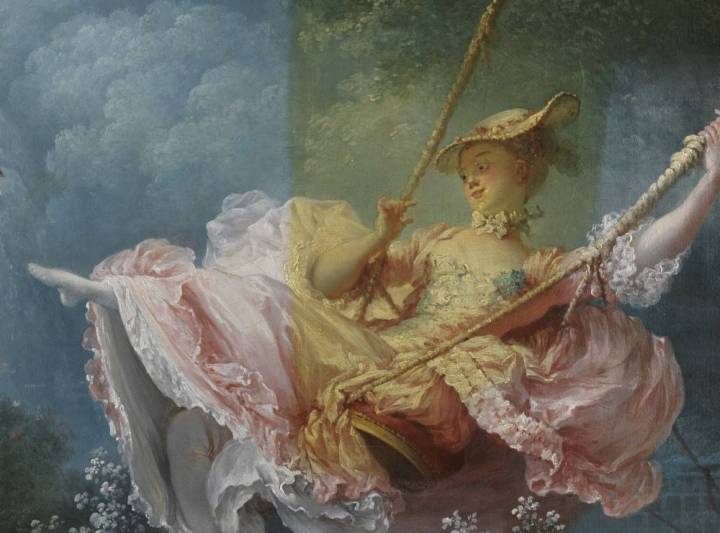
Between 2019 and 2021, five of the Wallace Collection’s eight paintings by Jean-Honoré Fragonard were cleaned and restored. This project has led to new discoveries about Fragonard’s working methods and provides the possibility for new interpretations of his work. Join our Head of Curatorial and Curator of French Paintings, Dr Yuriko Jackall, as she discusses this project and gives her reading of The Swing and its place in Fragonard’s career. She will also describe the long shadow of Fragonard’s influence, and how the ups and downs of his glittering career indelibly shaped the way in which we understand his art and the rococo aesthetic today. Thursday, 18 November 2021, 13.00 GMT.
This talk will be hosted online through Zoom and YouTube. Please click here to register for Zoom.
◊ ◊ ◊ ◊ ◊
From the press release for the project:

Jean-Honoré Fragonard, Les hasards heureux de l’escarpolette (The Swing), detail, after conservation, 1767–68, oil on canvas, 81 × 64 cm (London: The Wallace Collection).
Jean-Honoré Fragonard’s painting, The Swing, is the most iconic painting of the entire Rococo movement and one of the Wallace Collection’s most famous works of art. It has been admired for centuries for its romantic composition, skilful brushwork, and masterly use of colour. References to The Swing can be found in literature, contemporary art, design, and cinema. It is sought out and admired by thousands of visitors to the museum each year.
Despite its fame, relatively little is known about the painting. The circumstances of its commission are vague, with Fragonard opting to undertake a painting that other ‘academic’ painters had refused on account of its scandalous theme. Fragonard’s methods in building the composition are also unclear. In addition to this, the paint surface was previously obscured by yellowed varnish and old retouching had become visible.
Thanks to a generous grant from the Bank of America Art Conservation Project, throughout the summer of 2021 The Swing underwent intricate, sensitive highly skilled conservation and technical analysis for the first time. Uniquely, the conservation treatment has taken place in house at the Wallace Collection, with one of its conservation studios temporarily transformed especially for the purpose. The work has been undertaken by Martin Wyld, former Head of Conservation at the National Gallery, where he worked for more than 40 years restoring works by artists such as Leonardo and Velazquez.
Investigations have shed light on the mysteries surrounding The Swing and developed our understanding of Fragonard and his methods as an artist. The removal of the yellowed varnish has transformed the painting. The white lace of the young girl’s dress is now crisp, the composition has taken on a new sense of depth, background details are now apparent, and the overall freshness and texture of the artist’s paint surface has been restored. Little underdrawing or preparatory studies have been identified. Fragonard appears to have worked confidently and skilfully, directly on the canvas, to create The Swing, his finest masterpiece. The painting is being reinstalled in the specially relit galleries in November 2021, alongside the other seven Fragonard works in the Wallace Collection, allowing visitors to see for the first time how the artist developed across his career.
The return of The Swing is accompanied by a special season of events, which encompasses free public talks with special guests, a focused study course, and a book signing. The Collection has documented the conservation process and commissioned an insightful film exploring Fragonard and The Swing’s influence.
Online Conversations | Swing Time
A series of five conversations hosted by The Wallace Collection:
Swing Time: Serendipitous Conversations about the Rococo
Zoom Webinar and YouTube, The Wallace Collection, London, 8 November — 6 December 2021
Fragonard’s Les hasards heureux de l’escarpolette, known in English as The Swing, is a revered painting in the Wallace Collection and one of the most representative works of art of the entire French 18th century. To celebrate the gentle cleaning and restoration of this rococo icon, we have invited five art practitioners and five scholars to participate in a series of virtual conversations inspired by its key themes: Pink, Identity, Fashion, Play, and The Libertine. Join Dr Yuriko Jackall, Head of Curatorial and Curator of French Paintings at the Wallace Collection, to discover the influence of rococo art, and The Swing in particular, on artistic production today. The series will be recorded and made available on the Wallace Collection YouTube channel. Register for any of the five free talks here.
P I N K | Yuriko Jackall in conversation with Flora Yukhnovich and Valerie Steele
Monday, 8 November 2021, 19.00 GMT
Why is the colour pink so often associated with the frivolous, the dainty, and the overtly feminine? A plethora of images—of pink babies, pink flowers, pink fashion accessories—has cemented the gendering of pink in our collective imagination. Such is the case of Fragonard’s Swing, which displays at its centre a young woman in a billowing pink dress. Yuriko Jackall, artist Flora Yukhnovich, and curator Valerie Steele explore the widespread perception of the colour pink as particularly representative of femininity and the Rococo. See full event details here.
I D E N T I T Y | Yuriko Jackall in conversation with Catherine Yass and Rosalind McKever
Monday, 22 November 2021, 19.00 GMT
The name and motivations of the person who commissioned The Swing remain obscure. So do the identities of the three people depicted. Only the painter, Jean-Honoré Fragonard, is known to us. In cases like these, art historians rely upon visual clues to understand what is being represented. Yuriko Jackall is joined by artist Catherine Yass and curator Rosalind McKever in a conversation about how visual codes—dress, gesture, and representation of place—shape the way in which we read and perceive identity. See full event details here.
F A S H I O N | Yuriko Jackall in conversation with Sami Nouri and Jessica Degain
Monday, 29 November 2021, 19.00 GMT
During the last decades of the ancien régime (1760–1789), Paris became the epicentre of the fashion world. Vogues for hairstyle, dress shape, fabric patterns, or silk colour came and went, with the vertiginous rapidity associated to today’s ever-evolving fashion industry. Like his teacher, François Boucher, Fragonard excelled in putting his protagonists in the latest fashions. The fabrics, trimmings, and garments flowing from the brushes of these painters have, in turn, inspired fashion designers for the last 250 years. Join Yuriko Jackall, haute-couture fashion designer Sami Nouri, and curator Jessica Degain as they explore how 18th-century fashions continue to resonate today. See full event details here.
P L A Y | Yuriko Jackall in conversation with Monster Chetwynd and Alice Strang
Monday, 6 December 2021, 19.00 GMT
In sharp opposition to the architectural and rectilinear motifs of Classicism, the rococo aesthetic is populated by sinuous forms inspired by nature. Rocks, shells, leafy branches and sprigs of flowers introduce novelty and a sense of surprise into the furniture, wall panels and textiles of the eighteenth century. In turn, the unexpected playfulness of these rococo interiors encouraged a certain theatricality and whimsy in the demeanour of those who inhabited them. Yuriko Jackall, artist Monster Chetwynd, and curator Alice Strang discuss the resonance of rococo playfulness in contemporary practice, with special attention to layering, unusual juxtapositions, and the role of performance art as a means for exploring the eccentricities of everyday life. See full event details here.
T H E L I B E R T I N E | Yuriko Jackall in conversation with Simon Bejer and Chantal Thomas
Monday, 6 December 2021, 19.00 GMT
After enduring years of tight control under Louis XIV, the 18th-century privileged classes enjoyed unprecedented freedom during the Regency and the reign of Louis XV. In Paris, their lives unfolded at the opera, the theatre, and the masked ball. In their country estates and suburban maisons de plaisance, they tasted the escapist delights of the French pleasure garden. The intimacy of these environments invited a relaxation of etiquette and, occasionally, the transgression of moral codes. In the final conversation of our series, Yuriko Jackall, artist and theatre designer Simon Bejer, and writer Chantal Thomas, discuss how changes in moral codes in 18th-century France impacted the arts and literature. See full event details here.

Online Talk | Ann-Sophie Lehmann, Object Biography
From the BGC:
Ann-Sophie Lehmann, Object Biography: The Life of a Concept
Online, Seminar in Museum Conversations, Bard Graduate Center, New York, 2 November 2021

Jan Luyken, Design for frontispiece, Het Leerzaam Huisraad, 1709, 14 × 90 cm (Amsterdam: Rijksmuseum, RP-T-1989-183).
The object biography has gained popularity in art history, material culture studies, archaeology, history, conservation and restoration, and museum studies. As a concept, the biography creates attention for the individual trajectories of objects and how these change over time; it enables the connection of different approaches, usually dealt with by sub-disciplines (i.e. research into making, provenance, exhibition history, conservation, reception); it offers entry points even if no information is available and encourages interdisciplinarity as objects straddle many fields. Finally, the object biography stimulates new forms of writing because it lends the object a voice and foregrounds narrative.
But the concept’s anthropocentric foundations also raise questions. To have a ‘biography’ implies biological and mental development, which objects typically do not have. Are young objects less settled and do objects grow wiser the older they get? Metaphors of birth, maturing, and death might cover up exclusively thing-specific characteristics. Likewise, the proposed ‘life’ implies agency, but do objects really speak for themselves? Who actually tells their story, and would objects be better if we used concepts such as itineraries or necrographies to capture their histories?
This talk presents a brief history and theory of the concept of the object-biography, from its literary and didactic origins in the eighteenth-century to its recent critics, asking what the concept can help us see, which we otherwise would not. This free talk takes place, via Zoom, on Tuesday, November 2, at 5.00pm. Registration information is available here.
Ann-Sophie Lehmann is chair of art history & material culture at the University of Groningen. She recently published Lessons in Art: Art, Education, and Modes of Instruction, edited with E. Jorink and B. Ramakers (Leiden 2019). For an overview of her publications and activities is available here.
Online Series | The Museum and Gallery Today
From the PMC:
The Museum and Gallery Today: Paul Mellon Lectures 2021
Six Online Lectures, 20 October — 11 February 2022
Established in 1994, this lecture series was named in honour of Paul Mellon (Yale College, class of 1929), the philanthropist, collector of British art, and founder of both the Yale Center for British Art (YCBA) in New Haven and the Paul Mellon Centre for Studies in British Art (PMC) in London. Co-organised by the two institutions, these biennial lectures have traditionally been given by a specialist in British art, first at the National Gallery, London, and again at the YCBA in New Haven.
This year’s series, entitled The Museum and Gallery Today, is exclusively online and features individual talks from some of the world’s most distinguished museum and gallery directors. The lectures are presented as free live webinars. Registration is required (for each lecture, individually).
20 October 2021
Gabriele Finaldi (Director of the National Gallery)
3 November 2021
Kaywin Feldman (Director of the National Gallery of Art, Washington, DC)
10 November 2021
Thelma Golden (Director and Chief Curator of the Studio Museum in Harlem)
11 November 2021
Iwona Blazwick (Director of the Whitechapel Gallery)
24 November 2021
Maria Balshaw (Director of Tate)
11 February 2022
Eve Tam (Former Director of the Hong Kong Museum of Art)
Lecture Series | Printing Abolition, 1783–1807

Fold-out engraving in Charles Crawford, Observations on Negro-Slavery (Philadelphia: Eleazer Oswald, 1790)
(Philadelphia: Penn Libraries, Kislak Center for Special Collections, Rare Books and Manuscripts)
◊ ◊ ◊ ◊ ◊
From Penn Libraries:
Michael Suarez, Printing Abolition: How the Fight to Ban the British Slave Trade Was Won, 1783–1807
The A.S.W. Rosenbach Lectures in Bibliography
Online and In-person, University of Pennsylvania, Philadelphia, 25, 26, and 28 October 2021
In this series of highly illustrated lectures (originally scheduled for March 2020), Michael Suarez offers a fresh perspective on British abolition, richly informed by political prints and personal correspondence, newspapers and pamphlets, account books and committee minutes, parliamentary reports and private diaries. Suarez’s revisionist history not only traces the production and distribution of abolitionist print, but also reveals the hidden networks that variously sustained the first humanitarian mass media campaign. Abolition forces brilliantly exploited the power of print to contend with the complex legacies of the American and French Revolutions, the slave revolt in present-day Haiti, and the Napoleonic Wars. Seeking to understand how both abolitionists and their foes exploited systems of influence through printed words and images in many forms, Suarez delineates the strategies that abolitionists devised to overcome accusations of religious fanaticism, economic malfeasance, and political sedition. Exploring the first author’s book tour in the UK, a consumer boycott fostered by the radical press, and the fashionable publisher who clandestinely worked as press agent for the pro-slavery interest, these lectures will demonstrate the power of bibliography and book history to rewrite established narratives and to recover lives and labors typically left out of conventional accounts.
These three lectures will be held in person and also livestreamed via Zoom webinar (advance registration required to receive Zoom link). In addition, the lectures will be recorded and available for viewing and as podcasts approximately several weeks after being presented.
Michael F. Suarez, S.J. has served as Director of Rare Book School, Professor of English, University Professor, and Honorary Curator of Special Collections at the University of Virginia since 2009. Professor Suarez serves as Editor-in-Chief of Oxford Scholarly Editions Online. His recent books include The Cambridge History of the Book in Britain, Volume V, 1695–1830 (Cambridge University Press, 2009), co-edited with Michael Turner, and The Oxford Companion to the Book (Oxford University Press, 2010), a million-word reference work co-edited with H. R. Woudhuysen. The Book: A Global History, also co-edited with H. R. Woudhuysen, first appeared in 2013. In 2014, Oxford University Press published his edition of The Dublin Notebook, co-edited with Lesley Higgins, in the Collected Works of Gerard Manley Hopkins. He delivered the 2015 Lyell Lectures in Bibliography at the University of Oxford.
Feeding the Machine: A Triple System of Networks
Monday, 25 October 2021, 5.30pm (EST)
Register for this lecture (attending in person or attending virtually, via Zoom webinar).
Commodity Culture and the Political Economies of Print
Tuesday, 26 October 2021, 5.30pm (EST)
Register for this lecture (attending in person or attending virtually, via Zoom webinar).
Beyond Westminster: Toward More Global Forms of Knowing
Thursday, 28 October 2021, 5.30pm (EST)
Register for this lecture (attending in person or attending virtually, via Zoom webinar).
Rosenberg Lecture | Jessica Fripp, The French Academy in Rome
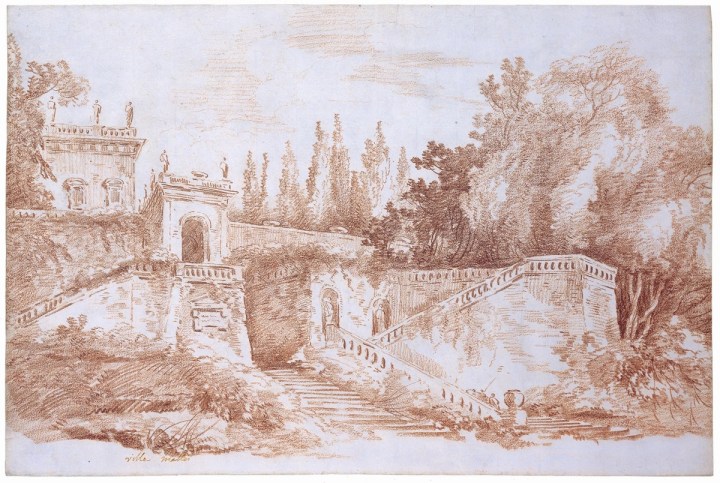
Hubert Robert, View of the Gardens at the Villa Mattei, 1761, red chalk on paper
(Dallas Museum of Art, fractional gift of Charlene and Tom Marsh, 2006.17)
◊ ◊ ◊ ◊ ◊
From the DMA:
Jessica Fripp, The French Academy in Rome: Adventures in Bromance
Annual Rosenberg Lecture
Online and In-Person, Dallas Museum of Art, 11 November 2021, 7.00pm
Presented by the Michael L. Rosenberg Foundation
Winning the Royal Academy’s prix de Rome was a major accomplishment for aspiring painters and sculptors in 18th-century France. The prize came with a three-year funded stay in Rome, and provided an opportunity for artists to finish their education by viewing firsthand antique, Renaissance, and Baroque works of art in the Eternal City. But, much like students who study abroad today, their time in Rome involved just as much play as work.
In this lecture, Jessica L. Fripp, Associate Professor of Art History and Undergraduate and Graduate Coordinator at Texas Christian University, will talk about works of art that provide a view into the less studious side of artists’ time in Rome: caricatures. What can these ‘silly’ drawings tell us about life in Rome as a young artist and the role of friendship and play in academic artistic training?
This talk will be livestreamed on the DMA’s YouTube channel, with limited in-person seating available. Dr. Fripp’s recent book Portraiture and Friendship in Enlightenment France will be available for purchase at the DMA Store, and a book signing will follow the event on-site.
To register (for either in-person or virtual attendance), click here»
Online Conference | Buying Art and Antiquities in 18th-Century Italy
From the conference program:
Buying Art and Antiquities in Eighteenth-Century Italy
La compra de arte y antigüedades en la Italia del siglo XVIII
Online, UNED, Madrid, 4, 11, 18, 23 November and 2 December 2021
Organized by Pilar Diez del Corral Corredoira and David Ojeda Nogales

Jean-François Sablet, In the Antiquities Shop, Rome, 1788 (Private Collection)
The third meeting of the international conference series Transnational Relations and the Arts will address the issue of art and antiquities markets in eighteenth century. With the Grand Tour at its peak, men from all over Europe and beyond flooded into the cities of Italy, mainly Rome but also Naples, Venice, and Florence. These grand tourists fed an already flourishing art market and were also active agents of the spread of ancient marbles and vases, Old Master paintings, ancient coins, and medals back to their homelands, not to mention the diffusion of an international ‘buon gusto’ among the middling and upper classes. For virtual access via Zoom, please email dojeda@geo.uned.es and diezdelcorral@geo.uned.es. The conference is also available for streaming (without registration) here.
This conference is part of the results of the I+D+i project (PID2020-117326GB-I00), FAKE- La perdurabilidad del engaño: Falsificación de Antigüedades en la Roma del siglo XVIII, and the Ramón y Cajal research Project (2017-22131), Academias artísticas, diplomacia e identidad de España y Portugal en la Roma de la primera mitad del siglo XVIII, both funded by the Ministerio de Ciencia e Innovación.
First Session — Agents and Art Markets
4 November 2021, 15.00 (Madrid Time)
• Sascha Kansteiner (Curator of Greek and Roman sculpture, Staatliche Kunstsammlungen, Dresden), Cavaceppi: Sculptor, Restorer, Dealer, Publisher, and Forger
• Jeffrey Laird Collins (Professor of Art History and Material Culture, Bard Graduate Center, New York), The Pope, the Curator, the Milord, and his Dealer: Rome’s Red-Hot Antiquities Market in Theory and in Practice.
• Heiner Krellig (Independent Scholar, Venice and Berlin), Preliminary Notes for a History of the Art Market in Eighteenth-Century Venice
• Paola D’Alconzo (Universidad de Nápoles Federico II), Il mercato di antichità nel Regno di Napoli nel XVIII secolo: quadro normativo e alcuni casi esemplari
• Alexandre Vico Martori (Universidad de Gerona), ‘Quattro quadri dipinti per il traverso dipinti in tavola’: El redescubrimiento de Sandro Botticelli y la adquisición de las spalliere del Palazzo Pucci
Second Session — Agents and Art Markets, part 2
11 November 2021, 15.00 (Madrid Time)
• Paweł Gołyźniak (Institute of Archaeology, Jagiellonian University), Philipp von Stosch (1691–1757) and His Dominant Position in Terms of Trade, Collecting, and Research of Engraved Gems in Eighteenth-Century Italy
• Tara Zanardi (Hunter College of the City University of New York), Isabel de Farnesio, Filippo Juvarra, and the Modern Interior at La Granja
• Mercedes Simal (Unversidad de Jaén), Troiano Acquaviva y el mercado artístico romano: un agente al servicio de los reyes de España y Nápoles
• Elena Dmitrieva (Department of the Classical Antiquities, The State Hermitage Museum), Russian Buyers of Antique and Modern Gems in the Italian Art Market in the Second Half of the Eighteenth Century
• Odile Boubakeur (Ecole du Louvre / Université Paris-Saclay), ‘Italy, Garden of the World’…or ‘jardin à l’anglaise’? British Supremacy on the Italian Antique Art Market through the Eighteenth Century
Third Session — Collectors and Their Collections
18 November 2021, 15.00 (Madrid Time)
• Tracy L. Ehrlich (Associate Teaching Professor, Parsons School of Design / The New School, New York), Alessandro Albani and European Practices of Collecting and Display in the Era of the Grand Tour
• Fabrizio Federici (Independent Scholar), Dispersing a Collection in Eighteenth-Century Italy: The Paintings and Statues of the Cybo Malaspina Family
• John E. Davies (FRHistS, former County Archivist Carmarthenshire Archive Service, independent scholar), An Examination of the Art Collecting of the First Baron Cawdor
• Theresa Kutasz Christensen (Exhibitions Researcher, Prints, Drawings, and Photographs, Baltimore Museum of Art), The King is Dead, Long Live the King’s Things: The Transformation of Private Pleasures into Public Propaganda in Gustav III of Sweden’s Museum of Antiquities
• Alexander V. Kruglov (Independent Scholar, New York), The Russian Grand Tour: Sculptures Purchased by Count and Countess of the North in Rome in 1782
Fourth Session — Collectors and Collections
23 November 2021, 15.00 (Madrid Time)
• Daniela Roberts (Assistant Professor, Institute of Art History, University of Würzburg), Grand Tour Pickings: Antiquities for Georgian Gothic Houses
• Maureen Cassidy-Geiger (Independent Scholar), Bringing Rome Home: Souvenirs and Gifts for Crown Prince Friedrich Christian of Saxony/Poland during His Sojourn in the Eternal City, 1738–39
• José Antonio Vigara Zafra (UNED), El Grand Tour del VI conde de Fernán Núñez: un ejemplo de cultura cortesana en la Europa de la Ilustración
• Domenico Pino (University College London), Gems Never Seen Before: William Hamilton, Vesuvius, and the Rising Taste for Precious Marble in Europe, c. 1770
• Ginevra Odone (Université de Lorraine / La Sapienza Università di Roma / Society for the History of Collecting, Italian Chapter), From Rome to London: Expertise, Dealer, and Buyer for Two Antique Hands
Fifth Session — Works of Art
2 December 2021, 15.00 (Madrid Time)
• Max Kunze (Professor at the University of Mannheim), Winckelmann and the Venus Menophantus or Emphatic Aspects of Restored Sculptures in the Eighteenth Century
• Alexis R. Culotta (Professor of Practice, Tulane University), Commemorating Italy?: The Walpole and Brand Cabinets as Grand Tour Souvenirs of Elsewhere
• David Ojeda (UNED), Forgeries in the Eighteenth Century and Classical Art: A Methodological Conundrum
• Julio C. Ruiz (Universidad Rovira i Virgili, Tarragona), Sobre un torso masculino con indumentaria militar en el Museo del Prado
• Lorenzo Ebanista (Independent Scholar), La felloplastica napoletana nel XVIII secolo tra scenografie presepiali, souvenirs del Grand Tour e rappresentazioni naturalistiche
• Eliška Petřeková (Masaryk University Brno), Between a Souvenir and Archeological Documentation: The Cork Model of the Paestum Temple in the Chancellor Metternich‘s Collection










 Enfilade
leave a comment