Lecture | James Middleton on Mexican Court Clothing
Tomorrow (Thursday) from BGC:
James Middleton | ‘But She’s Wearing It Backwards’: Understanding and Misunderstanding an Eighteenth-Century Mexican Court Gown
Online (Zoom), Bard Graduate Center, New York, 3 February 2022, 12.15 (ET)
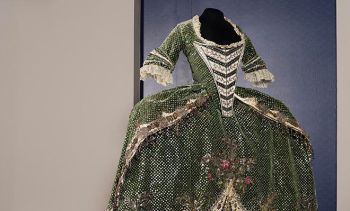
Museo Nacional de Historia. Photo by Omar Dumaine.
This talk will explore the history of a late eighteenth-century Mexican gown since its donation to Mexico’s Museo Nacional de Historia in 1900. The opulent, deep green silk-velvet and ivory satin dress with lavish silver embroidery has long been recognized as one of the most elaborate garments surviving from the colonial Americas, but has only recently been identified as a traje de corte—a court gown, one of four extant New Spanish garments to be so identified—made according to the etiquette requirements of the Spanish royal court. It has been exhibited in many guises, with and without its stomacher and/or train, and paired with radically different pannier and hoop variations. The genesis of the talk’s title is the gown’s first published appearance, in the 1988 book, La historia de Mexico a través de la indumentaria, in which it was correctly identified as a court gown, but misidentified as a Velázquez-era infanta dress and photographed worn backwards by a live model.
Middleton will be using this extant dress, as well as other extant garments in paintings, as a means of reflecting on some of the questions posed by the existence of court clothing in Spanish America. Who wore gowns like this? Were they required for functions of the viceregal court of Mexico City as they were for the court of Madrid, or were they aspirational garments worn for social display by the nouveau riche nobles of New Spain? The presentation will consist of photographs and analyses of extant and painted garments, as well as contemporary texts that document New Spanish tailoring practices and textile commerce, to investigate the little-understood phenomenon of court culture in the Americas.
James Middleton is an independent scholar working on dress in the Spanish-Colonial Americas circa 1520–1820. He has lectured and published on the subject in the US (Metropolitan Museum of Art, Los Angeles County Museum of Art, Denver Art Museum, et al.), Mexico (Museo Nacional de Historia, Museo Nacional de Arte), Colombia (Universidad de los Andes), and England (Society of Dress Historians). His particular interest in this subject dates from the early 1990s, when he first saw the dress that is this presentation’s focus in the conservation lab of the Museo Nacional de Historia, two weeks after having bought a copy of La historia de Mexico a través de la indumentaria.
This event will be held via Zoom. A link will be circulated to registrants by 10am on the day of the event. This event will be live with automatic captions. Registration is available here.
Call for Papers | Egypt in Early Modern Antiquarian Imagery
From ArtHist.net, which includes the German version of the CFP:
Egypt in Early-Modern Antiquarian Imagery
Ägypten in der frühneuzeitlichen antiquarischen Bildwelt
Online Workshops on 5 May, 2 June, 7 July 2022
Proposals due by 11 March 2022
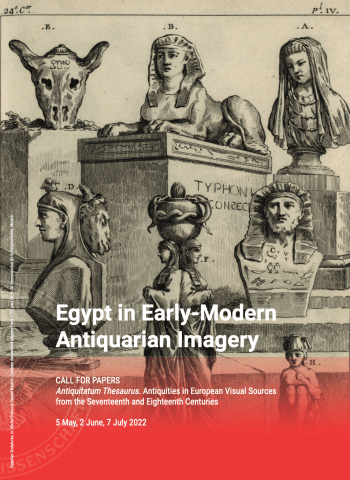 In 2022, Egyptology celebrates important historical events that number among the highlights in the exploration of the culture and civilization of the country by the Nile. In 1822, Jean-François Champollion succeeded in deciphering the hieroglyphics, the hieratic and the demotic scripts, by working primarily with the Rosetta Stone. In 1922, the British archaeologist Howard Carter discovered the tomb of the Pharaoh Tutankhamun in the Valley of the Kings.
The academy research project “Antiquitatum Thesaurus” would like to contribute to the international discourse and, in three half-day digital workshops in the summer semester of 2022 (5 May / 2 June / 7 July), draw attention to some central questions of the early-modern reception of Egypt, which preceded the events mentioned above.
How did contacts with the land of the pharaohs and their culture come about, and what image of it was conveyed? What role did aegyptiaca play in collections of antiquities, cabinets des curiosités or Wunderkammern? How were Egyptian or Egyptianising artefacts visually documented and discussed?
Before Napoleon’s great military expeditions and the subsequent scientific explorations of the country, when the number of travellers to the Levant was still manageable, the perception and understanding of Egypt far from the Nile had to rely primarily on easily portable objects. These had found their way to the other side of the Mediterranean at different times and along different routes. Finally, the study of ancient Greek and Roman authors, who transmitted their own mediated version of history and Egyptian culture, should not be underestimated.
Besides religious motivations, commercial and political activities or the desire to explore that lost or forgotten civilization, discoveries in Europe also stimulated further interest in Nilotic culture. Archaeological finds in Italy, France, Spain, German countries and Britain brought to light artefacts from the Roman imperial period. Through them people assimilated and adapted aspects of Egyptian religion, culture or aesthetics. They were collected together with artefacts from Egypt both as curiositates and as objects of study.
In the course of the early-modern period, a broad spectrum of antiquarian knowledge about Egypt was formed on the basis of these heterogeneous and today often not yet fully tangible foundations, and illustrated by an accompanying world of images.
The project “Antiquitatum Thesaurus” takes on the digital recording and indexing of antiquities in the graphic sources of the 17th and 18th centuries. It has begun this process with the subject area: “Egypt: On the Search of Origins.” Selected, representative illustrated printed works and drawing volumes dedicated to the material legacy of Egypt—or what was considered to be Egyptian—will be analysed. In addition to identifying the illustrated artefacts and architectural works, whether still preserved today or not, the project also aims to describe the methods of recording and conveying the mostly three-dimensional objects on paper, i.e. in a two-dimensional space. Furthermore, digital processing opens up possibilities for recognizing and illustrating spatial, temporal and personal chains within the transmission of knowledge and images across the widely scattered source material.
The subject areas of the three workshops include:
• The protagonists: A consideration of the circulation of artefacts through intermediaries, antiquarians and collectors as well as their reception and representation in drawings and printed works. Particular attention will be paid to how these figures were interconnected between c. 1600 and 1750.
• Multifaceted Egypt: How was the imagery or the idea of Pharaonic Egypt changed or complemented by small-scale artefacts such as amulets, jewellery and funerary objects alongside the familiar monumental evidence such as obelisks or sphinxes?
• The history of reception: What was the basis for the depictions of the many aegyptiaca in the graphic volumes of the time: direct observation or copies based on earlier publications? How exactly did the exchange of drawings and prints, descriptions etc. take place among the members of the European république des lettres?
We plan 20-minute talks in German or English. We kindly ask you to send an abstract relating to the aforementioned topics—alternative proposals are also welcome—of maximum 500 words in German, English, Italian, or French including a short CV to: thesaurus(at)bbaw.de by 11 March 2022. Please indicate the language in which you would like to speak. An answer will be given by 18 March 2022.
Lecture | Sarah Cohen on Sugar, Silver, and Slavery
Next month from BGC:
Sarah Cohen | Sugar, Silver, and the Bourbon Sucriers: Sweetening Slavery in 18th-Century France
The Françoise and Georges Selz Lectures on 18th- and 19th-Century French Decorative Arts and Culture
Online (Zoom), Bard Graduate Center, New York, 10 February 2022, 12.15 (ET)
Inseparable from the rise of sugar within the economies of international trade in eighteenth-century Europe was the Caribbean slave trade: in France, whose primary source of sugar for local consumption and re-export was its principal colony of Saint Domingue, the trade in enslaved persons swelled directly in tangent with the sugar business throughout the 1730s and beyond. But because all of the steps in harvesting and producing sugar, apart from some of the most elaborate refining processes, were carried out in the distant island colonies, such interdependency, to say nothing of the coerced labor it entailed, was invisible on the French dining table.

Paire de sucriers à poudre : esclaves chargés de cannes à sucre, 1730s (Paris: Musée du Louvre, photo by Daniel Arnaudet).
A startling exception to this submersion of the harsh facts of how sugar cane was harvested is found in a pair of silver sugar casters (sucriers) that depict a man and woman laboring beneath bundles of sugar cane, as if physically ‘delivering’ their sweet crystals for the elite dessert. Almost certainly made by the royal silversmith Claude II Ballin on commission for Louis-Henri, duc de Bourbon, the casters would have appeared among the duke’s many other worldly goods on display at the château of Chantilly in the 1730s. The harvesters would have been identifiable as an African woman and man through their carefully modelled physiognomies, which reflect incipient French understandings of racial type. Their bodies are cast in glistening, solid silver, while their hollowed burdens of bundled cane detach to dispense the powdered sweetener. Departing notably from typical examples of this type of luxury dispenser, whose baluster design references its placement and use on the table, rather than the sourcing of the product itself, the two large figures were also designed to occupy their own, unique place on a dessert or collation table. Cohen’s talk will explore the diverse implications of the sucriers within the context of international trade; the physical and cultural interconnections of sugar and slavery; and elite French practices of dining and festive entertainment in the early eighteenth century.
Registration is available here»
Sarah R. Cohen is Professor of Art History and Chair of the Department of Art and Art History at the University at Albany, SUNY. She is also a joint Professor in the Department of Women’s, Gender, and Sexuality Studies. Her research focuses on the body and sensory experience in art and culture from the sixteenth through eighteenth centuries, with a special emphasis on early modern France. Her books include Art, Dance and the Body in French Culture of the Ancien Régime (2000) and Enlightened Animals in Eighteenth-Century Art: Sensation, Matter, and Knowledge (2021). A third book, Picturing Animals in Early Modern Europe: Art and Soul, is forthcoming in 2022.
Online Symposium | Sea Machines

From the symposium website:
Sea Machines
Online, Daniels Faculty of Architecture, Landscape, and Design, University of Toronto, 4 February 2022
Organized by Christy Anderson and Jason Nguyen
Sea Machines is a one-day symposium (held on Zoom) that interrogates marine technology for the history and theory of architecture. From canoes and cargo ships to submarines and offshore drilling rigs, maritime vessels show how design has been employed to imagine, manoeuvre, conquer, and exploit the environments and ecosystems of the sea.
The sea has long been cast as the inverse of the habitable terracentric world. Depictions of storms, shipwrecks, and underwater monsters haunt the art and literature of coastal societies, serving as warnings to those who might venture into the blue expanse. Yet, across cultures and throughout history, humans have constructed elaborate structures to facilitate the crossing and even occupation of the ocean.
Recent scholarship in the blue humanities has shed light on the profound ways that oceans influence politics, economics, science, and culture. Aquatic environments have conditioned everything from human diets, artistic traditions, trade networks, and settlement patterns. Whereas architects and historians have studied harbours and ports, far fewer have looked at the vessels that traversed and inhabited the open water. These ‘sea machines’ signal the outer limits of a period and place’s techno-environmental imagination. What architectonic skills did designers, shipwrights, and navigators employ in the construction and operation of ocean structures? How did the forms and materials of water-based vessels speak to larger ideological and environmental forces, including those tied to colonization and slavery, capitalism, and the climate? And how might infrastructure linked to offshore extraction (e.g., fishing, pearl farming, coral and deep-sea mining, oil drilling, etc.) provide a specifically architectural way to evaluate the relationship between human and non-human entities across the land and sea divide?
Sea Machines brings together members of the Daniels Faculty and a diverse roster of internationally recognized scholars and practitioners with an interest in environmental history, technology, and design. The study of maritime spaces is timely and of wide interest for scholars and practitioners across the design disciplines, especially given the sea’s increasing precarity in the face of climate change. Ultimately, the symposium highlights the central role played by architecture in charting a future environmental and technological reality.
The event is free and open to the public. More information on the symposium and its speakers, including registration and Zoom information, is available here.
S C H E D U L E
10.00 Opening Remarks by Christy Anderson and Jason Nguyen
10.30 Session 1: Infrastructure
• Keller Easterling, ISO 1161
• Carola Hein, Oil on Water: The Global Petroleumscape and the Urbanization of the Sea
• Prita Meier, Below the Waterline: Dhows and the Politics of Heritage in the African Indian Ocean
11.30 Discussion
11.50 Lunch Break
1.00 Session 2: Culture
• Niklas Maak, Phalansteries at Sea: Fourier, Le Corbusier, and the Architecture of the Cruiseship
• Meredith Martin and Gillian Weiss, Sun King at Sea
• Elliott Sturtevant, Traveling the Heat Line: The ‘Great White Fleet’ as Climatic Media
2:00 Discussion
2.20 Break
2.30 Session 3: Energy
• Sara Rich, Naufragic Architecture in the Anthropocene
• Margaret Schotte, Water vs. Wood: Desalination Machines and the Shipboard Space, c. 1695
• Larrie Ferreiro, The Evolution of the Naval Architect, 1600–2000
3.30 Discussion
4.00 Closing Remarks by Christy Anderson and Jason Nguyen
Online Talk | Corey Brennan on the Villa Aurora
The sale of the Casino di Villa Ludovisi (Villa Aurora) has—understandably—generated lots of media attention (see the full announcement for press links), and at least some of the finds have involved the eighteenth century . . .
T. Corey Brennan, Inside the ‘World’s Most Expensive Home’: A Decade of Rutgers Research at the Villa Aurora in Rome
Online, 20 January 2022, noon (EST)
 The Villa Aurora in Rome—for precisely 400 years the home of the papal Boncompagni Ludovisi family—will go on auction this month with an asking price of $532 million dollars. Called by one leading art historian a “sort of seventeenth-century Sistine Chapel,” the Villa Aurora boasts famous mural art by more than a dozen major artists, including a unique 1597 ceiling painting by Caravaggio. In this richly illustrated talk, Professor Corey Brennan will discuss this landmark sale, his decade-long collaboration with the owners—†HSH Prince Nicolò and HSH Princess Rita Boncompagni Ludovisi—and the discoveries inside the Villa made with over two dozen Rutgers undergraduate students. This virtual presentation, open to the public, will take place on Thursday, 20 January 2022, 12:00–1:00pm (EST). Registration information is available here.
Online Study Day | Joshua Johnson: Conversations and New Discoveries
This online study day is held in conjunction with the the exhibition, which closes January 23:
Joshua Johnson: Conversations and New Discoveries
Online, Washington County Museum of Fine Arts, Hagerstown, Maryland, 14 January 2022.

Joshua Johnson, Portrait of Benjamin Franklin Yoe and Son Benjamin Franklin You Jr., 1809, oil on canvas mounted onto hardboard, 37 × 26 inches (Hagerstown: WCMFA, Gift of F. Sydney Cushwa).
The exhibition Joshua Johnson: Portraitist of Early American Baltimore presents a rare opportunity for Johnson scholars and art historians to study a significant group of Johnson’s works in one place.
Join WCMFA staff and colleagues Friday, January 14, for a day of intriguing, in-depth conversations about portraitist Joshua Johnson (ca. 1763–1824/25), one of the first professional African American artists. Joshua Johnson: Conversations and New Discoveries will be held from 9am to 4pm (EST) via Zoom. Organized in conjunction with the final days of the exhibition, this study day will address a variety of topics, including Johnson’s life and historical context in antebellum Maryland, his patrons, artistic style and technique, and connoisseurship. A broad range of speakers and special guests will offer unique perspectives and expertise about this fascinating artist in an informal, conversational format.
The first monographic presentation of the artist’s work since 1988, Joshua Johnson: Portraitist of Early American Baltimore contextualizes Johnson both historically and culturally and explores the key forms of natural symbolism represented in his paintings. Johnson was a freed slave who achieved a remarkable degree of success as a portraitist in his lifetime by painting affluent patrons in his native Baltimore such as politicians, doctors, clergymen, merchants, and sea captains. The exhibition is accompanied by a scholarly catalogue available for purchase from the museum.
To register for the study day, please email Donna Rastelli at drastelli@wcmfa.org or call 301.739.5727.
S C H E D U L E
9.00 Introduction by Sarah Hall (Director Washington County Museum of Fine Arts) with Opening Remarks by Kellie Mele (Director of Education for WCMFA)
9.30 Who Was Joshua Johnson? — David Terry (Associate Professor of History and Geography at Morgan State University) and Daniel Fulco (Agnita M. Stine Schreiber Curator at Washington County Museum of Fine Arts)
10.30 The Artist’s Patrons — Mark Letzer (President & CEO, Maryland Center for History and Culture), Stiles Colwill (Stiles T. Colwill Interiors), and Linda Crocker Simmons (Curator Emerita, Corcoran Gallery of Art)
11.15 Roundtable Discussion — This hour-long conversation features our panelists discussing Johnson’s influence and style, addressing his predecessors and contemporaries, some of whom are on view in a companion exhibition at the WCMFA.
12.15 Lunch Break
1.15 Johnson’s Cultural and Historical Context and Relationship to Baltimore Society — David Terry, Daniel Fulco, and Philippe Halbert (PhD candidate, Department of the History of Art, Yale University)
2.15 Connoisseurship: Technique, Materials, and Conservation. See the Yoe family portraits up close with Heather Smith (Conservator, Maryland Art Conservation), Sian Jones (Art Conservator), and Stiles Colwill.
3.15 Future Directions — In this concluding segment, panelists will discuss Johnson in public and private collections. Other topics include the art market as well as new research and directions in the field.
P A N E L I S T S
David Terry is Associate Professor of History and Geography at Morgan State University in Baltimore. He previously was the executive director of the Reginald F. Lewis Museum and was a research specialist in African American history for the Maryland State Archives. He holds a doctorate in history from Howard University, a Master of Arts in African American history from Morgan State University and a Bachelor of Arts in American studies from the University of Maryland-College Park.
Mark Letzer is the President and CEO of Maryland Center for History and Culture in Baltimore. Letzer is an expert in Maryland silver and decorative and fine arts. He became connected with MCHC when he was researching for his book, The Diary of William Faris: The Daily Life of an Annapolis Silversmith, which was published in 2003. In addition, he has written numerous articles on Maryland silver and decorative arts and lectured on the topic. Previously, he served as the Chief Development Officer for the Maryland Historical Society.
Anne Verplanck is Associated Professor of American Studies for Penn State-Harrisburg. She teaches courses in American art and visual culture, social and cultural history, American decorative arts and material culture, museum studies and heritage studies. Prior to becoming part of the Penn State-Harrisburg faculty she worked in the museum field for 30 years. She is the former Curator of Prints and Paintings at Winterthur Museum where she also served as Interim Director of Museum Collections and Interim Director of the Research Fellowship Program.
Linda Crocker Simmons has spent over 40 years in the museum field. Since 1998 she has held the title of Curator Emerita for the Corcoran Gallery of the Art. She has also worked with private and institutional clients including the Alice Ferguson Foundation at Hard Bargain Farm in Accokeek, Maryland. She holds a Bachelor of Arts in studio art and art history from American University; a Master of Arts in art history from the University of Delaware; a certificate in arts administration from Harvard University and remains a.b.d. for her PhD from the University of Virginia. She is an expert in the field of American painting from the end of the 18th century into the early 20th century.
Stiles Colwill has been the President and Chief Designer of Stiles Tuttle Colwill Interiors in Lutherville, Maryland, for nearly 30 years. Colwill also operates Halcyon House Antiques with New York City antiques firm John Rosselli & Associates. He previously served as a Board of Trustees for Baltimore Museum of Art where he served as chairman for five years. He also spent 16 years with the Maryland Historical Society.
Heather Smith is the Owner and Chief Conservator of Maryland Art Conservation LLC (formerly Art Conservation Services) in Baltimore. In 2005, she began her career with ACS after receiving her Master of Art Conservation at Queen’s University in Ontario, Canada, the previous year. She is a professional associate of the American Institute for Conservation.
Sian Jones is the previous owner of Art Conservation Services before retiring in 2018 after more than 30 years. She studied art conservation at the State University of New York at Oneonta, and studied art at Goucher College in Baltimore.
Phillipe Halbert is a doctoral candidate with the Department of History of Art at Yale University. He studies the intersection of art and identity in Colonial America and early modern Europe. For more than a decade he has been an independent museum consultant and has served as a guest curator at a variety of historic sites and museums. He has a Master of Philosophy in art history, criticism and conservation from Yale University and a Master of Arts in American material culture from the University of Delaware. He was a dual major in French and Francophone studies and history at The College of William and Mary where he received his undergraduate degree.
This exhibition is generously supported by grants from the following: National Endowment for the Arts (NEA), the Art Dealers Association of America (ADAA) Foundation, an anonymous donor, Mr. & Mrs. James N. Holzapfel, Dr. & Mrs. George E. Manger, the Heart of the Civil War Heritage Area (part of the Maryland Heritage Areas Authority), Maryland Marketing Partnership, Community Foundation of Washington County MD, Inc., Dr. & Mrs. Robert S. Strauch, and Mr. & Mrs. Thomas B. Riford.
Journées d’étude | The Rediscovered Colors of Aubusson Tapestries
From ArtHist.net:
Les Couleurs retrouvées des Tapisseries d’Aubusson
Online, Aubusson, 17–18 January 2022
Ces journées d’étude seront l’occasion de partager les premiers résultats d’une recherche pluridisciplinaire originale menée dans le cadre du programme Aubusson: Les couleurs retrouvées des tapisseries fines d’Aubusson (XVIIIe siècle) — Culture matérielle: conception, production, caractérisation, altération et conservation soutenu par la Région Nouvelle Aquitaine. Centrées sur l’étude d’un exemple, une tapisserie récemment acquise par la Cité internationale de la Tapisserie à Aubusson, elles convoquent l’histoire naturelle, l’histoire sociale, l’histoire de l’art, les sciences physiques et chimiques, les sciences du patrimoine et les nouvelles technologies afin de renouveler la connaissance des objets analysés. Le propos touche donc à l’identification des choses représentées, à l’examen des processus d’élaboration et des stratégies de production des tapisseries, à reconsidérer les techniques de tissage et les matériaux utilisés par la constitution d’une base de données des différents supports et par l’analyse non invasive des colorants. Il s’agit aussi de poser des diagnostics de conservation et de présentation des collections et de tenter une restitution numérique des couleurs d’origine.
These study days will be an opportunity to share the first results of an original multidisciplinary research conducted within the framework of the Aubusson program: Les couleurs retrouvées des tapisseries fines d’Aubusson (XVIIIe siècle) — Culture matérielle: conception, production, caractérisation, altération et conservation, supported by the Région Nouvelle Aquitaine. Focusing on the study of an single example, a tapestry recently acquired by the Cité internationale de la Tapisserie in Aubusson, they bring together natural history, social history, art history, physical and chemical sciences, heritage sciences, and new technologies in order to renew the knowledge of the analyzed objects. The aim is to identify the things represented in the tapestry, to examine the tapestry elaboration process and production strategies, and to reconsider the weaving techniques and the materials used through the constitution of a database of the different supports and by the non-invasive analysis of the dyes. It is also a question of diagnosing the conservation and presentation of the collections and attempting a digital restitution of the original colors of the tapestry.
Comité Scientifique
Alice Bernadac, Pascal-François Bertrand, Floréal Daniel, Aurélie Mounier, Audrey Nassieu Maupas, Bruno Ythier
Pour le 17/01 : https://us06web.zoom.us/j/87245772303
872 4577 2303 / pas de code secret
Pour le 18/01 : https://us06web.zoom.us/j/86846013778
868 4601 3778 / pas de code secret
1 7 J A N V I E R 2 0 2 2
9.00 Ouverture par Emmanuel Gérard, Directeur de la Cité internationale de la Tapisserie, et Introduction par Pascal-François Bertrand
10.00 Session 1 | Sciences Naturelles: ReprÉsenter la Nature
• Cécile Aupic — Identification de la flore dans la Verdure aux armes de Brühl
• Jacques Cuisin — Les animaux dans la Verdure aux armes de Brühl
11.00 Session 2 | Histoire Sociale: Approche Socio-Écomonique
• Koenraad Brosens — Le marché de la verdure en Europe
• Ute Koch — Heinrich von Brühl et les tapisseries de son château de Brody
12.00 Pause déjeuner
14.00 Visite des ateliers, Jean-Marie Dor
15.30 Session 3 | Histoire de l’Art: Peindre et Tisser des Paysages
• Ingrid de Meuter — Les verdures flamandes, 1640–1750
• Charissa Bremer David — Les verdures de la Manufacture de tapisserie de Beauvais, 1690–1740
• Camilla Pietrabissa — La peinture de paysage en France dans la première moitié du XVIIIe siècle
• Benjamin Perronet — Dessins de paysage autour d’Oudry et de Boucher
• Élodie Pradier — Jean-Baptiste Oudry et la question de la couleur
1 8 J A N V I E R 2 0 2 2
9.00 Session 4 | Sciences Physiques et Chimie
• Aurélie Mounier, Hortense de La Codre, et Floréal Daniel — Mise au point d’une méthodologie spécifique, sans contact, pour l’identification des colorants et textiles
• Hortense de La Codre, Rémy Chapoulie, Laurent Servant, et Aurélie Mounier — Manufactures Royales de Tapisseries françaises (Gobelins, Beauvais, Aubusson) : entre sources écrites et réalité matérielle. Application de méthodes spectroscopiques non-invasives à l’étude de trois tapisseries du XVIIIe siècle
10.00 Session 5 | Sciences du Patrimoine: Restauration et Muséologie
• Alice Bernadac, Carole Redais (Langlois Tapisseries), et Jean-Marie Dor — La restauration de la Verdure aux armes de Brühl
• Alice Bernadac — Présenter la Verdure aux armes de Brühl dans les salles de la Cité de la Tapisserie (dans les salles)
11.30 Session 6 | Technologies Numériques
• Loïc Espinasse, Pascal Mora, Michael Rouca, et François Daniel — Restituer virtuellement les couleurs de la Tapisserie aux armes de Brühl
12.00 Conclusion
• Bruno Ythier
Emma’s Songbooks: Rediscovered Music for Nelson

Songbook once owned by Lady Hamilton, which has a cantata composed by G.G. Ferrari and dedicated to Lord Nelson
(Museum of London, 31.17/2)
◊ ◊ ◊ ◊ ◊
From the Museum of London:
Emma’s Songbooks: Rediscovered Music for Nelson
Online, Museum of London Docklands, recording available 21 December 2021 — 11 January 2022
In partnership with the Guildhall School of Music & Drama, the Museum of London Docklands brings to life songs dedicated to Horatio Nelson’s naval victories, recently rediscovered in Emma Hamilton’s songbooks by Museum of London librarian Lluis Tembleque Terés. Terés kicks off the event with a presentation on his finds and their historical context, after which Christopher Suckling, Head of Historical Performance at the Guildhall School of Music & Drama, will give an insight onto the music world at the beginning of the 19th century. Following the talks, performers from the School will play the four rediscovered pieces, along with a number of other relevant scores. Finally, Terés will show items from the Museum collections connected to Lady Hamilton and Lord Nelson—all in the immersive surroundings of the Museum of London Docklands.
Please note that this will be a recording of the live event, which took place on December 11. You will have seven days to access the recording from the date you select as part of the ticket purchase process.

Songbook once owned by Emma Hamilton, here shown by Museum of London librarian Lluis Tembleque Terés
(Museum of London, 31.17/2; photo by John Chase)
◊ ◊ ◊ ◊ ◊
From the press release (via Art Daily) . . .
A recording of an old sea song, one of four recently rediscovered pieces of music paying tribute to Nelson, has been released today by the Museum of London. Brought to life by musicians from Guildhall School of Music & Drama, it marks the first performance of the piece in over 200 years. The extraordinary discovery was made last year by Museum of London librarian Lluis Tembleque Teres who discovered it amongst songbooks belonging to Nelson’s lover, the actress and model Emma Hamilton.
It is thought the song was sung after the battle of Cape St Vincent (1797) and transcribed by Nelson after hearing it chanted by his crew. The lyrics have been known about since a letter from Nelson to William Douglas, 4th Duke of Queensberry, was sold at auction in 2013—the only other known reference to the song. The new discovery points to the addition of new music and a chorus by the Duke, a notorious society figure, whose reputation for gambling and horse racing has long overshadowed his musical ability. A personal friend of Emma Hamilton, his authorship of the piece is recorded in Emma’s own hand.
Lluis Tembleque Teres, librarian, Museum of London, said, “The song was written by Nelson’s crew in one of his early victories. It is fascinating how, some four years later and already a national hero, he recovers the lyrics and sends them to the Duke of Queensberry, almost as if showing off his early successes. The Duke then adds music and a chorus, and gifts the manuscript to Emma Hamilton, thus allowing us exactly 220 years later to relive Nelson’s fame while performing it.”
Dr Christopher Suckling, Head of Historical Performance at the Guildhall School of Music & Drama, said, “Equally as extraordinary is that a man of the Duke of Queensberry’s position should take the time and take the effort to compose at least two pieces of music in Nelson’s honour. That he should choose to express himself through this least gentlemanly of arts speaks to both his strength of feeling for Nelson and his sensibility towards the Admiral’s relationship with Emma Hamilton.”
The original manuscripts reflect the different manner in which music was experienced at the turn of the nineteenth century, its empty staves typical of a time when music could be played by any combination of available musicians. Amongst the upper classes, the function of domestic music was largely seen as a way to kill time and despite some contemporaries considering social music making to be the embodiment of morality, playing and composing was not held in high regard.
The release follows a special one-off live performance of all four songs at the Museum of London Docklands on 11th December, which will be available to watch in full as an online event starting Tuesday, 21 December 2021.
A free copy of the sea song is available for download here»
Online Roundtable | The Animation of Decorative Arts in 18th-C France
From The Met:
The Animation of Decorative Arts in Eighteenth-Century France
Online, 14 December 2021, 6.00pm (Eastern Time)
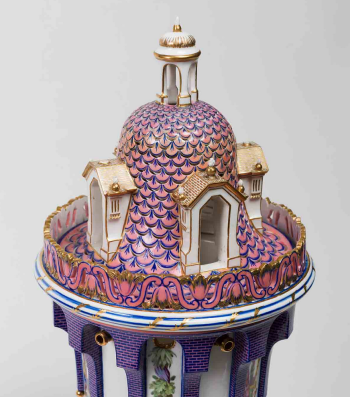 Presented in conjunction with the exhibition Inspiring Walt Disney: The Animation of French Decorative Arts, on view at The Metropolitan Museum of Art from 10 December 2021 until 6 March 2022, this live event takes place online. Watch on YouTube or Facebook (no login required).
Discover how furniture and decorative arts came to life in the literature, dance, and theater of eighteenth-century France, a theme later explored and elaborated by Disney in the classic animated film Beauty and the Beast.
• Wolf Burchard, Associate Curator, European Sculpture and Decorative Arts, The Met
• Alicia Caticha, Assistant Professor, Department of Art History, Weinberg College of Arts and Sciences, Northwestern University
• Sarah Lawrence, Iris and B. Gerald Cantor Curator in Charge, European Sculpture and Decorative Arts, The Met
• Meredith Martin, Associate Professor of Art History, Department of Art History, and Institute of Fine Arts, New York University
• David Pullins, Associate Curator, European Paintings, The Met
Online Talk | Mia Jackson on Boulle and Prints
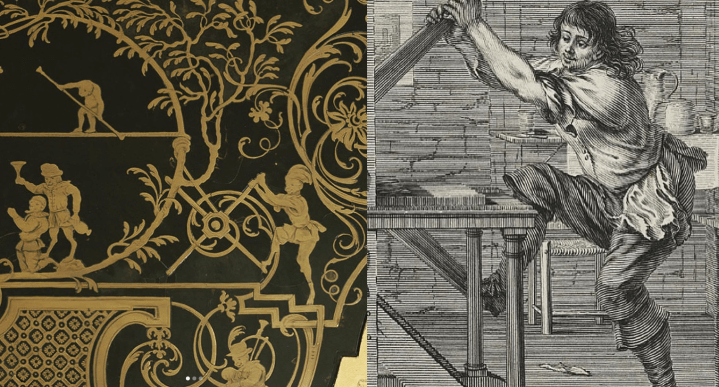
Left: André-Charles Boulle, detail of a table, veneered in turtleshell and brass, with gilt-bronze mounts, ca. 1705 (London: The Wallace Collection, F56). Right: Abraham Bosse, ‘Cette figure vous montre comme on Imprime les planches de taille douce…’, 1642, etching (London: British Museum, R,8.15).
◊ ◊ ◊ ◊ ◊
This Sunday from The Furniture History Society:
Mia Jackson | André Charles Boulle as a Maker, Designer, and Publisher of Prints
The Furniture History Society Online Lecture, 5 December 2021,7pm (GMT) / 2pm (EST)

André-Charles Boulle, table, veneered in turtleshell and brass, with gilt-bronze mounts, ca. 1705 (London: The Wallace Collection, F56).
André-Charles Boulle’s interest in print-making was not limited only to his vast collection of works on paper. The cabinet-maker also designed, made, and sold prints and used print-making techniques in the workshop. Drawing on her doctoral research, Mia Jackson will explore Boulle’s role in print-making, print-publishing, and print-selling. She will discuss Boulle’s series of prints of furniture designs, which her research into publishing history allows her to date more precisely. She will also discuss Boulle’s print design for the Confraternity of St Anne at Carmes-Billettes, and the numerous copperplates that he owned and from which he sold impressions. Dr Jackson’s talk is free to members and £5 for non-members (via this link with code AVUJEN).
Mia Jackson (@theboullelady) has been Curator of Decorative Arts at Waddesdon Manor since 2017. She studied French and Philosophy at Oxford University and then earned an MA in eighteenth-century French decorative arts at the Courtauld Insitute of Art. Her doctoral thesis entitled “André-Charles Boulle (1642–1732) and Paper: Prints and Drawings in the Workshop of an Ébéniste du Roi” was completed at Queen Mary University of London in 2016. She previously worked in the Prints and Drawings Department at The British Museum, at The Wallace Collection, and at English Heritage. She worked on the Riesener Project with The Wallace Collection and the Royal Collection, and is currently preparing a series of exhibitions on Alice de Rothschild with her colleagues at Waddesdon Manor.










leave a comment