Basile Baudez on Textiles, Policy, and Lived Spaces in 18th-C Venice
https://vimeo.com/646998977?embedded=true&source=video_title&owner=125550939
Basile Baudez contributed to this fall’s Princeton Talks series, a new initiative of the Princeton Public Lectures Committee:
Basile Baudez, “Regulation & Transgression: Textiles, Policy, and Lived Spaces in 18th-Century Venice,” Princeton Talks (Fall 2021), 14 minutes.
Online Talk | Gerstenblith on Reparations and the ‘Universal’ Museum
From Penn Museum:
Patty Gerstenblith | Imperialism, Colonialism, Reparations, and the ‘Universal’ Museum
Penn Cultural Heritage Center Lecture
Thursday, 2 December 2021, 12.30–2.00pm (ET)
In this virtual lecture hosted by the Penn Cultural Heritage Center, Patty Gerstenblith will discuss the concept of the ‘universal’ museum and its historical underpinnings. Dr. Gerstenblith will explore its origins across the arc of the 19th century, the inequities of the international legal system and its shortcomings, and the continuing justifications for the retention of looted cultural objects by European and North American museums and collectors.
The notion of the ‘universal’ museum developed in the late 18th and early 19th centuries in the context of the founding of the British Museum, the Napoleonic Wars, European imperialism and colonialism, and the mantra of the rescue narrative, which justified the removal of cultural artifacts first from the Mediterranean region and later sub-Saharan Africa and elsewhere. Evaluating the right to cultural heritage through a human rights perspective, this lecture will analyze the process and elements of reparations and will propose a paradigm for the restitution of cultural objects that fall outside of the legal and ethical frameworks.
Patty Gerstenblith, Ph.D., J.D., is distinguished research professor at the DePaul University College of Law in Chicago and faculty director of its Center for Art, Museum and Cultural Heritage Law. She was appointed by President Clinton to serve on the President’s Cultural Property Advisory Committee in the Department of State and later by President Obama as its chair. She publishes and lectures widely on the protection of cultural heritage during armed conflict and the interdiction of trafficking in archaeological materials. Her casebook Art, Cultural Heritage, and the Law is now in its fourth edition.
Online Colloquium | Celebrating the Illustrious in Europe, 1580–1750
From the programme for the conference:
La célébration des Illustres en Europe (1580-1750) : vers un nouveau paradigme?
Celebrating the Illustrious in Europe, (1580–1750): Towards a New Paradigm?
Online, 25–26 November 2021
Organized by Antoine Gallay, Carla Julie, and Matthieu Lett
Colloque organisé conjointement par l’UNIL (Section d’Histoire de l’art) et par l’Université de Bourgogne (LIR3S CNRS UMR 7366) avec le concours de la Conférence universitaire de Suisse occidentale (CUSO)
Le colloque se propose d’explorer une partie des productions biographiques d’une période usqu’alors peu étudiée sous cet angle. Les deux journées ont pour objectif de mieux comprendre comment se transformèrent, entre 1580 et 1750, les modes de célébration de la gloire des illustres, tant par l’écrit que par l’image, en tenant compte de l’ensemble des médiums que constituent le livre, l’estampe, la peinture, la sculpture ou encore la médaille.
Organisation
• Antoine Gallay (Université de Tel Aviv – The Cohn Institute), antgallay@hotmail.com
• Carla Julie (Université de Lausanne – Université de Bourgogne), carla.julie@unil.ch
• Matthieu Lett (Université de Bourgogne – LIR3S), matthieu.lett@u-bourgogne.fr
Comité scientifique
• Jan Blanc, professeur d’histoire de l’art de la période moderne (Université de Genève)
• Estelle Doudet, professeure de littérature française (Université de Lausanne)
• Laurence Giavarini, maîtresse de conférences HDR en littérature des XVIe et XVIIe siècles (Université de Bourgogne – LIR3S)
• Christian Michel, professeur d’histoire de l’art de la période moderne (Université de Lausanne)
• Frédéric Tinguely, professeur de littérature française (Université de Genève)
Lien du colloque:
https://unil.zoom.us/j/92708025500
ID de réunion : 927 0802 5500
J E U D I , 2 5 N O V E M B R E 2 0 2 1
9.15 Accueil
9.30 Introduction
• Antoine Gallay, Carla Julie, Matthieu Lett
10.00 Session 1: Nouveaux Illustres
Président de séance : Matthieu Lett
• Rémi Jimenes (Université de Tours) et Estelle Leutrat (Université Rennes 2) — Gabriel-Michel de La Rochemaillet, Jean Le Clerc et Les pourtraicts de plusieurs hommes illustres qui ont flory en France depuis l’an 1500
• Paula Almeida Mendes (CITCEM – Université de Porto) — Les ‘femmes illustres’: représentations littéraires et culturelles au Portugal, XVIe–XVIIIe siècles
• Malcolm Baker (University of California, Riverside) — How did images make modern authors illustrious?
12.30 Pause déjeuner
14.00 Session 2: Nouveaux Régimes de Célébration
Président de séance : Frédéric Tinguely
• Marion Deschamp (Université de Lorraine) — En être, ou pas. Conversions, redéfinitions et exclusions de l’économie des grandeurs dans les recueils protestants d’hommes illustres, XVIe– XVIIe siècles
• Pascale Cugy (Université Rennes 2) — Le monde du spectacle dans les portraits en mode parisiens (1690–1710) : à propos de la célébration gravée de quelques noms de la Comédie-Française et de l’Opéra
• Sophie-Luise Mävers (Universität zu Köln) — A faceless gallery of illustrious scientists and artists? Sébastien Leclerc’s orchestration of an institutional utopia
• François Lavie (Université Paris 8) — Recueillir les bons mots des « personnes illustres » dans la France moderne : pratiques de compilation et célébration de l’esprit des grands hommes, 1680–1750
V E N D R E D I , 2 6 N O V E M B R E 2 0 2 1
9.30 Session 3: Desseins Politiques
Président de séance : Laurence Giavarini
• Stanis Perez (Maison des sciences de l’homme Paris-Nord) — La Gallerie des femmes fortes : de la collection historiographique au miroir politique
• Margaux Prugnier (Université Paris Nanterre) — De la célébration des Grands à celle des Lorrains : les œuvres de Dom Calmet (1672–1757) au gré des évolutions de la France de la première moitié du XVIIIe siècle
• Craig Hanson (Calvin University, Grand Rapids) — Thomas Birch’s Heads of Illustrious Persons (1743–1751). Collecting Art, Collecting National Histories
12.00 Pause déjeuner
13.30 Session 4: De la Collection à la Célébration
Président de séance : Antoine Gallay
• Clarisse Evrard (Université de Lille) — Regard d’un illustre sur ses pairs : l’Armamentarium Heroicum, de la collection d’armures au théâtre de papier
• Carla Julie (Université de Lausanne – Université de Bourgogne) — Curieux d’estampes et Illustres dans la France du XVIIe siècle : autour de Michel de Marolles
• Maxime Martignon (Université Paris Nanterre) — Choisir les Illustres : Michel Bégon et le projet biographique
16.00 Conclusion
• Christian Michel (Université de Lausanne)
Online Book Launch | Enlightened Eclecticism
This Friday at 6.30pm (GMT) via Zoom:
Adriano Aymonino, Enlightened Eclecticism: The Grand Design of the 1st Duke and Duchess of Northumberland
Online Book Launch, Sir John Soane’s Museum, London, 19 November 2021
 Hosted by Sir John Soane’s Museum in their beautiful library, and presented in collaboration with the Society for the History of Collecting, this virtual event will celebrate the publication of Adriano Aymonino’s new book, Enlightened Eclecticism: The Grand Design of the 1st Duke and Duchess of Northumberland.
The central decades of the eighteenth century in Britain were crucial to the history of European taste and design. One of the period’s most important campaigns of patronage and collecting was that of the 1st Duke and Duchess of Northumberland: Sir Hugh Smithson (1712–86) and Lady Elizabeth Seymour Percy (1716–76). This book examines four houses they refurbished in eclectic architectural styles—Stanwick Hall, Northumberland House, Syon House, and Alnwick Castle—alongside the innumerable objects they collected, their funerary monuments, and their persistent engagement in Georgian London’s public sphere. Over the years, their commissions embraced or pioneered styles as varied as Palladianism, rococo, neoclassicism, and Gothic revival. Patrons of many artists and architects, they are revealed, particularly, as the greatest supporters of Robert Adam. In every instance, minute details contributed to large-scale projects expressing the Northumberlands’ various aesthetic and cultural allegiances. Their development sheds light on the eclectic taste of Georgian Britain, the emergence of neoclassicism and historicism, and the cultures of the Grand Tour and the Enlightenment.
S C H E D U L E
18.30 Introduction by Frances Sands (Curator of Drawings and Books, Sir John Soane’s Museum)
18.40 Talk by Kate Retford (Professor of Art History, Birkbeck, University of London)
19.10 Talk by Adriano Aymonino (Senior Lecturer and Director of Undergraduate Programs, Department of History and History of Art, University of Buckingham)
19.30 Conversation and questions moderated by Adriana Turpin (Director of Institut Des Etudes Superieurs Des Arts UK)
Lecture | Frédéric Ogée, Pleasures of the Senses and the Imagination
From the conference series Sociabilité et libertinage au siècle des Lumières, organized at the Cognacq-Jay Museum in conjunction with this year’s summer exhibition Realm of the Senses, from Boucher to Greuze / L’ Empire des sens, de Boucher à Greuze (19 May — 18 July 2021), curated by Annick Lemoine . . .
Frédéric Ogée | Plaisirs des sens, plaisirs de l’imagination dans l’art et la littérature anglaise du 18ème siècle
Online and In-Person, Musée Cognacq-Jay, Paris, 26 November 2021, 17.00
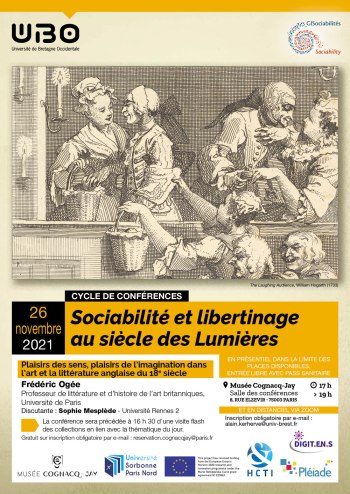 Dans le sillage de sa « Glorieuse Révolution » de 1688, l’Angleterre inaugura le siècle des Lumières en découvrant le plaisir d’un certain nombre de libertés : « régler le pouvoir des rois en leur résistant » (Voltaire), publier sans entrave, ré-évaluer l’héritage des Anciens, regarder la Nature à travers le prisme de Newton plutôt que celui des prêtres, entreprendre à crédit, célébrer la sensibilité et l’imagination. Les Anglais ont ainsi cherché de nouveaux équilibres entre la liberté de l’individu—son goût, sa subjectivité, sa perception du monde, son « progrès » —et les nécessités de la sphère collective, qu’elle soit publique ou privée. Ecrivains et artistes se sont vite employés à représenter cette nouvelle sociabilité, pour la modéliser et la polir autant que pour la promouvoir, au travers de remarquables expériences littéraires et picturales où les personnages se meuvent et s’émeuvent sous l’œil complice du spectateur-lecteur. Influencés par la philosophie empiriste ils font l’expérience du plaisir des sens pour accéder à la connaissance, d’eux-mêmes et du monde. La présente conférence permettra d’évoquer cette remarquable période de créativité qui, de Daniel Defoe et William Hogarth à Jane Austen et Thomas Lawrence, contribua au triomphe de la Grande-Bretagne sur la scène du monde.
Discutante: Sophie Mesplède (Université Rennes 2)
Frederic Ogee est professeur de littérature et d’histoire de l’art britanniques à l’Université de Paris. Ses principaux domaines de recherche sont l’esthétique, la littérature et l’art au cours du long 18ème siècle (1660–1815), sur lesquels il a souvent donné des conférences dans des universités européennes, nord-américaines et asiatiques. Commissaire de l’exposition sur le peintre anglais William Hogarth au Musée du Louvre en 2006, il est l’auteur de plusieurs ouvrages, notamment Diderot and European Culture, un recueil d’essais (Oxford: 2006, réédité 2009), J.M.W. Turner : Les paysages absolus (Hazan, 2010), et Jardins et Civilisations (Valenciennes, 2019), suite à une conférence organisée à l’Institut Européen des Jardins et Paysages de Caen. Il écrit actuellement une série de quatre monographies sur quelques grands artistes anglais (Thomas Lawrence, J.M.W. Turner, Thomas Gainsborough et William Hogarth) pour les éditions Cohen & Cohen (Paris), à paraître entre 2022 et 2025. De 2014 à 2017, il a été membre du conseil scientifique du musée Tate Britain à Londres et, depuis 2014, est membre du Conseil Scientifique de la Ville de Paris.
Conférence en présentiel dans la limite des places disponibles, entrée libre avec pass sanitaire ET en distanciel via Zoom. Participation libre sur inscription obligatoire: reservation.cognacqjay@paris.fr et alain.kerherve@univ-brest.fr. La conférence sera précédée à 16h30 d’une visite flash des collections en lien avec la thématique du jour.
Emmanuelle Brugerolles, Marine Carcanague, Marie-Anne Dupuy-Vachey, Guillaume Faroult, Yuriko Jackall, F. Joulie, É. Kerner, A. Laing, C. Le Bitouzé, A. Le Brun, A. Lemoine, N. Lesur, H. Meyer, L-A. Prat, S. de Saint-Léger, M. Szanto, L’ Empire des sens, de Boucher à Greuze (Paris Musées / Musée Cognac-Jay, 2020), 152 pages, ISBN: 978-2759605002, €30.
Online Talks | HECAA Emerging Scholars Showcase
This afternoon!
HECAA Emerging Scholars Showcase
Online, Saturday, 13 November 2021, 2:00–3:30pm (EST)
A reminder to join us for our HECAA Emerging Scholars Showcase on Saturday, 13 November, 2:00–3:30pm, EST. Please register via the zoom link below to hear our first seven emerging scholars present their research. Each participant will present for 3–5 minutes, and after all of the presentations we will host a question and answer session. Zoom Registration Link. Also, please also mark your calendars for our next Emerging Scholars Showcase to be held on Saturday, 23 April 2022.
Best wishes,
HECAA Board
◊ ◊ ◊ ◊ ◊
1 Deborah A. Fisher (Independent Scholar / PhD, Penn State University, 2021), The Metamorphoses of John Singleton Copley: Mythological Characters in American Colonial Portraiture
2 Samantha Happe (University of Melbourne), Between Isfahan and Versailles: Royal Diplomatic Gift Exchange in the Eighteenth Century
3 Philippe Halbert (Yale University), Letters of a Canadian Woman: Identity and the Self-Fashioning in the Atlantic World of Madame Bégon, 1696–1755
4 Cynthia Volk (Bard Graduate Center), Dehua Porcelain Figures of Budai: Models of Adaptivity in Seventeenth- and Eighteenth-Century China and Europe
5 Zoë Dostal (Columbia University), Rope, Linen, Thread: Gender, Labor, and the Textile Industry in Eighteenth-Century British Art
6 Alyse Muller (Columbia University), Between Land and Sea: French Maritime Imagery in the Long Eighteenth Century
7 Andrea Morgan (Independent Scholar / PhD, Queen’s University, 2021), Frances Reynolds and Mary Nugent-Temple-Grenville, Marchioness of Buckingham: Female Artists in the Orbit of Sir Joshua Reynolds
Online Workshop | Cotsen Textile Collection: From India to the World
From The George Washington University Museum:
The Cotsen Textile Traces Global Roundtable: From India to the World
Online, 17–18 November 2021

Panel fragment, painted and resist dyed, India, ca. 1770, 96 × 46 cm (Cotsen Textile Traces Study Collection T-2021, The George Washington University Museum and The Textile Museum).
More than 200 textiles from India form a cornerstone of the Cotsen Textile Traces Study Collection at The George Washington University Museum and the Textile Museum in Washington, D.C. They testify to cross-cultural exchanges, offer a rich resource for artistic inspiration and cross-disciplinary research, and serve as the inspiration for the Center’s second annual Cotsen Textile Traces Global Roundtable. On November 17, the theme is ‘Embroidered Textiles’; on November 18, ‘Painted and Printed Textiles’.
The Cotsen Textile Traces Study Collection represents a lifetime of collecting by business leader and philanthropist Lloyd Cotsen (1929–2017). Comprised of nearly 4,000 fragments from all over the world, the collection offers insights into human creativity from antiquity to the present. Cornerstones of the collection include fragments from Japan, China, pre-Hispanic Peru, and 16th- to 18th-century Europe. The entire collection is available online.
To join us for the roundtable, please register early to reserve your space. Once you have registered, we will email you links and details for joining each day of the roundtable on Zoom. We will also email registered participants a full program with a detailed schedule.
This program is made possible through funding from the Cotsen Textile Traces Study Collection Endowment, as well as support from Barbara Tober in honor of Dr. Young Yang Chung.
W E D N E S D A Y , 1 7 N O V E M B E R 2 0 2 1
Embroidered Textiles
9.00 Welcome and Introduction to Indian Embroidered Textiles from the Cotsen Textile Traces Study Collection
• Lori Kartchner, curator of education
• John Wetenhall, director
• Marie-Eve Celio-Scheurer, academic coordinator for the Cotsen Textile Traces Study Center
9.20 Keynote Conversation: Indian Textiles: Conversing with the Transcendent
• Ghiora Aharoni, Cotsen Studio artist-in-residence
• Mayank Mansingh Kaul, independent curator and writer, New Delhi
10.00 Panel 1: Chikankari and Inspiration for Today’s Fashion
• Shalini Sethi, creative head, Good Earth, New Delhi
• Paola Mandfredi, independent researcher and consultant, Milano, Italy
• Jaspal Kalra, social entrepreneur, design educator, executive director of Kalhath Institute, Lucknow, India
11.00 Panel 2: Kantha, Then and Now
• Ruchira Ghose, former director, National Crafts Museum, New Delhi
• Niaz Zaman, advisor, Department of English and Modern Languages, Independent University, Dhaka, Bangladesh
• Pika Ghosh, visiting associate professor, Haverford College, Haverford, Pa.
Noon Panel 3: Embroidered Traditions From Kashmir and Beyond
• Monisha Ahmed, independent anthropologist, Mumbai, India
• Asaf Ali, co-founder of the Kashmir Loom Company, New Delhi and Srinagar, Jammu and Kashmir
1.00 Reflections on Day 1
• Maximiliano Modesti, craft and fashion entrepreneur, Paris and Mumbai, India
• Attiya Ahmad, associate professor of anthropology and international affairs, George Washington University, Washington, D.C.
T H U R S D A Y , 1 8 N O V E M B E R 2 0 2 1
Painted and Printed Textiles
9.00 Introduction to Indian Painted and Printed Textiles from the Cotsen Textile Traces Study Collection
• Lori Kartchner, curator of education
• Marie-Eve Celio-Scheurer, academic coordinator for the Cotsen Textile Traces Study Center
9.15 Keynote Lecture: Indian Printed and Painted Textiles, a Global Phenomenon
• Lee Talbot, curator, The Textile Museum Collection
• Ben Evans, editor, Hali Publications, London
• Rosemary Crill, former senior curator, Victoria and Albert Museum, London
10.00 Panel 1: Hand Painted and Printed in India Today
• Brigitte Singh, artist, artisan and designer, Jaipur, India
• Renukha Reddy, artist, Red Tree Studio, Bangalore, India
• Sufiyan Ismail Khatri, Ajrakh craftsman, Kutch, India
11.00 Panel 2: From India to the World (Asia and Africa)
• Sae Ogasawara, professor emeritus, Japan Women’s University, Tokyo
• Ruth Barnes, curator, Yale University Art Gallery, New Haven, Conn.
• Sarah Fee, senior curator of global fashion and textiles, Royal Ontario Museum, Toronto
Noon Panel 3: From India to the World (Europe and America)
• Helen Bieri Thomson, director, Musée national suisse, Zürich, Switzerland
• Sylvia W. Houghteling, assistant professor, Department of History of Art, Bryn Mawr College, Bryn Mawr, Pa.
• Amelia Peck, Marica F. Vilcek Curator of American Decorative Arts and supervising curator of the Antonio Ratti Textile Center, The Metropolitan Museum, New York
Online Workshop | Insects and Colours between Art and Natural History
From ArtHist.net:
Insects and Colours between Art and Natural History
Online, 29–30 November 2021
Organized by V. E. Mandrij and Giulia Simonini
This two-day online workshop addresses the issue of recording colours in entomology during the 17th and 18th centuries. Because of the bewildering variety of insect colours, artists and naturalists had difficulty describing and reproducing them with pigments. Some early modern scholars disapproved of using colours to depict insects in entomological illustrations. Other naturalists instead collaborated with artists to document the colours and shapes of insects.
Centuries later, this cooperation continues. Although irrelevant for the study of their anatomy, colour was significant for the identification of different species. However, artists and naturalists had different ways of tackling the problem of recording the appearances and names of the chromatic variety that exists in the insect world. Despite the variety of approaches and techniques used or proposed to record the colors of insects, this issue has not received the scholarly attention it deserves.
This workshop investigates the relationship between colours and insect images and aims to answer questions such as: Why in entomology, more than in any other discipline, were so many different approaches developed to address the problem of recording colours? Why did painters and scholars not agree on one unique method? To what extent did their subjectivity play a role in their choice of approach?
Speakers from several fields will discuss the topic of recording the colours of insects in art and natural history. They will touch on topics such as the significance of entomology in the development of color standardization practices, new artistic techniques (such as lepidochromy) and optical theories.
To attend the online workshop and receive the zoom-link, please register by emailing the organisers Giulia Simonini (giulia.simonini[at]tu-berlin.de) and V.E. Mandrij (v.e.mandrij[at]uni-konstanz.de). The maximum number of participants is 40. Listed times correspond with Central European Time (CET).
M O N D A Y , 2 9 N O V E M B E R 2 0 2 1
14.00 Zoom room opens
14.15 Introduction
Giulia Simonini (she) and V. E. Mandrij (they), Translating Natural Colours of Insects
15.00 Break
15.10 Depicting Insects and Colouring Practices
Panellist: Florike Egmond
• Erma Hermens, Painting Insects in 17th-Century Netherlands: Written Instruction and Practice
• Giulia Simonini, Painting by Numbers and Entomology
• Beth Tobin, Colouring Drawings of Insects at Home and Abroad
17.10 Break
17.20 Colours of Insects
Panellist: Hanneke Grootenboer
• Kay Etheridge, The Biology of Colour
18.00 Break
18.10 Aperitivo
T U E S D A Y , 3 0 N O V E M B E R 2 0 2 1
14.00 Zoom room opens
14.05 Entomologists and Colours
Panellist: Friedrich Steinle
• Katharina Schmidt-Loske, Observation and Depiction: Maria Sibylla Merian’s Individual Style of Drawing Insects and Plants
• Stefanie Jovanovic-Kruspel, The Somber and Opaque Colors of Butterflies: Schiffermüller and His Attempt of a Colour System
15.25 Break
15.35 Lepidochromy
Panellist: Karin Leonhard
• V.E. Mandrij, ‘Butterflies Truer-to-nature than Paintings’: Colours in Lepidochromy Technique
• Grace Touzel, Lepidochromy at the Natural History Museum (London): Butterfly Wings as a Printing Medium
16.55 Break
17.05 Colours of Insects
Panellist: Hossein Rajaei
• Brian Ogilvie, Catching the Rainbow: Iridescent Insects Before Iridescence
17.45 Break
18.00 Final Discussion with Dominik Hünniger
Online Workshop | Antiquitatum Thesaurus
From the BBAW:
Antiquitatum Thesaurus: Antiken in den Wissensspeichern der Frühen Neuzeit und heute
Online, Berlin-Brandenburgische Akademie der Wissenschaften, 10 November 2021, 8pm
Registration due by 9 November 2021
Please join us for the inaugural online event of the Antiquitatum Thesaurus project, a long-term project initiated at the beginning of 2021 at the Berlin-Brandenburg Academy of Sciences and Humanities and devoted to documenting the tradition of antique material culture in visual sources from the 17th and 18th centuries. Under the direction of Elisabeth Décultot, Arnold Nesselrath, and Ulrich Pfisterer, the project aims to study a large corpus of diverse source material ranging from printed books to drawing collections and culminating in Bernard de Montfaucon’s L’Antiquités expliquée et représentée en figures in order to contribute to our understanding of the early modern views of the remains of Antiquity throughout Europe and the Mediterranean by identifying and cataloguing objects that—beyond ancient literary texts—served as reference points for antiquarians. All the information gathered in the process will be stored in a digital research platform that will illustrate and visualize the complex relationships between objects, sources, places, and people over time.
Register here»
P R O G R A M M
Grußworte
• Christoph Markschies (Akademiepräsident)
• Tonio Sebastian Richter (Sprecher des Zentrums Grundlagenforschung Alte Welt Akademiemitglied, Freie Universität Berlin)
Der Antiquitatum Thesaurus
• Elisabeth Décultot (Projektleitung, Martin-Luther-Universität Halle-Wittenberg)
• Arnold Nesselrath (Projektleitung, Rom / Berlin)
• Ulrich Pfisterer (Projektleitung, Ludwig-Maximilians-Universität München Zentralinstitut für Kunstgeschichte)
Investigating Cassiano dal Pozzo’s ‘Paper Museum’: Lights and Shadows
• Eloisa Dodero (Musei Capitolini, Rom)
Thesauri antiquitatum: storie e sfide
• Elena Vaiani (Pisa)
Paris–Province (XVIIIe–XIXe siècle): à chacun son Antiquité?
• Véronique Krings (Université de Toulouse – Jean Jaurès)
Antiquitatum Thesaurus – Fallstudie und digitale Strategie
• Cristina Ruggero (BBAW)
• Timo Strauch (BBAW)
Online Symposium | Hidden Hands: Untold Stories of the Object

Plate 419, Silver-plating in L’Enclopédie, ou Dictionnaire Raisonné des Sciences, des Arts et des Métiers by Denis Diderot.
◊ ◊ ◊ ◊ ◊
From the MFAH:
Hidden Hands: Untold Stories of the Object
Rienzi Biennial Symposium
Online, Rienzi, The Museum of Fine Arts, Houston, 6 November 2021
Geographic exploration and colonial expansion led to the introduction of new materials and technological innovation in the early modern period. These developments created an increased demand for goods made of ceramics, glass, exotic woods, textiles, and metals. The refining of raw materials and the production of these goods depended upon a diverse labor force made up of men, women, and children from across the globe. Despite the integral roles played by these workers in all of these varied enterprises, their names and contributions have often been lost to history. Who were these people? How did they interact and engage with these new materials and goods? What social, political, and economic forces contributed to the exclusion of their narratives? The symposium invites scholars to reconsider established ideas of craftsmanship and artistic authorship through the telling of these ‘hidden’ stories.
The symposium will be held in conjunction with the exhibition Hidden Hands: Invisible Workers in Industrial England, on view at Rienzi from 1 September 2021 to 3 January 2022.
Registration for the symposium is available here»
P R O G R A M M E
10.00 Session 1: Industry and Craft
• Misty Flores (Assistant Curator, Rienzi), Hidden Hands: Invisible Workers in Industrial England
• Javier Fernández Vázquez (PhD Candidate, Universidad Autónoma de Madrid), All the Names: Recovering the Ignored Authorship of Metal-Casting Patterns
• Daichi Shigemoto (PhD Student, The University of Texas at Austin), Hidden Hands for Frank Lloyd Wright’s Imperial Hotel in Tokyo
• Q&A
11.10 Break
11.40 Session 2: Cultural Exchanges in the Americas
• Alfredo A. Ortega-Ordaz (Conservator, National Museum of Anthropology, Mexico City), Lightweight Sculpting: About Admiration and Exclusion
• Marco Díaz-Güemez (Research Professor, Escuela Superior de Artes de Yucatán), The Yucatan Hammock as a Product of Mayan Women: Tradition, Adaptation, and Resistance
• Philippe Halbert (PhD Candidate, Yale University), A Toilette in Their Fashion: Indigenizing the Dressing Table in the French Atlantic World
• Q&A
12.55 Break
1.05 Session 3: Movement of People and Ideas
• Lindsay Alberts (Professor, SCAD), Mustafa di Ramadano: Slavery Hidden in the Hardstones of the Cappella dei Principi
• Jordan Smith (Assistant Professor, Widener University), The Caribbean Origins of European Craftsmanship: A Case Study in Rum
• Bindy Barclay (Freelance Writer and Researcher), Unraveling Cook’s Voyage: Repopulating the Colonial Exotic
• Q&A










leave a comment