Online Symposium | Drawn to Blue
From the University of Amsterdam, as announced at ArtHist.net:
Drawn to Blue
Online, 12–13 November 2024
Organized by Edina Adam, Leila Sauvage, and Michelle Sullivan
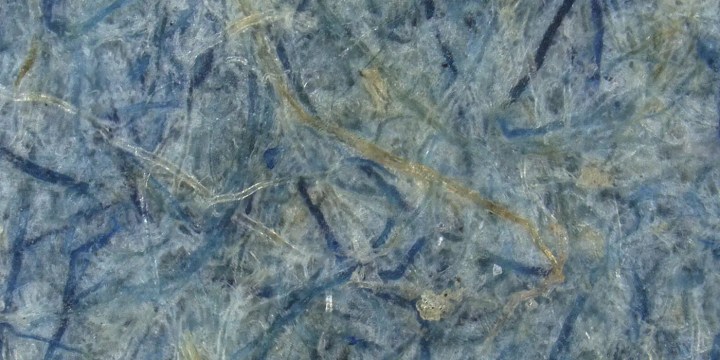
This two-day online symposium, co-organized by the J. Paul Getty Museum and the University of Amsterdam, brings together art historians and paper and textile conservators to share their new research on the history of early modern blue paper.
Made from discarded blue rags, early modern blue paper was a humble material. However, producing it required expert knowledge, and its impact on European draftsmanship was transformative. The rich history of blue paper, from the fifteenth to the mid-eighteenth centuries, illuminates themes of transcultural interchange, international trade, and global reach. Inspired by the recent Getty exhibition Drawing on Blue: European Drawings on Blue Paper, 1400s–1700s and coinciding with the current exhibition Drawn to Blue: Artists’ Use of Blue Paper at the Courtauld, this two-day online symposium brings together art historians and paper and textile conservators to share their new research on the history of early modern blue paper.
Registration is available here»
All times listed in Pacific Time and Central European Time.
t u e s d a y , 1 2 n o v e m b e r
9.00am / 6.00pm Opening remarks by Edina Adam, Leila Sauvage, and Michelle Sullivan
9.10am / 6.10pm Artistic and Non-artistic Use of Blue Paper
• Presence of the Blue Paper inside French Paintings of the 18th Century — Lorenzo Giammattei and Selene Secondo, La Sapienza Università di Roma
• Seeds of Blue: Archival Evidence of the Use of Blue Paper as Seed Packets — Maria Zytaruk, University of Calgary
10.15am / 7.15pm Raw Materials, Trade, Economics
• Blue Paper: Its Life, Origin, History and Artistic Exploration — Judith Noorman, University of Amsterdam
• Paper, Pastels, and Patriotism: Artistic Innovation and the American Revolution — Megan Baker, University of Delaware
11.20am / 8.20pm Works in Progress: Study, Examination, Collection Surveys on Blue Paper
• Surveying The Morgan’s Blue Paper Collection — Elizabeth Gralton, Reba Fishman Snyder, and Rebecca Pollak, The Morgan Library & Museum
• The Blue Paper Project at the Art Gallery of Ontario: Developing an Architecture for Close Looking of Drawing Supports — Maia Donnelly, Joan Weir, and Tessa Thomas, Art Gallery of Ontario
• The Blue Papers of Allan Ramsay at the National Galleries Scotland — Charlotte Park, Clara de la Pena McTigue, and Charlotte Topsfield, National Gallery of Scotland
w e d n e s d a y , 1 3 n o v e m b e r
9.00am / 6.00pm Technical Case Studies
• On Blue: The Portrait Drawings of Ottavio Leoni — Georg Dietz et al., Kupferstichkabinett, Staatliche Museen zu Berlin
• Out of the Blue? Tracing Object Biographies, Early Conservation Treatments, and the Original Appearance of Italian Old Master Drawings on Blue Paper at the Kunstmuseum — Annegret Seger, Rebecca Honold, and Max Ehrengruber, Kunstmuseum Basel
• Blue Paper in Late-19th Century Paris: Mary Cassatt Pastel Supports — Tom Primeau, Philadelphia Museum of Art
10.30am / 7.30pm Printing on Blue Paper
• From Aldus to Zanetti, Parenzo to Proops, Venice to Volhynia: Three Centuries of Hebrew Printing on Blue Paper in Southern, Western, Central, and Eastern Europe — Brad Sabin Hill, George Washington University
• Blueprint(s) — Armin Kunz, C.B. Boerner Gallery
• Etched in Blue: A Unique Set of Prints by the Abbé de Saint-Non — Rachel Hapoienu, Courtauld Gallery of Art
11.55 am / 8.55pm Roundtable
Moderated by Ketty Gottardo, Courtauld Gallery of Art
Program participants reflect on new insights, questions raised, and future avenues of research.
Conference | Unfolding the Coromandel Screen
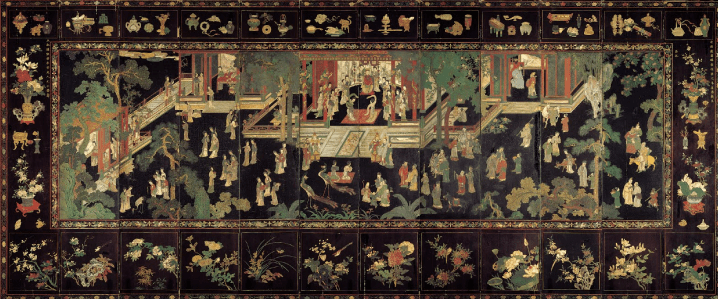
Coromandel Screen, Kangxi reign (1662–1722), Qing dynasty, carved lacquer, 258 × 52 × 3.5 cm
(Art Museum, The Chinese University of Hong Kong, 2001.0660)
◊ ◊ ◊ ◊ ◊
From the conference website and programme:
Unfolding the Coromandel Screen: Visual Mobility, Inscribed Objecthood, and Global Lives
Online and in-person, City University of Hong Kong, 22–23 November 2024
Organized by by Lianming Wang and Mei Mei Rado
During the second half of the seventeenth century, the production of Coromandel screens, also known as kuancai (‘carved polychrome’), flourished along China’s southeast coast. These screens became immensely popular both domestically and in European markets, establishing connections between regional artisans, merchants, and prominent European figures, including royalty and nobility. In the last two decades of this century, Coromandel screens emerged as one of China’s most frequently exported commodities, rivaling porcelain and challenging Japanese lacquerware exports. Their significance extends far beyond the common perception of them as merely mass-produced craftwork of inferior quality.
 With the generous support of the Bei Shan Tang Foundation, the Department of Chinese and History at City University of Hong Kong will host a two-part academic event titled Unfolding the Coromandel Screen to celebrate the department’s tenth anniversary. The conference, organized by Lianming Wang (City University of Hong Kong) in collaboration with Mei Mei Rado (Bard Graduate Center, New York), will take place on-site at City University of Hong Kong and via Zoom from 22 to 23 November 2024. It will bring together an international group of art historians, museum curators, conservators, collectors, and global historians. Participants will explore various aspects of the Coromandel screen and its intricate histories, including its interrelations with paintings, prints, decorative arts, palatial and interior designs, global maritime trade, and the fashion industry. Following the conference, the speakers will join a two-day traveling seminar from 24 to 25 November, visiting lacquer and conservation workshops as well as museum collections in Hong Kong and Guangzhou.
Registration for both onsite and online participation is available here»
Advisory Board
May Bo Ching (City University of Hong Kong), Burglind Jungmann (UCLA), Mei Mei Rado (Bard Graduate Center, New York), Anton Schweizer (Kyushu University), Ching-Fei Shih (National Taiwan University), Lianming Wang (City University of Hong Kong), Xiaodong Xu (†) (Art Museum of The Chinese University of Hong Kong)
Supporting Institutions
Art Museum of The Chinese University of Hong Kong, Indra and Harry Banga Gallery of City University of Hong Kong , Hong Kong Maritime Museum, Lee Shau Kee Library of The Hong Kong University of Science and Technology, Guangdong Provincial Museum, Guangzhou Museum, Chen Clan Ancestral Hall – Guangdong Folk Arts Museum
f r i d a y , 2 2 n o v e m b e r
8.30 Registration
9.00 Welcome and Introduction
• May Bo Ching (City University of Hong Kong), Lianming Wang (City University of Hong Kong), and Mei Mei Rado (Bard Graduate Center, New York)
9.15 Keynote
• Transcultural Treasures: Kuancai (Coromandel) Screens in China and Abroad — Jan Stuart (National Museum of Asian Art, Washington DC)
10.00 Coffee break
10.15 Panel 1 | Coromandel Screens as Sites of Power Representation
Chair: Libby Chan (Indra and Harry Banga Gallery, City University of Hong Kong)
• Place, Scale, and Medium in Several Cartographic Coromandel Screens — Stephen Whiteman (The Courtauld Institute of Art, London)
• Picture of the Immense Sea: Temporal and Spatial Transformation on the Birthday Celebration Screen of
Nan’ao (in Chinese with English subtitles) — Weiqi Guo (Guangzhou Academy of Fine Arts)
11.15 Panel 2 | Coromandel Screens and Intra-Asian Visual Entanglements
Chair: Wan Chui Ki Maggie (The Chinese University of Hong Kong)
• Coromandel Screens and Japanese Seminary Painters in Macau — Yoshie Kojima (Waseda University, Tokyo)
• When the Barbarians Came by Sea: Hunting Screens in China and Japan — Lianming Wang (City University of Hong Kong)
• Transcultural Pictorial Dynamics: Coromandel Screens and Joseon Court Painting and Visual Culture — Yoonjung Seo (Myongji University, Seoul)
12.40 Lunch break
14.00 Panel 3 | Format, Motif, and Technique: Understanding Coromandel Screens
Chair: Daisy Wang (Hong Kong Palace Museum)
• A Screen So Grand: Coromandel Screens from the Perspective of Scale — Tingting Xu (University of Rochester, New York)
• Decoding Frames: Unveiling Names, Provenance, and Connections of the Framed Images on the ‘Dutch
Tribute Screen’ in the National Museum of Denmark, Copenhagen — Xialing Liu (Central Academy of Fine Arts, Beijing / Utrecht University)
• Textiles, Taste, and Templates: Kuancai Screen Motifs and Techniques — Ricarda Brosch (Museum am Rothenbaum – World Culture and Arts, Hamburg)
• Copy Culture and Commodification in Coromandel Screens and Related Lacquerwares, 1680–1780 — Tamara Bentley (Colorado College)
15.40 Coffee Break
16.00 Panel 4 | Materials and Conservation: Perspectives from Labs and Workshops
Chair: Josh Yiu (Art Museum, The Chinese University of Hong Kong)
• On the Origins and Regional Differences of the Kuancai Screens (in Chinese with English subtitles) — Bei Chang (Southeast University, Nanjing) and Linlong Li (Centre de recherche sur les civilisations de l’Asie orientale, Paris)
• A Conservator’s Perspective: Technical Examination and Treatment Strategies for Coromandel Lacquer from the Kangxi Period — Christina Hagelskamp (The Metropolitan Museum of Art, New York)
• Scientific Analysis of a Coromandel Cabinet from the Victoria and Albert Museum, London — Julie Chang (Fu Jen Catholic University, Taipei) and Lucia Burgio (Victoria and Albert Museum, London)
18.00 Museum Visit — Might and Magnificence: Ceremonial Arms and Armour across Cultures,
Indra and Harry Banga Gallery, City University of Hong Kong
19.00 Dinner
s a t u r d a y , 2 3 n o v e m b e r
9.15 Keynote
• The Taste for Coromandel Lacquer in France in the 17th and 18th Centuries: Trade, Reception, and Customs — Stéphane Castelluccio (CNRS, Centre André Chastel, Paris)
10.00 Coffee Break
10.30 Panel 5 | Coromandel Screens as Global Artefacts
Chair: Phil Kwun-nam Chan (Art Museum, The Chinese University of Hong Kong)
• On the ‘Exoticness’ of the Coromandel Lacquerware — Ching-Ling Wang (Rijksmuseum Amsterdam)
• Coastal Landscape and Scenes of Europeans on Coromandel Folding Screens — Rui Oliveira Lopes (Museu das Convergências, Porto)
• Differences and Commonalities: Links between 17th- and 18th-Century Coromandel Export Lacquer Pieces and Luso-Asian Lacquers of the Previous Century — Ulrike Körber (IHA/FCSH//IN2PAST – Universidade Nova de Lisboa)
12.00 Lunch break
13.30 Panel 6 | Coromandel Screens and Their Global Lives, Part One
Chair: Nicole Chiang (Hong Kong Palace Museum)
• Beyond the Closet: The Taste for Coromandel Lacquerware Furniture in Holland and England, ca. 1675–1700 — Alexander Dencher (Rijksmuseum Amsterdam)
• ‘Sawed, Divided, Cut, Clift, and Split Asunder’? A Case Study of a European Chest of Drawers Decorated with Excerpts from a Coromandel Screen of Known Pictorial Model — Grace Chuang (Independent Scholar, Detroit)
• Reframing the West Lake in French Furniture and Interiors — Nicole Brugier (Ateliers Brugier, Paris)
14.30 Coffee Break
14.45 Panel 7 | Coromandel Screens and Their Global Lives, Part Two
Chair: Florian Knothe (University Museum and Art Gallery, The University of Hong Kong)
• The ‘Japanese Cabinet’ at the Hermitage in Bayreuth, Germany — Patricia Frick (Museum für Lackkunst, Münster)
• The Ludic Afterlife of Coromandel Screens: Integrating the Swinging Woman into 18th-Century French Interiors — Weixun Qu (Washington University in St. Louis)
16.00 Short Break
16.15 Panel 8 | The Afterlives of the Coromandel Screens
Chair: May Bo Ching (City University of Hong Kong)
• Art Dealer Florine Langweil and the European Market for Coromandel Screens in the Early 20th Century — Elizabeth Emery (Montclair State University, New Jersey)
• Inspiring Art Deco in Britain: The Architect, the Theatre, and the Coromandel Screen — Helen Glaister (Victoria and Albert Museum, London)
• Shifting Identities and Global Circulation of the Coromandel Screen in Early-20th-Century Buenos Aires — Mariana Zegianini (SOAS University of London)
• The Framework of Modernism: Lacquer Screen and Fashion Imagination in the 1920s — Mei Mei Rado (Bard Graduate Center, New York)
Exhibition | Colonial Crossings: The Spanish Americas

Unidentified workshop, Cuzco, Peru, Our Lady of the Rosary of Chiquinquirá with Female Donor, late 17th–early 18th century, oil and gold on canvas (Collection of Carl & Marilynn Thoma, 2013.046; photo by Jamie Stukenberg).
◊ ◊ ◊ ◊ ◊
Now on view at Cornell’s Johnson Museum of Art:
Colonial Crossings: Art, Identity, and Belief in the Spanish Americas
Johnson Museum of Art, Cornell University, Ithaca, New York, 20 July 2024 — 15 December 2024
Curated by Andrew Weislogel and Ananda Cohen-Aponte, with students in the course Colonial Connectivities: Curating the Arts of the Spanish Americas
The artworks featured in this exhibition span more than three hundred years of history, five thousand miles of territory, and two oceans, introducing the rich artistic traditions of Mexico, Venezuela, Colombia, Ecuador, Peru, Bolivia, Cuba, Puerto Rico, and the Philippines during the period of Spanish colonial rule (approximately 1492–1830).
This first exhibition of colonial Latin American art at Cornell considers the profound impact of colonization, evangelization, and the transatlantic slave trade in the visual culture of the Spanish empire, while also manifesting the creative agency and resilience of Indigenous, Black, and mixed-race artists during a tumultuous historical period bookended by conquest and revolution.
At first glance, these religious images, portraits, and luxury goods might seem to uphold colonial structures that suggest a one-way flow of power from Europe to the Americas. Yet closer consideration of these artists’ identities, materials, techniques, and subjects reveals compelling stories about the global crossings of people, commodities, and ideas in the creation of new visual languages in the Spanish Americas. These artworks testify to entangled cultural landscapes—from paintings of the Virgin Mary with ties to sacred sites of her apparition, to lacquer furniture bearing the visual stamp of trade with East Asia, they embody a plurality of cultural, material, and religious meanings.
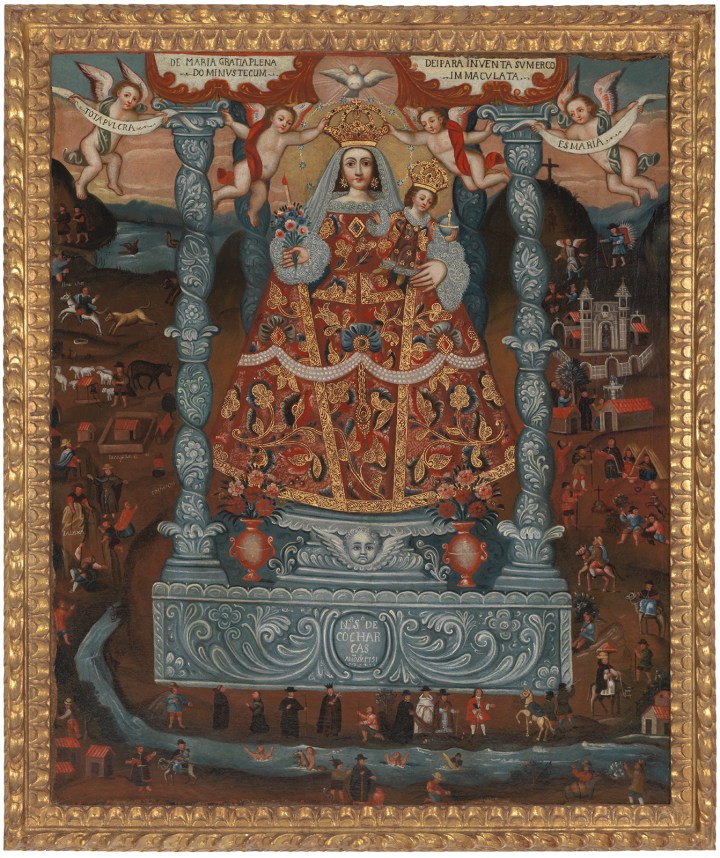
Unidentified workshop, Peru, Our Lady of Cocharcas, 1751, oiil and gold on canvas (Collection of Carl & Marilynn Thoma, 2011.040; photo by Jamie Stukenberg).
Colonial Crossings was curated by Dr. Andrew C. Weislogel, Seymour R. Askin, Jr. ’47 Curator of Earlier European and American Art at the Museum, and Dr. Ananda Cohen-Aponte, Associate Professor of the History of Art & Visual Studies, and the students in Colonial Connectivities: Curating the Arts of the Spanish Americas (ARTH 4166/6166):
Osiel Aldaba ’26
Miguel Barrera ’24
Daniel Dixon ’24
Juliana Fagua Arias, PhD student
Miche Flores, PhD student
Isa Goico ’24
Sara Handerhan ’24
Emily Hernandez ’25
Ashley Koca ’25
Maximilian Leston ’26
Maria Mendoza Blanco ’26
Lena Sow, PhD student
Nicholas Vega ’26
We are grateful to lenders Carl and Marilynn Thoma, the Denver Museum of Art, the Hispanic Society of America, and the Division of Rare and Manuscript Collections, Cornell University Library; and to David Ni ’24, the 2023 Nancy Horton Bartels ’48 Scholar for Collections, for organizational support.

Unidentified artist, Quito, Ecuador, Noah’s Ark, detail, late 18th century, oil on canvas (Collection of Carl & Marilynn Thoma, 2000.004).
◊ ◊ ◊ ◊ ◊
The Johnson Museum will also present this symposium:
Symposium | Reimagining the Américas: New Perspectives on Spanish Colonial Art
Online and in-person, Saturday, 9 November 2024
At this free symposium, presented in conjunction with the exhibition, established scholars whose work encompasses a variety of regions and approaches to colonial Latin American art history will offer new methodologies, seeking to expand the boundaries of this visual culture. Presentations will explore the exhibition’s thematic emphases on materiality and sacredness, hybridity and cross-cultural exchange, colonial constructions of race, and recovering art histories marked by silence and erasure.
• Time-Warping the Museum: Temporal Juxtapositions in Displays of Spanish Colonial Art — Lucia Abramovich, Museum of Fine Arts, Boston
• Framing Miracles for a New World: The Oval — Jennifer Baez, University of Washington
• Trent as Compass: Directions, Circuits, and Crossings of the Visual and Canonical in Spanish America — Cristina Cruz González, Oklahoma State University
• Splendor and Iridescence: Pearls in the Art of the Spanish Americas — Mónica Dominguez Torres, University of Delaware
• ‘Your Plenteous Grandeur Resides in You’: Asian Luxury in Spanish American Domestic Interiors — Juliana Fagua Arias, Cornell University
• Supplicant Africans: From Baptizands to Emblems of Abolition —Elena FitzPatrick Sifford, Muhlenberg College
• Voices of Influence: Exploring Power Dynamics in the Conservation of Musical Heritage in Colonial Latin America — Patricia García Gil, Cornell University
• Invisible Soldiers and Constant Servants: The Pre-Hispanic Roots of the Andean Cult of Angels — Maya Stanfield-Mazzi, University of Florida
A schedule will be posted soon. Please email eas8@cornell.edu to register in advance for in-person attendance. Click here to join the webinar.
Conference | The Window as Protagonist

Eric Ravilious, Beachy Head Lighthouse (Belle Tout), 1939, pencil and watercolour on paper (Christie’s Images / Bridgeman Images).
◊ ◊ ◊ ◊ ◊
From the Mellon Centre:
The Window as Protagonist in British Architecture and Visual Culture
Online and in-person, Paul Mellon Centre and The Warburg Institute, London, 21–22 November 2024
Organized by Rebecca Tropp
This two-day conference will explore the multifaceted, multi-purpose nature of the window as protagonist, with an emphasis on its place in British architecture and visual culture, broadly conceived. A range of interdisciplinary papers presented by international scholars will provide a platform for dynamic and engaging discourse that forefronts the cultural and social significance of the window in its many guises as object, as boundary, as frame, and as mediator.
More information is available here»
t h u r s d a y , 2 1 n o v e m b e r
Paul Mellon Centre
Panel 1 | Visions of Light
• Benet Ge (student, Williams College) — Looked Through: Edward Orme’s Transparent Prints and Masculinizing Georgian Windows, remote
• Francesca Strobino (independent) — The Window as a Test Object: W.H.F. Talbot’s Early Photographic Experiments with Latticed Patterns, remote
• Victoria Hepburn (postdoctoral associate, Yale Center for British Art) — A ‘Luminous Framework’ but not ‘Glass of a Modern Kind’: William Bell Scott’s Painted Windows for the Ceramic Gallery at the South Kensington Museum, remote
Panel 2 | Social Relations
• Shaona Barik (assistant professor of English literature at Visva-Bharati, Santiniketan, India) — Health, Hygiene, Sanitation in Colonial Bengal: Case Study of Windows, 1860–1920, remote
• Albie Fay (writer) — Through the Broken Glass: The Window as a Symbol of Social Unrest in Britain and Northern Ireland
• Ellie Brown (PhD candidate, University of Warwick) — The Window as a Frame and Boundary in the Shopping Centre
f r i d a y , 2 2 n o v e m b e r
The Warburg Institute
Panel 1 | The Art of Display: From Museums to Shop Windows
• Laura Harris (Senior Research Fellow, University of Southampton) — Art Gallery Windows
• Naomi Polonsky (assistant curator, House and Collection, Kettle’s Yard) — ‘The Vision of the Mind’: Windows In and Out of Art at Kettle’s Yard
• Alexandra Ault (Lead Curator of Manuscripts, 1601–1850, British Library) — Re-glazing the Print Shop Window: The Impact of Glass Technology on the Commercial Display of Fine Art Prints, ca. 1850–1900
• Birgitta Huse (social anthropologist, independent researcher) — More Than a Glimpse ‘In Passing’: Reflecting on Shop Windows as Provocateurs between Art, Commerce, and Cultural Traditions
Panel 2 | Architectural Manipulation
• Steven Lauritano (lecturer in architectural history, Leiden University) — Windows of Learning: Robert Adam, William Henry Playfair, and the Old College, University of Edinburgh
• Rebecca Tropp (archivist, Crosby Moran Hall and former Research and Events Convener at the Paul Mellon Centre) — Windows and the Picturesque
Panel 3 | Transparency and Materiality
• Alice Mercier (PhD researcher, University of Westminster) — Photographic Looking before Photographs: Watching through Windows in the Early-mid Nineteenth Century, remote
• Ruth Ezra (lecturer in art history, University of St Andrews) — Muscovy Glass, from Fenestration to Demonstration
• Deborah Schultz (senior lecturer in art history, Regent’s University London) — The Window as a Lens in the Work of Anna Barriball
Panel 4 | Cinematic and Literary Horrors
• Vajdon Sohaili (assistant professor of art history and contemporary culture, Nova Scotia College of Art and Design University) — Glass, Darkly: Equivocal Windows and the Architectural Paratext in Don’t Look Now
• Francesca Saggini (professor in English literature at the Università della Tuscia) — The Horror at the Window
Lecture | Black Genius: The Extraordinary Portrait of Francis Williams
From the V&A:
Fara Dabhoiwala | Black Genius: Science, Race, and the Extraordinary Portrait of Francis Williams
Online and in-person, Victoria & Albert Museum, London, 16 October 2024, 7pm (2pm ET)

Unidentified painter, Portrait of Francis Williams of Jamaica, ca. 1740, oil on canvas, 76 × 64 cm (London: V&A).
Join historian Fara Dabhoiwala for the captivating story behind one of the V&A’s most fascinating portraits.
In 1928, the V&A acquired a previously unknown portrait. It shows the Black Jamaican polymath Francis Williams (c. 1690–1762), dressed in a wig, surrounded by books and scientific instruments. In all of the previous history of Western art, there is no other image like this: a man who had been born into slavery, shown as a gentleman and scholar. The museum presumed it was a satire—but who had made it, when, where, and why, has remained a puzzle ever since. Join Fara Dabhoiwala as he reveals the astonishing story of the painting’s true meaning, its connections to the greatest scientists of the Enlightenment—and Francis Williams’s extraordinary message to posterity. This talk will be streamed on Zoom, and all ticketholders will receive a link to view the morning of the event.
The talk is in association with the London Review of Books.
Online Talk | Rachel Jacobs on Ornament Prints at the Cooper Hewitt
From the Cooper Hewitt:
Rachel Jacobs | A Dictionary of Ornament: Highlights from Cooper Hewitt’s Print Collection
Online (via Zoom), 24 October 2024, 1.00pm ET
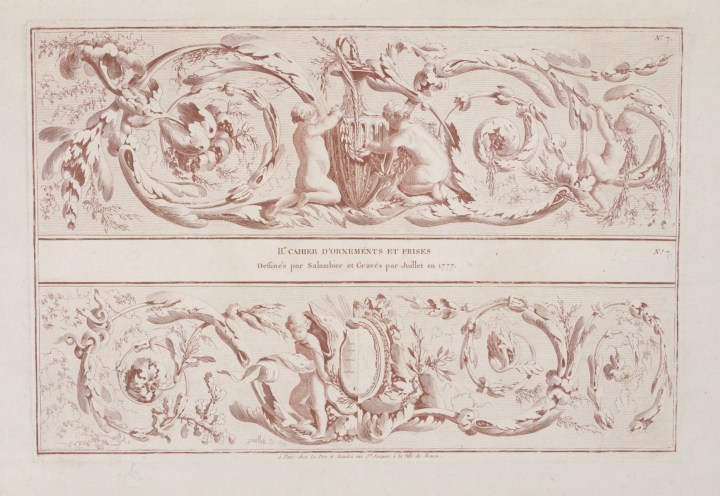
Title page and Frieze Designs, plate 7 from IIe Cahier d’Ornements et Frises (2nd Book of Ornaments and Friezes), 1777; Jacques Juillet after Henri Sallembier, published by Le Père et Avaulez (Paris); etching and engraving in red ink on laid paper (Cooper Hewitt).
Join Cooper Hewitt for an illustrated talk exploring the Decloux collection of ornament and architecture prints. The museum is home to the premier collection of ornament prints in the United States, consisting of over 13,000 European prints from the 16th to the 19th centuries. The lecture will include highlights from the collection by some of the most celebrated artists and designers of the period, as well a discovery of more hidden treasures by many forgotten or lesser-known artists and printmakers.
Ornament prints were produced with the purpose of illustrating designs, patterns, or motifs of decorative ornament for use by craftsman and applicable to all aspects of applied arts from ceramic vases to furniture, from wall paneling to wrought-iron gates. This illustrated talk will introduce the Decloux collection of ornament and architecture prints by exploring the language of ornament. How do these printmakers and publishers describe and title their works? What are the most common terms and motifs found in this broad genre and why? And how do these two-dimensional intaglio prints translate to real three-dimensional objects and interiors?
The talk is free with registration. It will also be recorded and posted on Cooper Hewitt’s YouTube channel within two weeks.
Rachel Jacobs is an independent curator specializing in French 17th-and 18th-century books and prints, based in Toronto, Canada. Since 2021, she is the Remote Senior Research Cataloguer for the Decloux collection of ornament and architecture prints in the Department of Drawings, Prints, and Graphic Design at Cooper Hewitt, Smithsonian Design Museum. She was previously Curator of Books and Manuscripts at Waddesdon Manor (Rothschild Collections) National Trust in England, where she continues to work remotely part-time. She has curated several exhibitions at Waddesdon Manor including most recently Alice’s Wonderlands: Life, Collections, and Legacy of Alice de Rothschild (1847–1922) (2022–23, co-curated).
Caitlin Condell is the associate curator and head of the Department of Drawings, Prints, and Graphic Design at Cooper Hewitt, Smithsonian Design Museum, New York, where she oversees a collection of nearly 147,000 works on paper dating from the 14th century to the present. She has organized and contributed to numerous exhibitions and publications. Prior to joining the Smithsonian, Condell held positions at the Massachusetts Museum of Contemporary Art and The Museum of Modern Art.
Lecture | Jussi Nuorteva on August Philip Armfelt in England, 1790–91
From the Society of Antiquaries:
Jussi Nuorteva | A Swedish-Finnish Antiquarian and Military Officer in England
Online (via YouTube), Society of Antiquaries of London, 14 October 2024, 1.30pm

August Philip Armfelt, ca. 1830 (Wiurila Manor, Halikko, Finland).
Discover the life of Baron August Philip Armfelt (1768–1839), Aide-de-Camp of the Swedish King Gustaf, and hear about his adventures during a trip to England in 1790–1791.
Free poster display on the ground floor of the Society’s Burlington House premises, 10am–4pm each day:
Tuesday, 15 October
Wednesday, 16 October
Thursday, 17 October
Friday, 18 October
During this period, the connection between Sweden and France had been close, but those ties were broken in the French Revolution of 1789. Afterward, new connections arose between Britain and Sweden. Britain was concerned about the rising power of Russia in the Baltic Sea area, crucial for import of tar and iron—essential materials in shipbuilding. Sweden, where Finland had been part of since 12th century, was the most important producer of these goods. Thus, new relations were formed.
While in England, August Philip Armfelt met many interesting people, not only the royals. His autobiography, around which the exhibition is built, tells of his various meetings and conversations with many other areas of the society. Armfelt met people like Goodfellow, the Swedish artist Elias Martin (one of the early academicians of the Royal Academy of Arts), and abolitionists like John Wedgwood and Swedish Carl Bernhard Wadenström. Sadly, Armfelt’s travels lasted only until 1792, when Swedish King Gustaf III was murdered by his opponents and a block of noble men took the power.
Live-streamed and open to anyone to join online, the lecture forms part of a series of events organised by the Embassy of Sweden in London and the Embassy of Finland in London, with the support of Samfundet Ehrensvärd, Medical Counsellor Sakari Alhopuro, Stiftelsen Tre Smeder and the Kalevi Kuitusen Foundation.
The YouTube link is available here»
Jussi Nuorteva was National Archivist of Finland until his retirement in 2022. He is a member of the Finnish Academy of Science and Letters, as well as Chancellor of the Orders of the White Rose of Finland and the Lion of Finland.
Artists in Conversation | Flora Yukhnovich
This evening from YCBA:
Artists in Conversation | Flora Yukhnovich
In-person and online, Hastings Hall, Yale School of Architecture, New Haven, 1 October 2025, 6pm

Flora Yukhnovich, photo by Kasia Bobula.
Flora Yukhnovich will talk to Eleanor Nairne, the Keith L. and Katherine Sachs Curator of Modern and Contemporary Art, the Philadelphia Museum of Art. Watch the livestream here.
The Artists in Conversation series brings together curators and artists to discuss artistic practices and insights into their work.
Born in 1990 in Norwich, UK, Flora Yukhnovich developed her characteristic painting language while studying at City and Guilds of London Art School, where she completed her MA in fine art in 2017. She also studied portraiture at the Heatherley School of Fine Art in London. Yukhnovich’s art boldly explores materiality and process as vehicles for meaning, with cascading and swirling forms that evoke rhythm and energy, flowing between representation and abstraction. Her immersive paintings splice historic styles, from French rococo and Italian baroque to abstract expressionism, with references drawn from contemporary films, music, literature, and consumer culture. Through her work, Yukhnovich addresses dynamics of power inherent in received readings of art-historical subjects and their associated hierarchies. She questions notions of femininity and gender that are hard-wired into the aesthetic language of color and form.
Yukhnovich received the Elizabeth Greenshields Foundation Award in 2013 and 2016. She has participated in group and solo exhibitions worldwide. Her work is included in many collections, including the Hirshhorn Museum, Washington, DC; the Montreal Museum of Fine Arts; the Roberts Institute of Art, London; and the National Gallery of Victoria, Melbourne. She lives and works in London.
Eleanor Nairne is the Keith L. and Katherine Sachs Curator of Modern and Contemporary Art and department head, modern and contemporary art, at the Philadelphia Museum of Art. Previously, she was the senior curator at Barbican Art Gallery, London, where her exhibitions included Basquiat: Boom for Real (2017), Lee Krasner: Living Colour (2019), Jean Dubuffet: Brutal Beauty (2021), Soheila Sokhanvari: Rebel Rebel (2022), Alice Neel: Hot Off The Griddle (2023), and Julianknxx: Chorus in Rememory of Flight (2023–24). She also curated Erotic Abstraction: Eva Hesse / Hannah Wilke (2021) at Acquavella Galleries in New York.
Lecture Series | Bénédicte Savoy on Returning Looted Heritage, 1815
This fall at the Prado (as noted by Nina Siegal in The New York Times) . . .
Bénédicte Savoy | Returning Looted Heritage: 1815, The Dismantling of the Louvre and the Rebirth of Museums in Europe
La recuperación del patrimonio saqueado: 1815, el desmantelamiento del Louvre y el renacimiento de los museos en Europa
Online and in-person, Museo Nacional del Prado, Madrid, 7, 14, 21, and 28 November 2024
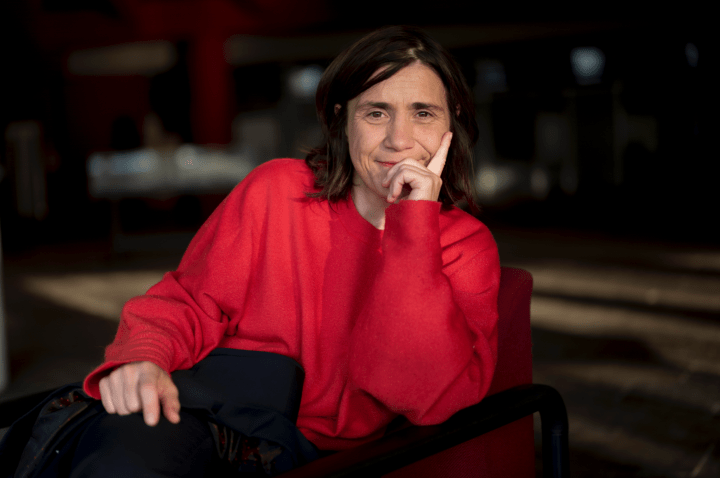
Bénédicte Savoy (Photograph by Maurice Weiss).
Between 1794 and 1811, successive French governments seized “works of art and science” from different states of Europe. This policy of appropriation, made legitimate by the belief that works of art, the natural by-product of freedom, should be returned to the land of liberty (i.e., France), gave rise to a major flow of cultural objects (paintings, sculptures, manuscripts, exquisite incunabula, etc.) from the countries involved towards France.
The vast majority of these objects, grouped together in the Louvre and the Bibliothèque nationale in Paris, were claimed by and returned to their rightful owners after the fall of the Empire (1814–1815). The restitution of 1815, a major historical and cultural event in Europe, mobilized the European intelligentsia and had a major impact on the cultural geography of the continent. The passions unleashed at the time fueled the European historiography of disentailment and confiscations during the 19th century. Most of the arguments exchanged then continue even now to structure the contemporary debate on restitutions. The lectures seek to identify the transnational concerns and consequences of this important event. Lectures will be given in French with simultaneous Spanish translation.
7 November — Reclaiming Cultural Heritage
The first lecture delves into the concept of restitution, especially from the point of view of those persons who traveled to Paris in 1815 with the intention of demanding the return of the plundered treasures. We shall study the relationship between post-conflict gestures of restitution and processes of reclaiming the objects of value. Among the key ideas to be discussed are the following: What steps are taken to actually reclaim the works of art? Who takes the initiative? In what circumstances? What resistance strategies are carried out by the possessing institutions?
14 November — The Interplay of Law and Morality
This lecture examines the complex relationship between legal principles and moral considerations as evidenced in the 1815 restitution debates. These discussions have profoundly influenced contemporary perspectives on repatriating looted assets. We contrast the legalists, who argue from a legal standpoint against the repossession of goods by Napoleon’s adversaries, with the moralists, who champion the rights of nations to their heritage and advocate for cultural justice. The enduring tension and the relevance of these two-century-old arguments will be critically analysed.
21 November — The Dilemma of Universality
In 1814 and 1815 European intellectuals praised the Louvre’s model for its intellectual, emotional, and historical significance while acknowledging the ethical dilemma it posed: the presence of these treasures in the museums in Paris was possible only because of their absence from other cities. This session explores the paradox of the universal museum concept and the ensuing debate over whether cultural assets should be centralized or dispersed to foster cultural development. The dismantling of the Louvre and the debates it sparked offer insights into museum discourse that echo through subsequent decades.
28 November — Paths to Reconnection
Following the upheaval of 1815, within a drastically transformed geopolitical landscape, there ensued diverse approaches to cultural reappropriation. They varied from nation to nation, community to community, spilling over even to academies and universities. The return of artworks to their places of origin opened up then, as it continues to do now, the possibility of finding a multitude of destinations beyond that of museums, including their reinstatement in original locations such as churches. This lecture will address how societies navigate the post-conflict recovery of their heritage and the time it takes to determine the rightful place for these works of art.
Devoted to the study of the processes of restitution of cultural property to countries looted by France during the Napoleonic period, the 12th Cátedra del Prado is led by Bénédicte Savoy, professor for Modern Art History at the Technische Universität Berlin. Between 2016 and 2021 Savoy also held a professorship at the Collège de France in Paris, where she taught the cultural history of artistic heritage in Europe from the 18th century to the 20th century. Her research focuses on museum history, Franco-German cultural transfer, Nazi looted art, and research on postcolonial provenance. In 2018 Professor Savoy wrote the report On the Restitution of African Cultural Heritage together with Senegalese scholar Felwine Sarr. This report was commissioned by Emmanuel Macron, President of France. She has received numerous awards for her research, academic activities, and teaching, including the 2016 Gottfried Wilhelm Leibniz Prize of the German Research Foundation and, most recently, the Berlin Science Prize. She is a member of the Berlin-Brandenburg Academy of Sciences and Humanities, a Knight of the French Legion of Honor and a member of various other institutions, advisory boards, and committees. Her most recent publications include the book Africa’s Struggle for Its Art: History of a Postcolonial Defeat, which has been translated into several languages, and the joint publication Atlas der Abwesenheit: Kameruns Kulturerbe in Deutschland (Atlas of Absence: Cameroon’s Cultural Heritage in Germany).
Symposium | A la Ronde: Female Expression through Craft and Design
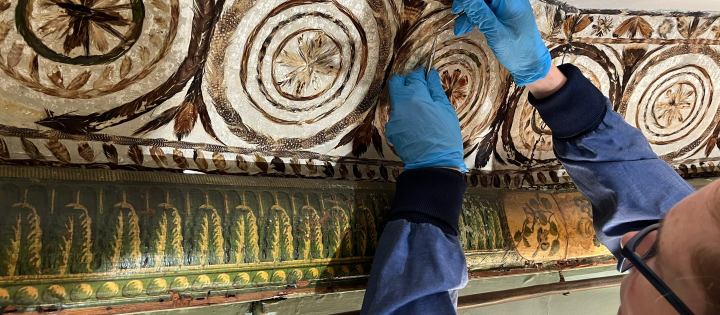
Conservation of the feather frieze in the Drawing Room at A la Ronde in Devon
◊ ◊ ◊ ◊ ◊
From the National Trust:
Female Expression through Craft and Design in the 18th and Early 19th Centuries
Online and in-person, Reed Hall, University of Exeter, 11 July 2024
The National Trust is delighted to announce this hybrid conference inspired by the conservation, outreach, and interpretation project A la Ronde: Conserving the Past, Creating the Future. Intended to forge new bonds with researchers and academic professionals, find synergies with similar projects and properties, and to share stories and discoveries from our recent conservation work in a broader context, the symposium will be offered in hybrid form, with presentations both in-person and online. Booking is available here»
About A la Ronde — A small estate in Lympstone, Devon, this 16-sided house and chapel were built, and perhaps designed, by Jane Parminter and her young cousin and ward, Mary, around 1796, following their return from several Grand Tours of Europe. The house is now owned by the National Trust and contains the extraordinary decorative interiors designed by the Parminters. These include over 27 metres of friezes formed from feathers in the drawing room, patterned wall painting in the central Octagon room, and a Shell Gallery sitting at the top of the house encrusted with over 26,000 individual components, accessed by a narrow Grotto Staircase from below. The wider estate also contained a chapel, alms houses, and school room for local unmarried women and girls, a manse, vegetable gardens, and small picturesque landscape in the context of a ferme ornée. Mary’s will records that the grounds originally contained decorative features including a shellery, fountain, obelisks, and seating. The Shell Gallery, Grotto Staircase, Drawing Room feather frieze, and Octagon have been recently conserved as part of a two-year multi-strand project, A la Ronde: Conserving the Past, Creating the Future, which culminates in 2024.
p r o g r a m m e
9.30 Welcome and Opening Remarks
• Jonathan Fisher (General Manager South East Devon Portfolio, National Trust)
• Emma Mee (Project Lead, National Trust)
9.45 Keynote Presentation
• Daniel Maudlin (University of Plymouth), Making Cottages: Rural Retreat and the Appropriation of the Vernacular in the 18th Century
10.10 Panel 1 | Female-Designed and Commissioned Domestic Spaces
• Rosemary Baird Andrae FSA, The Architectural Patronage of Mrs Montagu, Queen of the Bluestockings
• Tom Coombe (Collections and House Manager, National Trust), The Ornamental Dairy at Croome: Ceramics, Crafting, and Performance
• Jyoti Pandey Sharma (School of Planning and Architecture, New Delhi), Transculturalism in 19th-Century Mofussil India: Begam Samru and Her Architecturally Hybrid Sardhana Palace
• Saniya Siddiqui (School of Planning and Architecture, New Delhi), Taj Mahal Palace: A Royal Residence Commissioned by Nawab Shah Jahan Begum (r.1868–1901), Ruler of Bhopal Princely State in the British-ruled Indian Subcontinent
11.30 Coffee Break
11:45 Panel 2 | A la Ronde and National Trust Conservation Work
Convenor: Nigel Blades (Head of Conservation, National Trust)
• Daniel Cull (Conservator, National Trust), Conserving the Past, Creating the Future: A Summary of the Conservation Project at A la Ronde
• Nicola Shreeve (Remedial Conservator, National Trust), The Technical Investigation and Conservation of the Octagonal Chairs from A la Ronde
• Nicola Walker (Senior National Conservator, Paper and Photography, National Trust), Shells, Curtains, and a Doll’s House: Conservation and Collaboration
1.00 Lunch
1.45 Panel 3 | Decorative Historic Interiors and Material Histories
• Lucy Powell (Leverhulme Early Career Research Fellow, University of Oxford), ‘The Feather’d Fair’: Women, Femininity, and Feathers in the 1790s
• Clare Taylor (The Open University), ‘Our New Paper Hangings’: Women and Wallpaper in 18th-Century Britain
• Libby Horsfield (PhD student, Birkbeck University), The Centre of Attention: Women’s Crafted Fire Screens and the Country House Interior in the 19th Century
• Emily Deal (Digital Curator, National Trust), The Material Biography of Molly Lepell: Material Culture and Collection as a Form of Life Writing in the 18th Century
3.00 Coffee Break
3.10 Panel 4 | Georgian Period Embellished Decorative Interiors Using Natural Materials
Convenor: Rachel Conroy (Senior National Curator, Decorative Arts, National Trust)
• Wenyu Dong (MA student, Central Academy of Fine Arts), From Chinese Chambre to Feather Room: Elizabeth Montagu’s Interiors in the 1760s and 1780s London
• Kyriaki Hadjiafxendi (Senior Lecturer, Victorian Literature and Culture, Bath Spa University), The Eventfulness of Nature: Women and the Seashore in the Long 19th Century
• Beth Howell (Business Services Coordinator, National Trust), ‘Call Us Not Weeds!’: Examining the Aesthetics of Upcycling and Anonymity in Victorian Depictions of Seaweed
• Laura Keim (Stenton Curator), Kaila Temple (Stenton Curatorial Assistant), and Lara Kaplan (Objects Conservator Winterthur Museum), ‘Place to Cultivate Her Mind in by Musing’: Anne Reckless Emlen’s 1757 Shellwork Grotto
4.50 Closing Remarks
• Sarah Lloyd (Research Fellow, Institute of Historical Research, University of London)










 Enfilade
leave a comment