Online Talks | Tempus Fugit / Time Flies
I’m sorry to have missed the first half of the series; the last two talks take place in March and April. –CH
Tempus Fugit / Time Flies: Measuring, Perceiving, and Living Time in Early America
Online, Historic Deerfield, Sundays: 26 January, 23 February, 30 March, 27 April 2025

Tall Clock, detail, by Aaron Willard of Boston for Asa Stebbins of Deerfield, Massachusetts, ca. 1799 (Historic Deerfield).
Early New Englanders frequently invoked the passage of time in religious terms, but the ‘horological revolution’ of the seventeenth and eighteenth centuries produced technological developments in timepieces that complemented older cultural views of time. These developments went on to play an important role in the standardization of timekeeping, the rise of market economies, and industrialization. Sundials, mechanical clocks, and pocket watches were not only scientific marvels but also style-bearing objects that displayed refinement. Such objects provide suggestive windows into everyday life, especially when we broaden our sense of the many different objects and practices that marked the passage of time for diverse early Americans. This series features speakers who will address both the abstract and material nature of time found not only in clocks but also in other objects and processes central to life in early New England such as brewing, needlework, husbandry, farming, and cooking. Together the presentations will complicate our sense of what the passage of time meant for early New Englanders who had more than one way to ‘keep’ and ‘spend’ time. All lectures are free of charge and will be presented virtually via Zoom webinar. Registration required.
January 26, 2pm
Bob Frishman | Edward Duffield and Colonial American Clockmaking
Bob Frishman has professionally repaired nearly 8,000 timepieces and sold more than 1,700 vintage clocks and watches. In recent years, he has reduced his clock-repair activities and now devotes his time to research, writing, and lecturing. He has organized horology-related conferences at the Winterthur Museum, the Museum of Fine Arts Boston, the Henry Ford Museum, the Museum of the American Revolution, and the Horological Society of New York; he was also an organizer of the 2019 Time Made in Germany symposium in Nuremberg. Along with more than 100 articles and reviews, his recent book on the Philadelphia clockmaker Edward Duffield was published by the American Philosophical Society Press in 2024.
February 23, 2pm
Alexandra Macdonald | ‘Regard Not Time, but This Sign’: Recipes and Embodied Knowledge
Alexandra M. Macdonald is an historian of labour and the body with a particular interest in embodied knowledge and practices of making in the Atlantic world in the eighteenth century. As part of her research, she is interested in using period specific ingredients and methods to recreate historical craft and culinary recipes, for example indigo vats and preserved food. Alexandra has received a number of fellowships to support her research, including a fellowship from the New England Regional Fellowship Consortium which brought her to Deerfield. Most recently she was a Postdoctoral Fellow at Winterthur Museum, Garden & Library where she worked closely with conservation scientists to analyze a canvaswork embroidery made in Connecticut in the mid-eighteenth century. She is currently the Social Science and Humanities Research Council Postdoctoral Fellow at Brock University where she is working on a book length study of indigo in the Atlantic world.
March 30, 2pm
Sara Schechner | Marking Time during the American Revolutionary Period: Sundials and Clocks
Sara J. Schechner is the David P. Wheatland Curator of the Collection of Historical Scientific Instruments at Harvard University.
April 27, 2pm
Elizabeth Bacon Eager | Mastering Time: Slavery, Self-Sovereignty, and the 18th-C. Clockmaker
Elizabeth Bacon Eager is an assistant professor of art history at Southern Methodist University, where she teaches courses on early American art, architecture, and material culture. Exploring intersections between art, science, and technology of the eighteenth- and nineteenth-century Atlantic World, she is particularly interested in questions of materiality and process and fascinated by the reconstruction of historical tools and techniques. Her current research examines the material culture of time in early America, with a particular focus on objects and images produced by Black, Indigenous, and female makers. Dr. Eager’s work has been published in The Art Bulletin, Journal18, and Panorama: Journal of the Association of Historians of American Art.
Online Talk | Conserving Paper with Live Demonstration
From The Linnean Society:
John Abbott | How to Conserve 18th- and 19th-Century Paper with Live Demonstration
Online and in-person, The Linnean Society, Burlington House, 5 March 2025, 2pm
The Linnean Society takes the preservation of its collections seriously. The Society has a full-time conservator, Janet Ashdown, and an adopt-an-item programme (AdoptLINN). The Society is also incredibly fortunate in having had an experienced volunteer and retired paper conservator, John Abbott, who has been working with Janet since 2018. In the past seven years, John has conserved many illustrations within the Society Papers Collection, and in this talk, he will demonstrate how to conserve loose 18th- and early 19th-century papers. By showcasing papers in need of conservation, John will reveal the decision-making process even before the start of conservation, and then undertake a live conservation demonstration. The demonstration will cover cleaning as well as repairing paper. We will send the link for this online event two hours before it starts.
Registration is available here»
John Abbott is a retired archive conservator who worked for the National Archives and its predecessor The Public Record Office for 43 years. He was involved in the conservation and preservation of archival material including paper and parchment manuscripts, maps, plans, designs, posters, photographs, and seals. Between 1984 and 1986 John was part of a team of three (two archive conservators and one book conservator) involved in the conservation and rebinding of Great and Little Domesday books.
Research Seminar | Martin Myrone on the Foggo Brothers’ Parga

.
James and George Foggo, Parga during the Awful Ceremony that Preceded the Banishment of its Brave Christian Inhabitants and the Entrance of Ali Pacha, ca. 1819, lithograph, 42 × 64 cm (London: the British Museum, 1842,0319.14).
◊ ◊ ◊ ◊ ◊
Next month at the Mellon Centre:
Martin Myrone | A Radical Alternative within British Romanticism: The Foggo Brothers’ Parga
Online and in-person, Paul Mellon Centre, London, 19 March 2025, 5pm
This talk focuses on one of the most remarkable—but forgotten—works of British art of any era: The Christian Inhabitants of Parga Preparing to Emigrate (1822) by the brothers George and James Foggo. This huge painting, twenty-six feet long by sixteen high, was exhibited several times in the nineteenth century before disappearing. Recorded in a mezzotint, the picture features a multitude of figures in a scene of horror with the people of Parga in Greece disinterring their ancestors so that their remains were not left on ground falling under Ottoman rule. The incident of 1819 on which the picture was based was an international scandal, identified as an appalling indictment of British foreign policy. Ironically, the very size, political purpose and pictorial ambition of the Foggo brothers’ picture has made it easy to be ignored by art history. This talk will explore how the discipline has by contrast—and this is almost regardless of political orientation—been preoccupied with the subjective and commodified aesthetics assumed to be the enduring legacy of the ‘Romanticism’ of the era.
The event starts with a presentation and talk by Martin Myrone, lasting around 40 minutes, followed by Q&A and a free drinks reception. The event is hosted in our Lecture Room, which is up two flights of stairs (there is no lift). The talk will also be streamed online and recording published on our website.
More information and registration is available here»
Martin Myrone is Head of Research Support and Pathways at the Paul Mellon Centre. Before joining the Centre in 2020, Martin spent over twenty years in curatorial roles at Tate, London. His many exhibitions at Tate Britain have included Gothic Nightmares (2006), John Martin (2011), William Blake (2019), and Hogarth and Europe (2021). His research and publications have focused on eighteenth- and nineteenth-century British art, with a special interest in artistic identity and artists’ labour, class, cultural opportunity and gender. His many published works include Bodybuilding: Reforming Masculinities in British Art 1750–1810 (2005) and Making the Modern Artist: Culture, Class and Art-Educational Opportunity in Romantic Britain (2020), both published by the Paul Mellon Centre.
Online Conversation | Teaching the 18th Century Now
From the event flyer (which includes a QR code for registering). . .
Online Conversation | Teaching the Eighteenth Century Now: Pedagogy as Ethical Engagement
Online, Wednesday, 26 February 2025, 3pm (Eastern Time)
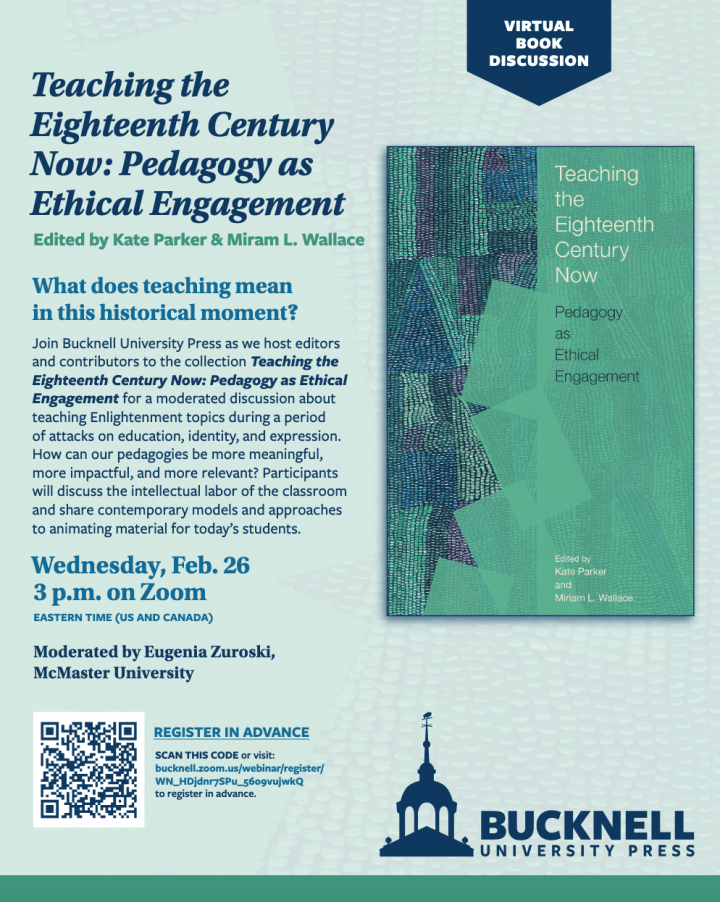 What does teaching mean in this historical moment? Join Bucknell University Press as we host editors and contributors to the collection Teaching the Eighteenth Century Now: Pedagogy as Ethical Engagement for a moderated discussion about teaching Enlightenment topics during a period of attacks on education, identity, and expression. How can our pedagogies be more meaningful, more impactful, and more relevant? Participants will discuss the intellectual labor of the classroom and share contemporary models and approaches to animating material for today’s students. The conversation will be moderated by Eugenia Zuroski.
Kate Parker and Miriam Wallace, eds., Teaching the Eighteenth Century Now: Pedagogy as Ethical Engagement (Lewisburg, PA: Bucknell University Press, 2024), 196 pages, ISBN: 978-1684485048 (hardcover) / ISBN: 978-1684485031 (paperback), $38.
Online Talks | HECAA Emerging Scholars Showcase, 2025
From the Historians of Eighteenth-Century Art & Architecture:
HECAA Emerging Scholars Showcase
Online, Tuesday, 18 February 2025, 11.00am–12.30pm EST
A beloved HECAA tradition, the Emerging Scholars Showcase serves as a platform for emerging scholars to connect with the wider HECAA community and get feedback on their research. We would appreciate your presence and participation in this meaningful event!
• Emily Hirsch (Brown University) — Flemish Sculptors and Terracotta, ca. 1600–1750
• Siraye Herron (University of Oklahoma) — Degrees of Indigenous Autonomy: Aestheticizing Artistic Survivance in Colonial Cuzco, 1690s–1780s
• Katie DiDomenico (Washington University in St. Louis) — Visions of Colonial Suriname, ca.1667–1795
• Katie Cynkar (University of Delaware) — Myth Making and Remembrance: A Sensorial Examination of Framed North Carolina Plantation-Made Cloth Samples, 1861–1865
• Amelia Goldsby (University of Iowa) — Trees as Bodies of Communication: The Arboreal Aesthetic in French Painting, 1780–1870
• Benet Ge (Williams College) — Looked Through: Edward Orme’s Transparent Prints between Britain and Canton
To attend, please register here»
As always, direct all questions, suggestions (and love) to hecaa.emergingscholarsrep@gmail.com.
Warmly,
Demetra Vogiatzaki
HECAA Board Member At-Large, Emerging Scholars Representative
Research Seminar | Artists and the East India Company, 1760–1830
Upcoming at the Mellon Centre:
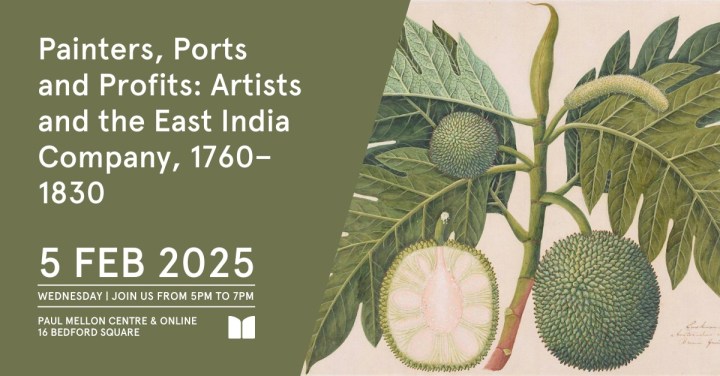
Holly Shaffer and Laurel Peterson | Painters, Ports, and Profits: Artists and the East India Company, 1760–1830
Online and in-person, Paul Mellon Centre, London, 5 February 2025, 5pm
In January 2026, the Yale Center for British Art (YCBA) will open Painters, Ports, and Profits: Artists and the East India Company, 1760–1830. This exhibition explores the interactions between artists trained in India, China, and Britain amid the relentless commercial ambitions of the East India Company at key ports and centres of trade in Asia. Featuring over a hundred objects drawn from the YCBA collection in various media—including architectural drafts, opaque watercolours, hand-coloured aquatints and small- and large-scale portraits—the exhibition highlights works by artists who are no longer well known alongside those of well-established ones. Brought together for the first time, these works tell a story of artists compelled by new subjects, styles and materials in expanding markets, profoundly affecting art within and beyond Asia.
As the power of the British empire waned in the twentieth century, ‘Company painting’ became a prevalent umbrella term to describe works made for Company officials, specifically by Indian artists, and ‘Export art’ became a descriptor for works created by Chinese artists for a European market. Painters, Ports, and Profits challenges and critically rethinks these terms while also putting the arts into dialogue. It presents an expanded conception of arts made under the auspices of the Company by focusing on artists trained in different ways who worked for Company patrons as well as commercial markets in India, China, and Britain; the types of subjects in which they specialised; and the artistic materials with which they experimented. By examining the range of arts and relationships developed during the Company’s relentless pursuit of profits, the exhibition sheds light on aesthetic and colonial discourses that were formed in the eighteenth and nineteenth centuries and persist today. Co-curators Laurel Peterson and Holly Shaffer will preview the themes and objects explored in the exhibition and the related catalogue.
Book tickets here»
Holly Shaffer is Robert Gale Noyes Assistant Professor of Humanities in the department of history of art and architecture at Brown University. Her research focuses on eighteenth- and nineteenth-century arts in Britain and South Asia, and their intersections. Her first book, Grafted Arts: Art Making and Taking in the Struggle for Western India, 1760–1910 (London and New Haven: Paul Mellon Centre with Yale University Press, 2022), was awarded the Edward C. Dimock Jr. Prize in the Indian Humanities and an Historians of British Art Book Award. In 2011, she curated Adapting the Eye: An Archive of the British in India, 1770–1830 at the YCBA, and in 2013, Strange and Wondrous: Prints of India from the Robert J. Del Bontà Collection at the National Museum of Asian Art. She has published essays in Archives of Asian Art, The Art Bulletin, Art History, Journal 18, Modern Philology, and Third Text, and recently edited volume 51 of Ars Orientalis on the movement of graphic arts across Asia and Europe.
Laurel O. Peterson is the Assistant Curator of Prints and Drawings at the Yale Center for British Art. She specialises in British works on paper produced during the long eighteenth century. She served as the organising curator of John Singer Sargent: Portraits in Charcoal in 2019 and as co-curator of Architecture, Theater, and Fantasy: Bibiena Drawings from the Jules Fisher Collection in 2021, both at the Morgan Library and Museum. She received her PhD in the history of art from Yale and her research has been supported by the Sir John Soane’s Museum Foundation, the Paul Mellon Centre for Studies in British Art, and the Lewis Walpole Library. She has held positions at the British Museum and the Morgan Library.
Image: Unknown artist (Company style), Breadnut (Artocarpus camansi), ca. 1825, watercolor, gouache, and graphite (New Haven: Yale Center for British Art, Paul Mellon Fund, B2022.5).
Williamsburg Garden Symposium | Influence of Great English Gardens
From the conference website (scholarships are available, with an application deadline of 7 February). . . .
78th Annual Garden Symposium: Celebrating the Influence of Great English Gardens
Online and in-person, Colonial Williamsburg, 10–13 April 2025
 When John Custis IV created his celebrated Williamsburg Garden, it was an English garden. Join us for the 2025 Garden Symposium celebrating the influence of great English gardens with keynote lectures by British garden historian and designer Todd Longstaffe-Gowan and Troy Scott Smith, head gardener at Sissinghurst, one of England’s most romantic and iconic landscapes. Todd Longstaffe-Gowan also joins in conversation with Will Rieley (historic landscape architect on such projects as Monticello, Poplar Forest, Carter’s Grove), Colonial Williamsburg’s executive director of archaeology Jack Gary, and the Margaret Beck Pritchard Curator of Maps & Prints Katie McKinney, to discuss the influence of imported prints on Virginia’s early gardens.
Marta McDowell (acclaimed garden author and avid gardener) explores “New Ideas from English Gardens and English Authors & Their Gardens,” and Brent Heath (naturalist, author, photographer, and award-winning horticulturalist) gives insight into “Bulbs as Companion Plants for Spring Flowering Bulbs.” From the Colonial Williamsburg Department of Landscape and Horticulture, senior manager Jon Lak expands upon colonial ecosystems and what we can learn from them, while horticulturalist Andrew Holland forays into how the Age of Exploration expanded science, gardening, and landscape design in England. Historic Trades master gardener Eve Otmar speaks to a fusion of three cultures that formed a new world.
In-person and virtual attendees have access to all lectures in the Hennage Auditorium, and in-person attendees can also choose from a variety of limited-capacity walking tours and workshops for a small additional fee.
Symposium | The Art of the Dolls’ House
 .
.
The Uppark dolls’ house from 1732, currently installed at the Huguenot Museum in Rochester. The Neo-Palladian house was a gift to ten-year-old Sarah Lethieullier from her father, who acquired it fully equipped from the Covent Garden auctioneer Christopher Cock. More information is available from Tessa Murdoch’s December 2023 Apollo article.
◊ ◊ ◊ ◊ ◊
Registration for the symposium is available at Eventbrite:
The Art of the Dolls’ House: The 49th Annual Furniture History Society Symposium
Online and in-person, Victoria & Albert Museum, London, 22 March 2025
Led by Tessa Murdoch
An international roster of speakers will celebrate the earliest surviving European dolls’ houses preserved in The Netherlands and Nuremberg. That tradition developed in Britain where two beautifully furnished ‘baby’ houses treasured by Huguenot heiresses are today curated by the National Trust. The dolls’ house belonging to Petronella de la Court in Utrecht complemented her contemporary art collection. 300 years later, model maker Ben Taggart will speak about making models of historic houses. Architect-designed Queen Mary’s Dolls’ House has just celebrated its centenary whilst the installation of dolls’ houses at the Young V&A by Rachel Whiteread and the curatorial team have contributed to its celebratory position as the 2024 Art Fund Museum of the Year. The symposium will revisit these miniature homes and explore their legacy and creative inspiration as educational tools opening the eyes of successive generations through fascination with miniature worlds.
There will be an opportunity for delegates to visit the exhibition of Sarah Lethieullier’s 1730s dolls’ house at the Huguenot Museum, Rochester, Kent on Friday, 21 March 2025.
p r o g r a m m e
10.00 Registration
10.30 Welcome by Christopher Rowell (FHS Chairman)
10.35 Session 1 | The European Dolls’ House
Moderated by Christopher Rowell
• Revisiting the ‘Nuremberg Houses’: 17th-Century Miniature Households as Imperfect Windows into the Past — Heike Zech, (Deputy Director, Germanisches Museum, Nuremberg)
• At Home in the 17th Century: The Rijksmuseum Dolls’ Houses — Sara van Dijk (Curator of Textiles, Rijksmuseum, Amsterdam)
• Petronella de La Court’s Dolls’ House in Utrecht (1670–1690): Registration, Research, and Re-Installation — Natalie Dubois (Curator of Applied Art and Design, Centraal Museum, Utrecht)
• Kinnaird Castle: A Miniature Mystery — Ben Taggart (model maker of historic properties)
12.45 Lunch — Study Sessions: Demonstration of miniature furniture making by Terence Facey and looking at silver toys with Kirstin Kennedy (curator, V&A Metalwork)
2.00 Session 2 | National Trust Dolls’ Houses
Moderated by Megan Wheeler (Assistant Curator, Furniture, National Trust)
• ‘Deceptively Spacious’: The Dolls’ House and Framing Significance and Story at Nostell — Simon McCormack (Property Curator, Nostell Priory, National Trust)
• The Lethieullier Family Dolls’ House at the Huguenot Museum — Tessa Murdoch
2.55 Break for tea
3.20 Session 3 | Displaying Dolls’ Houses
Moderated by Tessa Murdoch
• Fitted up with Perfect Fidelity’: Lutyens and Queen Mary’s Dolls’ House — Kathryn Jones (Senior Curator of Decorative Arts, Royal Collection Trust)
• Dolls’ Houses from the V&A — William Newton (Curator, Young V&A)
4.25 Closing remarks
Book Launch | The Dominion of Flowers
From EventBrite:
The Dominion of Flowers: North American Book Launch
Online and in-person, University of Toronto, Thursday, 23 January 2025, 6.30pm
 Between 1760 and 1840, plants were imported into Britain via empire and depicted in periodicals and scientific treatises as specimens alongside objects of natural history. Mark Laird’s provocative new book—part art history, part polemic—weaves fine art, botanical illustration, gender studies, and rare archival material into a political and ethical account of Britain’s horticultural heritage. Drawing on Professor Laird’s genealogical research into his family’s colonial past, The Dominion of Flowers foregrounds Indigenous ideas about ‘plant relations’ in a study that animates trans-oceanic movements of plants and people.
The talk will show how, researched ‘virtually’ in pandemic Toronto, the book’s three-part structure emerged: global, pan-European, and local. His epilogue links New Zealand to Canada, past and present. Following the talk, Therese O’Malley, a historian of landscape and garden design, will facilitate a conversation about Laird’s 40-year career as scholar and practitioner. Prompted by one reviewer who claimed “Laird pioneered plant humanities avant la lettre,” the conversation will turn to botanical studies within the humanities.
Mark Laird is Professor Emeritus at the University of Toronto’s John H. Daniels Faculty of Architecture, Landscape and Design, and a former faculty member of Harvard University. He is the author of The Flowering of the Landscape Garden and A Natural History of English Gardening. The Dominion of Flowers completes his trilogy. In the UK he has been historic planting consultant to Painshill Park Trust, English Heritage, and Strawberry Hill Trust, and in Ontario he has worked on Rideau Hall, Parkwood, and Chiefswood.
Therese O’Malley, FSAH is an historian of landscape and garden design, focusing on the 18th to 20th centuries and the transatlantic exchange of plants and ideas. Former associate dean of CASVA, National Gallery of Art (1984–2021), she continues to lecture and publish internationally. Her many publications include Keywords in American Landscape Design (2010), now expanded as the website, History of Early American Landscape Design (heald.nga.gov). O’Malley has held guest professorships at Penn, Harvard, and Princeton, and serves on boards and advisory committees including those of Dumbarton Oaks, New York Botanical Garden, and the U.S. State Dept. Ambassadors Fund for Cultural Property. She was chair of the Association of Research Institutes in Art History (1994–2000) and president of the Society of Architectural Historians (2000–2006).
Mark Laird, The Dominion of Flowers: Botanical Art and Global Plant Relations (London: Paul Mellon Centre for Studies in British Art, 2024), 277 pages, ISBN: 978-1913107451, £35 / $50.
Talk | Paris Spies-Gans on Sophie Fremiet’s Portrait of a Woman
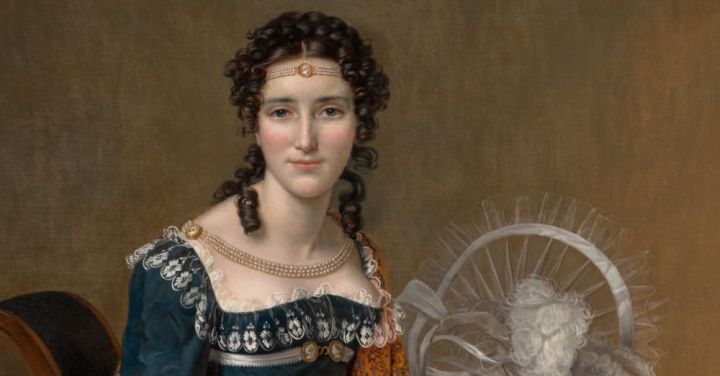
Sophie Frémiet (later Rude), Portrait of a Woman, detail, 1818, oil on canvas, 64 × 46 inches
(Los Angeles: Getty Museum, 2024.25).
◊ ◊ ◊ ◊ ◊
Upcoming at the Getty (which acquired the painting in 2024), as we all watch the fires with ache and concern . . .
Paris Spies-Gans | Breaking Barriers: Sophie Frémiet and the Rise of Women Artists in Europe
Online and in-person, Getty Center, Los Angeles, 4 May 2025, 2pm (originally scheduled for 26 January)
Around the turn of the 18th century, over a thousand women contributed more than 7,000 works to London’s and Paris’ premier exhibitions. It was a transformative moment for women artists in Europe, who exhibited and sold their art in unprecedented numbers. In this context, Sophie Fremiet painted her luminous Portrait of a Woman (1818). Paris Spies-Gans delves into this era to upend longstanding assumptions about women’s opportunities and wrongly forgotten triumphs. Tickets are free, but required for event entrance. Your event ticket will also serve as your Center entrance reservation. To watch online, please register via Zoom.
Paris A. Spies-Gans is a historian of art with a focus on women, gender, and the politics of artistic expression. Her first book, A Revolution on Canvas: The Rise of Women Artists in Britain and France, 1760–1830 (Paul Mellon Centre in association with Yale University Press, 2022), was named one of the top art books of 2022 by The Art Newspaper and The Conversation. It also received several prizes in the fields of British history, art history, and 18th-century studies. She is currently working on her second book, A New Story of Art (US/Doubleday and UK/Viking).
◊ ◊ ◊ ◊ ◊
Note (added 21 January 2025) — The posting has been updated with the rescheduled date.










leave a comment