Call for Applications | Painted Wall Preservation Scholarship
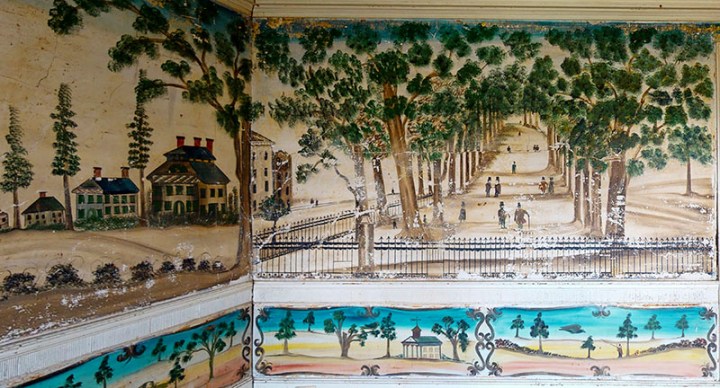 Interior of the Hersey-Whitten House, which was constructed in the late-18th or early-19th century in the village of Center Tuftonboro, New Hampshire. Originally built for the Copp family, it was once a dance hall and inn. Learn more from The Center for Painted Wall Preservation»
◊ ◊ ◊ ◊ ◊
From the scholarship announcement:
The Center for Painted Wall Preservation Scholarship
Applications due by 30 April 2026
The Center for Painted Wall Preservation (pwpcenter.org) invites undergraduate and graduate students, independent scholars, and artisans, whether established or in training, to apply for this scholarship, which aims to develop educational projects that further our mission through documentation, conservation, and preservation—where art, history, craft, and science meet.
This year’s scholarship of $2000 will be awarded to the individual whose proposal for an educational, scholarly project is deemed best designed to further the stated mission of our organization—to further the study, understanding, and appreciation of paint-decorated plaster walls and associated interior colorized items of the 18th and early 19th centuries in New England and New York, and to educate the public about this unique and vulnerable cultural heritage. Interested parties may apply for an Application Process Summary and Application Form by contacting info@pwpcenter.org with ‘Scholarship Fund’ in the subject line. Applications will be accepted from 1 January until midnight, 30 April 2026.
The Center for Painted Wall Preservation is a nationally recognized 501(c)(3) Nonprofit Organization.
Funding | Burlington Bursaries for Researching Drawings
From ArtHist.net:
The Burlington Magazine’s Travel Bursaries for Researching European Drawings
Applications due by 1 February 2026
We are delighted to announce a new initiative: The Burlington Magazine Travel Bursaries, generously funded by the Rick Mather David Scrase Foundation. These bursaries are designed to support emerging art historians undertaking research on old master drawings. The awards will fund travel to major collections worldwide to study works of Western art on paper from the Renaissance to 1900.
Typical awards will range from £2,000 to 2,500 for travel within Europe and £3,000–3,500 for intercontinental travel. Applications are welcomed from postgraduate and curatorial researchers worldwide. The deadline for applications is Sunday, 1 February 2026. Further details and application guidelines can be found at The Burlington website.
Fellowships | The Reception of Antique Works of Art and Architecture
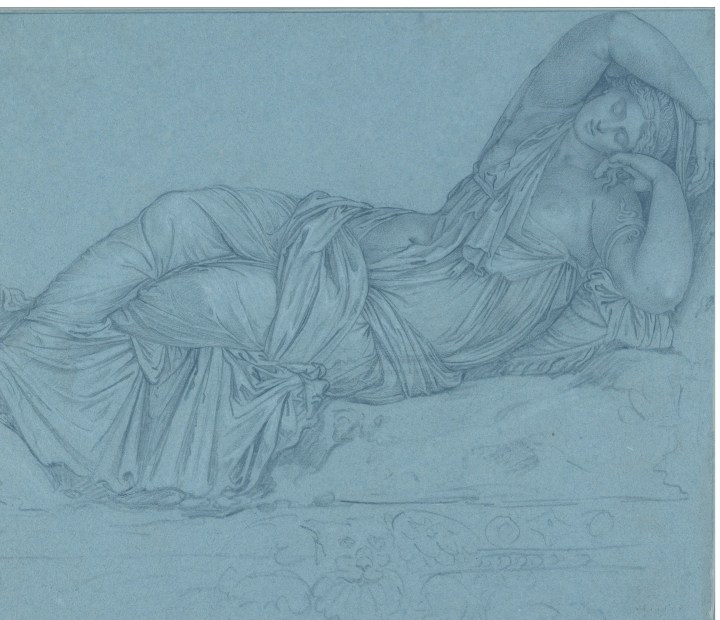
Hendrick Goltzius, Cleopatra/Ariadne, 1590–91, black and white chalk with pencil on blue paper, 25 × 30 cm
(Haarlem: Teylers Museum, purchased from the Odescalchi heirs in Rome, 1790, N061; CensusID 47461)
◊ ◊ ◊ ◊ ◊
From ArtHist.net:
Census Fellowship in the Reception of Antiquity, 1350–1900
Humboldt-Universität (Berlin), Bibliotheca Hertziana (Rome), Warburg Institute (London), March–December 2026
Applications due by 31 January 2026
The Institut für Kunst- und Bildgeschichte, Humboldt-Universität zu Berlin, the Bibliotheca Hertziana – Max Planck Institute for Art History, and the Warburg Institute, School of Advanced Study, University of London, are pleased to announce a fellowship in Berlin, Rome, and London, offered at either the predoctoral or postdoctoral level. These fellowships grow out of the longstanding collaboration between the Humboldt, the Hertziana, and the Warburg in the research project Census of Antique Works of Art and Architecture Known in the Renaissance.
The fellowships extend the traditional chronological boundaries of the Census and are dedicated to research and intellectual exchange on topics related to the reception of antiquity in the visual arts from approximately 1350 to 1900. In the context of the fellowships, the topic of the reception of antiquity is also broadly conceived without geographical restriction. Proposals can optionally include a digital humanities perspective, engage with the database of the Census, or make use of the research materials of the Census project available in Berlin, Rome, and London.
The Humboldt, the Hertziana, and the Warburg sponsor a research grant of 6 months for students enrolled in a PhD program (predocs), or 4 months for candidates already in possession of a PhD (early career postdocs). Fellows can set their own schedule and choose how to divide their time evenly between at least two institutes, of which one must be the Hertziana. The stipend will be set at about 1,500 EUR per month at the predoctoral level and about 2,500 EUR per month at the postdoctoral level, plus a travel stipend of 500 EUR. The fellowship does not provide housing.
The sponsoring institutes adhere to the principles of diversity, equity, and inclusion, and therefore encourage applications from underrepresented groups. Candidates can apply via the portal available on the Hertziana website. They should upload the requested PDF documents in English, German, or Italian by 31 January 2026, with details of their proposed dates for the fellowship during the year 2026 (starting earliest March, ending latest December 2026).
Call for Papers | Graduate Symposium: Single Object Studies
From ArtHist.net:
One and Done: Single Object Studies
Art & Architectural History Graduate Symposium
University of Virginia, Charlottesville, 25–26 March 2026
Proposals due by 1 December 2025
The Art History Graduate Association (AHGA) at the University of Virginia is excited to announce our upcoming graduate research symposium titled One and Done: Single Object Studies.
Keynote Speaker
Jennifer Raab, Professor of History of Art at Yale University and author of Relics of War: The History of a Photograph (Princeton University Press, 2024)
This is a symposium about single objects. Dr. Jennifer Raab’s recent monograph, Relics of War: The History of a Photograph, examines how one photograph—carefully staged by Clara Barton through acts of collecting, naming, and labeling—transformed salvaged artifacts from a Civil War prison camp into material testimony, serving as both evidence of absence and witness to wartime suffering. Inspired by her methodological commitment to writing about a single photograph, this symposium turns to the potential of singularity.
One and Done: Single Object Studies invites graduate students across disciplines to share the intellectual, methodological, and narrative possibilities of centering a singular object of study—whether an artifact, image, monument, architectural structure, manuscript, or unique material form. In turning to the singular, this interdisciplinary symposium asks: How does a focused examination of one object–or one object type–open up expansive questions and stimulate critical discussion? What sorts of approaches can be taken when we examine an object? What roles do materiality, affect, or embodied engagement play when our research dwells with a single object over time? How do practices of display, collection, and conservation shape our understanding of singularity and its interpretation? And what are the rewards–or the risks–of asking one object to stand in for many?
We welcome submissions from graduate students at all stages whose work engages with visual, material, spatial, or object-centered inquiry across discipline, time, and geography. Paper presentations should be 20 minutes in length and will be followed by a Q&A session. Submissions should be original but may include previously published/written material that has been substantially reframed to focus on a single object.
Possible approaches include, but are not limited to:
• Object’s biography and afterlives
• Techniques of making and materials analysis
• Social, cultural, and/or ritual contexts
• Relationships between individuals and objects (makers, patrons, viewers, collectors)
• Mobility and circulation
• Spatial/Distribution analysis
• Categorization and decategorization of a particular form
Please submit a CV and a 250-word abstract along with an image of the studied object (with full caption) as a single PDF to uvagradsymposium2026@virginia.edu by 1 December 2025. Applicants will be notified by 20 December 2025. Limited funds will be available to help cover expenses associated with presenting at the symposium.
Call for Papers | Graduate Symposium: ‘Ghost Stories for Grown-Ups’
From ArtHist.net:
‘Ghost Stories for Grown-Ups’: Hauntings, Afterlives, and Reawakenings
Washington University in St. Louis, 13–14 February 2026
Proposals due by 8 December 2025
The Department of Art History and Archaeology at Washington University in St. Louis is seeking papers for its 2026 Graduate Student Art History Symposium (GSAHS). The theme of the symposium is ‘Ghost Stories for Grown-Ups’: Hauntings, Afterlives, and Reawakenings, and the event will be held in-person on our campus in St. Louis 13–14 February 2026.
While working on the Mnemosyne Atlas (1925–29), Aby Warburg characterized his art historical practice as a “ghost story for grown-ups.” As scholars, we are often all too familiar with recurring images, motifs, and ideas that persist in the canon or emerge from the archive as if of their own volition. Similarly, many communities have their own traditions and tales of spirits or spectral encounters that linger in visual culture. Many studies across the humanities have attended to the culture of the afterlife, both literally and figuratively. In his book Specters of Marx (1993), Jacques Derrida introduced the theoretical framework of “hauntology” to consider elements of the social and cultural past that endure and reappear in a manner of ghostliness. Furthermore, sociologist Avery Gordon contends that such hauntings are an index of “dispossession, exploitation, and repression” that reemerge in order to demand being addressed. This symposium seeks to lift the veil by critically engaging with hauntings, afterlives, and ghostliness as both cultural phenomena and a conceptual model for art historical inquiry.
We invite current and recent graduate students in art history, archaeology, visual culture and related disciplines to submit abstracts for this symposium. Submissions may explore aspects of this theme as manifested in any medium, historical period, cultural, and geographical context. We welcome potential topics from any time period/geographical area that contend with ghosts, phantoms, spirits, or hauntings, including but not limited to:
• Spirit photography
• Ghosts, spirits, and demons in historical folk and religious art
• Spectral images in theatre and cabaret performances
• Paranormal and horror cinema
• The afterlives of artworks, motifs, notable figures, or ideas
• The persistence and/or reemergence of repressed peoples, beliefs, and images
• Art made in the wake of war, genocide, or tragedy
• Mausoleums, tombs, memorials, or other elements of the built environment connecting the living with the dead
• The display of human remains, sacred relics, and objects that house spirits in museums, cultural institutions, and tourist attractions
To apply, please submit a 350-word abstract and a CV in a single PDF file by Monday, 8 December 2025, to Jillian Lepek and Hannah Wier at gsahs@wustl.edu. Selected speakers will be notified by Friday, January 2. Paper presentations must not exceed 18 minutes in length and should be accompanied by a PowerPoint presentation. The symposium will be held entirely in-person at Washington University in St. Louis. Modest honoraria will be provided to student speakers to offset the cost of travel and accommodation.
Keynote Speaker: Dr. Patrick R. Crowley, Associate Curator of European art at the Cantor Arts Center, Stanford University
Call for Articles | Sequitur (Fall 2025): Currents
◊ ◊ ◊ ◊ ◊
From the Call for Papers:
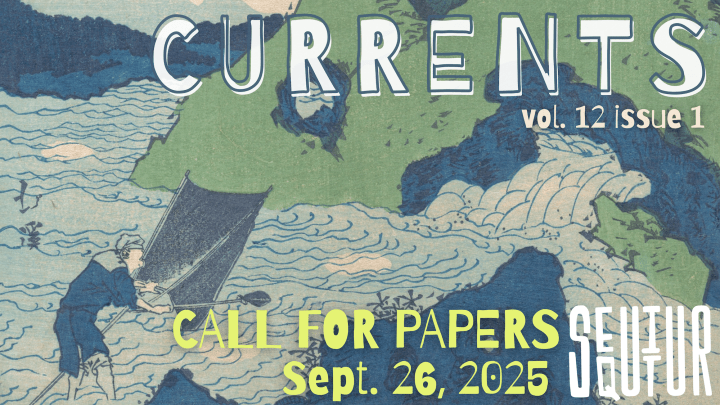
Sequitur, Fall 2025 | Currents
Submissions due by 26 September 2025
The editors of SEQUITUR, the graduate student journal published by the Department of History of Art & Architecture at Boston University, invite current and recent MA, MFA, and PhD students to submit content on the theme of “Currents” for our Fall 2025 issue.
This issue invites submissions that consider how artistic activity and material culture make visible, help detect, and even resist the invisible forces at work in our world. When used in the scientific fields of meteorology or hydrology, currents describe the perpetual motion of air and water. In the study of the humanities, the term might connote a prevailing trend or the zeitgeist of a particular historical moment.
Furthermore, scholarship in the blue humanities frames oceanic and cultural currents as part of an assemblage, suggesting that the ocean’s liquid perpetual motion and heterogeneous material composition are more than just a backdrop for human culture. At its surface, the ocean has served as a site of imperial conquest, extractivism, and militarization, but is also a site of migration, diaspora, and resistance. Scholars Kimberley Peters and Philip Steinberg even use the concept of the ocean, and all that it intermingles with, as a “Hypersea” to describe how the ocean exceeds its liquid form, perpetual cycles, or a specific body of water by permeating and shaping physical matter, such as the atmosphere and our bodies, but especially our imaginations. Peters and Steinberg’s work provokes further consideration of what art historical scholarship might look like when informed by natural and social currents that exceed their boundaries and inscribe one another.
From 17th-century Dutch still life painters’ fascination with the products of colonial and transoceanic trade to contemporary work such as Hito Stereyl’s Liquidity Inc. (2014), which draws parallels between liquid currents and the fluidity of financial assets, identities, and borders in a digital world, artists, architects, and collectors have responded to the questions and conditions shaped by natural and social currents. This issue seeks to collect scholarship spanning antiquity to the present that grapples with such currents as complex, historical assemblages and asks where art might serve as a tool to interrogate them.
Possible subjects may include, but are not limited to:
• Currents, Movement, and Temporality: Flow; perpetual motion; flux; swell; direction; circulation; pushing and pulling; present; contemporary; prevailing; instant; prediction; ongoing; trends
• Currents and Systems: Weather patterns; transoceanic drift; mapping; hydrocommons; oceanic and atmospheric ecologies; rivers; oceans
• Currents and Culture: (Un)intended distribution (shells, marine salvage, etc.); spirituality and religion (ritual, baptism, purification, etc.); contact zones; migration; undercurrents
• Currents and Scholarship within the Oceanic Turn: transoceanic imaginaries (Elizabeth DeLoughrey); a “poetics of planetary water” (Steve Mentz); tidalectics (Kamau Brathwaite); the Undersea, and other theoretical methods (including works of Stacy Alaimo, Hester Blum, John R. Gillis, Epeli Hau’ofa, Melody Jue, Astrida Neimanis, Serpil Oppermann, or Philip Steinberg, among many others)
SEQUITUR welcomes submissions from graduate students in the disciplines of art history, architecture, archaeology, fine arts, material culture, visual culture, literary studies, queer and gender studies, disability studies, memory studies, and environmental studies, among others. We encourage submissions that take advantage of the digital format of the journal.
Founded in 2014, SEQUITUR is an online biannual scholarly journal dedicated to addressing events, issues, and ideas in art and architectural history. SEQUITUR, edited by graduate students at Boston University, engages with and expands current conversations in the field by promoting the perspectives of graduate students from around the world. It seeks to contribute to existing scholarship by focusing on valuable but often overlooked parts of art and architectural history. Previous issues of SEQUITUR can be found here.
We invite full submissions in the following categories. Please submit your material in full for consideration in the publication:
Feature essays (1,500 words)
Content should present original material that falls within the stipulated word limit (1,500 words). Please adhere to the formatting guidelines available here.
Visual and creative essays (250 words, up to 10 works)
We invite M.Arch. or M.F.A. students to showcase a selection of original work in or reproduced in a digital format. We welcome various kinds of creative projects that take advantage of the online format of the journal, such as works that include sound or video. Submissions should consist of a 250-word artist statement and up to 10 works in JPEG, HTML, or MP4 format. All image submissions must be numbered and captioned and should be of good quality and high resolution.
We invite proposals for the following categories. Please write an abstract of no more than 200 words outlining your intended project:
Exhibition reviews (500 words)
We are especially interested in exhibitions currently on display or very recently closed. We typically prioritize reviews of exhibitions in the Massachusetts and New England area.
Book or exhibition catalog reviews (500 words)
We are especially interested in reviews of recently published (1–3 years old) books and catalogs.
Interviews (750 words)
Please include documentation of the interviewee’s affirmation that they will participate in an interview with you. Plan to provide either a full written transcript or a recording of the interview (video or audio).
Research spotlights (750 words)
Short summaries of ongoing research written in a more casual format than a feature essay or formal paper. For research spotlights, we typically, but not universally, prioritize doctoral candidates who plan to use this platform to share ongoing dissertation research or work of a comparable scale.
To submit, please send the following materials to sequitur@bu.edu:
• Your proposal or submission
• A recent CV
• A brief (50-word) bio
• Your contact information in the body of the email: name, institution, program, year in program, and email address
• ‘SEQUITUR Fall 2025’ and the type of submission/proposal as the subject line
All submissions and proposals are due 26 September 2025. Please remember to adhere to the formatting guidelines available here. Text must be in the form of a Word document, and images should be sent as .jpeg files. While we welcome as many images as possible, at least one must be very high resolution and large format. All other creative media should be sent as weblinks, HTML, or MP4 files if submitting video or other multimedia work. Please note that authors are responsible for obtaining all image copyright releases before publication. Authors will be notified of the acceptance of their submission or proposal the week of 15 October 2025, for publication in January 2026. If you have any questions, please do not hesitate to contact the SEQUITUR editors at sequitur@bu.edu.
The SEQUITUR Editorial Team
Ada, Emma, Hamin, Isabella, Jenna and Megan
SAAM Fellowships in American Art
From SAAM:
Fellowships in American Art | Smithsonian American Art Museum
The Smithsonian American Art Museum and its Renwick Gallery invites applications to its premier fellowship program, the oldest and largest in American art. Scholars from any discipline whose research engages the art, craft, and visual culture of the United States are encouraged to apply, as are those who foreground new perspectives, materials, and methodologies. Fellowships are residential and support full-time research in the Smithsonian collections. SAAM is devoted to advancing excellence in art history and encourages candidates from all backgrounds to apply.
Each fellow is provided a carrel in SAAM’s Research and Scholars Center. There, they have access to the museum’s collection of over 46,500 works, specialized study collections and databases, the Smithsonian’s Archives of American Art, and an 180,000-volume branch library specializing in American art. The Research and Scholars Center is a short walk from other Smithsonian museums and libraries, the Library of Congress, the National Archives, and the National Gallery of Art. Regular workshops, seminars, and lectures provide a forum for lively scholarly exchange and professional advancement.
Candidates may apply to one or more of the following three opportunities:
• SIFP Fellowships at SAAM
SAAM hosts fellows through the Smithsonian Institution Fellowship Program (SIFP) and awards its own named fellowships to predoctoral, postdoctoral, and senior candidates from this general pool. Stipend:$10,000 for a ten-week term at the graduate student level; $45,000 for a twelve-month term at the predoctoral level; $57,000 for a twelve-month term at the postdoctoral and senior levels. Deadline: 15 October 2025.
• Betsy James Wyeth Fellowship in Native American Art
This joint fellowship at SAAM and the National Museum of the American Indian is awarded for a twelve-month term at the predoctoral level or a nine-month term at the postdoctoral or senior level. Stipend: $53,000. Deadline: 15 October 2025.
• Audrey Flack Short-Term Fellowship
One fellowship is awarded annually at the predoctoral, postdoctoral, or senior level for a one-month term. Stipend: $5,000. Deadline: 1 February 2026.
For general information about our program, visit AmericanArt.si.edu/fellowships. For further guidance on how to apply, watch our tutorial on SAAM’s YouTube channel.
Decorative Arts Trust, Research Grant Recipients, 2025
From The Decorative Arts Trust:
In 2025, the Decorative Arts Trust celebrates another record-breaking year for our Research Grants program, with 16 recipients receiving travel funding to study objects and archival records.
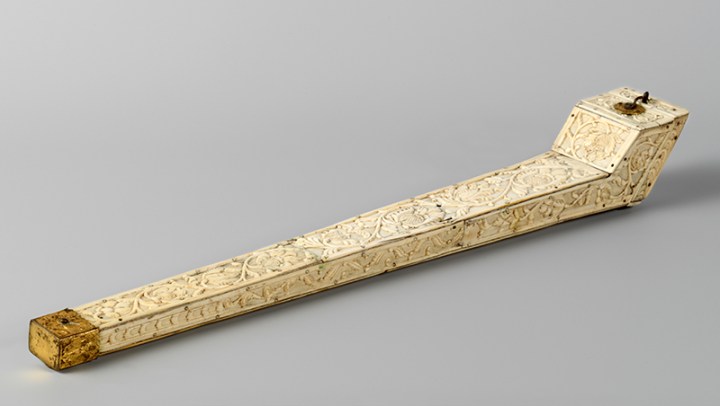
Nur’Ain Taha is studying ivory pipe cases. Pictured: Pipe case from Ceylon, 1799–1825, Sri Lanka, ivory, tropical wood, copper (Amsterdam: Rijksmuseum, NG-453).
The Trust congratulates the 2025 Research Grant recipients:
• Carson L. Beauman, MA Student, Georgia Southern University, the curriculum of Boston schools run by women, 17th–18th centuries
• Anna Flinchbaugh, PhD student, University of Southern California, embroidery’s intersection of craft and industry in the Britain and the United States, late 19th–early 20th centuries
• Kathryn Griffith, PhD student, University of Southern California, Italian goldwork in textiles and the decorative arts, 15th–16th centuries
• Julia LaPlaca, PhD student, University of Michigan, tapestries in European altar environments, 14th–16th centuries
• Jasper Martens, PhD student, University of California Santa Barbara, Netherlandish portrait miniatures with translucent mica overlays, mid-17th century (The Decorative Arts Society of Orange County Grant)
• Fiona Owens, MA student, Winterthur Program in American Material Culture, University of Delaware, the framing of Pre-Raphaelite artist Mary Macomber’s paintings, late 19th century (The Marie Zimmermann Grant)
• Emma Piercy-Wright, PhD student, University of Exeter, mother-of-pearl in French decorative arts, late 17th–early 19th centuries
• Sarah Rapoport, PhD student, Yale University, French transfer-printed ceramics, late 19th century
• Servane Rodie-Dumon, PhD student, Universite d’Artois, the career of French architect-decorator Émile Peyre, late 19th century
• Joseph Semkiu, PhD student, University of Southern California, materiality of radio chassis, mid-20th century
• Arielle Suskin, PhD student, Case Western Reserve University, Roman figural balsamaria, 3rd century BCE – 3rd century CE
• Nur’Ain Taha, PhD student, Utrecht University, ivory pipe cases that connect the early Dutch Republic and Ceylon, 17th century
• Ashley Vernon, MA student, Winterthur Program in American Material Culture, University of Delaware, ‘paper home’ collages crafted by women, late 19th century
• John White, PhD student, Princeton University, walrus and narwhal ivory in Germanic decorative arts, 15th–17th centuries
• Natalie Wright, PhD student, University of Wisconsin-Madison, The Functional Fashions Line of the Clothing Research and Development Foundation, late 20th century
• Rebecca Yuste, PhD student, Columbia University, the importation of Neoclassical style to New Spain, late 18th century
The application deadline for Research Grants is April 30 annually. For more information on grants and scholarships from the Decorative Arts Trust, read about our Emerging Scholars Program, generously supported by Trust members and donors. For deadline reminders, sign up for our e-newsletter and follow us on Facebook and Instagram. The deadline for institutions to apply for the 2025 Prize for Excellence and Innovation is approaching on June 30.
Study Course | Drawings in Theory and Practice
From ArtHist.net:
Drawings in Theory and Practice: Connoisseurship – Collecting – Curatorial Practice
Albertina, Vienna, 28 July — 1 August 2025
Applications due by 6 June 2025
We are pleased to announce the Albertina’s 7th annual study course on drawings. The course is designed for doctoral students and early post-doc-researchers who are working in the field of drawings and prints and are interested in exploring curatorial practices. The course offers the opportunity to discuss current research on the graphic arts and, at the same time, to gain insight into one of the most renowned collections of prints and drawings. The course is organized jointly by the Institute of Art History at the University of Vienna and the Albertina and is generously supported by the Wolfgang Ratjen Foundation.
Participants are expected to present aspects of their current research in a 30-minute paper. Together we will discuss relevant drawings in the Albertina and gain insight into different curatorial practices: conception and planning of exhibitions, publication of catalogues, conservation and marketing, collecting and provenance research. Accommodation in Vienna will be covered as well as documented travel costs (economy flight, 2nd class train ticket) up to 350 Euros. The general course language is English, while individual papers can be presented in German, Italian, and French. The course is directed by Univ.-Prof. Dr. Sebastian Schütze and Dr. Christof Metzger.
Applications—including a cv, short description of the drawing or print related research project, and a reference letter from a university professor—should be sent by 6 June 2025 to Dr. Silvia Tammaro, silvia.tammaro@univie.ac.at. Applicants will be notified by 15 June 2025.
Graduate Student Seminar | Caricature and the Grotesque
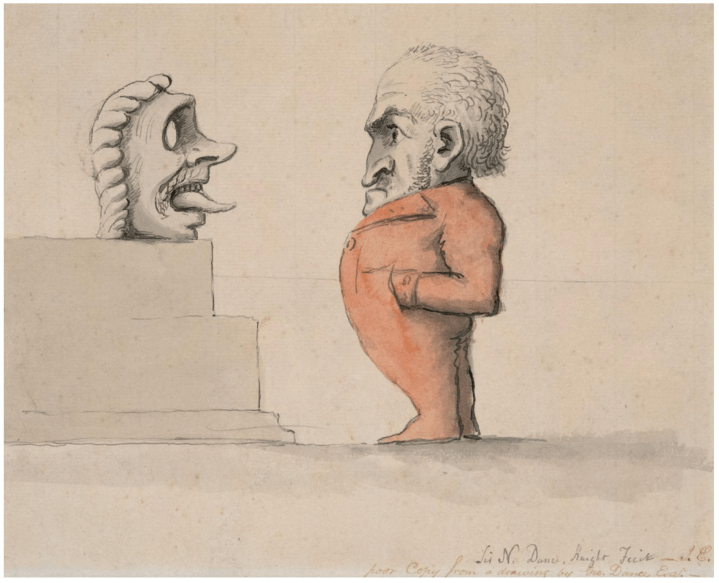
Nathaniel Dance, The Antiquarian, ca.1800, pen, ink, and watercolor.
◊ ◊ ◊ ◊ ◊
The application form is available here:
Caricature and the Grotesque: Early Modern Prints and Politics
Graduate Student Seminar led by Peter Parshall, with Cynthia Roman and Freyda Spira
The Lewis Walpole Library and Yale University Art Gallery, 21–22 May 2025
Applications accepted until 12 May 2025 (with rolling acceptance)
Distortion takes many different forms and plays a role in all artistic traditions. In one sense or another the pictorial response to the world has always shown an inclination to turn things inside out. Our task in this two-day graduate seminar will be to consider this phenomenon as it evolves in the graphic arts from the Renaissance into the early nineteenth century. In this admittedly broad setting we shall concentrate specifically on the use of distortion in political and social contexts, especially in printmaking where the wide and efficient distribution of texts and pictures first became possible. How does the use of caricature, satire, and the grotesque inflect the message of an image? What lies behind its preference for the artist and its appeal to the viewer? Does a potentially ‘popular’ medium like printing inevitably lead to the embrace of the grotesque and a conscious degradation of pictorial rhetoric?
We shall approach these questions through a discussion of original works of art, primarily works available in the Yale University Art Gallery and the Lewis Walpole Library. The main areas of study will be: Renaissance prints and the transformation of the grotesque; the invention of modern caricature with particular attention to anti-Semitism; the flourishing of British caricature in the eighteenth century; William Hogarth and social satire as political argument; and last, Francisco Goya and the relation between realism and fantasy. There will be short readings for each of four sessions held over two consecutive days. The emphasis will be on group discussion conducted as an open forum and inviting all manner of inquiry pertinent to the questions being addressed and the objects at hand.
With space limited to 10 participants, this program is open by application. Applications will be reviewed and successful applicants notified on a rolling basis until 12 May 2025, or until enrollment is filled. This seminar is sponsored by the Lewis Walpole Library, Yale University. Please contact cynthia.roman@yale.edu with questions.
• Peter Parshall, former Jane Neuberger Goodsell Professor of Art and Humanities at Reed College and Curator of Old Master Prints at the National Gallery of Art
• Cynthia Roman, Curator of Prints, Drawings, and Paintings, the Lewis Walpole Library, Yale University
• Freyda Spira, Robert L. Solley Curator of Prints and Drawings, Yale University Art Gallery
Peter Parshall has written and lectured widely on early modern art with special emphasis on the history of prints, the history and the organization of collecting, and Renaissance art theory. He co-authored with David Landau The Renaissance Print (1994), recipient of the Mitchell Prize. Among exhibitions curated are: The Unfinished Print (2001); Origins of European Printmaking (2005) with Rainer Schoch; and The Darker Side of Light: Arts of Privacy, 1850–1900 (2008). Since formal retirement he has pursued several topics of current interest and is presently writing a book on art and politics.










 Enfilade
leave a comment