8th Annual Ricciardi Prize from Master Drawings
From Master Drawings:
Eighth Annual Ricciardi Prize from Master Drawings
Submissions due by 15 November 2025
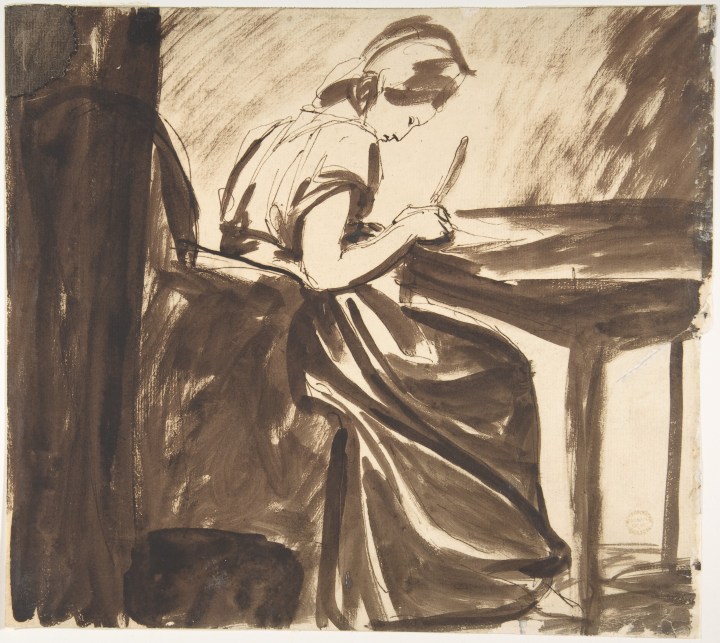
George Romney, Lady Seated at a Table (recto); pen and brown ink, brush and brown wash (NY: The Metropolitan Museum of Art, 11.66.3).
Master Drawings is now accepting submissions for the 8th Annual Ricciardi Prize of $5,000. The award is given for the best new and unpublished article on a drawing topic (of any period) by a scholar under the age of 40. Candidates are also eligible for a $1000 runner-up prize and publication. Prize winners are eligible for reimbursement of costs associated with obtaining image publication permissions. They will be invited to present their research at a symposium held during Master Drawings Week in New York (January 2026). Information about essay requirements and how to apply can be found here. Information about past winners and finalists is available here.
The average length is between 2,500 and 3,750 words, with five to twenty illustrations. Submissions should be no longer than 7,500 words and have no more than 75 footnotes. All submissions must be in article form, following the format of the journal. Please refer to our Submission Guidelines for additional information. We will not consider submissions of seminar papers, dissertation chapters, or other written material that has not been adapted into the format of a journal article. Written material that has been previously published, or is scheduled for future publication, will not be eligible. Articles may be submitted in any language. Please be sure to include a 100-word abstract outlining the scope of your article with your submission.
Call for Submissions | Horowitz Book Prize
From the Bard Graduate Center:
The Mr. and Mrs. Raymond J. Horowitz Book Prize
For titles on the decorative arts or material culture of the Americas published in 2024
Submissions must be postmarked by 4 April 2025
Bard Graduate Center welcomes submissions for the Mr. and Mrs. Raymond J. Horowitz Book Prize, awarded annually to the best book on the decorative arts, design history, or material culture of the Americas. The prize rewards scholarly excellence and commitment to cross-disciplinary conversation. The winning author(s) or editor(s) will be chosen by a committee of Bard Graduate Center faculty and will be honored with a research event exploring critical applications of the awarded book’s argument. Eligible titles include monographs, exhibition catalogues, and collections of essays in any language, published in print or in digital format. Submissions must have a 2024 publication date.
Three copies of each print title and an entry submission form should be sent to the below address. For digital publications, please email a copy of the submission form, a PDF of the publication, and a link to the publication to horowitz.prize@bgc.bard.edu. Submissions must be postmarked by 4 April 2025. There is no limit to the number of submissions, but please note that we are unable to return items submitted for review. Incomplete submissions will not be considered. Shipping is the responsibility of the applicant and we are not able to confirm receipt of submissions. The winning title will be announced in September 2025. For questions, contact Mary Adeogun, manager of public research and education, at horowitz.prize@bgc.bard.edu.
Horowitz Book Prize Committee
Bard Graduate Center
38 West 86th Street
New York, NY 10024
Morgan Library & Museum Seminar | Drawing Nature, 1500–1900
The Morgan presents this day-long seminar for graduate students:
Drawing Nature, 1500–1900
The Morgan Library & Museum, New York, Friday, 4 April 2025
Proposals due by 21 February 2025
Led by Sarah Mallory, Assistant Curator of Drawings and Prints at the Morgan; Olivia Dill, Moore Curatorial Fellow at the Morgan; and Roberta J. M. Olson, Curator of Drawings Emerita at The New York Historical
European and North American Natural History drawings made before 1900 are historically understood as either works of fine art or as scientific records. The Morgan Library & Museum’s significant collection of natural history drawings, however, provides an opportunity to rethink longstanding divisions between the arts and sciences. This seminar will focus on collection holdings made by artists working in The Netherlands, Germany, England, France, and the Americas, from ca. 1450 to ca. 1850. Participants will have the opportunity to closely examine a large selection of works by Maria Sibylla Merian, Mark Catesby, Madeleine Françoise Basseporte, Georg Dionysius Ehret, John James Audubon, and many others. Lively discussions will address the production and subsequent uses of natural history drawings, including the ways in which techniques of observation and scientific developments informed drawing praxis. Key too will be instances in which artistic practice conditioned the production of empirical knowledge. We will also consider how gender, patronage, collecting practices, and colonial expansion inform natural history drawings.
This seminar is open to graduate students of the history of art, the history of science, and related fields, and also to graduate students interested in the conservation of works on paper. Applicants are kindly invited to submit a one paragraph statement which should include the following:
• Name and email
• Academic institution
• Class year
• Field of study
• Interest in natural history drawings and relevance of the seminar to your research
Applications should be submitted electronically with the subject header ‘Drawing Nature Seminar’ to drawinginstitute@themorgan.org by 21 February 2025. Participants will be notified by March 4.
Decorative Arts Trust Announces 2025 Failey Grants
.
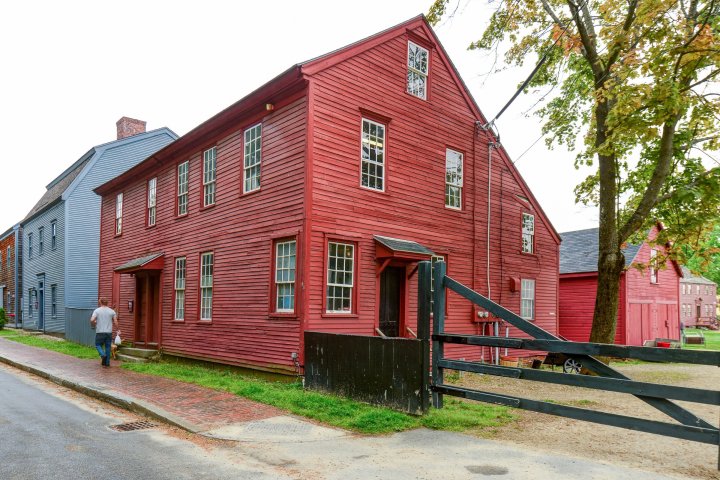
Strawbery Banke Museum in Portsmouth, New Hampshire is an outdoor history museum that preserves a neighborhood’s evolution of over 350 years, with most of the historic houses on their original sites. The Penhallow House—built in 1750 and moved to its present location in 1862—is Strawberry Banke’s only remaining ‘saltbox’. It was recently given a new foundation with a wet-proof basement to counteract rising sea and groundwater levels. In the 20th century, Penhallow House contained three apartments and the daily lives of an extended African-American family. Strawbery Banke intends to interpret the 20th-century Black experience in Penhallow House: the story of Kenneth ‘Bunny’ Richardson, a 20th-century story of Black Portsmouth and Civil Rights.
◊ ◊ ◊ ◊ ◊
From the December press release, with additional information available here:
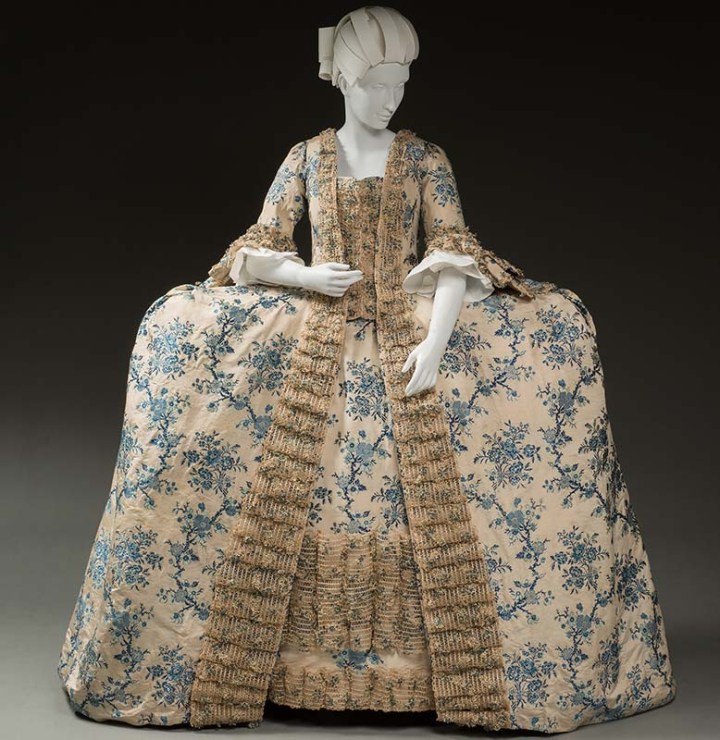
Formal dress (robe à la Française), 1765–70, French or Dutch, brocaded silk with knotted silk fringe and linen lining (Historic Deerfield, HD F.355).
The Decorative Arts Trust is pleased to announce the seven 2025 Dean F. Failey Grant recipients: the Birmingham Museum of Art in Birmingham, AL, for the Silver & Ceremony from Southern Asia, 1850–1910 exhibition; Historic Deerfield in Deerfield, MA, for the Body by Design: Fashionable Silhouettes exhibition; Honolulu Museum of Art in Honolulu, HI, for quilt conservation; the Museum of the American Revolution in Philadelphia, PA, for flag conservation; Strawbery Banke Museum in Portsmouth, NH, for Penhallow House wallpaper; Telfair Museums in Savannah, GA, for The Moss Mystique: Southern Women and Newcomb Pottery exhibition; and Wyck in Philadelphia, PA, for a Chinese desk conservation.
The Failey Grant program provides support for noteworthy exhibition and object-based conservation projects through the Dean F. Failey Fund, named in honor of the Trust’s late Governor. Failey Grant applications are due October 31 annually.
Call for Applications | Chinese Object Study Workshops, 2025
From ArtHist.net:
Materials and Methods in Chinese Calligraphy
University of Michigan Museum of Art, Ann Arbor, 9–13 June 2025
On Jewelness: Buddhist Materiality in Sino-Himalayan Art, 1400–1800s
Asian Art Museum of San Francisco, 18–22 August 2025
Applications due by 3 March 2025
An essential element in the training of art historians and curators is object-based learning in an immersive and supportive museum environment. This hands-on experience is critically important to scholars’ developing skills in close observation, connoisseurship, and art historical and conservation analysis. The China Objects Study Workshop—currently administered by the National Museum of Asian Art and starting 2025 the University of Michigan Museum of Art—is designed to cultivate a sensitivity to the importance of objects and a holistic understanding of art that can only be achieved through in-person examination. The workshops, occurring twice yearly, provide selected graduate students in the field of pre modern Chinese art history with an immersive experience in the study of objects through a week-long intensive session at rotating North American museums. During the week the students also develop insights into museum operations and practices as well as working relationships that can advance scholarly exchange and enduring professional connections.
The program is funded by the Kingfisher Foundation and administered by the University of Michigan Museum of Art. The program is open to graduate students enrolled in, or accepted to, a PhD program in the field of Chinese art history at a North American or European university. Graduate students from other art history–related programs and/or who are working closely with Chinese art objects are welcome to apply as well. Applicants may be of any nationality and may apply for more than one workshop. Housing, most meals, and a transportation stipend will be provided for each participant.
Students are welcome to apply for both workshops in a single application, addressing their background and interest in each workshop in separate application statements. One recommendation letter for the two workshop topics is sufficient. The application deadline is March 3, and decisions will be announced by March 31. To apply, please visit the link here.
The two following workshops are offered in 2025:
Materials and Methods in Chinese Calligraphy
University of Michigan Museum of Art, Ann Arbor, 9–13 June 2025
This workshop aims to engage participants in an immersive study of the materials, tools, and techniques used in writing and researching calligraphy. Participants will closely examine a rich collection of Chinese calligraphy from the Lo Chia-Lun Collection of Chinese Calligraphy at the University of Michigan Museum of Art in Ann Arbor, MI, alongside pieces from the museum’s longstanding collection of Chinese art. The workshop will cover all aspects of calligraphy as an art object as well as the writing process and methods. This includes materials and techniques for writing and mounting, seal placement, and para-matter and content (such as frontispiece, signature, colophon, etc.). Through the practice of close looking and group discussion in front of the pieces, the workshop helps participants understand the formation of styles and modes of display and reception. In doing so, the workshop encourages participants to master the skills necessary for researching any given piece of calligraphy within a historical context and to explore new possibilities for establishing research methodologies that expand the study of Chinese art history as a holistic field.
Workshop Leaders
• Lihong Liu, University of Michigan
• Qianshen Bai, Zhejiang University
• Natsu Oyobe, University of Michigan Museum of Art
On Jewelness: Buddhist Materiality in Sino-Himalayan Art, 1400–1800s
Asian Art Museum of San Francisco, 18–22 August 2025
Jewels are a ubiquitous presence in Buddhist literary and material culture. From the Three Jewels of Buddhism to the visual and material instantiation of the wish-fulfilling jewel, the frequent appearance of jewels as metaphor and material inspires cross-disciplinary inquiries into Buddhist world-making. How might a close study of objects shed new light on jewelness in Buddhist discourse and visual culture? This workshop explores the theme of jewelness through a selection of Sino-Himalayan objects in the collection of the Asian Art Museum of San Francisco. Drawing on Buddhist objects from the 14th to the 19th centuries that highlight the connection between China and the Himalayas, the workshop will offer students the hands-on opportunity to study a range of media. They include stone carvings, glazed ceramics, glass, bronze images, precious stone inlays, illuminated manuscripts, relics and reliquaries, sculptures in dry lacquer and wood, as well as pigments and painted representations. Topics to be explored include luster, luminescence, and translucency; related ritual and technological processes; history of transcultural exchanges; broader aesthetics of opulence and splendor in Chinese and Tibetan Buddhism; and the dialectics of transparency and opacity, concealment and revelation.
Workshop Leaders
• Wen-shing Chou, Hunter College & The Graduate Center, CUNY
• Ellen Huang, ArtCenter College of Design
• Jeffrey S. Durham, Asian Art Museum of San Francisco
Burlington Magazine Scholarship | French 18th-Century Art
From The Burlington:
The Burlington Magazine Scholarship | French 18th-Century Fine and Decorative Art
Applications due by 30 March 2025
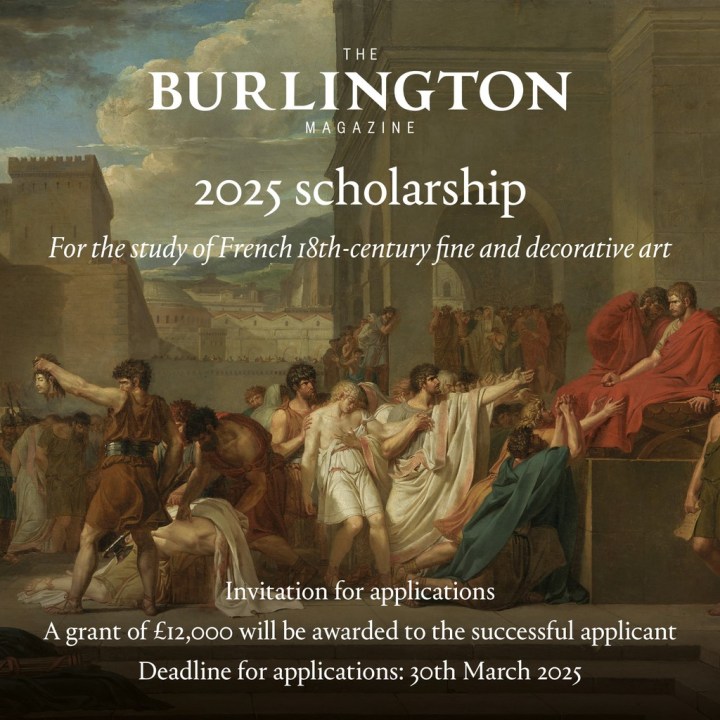 Applicants must be studying, or intending to study, for an MA, PhD, post-doctoral or independent research in the field of French 18th-century fine and decorative arts within the 12-month period the funding is given. The start date of successful applications should be at the beginning of the academic year (generally September). Earlier start dates will be considered for independent scholars or post-doctoral research. The funding is open to UK and international applicants. Research funded by this scholarship may lead to the submission of articles for publication in the Magazine: as such, the panel are looking for object related research, of the kind that the Burlington publishes.
To apply, please send your CV, description of project/research (no longer than 2 pages of A4), budget, proof of Institution you are attending/will attend to: scholarship@burlington.org.uk. Applications must be sent in PDF or Word document (.docx) format. Applications can only be submitted via email by 30 March 2025. The successful applicant will be notified by 31 May 2025.
Call for Applications | Baroque Summer Course: Death
From ArtHist.net:
Baroque — Death / Barock — Tod
24th Baroque Summer Course, Bibliothek Werner Oechslin, Einsiedeln, Switzerland, 22–26 June 2025
Organized by Anja Buschow Oechslin, Axel Christoph Gampp, and Werner Oechslin
Applications due by 23 February 2025
Death is omnipresent. No one can escape it; it is among us and goes about its business as it sees fit. If one takes seriously the “memento mori” that we encounter in droves on tombstones and that is addressed to us, the (still) living, then one can see that this commingling of life and death is of central importance to human culture and has always had a significant impact on its art forms.
This ubiquity and omnipresence of death was summed up in the long-popular Dance of Death: “we all die” according to the biblical saying “Omnes Morimur.” Patritius Wasserburger put this into verse for Count Sporck as “Zuschrift an das sämmtlich-menschliche Geschlecht” (“Letter to the whole human race”):
“You popes! Cardinals!
You bishops! You abbots!
You lappeted gentlemen!
You canons! You prelates!
All manner of priests,
Of high dignity, and also of lower rank. […]”
He records them all, even the “drunkards”:
“Oh you brothers of the wet stream!
Guzzle, dance, sing songs!
You are wild and tipsy, jolly: bluster, sleep around, shack up, rave!
Go on, twirl, feast, roister!
But: woe for eternity.”
Michael Heinrich Rentz illustrated this in his dramatic images and emphasized the direct partnership—and equality—of man and death. The series of images, first printed in 1753, was realized as a perfect baroque book, “full of meaning, instruction, and spirit.” And we are already amid the exuberant baroque pleasure in shaping and designing. Baroque rhetoric, with its astute precepts of “argutezza” or even “cavillatio,” takes particular pleasure in the boundaries, in the contact between life and death. Nothing is alien to this and the desire to transcend such boundaries fires the imagination. In 1774, the Archbishop and Elector of Mainz, who had been blessed with the “temporal right of sovereignty,” was mourned accordingly: “The tombstones may restrict his generous hands, but his heart allows no limits to be set, such as to work immortally in faithfulness to God, thus in love for his needy people.” After the “passing away,” as if only a small disturbance had occurred, it is all about the “denatus”; he has merely changed his condition—for the better, of course.
Glorification of human deeds in light of the future life after death, as the motto of the Duke of Brauschweig, Johann Friedrich, says: EX DURIS GLORIA. The separation through death is followed by reflection and the gain of a “better life.” Death is given this powerful, dialectical function of the historical continuation of “lived reality” by virtue of idealization. It challenges all the arts and the artifices of rhetoric, which “mediate” in all possible tones of a “heroic poem” in an “Imitatio Epica,” whether allegory, or panegyric or in the “Epicedium” particularly assigned to funeral ceremonies.
Those who focus so much on the afterlife, as was the case in the Baroque ecclesiastical world in the most pronounced way, have before their eyes all the glory that is emulated in this world with the greatest artistic effort in order to convey it to people and their sensory perceptions. This is what led someone like Karl Wilhelm Ferdinand Solger to recommend: “He who cannot reach God in his spirit should seek him in images, he will not be led astray.” To “draw God down into his sphere” was the motto and it fit best precisely where the scene is changed, as it were, with death. Friedrich Wilhelm Schelling saw it correctly: “This symbolic view is the church as a living work of art.” And there is more, something fundamental, hidden behind this paradigm of human destiny and the conditions of privileged human existence. Marsilio Ficino states this in the first sentences of his “Cristiana religione” (1474/5). If man could not distinguish between good and bad in the “lume dell’intellecto,” he would be the most miserable creature, as he, unlike other living creatures, also has to dress himself. And at the beginning of “Platonica Theologia” (1482), he formulates its essence: “Si animus non esset immortalis: nullum animal esset infelicius homine.”
Art draws its deeper justification from this and declares that no effort is too great for it, especially when it comes to the furnishings for funeral ceremonies, when entire church interiors are covered with allegorical scenes and high catafalques are erected. The unsurpassable dialectic of life and death calls for the greatest artistic invention, which is particularly desirable in “baroque” times and results in works of art that would give even someone like Wölfflin a headache. When Rudolf Wittkower opened the Guarini Congress in Turin in 1968, he had a whole repertoire of “unorthodox” forms at hand: “Paradossi ed apparenti contraddizioni, volute incongruenze”; it is much more than just “varietà” and—in the tradition of Nicholas of Cusa—also encompasses mathematics: “Famose (!) compenetrazioni di spazi diversi.” He observes the juxtaposition of “morbidi moduli ornamentali manieristici” and “forme cristalline di estrema austerità.” They are “prodigi strutturali.” And Wittkower’s insight was: “intelletto” and “emozione” are not separate, but belong together, just as—in art—life and death appear intertwined and death, if man takes his divinely inspired, spiritual life seriously, is ultimately only a gateway to another world. It is understandable that a cemetery is then described as “the Elysian Fields.” There are no limits to the imagination and to art.
The course is open to doctoral candidates as well as junior and senior scholars who wish to address the topic with short papers (20 minutes) and through mutual conversation. As usual, the course has an interdisciplinary orientation. We hope for lively participation from the disciplines of art and architectural history, but also from scholars of history, theology, theatre and other relevant fields. Papers may be presented in German, French, Italian or English; at least a passive knowledge of German is a requirement for participation. The Foundation assumes the hotel costs for course participants, as well as several group dinners. Travel costs cannot be reimbursed. Please send applications with brief abstracts and brief CVs by email to: anja.buschow@bibliothek-oechslin.ch. The deadline is 23 February 2025.
Concept / Organization: Dr. Anja Buschow Oechslin (Einsiedeln), Prof. Dr. Axel Christoph Gampp (Uni Basel, Fachhochschule Bern), Prof. Dr. Werner Oechslin (Einsiedeln)
The Courtauld Announces New Manton Centre for British Art
From the press release earlier this fall (6 August 2024) . . .
The Manton Foundation has donated $12 million to The Courtauld to create the Manton Centre for British Art. The Centre, named after British art collectors and philanthropists, Sir Edwin Manton and Florence, Lady Manton, will help secure The Courtauld’s ambition of becoming a world leader in the field of British art and marks the continued commitment of the Manton family to arts education.
The Manton Centre for British Art will serve as an intellectual hub for art historians, curators, critics, artists, and students nationally and internationally, providing a platform for sharing world-leading research and for teaching the next generation of British art specialists. Located initially at The Courtauld’s current campus at Vernon Square, the Manton Centre will later be housed in the purpose-designed premises at Somerset House, providing the physical and intellectual home for The Courtauld’s research and teaching on British art. The Courtauld’s specialists in British art will become members of the Centre and help shape its activities and development. The Centre will operate as the base for students taking modules in British art as part of their MA degree and also provide a home for The Courtauld’s PhD students researching British art.
Professor Mark Hallett, Märit Rausing Director, said: “This is a thrilling moment for The Courtauld. Our new Manton Centre will place British art in a global context, and aim to deliver truly world-class teaching and research in this rich, endlessly fascinating field of study. The Centre will support students through a generously endowed programme of scholarships, and offer a dynamic programme of activities and events across the year. We are hugely grateful to the Manton Foundation for their generous gift, which will enable us to support the very best new thinking and teaching on British art for generations to come.”
Julia Krapf and Sandy Niles, Trustees of The Manton Foundation, said: “After a visit to The Courtauld and several discussions with its leadership and faculty, we came away impressed by the dedicated academic training offered to students interested in British art, including the period of most interest to our grandparents. We are excited and motivated by the opportunity to help The Courtauld strengthen and formalize its research capacity in that area.”
The Centre will present an ambitious and dynamic programme of events including:
• An annual lecture in memory of Sir Edwin and Lady Manton
• An annual international conference devoted to a major topic in the field
• Regular workshops devoted to specific areas of British art
• An annual programme of seminars and lectures enabling scholars, curators, critics, and artists to share their thinking and research
• An annual ‘scholar in residence’ programme, designed to host a leading figure in the field of British art
The Manton Centre for British Art will also pursue collaborations with other scholarly and artistic institutions both in the UK and around the world. In pursing these collaborations and partnerships, the Centre will engage with all areas and periods of British art, and with a wide range of partners and interlocutors.
MA Program at The Courtauld
From The Courtauld:
MA, History of Art, The Courtauld, London
Applications due by 20 January 2024
The Courtauld’s MA in History of Art is one of the largest graduate Art History programmes anywhere in the world and offers an unrivalled combination of breadth and depth. The course provides the best research-led teaching in a unique, single-subject setting. This rich academic resource is complemented by the internationally renowned excellence of the Courtauld Gallery, which is famous for the quality of its collection and the ambition and scholarship of its exhibition programme. . . .
Next year’s Special Option modules (each open to 10–12 students) include these four offerings on the 18th century:
• Architecture and Empire: Imperial Legacies at Home and Abroad, ca. 1620–1920 | Kyle Leyden
• Art and the Matter of Global Encounter in Early Modern France, ca. 1550–1820 | Sarah Grandin
• Art, Oceans, and the British Empire, ca. 1750–1900 | Tom Young and Esther Chadwick
• Beijing and Beyond: Art and Empire in Early Modern China, ca. 1600–1900 | Stephen Whiteman
More information is available here»
Morgan Library & Museum Fellowships
From The Morgan Library & Museum:
The Morgan Library & Museum is offering four fellowships for pre- and post-doctoral students. Applications must be submitted by 31 December 2024.
1 Drawing Institute Predoctoral Research Fellowship, 2025–26
The Morgan Drawing Institute will award one nine-month Predoctoral Research Fellowship to an advanced-level graduate student who has completed all course work and exams. The student should be currently engaged in carrying out research leading to the completion of a doctoral dissertation in the history of art, a significant component of which pertains to the history, theory, collecting, function, or interpretation of drawings. The stipend is $4000/month for 9 months, September/October 2025–May/June 2026, plus a $2000 travel allowance intended to support or subsidize a short research trip.
2 Drawing Institute Postdoctoral Research Fellowship, 2025–26
The Morgan Drawing Institute will award one nine-month Postdoctoral Research Fellowship to a scholar in the first decade of their career following the completion of the Ph.D. or equivalent advanced degree. The Postdoctoral Research Fellowship supports an independent research project, ideally working toward a clearly defined publication relating to some aspect of the history, theory, collecting, function, or interpretation of drawings. The stipend is $4850/month for 9 months, generally expected to run between September/October 2025 – May/June 2026, plus a $2000 travel allowance intended to support or subsidize a short research trip. If a fellowship is sought for a specific time (e.g. around a professor’s semester-long sabbatical), that should be clearly indicated in the application.
3 Belle da Costa Greene Curatorial Fellowships
The Morgan Library & Museum seeks applications for the Belle da Costa Greene Curatorial Fellowship, a two-year curatorial fellowship to be awarded to two promising scholars with experiences and perspectives that have not been adequately reflected in the curatorial and special collections fields. Named for the Morgan’s first director, one of the most prominent American librarians and cultural leaders of the first half of the twentieth century and a woman of African-American descent, this full-time program will equip the Fellows with a strong working knowledge of museum and special collections library operations and provides the Fellows with resources and mentorship to further a professional career in libraries, archives, or museums. The Morgan seeks candidates who are interested in working on specific projects as outlined on the museum’s website. The program will provide the Fellows with experience in a variety of core curatorial activities, such as exhibition and publications planning, research on the collection and on potential acquisitions, the creation of public programs, and donor relations. The Fellows will also have the opportunity to propose and curate an installation or small exhibition in the museum. The salary is $52,000 annually; excellent benefits. Fellows will also have a travel budget of $2000 per year for research and for activities supporting their professional development, such as attendance at a conference.
4 Shelby White & Leon Levy Fellowship in Manuscript Cataloging
The Morgan Library & Museum invites applications for the Shelby White & Leon Levy Fellowship in Manuscript Cataloging. The Fellowship is intended for new professionals who have demonstrated engagement with general cataloging or archival processing and wish to enhance their skills through intensive specialized training. This is a unique opportunity for early-career professionals to receive training and mentoring as members of the Morgan Library & Museum curatorial and cataloging staff. Starting in February 2025, the Fellowship will consist of 650 hours, and applicants will have a choice between full-time (35 hours per week) or part-time (21 hours per week) work in order to complete the 650 hours. Fellows will be assigned to work on specific groups of 19th- or 20th-century correspondence. They will be expected to research the historical and cultural context in which the letters and documents were produced, create collection and item level records in CORSAIR—the Morgan’s collections database—according to DCRM(MSS), assign accession numbers, and attend to the rehousing and conservation needs of the material. Considerations will be given to applicants’ areas of experience or expertise, such as specific language skills or subject specialization in art, literature, history, film, history of science, etc.










 Enfilade
leave a comment