The Decorative Arts Trust Announces Recipients of Publishing Grants
From the press release (13 June 2024) . . .
The Decorative Arts Trust congratulates the inaugural recipients of their new Publishing Grants. The Hispanic Society Museum and Library; the Philadelphia Museum of Art; and The Huntington Library, Art Museum, and Botanical Gardens received Publishing Grants for Collections, Exhibitions, and Conferences, and Dr. Joseph Larnerd from Drexel University received a Publishing Grant for Dissertations and First-Time Authors.
In November 2024, the Hispanic Society Museum and Library in New York City’s Washington Heights will publish A Room of Her Own: The Estrados of Viceregal Spain to accompany their landmark exhibition of the same name. Guest Curator Alexandra Frantischek Rodriguez-Jack and Deputy Director and Head of Collections Margaret Connors McQuade will lead this examination of the estrado, defined in the early 18th-century treatise Diccionario de Autoridades as the “set of furniture used to cover and decorate the place or room where the ladies sit to receive visitors.” The estrado was a remarkable space where a diverse group of women engaged in elaborate social practices and displayed their collections of valuable objects from the Americas, Asia, and Europe. Decorative arts, paintings, rare books, and engravings from the Hispanic Society Museum and Library’s collection will be presented in an entirely new light, with many to be exhibited for the first time.
The Huntington Library, Art Museum, and Botanical Gardens in San Marino, California plans to release a comprehensive publication about an influential Los Angeles-based ceramics artist in fall 2026. Although additional details cannot be announced at this time, the book will complement an exhibition led by Lauren Cross, PhD, the Gail-Oxford Associate Curator of American Decorative Arts.
The Philadelphia Museum of Art is publishing Art, Industry, and Reform in Philadelphia, 1876–1926, accompanying the museum’s spring 2026 exhibition of the same name. David Barquist, The H. Richard Dietrich, Jr., Curator of American Decorative Arts, and Colin Fanning, Assistant Curator of European Decorative Arts, lead the exhibition and publication, which will focus on Philadelphia artisans and architects who drew on a range of inspirations—from the British Arts and Crafts movement to masterworks at the World’s Fairs—to address challenges of urban industrialization. Their investigation will be among PMA’s offerings during the nation’s 250th commemoration, which is also the museum’s 150th anniversary year.
Dr. Joseph Larnerd received the inaugural Publishing Grant for Dissertations and First-Time Authors. Larnerd, an Assistant Professor of Design History at Drexel University in Philadelphia, will publish Undercut: Cut Glass in Working-Class Life during the Long Gilded Age with the University of Delaware Press in fall 2025. This publication offers an original history of cut glass refracted through the labors required to make and maintain the glistening wares. Larnerd will show how popular representations of the medium and these widely discussed labors undercut how working-class peoples imagined and enacted social class, privilege, and mobility.
The deadline to apply for Decorative Arts Trust Publishing Grants is March 31 annually. For more information, visit decorativeartstrust.org.
Funding News | Mellon Centre Publication and Digitisation Grants
The Mellon Centre recently announced changes to its publication grants and the introduction of digitization grants:
Paul Mellon Centre Funding: Publication and Digitisation Grants
Applications accepted 5 August — 30 September 2024
Ahead of the opening of the autumn 2024 round of funding opportunities we have made some alterations to simplify and improve our Publication Grants. Our Publication Grants continue to be one of our most heavily subscribed awards, and in 2023 received over ninety applications. Therefore we have decided to streamline the process; instead of having the single Publication Grant, for which authors and publishers could apply separately or together, from autumn 2024 there will be three distinct grant categories:
Author Grants (Large)
Awards of up to £6,000 which can only be applied for by authors, editors or individuals working on a long-form piece of written work (e.g. monograph, catalogue etc.). This award is designed to support costs incurred by the author relating to the publication, such as image purchasing and copyright, commissioning of new photography or graphics, marketing/publicity costs and supporting publisher subventions.
Author Grants (Small)
Awards of up to £1,000 which can only be applied for by individuals working on a short-form piece of written work (e.g. article, chapter etc.) for a scholarly journal or edited volume. This award is primarily designed to support costs incurred by the individual for images use associated with their piece of writing (e.g. copyright costs, image purchasing, commissioning of new photography or graphics).
Exhibition Publication Grants
Awards of up to £6,000 which can only be applied for by organisations, institutions or publishers working on a publication associated with an exhibition on British art or architectural history. The publication could be due to be published to coincide with the exhibition or as a direct result of an exhibition. This award is primarily designed to support the practical costs incurred by the organisation, institution or publisher when publishing the work (e.g. printing, binding, image rights, commissioning new photography or images, indexing, copy-editing, production costs, marketing and publicity etc.). If a publisher is interested in applying for a grant for a publication not relating to an exhibition we would encourage them to speak to the author or editor so they can apply for an Author Grant (Large).
Applications will open on 5 August and close 30 September. Please do contact the Grants & Fellowships Manager if you have any questions relating to these changes. Multiple applications across these schemes, for the same publication, will not be accepted. If an applicant is interested in digitising a publication then we would encourage them to look at our new Digitisation Grant which is due to be introduced in autumn 2024.
Supporting the field of British art history publishing has been an important strand of grantmaking for Paul Mellon Centre since its inception in 1970. These changes to the structure of the publications grants will not impact on the overall amount awarded to publication annually, and we will endeavour to support as many projects as possible.
◊ ◊ ◊ ◊ ◊
Digitisation Grants
The Mellon Centre is pleased to be able to introduce Digitisation Grants, a new funding opportunity that will be offered for the first time in our autumn 2024 round. Our Digital Project Grant was introduced in 2015 and since then has supported a variety of fascinating and innovative digital projects; however, since its inception we have noticed that many applicants are looking for funding to support more straightforward digitisation projects, and we hope this new grant will help.
The Digitisation Grant is an award of up to £5,000 and is specifically designed to help organisations make materials from their collections freely available for users online via digital methods. The grant may be used towards the practical costs of in-house digitisation (e.g. equipment and software), hiring an external digitisation service and personnel costs for cataloguing or research purposes.
Materials to be digitised could include:
• photographic collections
• archival collections of letters, index cards, notes etc.
• bound volumes (e.g. diaries, magazines, newspapers, albums, sketchbooks, published books etc.)
• objects, paintings or assets
• publications
Please note that organisations can only apply for this award to digitise items in their own collections.
We hope this grant will help to make materials concerning British art and architectural history available to a wider audience and continue Paul Mellon Centre’s mission to champion new ways of understanding British art history and culture.
Decorative Arts Trust Prize for Excellence and Innovation
From The Decorative Arts Trust:
Decorative Arts Trust Prize for Excellence and Innovation, $100,000
Application due by 30 June 2024
To further the Decorative Arts Trust’s mission to foster appreciation and study of the arts, the Trust established this $100,000 Prize for Excellence and Innovation. The Prize funds outstanding projects that advance the public’s appreciation of decorative art, fine art, architecture, or landscape. The Prize is awarded to a non-profit organization in the United States or abroad for a scholarly endeavor, such as museum exhibitions, print and digital publications, and online databases. The Trust’s selection committee aims to recognize impactful and original projects that advance scholarship in the field while reaching a broad audience.
Visit the Trust’s website for details and application instructions.
Wentworth Woodhouse Visit
From the York Georgian Society:
Wentworth Woodhouse Visit with the York Georgian Society
24 April 2024

Wentworth Woodhouse, South Yorkshire.
An opportunity to visit one of England’s greatest Georgian country houses—rebuilt by the 2nd Marquess of Rockingham in the mid-18th century—to view the latest developments in its ambitious conservation and restoration programme.
The day will begin with a guided tour of the State Rooms on the main floor. Lunch will be followed by a look at the newly restored Camellia House in the company of Dorian Proudfoot, lead conservation architect for the Wentworth Woodhouse Restoration Project. Originally built in 1738 as an orangery and tea room, the building was later converted to house camellias and other rare plants from China and Japan. After complete restoration from dereliction it is now back in use as a tea room and events venue. Dorian will then take us to the magnificent stable block, originally built in 1782 to house 84 horses and more than 30 staff, together with a riding school, carriage house, and saddlery. The stables and courtyard are being transformed in a £5 million regeneration plan to accommodate a visitors’ centre, kitchen, café, and events venue.
Bookings: YGS members and Friends of York Art Gallery: £43; non-members: £48. Places are limited to 25 persons. The cost includes tea/coffee and biscuits on arrival, lunch, and tours of the State Rooms, Camellia House, and Stables. Book your place here.
AHRC Studentship | The Status of Prints at the British Library
◊ ◊ ◊ ◊ ◊
From Birkbeck:
Re-evaluating the Status of Prints at the British Library
AHRC Collaborative Doctoral Studentship, The British Library and Birkbeck, University of London
Applications due by 29 April 2024
Birkbeck, University of London, and the British Library are pleased to announce the availability of a fully funded Collaborative Doctoral Studentship from 1 October 2024 under the AHRC Collaborative Doctoral Partnership Scheme. The focus of this project is on identifying, researching, and analysing the provenance, changing status, and visibility of about 500 books of prints in the British Library’s collection, using an 1812 unpublished finding list as a starting point. This project will be jointly supervised by Kate Retford at Birkbeck (Professor of History of Art, School of Historical Studies) and Felicity Myrone at the British Library (Lead Curator, Western Prints and Drawings). The student will spend time with both Birkbeck and the British Library and will become part of the wider cohort of AHRC CDP funded PhD students across the UK.
More information and directions for applying are available here»
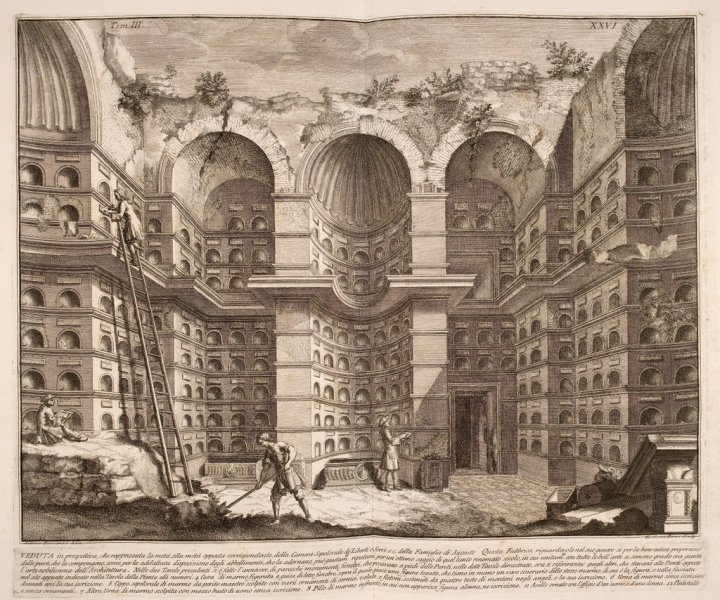
Image: Giovanni Piranesi, Illustration of an aviary, from Le Antichità romane, opera di Giambatista Piranesi, etc. (London: British Library, c13091-59; shelfmark: 744.f.2 26).
American Ceramic Circle Research Grants
From ArtHist.net:
American Ceramic Circle Research Grants
Applications due by 2 April 2024
To encourage new scholarship in the field of ceramics, the American Ceramic Circle (ACC) annually underwrites grants for up to $5,000 to individuals to help offset costs associated with original research. Grant applications, which are reviewed by the Grants and Scholarship Committee, are due the second Friday of April. Grants are not intended for projects involving commercial profit, including publication subventions. Successful applicants are required to submit the results of their completed research to the ACC in the form of a paper, which may be published in the ACC Journal. Grantees may also be invited to speak at the annual ACC symposium. Please send completed application including a coversheet and proposal as PDF to: ACC Grants and Scholarship Chair at accgrants@gmail.com using this form.
1 Coversheet
• Name
• Address
• Telephone
• Email
• Institutional Affiliation
• List of Publications — please attach copy of one, especially if related to proposed topic.
• References — please ask references familiar with your project to send letters of recommendation directly to accgrants@gmail.com as PDFs.
2 Proposal
Please prepare an attachment to the cover sheet with the following sections:
• Project title
• Brief project summary (100 words max)
• Significance of topic (500 words max)
• List of primary sources consulted (if project is historic in nature)
• Project description: plans for the project, reasons, how it will be accomplished, and describe the qualifications of individuals involved in project (500 words max)
• Research plan
• Timeline, including estimated date of completion
• Collections, archives, institutions, etc. to be visited
• Proposed budget, with estimated expenditures
• Total amount requested from ACC
The American Ceramic Circle was founded in 1970 as a non-profit educational organization committed to the study and appreciation of ceramics. Its purpose is to promote scholarship and research in the history, use, and preservation of ceramics of all kinds, periods, and origins. The current active membership is composed of ceramics enthusiasts from many walks of life, including museum professionals, collectors, institutions, auction house professionals, and dealers in ceramics. Member interest is focused on post-Medieval pottery and porcelain of Europe, Asian ceramics of all periods, and ceramics made, used, or owned in North America.
Workshop | Touched / Retouched: Paper across Time, 1400–1800
From the Call for Applications at the Bibliotheca Hertziana:
Touched / Retouched: Paper across Time, 1400–1800
Rome, 11–16 November 2024
Applications due by 20 March 2024
The Lise Meitner Group at the Bibliotheca Hertziana – Max Planck Institute for Art History and the Istituto Centrale per la Grafica in Rome invite applications for an intensive one-week, hands-on workshop for early career specialists in the field of prints and drawings. This is made possible with support from Getty through The Paper Project initiative.
The goal of the workshop is to provide object-based training to the next generation of curators in the graphic arts, with a focus on premodern practices of retouching. We take an expansive approach to the term ‘retouching’ to encompass any discernible alterations carried out on drawings, prints, or their support after completion. Once identified, such alterations carry important repercussions: they change the way an object is cataloged, interpreted, and presented to the public; they influence choices about acquisition or deaccessioning; they shape decisions about conservation, affecting storage and treatment needs. Among drawing specialists, detecting and dating traces of retouching is considered to be largely a matter of tacit knowledge. The reconstruction of the chronological sequence of interventions via close looking or the help of diagnostic technologies is carried out on a daily basis in collections worldwide, yet this practice is often virtually inaccessible to outsiders.
This workshop is designed to provide a source of technical and material knowledge that will prove essential for drawing and print curators entering the field. By focusing on retouching and its interpretation, we intend to advance a materially layered understanding of paper objects that builds on recent scholarly literature while exploring a fundamental point of intersection between academic, curatorial, and conservation practices. The Hertziana leads (Francesca Borgo, Camilla Colzani, Alice Ottazzi) and ICG co-leads (Giorgio Marini and Gabriella Pace) will be joined by keynote speakers Carmen Bambach and Antony Griffiths and senior discussants Jonathan Bober, Hugo Chapman, and Catherine Goguel, among others.
During the first, virtual phase of the program, participants will present their own preliminary research on a selected drawing from the BHMPI’s collections. This will lay the groundwork for the second, central segment: a week-long, in-person workshop in Rome, with senior experts from prominent European and North American graphic arts collections joining the cohort of instructors. Hands-on examination of works on paper both pre- and post-treatment, viewing exercises, and practical paper-marking experiences will take place at the BHMPI’s and ICG’s study rooms, at the Diagnostic Lab and Paper Conservation Department, at local archives, and in Fabriano, the largest paper production center of premodern Europe. Dedicated presentations on the most common forms of manipulation will cover collector’s marks, highlighting and overdrawing, pricking and pouncing, framing and binding, hand-coloring, conservation decisions, and archiving and filing. The week will be followed by a remote capstone session and presentation of individual projects.
During the week in Rome, accommodation and travel expenses will be covered for all participants. Shared meals and a per diem will also be provided.
This project is aimed at early career curators and academics with demonstrable interest and experience in the field of graphic art. Eligible candidates for application should hold a doctoral degree (earned within the past 10 years), be enrolled in a doctoral program, or possess a solid curatorial experience in graphic arts collections. A background in conservation is not a prerequisite. An active museum affiliation is preferable but not required. The working language is English. Knowledge of Italian is advantageous but not essential.
Applications to participate in the workshop must be submitted via the online application portal before 20 March 2024, 11.59pm CEST.
More information is available here»
Summer Seminar | Disability Histories in the Visual Archive
This week-long summer seminar will take place at the American Antiquarian Society:
Disability Histories in the Visual Archive: Redress, Protest, and Justice
American Antiquarian Society, Worcester, Massachusetts, 9–14 June 2024
Led by Jennifer Van Horn and Laurel Daen
Applications due by 8 April 2024
The seminar will focus on the visual and material cultures of disability in eighteenth and nineteenth-century North America. Participants will hone their skills in visual and material culture analysis, learn key methods and theories, including cripping, and gain experience working closely with archives and visual materials that support disability history. We will explore the unparalleled collections of the AAS, especially the library’s exemplary graphic arts collection of prints, photographs, and ephemera as well as collections materials on related topics such as education and printing for the blind.
The seminar will interrogate disability as lived experience, analytical category, and site for creativity and protest. Centering the histories of diverse peoples, we will explore topics such as enslavement, colonization, indigeneity, gender, education, warfare, and disability rights. Participants will actively work toward disability justice by attending to understudied and obscured histories, by questioning how we can use visual and material things to redress past injustices and dismantle ableism, and by considering equitable archival access.
Interdisciplinary in approach, the seminar welcomes scholars across multiple fields and areas of expertise that might include art history, Black studies, design history, disability studies, medical humanities, histories of vast early America, Native and Indigenous studies, and visual and material culture studies. Librarians, museum professionals, and public historians are encouraged to apply. No previous experience in disability studies or visual culture is required.
Guest speakers will include Jenifer Barclay, Associate Professor of History, University of Buffalo and author of The Mark of Slavery: Disability, Race, and Gender in Antebellum America (University of Illinois Press, 2020), and Erin Corrales-Diaz, Curator of American Art, Toledo Museum of Art.
Please follow this link for more information and instructions on how to apply.
The tuition fee for each seminar is $800, which includes meals throughout the week and evening receptions. Modest aid may be available for graduate students and early-career scholars to assist with travel and housing costs. Please feel free to reach out to Jennifer Van Horn with any questions (jvanhorn@udel.edu), or questions can be addressed to John J. Garcia, AAS Director of Scholarly Programs and Partnerships, jgarcia@mwa.org.
The seminar is sponsored by the Center for Historic American Visual Culture (CHAViC).
Workshop | Understanding Period Plasterwork
From the Traditional Architecture Group:
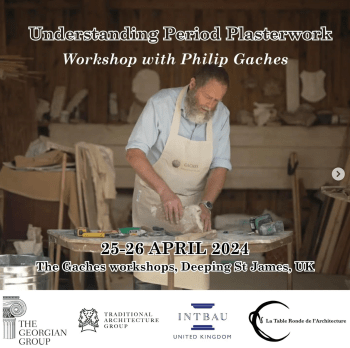
Understanding Period Plasterwork: A Workshop with Philip Gaches
Gaches Workshops, Deeping St James, Lincolnshire, 25–26 April 2024
Registration due by 1 March 2024
 There are three distinctly different periods of plasterwork in the UK. The use of plaster on ceilings began toward the end of the 15th century, flourished with 16th-century Elizabethan masterpieces, and blossomed in the 17th century with more complex Jacobean work. By 1700, fashion was changing with more influence from Europe, and Palladianism swept in with its beautiful balance and precision, a style that continued through the Georgian period and its neo-classicism. By 1850, however, a new method was introduced: cheaper, quicker fibrous casting, which is installed dry. Though inferior to all that came before, fibrous cast plaster still remains the most popular method of creating ornamental plasterwork.
Philip Gaches has taught traditional plastering in Myanmar, Afghanistan, and across Europe during his 45-year career, from which he has gained a huge amount of experience that he brings to his courses. In the two-day Understanding Period Plasterwork course, he will guide students through the three periods of British plasterwork, using a combination of presentations and practical demonstrations—after which participants will create, with Philip’s guidance, their own pieces of plasterwork from each period, underscoring the differences between materials, methods, and designs.
Course fees are £350 per person / £250 (full-time student rate). Included are Gaches aprons for each student, along with all tools, materials, and PPE. To register, please send an email to admin@traditionalarchitecturegroup.org before 1 March 2024 for payment instructions. Students should include proof of school/university registration.
7th Annual Ricciardi Prize from Master Drawings
Ian Hicks was the winner of the 2024 Ricciardi Prize for his ground-breaking reconsideration of a group of drawings by Giambattista Tiepolo, research that was begun during his term as the Moore Curatorial Fellow at the Morgan (2020–22). From Master Drawings:
Seventh Annual Ricciardi Prize from Master Drawings
Submissions due by 15 November 2024

Johann Schenau, The Crowning of the Rosiere, pen and brown ink and wash over graphite, on wove paper (New York: The Morgan Library & Museum, 2009.287).
Master Drawings is now accepting submissions for the 7th Annual Ricciardi Prize of $5,000. The award is given for the best new and unpublished article on a drawing topic (of any period) by a scholar under the age of 40. The winning submission will be published in a 2025 issue of Master Drawings. Information about essay requirements and how to apply can be found here. Information about past winners and finalists is available here.
The average length is between 2,500 and 3,750 words, with five to twenty illustrations. Submissions should be no longer than 10,000 words and have no more than 100 footnotes. All submissions must be in article form, following the format of the journal. Please refer to our Submission Guidelines for additional information. We will not consider submissions of seminar papers, dissertation chapters, or other written material that has not been adapted into the format of a journal article. Written material that has been previously published, or is scheduled for future publication, will not be eligible. Articles may be submitted in any language. Please be sure to include a 100 word abstract outlining the scope of your article with your submission.










 Enfilade
leave a comment