Online Resources from the National Portrait Gallery
From the newsletter of the Society of Antiquaries of London, Salon 375 (15 November 2016). . .
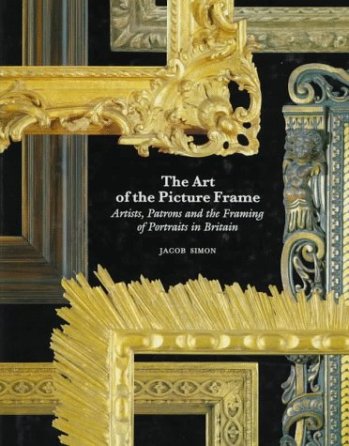 Jacob Simon FSA, Research Fellow at the National Portrait Gallery, notes that 2016 is the tenth anniversary of the launch of the Gallery’s online resource British Artists’ Suppliers, 1650–1950, in partnership with Cathy Proudlove. Three other resources have since been added: British Picture Framemakers, 1600–1950 (2007), British Picture Restorers, 1600–1950 (2009), and British Bronze Sculpture Founders and Plaster Figure Makers, 1800–1980 (2011). These four online resources are selectively updated twice a year and have doubled in size since launch. Further reviews and additions are planned, including to the features on picture framing; the Gallery’s exhibition, The Art of the Picture Frame, celebrated its 20th anniversary on 8 November. Karen Hearn FSA writes to commend these remarkable online resources and “the exceptional amount of research, work, and coordination that their originator, Jacob Simon, has put into making so much invaluable information available to a wide audience.”
UK Export Bar Placed on Mazarind Tapestry, ca. 1700

Michael Mazarind Workshop, Chinoiserie Tapestry with Courtly and Hunting Scenes, made in London,
ca. 1696–1702.
◊ ◊ ◊ ◊ ◊
Press release (20 October 2016) from Gov.UK’s Department for Culture, Media & Sport:
Culture Minister Matt Hancock has placed a temporary export bar on a rare tapestry by Michael Mazarind to provide an opportunity to keep it in the country. The tapestry is at risk of being exported from the UK unless a buyer can be found to match the asking price of £67,500. Inspired by Indian, Chinese, and Japanese design, it is the only surviving tapestry to feature Michael Mazarind’s workshop mark [lower right-hand corner]. Little is known of his workshop, but it is believed he was based in Portugal Street, London, between 1696 and 1702. Mazarind was relatively unknown, but is said to have connections to John Vanderbank, the Soho-based weaver. The tapestry includes small groups of oriental figures, buildings, exotic creatures, and plants. This combination of elements was described as ‘in the Indian manner’ and was one of the most popular decorative fashions of the period.
Minister of State for Digital and Culture Matt Hancock said: “This intricate design provides us with a unique opportunity to explore the tapestry workshops of 1600s London. I hope we are able to keep it in the country so we can learn more about our nation’s textile industry, and of the decorative fashions of the time.”
The decision to defer the export licence follows a recommendation by the Reviewing Committee on the Export of Works of Art and Objects of Cultural Interest (RCEWA), administered by The Arts Council. The RCEWA made its recommendation on the grounds of significance for the study of Mazarind’s work, English tapestry of the period, and London’s history.
RCEWA member Christopher Rowell said: “This beautiful blue ground tapestry, with an equally unusual border of Chinese inspiration, dates from the late 1600s and is the only one to bear the woven signature of the mysterious Michael Mazarind, who was a rival of the more well-known London tapestry weaver, John Vanderbank. This type of ‘Indian’ tapestry depicting a Chinoiserie fantasy paradise in Cathay, with courtly and hunting scenes, was devised for the court but soon became more broadly popular. Saving the tapestry for the nation will allow specialists to study it in detail and help to reconstruct Mazarind’s contribution to tapestry production in early-Georgian London.”
The decision on the export licence application for the tapestry will be deferred until 19 January 2017. This may be extended until 19 April 2017 if a serious intention to raise funds to purchase it is made at the recommended price of £67,500. Offers from public bodies for less than the recommended price through the private treaty sale arrangements, where appropriate, may also be considered by Matt Hancock. Such purchases frequently offer substantial financial benefit to a public institution wishing to acquire the item.
Nationalmuseum Releases 3,000 images on Wikimedia Commons

Jean-Baptiste Pater (1695–1736), A Company of Bathers in a Park, oil on canvas, 49 x 59 cm (Stockholm: Nationalmuseum, NM874, photograph by Cecilia Heisser).
◊ ◊ ◊ ◊ ◊
Press release (11 October 2016) from Sweden’s Nationalmuseum:
Nationalmuseum is making 3,000 high-resolution images of its most popular artworks available for free download on Wikimedia Commons. Zoomable images will also be added to the museum’s online database. The digitization project is a major advance in making Nationalmuseum’s collections more accessible.

David von Cöln, Pineapple Plant, 1729, oil on canvas, 112 x 91 cm (Stockholm: Nationalmuseum / Gripsholm Castle).
While the Nationalmuseum building is under renovation, only a small part of the collections is accessible to the public. To provide more opportunity for people to enjoy its artworks, the museum embarked last year on a joint project with Wikimedia Sweden. As a result, high-resolution images of some 3,000 paintings from the collections are now available for download on Wikimedia Commons as public domain. This means they are part of our shared cultural heritage and can be freely used for any purpose. The images are also now zoomable, but not currently downloadable, in Nationalmuseum’s online database.
“We are committed to fulfilling our mission to promote art, interest in art, and art history by making images from our collections an integral part of today’s digital environment,” said Berndt Arell, director general of Nationalmuseum. “We also want to make the point that these artworks belong to and are there for all of us, regardless of how the images are used. We hope our open collection will inspire creative new uses and interpretations of the artworks.”
Nationalmuseum will continue to make its collections more accessible as digitization gathers pace and digital infrastructure improves. The longer-term goal is to create a portal offering quick and easy access to all the museum’s fine art collections and archives. Nationalmuseum joins a growing number of museums that have released images of their collections, including The Royal Armoury and Skokloster Castle with the Hallwyl Museum Foundation in Sweden, the Rijksmuseum in Amsterdam, and the National Gallery of Denmark in Copenhagen. Data on the images in Wikipedia Commons, including links to the zoomable versions, is available on GitHub as raw material for coders taking part in Hack4Heritage—an event being organized by Digisam, the agency coordinating the digitization of Sweden’s cultural heritage, in partnership with the Stockholm City Archives, on 14–16 October.
Sean Moore Appointed Editor of ECS
Over the weekend (20 August 2016), the American Society for Eighteenth-Century Studies announced the appointment of the next editor of ECS. Starting next summer, Sean Moore will succeed Steven Pincus, who has filled the position since July 2012.
Sean Moore (University of New Hampshire) has been appointed as the next Editor of Eighteenth-Century Studies for a five-year term beginning July 1, 2017.
Sean Moore is Associate Professor of English at the University of New Hampshire, where he served as Director of the UNH Honors Program from 2011 to 2014. He has been a member of ASECS for 17 years, served for many years as the Chair of the Irish Studies Caucus of ASECS and as the North American Correspondent for the Eighteenth-Century Ireland Society, and has given papers at ASECS panels sponsored by the SHARP caucus and Race and Empire caucus. His first monograph, Swift, the Book, and the Irish Financial Revolution, won the Murphy Prize for Distinguished First Book from the American Conference for Irish Studies, and he edited a special issue of Eighteenth-Century Studies on the Irish Enlightenment in 2012. His new work, “Slavery and the Making of the Early American Library,” is in a transatlantic and early American direction, focusing on how slave capitalism financed the transatlantic book trade in British texts. He has been the recipient of fellowships from the NEH, American Antiquarian Society, Newport Mansions, New England Regional Fellowship Consortium, Library Company of Philadelphia/Historical Society of Pennsylvania, John Carter Brown Library, Folger Library, and Fulbright Scholarship Board.
Sotheby’s Museum Network to Launch in August
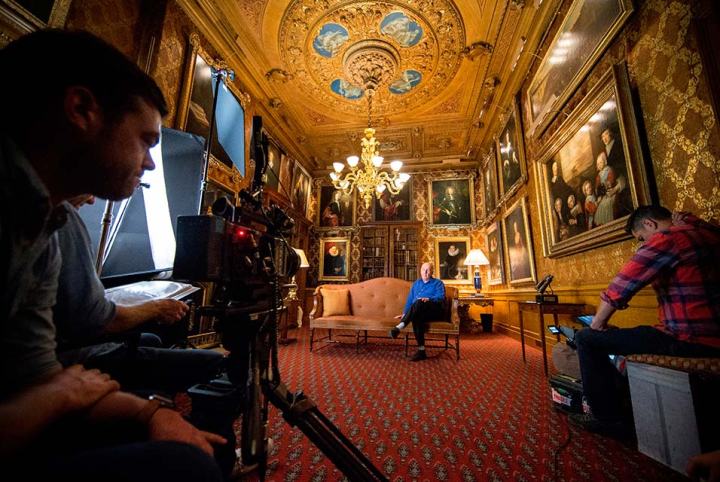
The 13-part series The Treasures of Chatsworth is currently in production and will debut in Autumn 2016
(Photo: Sotheby’s)
◊ ◊ ◊ ◊ ◊
Press release (5 August 2016) from Sotheby’s:
Sotheby’s announces the upcoming launch [scheduled for August 29] of an online destination to discover video content created by and about the world’s leading museums. The digital hub will be called Sotheby’s Museum Network, and it will be featured prominently on Sothebys.com as well as Sotheby’s Apple TV channel. The museums in this network will include internationally-renowned public institutions, such as The Metropolitan Museum of Art, Tate, and the National Palace Museum in Taiwan, as well as well as newer institutions founded by private collectors, including the Garage Museum of Contemporary Art in Moscow.
In addition to syndicating museums’ own content, the Sotheby’s Museum Network will be the home of original programming conceived and produced by Sotheby’s. The Treasures of Chatsworth, a 13-part series on one of Europe’s greatest private houses and most significant art collections, is currently in production and will debut this autumn. Further information will be shared in the coming months.
Recent years have seen the opening of numerous private museums by passionate patrons, as well as record attendance at major exhibitions worldwide, reflecting a seemingly insatiable public interest in great art and collections. Sotheby’s Museum Network will reach a global audience for whom museums and foundations are a new entry point into the world of art, as well as seasoned collectors and connoisseurs who look upon these institutions as the ultimate source of authority on art and culture. It will ultimately encompass thousands of existing museum videos, which have never before been aggregated into one channel, making it easier for people to discover what they love as well as introducing new audiences to the great work that these institutions are creating worldwide.
“We are thrilled to host the extraordinary videos produced by our museum partners around the world,” commented David Goodman, Executive Vice President, Digital Development & Marketing. “The Museum Network is a response to a growing global audience that wants to experience the world of art and collecting. The network is a natural evolution of the existing ties we have with museums through programs like Sotheby’s Preferred, and we can now deepen those relationships with institutions and their benefactors as we expose their outstanding collections to millions of art lovers who engage via digital channels. The Treasures of Chatsworth is the perfect way to launch our drive into original video content creation centered on the arts and will be the first of many original films that will reveal the wonder of art and collecting.”
Newly Redesigned Getty Research Portal Now Available

◊ ◊ ◊ ◊ ◊
The Getty Research Institute (GRI) is pleased to announce the launch of an updated version of its research tool, the Getty Research Portal. A virtual library of art history texts, the newly redesigned Getty Research Portal now offers more than 100,000 volumes available from more than 20 international partners.
Launched in 2012, and created in partnership with some of the world’s leading art libraries, the Getty Research Portal is a free online search gateway that aggregates the metadata of art history and cultural texts, with links to fully digitized copies that are free to download. There are no special requirements in order to use this resource and it is completely open to anyone with internet access.
“When we began this exceptional project we had eight founding institutions, all committed to sharing their digitized collections of rare books, foundational art historical literature, catalogues, periodicals, and other published resources with researchers without limit or impediment,” says Thomas W. Gaehtgens, director of the GRI. “On our 4th anniversary, we renew that commitment, with an improved user interface, more international partners, and now more than 100,000 volumes available for download. Thousands of people use this tool and our books have been viewed nearly 13 million times. This broad access is fundamental to the GRI’s mission to further the understanding of art and a core principal in our approach to art historical research.”
The re-launched Portal has been rebuilt and redesigned, marking it easier to explore digitized texts on art, architecture, material culture, and related fields from the Getty Research Library and international partners. The new user interface features several key improvements, including: new search filters that make results sortable by criteria such as date and language; a responsive design that allows for better use on phones and tablets; individual pages for each digitized text enabling users to easily share links; prominent display of edition details for books, when available; and new additions from participating libraries are more clearly highlighted.
The newest partners to join the Portal are the Bibliotheca Hertziana — Max-Planck-Institut für Kunstgeschichte in Rome, the Herzog August Bibliothek in Wolfenbüttel, the Menil Library Collection in Houston, the Ryerson & Burnham Libraries — Art Institute of Chicago, the Solomon R. Guggenheim Museum Library and Archives in New York, and the Warburg Institute Library in London.
To learn more about the recent updates to this project, see this post from the Getty’s online magazine, The Iris.
The Met Launches New Edition of the Heilbrunn Timeline of Art History
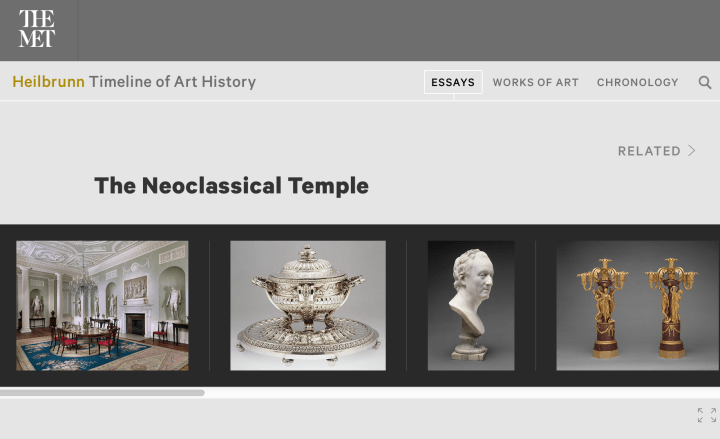
Screen shot (June 2016) of The Met’s Heilbrunn Timeline of Art History, with Cybele Gontar’s essay “The Neoclassical Temple” (October 2003).
◊ ◊ ◊ ◊ ◊
From H-ArtHist (13 June 2016). . .
Heilbrunn Timeline of Art History: The New Edition
The Heilbrunn Timeline of Art History is rethought with a new navigation and interface, updated images, and restructured editorial content. Still relational in nature, it allows a reader to find exactly what he or she needs while also encouraging total immersion through a seamless browsing experience. The new Timeline is fully optimized to be responsive on desktop and mobile devices, enabling easy access anywhere.
The Heilbrunn Timeline of Art History presents a chronological, geographical, and thematic exploration of global art history through The Met collection. It is a reference, research, and teaching tool conceived for students and scholars of art history. Authored by The Met’s experts, the Timeline comprises 300 chronologies, close to 1000 essays, and over 7000 works of art. It is regularly updated and enriched to provide new scholarship and insights on the collection, and draws 1 to 1.5 million visits per month during the academic year. The Met’s Heilbrunn Timeline of Art History is funded by the Heilbrunn Foundation, New Tamarind Foundation, and Zodiac Fund.
We would love to know what you think of the new site. For all questions and comments, please contact timeline@metmuseum.org.
Online Resource | James Gillray: Caricaturist

James Gillray, A Cognocenti Contemplating ye Beauties of ye Antique, 1801 (London: The British Museum)
James Gillray: Caricaturist
For those of you interested in eighteenth-century caricature and particularly James Gillray, there is a new online resource: James Gillray: Caricaturist. The site includes a chronological catalogue of Gillray’s known prints, a list of major museums and archives where his work can be seen, information about him and his methods and techniques, and links to short biographical sketches of some of the people he caricatured.
The work of Jim Sherry, who has written on the modes of caricature as well as the humor of Thomas Rowlandson, the site continues to grow as Jim adds commentaries on individual Gillray prints (48 so far).
Göttingen Summer School | Academic Collecting and Knowledge
From H-ArtHist:
Göttingen Spirit Summer School
Academic Collecting and the Knowledge of Objects, 1700–1900
Lichtenberg-Kolleg, Historic Observatory, University of Göttingen, 5–10 September 2016
Applications due by 1 May 2016
Experts/Speakers
Anne Mariss, University of Tuebingen
Maria Rentetzi, National Technical University of Athens, Lise Meitner fellow, University of Vienna
Kim Sloan, British Museum London
Emma Spary, University of Cambridge
Early modern cabinets of curiosities/Wunderkammern can be considered as an important space especially for those developing sciences that wanted to transcend text based scholasticism and base their knowledge solely on experience. Scholarly engagement with collections laid the foundations for knowledge production that was based on experiment and research with and on objects. Since this development took shape during the 17th century, collecting, storing, ordering, and the presentation of objects has become a strong concern for many academic disciplines.
Accordingly, technologies that transformed things into objects of knowledge and rendered them accessible and sustainable are equally practical as well as epistemological techniques. Current research in the history of science and knowledge focuses increasingly on practices of collecting, ordering and presenting. Thus highlighting how scientific research and its results are intertwined with and rely upon different cultures of materiality and the handling of objects is the main concern of the summer school.
In addition to questions concerning the role of objects and collections in the processes of knowledge production, we would also like to address the state and development of object based research in the humanities. How can humanities research be enhanced by engaging with objects? Which methods and theories can be successfully employed in order to achieve meaningful knowledge about these processes on a medium and larger scale? Each day of the summer school will be dedicated to a specific topic where four PhD candidates will present their research and give an introduction to their projects, with one expert commenting and leading the discussion for each project.
As we acknowledge the epistemic value of engaging with objects, visits to the relevant academic collections at the University of Göttingen are an integral part of the program. Two of our experts, Kim Sloan and Emma Spary, will also give keynote lectures on Monday and Wednesday respectively. On Thursday evening, Anne Mariss will introduce her recent book ‘A World of New Things’: Praktiken der Naturgeschichte bei Johann Reinhold Forster (Johann Reinhold Forster and the Practices of Natural History), thereby reflecting on her process of writing a thesis on praxeological aspects of knowledge production and engaging with material culture.
The four thematic sections are:
From encyclopaedic to specialised collecting: Practices of collecting and exhibiting, the role of collectors and things // Kim Sloan, British Museum
During the two centuries between 1700 and 1900, a far-reaching transformation took place that influenced both the scientific practices related to objects and the role of collectors. Burgeoning university collections differed considerably from most private or courtly cabinets of curiosities regarding their claims to establish order, classification and systematic comparison: the typical and the ordinary gradually replaced the rare and the unique, and the learned collector became the collecting scholar. The 18th century can be seen as a period of transition and the nineteenth 19th century was a threshold in the process of the differentiation of academic disciplines. This also influenced the collections, which were separated as well and thereby shed new light on the objects and thus eventually led to new ways of knowledge production. Accordingly, we especially invite presentations that address continuities and discontinuities in practices of collecting and the role of the collectors, as well as the actual order, presentation and spatial distribution of objects in the collections. Additionally, presentations that engage with wider epistemological, cultural, social and political contexts are equally welcome.
‘Putting nature in a box’ The material order of things: shelves, cabinets, boxes and other furniture of order // Maria Rentetzi, NTU Athens, University of Vienna
Furniture that helps to order and to store collections is an important part of the social world of collecting and is embedded in the epistemic practices surrounding collections as well. Material appliances influence the rules of the handling of objects and permit as well as prohibit certain practices. Thus, they are not neutral vessels but material conditions of possibilities regarding what and what cannot be known at a particular time and space. Which role do these vessels play concerning the development of object centred sciences in the18th and 19th century, especially concerning the production of knowledge and its contents? How did cabinets and other storage systems help natural historians to organise knowledge, and how did they help to create knowledge about the natural world? How did boxes become multifunctional tools in transferring the collected material into systematics? Could this furniture be regarded as a kind of laboratory that decontextualized and re-contextualised objects in changing spatial-systematic vicinities?
Networks, actors and objects // Emma Spary, Cambridge University
Current research in the history of science and knowledge no longer focuses solely on individual collectors and well-known collections, but also on complex and far-reaching networks of collecting that mobilised and thereby often transformed objects, actors and inscriptions. This approach lead to the decentralisation of the persona of the collector and collections were conceptualised in the Latourian framework as ‘centres of calculation’. Special emphasis was laid on the analysis of the diverse spaces within which objects of knowledge were constituted and circulated. This panel wants to address the complicated movements of objects, materials, specimen and living creatures (both humans and other animals) within these wide and heterogeneous networks. Studies that address their itineraries between various spaces of encounter, e.g. academic collections, the marketplace, the scholars’ houses, lecture halls, hospitals, etc. are especially welcome. Additionally, we are interested in the multitude and diversity of the actors in these spaces. Extending the research beyond the scholar as the classical focus in the history of science, we want to know about artisans, merchants and, very importantly, the members of the source communities from where the objects originated. It will be interesting to see if these diversities also produced different kinds of knowledge. Besides well-studied analytical and systematic forms of knowledge, other kinds, especially corporeal, implicit and tacit knowledge as well as technological, practical and artisanal competence—that all of these actors applied in one way or another—will be the focus of this panel. Calculation, Ordering and Classification are only three possible practices that would highlight these processes, and we are equally looking forward to presentations addressing further practices.
The long road to the image: strategies of visualisation in collections // N.N.
Images are also part of the transformation processes surrounding objects but they exemplify a special form of inscription in their claim to be mimetic. Current history of science and interdisciplinary visual culture studies have shown that the road from object to image is not as straightforward and simple as previously acknowledged. In order to understand the visual representation of collections, objects, and collectors, the manifold processes that lead from object/subject to image have to be analysed thoroughly. Traditions and conventions of image making have to be studied in order to show how social, epistemic and affective contexts of image production and presentation have influenced these processes.
Applications and selection procedure
The summer school will be held in English and welcomes PhD candidates or advanced postgraduates to apply. Up to 16 applicants will be admitted. Interested applicants are asked to send a cover letter, a CV and a research exposé (1500–2000 words/approx. 3–5 pages) preferably via e-mail as one pdf file to summerschool@kustodie.uni-goettingen.de by 1st of May 2016. The cover letter should address to which of the four sections the project would correspond to. Ideally, it should already mention a special interest in one or more academic collections from Göttingen, as well as contain a short explanation why the certain collection(s) would be interesting for the PhD or postgraduate project. The selection will be conducted by the convenors, the experts and the academic advisory board of the Zentrale Kustodie. Successful candidates will be informed early in June, and will then be asked to send in a more developed research exposé (up to 8000 words/approx. 15–20 pages) within 6 weeks of the invitation. These texts will be circulated among all participants of the summer school and will be the basis for the experts‘ commentaries and the discussions during the summer school. We ask all applicants to address not only the research content of their projects but also to include references to concepts and methodologies and an explication of their research agenda and the sources employed. A discussion on how objects and collections feature in the research project is very much appreciated.
Thanks to the generous support of the Goettingen Spirit Summer School program at the University of Göttingen, we are able to provide board and lodging for all participants. The participation fee is 50€. For further information and questions, please contact Christian Vogel (summerschool@kustodie.uni-goettingen.de).
Convenors
Marie Luisa Allemeyer (Zentrale Kustodie, University of Göttingen)
Dominik Hünniger (Lichtenberg-Kolleg, University of Göttingen)
Christian Vogel (Zentrale Kustodie, University of Göttingen)
◊ ◊ ◊ ◊ ◊
M O N D A Y , 5 S E P T E M B E R 2 0 1 6
5:00 Arrival and registration
6:30 Keynote lecture by Kim Sloan
8:00 Opening dinner
T U E S D A Y , 6 S E P T E M B E R 2 0 1 6
From encyclopaedic to specialised collecting: Practices of collecting and exhibiting, the role of collectors and things / Kim Sloan
9:30 Presentation of the chair
10:00 Two project presentations
1:30 Visit of a collection
4:00 Two project presentations
6:30 Guided tour Historic Observatory
8:00 Dinner
W E D N E S D A Y , 7 S E P T E M B E R 2 0 1 6
‘Putting nature in a box’: The material order of things: shelves, cabinets, boxes and other furniture of order / Maria Rentetzi
9:30 Presentation of the chair
10:00 Two project presentations
1:30 Visit of a collection
4:00 Two project presentations
6:30 Keynote lecture by Emma Spary
8:00 Dinner
T H U R S D A Y , 8 S E P T E M B E R 2 0 1 6
Networks, Actors and Objects / Emma Spary
9:30 Presentation of the chair
10:00 Two project presentations
1:30 Visit of a collection
4:00 Two project presentations
6:30 Book presentation by Anne Mariss
8:00 Dinner
F R I D A Y , 9 S E P T E M B E R 2 0 1 6
The long road to the image: strategies of visualisation in collections / N. N.
9:30 Presentation of the chair
10:00 Two project presentations
1:30 Visit of a collection
4:00 Two project presentations
6:30 Anthropology performance
8:00 Dinner
Summer Workshop | Visualizing Venice: The Ghetto of Venice

◊ ◊ ◊ ◊ ◊
From H-ArtHist, with more information available from Venice International University:
Visualizing Venice Workshop: Mapping and Modeling the Ghetto of Venice
Venice International University, 8–20 June 2016
Applications due by 31 March 2016
With the support of The Getty Foundation as part of its Digital Art History initiative, The Wired! Lab at Duke University, Università Iuav di Venezia, the University of Padua, and Venice International University are collaborating on a summer workshop that will train art, architectural, and urban historians with the digital media that can enhance or transform their research questions and their capacity to communicate narratives about objects, places, and spaces to the public.
This fifth annual 12-day workshop teaches a range of digital skills in mapping, 3D modeling, mobile application and web development, and time based media authorship to enable participants to engage historical questions with emerging digital tools. The course will engage with the Ghetto of Venice on the 500th anniversary of its creation as case study for training with a variety of technologies and applications. Instruction will be given in English by faculty and staff from Duke University’s Wired! Lab and Università Iuav di Venezia.
The workshop is designed for PhD or post doctoral participants in the interpretive humanities (including cultural patrimony, history of art, architecture and urbanism, history, geography, architecture, archaeology, and other relevant disciplines). Preference will be given to PhD students and recent PhD graduates in the history of art, architecture, and urbanism. The workshop is taught at Venice International University on the island of San Servolo in the Venetian Lagoon. Participants can live in the housing facilities of the island of San Servolo or arrange for accommodation in the city of Venice. Tuition fees are 1,000€ (+22%VAT). Scholarships are available in order to support tuition, travel, board, and accommodation expenses thanks to the generosity of The Getty Foundation.










 Enfilade
leave a comment