Renovation and Conservation at the YCBA and the Beinecke
For those of you thinking ahead in terms of fellowships at Yale, bear in mind these planned closures for 2014 and 2015. 2016, however, seems like a fine time to be in New Haven!
◊ ◊ ◊ ◊ ◊
From the Beinecke:
The Beinecke Rare Book & Manuscript Library will undergo a major renovation beginning at the end of May 2015. The renovation will replace the library’s mechanical systems and expand its research, teaching, storage, and exhibition capabilities. The library will reopen in September 2016.
A temporary reading room in the Sterling Memorial Library will provide researchers access to the library’s collections while work is under way. Beginning in April 2014, access to various collections will be limited as we prepare the library for closure. Please consult our closed collections schedule for information about when specific collections will be unavailable.
We invite you to learn more about the project, and follow our progress as we prepare the library for another 50 years as a world-class center of research and scholarship.
◊ ◊ ◊ ◊ ◊
From the YCBA:
. . . Planning is well underway for the second phase of the project, which will take place in 2015. The focus of this next phase will be the renewal of the public galleries on the second, third, and fourth floors, as well as the refurbishment of the Lecture Hall. The project will also address improvements related to life safety and accessibility, and extensive building-wide mechanical and electrical upgrades will be made. Visitors will have limited access to the building and no special exhibitions will be mounted or visiting fellowships awarded. When the Center reopens in January 2016, its collections will be completely reinstalled in the elegant, sky-lit galleries of the fourth floor, and three focused exhibitions, featuring specific aspects of the Center’s collection, will be on view in the second- and third-floor galleries.
◊ ◊ ◊ ◊ ◊
From Yale UP
Peter Inskip and Stephen Gee in association with Constance Clement, Louis I. Kahn and the Yale Center for British Art: A Conservation Plan (New Haven: Yale University Press, 2012), 200 pages, ISBN 978-0300171648, $50.
 The standing of the Yale Center for British Art as one of the world’s great museums and study centers finds expression in its remarkable building, designed by Louis I. Kahn (1901–1974). In this important and innovative volume, two architects offer a plan to ensure the proper stewardship of the building in order to preserve its essence as a great architectural structure. Peter Inskip and Stephen Gee describe the design, construction, and subsequent renovation of the building; assess its cultural significance; analyze the materials that comprise it (steel, concrete, glass, white oak, and travertine); and shed light on its evolution over the four decades since it was built. Drawing on their extensive experience developing conservation plans for both historic sites and modern buildings, they propse a series of policies for the Center’s conservation into the future.
Peter Inskip and Stephen Gee are with the London-based firm Peter Inskip + Peter Jenkins Architects. Constance Clement is Deputy Director of the Yale Center for British Art.
Additions to The Art World in Britain 1660 to 1735
Richard Stephens, the editor for The Art World in Britain 1660 to 1735, and his team continue to expand what is already an extraordinary resource. From the most recent update (25 March 2014). . .

◊ ◊ ◊ ◊ ◊
11,000 auction records have been published, bringing the total now online to 87,000 lots. Here are the main additions:
Three great collections
The library of Edward, 2nd Earl of Oxford (1689-1741) was ‘the most choice and magnificent that were ever collected in this Kingdom’. His bound prints and illustrated books were sold by his widow in 1746 over 22 nights. The sale catalogue is the longest & most detailed of its kind from this period, by some way.
The South Sea Bubble triggered one of the greatest picture sales of the early 18th century, when the heavily-indebted Henry, 1st Duke of Portland (1682-1726) sold his paintings in 1722. One copy of the catalogue survives, in the Frick library. Its manuscript annotations, which list every buyer and price fetched, provide an invaluable snapshot of the major collectors and dealers of that moment.
The collection of old master drawings belonging to the Roman connoisseur Padre Resta was “the finest without doubt in Europe” according to John Talman. Resta sold almost 4000 sheets to the Whig Lord Chancellor, Baron Somers (1651-1716), which were auctioned in London in 1717.
Sales of artists, architects & a composer
Auction catalogues offer a window onto the careers, households and intellectual worlds of the vendors. In this update are the posthumous catalogues of architects Nicholas Hawksmoor (1740), William Kent (1749), Sir Christopher Wren (1749), and Leonard Wooddeson (1733); the painters John Robinson (1746), Louis Goupy (1748), Thomas Morland (1748), Joseph Vanhaecken (1751) and John Ellys (1760); the engraver John Dunstall (1693); and the composer George Frederick Handel (1760).
Auctioneer’s copies
The Frick’s Portland annotations are probably based on information from the auctioneer’s office, given their completeness & the fact that the prices include the post-sale fee (by contrast, the Houlditch transcript of the Portland sale gives the hammer price only). Another catalogue published now – the heavily-annotated catalogue of the 1719 sale of the contents of the Duke of Ormonde’s London house – appears to be the only auctioneer’s working copy surviving from any sale before the foundation of Christie’s.
This update of sale catalogues has been funded very generously by Lowell Libson Ltd. The editor is also very grateful to Ashley Baynton-Williams, Shana Fung, Peter Moore, Kate Papworth, William Schupbach and Jacob Simon for their contributions of data, images and corrections.
A full list of sources published is available here»
Four Centuries of Massachusetts Furniture

◊ ◊ ◊ ◊ ◊
Press release (21 May 2013) for the collaboration Four Centuries of Massachusetts Furniture:
A first-time collaboration among eleven founding institutions and numerous other organizations throughout the state, Four Centuries of Massachusetts Furniture highlights Massachusetts furniture-making, from the 1600s to the present day, through a series of exhibitions, symposia, public programs, and a dedicated website. Founding institutions consist of the Colonial Society of Massachusetts; Concord Museum; Fuller Craft Museum; Historic Deerfield; Historic New England; Massachusetts Historical Society; Museum of Fine Arts, Boston; North Bennet Street School; Old Sturbridge Village; Peabody Essex Museum; and Winterthur Museum, Garden and Library. Never before have so many renowned institutions in the Northeast joined forces to exhibit, study, and promote a single topic in the field of American Decorative Art. Four Centuries of Massachusetts Furniture is an unprecedented celebration of the Bay State’s remarkable furniture-making legacy. From the earliest products of newly arrived immigrants in the 1600s, to the outstanding work of present-day studio furniture-makers, Massachusetts holds one of the most prominent places in American furniture-making history.
Four Centuries of Massachusetts Furniture will include seven museum exhibitions, each focusing on a different aspect of Massachusetts furniture-making. The Massachusetts Historical Society will mount a display of documented Boston furniture from private collections, supplemented with rarely seen items in the Society’s collection, including relevant paintings, prints, account books, and ledgers. The exhibition at Historic Deerfield will take a fresh look at two centuries of furniture-making in western Massachusetts, showcasing a wealth of objects, many of which are new acquisitions. The Concord Museum’s exhibition will explore the remarkable life and career of William Munroe through the objects he made and a rare collection of shop records and Old Sturbridge Village will explore the career of prominent Federal-period artisan Nathan Lombard. The exhibition at the Fuller Craft Museum will feature contemporary studio furniture from the Bay State over the past half century and the final exhibition, slated to open at the Peabody Essex Museum in 2014, examines the career of eminent Salem cabinetmaker Nathaniel Gould. In addition, Winterthur Museum has installed fifty of its finest pieces of Boston furniture in an exhibition titled Boston Furniture at Winterthur and numerous other institutions throughout the state will highlight key pieces of Massachusetts furniture in their collections. (more…)
Subject of Art History Added to Oxford Bibliographies
Under the direction of Editor-in-Chief Thomas DaCosta Kaufmann, Art History is the latest subject to be added to OUP’s subscription-based resource Oxford Bibliographies (as of January 2014). At present there are only 50 articles—ranging from ‘Art of the Aztec Empire’ to ‘Yuan Dynasty Art’—with plans for a few dozen more to be added in the coming months. And so for now, the resource is better at showcasing potential than providing a truly useful, comprehensive collection of bibliographies. That said, Dorothy Johnson’s entry for Jacques-Louis David provides a promising glimpse of what the future might entail, and the larger Oxford Bibliographies project ranked among Choice’s Top Ten Internet Resources for 2013 (along with ARTstor). All of the usual concerns about expensive, subscription-based resources, inevitably, remain relevant. -CH
◊ ◊ ◊ ◊ ◊
◊ ◊ ◊ ◊ ◊
From the Art History page of Oxford Bibliographies:
Art history is a vast discipline, geographically, historically, and intellectually. In its initial centuries, art history dealt with Western art, but the boundaries of the field have since expanded. The canon continues to be redefined as histories of art in regions that had previously been ignored are brought into the mainstream. Traditional emphases on European art have been reduced, as the discipline reaches world-wide dimensions in which connections as much as differences have increasingly come into focus. Originating as a study much informed by ancient art, and then by the art of the Renaissance, the historical dimension of the discipline has also continuously advanced with time. More and more works and types of objects are made throughout the world, and art historians’ interests have increasingly shifted to more recent art. In the past half century art historians have also engaged more and more with questions of theory, method, and the history of the discipline. New approaches, often borrowed from other fields, have proliferated.
As a result of all this flux and ferment, it has become progressively more difficult to grasp the literature of the field, and to gain an orientation to current and perennial problems. Oxford Bibliographies in Art History responds to these needs and offers a trustworthy pathway through the thicket of information overload. Whether an expert in contemporary European art needs to read up on the art of ancient China for a book project or an undergraduate student needs to start a research paper on iconography in Renaissance art, Oxford Bibliographies in Art History will provide a trusted source of selective bibliographic guidance.
Online Course | Conservation of Globes
From the Hornemann Institute in Hildesheim:
Online Course | Patricia Engel and Michael Højlund Rasmussen, Conservation of Globes
Through the Hornemann Institute, 31 March — 1 June 2014
Historic globes exist all over Europe, in public collections and libraries, but also as private property. While older celestial globes were made of metals, since Behaim’s Erdapfel from 1492, globes have been made of paper, papier-mâché, wood, and parchment. In contrast to this omnipresence of globes, there is a sort of vacuum in conservation expertise concerning globe conservation. Today there are only a few conservators working in different European countries, who, due to their individual careers, are able to deal with the conservation of globes. Isolated articles in various journals have so far been the only competent publications in the field of globe conservation.
Course Structure
The first chapter of the course gives a description of the cultural and historical background of the topic and describes the history of the globes from 3000 BC to the 20th century. This is followed by helpful suggestions for the documentation of a globes material and an overview of damages. The latter provides pictures of typical damages on the globes along with case-by-case explanations. It will enable conservators to identify damages – even rare ones – and help the laymen to deal with their problems. The main chapters deal with specific suggestions for conservators concerning concrete practical conservation requests including the preparation of some materials and the techniques of surface cleaning on globes. The last chapter explains the practical storage problems, the climatic conditions and the correct packing and transportation of globes. Fee: 198€ (20% reduction for students).
Instructors: Based on her broad experiences in globe conservation Dr. Patricia Engel (European Research Centres for Book and Paper Conservation-Restoration in Horn, Austria) developed an e-learning course with the most up-to-date technical possibilities. Michael Højlund Rasmussen (Conservation Centre Vejle, Dänemark) cooperated in this project. For further information ask: hentschel@hornemann-institut.de
If you also want to deepen practically your new knowledge, please contact directly the author Dr. Patricia Engel, who offers regularly workshops for the conservation of globes in the European Research Centre for Book and Paper Conservation-Restoration in Horn, Austria. Further information can be found here.
The Burlington Magazine Index Blog
A recent posting at British Art Research highlights The Burlington Magazine Index Blog. The work of Barbara Pezzini, the site has been up since November 2013. In a contribution posted 29 January 2014, Neil Jeffares examines “the language implicit and explicit in the coverage of pastels made before 1800 in The Burlington Magazine, with the aim of investigating how this journal participated in the formation of these attitudes.”
From the about page:

◊ ◊ ◊ ◊ ◊
The Burlington Magazine Index Blog is a weekly blog dedicated to all matters related to the history of The Burlington Magazine, written in an accessible style and aimed not just at scholars.
It includes, but it is not limited to, research and news on:
* The art writing of the magazine, recounted in both historiographic and biographical terms.
* The works of art that this journal treated in the two centuries of its existence: their attribution, conservation, critical reception, forgeries and circulation through reproductive engravings and photographs.
* The art world around these works, especially the network of commercial galleries and dealers that contributed to their circulation and interpretation.
This project, previously funded by the Andrew W. Mellon Foundation and currently supported by The Monument Trust, stems from The Burlington Magazine Index, for which there has been a compete re-reading and cataloguing of the whole contents of this journal from its inception in March 1903 until the present. The Burlington Magazine Index contains more than 40,000 records and refers to more than 10,000 artists. It is not only an essential reference for art historical investigation but also a primary source for research on art criticism, art historiography and the art market.
While researching for the Burlington Index, a wealth of new information has been uncovered: much of this it has either been published or it is currently being published in essay form, but much more is hidden in the database: this blog wishes to be a more discursive and engaging approach to some of that information.
As the current stage of the project is the indexing of some 90,000 historical advertisements of art dealers in the Burlington, this blog will have a bias on art galleries and, more widely, on the history of the art market and its intersections with art criticism.
This blog is written by me, Barbara Pezzini, with external contributors. I am an art historian and the Editor of The Burlington Magazine Index.
I welcome external contributions. Write to pezzini@burlington.org.uk
Thanks to: Dylan Armbrust, Alison Bennett, Bart Cornelis, Alan Crookham, Chris Hall, Caroline Elam, Ulrike Kern, Noti Klagka, Nicola Kennedy, Mark MacDonald, Olivia Parker, Madeleine Pearce, Mark Westgarth, Alison Wright and Foteini Vlachou for their contribution to this project.
The French Book Trade in Enlightenment Europe
Anyone thinking about applying for the UCLA summer institute on Beyond the Digitized Slide Library, might spend some time with the French Book Trade in Enlightenment Europe:
The French Book Trade in Enlightenment Europe (FBTEE) project uses database technology to map the trade of the Société Typographique de Neuchâtel (STN), a celebrated Swiss publishing house that operated between 1769 and 1794. As the STN sold the works of other publishers alongside its own editions, their archives can be considered a representative source for studying the history of the book trade and dissemination of ideas in the late Enlightenment.
More information is available here»
Historic Heston / Jas. Townsend & Son
This discussion with Heston Blumenthal, Ivan Day, and Bee Wilson is one of the events I would have most liked to have attended in 2013 (I’m a huge Bee Wilson fan). Alas, Blumenthal’s tome is available for purchase. Paula Forbes provides a thorough review at Eater (16 October 2013), with this brilliant summary: “if Willy Wonka ran Hogwarts, Historic Heston would be the history textbook.” -CH
As noted by Barley Blyton at the British Library’s Social Science Blog, “Historic Heston at the British Library” (29 November 2013) . . .
[On November 8] as part of the Georgians Revealed exhibition, the British Library hosted a discussion between Heston Blumenthal—one of Britain’s most acclaimed chefs and exponent of the egg and bacon ice-cream—and Ivan Day—food historian, broadcaster, writer and confectioner. Centring on Heston’s new book and using the Georgian period as the frame for their discussion, Blumenthal and Day wound their way through history and their own pasts, expertly guided by food writer and historian Bee Wilson as Chair. . .
◊ ◊ ◊ ◊ ◊
Heston Blumenthal, Historic Heston (London: Bloomsbury, 2013), 432 pages, ISBN: 978-1620402344, £125 / $200 (currently discounted to $125 on Amazon).
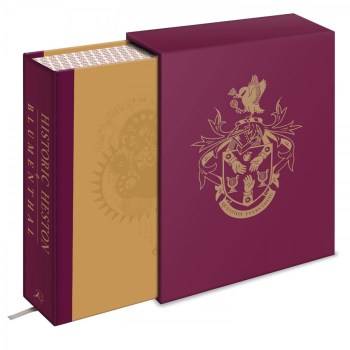 British gastronomy has a grand old tradition that has been lost over time. Now England’s most inventive chef is out to reclaim it. Heston Blumenthal, whose name is synonymous with cutting-edge cuisine, nonetheless finds his greatest source of inspiration in the unique and delicious food that the sceptered isle once produced. This has been the secret to his success at world-famous restaurants The Fat Duck and Dinner, where a contrast between old and new, modern and historic, is key.
Historic Heston charts a quest for identity through the best of British cooking that stretches from medieval to late-Victorian recipes. Start with thirty historic dishes, take them apart, put them together again, and what have you got? A sublime twenty-first-century take on delicacies including meat fruit (1500), quaking pudding (1660), and mock-turtle soup (1892). Heston examines the history behind each one’s invention and the science that makes it work. He puts these dishes in their social context and follows obscure culinary trails, ferreting out such curious sources as The Queen-like Closet from 1672 (which offers an excellent method for drying goose). What it adds up to is an idiosyncratic culinary history of Britain.
This glorious tome also gives a unique insight into the way that Heston works, with signature dishes from both The Fat Duck and Dinner. Illustrated by Dave McKean and with some of the most superb food photography you’ll ever see, Historic Heston is a book to treasure. You think you know about British cooking? Think again.
◊ ◊ ◊ ◊ ◊
If any of this gets you in the mood for exploring eighteenth-century food, you might also be interested in the blog Savoring the Past along with the accompanying video series 18th-Century Cooking with Jas. Townsend & Son. Both are connected to the Indiana-based, online retailer Jas. Townsend & Son. With food goods comprising only a portion of the company’s business, the store, has “helped historical reenactors, movie makers, theatrical companies, pirates, and regular people find items including clothing, tents, books, knives, tomahawks, oak barrels, and lots of other goods appropriate for 1750 to 1840,” for over 35 years. Perhaps just the thing as you get ready for ASECS in Williamsburg . . .
Here Jonathan Townsend makes mushroom ketchup:
The British Library to Crowdsource a Million+ Images
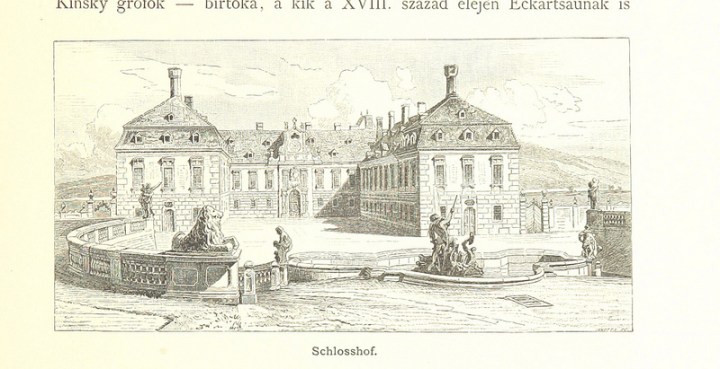
This posting by Ben O’Steen, excerpted below, comes from the British Library’s Digital Scholarship Blog (12 December 2013); for the complete text and full links, readers should consult the original posting. The image above is my own fairly arbitrary selection: added to the BL’s Flickr site on 10 December 2013, this illustration of the Austrian Schloss Hof (enlarged in the 1720s) comes from page 457 of Az Osztrák-magyar monarchia irásban és képben (1885). Stay tuned for details of the project after the new year. —CH
◊ ◊ ◊ ◊ ◊
A Million First Steps
We have released over a million images onto Flickr Commons for anyone to use, remix and repurpose. These images were taken from the pages of 17th-, 18th- and 19th-century books digitised by Microsoft who then generously gifted the scanned images to us, allowing us to release them back into the Public Domain. The images themselves cover a startling mix of subjects: There are maps, geological diagrams, beautiful illustrations, comical satire, illuminated and decorative letters, colourful illustrations, landscapes, wall-paintings and so much more that even we are not aware of.
Which brings me to the point of this release. We are looking for new, inventive ways to navigate, find and display these ‘unseen illustrations’. The images were plucked from the pages as part of the ‘Mechanical Curator’, a creation of the British Library Labs project. Each image is individually addressible, online, and Flickr provies an API to access it and the image’s associated description.
We may know which book, volume and page an image was drawn from, but we know nothing about a given image…
Next Steps
We plan to launch a crowdsourcing application at the beginning of next year, to help describe what the images portray. Our intention is to use this data to train automated classifiers that will run against the whole of the content. The data from this will be as openly licensed as is sensible (given the nature of crowdsourcing) and the code, as always, will be under an open licence.
The manifests of images, with descriptions of the works that they were taken from, are available on github and are also released under a public-domain ‘licence’. This set of metadata being on github should indicate that we fully intend people to work with it, to adapt it, and to push back improvements that should help others work with this release.
There are very few datasets of this nature free for any use and by putting it online we hope to stimulate and support research concerning printed illustrations, maps and other material not currently studied. Given that the images are derived from just 65,000 volumes and that the library holds many millions of items.
If you need help or would like to collaborate with us, please contact us on email, or twitter (or me personally, on any technical aspects)
The Initial Layout
The images have been tagged to aid browsing and to provide new views on the works themselves. They are tagged by publication year (eg 1764, 1864, 1884), by book (eg 003927270, 000149253), by author (eg Charles Dickens) and by other means.
This structure is helpful but we can do better! We want to collaborate with researchers and anyone else with a good idea for how to markup, classify and explore this set with an aim to improve the data and to improve and add to the tagging. We are looking to crowdsource information about what is depicted in the images themselves, as well as using analytical methods to interpret them as a whole.
We are very interested to hear what ideas and projects people use these images for and we would ideally like to collaborate with those who have been inspired to explore them.
Finally, while they have been released into the public domain, we would like to direct you to a post by Dan Cohen titled “CC0 (+BY)” [26 November 2013]. There is no obligation for you to attribute anything to us, but we’d appreciate it. The dataset will develop over time, and will improve after all! …
Ben O’Steen’s full posting—including links, contact information, and examples—is available here»
HBA Publication Grant
Historians of British Art Publication Grant
Proposals due by 15 January 2014
The Historians of British Art (HBA) invites applications for its Publication Grant. The organization grants a sum of $600 to offset publication costs for a book manuscript in the field of British art or visual culture that has been accepted by a publisher. Applicants must be current members of HBA. To apply, send a 500-word project description, publication information (name of press and projected publication date), budget, and CV to Renate Dohmen, Prize Committee Chair, HBA, brd4231@louisiana.edu. The deadline is January 15, 2014.










 Enfilade
leave a comment