The Decorative Arts Trust Launches Collecting250
From the press release:
Collecting250
The Decorative Arts Trust
New Online Resource Commemorates the Semiquincentennial through 250 Objects from across America.
The Decorative Arts Trust is pleased to share Collecting250.org, an interactive online resource that celebrates the importance of objects in narrating the history and evolution of the United States and the communities contained within. To commemorate America’s 250th, the United States Semiquincentennial, the Trust asked museums and historical societies to submit images and information about objects in their collections that tell powerful stories about national, state, or local identity. Collecting250 showcases 250 objects from over 140 institutions, and the release is timed in conjunction with the commencement of festivities honoring the 250th anniversary of the American Revolution’s first salvos in Massachusetts in 1775.
“We sought objects that are attached to a specific place, time, and people,” shares Trust Executive Director Matthew A. Thurlow. “Our aim was to present 250 objects from public collections across the country, thereby drawing attention to the broad swath of institutions that steward decorative arts of historical significance. This project aligns beautifully with the Trust’s mission to promote and foster an interest in decorative arts and material culture through our role as a community foundation elevating curatorial efforts to steward and study objects.”
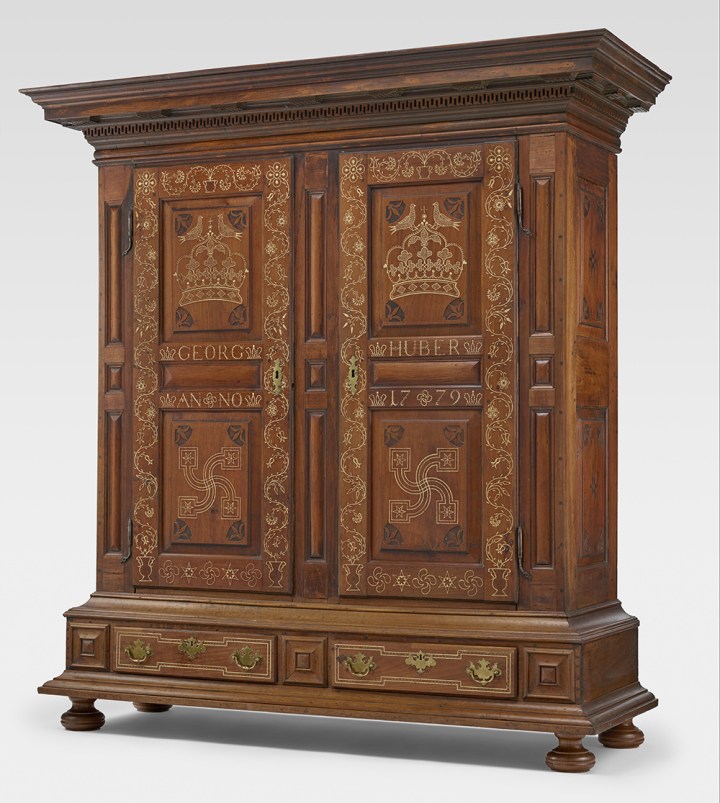
Kleiderschrank (Clothes Press), 1779, Lancaster County, Pennsylvania; walnut, yellow pine, oak, sulfur, iron; 6 feet 10 inches × 6 feet 6 inches × 27 inches (Philadelphia Museum of Art, 1957-30-1).
All 50 states and the District of Columbia are represented, and each record contains an image, tombstone information, and a description of the object’s importance. The ability to search for entries based on location, category, and keyword provides the chance to make exciting and enlightening discoveries in unexpected places. The Trust developed connections with museums and historical societies beyond our traditional network, allowing them to highlight extraordinary artistic achievements in the west, including a mid-19th-century bed covering (New Mexico History Museum) featuring churro wool yarn and colcha embroidery introduced by early Spanish settlers.
There is an interplay between objects that are isolated from one another by time, location, maker, and function. For example, two disparate entries associated with the care and storage of textiles: a humble, late-19th-century pressing iron (Illinois State Museum) that Mississippian Bettye Kelly brought to Joliet, IL, in the 1960s; and a stunning sulfur-inlaid kleiderschrank (Philadelphia Museum of Art) made in Manheim, Pennsylvania, in 1779 for Georg Huber. The former speaks to the Great Migration of African Americans northward in the 20th century; the latter to the Germanic communities that were thriving on the eastern seaboard during the American Revolution.
The tradition of basket weaving has been practiced and perfected by various cultures over the past 10,000 years. Two entries separated by a century and the entire continent of North America illustrate the cultural convergences and impulses behind the production of basketry. In 1905, Aleksandra Kudrin Reinken, the daughter of a Unangax̂ (Aleut) mother and Russian father used her community’s traditional weaving techniques to create a basket (Hood Museum of Art) for a tourist clientele that incorporates ornamentation from prints, magazines, and perhaps even a Whitman’s Chocolate Sampler box. In 2007, Mary Jackson, an internationally recognized master of sweetgrass basketry, completed Never Again (Gibbes Museum of Art), inspired by the traditional Gullah rice fanner baskets that she learned to create from her mother and grandmother and that were once made and used on Lowcountry plantations.
Collecting250 is free and open to the public. Visit Collecting250.org to start exploring. The Decorative Arts Trust, founded in 1977, is a nonprofit organization that promotes and fosters the appreciation and study of the decorative arts through programs, partnerships, and grants. Learn more at decorativeartstrust.org.
Four Educator Guides, designed specifically for the Collecting250 project, are also available.
◊ ◊ ◊ ◊ ◊
Note (added 20 December 2025) — The post was updated to include the link for the educator guides.
Eli Wilner & Co. Makes an 18th-C. Pier Mirror for Drayton Hall
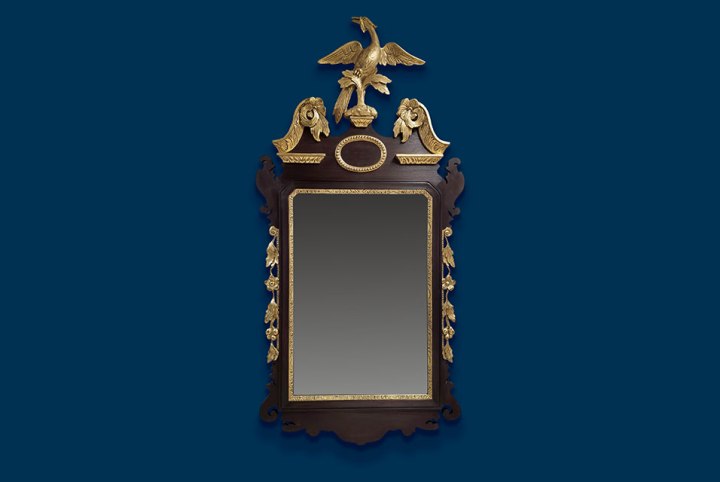
Late-18th-century-style pier mirror; walnut, basswood, and parcel-gilt; created in 2024–25 by Eli Wilner & Company for Drayton Hall Preservation Trust, Drayton Hall Museum Collection. The mirror was unveiled at the 2025 Charleston Show (March 21–23).
◊ ◊ ◊ ◊ ◊
As noted at Art Daily:
With assistance from their partial funding program for museums, Eli Wilner & Company recently completed the creation of a late 18th-century style pier mirror for Drayton Hall Preservation Trust. March has been another successful month for Eli Wilner & Company’s frame funding initiative, with $125,000 in partial grants having been distributed to date. Nearly $50,000 in funding is still available. Exciting new projects are being submitted on a daily basis by museums across the country. Remaining funds will be committed to new projects by 30 April 2025 and can be used for frame restoration, historic frame replication, or mirror replication projects. Interested institutions can apply by emailing the details of their reframing or frame restoration needs to info@eliwilner.com. No project is too large.
Patricia Lowe Smith, Drayton Hall’s Director of Preservation, initially contacted Wilner in the spring of 2024 about the potential project after they had discovered telltale marks on the original moldings surrounding the drawing room windows, indicating a lost pier mirror. Since no other documentation was found to provide the specifications or origin of the object, Wilner presented Drayton’s team with period-appropriate replacement options based on historical photographs and hand-tracings of Drayton’s walls.
The selected digital mockup was then printed to scale for Wilner’s master carpenters to begin construction of the walnut substrate and basswood blocks for the multiple hand carved elements. To get a better understanding of the depth proportions and construction methods that were not apparent in two-dimensional photographic images, they visited nearby institutions including the Metropolitan Museum of Art and the New-York Historical Society, and the Museum of the City of New York to examine similar objects.
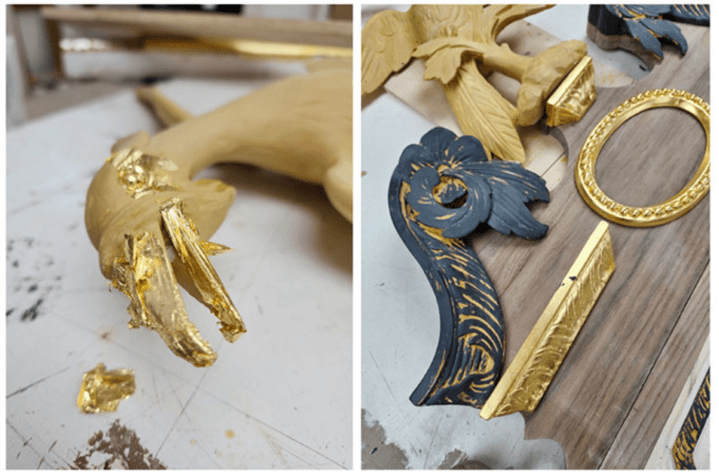 After several months of woodworking and carving, the basswood portions of the frame were prepared with layers of finely sanded gesso and bole (a liquid clay) and watergilded. These delicate elements were then burnished and patinated to a period appropriate character. Meanwhile, the walnut substrate sections were stained. Finally in February 2025, following an in-person studio visit with members from Drayton Hall’s preservation team, all portions of the frame were fully secured into position, and the glass and hanging hardware was installed.
Eli Wilner & Company has completed over 15,000 framing projects for private collectors, museums, and institutions including The Metropolitan Museum of Art, the Smithsonian American Art Museum, and The White House. Wilner was honored by the Historic Charleston Foundation with the Samuel Gaillard Stoney Conservation Craftsmanship Award, for their work in historic picture frame conservation. In 2024, Eli Wilner was presented with an Iris Award for Outstanding Dealer of the Year by the Bard Graduate Center in New York City.
Journal18, Fall 2024 — Craft
The latest issue of J18 (I’m sorry to be slow with this one! –CH) . . .
Journal18, Issue #18 (Fall 2024) — Craft
Issue edited by Jennifer Chuong and Sarah Grandin
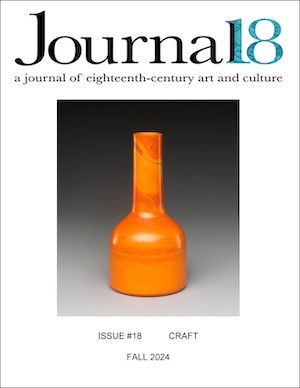 When, where, and why does craft matter? Craft, by definition, is any activity involving manual skill. But in the modern western world, the term typically implies specific kinds of activities that produce specific kinds of objects: things like baskets, lace, and lacquerware. In a culture that has historically privileged rationality and innovation, craft’s commitment to tradition, reliance on haptic knowledge, and association with marginalized subjects have rendered it the minor counterpart to more ‘serious’ forms of material production. As a subsidiary to art and industry, craft has often occupied a circumscribed role in accounts of modern art and modernity’s origins in the eighteenth century. Recently, however, craft—as a more capacious category of material production—has become a crucial term in efforts to expand and diversify the study of eighteenth-century art.
This special issue builds on recent investigations while considering how craft’s ancillary role within the Anglo-European tradition has limited its capacity to transform the field. Drawing inspiration from the absence of an art/craft divide in many cultures, we are interested in exploring craft’s potential to radically reframe, reconceptualize, and globalize the history of art.
a r t i c l e s
Elizabeth Eager — Labor, Leisure, and Lost Time in Eighteenth-Century Women’s Embroidery
Yve Chavez — Eighteenth-Century Loom and Basket Weaving at the California Missions
Hampton Smith — Insurgent Tooling and the Collective Making of Slave Revolts
Natalie E. Wright and Glenn Adamson — Encyclopædia Materia: Material Intelligence and Common Knowledge
Julie Bellemare, N. Astrid R. van Giffen, and Robert Schaut — Hot Tempered: Recreating a Lost Glass Recipe
Caroline Wigginton — Reading with Indigenous Form: Lucy Tantaquidgeon Tecomwas’s Moccasins (ca. 1767)
Ellen Siebel-Achenbach — Bookbinding in Eighteenth-Century Nuremberg: Reconstructing an Edge Plough from the Hausbücher der Nürnberger Zwölfbrüderstiftungen
All articles are available for free here, along with recent notes & queries:
r e c e n t n o t e s a n d q u e r i e s
Lytle Shaw — A Pirate Primer? Review of Stan Douglas: The Enemy of All Mankind
Sofya Dmitrieva — The Art Collection of the French Royal Academy of Painting and Sculpture: Notes on the Database
Jennifer Laffick — Lethière in Williamstown and Paris: A Transatlantic Exhibition Review
Kristina Kleutghen — Beijing to Dresden via St. Petersburg: An Early Qing Enameled Snuff Bottle in the Collection of Augustus II the Strong
Geoff Quilley — Lubaina Himid’s Naming the Money at the Entangled Pasts, 1768-now Exhibition, Royal Academy, London
Funding | Research Related to Castletown House, County Kildare
From the application form:
Kevin B. Nowlan Castletown Bursary
Applications due by 9 May 2025
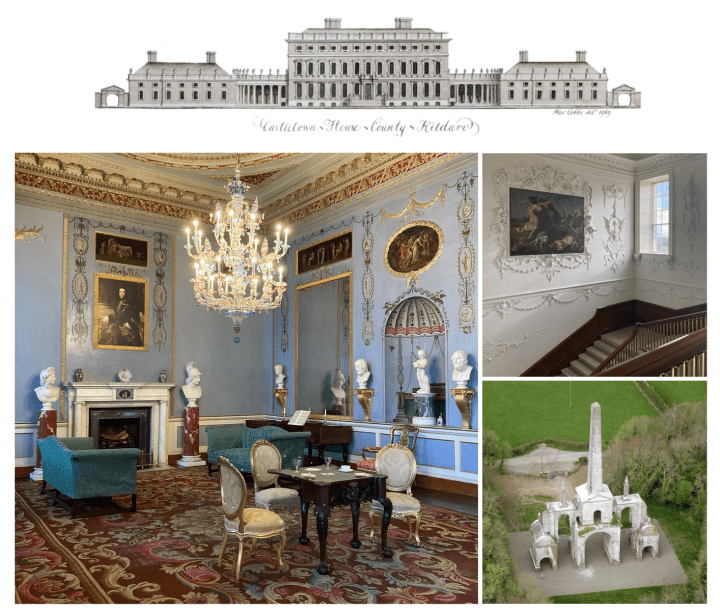 The Castletown Foundation is pleased to announce a call for applicants for the Kevin B. Nowlan Castletown Research Bursary, established to honour the memory of our esteemed former chairman. This scholarship aims to further research that focuses on or relates to Castletown: this extends to houses, collections, objects, and landscapes of allied family properties across Ireland and Great Britain that will have a direct bearing on the mediation and interpretation of Castletown house. Applications are invited from post-graduate students, early career professionals, and established scholars. The award of up to €5,000 may be used for research-related expenses only. The selection committee will be composed of members of the Castletown Foundation and one external specialist. The scholarship need not be awarded in any one year, and the decision of the assessors is final.
Your proposal (max. 1,000 words) should outline how existing knowledge will be extended by your work; it should also include a timeline for the research and an indicative budget. That document together with this application form must be submitted by email to Dr Alison FitzGerald (alison.fitzgerald@mu.ie) and Dr Patrick Walsh (WALSHP9@tcd.ie) by Friday, 9 May 2025 at 5pm, with the subject line ‘Kevin B. Nowlan Castletown Bursary’. A confidential reference supporting the application must arrive separately, before the closing date.
American Ceramic Circle Research Grants
From ArtHist.net:
American Ceramic Circle Research Grants
Applications due by 11 April 2025
To encourage new scholarship in the field of ceramics, the American Ceramic Circle (ACC) annually underwrites grants for up to $5,000 to individuals to help offset costs associated with original research. Grant applications, which are reviewed by the Grants and Scholarship Committee, are due the second Friday of April. Grants are not intended for projects involving commercial profit, including publication subventions. Successful applicants are required to submit the results of their completed research to the ACC in the form of a paper, which may be published in the ACC Journal. Grantees may also be invited to speak at the annual ACC symposium. To apply, please send your coversheet and proposal as a PDF file to Yao-Fen You, the ACC Grants and Scholarship Chair, at accgrants@gmail.com using this form. Queries are also welcome.
1 Coversheet
• Name
• Address
• Telephone
• Email address
• Institutional Affiliation
• List of Publications — please attach copy of one, especially if related to proposed topic.
• References — please ask references familiar with your project to send letters of recommendation directly to accgrants@gmail.com as PDFs.
2 Proposal
Please prepare an attachment to the cover sheet with the following sections:
• Project title
• Brief project summary (100 words max)
• Significance of topic (500 words max)
• List of primary sources consulted (if project is historic in nature)
• Project description: plans for the project, reasons, how it will be accomplished, and describe the qualifications of individuals involved in project (500 words max)
• Research plan
• Timeline, including estimated date of completion
• Collections, archives, institutions, etc. to be visited
• Proposed budget, with estimated expenditures
• Total amount requested from ACC
The American Ceramic Circle was founded in 1970 as a non-profit educational organization committed to the study and appreciation of ceramics. Its purpose is to promote scholarship and research in the history, use, and preservation of ceramics of all kinds, periods, and origins. The current active membership is composed of ceramics enthusiasts from many walks of life, including museum professionals, collectors, institutions, auction house professionals, and dealers in ceramics. Member interest is focused on post-Medieval pottery and porcelain of Europe, Asian ceramics of all periods, and ceramics made, used, or owned in North America.
Prado Launches Online Collection of Printed References to Goya
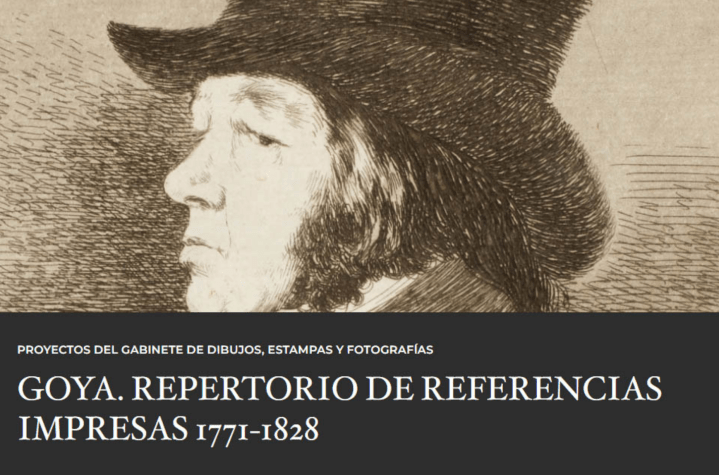
As noted at Art History News, the Prado has just launched its latest online digital project, Goya: Repertorio de referencias impresas: 1771–1828, which collects some 30,000 published references to Goya made during his lifetime in books, advertisements, newspaper articles, and prints. From the press release (6 February 2025) . . .
Goya: Repertorio de Referencias Impresas, 1771–1828
Online, The Prado Museum, Madrid
El Museo del Prado amplía los proyectos digitales del Gabinete de Dibujos, Estampas y Fotografías reuniendo por primera vez todas las referencias impresas sobre Goya publicadas durante su vida. Este Repertorio de referencias impresas. 1771–1828, disponible en la web, facilita el acceso a un corpus documental de gran valor para investigadores y amantes del arte, y público en general.
Para acercar al público su extensa colección de dibujos, estampas y fotografías—formada por aproximadamente 30.000 obras que por motivos de su conservación no se exponen permanentemente en las salas—el Museo Nacional del Prado ha desarrollado un espacio web con contenidos monográficos especialmente concebidos para dar a conocer su singularidad y riqueza. En este contexto, el Museo presenta el Repertorio de referencias impresas. 1771–1828 sobre Francisco de Goya, una herramienta única que pone a disposición del público el primer repertorio en el mundo que reproduce la totalidad de referencias publicadas sobre un artista durante su vida.
Este nuevo repertorio amplía el campo de divulgación de la obra de Goya mediante la recopilación de referencias impresas, conservadas en bibliotecas y museos de todo el mundo, algunas de difícil acceso. Desde la primera mención de Goya en 1771 hasta su fallecimiento en 1828, su nombre fue citado en libros, anuncios, artículos periodísticos y estampas, reflejando su notoriedad y reconocimiento en vida. El Repertorio de referencias impresas. 1771–1828 está organizado mediante fichas cronológicas que incluyen datos bibliográficos, transcripciones, traducciones, imágenes de documentos originales y enlaces a versiones digitalizadas completas. Asimismo, se ha desarrollado un sistema de búsqueda por términos y etiquetas, permitiendo filtrar la información por tipología documental y década.
Este recurso digital ha sido posible gracias al trabajo del especialista en obra gráfica de Goya, Juan Carrete Parrondo, quien inició este proyecto antes de su fallecimiento en 2023. Tras dos años de labor, el Museo del Prado culmina su esfuerzo y lo pone a disposición del público. Siguiendo el espíritu colaborativo de su creador, el proyecto sigue abierto a nuevas aportaciones, invitando a los usuarios a contribuir con referencias adicionales mediante el correo gabinete.dibujos@museodelprado.es.
El Repertorio de referencias impresas. 1771–1828 ha sido financiado con fondos del Plan de Recuperación, Transformación y Resiliencia de España (PRTR) y vinculado a las actuaciones dentro del programa C.24 I3 Digitalización e impulso de los grandes servicios culturales, incluido en el eje incluido en el eje Prado Formación y dentro de la actuación “Prado Formación e Investigación” y de la actividad Canal de formación e investigación.
The Decorative Arts Trust Invites Proposals for Its Publishing Grants
From The Decorative Arts Trust:
Publishing Grants from The Decorative Arts Trust
Proposals due by 31 March 2025
The Decorative Arts Trust established a new publishing grant program in December 2023, the latest expansion of the organization’s efforts to invigorate scholarship and broaden appreciation of material culture. The endeavor is structured to support publications tackling the broad context of the Americas and to encourage projects that advance diversity in the study of American decorative arts and material culture. The program will also respond to the changing needs of the field and will consider publishing efforts in both the print and digital sectors. This new venture establishes a commitment to sharing important art historical research as broadly as possible. An advisory committee consisting of museum professionals and academics with broad experience in publishing stewards the program and oversees the selection of grant recipients.
The Trust will fund two separate grant lines:
Publishing Grants for First-Time Authors of Book-Length Publications
This program is focused specifically to support an author’s first book-length publication (based on a completed dissertation, thesis, or other scholarly research) that increases the awareness and appreciation of important areas of material culture.
Publishing Grants for Collections, Exhibitions, and Conferences
The program awards grants to support book-length publications tied to collections, exhibitions, and conferences that increase the awareness and appreciation of important areas of research in the decorative arts including catalogues, and compilations of conference papers.
Exhibition | A Lively Mind: Jane Austen at 250
There’s no shortage of stimulating events marking this year’s 250th anniversary of Jane Austen’s birth, and readers will know this terrain much better than I. But for anyone tring to keep up, the following sites offer a useful starting place. –CH
• Ben Jureidini, “Is 2025 the Year of Jane Austen? From Society Balls to Blockbuster TV Shows, the 250th Anniversary of ‘Britain’s Greatest Author’ Is Set to Break Records,” The Tatler (6 January 2025). Miss Austen and The Other Bennet Sister on the BBC, a Dolly Alderton adaptation of Pride and Prejudice heading for Netflix, and a tourism boom for real-life regency balls, there’s something truly Austentatious about 2025. Link»
• “Worldwide Guide to Jane Austen 250th Events,” from the Jane Austen Centre in Bath, which focuses on the life and works of Jane Austen, as well as the Regency period in which she lived. Link»
• The Jane Austen Society, founded in 1940 by Dorothy Darnell with the purpose of raising funds to preserve the Cottage in the village of Chawton, Hampshire, where Jane Austen lived with her mother and sister Cassandra from 1809 to 1817. Link»
• The Jane Austen Society of North America, a non-profit organization staffed by volunteers and dedicated to the enjoyment and appreciation of Jane Austen and her writing. Link»
◊ ◊ ◊ ◊ ◊
Opening at The Morgan in June:
A Lively Mind: Jane Austen at 250
The Morgan Library and Museum, New York, 6 June — 14 September 2025
Organized by Dale Stinchcomb and Juliette Wells
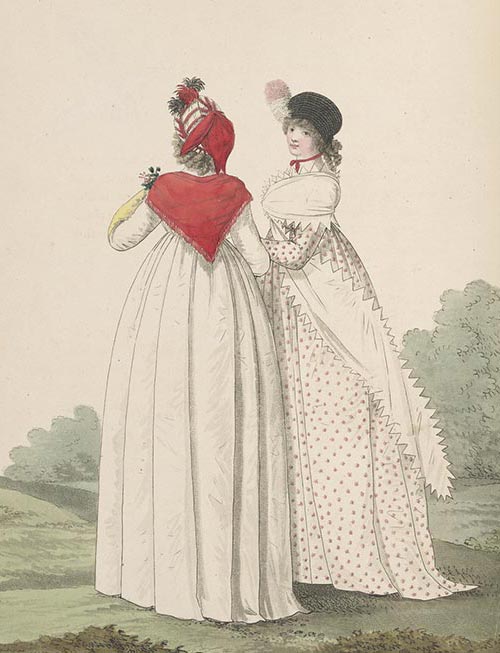
Morning Dresses from Gallery of Fashion (London: N. Heideloff, 1798), figs. 198, 199 (New York: The Morgan Library & Museum; PML 5680).
A Lively Mind immerses viewers in the inspiring story of Jane Austen’s authorship and her gradual rise to international fame. Iconic artifacts from Jane Austen’s House in Chawton, England join manuscripts, books, and artworks from the Morgan, as well as from a dozen institutional and private collections, to present compelling new perspectives on Austen’s literary achievement, her personal style, and her global legacy.
Beginning as a teenager, Austen cultivated her imaginative powers and her ambition to publish. Encouraged by her family, especially her father and her sister Cassandra, she persevered through years of uncertainty. Her creativity found expression in a range of artistic pursuits, from music-making to a delight in fashion. The story of how Americans first encountered and responded to Austen’s novels, unbeknownst to her, emerges from four surviving copies of an unauthorized edition of Emma published during her lifetime. Following Austen’s death, family members preserved their memories of her, while carefully guarding what was publicly revealed. Austen’s audience continued to grow as those who loved her novels helped new generations of readers to appreciate them. In addition to celebrating Austen, A Lively Mind commemorates the landmark gift of Austen manuscripts to the Morgan in 1975 by Alberta H. Burke and draws extensively on the extraordinary collection she bequeathed to Goucher College in Baltimore.
A Lively Mind: Jane Austen at 250 is organized by Dale Stinchcomb, Drue Heinz Curator of Literary and Historical Manuscripts, and Juliette Wells, Professor of Literary Studies at Goucher College. It is made possible by generous support from the Drue Heinz Exhibitions and Programs Fund, Cynthia H. Polsky, Martha J. Fleischman, the Caroline Morgan Macomber Fund, the Lucy Ricciardi Family Exhibition Fund, and Alyce Williams Toonk.
Decorative Arts Trust Announces 2025 Failey Grants
.
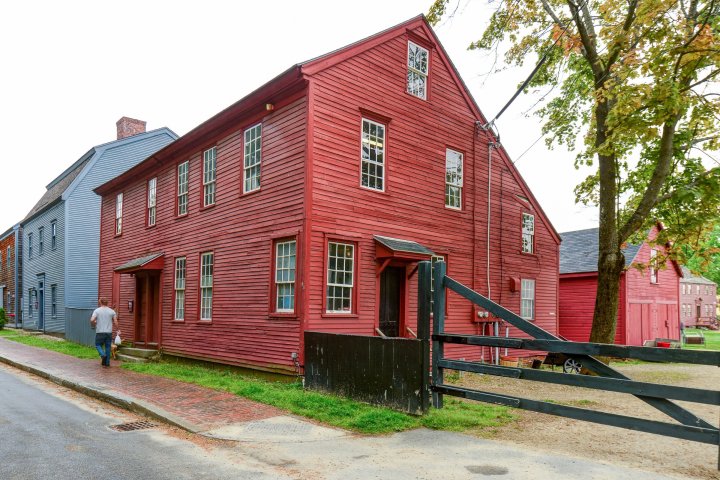
Strawbery Banke Museum in Portsmouth, New Hampshire is an outdoor history museum that preserves a neighborhood’s evolution of over 350 years, with most of the historic houses on their original sites. The Penhallow House—built in 1750 and moved to its present location in 1862—is Strawberry Banke’s only remaining ‘saltbox’. It was recently given a new foundation with a wet-proof basement to counteract rising sea and groundwater levels. In the 20th century, Penhallow House contained three apartments and the daily lives of an extended African-American family. Strawbery Banke intends to interpret the 20th-century Black experience in Penhallow House: the story of Kenneth ‘Bunny’ Richardson, a 20th-century story of Black Portsmouth and Civil Rights.
◊ ◊ ◊ ◊ ◊
From the December press release, with additional information available here:
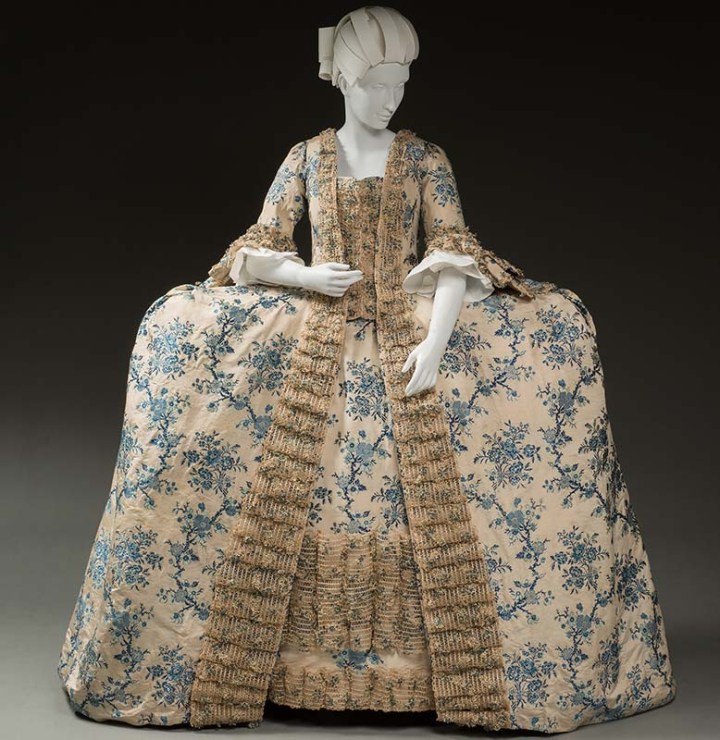
Formal dress (robe à la Française), 1765–70, French or Dutch, brocaded silk with knotted silk fringe and linen lining (Historic Deerfield, HD F.355).
The Decorative Arts Trust is pleased to announce the seven 2025 Dean F. Failey Grant recipients: the Birmingham Museum of Art in Birmingham, AL, for the Silver & Ceremony from Southern Asia, 1850–1910 exhibition; Historic Deerfield in Deerfield, MA, for the Body by Design: Fashionable Silhouettes exhibition; Honolulu Museum of Art in Honolulu, HI, for quilt conservation; the Museum of the American Revolution in Philadelphia, PA, for flag conservation; Strawbery Banke Museum in Portsmouth, NH, for Penhallow House wallpaper; Telfair Museums in Savannah, GA, for The Moss Mystique: Southern Women and Newcomb Pottery exhibition; and Wyck in Philadelphia, PA, for a Chinese desk conservation.
The Failey Grant program provides support for noteworthy exhibition and object-based conservation projects through the Dean F. Failey Fund, named in honor of the Trust’s late Governor. Failey Grant applications are due October 31 annually.
Exhibition | Recasting the Past: The Art of Chinese Bronzes, 1100–1900

Incense Burner in the Form of a Goose, Ming dynasty (1368–1644), early 15th century, bronze
(New York: The Metropolitan Museum of Art).
◊ ◊ ◊ ◊ ◊
From the press release (9 January) for the exhibition:
Recasting the Past: The Art of Chinese Bronzes, 1100–1900
The Metropolitan Museum of Art, New York, 28 February — 28 September 2025
Shanghai Museum, 3 November 2025 — 8 March 2026
Curated by Pengliang Lu
In ancient China, bronze vessels were emblems of ritual and power. A millennium later, in the period from 1100 to 1900, such vessels were rediscovered as embodiments of a long-lost golden age that was worthy of study and emulation. This ‘return to the past (fugu) was part of a widespread phenomenon across all the arts to reclaim the virtues of a classical tradition. An important aspect of this phenomenon was the revival of bronze casting as a major art form. Opening at The Metropolitan Museum of Art on 28 February 2025, Recasting the Past: The Art of Chinese Bronzes, 1100–1900 aims to be the most comprehensive study of Chinese bronzes during this period. This exhibition, co-organized by The Met and the Shanghai Museum, where it will open following its display in New York, will present the new aesthetic represented by these creative adaptations of the past, while exploring their cultural and political significance throughout China’s long history.
 “While bronze as an art form has long held a significant role throughout China’s history, this exhibition explores an often-overlooked time period when a resurgence of craftsmanship and artistic achievements revitalized the medium,” said Max Hollein, The Met’s Marina Kellen French Director and Chief Executive Officer. “Bringing together major loans from institutions in China alongside works from The Met collection, this exhibition offers viewers an important opportunity to better understand the lasting aesthetic and cultural impact of bronze objects.”
The exhibition will be divided into five thematic and chronological sections that explicate over 200 works of art—an array of bronze vessels complemented by a selection of paintings, ceramics, jades, and other media. Some 100 pieces from The Met collection will be augmented by nearly 100 loans from major institutions in China, Japan, Korea, Germany, France, the United Kingdom, and the United States to present the most comprehensive narrative of the ongoing importance of bronzes as an art medium throughout China’s long history. Featured in the exhibition are around 60 loans from institutions in China, including major works such as a monumental 12th-century bell with imperial procession from the Liaoning Provincial Museum, documented ritual bronzes for Confucian temples from the Shanghai Museum, and luxury archaistic vessels made in the 18th-century imperial workshop from the Palace Museum, Beijing.
The exhibition begins with the section “Reconstructing Ancient Rites,” which introduces how emperors and scholar-officials commissioned ritual bronzes from the 12th to the 16th century as part of an effort to restore and align themselves with antique ceremonies and rites. The exhibition continues with “Experimenting with Styles,” illustrating how the form, decoration, and function of ancient bronzes were creatively reinterpreted from the 13th to the 15th century. The next section, “Establishing New Standards,” will explore further transformations in both the aesthetic and technical direction of bronze making from the 15th to the 17th century. The fourth section, “Living with Bronzes,” will feature a display in the Ming Furniture Room (Gallery 218) to demonstrate how bronzes were used in literati life from the 16th to the 19th century. The last section, “Harmonizing with Antiquity,” will examine how the deep scholarly appreciation of archaic bronzes during the 18th and 19th centuries led to a final flourishing of bronze production.
Pengliang Lu, Brooke Russell Astor Curator of Chinese Art at The Met, said: “This exhibition attempts a long-overdue reevaluation of later Chinese bronzes by seeking to establish a reliable chronology of this art form across the last millennium of Chinese history. The exhibition will also distinguish outstanding works from lesser examples based on their artistic and cultural merits.”
Later Chinese bronzes have long been stigmatized as poor imitations of ancient bronzes rather than being seen as fundamentally new creations with their own aesthetic and functional character. This exhibition redresses this misunderstanding by showcasing their artistic virtuosity, innovative creativity, and wide cultural impact. Through archaeologically recovered examples and cross-medium comparisons to a wide range of objects, the exhibition demonstrates the ongoing importance and influence of bronzes as well as how they inspired the form and function of works in other media. Recasting the Past: The Art of Chinese Bronzes, 1100–1900 is curated by Pengliang Lu, Brooke Russell Astor Curator of Chinese Art at The Metropolitan Museum of Art.
The catalogue is distributed by Yale University Press:
Pengliang Lu, Recasting the Past: The Art of Chinese Bronzes, 1100–1900 (New York: The Metropolitan Museum of Art, 2025), 320 pages, ISBN: 978-1588397904, $65.










 Enfilade
leave a comment