New Acquisition at the Folger
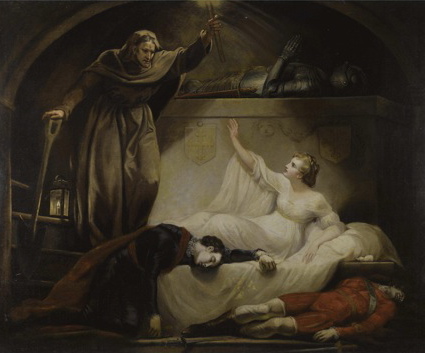
James Northcote, "Romeo and Juliet, act V, scene III," ca. 1790
Last fall, Enfilade included a posting on Sotheby’s Old Master & Early British Paintings auction (29 October 2009), with reference to James Northcote’s painting of the tomb scene from Romeo and Juliet. Erin Blake, Curator of Art and Special Collections at the Folger Shakespeare Library, notes that the Folger acquired the picture — all 9 x 11 feet of it! Details can be found here and here.
Assessing the Digital Burney Newspaper Collection
Last October, Gale made its Burney Collection of newspapers available for a free trial through Early Modern Online Bibliography. In a recent posting at EMOB, Eleanor Shevlin summarizes an article from The Papers of the Bibliographical Society of America on this digital resource:
◊ ◊ ◊ ◊ ◊
Ashley Marshall and Rob Hume, “The Joys, Possibilities, and Perils of the British Library’s Digital Burney Newspapers Collection,” PBSA 104:1 (2010): 5-52.
At forty-seven pages Ashley Marshall and Rob Hume’s article offers a substantive assessment of this relatively recent electronic resource for early modern studies. Early on the authors argue that “[d]igital Burney is amazing, but exploiting it fully is going to demand some serious rethinking and reorientation in both our research and our teaching (6-7). Their claim that this tool “will change the way we conduct our business” (7) possesses much merit; fulfilling digital Burney’s promise, however, will depend on far broader scholarly access than currently exists. Equally important, scholars need to acquire a firm understanding of its possible uses, search capabilities, and limitations. While Marshall and Hume’s piece cannot assist in matters of accessibility (though it could serve as support for the tool’s purchase), their essay does advance our knowledge of how this tool might be employed and how its features and limitations can best be navigated.
The article is usefully divided into five sections. . . .
The full review of the article is available here»
New Resource for Slavery and Abolition Studies
As recently noted at H-Albion:
It is our pleasure to announce the launch of the Yale Slavery and Abolition Portal. The site is designed to help researchers and Yale students find primary source material related to slavery and its legacies within the university’s many libraries and galleries. Users can browse a small catalog of noteworthy collections, learn how to search for additional material, or explore a growing list of external resources. The portal is still in its early stages, and we welcome input and suggestions from researchers, students, and staff. Future improvements will include an interactive teaching component, dynamic tags, user-submitted material, and more.
Developed in cooperation with the Gilder Lehrman Center for the Study of Slavery, Resistance, and Abolition, this portal shares the Center’s interest in the global history of slavery and its legacies, broadly defined. Items featured on this website are not confined to the United States or the Atlantic world or the eighteenth and nineteenth centuries, even if these places and periods tend to form the focus of the sources we have included.
Collection descriptions were copied or adapted from those in the Finding Aid Database, the Orbis Libary Catalog, and other relevant sites. In some cases, we have added text to alert researchers to additional information about a collection. At this stage, we have decided to limit our focus to original manuscripts, material artifacts, and other rare or unpublished material. With a few exceptions, we have excluded printed books and pamphlets and material that is readily available elsewhere online.
Although we hope this portal will provide a springboard for future research, it is hardly exhaustive, and we welcome suggestions of new content from researchers, students, and staff. Information about how to locate primary source material in Yale archives can be found on the research page.
New Online Art History Publication — ‘RIHA Journal’
RIHA, the International Association of Research Institutes in the History of Art, is pleased to announce the launch of RIHA Journal, the new international online-journal for the history of art, on April 14, 2010. A joint project of 27 institutes in 18 countries, the journal provides an excellent medium for fostering international discourse among scholars. Funding is provided by the German Federal Government Commissioner for Culture and the Media (Beauftragter der Bundesregierung für Kultur und Medien, BKM). RIHA Journal (ISSN 2190-3328) features research articles in either English, French, German, Italian, or Spanish, and invites submissions on the whole range of art historical topics and approaches. Manuscripts undergo a double blind peer review process and are published within few months from submission. A not-for-profit e-journal committed to the principles of Open Access, RIHA Journal makes all articles available free of charge. RIHA Journal welcomes submissions at any time; for details, please contact the RIHA institute in your country and/or field of expertise.
Happy (Belated) Birthday, Dr. Sloane!
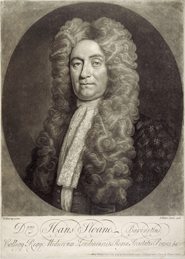 In the midst of the disruptions from the volcanic ash cloud, I failed to note the birthday of Sir Hans Sloane (1660-1753), who would have turned 350 years this past Friday (April 16). The physician was an important naturalist, bibliophile, and collector. As outlined in his will, the bequest of his vast collections to the nation provided the foundation of the British Museum. To mark the anniversary, a series of events have been organized at the British Museum, London’s Natural History Museum, and the Old Operating Theatre Museum, as well as in the Northern Ireland village of Killyleagh, where Sloane was born. Although most events took place last week, in June a major conference will be held at the British Library (see below for the schedule). For whatever it’s worth, I have a hunch that Sloane would have been thrilled to have his birthday marked by the eruption of Iceland’s Eyjafjallajokull -C.H.
◊ ◊ ◊ ◊ ◊
In addition, the Sloane Printed Books Catalogue, is an outstanding new online resource. As noted on the BL’s website:
Sloane’s library of approximately 40,000 volumes, now dispersed within the collections of the British Library and other research libraries, is being identified. Bibliographical descriptions are enhanced with information about pre-Sloane provenance, annotations and other copy-specific information. The information accumulated is being made available through a web-accessible database, the Sloane Printed Books Catalogue, maintained by the British Library. The work of this project will form a significant research resource for medical, scientific and intellectual historians of the period.
◊ ◊ ◊ ◊ ◊
From Books to Bezoars: An International Conference Celebrating the 350th Anniversary of the Birth of Sir Hans Sloane, Physician, Naturalist and Collector
British Library, London, 7-8 June 2010
MONDAY, JUNE 7
9:30 Registration
10:00 Plenary Session
- James Delbourgo (Rutgers University), Collecting Sir Hans Sloane
10:45 Coffee
11:05 Sloane’s Origins, Life and Work
- Mark Purcell (National Trust), “Settled in the north of Ireland”, or Where did Sloane come from?
- Pratik Chakrabarti (University of Kent), The Voyages of Hans Sloane: A colonial history of gentlemanly science
- Lisa Smith (University of Saskatchewan), Sir Hans Sloane: Physician of the family
12:15 Lunch
1:10 Specimens and Classification
- Charlie Jarvis, Mark Spencer, and Rob Huxley (Natural History Museum), Sloane’s plant specimens at the Natural History Museum
- Savithri Preetha Nair (Independent Scholar), Botanising on the Coromandel coast in the seventeenth century
- Jill Cook (British Museum), Sloane, elephants and climate change
3:00 Tea
3:20 Sloane and the West Indies
- James Robertson (University of the West Indies), Knowledgeable readers- Jamaican critiques of Hans Sloane’s botany
- Julie Chun Kim (Fordham University), The African and Amerindian sources of Atlantic medicine
- Wendy Churchill (University of New Brunswick), Hans Sloane’s perspectives on the medical knowledge and health practices of non-Europeans
- Tracy-Ann Smith and Katherine Hann (Natural History Museum), Sloane, slavery and the natural world: New perspectives from community programming
6:30 Reception in the Enlightenment Gallery of the British Museum
TUESDAY, JUNE 8
10:00 Plenary Session
- Kim Sloan (British Museum), Sir Hans Sloane’s ‘Paper Museum’
10:45 Coffee
11:05 The Culture of Collecting
- Kathryn James (Beinecke Library, Yale), Hans Sloane and the public performance of natural history
- Barbara Benedict (Trinity College, Hartford), Sloane’s Ranges: Shifts in Sir Hans Sloane’s literary representation in the eighteenth century
- Eric Jorink (Huygens Instituut), Sloane and the Dutch connection
12:15 Lunch
1:15 Catalogues, Books, and Manuscripts
- Alison Walker, The Sloane Printed Books Project
- Marjorie Caygill (British Museum), Sloane’s catalogues in the British Museum
- Arnold Hunt, Sloane as a manuscript collector
2:20 Tea
2:50 Sloane’s Book Collections
- John Goldfinch (British Library), A rediscovered volume of printed and mss fragments from Sloane’s library
- Julianne Simpson (Wellcome Library), The dispersal of Sir Hans Sloane’s library: A case study from the Medical Society of London collection
- Stephen Parkin (British Library), Sloane’s Italian books
- Will Poole (New College, Oxford), Sloane’s books at the Bodleian Library
4:20 Concluding Remarks
Walpole and Strawberry Hill
The March issue of Apollo Magazine includes a review by Hugh Belsey of the Walpole exhibition now at the V&A in London:
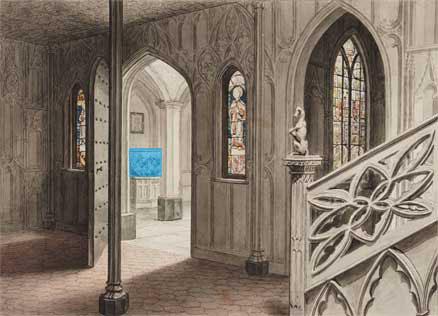
John Carter, "View from the Hall at Strawberry Hill," 1788, pen and ink, and watercolour on laid paper, from Horace Walpole’s extra-illustrated copy of "A Description of the Villa…at Strawberry-Hill" (Strawberry Hill, 1784). Lewis Walpole Library, Yale University. Folio 49 3582, fol. 24.
In 1818 William Hazlitt cruelly remarked that Horace Walpole’s ‘mind as well as his house, was piled up with Dresden china, and illuminated through painted glass’. Twenty-four years later the contents of his house, Strawberry Hill on the banks of the Thames at Twickenham, including the china, were sold. It took the auctioneer, George Robins, 24 days to complete the sale and gave the public the last opportunity to sample Walpole’s mind and taste – or not quite the last opportunity, as many of the rich, strange and beautiful lots have been reassembled in an exquisite exhibition . . . It is a display that sparkles, enchants and entrances. . . .
The full review can be found here»
◊ ◊ ◊ ◊ ◊
In conjunction with the exhibition, there is an outstanding digital component that includes virtual tours and immensely useful search functions for the database (including provenance). As noted on the site:

John Carter, "Tribune from Strawberry Hill", 1789
Horace Walpole’s Strawberry Hill Collection was initially developed by the Lewis Walpole Library to support research for the exhibition Horace Walpole’s Strawberry Hill and for the renovation of the house itself, undertaken by the Strawberry Hill Trust. Dispersed since the famous sale in 1842, Walpole’s collection was one of the most significant in eighteenth-century Britain, numbering several thousand items. This database encompasses the entire range of art and artifacts from Walpole’s collections, including all items whose location is currently known and those as yet untraced but known through a variety of historical records. This information is now made available for public access. The database is an ongoing project: the Library will continue to add and enhance records as further discoveries are made. Queries and comments are invited.
◊ ◊ ◊ ◊ ◊
Finally, it’s worth noting that Strawberry Hill will itself be open to visitors, starting in September, after extensive renovations (projected to cost £8.9 million). For details, see the website of the Strawberry Hill Trust.
From an Eighteenth-Century Kitchen
If this Easter weekend has you thinking about eggs, you might consider this eighteenth-century recipe for Princess Poached Eggs from the blog, 18thC Cuisine. Written by Carolyn Smith-Kizer, the site focuses especially on French cuisine of the period “as a habitante in Nouvelle France may have cooked,” complete with “Anglo and other American influences.”
◊ ◊ ◊ ◊ ◊
 Princess Poached Eggs.
Start by dissolving sugar [simple syrup], cooking until it takes a consistency of syrup; break eggs, using only the yolks, put each one in an eating spoon, & hold in the syrup, until they are cooked; make as many and as cooked [hard or soft] as you like, & when your dish is filled, sprinkle with sugar, and when they are served, pour a little Orange flower water over them and add a grating of candied lemon peel.
Interesting taste, one of those items of which you close your eyes before you take a bite–reminds me of what I thought was crazy when the boys in the cafeteria at college in East Texas poured pancake syrup on their eggs–but it actually tastes good. Evidently it is still appreciated in Quebec where they pour maple syrup over eggs.
*****Œufs pochez à la Princesse.
On commence par faire fondre du sucre qu’on cuit, jusqu’à ce qu’il ait pris une consistance de syrop; on casse des œufs dont on ne prend que les jaunes, qu’on met l’un aprés l’autre dans une cuilliere à bouche, & qu’on tient ainsi dans le syrop, jusqu’à ce qu’ils soient cuits, on en fait tant qu’on en veut de cette maniere, & lorsque le plat est rempli, on les poudre de sucre, puis on les sert, piquez d’écorce de citron confits, avec de l’eau de fleur d’Orange, qu’on verse pardessus.
Le Menage de la Ville et des Champs, et le Jardinier François, Louis Liger & Nicolas de Bonnefons. Chez Jean Leonard, Brussels, 1712, p.156-157.
◊ ◊ ◊ ◊ ◊
Warm thanks to Carolyn Smith-Kizer for permission to republish this posting. For an interview with her, click here»
The BHA is Back — For Everyone
After lots of uncertainty, the BHA has been saved after all! As noted at the Getty website:
 As of April 1, 2010, the Bibliography of the History of Art (BHA) will be available free of charge on the Getty Web site at http://library.getty.edu/bha. Free Web access to BHA is an advantage not only to all traditional users of the database but also to such potential users as institutions in developing countries and independent scholars worldwide, who until now have been unable to afford access to the BHA. Since ending its collaboration with the Institut de l’Information Scientifique et Technique (INIST)–CNRS in December 2007, the Getty has been searching for partners to continue the production and distribution of BHA. This process has been complicated, and with no suitable arrangement immediately available, the Getty decided to act on its commitment to the scholarly community by providing access to BHA directly from its own Web site.
BHA on the Getty Web site offers both basic and advanced search modules, and can be searched easily by subject, artist, author, article or journal title, and other elements. To search BHA, please visit, http://library.getty.edu/bha. Note that the database search includes both BHA (covering 1990-2007) and the International Bibliography of Art (IBA), covering the years 2008 and part of 2009. The Répertoire de la litterature de l’art (RILA), one of the predecessors of BHA, with records that cover 1975–1989, will be online by May 1.
About the BHA
The Bibliography of the History of Art (BHA) is the world’s most comprehensive bibliography of scholarly writing about the history of western art.
Journals Included in BHA (PDF, 308 K)
BHA includes articles from over 1,200 journals. The link above leads to a list of names and ISSNs of each of those journals.
Note: BHA includes all articles within the subject scope of BHA regardless of the subject focus of a particular journal. Thus, many of the journals on this list are covered partially, as only some of their articles are within BHA’s scope.
Trade Cards, as Fleeting and Fragile as Butterfly Wings
The trade card collection from Waddeston Manor is a fascinating collection of advertising images. Searchable, high-resolution images accompanied by notes are available here. The following description comes from The Warwick Eighteenth-Century Center.

Card of Didier Aubert, Printseller & Engraver
Advertising has long been known to be both the reflection of and means to create desire for commodities. The study of historical advertising is, therefore, a key means to understand consumers and consumer markets in early modern society. Despite an extensive literature on the proliferation of new goods and their consumers between 1760 and 1800, there has been little research on the part played by advertising in creating consumer markets. Furthermore, research has tended to focus on texts and the English-speaking world.
Waddesdon Manor has a unique collection of French and German trade cards dating from the seventeenth and eighteenth centuries. Trade cards, prints with a combination of image and text, provided information about the location, goods and services of a given business. A thorough study of these objects can inform us about early modern attitudes to the burgeoning world of goods and the inter-relationship between commercial and fine art.
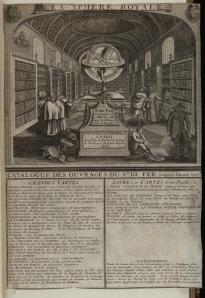
Card of Nicolas de Fer, Geographer and Map-seller, A La Sphere Royale, 1705
‘Selling Consumption,’ is a three-year Leverhulme funded project that seeks to catalogue and analyse these cards using approaches from social history, material culture, art history and the history of collections to provide a resource based on this rich, but under-studied, form of commercial ephemera. The catalogue will be published in the form of an on-line database in Spring 2009, providing scholars with a vital resource to continue the study and understanding of this material. The database has been designed to allow scholars to search by trade or product as well as by decorative motif or iconographic subject. A further field entitled ‘Research Concepts’ aims to facilitate searching the database through the lens of contemporary research interests.
This project has led on to the organisation of an exhibition, to be held at Waddesdon Manor from March to October 2008. The exhibition ‘Selling Shopping in Paris 1680-1820’ will introduce visitors to the unique collection of French trade cards and allow them to learn what and how the cards tell us about the production of advertising, the imagery of consumption, the types of products on sale, the location of trades, as well as what it was like to go shopping in Paris of the long eighteenth century. The items on display: trade cards, textiles, drawings, books, and other objet d’art reflect the interdisciplinary nature of the project.
Marvels in the Marketplace: the Germanic trade cards at Waddesdon Manor
In the course of digitising, cataloguing and investigating the rare collection of trade cards at Waddesdon Manor, the uniqueness of a particular part of the collection has come to light. The last of the four volumes does not contain French prints, nor is it arranged in the broad chronology used to organise the rest of the material. A group of cards relating to hotels and inns, as well as a significant number representing dealers in paintings, antiquities and silverware, provides evidence of links between French mercantile travel and the formation of the collection. Another group of cards illustrating human prodigies and fair-ground entertainers indicates that this ‘French’ view of Germanic cultural activity was figured through the spectacle of abnormal bodies. Currently, it is believed that the French collections of ephemera were driven by nostalgia for the Paris of the Ancien Regime. These cards indicate that other interests helped to shape the collection. A three-month British Academy grant will allow the cataloguing of this volume using the methodologies developed in the ‘Selling Consumption’ project, as well as allowing discreet research to be carried out on these cards . . . .
For additional information, including a bibliography, click here»
Spring Cleaning Your CV
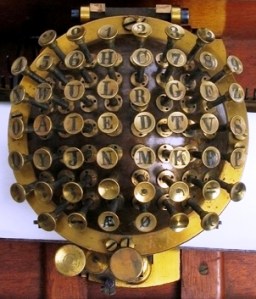
The keyboard of a writing ball, seen from above. Rasmus Malling-Hansen invented this writing machine in 1865 (Photo: Wikimedia Commons)
From the Editor
As we move into spring and past the high season for job interviews and fellowship deadlines, it may seem like a strange time to revise your CV. On the other hand, now might just be an ideal moment. Without the pressure of looming due dates, you might be able to approach the task with a clearer head and fresh energy. It might even feel constructive as opposed to being one more academic chore, another box to check in the process of submitting applications. Updating a CV can provide a useful means of assessing what you’ve accomplished in the recent past — and what sorts of holes you need to work to fill for the future. Again, there’s a tendency to push it off until some pressing deadline, but deadlines come with enough pressure without having to scramble to fix the CV (and those moments are rarely well-suited for taking stock of one’s scholarly and professional goals and progress).
 A recent posting at The Art History Newsletter notes the return of the CV Doctor at The Chronicle of Higher Education. The article (written by Julie Miller Vick and Jennifer Furlong, authors of The Academic Job Search Handbook) includes ‘before’ and ‘after’ examples, including one from art historian, ‘Lucy Scholar’. The College Art Association includes models at its Standards and Guidelines pages for Art Historians (2003) and Museum Professionals (2000). And, notwithstanding the array of bad sites, there are plenty of useful resources across the web for improving your formatting.
Remarkably — though perhaps not surprisingly — prescriptions from academic bastions such The Chronicle and CAA offer minimal help in terms of updating the visual design for a CV. Here’s CAA’s recommendation:
Avoid making the cv complicated. Dramatic layouts and attempts to pad your cv will probably work against you. A beautifully constructed cv will not get you the job if your scholarship is weak.
I agree, but none of this is especially useful in terms of actually formatting a document, and the last sentence seems to harbor a funny suspicion that ultimately appearances are deceptive and thus not to be trusted. In any case, even if “your scholarship is weak” you’re surely under no obligation to make your CV look bad, too. (In an interesting way, this returns us to the bias against fashion in academic circles).
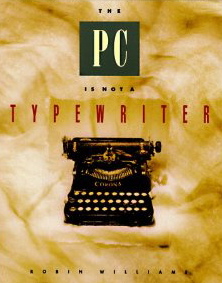 To be clear: an academic CV should conform to traditional visual standards. Yet, no one expects you to use a typewriter, and presumably doing so would be counted against you. The analogy, in fact, lies at the center of the argument made in Robin Williams’s wonderful book, The PC Is Not a Typewriter. Don’t let the publication date of 1995 put you off; it’s full of terrific advice that’s still all too timely. You’ll learn for instance, why it makes sense to use two spaces between sentences on a typewriter but is absurd to do so on a computer keyboard (the last time I surveyed my students on this point, the majority had still been instructed to keyboard with two spaces after each period). I’ve also found the advice at LifeClever Give Your Resume a Face Lift to be immensely useful, and the end result is hardly “dramatic” — just a much better formatted CV. Other resources or ideas? Feel free to comment. –C.H.










 Enfilade
leave a comment