The BHA is Back — For Everyone
After lots of uncertainty, the BHA has been saved after all! As noted at the Getty website:
 As of April 1, 2010, the Bibliography of the History of Art (BHA) will be available free of charge on the Getty Web site at http://library.getty.edu/bha. Free Web access to BHA is an advantage not only to all traditional users of the database but also to such potential users as institutions in developing countries and independent scholars worldwide, who until now have been unable to afford access to the BHA. Since ending its collaboration with the Institut de l’Information Scientifique et Technique (INIST)–CNRS in December 2007, the Getty has been searching for partners to continue the production and distribution of BHA. This process has been complicated, and with no suitable arrangement immediately available, the Getty decided to act on its commitment to the scholarly community by providing access to BHA directly from its own Web site.
BHA on the Getty Web site offers both basic and advanced search modules, and can be searched easily by subject, artist, author, article or journal title, and other elements. To search BHA, please visit, http://library.getty.edu/bha. Note that the database search includes both BHA (covering 1990-2007) and the International Bibliography of Art (IBA), covering the years 2008 and part of 2009. The Répertoire de la litterature de l’art (RILA), one of the predecessors of BHA, with records that cover 1975–1989, will be online by May 1.
About the BHA
The Bibliography of the History of Art (BHA) is the world’s most comprehensive bibliography of scholarly writing about the history of western art.
Journals Included in BHA (PDF, 308 K)
BHA includes articles from over 1,200 journals. The link above leads to a list of names and ISSNs of each of those journals.
Note: BHA includes all articles within the subject scope of BHA regardless of the subject focus of a particular journal. Thus, many of the journals on this list are covered partially, as only some of their articles are within BHA’s scope.
Trade Cards, as Fleeting and Fragile as Butterfly Wings
The trade card collection from Waddeston Manor is a fascinating collection of advertising images. Searchable, high-resolution images accompanied by notes are available here. The following description comes from The Warwick Eighteenth-Century Center.

Card of Didier Aubert, Printseller & Engraver
Advertising has long been known to be both the reflection of and means to create desire for commodities. The study of historical advertising is, therefore, a key means to understand consumers and consumer markets in early modern society. Despite an extensive literature on the proliferation of new goods and their consumers between 1760 and 1800, there has been little research on the part played by advertising in creating consumer markets. Furthermore, research has tended to focus on texts and the English-speaking world.
Waddesdon Manor has a unique collection of French and German trade cards dating from the seventeenth and eighteenth centuries. Trade cards, prints with a combination of image and text, provided information about the location, goods and services of a given business. A thorough study of these objects can inform us about early modern attitudes to the burgeoning world of goods and the inter-relationship between commercial and fine art.
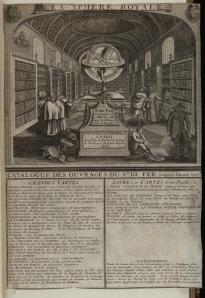
Card of Nicolas de Fer, Geographer and Map-seller, A La Sphere Royale, 1705
‘Selling Consumption,’ is a three-year Leverhulme funded project that seeks to catalogue and analyse these cards using approaches from social history, material culture, art history and the history of collections to provide a resource based on this rich, but under-studied, form of commercial ephemera. The catalogue will be published in the form of an on-line database in Spring 2009, providing scholars with a vital resource to continue the study and understanding of this material. The database has been designed to allow scholars to search by trade or product as well as by decorative motif or iconographic subject. A further field entitled ‘Research Concepts’ aims to facilitate searching the database through the lens of contemporary research interests.
This project has led on to the organisation of an exhibition, to be held at Waddesdon Manor from March to October 2008. The exhibition ‘Selling Shopping in Paris 1680-1820’ will introduce visitors to the unique collection of French trade cards and allow them to learn what and how the cards tell us about the production of advertising, the imagery of consumption, the types of products on sale, the location of trades, as well as what it was like to go shopping in Paris of the long eighteenth century. The items on display: trade cards, textiles, drawings, books, and other objet d’art reflect the interdisciplinary nature of the project.
Marvels in the Marketplace: the Germanic trade cards at Waddesdon Manor
In the course of digitising, cataloguing and investigating the rare collection of trade cards at Waddesdon Manor, the uniqueness of a particular part of the collection has come to light. The last of the four volumes does not contain French prints, nor is it arranged in the broad chronology used to organise the rest of the material. A group of cards relating to hotels and inns, as well as a significant number representing dealers in paintings, antiquities and silverware, provides evidence of links between French mercantile travel and the formation of the collection. Another group of cards illustrating human prodigies and fair-ground entertainers indicates that this ‘French’ view of Germanic cultural activity was figured through the spectacle of abnormal bodies. Currently, it is believed that the French collections of ephemera were driven by nostalgia for the Paris of the Ancien Regime. These cards indicate that other interests helped to shape the collection. A three-month British Academy grant will allow the cataloguing of this volume using the methodologies developed in the ‘Selling Consumption’ project, as well as allowing discreet research to be carried out on these cards . . . .
For additional information, including a bibliography, click here»
Spring Cleaning Your CV
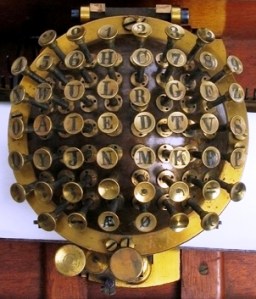
The keyboard of a writing ball, seen from above. Rasmus Malling-Hansen invented this writing machine in 1865 (Photo: Wikimedia Commons)
From the Editor
As we move into spring and past the high season for job interviews and fellowship deadlines, it may seem like a strange time to revise your CV. On the other hand, now might just be an ideal moment. Without the pressure of looming due dates, you might be able to approach the task with a clearer head and fresh energy. It might even feel constructive as opposed to being one more academic chore, another box to check in the process of submitting applications. Updating a CV can provide a useful means of assessing what you’ve accomplished in the recent past — and what sorts of holes you need to work to fill for the future. Again, there’s a tendency to push it off until some pressing deadline, but deadlines come with enough pressure without having to scramble to fix the CV (and those moments are rarely well-suited for taking stock of one’s scholarly and professional goals and progress).
 A recent posting at The Art History Newsletter notes the return of the CV Doctor at The Chronicle of Higher Education. The article (written by Julie Miller Vick and Jennifer Furlong, authors of The Academic Job Search Handbook) includes ‘before’ and ‘after’ examples, including one from art historian, ‘Lucy Scholar’. The College Art Association includes models at its Standards and Guidelines pages for Art Historians (2003) and Museum Professionals (2000). And, notwithstanding the array of bad sites, there are plenty of useful resources across the web for improving your formatting.
Remarkably — though perhaps not surprisingly — prescriptions from academic bastions such The Chronicle and CAA offer minimal help in terms of updating the visual design for a CV. Here’s CAA’s recommendation:
Avoid making the cv complicated. Dramatic layouts and attempts to pad your cv will probably work against you. A beautifully constructed cv will not get you the job if your scholarship is weak.
I agree, but none of this is especially useful in terms of actually formatting a document, and the last sentence seems to harbor a funny suspicion that ultimately appearances are deceptive and thus not to be trusted. In any case, even if “your scholarship is weak” you’re surely under no obligation to make your CV look bad, too. (In an interesting way, this returns us to the bias against fashion in academic circles).
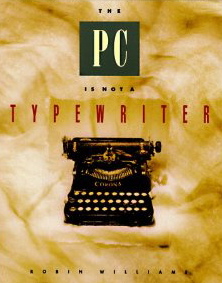 To be clear: an academic CV should conform to traditional visual standards. Yet, no one expects you to use a typewriter, and presumably doing so would be counted against you. The analogy, in fact, lies at the center of the argument made in Robin Williams’s wonderful book, The PC Is Not a Typewriter. Don’t let the publication date of 1995 put you off; it’s full of terrific advice that’s still all too timely. You’ll learn for instance, why it makes sense to use two spaces between sentences on a typewriter but is absurd to do so on a computer keyboard (the last time I surveyed my students on this point, the majority had still been instructed to keyboard with two spaces after each period). I’ve also found the advice at LifeClever Give Your Resume a Face Lift to be immensely useful, and the end result is hardly “dramatic” — just a much better formatted CV. Other resources or ideas? Feel free to comment. –C.H.
CAA Member Directory Now Available
As noted at CAA News (15 March 2010),
The CAA Member Directory, now available online to current individual members, allows you to search for other members internationally. Search criteria include first and last name, organization or institution name, and city, state, and country. Those fields—as well as telephone numbers, email address, and website—are shown in your search results, unless an individual has opted to exclude certain details. To review and update your contact information, including that which appears in the Member Directory, please log into your CAA account. Next, click the “Contact Info” link on the left side to review your contact information. Instructions on the page will help you choose an address for the Member Directory. You may prevent any information from appearing in the directory at any time by unchecking the “Directory” box for all addresses on your record. If you have more than one valid address on your record, please choose which address to include in the directory. Organization and title will only be included with a business address. In addition, only your primary phone, email, and/or website address will be used regardless of which address you choose. You may also remove duplicate or outdated information.
Accessing Library Resources in the Digital Age

Koninklijke Bibliotheek, National Library of the Netherlands
Recently within the context of a discussion at C18-L of J-Stor’s experiments with adding auction catalogs to its collection of resources, the inevitable question surfaced: what about access for people who are not attached to institutions that subscribe to such costly databases? At a time when scholarly materials are increasingly migrating from paper to digital storage formats, it’s a serious concern. The web is undoubtedly opening up tremendous avenues, but often at enormous costs, and for individuals not fortunate enough to benefit from libraries that can absorb such costs, the threat of a digital divide is anything but theoretical. One contributor suggested joining the Koninklijke Bibliotheek (KB) in The Hague, which provides remote access to the library’s resources, including the subscription databases. I’ve not tried it, but judging from the
information available on the site it seems to be a viable solution.
At just €15/year, it’s certainly affordable. Other ideas? –C.H.
Now Available: Audio Replay of CAA in Chicago
From CAA News, 5 March 2010:
The 2010 Annual Conference in Chicago, one of the best attended in recent years, had an incredibly diverse array of sessions. Audio recordings for eighty-one of those panels are now available for sale. A set of MP3 audio recordings from the Chicago conference is available for only $149.95, either as a download or on interactive CD-ROMs. Individual sessions, available only as downloads, are $24.95 each. Please visit Conference Media to view the list of sessions and to order.
Available sessions include such timely topics as “Lifeloggers: Chronicling the Everyday” and “Autofictions, Avatars, and Alter Egos: Fabricating Artists.” Thematic art-historical topics, on analyzing repetition in ancient art and on violence and narrative in early modern art, also make appearances, as do state of the field talks on the art history of the African diaspora and on American-art textbooks. Included in the mix are pedagogical topics involving “Autonomizing Practices in Art, Art History, and Education” and “WTF: Talking Theory with Art and Art-History Undergrads,” among others.
Whether you took part in, attended, or missed a particular conference session, these recordings are a must-have for your library, research, or teaching. Listen to them while walking across campus, while driving in your car or using public transportation, or while relaxing in your home.
In addition to the Chicago sessions, you can also purchase session audio recordings from the 2006–9 conferences in Boston, New York, Dallas–Fort Worth, and Los Angeles. See http://conference.collegeart.org/audio for details.
Sartorial Choices Part II
Several weeks ago Enfilade included a reference to the fashion blog, Academichic. Readers who found it interesting, might enjoy this interview at Already Pretty, where the participants unpack their thinking on the importance of clothing within academia.

Protection in the Eighteenth Century
 As recently noted on the website of Amadeus Mozart, various examples of eighteenth-century prophylactics have been recreated and are now available from Dr. Roberts. Details can be found at his site, Tempus Fugit: An Account of the Activities & Adventures of a Gentleman Physician.
These are reproductions of the offerings of Mrs. Phillips in her shop at Orange Court in London. She designed them from sheep or goat’s gut, pickled, scented and delicately fashioned on glass moulds by the hands of the proprietress herself. I will be providing the standard “Baudruches fines,” and for the more cautious customers, the “Superfine Double” which was made from two superimposed and gummed caecums, the blind end of a sheep’s bigger gut. They are to be Five dollars a piece. Contact me straight away to place your order before they run out!
Johan Zoffany’s 1779 Self Portrait in the National Gallery at Parma includes a pair of such sheaths [see William Pressly, “Genius Unveiled: The Self-Portraits of Johan Zoffany,” Art Bulletin 69 (March 1987): 88-101.] Any other relevant examples come to mind?
Accessing Auction Catalogs
As noted by Jason Kelly at H-Albion (and then picked up on C-18L), JSTOR is piloting an online storage bank of auction catalogs, currently ranging from the eighteenth to twentieth centuries. The following description comes from the beta site:
JSTOR is collaborating with the Frick Collection and the Metropolitan Museum of Art in a pilot project funded by The Andrew W. Mellon Foundation to understand how auction catalogs can be best preserved for the long-term and made most easily accessible for scholarly use. Auction catalogs are vital for provenance research as well as for the study of art markets and the history of collecting.
This prototype site is open to the public through June 2010. If you are interested in this content and the importance to art research, we encourage you to try the site and take the brief survey linked below. In June, we will evaluate use of the content and the feedback we have received in order to help determine the future of the resource.
For more information, click here» And by all means, feel free to chime in with observations here in the ‘Comments’ section.
Stephen Bury Named New Librarian at the Frick
From a Frick press release:
 The Frick Collection is pleased to announce the appointment of Dr. Stephen J. Bury to the post of Andrew W. Mellon Chief Librarian at the Frick Art Reference Library. For the past ten years, he has been at the British Library, the national library of the United Kingdom, and one of the world’s greatest research institutions, where he is a Deputy Director and Head of European and American Collections, as well as Maps, Music, and Philatelic Collections. Previously, Dr. Bury was Head of Learning Resources at the Chelsea College of Art & Design, London. Comments Anne Poulet, Director of The Frick Collection, “Dr. Bury brings to this leadership position an exceptional dual perspective. He is both an art historian― who understands first hand the needs of those who teach, research, and curate―as well as an internationally regarded librarian. An active participant on numerous professional commissions as well as dynamic division head of the British Library, he is a great strategic thinker in a rapidly changing field. Stephen Bury has developed a keen understanding in areas of mutual interest to the Frick, among them digitization, collection sharing, storage, and encouraging greater use of new technologies by staff. Furthermore, the nature of the collections he oversees at the British Library, being both European and American, dovetails beautifully with the scope of our holdings and initiatives. With his arrival in May, we know that the Frick Art Reference Library will benefit greatly from Dr. Bury’s insights as well as from the broad connections he has developed through years of highly engaged service and scholarship.”
Adds Dr. Bury, “The Frick Art Reference Library is internationally well-regarded, not just for its rich resources, but for the very proactive approach the institution has taken in light of the changing universe of libraries and the needs of the audiences they serve. The Frick has played a notable role in exploring such important ventures as digitization and collection sharing, and we are of like mind that the future of libraries is an exciting one. I am thrilled to have the opportunity to lead the remarkably talented staff at this venerable research center. At the same time, the post represents a wonderfully appealing opportunity for me to return to an art historical focus, that area of study being at the core of my academic background.” (more…)










1 comment