Update on the Well-Being of the Wellcome Library
I’m glad to note that I received the following message of assurance from Simon Chaplin, the Head of the Wellcome Library, in regard to my earlier question about the fate of the Library. I observed that it’s difficult for me to imagine the Library without the Centre — it seems that, in fact, the Library is starting to make plans for assuming some of the responsibilities previously handled by the Centre, such as support of visiting scholars. Many thanks, Simon, for the clarification, and my apologies for perpetuating any unreliable information. -C.H.
◊ ◊ ◊ ◊ ◊
I’m happy to say that the decision about the Centre hasn’t raised any questions about the library — our position is very secure. We’re about to embark on a big project to put more of our collections online – the Trust has earmarked four million pounds for this over the next two years, with up to another sixteen million pounds available once the project is up and running – and the numbers of physical users are also going up by 25% a year, so there is no danger that the move to digital will reduce our physical presence. I’ve been talking with colleagues in the Centre and the Trust about how we can support visiting researchers using the library if the Centre moves out of its present location, so we should be able to maintain this service regardless of the changes. I’d be grateful if you could offer Enfilade readers some reassurance on this – there have been several other reports about the Wellcome Library’s ‘closure’, and I’m keen that the rumour doesn’t put down roots. With best wishes – and hoping to see you in the library soon!
Dr Simon Chaplin
Head of the Wellcome Library
Wellcome Library
183 Euston Road, London NW1 2BE
A World without the Wellcome?
From the Editor
As a former research associate at the Wellcome Trust Centre for the History of Medicine, I’m as dismayed as anyone at the recent announcement that the Centre will be closing. The Wellcome has played an immensely valuable role for scholars across multiple disciplines, including art history. Thanks in part to the importance of Roy Porter for the Centre (and of course the importance of the Enlightenment for the history of medicine), the Wellcome has provided valuable institutional support for the field of eighteenth-century studies generally. The announcement also raises questions about the fate of the Wellcome Library, which includes an unrivaled collection of visual resources, much of which has been available online (reassurances have been made, but it’s difficult for me to imagine the Library without the Centre; at the very least, its mission would change).* For more information, see the announcement at the UCL website, a brief article at The Times Higher Education, and this editorial from the Telegraph. I hope you’ll consider signing the following petition.
-Craig Hanson
To: UCL/The Wellcome Trust
On March 31st the Wellcome Trust and UCL announced the closure of the Wellcome Trust Centre for the History of Medicine. This decision came in the middle of negotiations concerning the normal quinquennial review of funding for the Centre. The proposal to close the Centre was made by a handful of persons within the Wellcome Trust without, as far as is known, the involvement of any historian of medicine. We call upon the Trust to reconsider its decision, reinstate the independent peer review process, and permit any subsequent Centre to remain within the Wellcome building. We call upon UCL to maintain the history of medicine as a visible entity within College serving both historians and medics.
* N.B. –– Regarding the fate of the Library, please see this posting, added 26 May 2010.
◊ ◊ ◊ ◊ ◊
Roy Porter Memorial Lecture by Quentin Skinner, Political Liberty: The Enlightenment Debate
Wellcome Building, 183 Euston Road, London, 26 May 2010
With the announcement of the closure of the Centre by UCL and the Wellcome Trust, and the uncertainty regarding the precise details of the two-year wind-down, the 2010 Roy Porter Memorial lecture will be the last. Professor Quentin Skinner will talk on Political Liberty: The Enlightenment Debate, a subject Roy would have particularly enjoyed.
Jeremy Bentham announced in 1776 that he had made a ‘discovery’ about the concept of liberty. John Lind put forward a similar view in his official response to the Declaration of Independence, but Lind was persuaded (not least by Bentham himself) to accept that Bentham had been the first to articulate the argument. Bentham’s view was primarily directed against the pamphlets of the common lawyer Richard Hey, while Lind’s was more ambitiously directed against the pro-American writings of Richard Price. The lecture begins by examining the background to the theory that Lind denounced, and then turns to examine the background to the rival theory that he and Bentham both espoused. As the latter discussion unfolds, a doubt about Bentham’s claims to originality begins to arise. The lecture ends by suggesting that the earliest articulation of the theory that he claimed as his own was in fact the work of Thomas Hobbes.
The lecture will be held on May 26th in the Wellcome Building, 183 Euston Road. Attendance is free on receipt of an e-ticket which may be obtained by emailing: hom-events@ucl.ac.uk.
Keeping Track — New Acquisitions Blog at the Walpole Library
Scholarship in the digital age of connectivity creates enormous possibilities, and yet these possibilities also pose new problems. It’s terrific that collections of visual and textual materials are increasingly available online, but knowing what’s where can be tricky. Further complicating matters is the fact that institutional collections are always adding more. Just because something wasn’t available online last summer doesn’t mean that it’s not there now. In some ways, this is just a new version of the old problem of spreading the word about new acquisitions. Fortunately, the digital age provides us with tools that could help. Listservs and blogs are ideally suited for such announcements, and Enfilade is certainly one forum for sharing these kinds of updates.
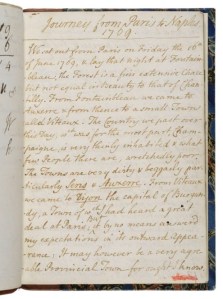
"Journey from Paris to Naples, 1769"

LWL Mss Vol 181, William Henry Bunbury
In a more focused manner, the Lewis Walpole Library hosts a blog dedicated to its own “Recent Antiquarian Acquisitions.” The posting from 11 May 2010, for instance, takes note of the travel diary of William Henry Bunbury (1750-1821), which documents his journey from Paris to Naples in 1769. Now best known for his caricatures, William was the younger brother of Sir Charles Bunbery, whose first wife was famously painted by Sir Joshua Reynolds (the portrait of Lady Sarah Sacrificing to the Graces is in the collection of the Art Institute of Chicago). Of course, the Walpole Library blog becomes one more site to keep tabs on, but it would seem like a workable solution. Any thoughts?
New Acquisition at the Folger
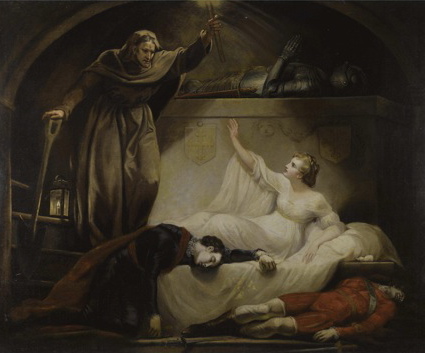
James Northcote, "Romeo and Juliet, act V, scene III," ca. 1790
Last fall, Enfilade included a posting on Sotheby’s Old Master & Early British Paintings auction (29 October 2009), with reference to James Northcote’s painting of the tomb scene from Romeo and Juliet. Erin Blake, Curator of Art and Special Collections at the Folger Shakespeare Library, notes that the Folger acquired the picture — all 9 x 11 feet of it! Details can be found here and here.
Assessing the Digital Burney Newspaper Collection
Last October, Gale made its Burney Collection of newspapers available for a free trial through Early Modern Online Bibliography. In a recent posting at EMOB, Eleanor Shevlin summarizes an article from The Papers of the Bibliographical Society of America on this digital resource:
◊ ◊ ◊ ◊ ◊
Ashley Marshall and Rob Hume, “The Joys, Possibilities, and Perils of the British Library’s Digital Burney Newspapers Collection,” PBSA 104:1 (2010): 5-52.
At forty-seven pages Ashley Marshall and Rob Hume’s article offers a substantive assessment of this relatively recent electronic resource for early modern studies. Early on the authors argue that “[d]igital Burney is amazing, but exploiting it fully is going to demand some serious rethinking and reorientation in both our research and our teaching (6-7). Their claim that this tool “will change the way we conduct our business” (7) possesses much merit; fulfilling digital Burney’s promise, however, will depend on far broader scholarly access than currently exists. Equally important, scholars need to acquire a firm understanding of its possible uses, search capabilities, and limitations. While Marshall and Hume’s piece cannot assist in matters of accessibility (though it could serve as support for the tool’s purchase), their essay does advance our knowledge of how this tool might be employed and how its features and limitations can best be navigated.
The article is usefully divided into five sections. . . .
The full review of the article is available here»
New Resource for Slavery and Abolition Studies
As recently noted at H-Albion:
It is our pleasure to announce the launch of the Yale Slavery and Abolition Portal. The site is designed to help researchers and Yale students find primary source material related to slavery and its legacies within the university’s many libraries and galleries. Users can browse a small catalog of noteworthy collections, learn how to search for additional material, or explore a growing list of external resources. The portal is still in its early stages, and we welcome input and suggestions from researchers, students, and staff. Future improvements will include an interactive teaching component, dynamic tags, user-submitted material, and more.
Developed in cooperation with the Gilder Lehrman Center for the Study of Slavery, Resistance, and Abolition, this portal shares the Center’s interest in the global history of slavery and its legacies, broadly defined. Items featured on this website are not confined to the United States or the Atlantic world or the eighteenth and nineteenth centuries, even if these places and periods tend to form the focus of the sources we have included.
Collection descriptions were copied or adapted from those in the Finding Aid Database, the Orbis Libary Catalog, and other relevant sites. In some cases, we have added text to alert researchers to additional information about a collection. At this stage, we have decided to limit our focus to original manuscripts, material artifacts, and other rare or unpublished material. With a few exceptions, we have excluded printed books and pamphlets and material that is readily available elsewhere online.
Although we hope this portal will provide a springboard for future research, it is hardly exhaustive, and we welcome suggestions of new content from researchers, students, and staff. Information about how to locate primary source material in Yale archives can be found on the research page.
New Online Art History Publication — ‘RIHA Journal’
RIHA, the International Association of Research Institutes in the History of Art, is pleased to announce the launch of RIHA Journal, the new international online-journal for the history of art, on April 14, 2010. A joint project of 27 institutes in 18 countries, the journal provides an excellent medium for fostering international discourse among scholars. Funding is provided by the German Federal Government Commissioner for Culture and the Media (Beauftragter der Bundesregierung für Kultur und Medien, BKM). RIHA Journal (ISSN 2190-3328) features research articles in either English, French, German, Italian, or Spanish, and invites submissions on the whole range of art historical topics and approaches. Manuscripts undergo a double blind peer review process and are published within few months from submission. A not-for-profit e-journal committed to the principles of Open Access, RIHA Journal makes all articles available free of charge. RIHA Journal welcomes submissions at any time; for details, please contact the RIHA institute in your country and/or field of expertise.
Happy (Belated) Birthday, Dr. Sloane!
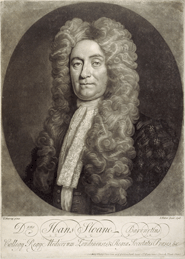 In the midst of the disruptions from the volcanic ash cloud, I failed to note the birthday of Sir Hans Sloane (1660-1753), who would have turned 350 years this past Friday (April 16). The physician was an important naturalist, bibliophile, and collector. As outlined in his will, the bequest of his vast collections to the nation provided the foundation of the British Museum. To mark the anniversary, a series of events have been organized at the British Museum, London’s Natural History Museum, and the Old Operating Theatre Museum, as well as in the Northern Ireland village of Killyleagh, where Sloane was born. Although most events took place last week, in June a major conference will be held at the British Library (see below for the schedule). For whatever it’s worth, I have a hunch that Sloane would have been thrilled to have his birthday marked by the eruption of Iceland’s Eyjafjallajokull -C.H.
◊ ◊ ◊ ◊ ◊
In addition, the Sloane Printed Books Catalogue, is an outstanding new online resource. As noted on the BL’s website:
Sloane’s library of approximately 40,000 volumes, now dispersed within the collections of the British Library and other research libraries, is being identified. Bibliographical descriptions are enhanced with information about pre-Sloane provenance, annotations and other copy-specific information. The information accumulated is being made available through a web-accessible database, the Sloane Printed Books Catalogue, maintained by the British Library. The work of this project will form a significant research resource for medical, scientific and intellectual historians of the period.
◊ ◊ ◊ ◊ ◊
From Books to Bezoars: An International Conference Celebrating the 350th Anniversary of the Birth of Sir Hans Sloane, Physician, Naturalist and Collector
British Library, London, 7-8 June 2010
MONDAY, JUNE 7
9:30 Registration
10:00 Plenary Session
- James Delbourgo (Rutgers University), Collecting Sir Hans Sloane
10:45 Coffee
11:05 Sloane’s Origins, Life and Work
- Mark Purcell (National Trust), “Settled in the north of Ireland”, or Where did Sloane come from?
- Pratik Chakrabarti (University of Kent), The Voyages of Hans Sloane: A colonial history of gentlemanly science
- Lisa Smith (University of Saskatchewan), Sir Hans Sloane: Physician of the family
12:15 Lunch
1:10 Specimens and Classification
- Charlie Jarvis, Mark Spencer, and Rob Huxley (Natural History Museum), Sloane’s plant specimens at the Natural History Museum
- Savithri Preetha Nair (Independent Scholar), Botanising on the Coromandel coast in the seventeenth century
- Jill Cook (British Museum), Sloane, elephants and climate change
3:00 Tea
3:20 Sloane and the West Indies
- James Robertson (University of the West Indies), Knowledgeable readers- Jamaican critiques of Hans Sloane’s botany
- Julie Chun Kim (Fordham University), The African and Amerindian sources of Atlantic medicine
- Wendy Churchill (University of New Brunswick), Hans Sloane’s perspectives on the medical knowledge and health practices of non-Europeans
- Tracy-Ann Smith and Katherine Hann (Natural History Museum), Sloane, slavery and the natural world: New perspectives from community programming
6:30 Reception in the Enlightenment Gallery of the British Museum
TUESDAY, JUNE 8
10:00 Plenary Session
- Kim Sloan (British Museum), Sir Hans Sloane’s ‘Paper Museum’
10:45 Coffee
11:05 The Culture of Collecting
- Kathryn James (Beinecke Library, Yale), Hans Sloane and the public performance of natural history
- Barbara Benedict (Trinity College, Hartford), Sloane’s Ranges: Shifts in Sir Hans Sloane’s literary representation in the eighteenth century
- Eric Jorink (Huygens Instituut), Sloane and the Dutch connection
12:15 Lunch
1:15 Catalogues, Books, and Manuscripts
- Alison Walker, The Sloane Printed Books Project
- Marjorie Caygill (British Museum), Sloane’s catalogues in the British Museum
- Arnold Hunt, Sloane as a manuscript collector
2:20 Tea
2:50 Sloane’s Book Collections
- John Goldfinch (British Library), A rediscovered volume of printed and mss fragments from Sloane’s library
- Julianne Simpson (Wellcome Library), The dispersal of Sir Hans Sloane’s library: A case study from the Medical Society of London collection
- Stephen Parkin (British Library), Sloane’s Italian books
- Will Poole (New College, Oxford), Sloane’s books at the Bodleian Library
4:20 Concluding Remarks
Walpole and Strawberry Hill
The March issue of Apollo Magazine includes a review by Hugh Belsey of the Walpole exhibition now at the V&A in London:
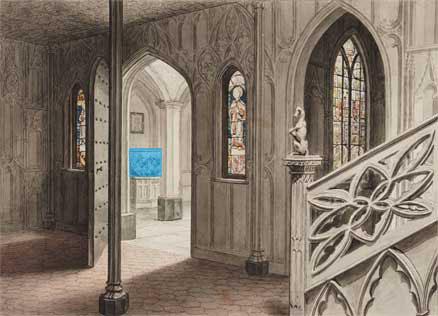
John Carter, "View from the Hall at Strawberry Hill," 1788, pen and ink, and watercolour on laid paper, from Horace Walpole’s extra-illustrated copy of "A Description of the Villa…at Strawberry-Hill" (Strawberry Hill, 1784). Lewis Walpole Library, Yale University. Folio 49 3582, fol. 24.
In 1818 William Hazlitt cruelly remarked that Horace Walpole’s ‘mind as well as his house, was piled up with Dresden china, and illuminated through painted glass’. Twenty-four years later the contents of his house, Strawberry Hill on the banks of the Thames at Twickenham, including the china, were sold. It took the auctioneer, George Robins, 24 days to complete the sale and gave the public the last opportunity to sample Walpole’s mind and taste – or not quite the last opportunity, as many of the rich, strange and beautiful lots have been reassembled in an exquisite exhibition . . . It is a display that sparkles, enchants and entrances. . . .
The full review can be found here»
◊ ◊ ◊ ◊ ◊
In conjunction with the exhibition, there is an outstanding digital component that includes virtual tours and immensely useful search functions for the database (including provenance). As noted on the site:

John Carter, "Tribune from Strawberry Hill", 1789
Horace Walpole’s Strawberry Hill Collection was initially developed by the Lewis Walpole Library to support research for the exhibition Horace Walpole’s Strawberry Hill and for the renovation of the house itself, undertaken by the Strawberry Hill Trust. Dispersed since the famous sale in 1842, Walpole’s collection was one of the most significant in eighteenth-century Britain, numbering several thousand items. This database encompasses the entire range of art and artifacts from Walpole’s collections, including all items whose location is currently known and those as yet untraced but known through a variety of historical records. This information is now made available for public access. The database is an ongoing project: the Library will continue to add and enhance records as further discoveries are made. Queries and comments are invited.
◊ ◊ ◊ ◊ ◊
Finally, it’s worth noting that Strawberry Hill will itself be open to visitors, starting in September, after extensive renovations (projected to cost £8.9 million). For details, see the website of the Strawberry Hill Trust.
From an Eighteenth-Century Kitchen
If this Easter weekend has you thinking about eggs, you might consider this eighteenth-century recipe for Princess Poached Eggs from the blog, 18thC Cuisine. Written by Carolyn Smith-Kizer, the site focuses especially on French cuisine of the period “as a habitante in Nouvelle France may have cooked,” complete with “Anglo and other American influences.”
◊ ◊ ◊ ◊ ◊
 Princess Poached Eggs.
Start by dissolving sugar [simple syrup], cooking until it takes a consistency of syrup; break eggs, using only the yolks, put each one in an eating spoon, & hold in the syrup, until they are cooked; make as many and as cooked [hard or soft] as you like, & when your dish is filled, sprinkle with sugar, and when they are served, pour a little Orange flower water over them and add a grating of candied lemon peel.
Interesting taste, one of those items of which you close your eyes before you take a bite–reminds me of what I thought was crazy when the boys in the cafeteria at college in East Texas poured pancake syrup on their eggs–but it actually tastes good. Evidently it is still appreciated in Quebec where they pour maple syrup over eggs.
*****Œufs pochez à la Princesse.
On commence par faire fondre du sucre qu’on cuit, jusqu’à ce qu’il ait pris une consistance de syrop; on casse des œufs dont on ne prend que les jaunes, qu’on met l’un aprés l’autre dans une cuilliere à bouche, & qu’on tient ainsi dans le syrop, jusqu’à ce qu’ils soient cuits, on en fait tant qu’on en veut de cette maniere, & lorsque le plat est rempli, on les poudre de sucre, puis on les sert, piquez d’écorce de citron confits, avec de l’eau de fleur d’Orange, qu’on verse pardessus.
Le Menage de la Ville et des Champs, et le Jardinier François, Louis Liger & Nicolas de Bonnefons. Chez Jean Leonard, Brussels, 1712, p.156-157.
◊ ◊ ◊ ◊ ◊
Warm thanks to Carolyn Smith-Kizer for permission to republish this posting. For an interview with her, click here»










leave a comment