Reviewed | Davis’s ‘A General Theory of Visual Culture’
Recently added to caa.reviews:
Whitney Davis, A General Theory of Visual Culture (Princeton: Princeton University Press, 2011), 432 pages, ISBN: 9780691147659, $55.
Reviewed by James Elkins, School of the Art Institute of Chicago; posted 18 May 2012.
Along with David Summers’s ‘Real Spaces: World Art History and the Rise of Western Modernism’ (New York: Phaidon, 2003) (click here for review), Whitney Davis’s ‘A General Theory of Visual Culture’ is one of the most ambitious and potentially foundational books on art history in recent decades. It is unusually dense in logical argumentation, so it is more than a convention to say that it cannot helpfully be summarized. Because longer reviews will be needed to assess the book’s arguments, I want to use the generally shorter review length here in caa.reviews to raise two points about the book as a whole. But first I will evoke, as succinctly as possible, the book’s content, purpose, and significance.
Davis’s book ranges widely across the central examples of art-historical methodology, from Heinrich Wölfflin to Michael Baxandall, including discussions of writers as different as T. J. Clark, Arthur Danto, Ernst Cassirer, Nelson Goodman, and Giovanni Morelli. There are extended readings of texts by Erwin Panofsky, Richard Wollheim, E. H. Gombrich, and Ludwig Wittgenstein, and critiques of formal analysis (chapter 3), style analysis (chapter 4), and iconography (chapter 7). The book’s visual examples range from prehistory to Renaissance art to modernism and Warhol.
Davis’s principal purpose is to provide a “general theory of visual culture,” by which he means an account of the relation between what is cultural about vision, and what is visual about culture. He has many ways of putting this difference, and the variety is itself significant. (More on that later.) To ask about what is cultural about vision is to note that “styles of depiction . . . have materially affected human vision,” and to ask about what is visual about culture entails the possibility that “some things,” but not all, “are visual in culture, or visible as culture” (6; see also p. 8).
As a conceptual reorganization of art history’s fundamental terms of engagement with objects, the book is exemplary, and it is difficult to imagine a reader who is engaged with the discipline for whom this book is optional reading. . .
The full review is available here» (CAA membership required)
Reviewed | Charlotte Yeldham’s ‘Maria Spilsbury’
Recently added to caa.reviews:
Charlotte Yeldham, Maria Spilsbury (1776–1820): Artist and Evangelical (Burlington: Ashgate, 2010). 230 pages, ISBN: 9780754669913, $125.
Reviewed by Jonathan Rinck, Spring Arbor University; posted 22 March 2012.
In her short biographical work ‘Father and Daughter: Jonathan and Maria Spilsbury’ (London: Epworth, 1952), Ruth Young, a descendant of Maria Spilsbury (Spilsbury-Taylor, after her marriage in 1808), recounts a delightful anecdote in which the future King George IV visited Spilsbury’s studio on St. George’s Row, London. Impatient with how slowly work was progressing on his commission which, to his judgment, seemed complete, he exclaimed, ‘Really, Mrs. Taylor, I swear that you can do no more to that! You’ve finished it and a damned good picture it is’. Unconvinced, Spilsbury sought a second opinion from her maid. Upon close inspection, the maid astutely pointed out that, distressingly, the woman sewing in the painting still lacked a thimble. At this, the exasperated prince, Young writes, chased the maid out of the room, ‘her cap-strings flying’ (32). Any other artist might have obligingly yielded to the prince, but such was Spilsbury’s notoriety that visits from the Prince Regent, her chief patron, were merely commonplace.
In spite of her success and popularity, astonishingly little scholarly attention has been given to Spilsbury. Redressing this problem, Charlotte Yeldham’s ‘Maria Spilsbury (1776–1820): Artist and Evangelical’ fills a void that has remained embarrassingly vacant for too long. Additionally, Yeldham offers special attention to the influence of the Evangelical faith upon Spilsbury’s art, a topic which has also been largely ignored, not merely in the life of Spilsbury, but in the larger context of late eighteenth-century artists in general. On both fronts, this book will prove to be an invaluable and authoritative contribution to Spilsbury scholarship.
In the introduction, Yeldham writes that the intent of her book is to give attention to an artist who exhibited at the Royal Academy at the age of fifteen, was exhibited at the British Institution, is represented in public and private collections in England, Ireland, America, Australia, and New Zealand, and frequently present in auction houses, yet of whom very little is known . . .
The full review is available here» (CAA membership required)
April 2012 Issue of ‘Apollo Magazine’
Eighteenth-century offerings from the latest Apollo Magazine (for the full text of each article, click on the images below). . .
◊ ◊ ◊ ◊ ◊
Anne Kapeller, “A Unique Heritage: Treasures of the Swiss National Museum in Nyon,” Apollo Magazine (April 2012).
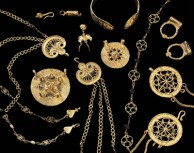 . . . In 1741, the curate Johann Georg Sulzer carried out a series of excavations at Lunnern, in the Reuss Valley near Zurich, leading to the discovery of a Roman temple, baths and a necropolis. On 17 November, he uncovered a hoard consisting of 17 pieces of gold jewellery and 84 silver coins, hidden in a recess. Three days later news of the sensational discovery reached Zurich. The painter Johann Balthasar Bullinger was commissioned to visit the site and produce a picture of the excavations. It was preserved along with the jewels in the art collection of the Wasserkirche in Zurich, before becoming part of the collections of the SNM. . .
◊ ◊ ◊ ◊ ◊
Lucy Davis & Christoph Martin Vogtherr, “A Taste for Blue,” Apollo Magazine (April 2012).
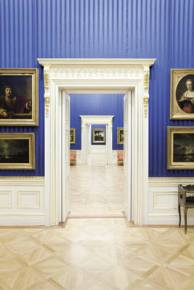 The Wallace Collection is famous for its exceptional group of works from the French 18th century. A smaller collection of around 150 Dutch 17th-century paintings is of equally fine quality, including masterpieces by Frans Hals, Rembrandt, Gerard ter Borch, Pieter de Hooch, Jan Steen, Gabriel Metsu, Caspar Netscher, Jacob van Ruisdael, Nicolaes Berchem, Philips Wouwermans and other leading painters of the Golden Age. It is particularly rich in genre paintings, landscapes by the Dutch Italianates and the work of some outstanding artists – Rembrandt first of all, but also Steen, Metsu, Willem van de Velde, Meindert Hobbema and Willem van Mieris. The resulting view of Dutch art does not provide a systematic overview but follows the personal preferences of the collectors and the typical view of Dutch art during the 18th and early 19th centuries. Artists such as Jan van Goyen, Hercules Seghers and Vermeer, but also the earlier periods before Rembrandt, are hardly represented. They were only admitted to the canon
at a time when the Hertford family had stopped collecting Dutch art. . .
◊ ◊ ◊ ◊ ◊
Juliet Carey, “A House of Cards: Taking Time,” Apollo Magazine (April 2012).
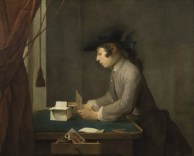 Waddesdon Manor is temporarily home to a small but extraordinarily beautiful group of works by one of the most revered of all French painters. The exhibition Taking Time: Chardin’s ‘Boy Building a House of Cards’ and Other Paintings is prompted by the recent acquisition of one of four works by Jean-Siméon Chardin (1699–1779) of a subject that particularly fascinated him. The last to enter the public domain, the Waddesdon canvas, is united for the first time with three other variations on the theme, on loan from national collections in France, Britain and the United States. . .
◊ ◊ ◊ ◊ ◊
Humphrey Wine, “The Art of a Connoisseur: Review of Pierre Rosenberg and Laure Barthélemy-Labeeuw, Les Dessins de la Collection de Pierre-Jean Mariette (2011),” Apollo Magazine (April 2012).
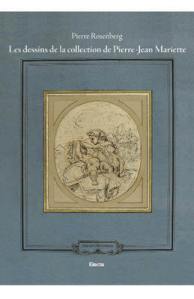 Soon after the death of Pierre-Jean Mariette (1694–1774) his heirs had Pierre François Basan organise a sale of his collection. It included paintings (among them Poussin’s Nurture of Bacchus, c. 1628, now in the National Gallery, London), terracottas, antique marbles, bronzes and engraved gems; the bulk of the sale, however, comprised some 9,000 Italian, Dutch, Flemish and French drawings. It was not only size that distinguished Mariette’s collection of drawings – the earlier collection of Pierre Crozat, built with Mariette’s advice, had been twice as large – but also its quality and comprehensive nature. . . .
Reviewed | ‘Revolution! The Atlantic World Reborn’
Thomas Bender, Laurent Dubois, and Richard Rabinowitz, eds. Revolution! The Atlantic World Reborn (London: D. Giles Limited in association with the New-York Historical Society, 2011), 287 pages, ISBN: 9780916141240 (softcover), $45 / ISBN: 9781904832942 (hardcover), $65.
Reviewed for Enfilade by Jason Nguyen (Harvard University)
 In the lavishly illustrated catalogue for Revolution! The Atlantic World Reborn (on view at the New-York Historical Society through April 15, 2012), editors Thomas Bender, Laurent Dubois, and Richard Rabinowitz present a collection of eleven essays on the connections between the American, French, and Haitian Revolutions. Whereas traditional narratives have tended to treat the three events separately, the fourteen contributors to Revolution focus instead on their political, economic, and social junctures. “The point here is not to abandon or dilute national history,” Thomas Bender suggests in the catalogue’s first essay, “but rather to enrich it by revealing the ways in which historical causation operates across space as well as through time” (40).
The chain of political events linking the three revolutions is offered straightaway by Bender (and subsequently evaluated by his fellow contributors). The financial and military support that France provided to the United States in their War for Independence sent the European kingdom into a crippling debt that led to the calling of the Estates General in May of 1789. This event resulted in the establishment of the National Assembly and, consequently, the onset of the French Revolution. The rhetoric of the Revolution, and in particular the Déclaration des droits de l’Homme et du Citoyen (1789), helped to ignite abolitionist discourses and revolutionary fervor in the French colony of Saint-Domingue (present-day Haiti). And the political and military successes by the Haitians in the early years of the nineteenth century resulted in the selling of Louisiana by Napoleon to the United States in 1803, thus providing the young American nation with its first taste of continental expansion.
While each essay addresses at least one component of this transcontinental circuit of events, the scope of the catalogue is hardly limited to the political sphere. Cathy Matson, for example, reveals how the revolutions in France and Haiti nearly destabilized the commercial life among Philadelphia grain merchants in the last two decades of the eighteenth century. And in one of the catalogue’s more emotional contributions, Rebecca J. Scott and Jean M. Hébrard chronicle through a chain of legal documents and personal letters the tumultuous social and family life of Rosalie, an African-born inhabitant of Saint-Domingue who found herself the victim of sexual and racial slavery three times during the course of her life.
Rosalie’s story encapsulates two themes that course through the various essays. First is the focus on the peripheral within the predominant historical narrative, or as Richard Rabinowitz terms it, “history’s silences.” This can be noted by the prominence of the Haitian Revolution in the catalogue, with seven of the eleven contributions centering squarely on the global and local dealings of the Caribbean colony between 1791 and 1804. Of the remaining four essays, two focus on the economic and social situation in America, one addresses the broader global condition linking the revolutionary conflicts in the United States, France, and Haiti, and one presents the aims and intentions of the exhibition. The curatorial decision to cast increased light on the Haitian Revolution serves two purposes. The first concerns the marked absence within the general public consciousness of the social and political insurrections that transformed the former French colony. And the second speaks to its privileged status as the culmination (and, indeed, the ultimate test) of eighteenth-century revolutionary fervor. “As the most thoroughgoing of these upheavals,” Rabinowitz writes in the catalogue’s concluding essay, “at least in its destruction of slavery, imperial dependency, and constitutionally sanctioned inequalities — the Haitian revolution could be viewed as the climax of the entire age of Atlantic revolutions” (255).
The revolutionary quest for “freedom” rarely followed a straight path, however: it is this concern that serves as the second theme of the catalogue. Robin Blackburn, for example, carefully unpacks the means by which the slave uprisings in Saint-Domingue during the early 1790s mobilized the Enlightenment trope of “utility” in order to achieve social and economic liberty. The first clause of the Déclaration des droits de l’Homme et du Citoyen, she notes, clearly stated that, “Men are born, and always continue, free and equal in respect of their rights. Civil distinctions, therefore, can be founded only on public utility” (118). The Haitian rhetoric of freedom, therefore, served an instrumental purpose in broadening the social, cultural, and political conceits that made the revolutionary ideology in France possible in the first place. Laurent Dubois and Julius S. Scott press the significance of figurative speech further, examining how the Haitian revolutionaries deployed a host of linguistic symbols, often in conflict with one another. Sometimes Royalist and sometimes Republican, their words and texts eventually turned toward the possibility of national sovereignty, a declaration ultimately claimed in 1804. Yet, as the early decades of Haiti’s independence reveal, this situation too presented profound struggles, including local forms of political tyranny and crippling trade embargoes by both Napoleon’s French Empire and Jefferson’s United States.
The attention paid to verbal and textual rhetoric, however, marks the limit of the authors’ interest in representation, as the images within the catalogue serve mostly an illustrating function. Yet, as art historical contributions by Tim Barringer, Darcy Grimaldo Grigsby, and Jennifer L. Roberts, among others, have made clear, colonial and revolutionary images are profoundly complex, embodying in their very form the geo-political and ideological rupturing that marked the events of this period. “To paint is, at the most fundamental level, to incorporate,” noted Grigbsy in her groundbreaking 2002 analysis of Anne-Louis Girodet’s Portrait of Jean-Baptiste Belley (1797), which serves as the cover image for the Revolution catalogue. “Formal description reenacts that deceptively transparent act of inclusion … constituting Belley as picturing’s object (paint) and aggrandizing him as social subject (portraiture’s sitter) were deeply bound up with one another …”[1] Dubois and Scott acknowledge (while not specificing by name) contributions by Grigsby and others in their essay, “An African Revolution in the Atlantic World.” For them, however, Girodet’s painting – on loan for the exhibition from the Musée National du Château de Versailles – serves not as a problematic in and of itself. Instead, it stands as an optimistic visual prolepsis, demarcating through imagery a future that was never to be realized fully.
Such a critique should hardly detract from the merits of the catalogue, which lucidly present for a general audience the social, political, and economic connections linking the late eighteenth-century Atlantic world. Timely and provocative, it suggests that the each historical event carries with it profound global ramifications. And by tracing these connections (through texts, objects, and images), we might begin to understand better the universal aspirations for human equality and freedom.
[1] Darcy Grimaldo Grigsby, Painting Empire in Post Revolutionary France (New Haven: Yale University Press, 2002), p. 13.
Cinema Returns to Marie Antoinette

◊ ◊ ◊ ◊ ◊
Les adieux à la reine (Farewell, My Queen). Directed by Benoit Jacquot. Based on the 2002 novel by Chantal Thomas. With Lea Seydoux, Diane Kruger, Virginie Ledoyen, Xavier Beauvois, Noemie Lvovsky, Michel Robin, Julie-Marie Parmentier, Lolita Chammah, Marthe Caufman, Vladimir Consigny. French, English dialogue. 99 mintues, 2012.
◊ ◊ ◊ ◊ ◊
As reviewed by Geoffrey Macnab for The Independent (15 February 2012). . .
The French Revolution has been portrayed many times before on screen but never in quite oblique a way as in Benoit Jacquot’s film. This is a very well observed study of social breakdown and decay set over four days in July 1789, seen from the perspective of palace servant Sidonie Laborde (the pouting young French actress Lea Seydoux.)
There are no tumbrels or guillotines. Court life in Versailles is carrying on just about as normal but we are always aware of the mounting sense of panic. Even as they adhere to courtly rituals, the courtiers can smell and feel that their way of life is coming to end. The costume and production design deliberately show the cracks beginning to appear. Versailles is magnificent but under director Benoit Jacquot’s close-up gaze, we see that everything is past its best. Even Marie Antoinette (played with a winning mix of haughtiness and vulnerability by Diane Kruger) has to fuss about her dresses and wigs. . .
The full review is available here»
The Burlington Magazine, February 2012
The eighteenth century in The Burlington:
The Burlington Magazine 154 (February 2012)
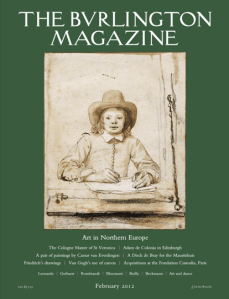 • Sophie Raux, “Carel Fabritius in Eighteenth-Century Paris,” pp. 103-06. This article establishes, among other things, that Carel Fabritius’s Mercury and Argus (c.1645–47; Los Angeles County Museum of Art) was in the collection of François Boucher, where it was seen by Fragonard.
Reviews
• Christian Tico Seifert, Review of Vadim Sadkov, The Pushkin State Museum of Fine Arts: Netherlandish, Flemish, and Dutch Drawings of the XVI-XVIII Centuries. Belgian and Dutch Drawings of the XIX-XX Centuries (Amsterdam: Foundation for Cultural Inventory, 2010), pp. 128-29.
• Xander Van Eck, Review of Lyckle de Vries, How to Create Beauty: De Lairesse on the Theory and Practice of Making Art (Leiden: Primavera Pers, 2011), pp. 129-30.
• Kate Retford, Review of the exhibition The First Actresses: Nell Gwyn to
Sarah Siddons (London: National Portrait Gallery), pp. 134-35.
• Xavier F. Salomon, Review of the exhibition Il Settecento a Verona: Tiepolo,
Cignaroli, Rotari — La Nobilità della Pittura (Verona: Palazzo della Gran
Guardia), pp. 146-48.
Reviewed: ‘Picturing Art History’
Recently added to caa.reviews:
Ingrid R. Vermeulen, Picturing Art History: The Rise of the Illustrated History of Art in the Eighteenth Century (Amsterdam: Amsterdam University Press, 2011), 359 pages, ISBN: 9789089640314, $69.50.
Reviewed by Pamela J. Warner, University of Rhode Island; posted 9 February 2012.
Ingrid Vermeulen undertakes an important self-reflexive task in ‘Picturing Art History’: the examination of the transition from unillustrated to illustrated texts about art. Surprisingly, that transformation had little to do with technological changes. Using three specific publications as examples, she argues that eighteenth-century scholars increasingly came to conceive of the artistic past not as a series of biographies of artists, but rather as a seamless “chain” of artworks in which historical progress can, and indeed must, be seen to be fully understood. Vermeulen tracks her topic through four related questions: What types of images were considered appropriate to the study of art history? How should we understand the notion that drawing and reproductive print collections, along with illustrated art books, embody the artistic past? How did collecting traditions relate to art-historigraphic traditions? And to what extent did eighteenth-century scholars believe that works on paper were faithful representations of the artworks they studied? (12–13) She organizes her answers into three chapters dedicated to case studies of individual projects by Giovanni Bottari, Johann Joachim Winckelmann, and Jean-Baptiste Séroux d’Agincourt, each of whom mobilized a different type of visual resource, namely prints, drawings, and book illustrations. . . .
The full review is available here» (CAA membership required)
Reviewed: The English Virtuoso
On a personal note, I want to say how much I appreciate Janice Neri’s thoughtful review. Her reading of my book is, I think, careful and fair. More importantly, her questions and criticisms are spot-on. Thanks as well to Laura Auricchio for doing such a terrific job coordinating reviews as the field editor for the eighteenth century! -CH
Recently added to caa.reviews:
Craig Ashley Hanson, The English Virtuoso: Art, Medicine, and Antiquarianism in the Age of Empiricism (Chicago: University of Chicago Press, 2009), 344 pages, ISBN: 9780226315874, $50.
Reviewed by Janice Neri, Boise State University; posted 28 December 2011.
To the modern day reader, hospitals and scientific societies might seem to be unlikely settings for exhibiting and discussing contemporary art. In ‘The English Virtuoso: Art, Medicine, and Antiquarianism in the Age of Empiricism‘, Craig Ashley Hanson shows how it made perfect sense that such venues would foster art theory and practice in seventeenth- and eighteenth-century England. The leading role in this book is played by the figure of the virtuoso, whose eclectic interests were united under the umbrella of curiosity. Encompassing activities as wide ranging as medicine (learned and unlearned), classical studies, and art collecting, patronage, practice, and theory, Hanson’s study of English virtuoso culture makes an important contribution to an understanding of the intellectual foundations of art scholarship and writing. In illuminating the complex world of the virtuoso, this insightful book also shows how early forms of interdisciplinarity actually worked. Drawing connections between the seventeenth and eighteenth centuries, ‘The English Virtuoso’ provides an opportunity to reflect on the ways that boundaries were often blurred between intersecting areas of knowledge. . . .
The full review is available here» (CAA membership required)
Reviewed: Architectural Space in Eighteenth-Century Europe
Recently added to caa.reviews:
Denise Amy Baxter and Meredith Martin, eds., Architectural Space in Eighteenth-Century Europe: Constructing Identities and Interiors (Burlington: Ashgate, 2010), 284 pages, ISBN: 9780754666509), $119.95.
Reviewed by Heather Hyde Minor, University of Illinois, Urbana-Champaign; posted 13 December 2011.
Eighteenth-century Europe was home to a dazzling array of architectural interiors, from priest-holes designed to hide ecclesiastics from Protestant authorities in England to the home theaters of courtesans in Paris. Diverse characters populated these domains. Bluestockings gathered in a Chinoiserie room while guests waited to be served refreshments before taking in Europe’s premier public collection of ancient sculpture.
‘Architectural Space in Eighteenth-Century Europe’ examines all of these environments and personages, exploring the role architecture and interiors played in fashioning identity in the eighteenth century. The ten essays that it gathers together seek to demonstrate that these spaces served to form a sense of self in creative ways. The book’s editors, Denise Amy Baxter and Meredith Martin, are to be commended for addressing this important question, one that spans a range of fields, and for gathering essays written by scholars from a range of disciplines. Contributing to the recent explosion of interest in eighteenth-century interiors, the volume builds on the work of Katie Scott, Mimi Hellman (both of whom are cited in the introduction), and others. . . .
The full review is available here» (CAA membership required)
Online Reviews from BSECS
 The British Society for Eighteenth-Century Studies launched its new online reviewing system at its annual conference in Oxford earlier this month. The site is designed to address Music, Media (of all sorts), Exhibitions, and Theatre, areas of performance which fall within the Society’s remit. The site’s remit is not limited; as can be seen from the reviews the system contained at its launch, it will include reviews world-wide. All those with interests in the 18th century are encouraged to contribute.
The site is under editorship of Matthew McCormack, reviews editor for the Journal of Eighteenth-century Studies; the area editors are Zak Ozmo (Music), Daniel Cook (Media), Alexander Marr (Exhibitons), and Michael Caines (Theatre).










 Enfilade
leave a comment