Reviewed: ‘Picturing Art History’
Recently added to caa.reviews:
Ingrid R. Vermeulen, Picturing Art History: The Rise of the Illustrated History of Art in the Eighteenth Century (Amsterdam: Amsterdam University Press, 2011), 359 pages, ISBN: 9789089640314, $69.50.
Reviewed by Pamela J. Warner, University of Rhode Island; posted 9 February 2012.
Ingrid Vermeulen undertakes an important self-reflexive task in ‘Picturing Art History’: the examination of the transition from unillustrated to illustrated texts about art. Surprisingly, that transformation had little to do with technological changes. Using three specific publications as examples, she argues that eighteenth-century scholars increasingly came to conceive of the artistic past not as a series of biographies of artists, but rather as a seamless “chain” of artworks in which historical progress can, and indeed must, be seen to be fully understood. Vermeulen tracks her topic through four related questions: What types of images were considered appropriate to the study of art history? How should we understand the notion that drawing and reproductive print collections, along with illustrated art books, embody the artistic past? How did collecting traditions relate to art-historigraphic traditions? And to what extent did eighteenth-century scholars believe that works on paper were faithful representations of the artworks they studied? (12–13) She organizes her answers into three chapters dedicated to case studies of individual projects by Giovanni Bottari, Johann Joachim Winckelmann, and Jean-Baptiste Séroux d’Agincourt, each of whom mobilized a different type of visual resource, namely prints, drawings, and book illustrations. . . .
The full review is available here» (CAA membership required)
Reviewed: The English Virtuoso
On a personal note, I want to say how much I appreciate Janice Neri’s thoughtful review. Her reading of my book is, I think, careful and fair. More importantly, her questions and criticisms are spot-on. Thanks as well to Laura Auricchio for doing such a terrific job coordinating reviews as the field editor for the eighteenth century! -CH
Recently added to caa.reviews:
Craig Ashley Hanson, The English Virtuoso: Art, Medicine, and Antiquarianism in the Age of Empiricism (Chicago: University of Chicago Press, 2009), 344 pages, ISBN: 9780226315874, $50.
Reviewed by Janice Neri, Boise State University; posted 28 December 2011.
To the modern day reader, hospitals and scientific societies might seem to be unlikely settings for exhibiting and discussing contemporary art. In ‘The English Virtuoso: Art, Medicine, and Antiquarianism in the Age of Empiricism‘, Craig Ashley Hanson shows how it made perfect sense that such venues would foster art theory and practice in seventeenth- and eighteenth-century England. The leading role in this book is played by the figure of the virtuoso, whose eclectic interests were united under the umbrella of curiosity. Encompassing activities as wide ranging as medicine (learned and unlearned), classical studies, and art collecting, patronage, practice, and theory, Hanson’s study of English virtuoso culture makes an important contribution to an understanding of the intellectual foundations of art scholarship and writing. In illuminating the complex world of the virtuoso, this insightful book also shows how early forms of interdisciplinarity actually worked. Drawing connections between the seventeenth and eighteenth centuries, ‘The English Virtuoso’ provides an opportunity to reflect on the ways that boundaries were often blurred between intersecting areas of knowledge. . . .
The full review is available here» (CAA membership required)
Reviewed: Architectural Space in Eighteenth-Century Europe
Recently added to caa.reviews:
Denise Amy Baxter and Meredith Martin, eds., Architectural Space in Eighteenth-Century Europe: Constructing Identities and Interiors (Burlington: Ashgate, 2010), 284 pages, ISBN: 9780754666509), $119.95.
Reviewed by Heather Hyde Minor, University of Illinois, Urbana-Champaign; posted 13 December 2011.
Eighteenth-century Europe was home to a dazzling array of architectural interiors, from priest-holes designed to hide ecclesiastics from Protestant authorities in England to the home theaters of courtesans in Paris. Diverse characters populated these domains. Bluestockings gathered in a Chinoiserie room while guests waited to be served refreshments before taking in Europe’s premier public collection of ancient sculpture.
‘Architectural Space in Eighteenth-Century Europe’ examines all of these environments and personages, exploring the role architecture and interiors played in fashioning identity in the eighteenth century. The ten essays that it gathers together seek to demonstrate that these spaces served to form a sense of self in creative ways. The book’s editors, Denise Amy Baxter and Meredith Martin, are to be commended for addressing this important question, one that spans a range of fields, and for gathering essays written by scholars from a range of disciplines. Contributing to the recent explosion of interest in eighteenth-century interiors, the volume builds on the work of Katie Scott, Mimi Hellman (both of whom are cited in the introduction), and others. . . .
The full review is available here» (CAA membership required)
Online Reviews from BSECS
 The British Society for Eighteenth-Century Studies launched its new online reviewing system at its annual conference in Oxford earlier this month. The site is designed to address Music, Media (of all sorts), Exhibitions, and Theatre, areas of performance which fall within the Society’s remit. The site’s remit is not limited; as can be seen from the reviews the system contained at its launch, it will include reviews world-wide. All those with interests in the 18th century are encouraged to contribute.
The site is under editorship of Matthew McCormack, reviews editor for the Journal of Eighteenth-century Studies; the area editors are Zak Ozmo (Music), Daniel Cook (Media), Alexander Marr (Exhibitons), and Michael Caines (Theatre).
Reviewed: Fordham’s ‘British Art and the Seven Years’ War’
Recently added to caa.reviews:
Douglas Fordham, British Art and the Seven Years’ War: Allegiance and Autonomy (Philadelphia: University of Pennsylvania Press, 2010), 352 pages, ISBN: 9780812242430, $65.
Reviewed by Kay Dian Kriz, Brown University; posted 8 December 2011.
In ‘British Art and the Seven Years’ War: Allegiance and Autonomy’, Douglas Fordham offers an original and provocative re-interpretation of the emergence of public art and art institutions in eighteenth-century Britain. Scholars have long noted that the 1750s and 1760s were marked by increasing concern about the development and institutionalization of a school of British art. “Why,” Fordham asks, “did the visual arts become a pressing national concern at this moment in Britain’s history?” (1) He argues that any answer to such a question must take into account the “transformative place in British culture” (2) occupied by the Seven Years’ War, which was fought in the middle of this time period (1756–63). And indeed, cultural, political, and military history were deeply intertwined at this moment when the British Empire in America was firmly secured through a war that has largely been overlooked by art historians.
Books about art and war usually focus on military painting; Fordham’s book is much more expansive and ambitious, being concerned with the effects of militarism on the development and organization of the arts, as well as on their subject matter. . . .
The full review is available here» (CAA membership required)
Reviewed: Trio of Books on the Dilettanti and Antiquarianism
Recently added to caa.reviews:
Bruce Redford, Dilettanti: The Antic and the Antique in Eighteenth-Century England, exhibition catalogue (Los Angeles: Getty Trust Publications, 2008), 232 pages, ISBN: 9780892369249, $49.95.
Ilaria Bignamini and Clare Hornsby, Digging and Dealing in Eighteenth-Century Rome, 2 volumes (New Haven: Yale University Press, 2010), 622 pages, ISBN: 9780300160437, $85.
Jason M. Kelly, The Society of Dilettanti: Archaeology and Identity in the British Enlightenment (New Haven: Yale University Press, 2010), 366 pages, ISBN: 9780300152197, $75.
Reviewed by Susan Dixon, University of Tulsa; posted 1 December 2011.
These three recent books explore an eighteenth-century British engagement with classical archaeology during a time when the practice was transforming from an early modern antiquarianism into a modern scientific discipline. Two of the books are monographic studies of the Society of the Dilettanti, an organization that became known for its support of unprecedented archaeological activity in Greece, while a third outlines how British subjects, some of whom were Dilettanti, undertook archaeological excavations on Italian soil and refurbished, sold, and bought the antiquities found there. In some measure, all the authors note this engagement as integral to shaping British cultural identity in the eighteenth century, and in this way add to robust scholarship on the issue. . . .
The full review is available here» (CAA membership required)
Reviewed: Meredith Martin’s ‘Dairy Queens’
Recently added to caa.reviews:
Meredith Martin, Dairy Queens: The Politics of Pastoral Architecture from Catherine de’ Medici to Marie-Antoinette, Harvard Historical Studies, vol. 176 (Cambridge: Harvard University Press, 2011), 336 pages, ISBN: 9780674048997, $45.
Reviewed by Jean-François Bédard; posted 3 November 2011.
Among the most fanciful objects commissioned by the French monarchy is a pair of Sèvres porcelain pails designed for Marie-Antoinette’s pleasure dairy at the Château de Rambouillet. They are shaped like tinettes—wooden buckets used on ordinary dairy farms for making fresh cheese—and painted with wood grain to imitate their rustic models. Like Marie-Antoinette’s mock hamlet at Trianon, the Rambouillet pails are outlandish inventions of the pastoral movement in literature and art, which celebrated naturalness with contrived theatricality. As the ill-fated monarch so cruelly experienced, bourgeois sensibilities soon lashed out at this noble ostentation. To pre-Revolutionary critics of the society of orders, a queen masquerading as a dairy maid in a luxurious simulated farm was particularly odious. Marie-Antoinette’s pastoral persona triggered venomous accusations of social irresponsibility, political usurpation, and even sexual deviance that contributed to her downfall and still taint her reputation.
The pastoral has not always elicited such heated reactions. In her amusingly titled book, Meredith Martin sets out to rehabilitate this courtly art form. Looking beyond the alleged frivolity of pastoral art and architecture, Martin emphasizes the crucial role they played in the social and political self-fashioning the French nobility, most notably the queens, forged for itself. Her discussion focuses on the pleasure dairy—known in French as the ‘laiterie d’agrément’, or ‘laiterie de propreté’, to distinguish it from the functioning dairy (laiterie de préparation). . . . Martin makes a convincing case for the importance of pleasure dairies as sites of empowerment for French noblewomen. . . .
The full review is available here» (CAA membership required)
Reviewed: ‘Thomas Lawrence: Regency Power and Brilliance’
Recently added to caa.reviews:
Cassandra Albinson, Peter Funnell, and Lucy Peltz, eds., Thomas Lawrence: Regency Power and Brilliance, exhibition catalogue (New Haven and London: Yale Center for British Art, National Portrait Gallery, London, and Yale University Press, 2011), 280 pages, ISBN: 9780300167184, $70.
Reviewed by Bruce Redford; posted 17 November 2011.
‘How various he is!’ Thomas Gainsborough’s tribute to Joshua Reynolds applies equally well to their successor in grand-manner portraiture. It is one of the signal achievements of ‘Thomas Lawrence: Regency Power and Brilliance’ that it removes any lingering traces of the negative stereotype: Lawrence the slick, formulaic sycophant who prostituted his gifts in the service of a decadent Regency elite. In its place this wide-ranging exhibition and thoughtful catalogue substitute a dynamic, probing, and inventive explorer of human psychology—one who is keenly attentive to the interplay of surface and depth, social mask and private self. Even Lawrence’s most public statements create a form of co-extensive space: not by breaking the picture plane, as in Caravaggio for instance, but by drawing the viewer into an
electric zone of intimacy. . . .
The full review is available here» (CAA membership required)
November 2011 Issue of ‘Art History’
Eighteenth-century offerings from the November 2011 issue:
Andrei Pop, “Sympathetic Spectators: Henry Fuseli’s Nightmare and Emma Hamilton’s Attitudes,” Art History 34.5 (November 2011): 934-57.
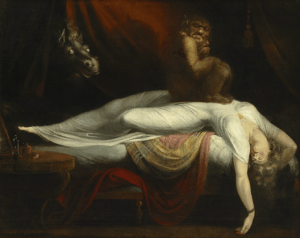
Henry Fuseli, "The Nightmare," 1781, exhibited in 1782 at the Royal Academy of London (Detroit Institute of Arts)
Abstract: Henry Fuseli’s painting The Nightmare (1782), unusual in the artist’s oeuvre and in the painting of its time as the public visualization of a private mental state, can be made sense of in light of late eighteenth-century practices and theories of privacy and of the agency that minds can exert on the world on on each other. By comparison with another dream-like performance, Emma Hamilton’s Attitudes, and informed by David Hume’s theory of sympathy, which was designed to explain the social communicability of mental states, a reading of The Nightmare emerges which shows that it did not aim to make visible dream imagery, but to induce spectators to have or feel as if they had an analogous experience. The painting is thus typical of the formative stage of a modern understanding of public life as a contingent
association of private lives.
Andrei Pop studied art history at Stanford and Harvard Universities and is a postdoctoral fellow at the Universität Berlin. The present essay is part of Neopaganism, a book in progress on the cultural politics of classicism. His article on Fuseli and tragedy will appear in the March 2012 Art Bulletin. His translation, together with Mechtild Widrich, of Karl Rosenkranz’s Aesthetics of Ugliness (1853) is forthcoming.
◊ ◊ ◊ ◊ ◊
Steven Adams, “Amateurs and Revolutionaries in Eighteenth-century France,” Art History 34.5 (November 2011): 1042-46.
 Review of Charlotte Guichard, Les Amateurs d’art à Paris au XVIII siècle (Paris: Champ Vallon, 2008); Laura Auricchio, Adélaïde Labille-Guiard: Artist in the Age of Revolution (Los Angeles: Getty Publications, 2009); and Rolf Reichardt and Hubertus Kohle, Visualizing the Revolution: Politics and the Pictorial Arts in Late Eighteenth-century France (London: Reaktion Books, 2008).
◊ ◊ ◊ ◊ ◊
Marion Endt-Jones, “Commemorative Reconsiderations,” Art History 34.5 (November 2011): 1053-56.
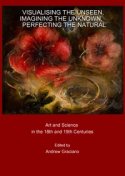 Review of Diana Donald and Jane Munro, eds., Endless Forms: Charles Darwin, Natural Science, and the Visual Arts (New Haven and London: Yale Center for British Art, 2009); and Andrew Graciano, ed., Visualizing the Unseen: Imagining the Unknown, Perfecting the Natural: Art and Science in the 18th and 19th Centuries (Newcastle: Cambridge Scholars Publishing, 2008).
◊ ◊ ◊ ◊ ◊
Editor’s Note: At February’s CAA meeting in Los Angeles, there is an entire session, sponsored by the Midwest Art History Society, on the subject of The Nightmare. -CH.
Icons of the Midwest: Henry Fuseli’s Nightmare
Wednesday, 22 February, 12:30–2:00
Chairs: Laura Gelfand (Utah State University) and Judith Mann (Saint Louis Art Museum)
• Salvador Salort-Pons (Detroit Institute of the Arts), Living with Fuseli’s Nightmare
• Beth S. Wright (University of Texas at Arlington), ‘As I Was Perpetually Haunted by These
Ideas’: Fuseli’s Influence on Mary Shelley’s Mathilda and Frankenstein
• Scott Bukatman (Stanford University), Dreams, Fiends, and Dream Screens
Holiday Gift Guide, Part 1: Music
Wondering what to get the dix-huitièmiste in your life for the holidays? This year at Enfilade, we’re here to help with our first (annual?) gift guide. Before the week is over, we’ll cover food, drink, travel, and some lovely finds from museum gift shops. From the accessible to the purely aspirational, you’ll at least get a wide variety of ideas. And the postings provide a fine chance to consider some of the things the past year has brought to the marketplace. Michael Yonan brilliantly kicks off the series with his top music picks. Feel free to add your own ideas in the comments sections, and enjoy! -CH
◊ ◊ ◊ ◊ ◊
By Michael Yonan
 The classical music recording industry, we are told, is dying, but you’d never know that when looking at new releases of eighteenth-century music. There were so many new recordings issued this year that even an avid music lover couldn’t possibly keep up with them. In the realm of opera alone, 2011 saw new releases of Handel’s Agrippina, Ariodante, and Alessandro Severo; Vivaldi’s Ottone in Villa, Il Farnace, and Teuzzone; Telemann’s Germanicus, and even José de Nebra’s Spanish-language Iphigenia en Tracia, first performed in Madrid in 1747. These appeared alongside literally dozens of new instrumental music recordings. The following is, therefore, a highly personal list that reflects my fancies and predilections, but all are also critically acclaimed recordings and easy to acquire.
 1. François-André-Danican Philidor, Sancho Pança (Naxos) This is an opéra comique first performed at Fontainebleau in 1762, realized by Opera Lafayette, a period-instruments group based in Washington, D.C. The story is based on Cervantes’s novel, but only loosely: here Sancho Panza is the governor of an imaginary island and suffers from delusions of grandeur not unlike those of his onetime master.
2. Gluck, Ezio (Virgin Classics) The 1750 version of Gluck’s opera, first performed in Prague in 1750. An international cast and liner notes by ASECS regular Bruce Alan Brown!
3. Johann Sebastian Bach, Cantatas BWV 82, “Ich habe genug,” and BWV 169, “Gott soll allein mein Herze haben,” Andreas Scholl, countertenor, and the
Kammerorchester Basel (Decca) Could this be the most
beautiful countertenor voice in the world? I think so.
 4. Carl Philipp Emanuel Bach, Sei concerti per il cembalo concertato, Wq43 (Harmonia Mundi) With Andreas Staier, harpsichord, and Petra Müllejans conducting the superb Freiburg Baroque Orchestra.
5. Handel, Amor Oriental: Händel alla Turca (Dhm) For something completely different, an interesting attempt to program works by Handel with performances by a traditional Turkish sufti singer.
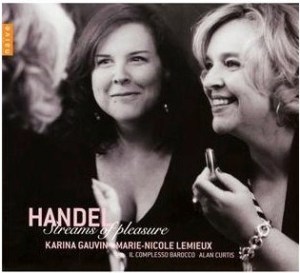
6. Handel, Streams of Pleasure, Karina Gauvin and Marie-Nicole Lemieux, with Il Complesso Barocco conducted by Alan Curtis (Naïve Classique) My top recommendation. Two extremely gifted French Canadian singers
with beautiful voices—Gauvin is a coloratura soprano, Lemieux a
true contralto—performing arias and duets from Handel’s English-
language oratorios.
◊ ◊ ◊ ◊ ◊
Michael Yonan is Associate Professor of Art History at the University of Missouri-Columbia. His book, Empress Maria Theresa and the Politics of Habsburg Imperial Art, appeared earlier this year from Penn State University Press (and would itself make for a lovely gift!).










leave a comment