New Film: ‘Mozart’s Sister’
Mozart’s Sister, from French director René Féret, is now playing in select theaters. -AS
Reviewed by Manohla Dargis for The New York Times (18 August 2011) . . .

A 1779 portrait of the Mozarts: Nannerl, Wolfgang and their watchful father Leopold. Image Credit: Hulton Archive/Getty Images
Mozart’s Sister has just started when the French director René Féret makes the point that his fictional look at the early life and times of Wolfgang Amadeus isn’t interested in the pretty manners and nostalgia of many period movies. In truth, the film has little to do even with Wolfgang, a side note in a story focused on his only sister who’s first seen squatting on the side of a road taking care of business at a short distance from her similarly engaged father, mother and brother. This is the Family Mozart, Mr. Féret seems to declare with this scene, stripped down and at their most human.
That sister, Maria Anna Walburga Ignatia Mozart, born in 1751 and known as Nannerl, was said to posses a rare talent that, by some accounts, this film included, nearly rivaled that of her brother. Played by Marie Féret (the filmmaker’s daughter), Nannerl is an attractive, obedient and rather opaque 14-year-old going on 15, given to watchful silences and long looks at Wolfgang (David Moreau), who was younger by four and a half years. They were the only children out of the seven born to Leopold (Marc Barbé) and Anna-Maria (Delphine Chuillot) to survive childhood. If the calamity of those deaths weighed on the family it doesn’t register in “Mozart’s Sister,” which unfolds at the end of a long tour that began in 1763 when Wolfgang was 7.
Drawing on Leopold’s letters, among other sources, Mr. Féret paints a speculative, intimate portrait of a family bound by love, genius and ambition and almost undone by the same. . . .
For the entire review, visit The New York Times
◊ ◊ ◊ ◊ ◊
Reviewed: ‘The Efflorescence of Caricature’
Recently added to caa.reviews:
Todd Porterfield, ed., The Efflorescence of Caricature, 1759–1838 (Burlington: Ashgate, 2011), 240 pages, ISBN: 9780754665915), $99.95.
Reviewed by Amelia Rauser, Franklin & Marshall College; posted 15 September 2011.
Caricature still has the power to inflame. In the last five years, several incidents—from the Danish satires depicting Muhammad to the racially tinged caricature of Barack Obama as a crazed chimp published by the ‘New York Post’ early in his presidency—have shown that caricature can still spark rage as well as pleasure. Developed in tandem with modern conceptions of identity, caricature is a quintessentially modern visual language. Caricature paradoxically reveals the truth of a person’s interior through the deformation of her or his exterior, thus making the invisible visible and satisfying a cultural desire for transparency and the unmasking of hypocrisy. At the same time, caricature is deeply subjective, its virtuosic linearity ostentatiously imaging the hand of the artist, and thereby providing an alibi for the truths that are unmasked: this is only my opinion, the caricature seems to say, and I’m only joking.
‘The Efflorescence of Caricature, 1759–1838‘, Todd Porterfield’s edited collection of essays on caricature’s “golden age,” is uneven, but on the whole it enriches and expands an understanding of the first flowering of caricature in the modern West. Emerging from a 2006 conference, the volume is more international than usual in two ways: the essays frequently address issues of influence, exchange, and imperialism among different nations; and the authors themselves are from several different countries, thus bringing refreshingly different approaches and concerns to bear in their contributions. Besides this internationalism, Porterfield also stresses the importance of a broad, “continental” definition of caricature in his introduction to the volume. This approach allows for a diverse array of satirical imprints to be included, including those that completely eschew bodily deformation as a means of communication. But it also invites inexactness and can lead to conceptual confusion . . .
The full review is available here» (CAA membership required)
Reviewed: ‘Re-Reading Leaonardo’
This terrific collection of essays grew out of the 2001 conference The Fortuna of Leonardo da Vinci’s ‘Trattato della Pittura’, held at the Warburg Institute in London. I count myself lucky to have attended. Held just days after the 9/11 bombings (September 13-14), the conference was, as I recall, however, a strange affair — as so much of life was in those days immediately following the attacks — all the more reason to celebrate this accomplished volume. -CH
Recently added to caa.reviews:
Claire Farago, ed., Re-Reading Leonardo: The ‘Treatise on Painting’ across Europe, 1550–1900 (Burlington, VT: Ashgate, 2009), 652 pages, ISBN: 9780754665328, $124.95.
Reviewed by Ellen Prokop, The Frick Art Reference Library; posted 3 August 2011.
This impressive, generously illustrated collection of essays edited by Claire Farago developed from a symposium held in London in 2001 that focused on the historical reception of Leonardo da Vinci’s Trattato della pittura. Twenty-three studies, including introductory remarks and an annotated bibliography, by twenty authors (three scholars make multiple contributions) examine the transnational fortune of the treatise and consider Leonardo’s influence on the institutionalization of artistic production in early modern Europe. The focus on reception leads to consideration of fundamental issues regarding Leonardo’s legacy, such as the development of the modern conception of artistic genius, as well as broader concerns, such as the disciplinization of art history. By positing Leonardo’s influence instead of his reputation as the “historical phenomena” (3), the essays systematically problematize the constitution of that reputation. As Farago states: “An historical practice that focuses on the author’s identity without attending to the construction of identity per se, is blind to its own modes of knowledge production” (4). . . .
The full review is available here» (CAA membership required)
◊ ◊ ◊ ◊ ◊
While many of the contributions are relevant for the eighteenth century; these essays address the period directly:
•Thomas Willette, “The First Italian Publication of the Treatise on Painting: Book Culture, the History of Art, and the Naples Edition of 1733″
•Thomas Kirchner, “Between Academicism and Its Critics: Leonardo da Vinci’s Traité de la Peinture and 18th-century French Art Theory”
•Javier Navarro de Zuvillaga, “The Trattato in 17th- and 18th-century Spanish Perspective and Art Theory”
•Richard Woodfield, “The 1721 English Treatise of Painting: A Masonic Moment in the Culture of Newtonianism”
•Geoff Quilley, “The Trattato della Pittura and Leonardo’s Reputation in 18th-century British Art and Aesthetics”
Reviewed: ‘Jean de Jullienne et les collectionneurs de son temps’
Isabelle Tillerot, Jean de Jullienne et les collectionneurs de son temps (Paris: Editions Maison des Sciences de L’homme, 2011), 510 pages, ISBN: 9782735112531, €48.
Reviewed for Enfilade by David Pullins
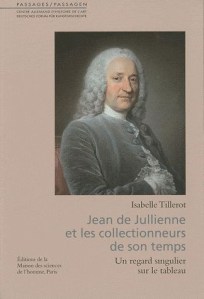 Between 1726 and 1735, Jean de Jullienne oversaw and financed the publication of some 495 prints in four volumes, all after the work of the recently deceased painter and draftsman, Antoine Watteau. This unprecedented form of commitment to a contemporary artist has rightly secured Jullienne’s fame ever since and earned the complicated publishing venture he spearheaded the unofficial title of the “Recueil Jullienne.” Émile Dacier and Albert Vuaflart’s three-volume Jean de Jullienne et les graveurs de Watteau au XVIIIe siècle (1921–29) remains indispensible for understanding the project, its chronology, and participants. A recent exhibition and catalog from the musée du Louvre, Antoine Watteau et l’art de l’estampe (2010), revisited the history of the publication by attempting to piece together what can be learned by comparing the wide variation between surviving copies. As the consolidation of an artistic personality that took into account all aspects of a single artist’s production, the Recueil Jullienne continues to have much to offer scholars not merely as documentation of lost works by Watteau, but also as a significant moment in the practice of writing and publishing the history of art.
In a substantial new monograph on Jullienne, Isabelle Tillerot deliberately devotes only a few pages directly to the Recueil in order to focus her attention on Julienne as a collector and amateur. While Jullienne no doubt will remain best known for the Recueil bearing his name, Tillerot’s work uncovers the social and commercial networks that he occupied in meticulous detail and plants him firmly in the ground of recent scholarship on the art market, collecting, and the amateur in eighteenth-century France. While consistent in its thoroughness with the monographs that have come out of France in recent years – including the most exhaustive examples, Guillaume Glorieux’s work on the dealer Gersaint (2002) or Christian Michel on Cochin (1993) – Tillerot’s book aims to connect with broader theories on collecting and the status of works of art as physical objects with citations from Maurice Blanchot and Michel Foucault. This framework speaks to a larger ambition for the potential of monographic studies, while at times not feeling entirely integrated with the primary material that is in the end the heart of her project.
For the history of collecting, Jullienne’s singularity is based largely on his social position as a successful dyer and cloth merchant and the survival of an album of watercolors illustrating the hang of his collection at his hôtel in the rue des Gobelins from around 1756 (now owned by the Pierpont Morgan Library). While Dacier and Vuaflart alerted scholars to both of these elements in the 1920s, Tillerot contributes additional archival research (providing more precise documentation of available sources) and then extrapolates from this material in order to argue for why Jullienne is of interest apart from his engagement with Watteau. Jullienne’s self-made status – “I declare that I have not inherited any means either from my father or mother and that all I have comes solely from my own efforts and pains,” he wrote in 1764[i] – and strong mercantile ties make him unusual among French collectors of the first half of the eighteenth century. His patent of nobility, granted in 1736, was in fact based on his success in business; when he met Rosalba Carriera, probably through Pierre Crozat in 1721, he gave her a piece of scarlato, an expensive fabric related to his trade.[ii]
Tillerot highlights Jullienne as an early example of the merchant-collector in France and works through the unlikely but intimate connection of his family to the circle of the comtesse de Verrue, a pioneer in the collecting of Flemish painting, but also a representative of a more conventional, aristocratic model in Tillerot’s account. The illustrated album of Jullienne’s collection – the survival of which is a remarkable piece of historical luck – allows Tillerot to discuss the means through which Jullienne integrated the longstanding French admiration for Italian painting, newly developing taste for Flemish painting, and his own interest in the contemporary French school. By the time of his death in 1766, Jullienne owned a significant group of contemporary French paintings by Watteau, Boucher, Greuze, and de Troy (both father and son). In charting his relationship to the art of his own time, Tillerot works from Colin Bailey’s articulation of a “goût patriotique,” and, again, Jullienne emerges as a particularly early and notable example of a model more familiar later in the century. In dialogue with the recent work of Charlotte Guichard on the institutional framework supporting the amateur in eighteenth-century France, this aspect of Jullienne’s collection returns her to his publishing project and his gift in 1739 of the four volumes after Watteau to the Académie royale, which in turn granted him the title conseiller honoraire et amateur.
The impact of Tillerot’s work is evident already in Christoph Vogtherr and Jennifer Tonkovich’s current exhibition and catalogue for The Wallace Collection, Jean de Julienne: Collector & Connoisseur (2011), which relies heavily on the research presented in Tillerot’s dissertation, completed under Christian Michel in 2005 and on which the present book is closely based. The relevance of Tillerot’s research will continue to be felt with the massive, continued efforts to document the life and work of the collector Jean-Pierre Mariette – who, as Tonkovich has detailed in the Wallace catalogue and related articles, heavily annotated the catalog of Jullienne’s collection when it was sold over fifty-four days in 1767. While the documentary evidence Tillerot provides (including a lengthy index of his painting collection and images from the album) proves an important resource, her shift towards a more integrative approach, taking into account the broader social network in which Jullienne functioned moves her study away from the recent impulse toward the exhaustive monograph and points to the potential for examining the almost maddening interconnectedness that characterizes collecting in eighteenth-century France.
Reviewed: Life and Luxury in Paris
The exhibition Paris: Life and Luxury in the Eighteenth Century closes today at the Getty. It opens at the Museum of Fine Arts, Houston on September 18th and runs through December 11. With her typically lucid prose, Amanda Vickery reviews the exhibition for The Guardian (29 July 2011). . .
Opulence, bling and luxury provoke powerful responses in an age of austerity, from wistful envy to righteous disgust. Working girls flocked to see lamé gowns on the silver screen in the hungry 1930s, but Marie Antoinette is scorned for wondering why in the 1790s the poor didn’t eat brioche when the bread ran out. “Luxury” sounds so old fashioned, but the word still flourishes in marketing. The 21st-century “luxury goods market” embraces everything from jewels and luggage to private jets. In yoking a brand to luxury, advertisers draw on a vintage notion of refined taste – harking back to a world of connoisseurs, exquisite workmanship and, above all, sophistication.
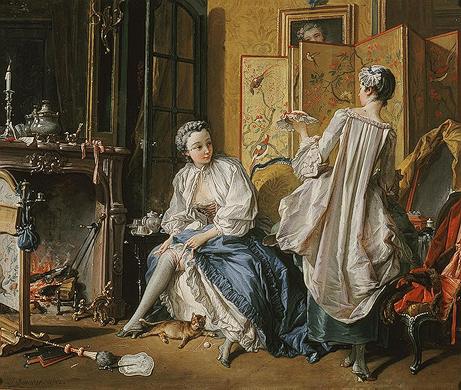
François Boucher, "A Lady Fastening Her Garter (La Toilette)," 1742 (Madrid: Museo Thyssen-Bornemisza)
It is this mélange of consumerism and lifestyle that the Getty exhibition Paris: Life and Luxury in the Eighteenth Century seeks to evoke. It is built round the outstanding collection of French decorative art that Jean Paul Getty, oil tycoon and once America’s richest man, left to his museum at his death. Ancien Regime Paris was the epicentre of European style. “Fashion is to France what the gold mines of Peru are to Spain,” concluded Jean-Baptiste Colbert, Louis XIV’s minister in 1665. French manufacturing was geared to the carriage trade. Demolish the Paris luxury industry, the Baroness d’Oberkirch concluded, and French international supremacy would wither overnight.
Across the channel the British were grinding their teeth. France was Britain’s only real economic and diplomatic rival – the two countries went to war seven times between 1688 and 1815. France was everything the new Protestant parliamentary state abhorred – Catholic, authoritarian, pleasure loving and effervescent. Yet still those thrifty Anglo Saxon Protestants could not contain their desire for French silks, tapestry, porcelain, mirrors, clocks and cabinetwork. “We are the whipped cream of Europe,” sighed Voltaire in 1735. . . .
Read the full article here»
Reviewed: ‘The Temperamental Nude’
Recently added to caa.reviews:
Tony Halliday, The Temperamental Nude: Class, Medicine and Representation in Eighteenth-Century France, Studies on Voltaire and the Eighteenth Century (Oxford: Voltaire Foundation, 2010), 272 pages, ISBN: 9780729409940, £55.
Reviewed by Dorothy Johnson, University of Iowa; posted 14 July 2011.
In “The Temperamental Nude: Class, Medicine and Representation in Eighteenth-Century France,” the late Tony Halliday studies a neglected facet of visual representation in Enlightenment culture, namely, the revival and significance of the theory of the temperaments and its impact on the depiction of the human figure, specifically the male figure, in painting, sculpture, and prints. His study focuses principally on mid- to late eighteenth-century France, with particular emphasis on the Revolutionary period. The contested idea of the new citizen (who was male according to French convention and law) and his fluctuating image in the visual arts during the Revolution, Republic, and Directory (1789–99) constitute the principal matter of the book. . . .
The full review is available here» (CAA membership required)
Reviewed: ‘Thomas Gainsborough and the Modern Woman’
Benedict Leca, Aileen Ribeiro, and Amber Ludwig, Thomas Gainsborough and the Modern Woman, ed. Benedict Leca (London: Giles Limited, 2010) 196 pages, ISBN: 9781904832850, $49.95.
Reviewed for Enfilade by Susan M. Wager
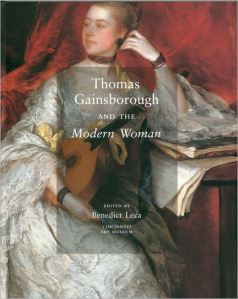 After a visit to Thomas Gainsborough’s studio in October 1760, the socially and culturally accomplished Mary Delany wrote, “There I saw Miss Ford’s picture—a whole length with her guitar, a most extraordinary figure, handsome and bold; but I should be sorry to have any one I loved set forth in such a manner.” The picture in question, Gainsborough’s Ann Ford of 1760, and the ambivalent reactions (like Mrs. Delany’s) it has engendered, is the central focus of Thomas Gainsborough and the Modern Woman. This lavishly illustrated catalogue, published to accompany an exhibition of the same name that originated at the Cincinnati Art Museum in 2010 before traveling to the San Diego Museum of Art earlier this year, was edited by Benedict Leca, Curator of European Painting, Sculpture, and Drawings at the Cincinnati Art Museum.
The portrait of Ann Ford—an eighteenth-century woman who garnered an ambiguous reputation by daring to organize public performances of her talent at the viola da gamba (unusual for a woman at the time)—was acquired by the Cincinnati Art Museum in 1927 and remains a highlight of the Museum’s collection. Leca has cleverly constructed an exhibition around the portrait, enriching our understanding of it through the juxtaposition of several well-selected loans. These include some of Gainsborough’s portraits of other “demireps”—women whose “social and sexual assertiveness combined with their flair for personal style and public exposure ran counter to propriety,” as defined by Leca. The catalogue’s three essays—by Leca, Aileen Ribeiro, and Amber Ludwig—all seem to be underpinned, implicitly, by the question: to what extent were these “demireps” in control of the constructed identities mediated through their painted portraits?
Leca’s approach to this question is decidedly optimistic. Drawing on compelling evidence such as Ann Ford’s published writings on the merits of the female sex, Leca argues that Gainsborough and Ford, in addition to some of his other female sitters, were equal partners in the production of images that challenged circumscribed gender codes and asserted female liberation from masculine control. Leca reads the correlation of Gainsborough’s signature loose brushwork—deemed “feminine” by his contemporaries—with painted passages of conventionally feminine accessories adorning sexually assertive women as the artist’s ironic and progressive rejection of masculinist norms. As Leca writes, Gainsborough’s portraits present “provocative women provocatively painted.”
Ribeiro’s essay considers how the costumes worn by Gainsborough’s demireps participated in the negotiation of reputation, class, and status. Ribeiro subtly complicates Leca’s reading of Ann Ford by evoking scholars who have suggested that paintings of accomplished women like Ford could be seen as relatively traditional presentations of ideal and precious objects of beauty, served up for the viewer’s delectation. Although Ribeiro ultimately disagrees with these readings, her essay nonetheless gestures toward the plurality of interpretations that can be gleaned from images of demireps.
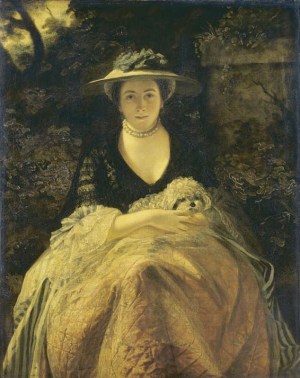
Joshua Reynolds, "Portrait of Nelly O'Brien," ca. 1762-64 (London: Wallace Collection)
Leca and Ribeiro mobilize two different portraits by Joshua Reynolds of the courtesan Nelly O’Brien to make divergent points about Ann Ford. Leca emphasizes the “subversive femininity” and “suggestiveness” of Ford’s pose by contrasting it to Reynolds’s 1762-4 portrait of O’Brien (The Wallace Collection). Whereas Reynolds dissembles the unsavory profession of O’Brien through the imposition of a pyramidal, closed, Marian pose onto her body, Gainsborough flaunts the immodesty and impropriety of Ford’s dynamic, crossed-leg attitude. Ribeiro, however, juxtaposes Ann Ford with a 1763-7 Reynolds portrait of O’Brien (The Hunterian Museum & Art Gallery, University of Glasgow) in order to underscore the formality of Ford’s dress in contrast to O’Brien’s “loose bed-gown.” The latter is far more scandalous than Ford’s costume, which would have been chosen precisely to shore up Ford’s ambiguous reputation. Conflicting readings like these do not detract from the overall thrust of the book; instead, they strengthen it, attesting to the complexity of the images under examination.

Joshua Reynolds, "Portrait of Nelly O'Brien," ca. 1763-67 (Glasgow: Hunterian Museum)
Indeed, complexity characterizes the images addressed by Amber Ludwig in her essay on how portraiture could attach the appearance of virtue to women with dubious reputations. Addressing pictures of Emma Hamilton, she underscores, for instance, tensions between the desires and personality of the sitter and the desires for propriety imposed by her husband or lover.
Thomas Gainsborough and the Modern Woman would be a welcome addition to the libraries of scholars and general readers alike. The catalogue’s clear prose is supplemented by sumptuous, full-color plates and extraordinarily high-resolution details, offering a worthy substitute for individuals who did not see the exhibition, or a handsome aide-mémoire for those who did.
◊ ◊ ◊ ◊ ◊
Susan M. Wager is a Ph.D. candidate in Art History & Archaeology at Columbia University. Her research examines eighteenth-century reproductions after François Boucher in the mediums of gems, porcelain, and tapestries at the intersection of consumer culture, natural history, antiquarianism and connoisseurship, and global exchange.
Reviewed: English Silver from the Virginia Museum of Fine Arts
Recently published by Apollo Magazine:
Christopher Hartop, A Noble Pursuit: English Silver from the Rita Gans Collection at the Virginia Museum of Fine Arts (Richmond: Virginia Museum of Fine Arts, 2011), 88 pages, ISBN 9780917046902, $25.
Reviewed by Martin Chaisin; posted 1 May 2011.
In 1988, Jerome (Jerry) and Rita Gans loaned their magnificent collection of English silver of the 17th and 18th centuries to the Virginia Museum of Fine Arts (VMFA). The collection was eventually gifted to the museum in 1997; a decade later, it was permanently housed in a beautifully designed installation, as celebrated in Christopher Hartop’s earlier overview, ‘A Noble Feast: The Jerome and Rita Gans Collection of English Silver’ (2007). Then, following Jerry’s death, Rita assembled a collection – reflecting her taste and engaging personal style – from which she donated an additional 50 pieces to the museum in 2009. Hartop’s present publication is a catalogue of that latter collection, as well as an illuminating discussion of collecting, connoisseurship and the design and uses of silver in 18th-century England. . . .

The full review is available here»
Reviewed: ‘Baroque: Style in the Age of Magnificence’
Recently added to caa.reviews:
Michael Snodin and Nigel Llewellyn, eds., Baroque: Style in the Age of Magnificence 1620–1800, exhibition catalogue (London: V&A Publishing, 2009), 372 pages, ISBN: 9781851775583, $85.
Reviewed by Matthew Knox Averett, Creighton University; posted 29 April 2011.
‘Baroque 09’ was a yearlong series of cultural events in the United Kingdom that celebrated the era’s art, music and culture. The Victoria and Albert Museum participated with the well-received exhibition, ‘Baroque 1620–1800: Style in the Age of Magnificence‘, which ran from April 4 to July 19, 2009. Michael Snodin and Nigel Llewellyn’s volume of the same name serves as the catalogue for the exhibition. The book is more than this, however, as the catalogue itself comprises only twenty-eight pages located toward the back of the book. The preceding three hundred pages attempt to reconstruct the Baroque and present it to a wide audience. Making sense of the Baroque is a difficult challenge, but for the
most part the authors have succeeded. . .
The full review is available here» (CAA membership required)
Reviewed: New Publications on Meissen
Recently added to caa.reviews:
Ulrich Pietsch and Claudia Banz, eds., Triumph of the Blue Swords: Meissen Porcelain for Aristocracy and Bourgeoisie, 1710–1815 (Leipzig: E. A. Seemann, 2010), 400 pages, ISBN: 9783865022486, €49.90.
Ulrich Pietsch and Theresa Witting, eds., Fascination of Fragility: Masterpieces of European Porcelain (Leipzig: E. A. Seemann, 2010), 368 pages, ISBN: 9783865022479, €49.90.
Reviewed by Donna Corbin, Associate Curator, European Decorative Arts, Philadelphia Museum of Art; posted 22 April 2011.
‘Triumph of the Blue Swords, Meissen Porcelain for Aristocracy and Bourgeoisie, 1710–1815’ (the English-language version of ‘Triumph der blauen Schwerter. Meissener Porzellan für Adel und Bürgertum 1710–1815‘) and the accompanying exhibition at the Japanese Palace in Dresden (May 8–August 29, 2010) celebrate the three hundredth anniversary of the founding of the Meissen porcelain manufactory. The exhibition was conceived as one of three complementary exhibitions—the other two being ‘The Fascination of Fragility‘ (Ephraim-Palais, Berlin, May 9–August 29, 2010; catalogue reviewed below) and ‘All Nations are Welcome. Three Hundred Years of the Meissen Manufactory’ (Meissen, January 23–December 31, 2010)—organized for the anniversary year. The exhibitions were intended to commemorate the anniversary, to highlight the indisputably influential role Meissen played in the development of porcelain production across Europe in the eighteenth century, and to bring attention to the Staatliche Porzellan-Manufaktur Meissen that still exists today. . .
The full review is available here» (CAA membership required)










 Enfilade
leave a comment