Thinking Digitally in the Museum
Recently added to caa.reviews:
Ross Parry, ed., Museums in a Digital Age (New York: Routledge, 2009), 496 pages, ISBN: 9780415402620, $52.95.
Reviewed by Craig Saper, Texts and Technology Doctoral Program and Department of English, University of Central Florida; posted 5 August 2010.
This useful collection of previously published essays appears in a series of course readers in museum studies edited by Simon Knell. The goal of this particular anthology is to illuminate the impact of digital media on museum exhibitions and on the conserving of digital artifacts in museums. Knell’s explanation of the general goals of the series ends with a citation from Michel Foucault as a guide to each volume’s efforts to update museum studies curricula. With that directive, it is inevitable that the series will have to navigate between the most mundane practical concerns, in this case how to run a museum’s digital collections and exhibitions, and more theoretical issues involving the implications of conserving an ephemeral digital heritage and putting exhibitions online. The two overlapping conflicts, or contradictions, of museum studies (i.e., practical versus theoretical and the virtual versus actual objects) challenge Museums in a Digital Age to get these concerns to address each other or at least to speak the same language.
Ross Parry, who edited the anthology, organizes the chapters into seven sections (prefaced by his useful introductions) that loosely correspond to the history and management of information, the real and virtual spaces of exhibitions, access and usability, interpretive and educational services, the status of museum artifacts (including digital), sustainability and technical production issues, and speculations on the future of museums. That organization certainly fits neatly with courses in museum studies, but, in following Parry’s description of the volume as a collage, one might also cross-index the chapters into four categories: history of practices, new gadgets and practices, usability of technological resources, and appealing to a wider (and different) audience. . .
For the full review, click here» (CAA membership required)
The July Issue of ‘The Burlington Magazine’
The Burlington Magazine 152 (July 2010); the issue concentrates on the eighteenth century with the following:
Articles
- Todd Longstaffe-Gowan, “Mignard, the Marquise and Martinique: A West Indian Setting for a Masterpiece of ‘Grand Epoque’ Portraiture,” pp. 448-51.
- Alden R. Gorden, “Sets and Pendants by J.-B.-M. Pierre and François Boucher in the Collections of Madame de Pompadour and the Marquis de Marigny,” pp. 452-60.
- Deborah Gage, “The Chatsworth Vases: A Gift from Louis XV in 1768 to Henry Léonard Jean-Baptise Bertin,” pp. 461-63.
- Wendy W. Erich, “Did Benjamin Franklin Invent Transferware?,” pp. 464-69.
- Rosalind Savill, “A New Catalogue of French Porcelain in the Royal Collection,” pp. 470-73.
Reviews
- Christoph Martin Vogtherr, Review of Jean-Baptiste Deshays, 1729-1765 by A. Bancel, pp. 479-80.
- Jonathan Scott, Review of Digging and Dealing in Eighteenth-Century Rome by I. Bignamini and C. Hornsby, p. 480.
- Christopher M. S. Johns, Review of The Borghese Collections and the Display of Art in the Age of the Grand Tour by C. Paul, pp. 480-81.
- Richard Rand, Review of Watteau to Degas: French Drawings from the Frits Lugt Collection by C. B. Bailey, S. Grace, and M. van Berge-Gerbaud, p. 482.
- Chris Miele, Review of The Judicious Eye: Architecture against the Other Arts by J. Rykwert, p. 482.
Reviewed: Surveying British Art
Recently added to caa.reviews:
David Bindman, ed., The History of British Art, Volume 2: 1600–1870 (New Haven and London: Yale Center for British Art and Tate Britain, 2008), 248 pages, ISBN: 9780300116717, $50.
Reviewed by Brian Lukacher, Department of Art, Vassar College; posted 21 July 2010
In his magisterial survey of British art, commissioned for the gold standard Pelican History of Art and first published in 1953, Ellis Waterhouse paused in his discussion of Thomas Gainsborough and made the following admission: “Unpleasant as it still is for some of us to introduce the shade of Marx into the history of art, it may contribute to the understanding of Gainsborough” (261). This passage attests to the anxiety of the art historian in introducing even the most innocuous hint of social analysis into the study of art during the post-war period. Waterhouse’s colleague and contemporary Anthony Blunt would find another, more furtive, way around this problem. This squeamishness over allowing “the shade of Marx” to haunt so fleetingly the pages of his survey book itself shows Waterhouse’s sensitivity to one of the most powerful and renowned images in Marxist political discourse—the “specter of communism” with which the Communist Manifesto opened and that would later be exorcised through the deconstructive logic of Derrida’s “specters of Marx.”
A couple of generations later and the history of British art finds itself still contending with “the shade of Marx.” But this shade has become considerably more tangible and omnipresent—in fact, it has now become mainstreamed. This is surely evident in the second volume from the recent three-volume survey entitled “The History of British Art.” Under the capable and expert editorial direction of David Bindman, who is also a contributor to this volume, which covers the Restoration period to the Victorian age, the series seeks to incorporate recent currents in art-historical academic research and cultural theory in its sweeping overview of large swathes of British art and society. Co-sponsored by the Yale Center for British Art and Tate Britain (not exactly cultural bastions of revolutionary discontent), this new survey wants to shake off the dusty tedium associated with older forms of British art history that were structured around the chronology of royal patronage, the tyranny of genre, and the evolution of artistic style. The challenge, which is not without peril and contradiction, is to present a more theoretically complex and politically engaged art history of the kind that has been flourishing in academic circles for the last two decades in a manner that would be accessible to the museum-going public visiting the Yale Center and the Tate.
It is a difficult balancing act, but one carried off with admirable success in volume two of this series. . . .
For the full review, click here» (CAA membership required)
Visiting London
From The New York Times Book Review (30 July 2010) . . .
Julie Flavell, When London Was Capital of America (New Haven: Yale University Press, 2010), ISBN: 9780300137392, $32.50.
Reviewed by Andrea Wulf
In the decades before the Declaration of Independence, thousands of American colonists visited London. Wealthy Southern plantation owners and New England merchants, husbands and wives, children and slaves all arrived in what was thought to be the most exciting city in the world. Some went shopping for exquisite silver, fashionable furniture and the latest books; others traded their goods and engaged in political arguments in noisy coffee houses. A sojourn in London was part of the education of the sons (and sometimes daughters) of wealthy colonial families because, as one contemporary observed, “more is learnt of mankind here in a month than can be in a year in any other part of the world.”
Julie Flavell’s “When London Was Capital of America” illuminates this fascinating chapter of London’s — and North America’s — past, showing how the metropolis functioned as a magnet for colonists from across the Atlantic (including the West Indies) who sought accomplishment, opportunity and commerce. An American-born scholar who is a fellow of the Royal Historical Society, Flavell has unearthed a host of stories that bring alive a previously neglected aspect of the colonial experience. . . .
The full review is available here»
Recently Reviewed: Books on Houdon, Tiepolo, and the Dilettanti
 It’s been exciting to see the recent expansion of The Art History Newsletter, as Jon Lackman has been joined by a number of contributors. On July 5th, Lackman himself reports on catching up on “The Glorious 18th Century,” with pieces from The New York Review of Books: Willibald Sauerländer on the Houdon exhibition at Montpellier (April 8 issue) and Ingrid Rowland on Roberto Calasso’s Tiepolo Pink (March 11 issue).
Meanwhile the June 24 issue of the London Review of Books includes a review of Jason Kelly’s book The Society of Dilettanti: Archaeology and Identity in the British Enlightenment by Rosemary Hill.
The London Town House
From Apollo Magazine:
Rachel Stewart, The Town House in Georgian London (New Haven: Yale University Press, 2009), ISBN 9780300152777, $65.
Reviewed by Conor Lucey, the editor of Irish Architectural and Decorative Studies.
On 16 May 1775, a notice in The Public Advertiser advised its readers that ‘the Right Hon. the Earl Temple is again much indisposed with an inflammatory Disorder in his Bowels, at his house in Pall Mall’. As a means of identifying the singular association between Britain’s aristocracy and their London residences, this very public announcement of the Earl Temple’s unfortunate medical circumstances, and the crucial specificity of location, represents a decisive example of the significance of West End property within the Georgian social arena. Deftly synthesising such illuminating anecdotal evidence with documentary fact, Rachel Stewart’s study of the 18th-century London town house provides valuable new description and interpretive analysis of this representative building type.
Critical of how architectural historiographies have underestimated both the practical and conceptual importance of town residences for the owner/occupier, Stewart’s narrative sets out to examine and, indeed, complicate the role, function and meaning of the city dwelling for those ‘who may have had some choice as to whether or not to take a town house, rather than the London-based middling classes whose town home was their principal and most often sole residence’. . . .
The full review can be found here»
Pompeii’s Romantic Legacy / Architecture and the Public Sphere
Recently added to caa.reviews:
Göran Blix, From Paris to Pompeii: French Romanticism and the Cultural Politics of Archaeology (Philadelphia: University of Pennsylvania Press, 2008), 320 pages, ISBN: 9780812241365, $59.95.
Reviewed by Pamela J. Warner, Department of Art and Art History, University of Rhode Island; posted 3 June 2010.
. . . readers looking for a history of archaeology in the nineteenth century should look elsewhere, as should those looking for detailed accounts of the actual archaeological site of Pompeii. As Blix writes in the introduction, his book is not “about the rise of archaeology . . . but about its broader mythical impact” (4). Thus the ancient site of Pompeii serves him as a repeating melody, a common but far from unique point of reference from which to cull evidence of a much broader archaeological gaze. Pompeii features as a figure that inspires a more diffuse range of approaches to not just the archaeological past but also the present and the future. Within that large compass, Blix concentrates on the myths and methods that determined the cultural practices of French Romanticism. . . . in making his case for the archaeological imaginary, Blix analyzes an impressive array of examples from a wide range of discourses, seeing in them underlying desires and fantasies that fueled archaeology as a science and allowed it to deeply permeate the Romantic mentality. His own prose, rich and filled with metaphors, makes the book a model of literary accomplishment, mirroring in this the hybrid qualities of the period it studies. . . .
For the full review, click here» (CAA membership required)
◊ ◊ ◊ ◊ ◊
Richard Wittman, Architecture, Print Culture, and the Public Sphere in Eighteenth-Century France (New York: Routledge, 2007). 304 pages, ISBN: 9780415774635, $165.
Reviewed by Freek Schmidt, Faculty of Arts, Vrije Universiteit Amsterdam; posted 2 June 2010.
There was a time when architecture existed mainly in the physical reality of the built environment and in the imagination. That was before it became a standard ingredient of the contemporary media, and a subject attracting the interest of historians, travelers, writers, and the general population. Exactly how this happened is not easy to reconstruct, but it seems very likely that some major changes took place in the eighteenth century with the emergence of the modern public and its attendant configuration of public and private spheres.
In this important book, Richard Wittman suggests that many of the defining characteristics of modern architectural culture have their origins in the transformations of architectural publicity in eighteenth-century France. He does so at the end of Architecture, Print Culture, and the Public Sphere in Eighteenth-Century France, a clever reworking of his doctoral dissertation of 2001, after having presented the reader with a chronological study in four parts, consisting of twelve chapters, over the course of which he painstakingly unfolds his story of the emergence of the public as an extremely influential party in the development of French architecture and architectural debate. . . .
For the full review, click here» (CAA membership required)
Liotard Tome Reviewed at ‘Apollo Magazine’
From Apollo Magazine:
Marcel Roethlisberger and Renée Loche, Liotard: catalogue, sources et correspondance, 2 vols. (Doornspijk: Davaco, 2008), ISBN 907028808, £503.
Reviewed by Robert Oresko.
On 30 September 1762, 24-year-old Bostonian John Singleton Copley wrote to Jean-Étienne Liotard (1702-1789), by then aged nearly 60, whom he had previously met in London, asking for help in procuring ‘a sett of the best Swiss Crayons for drawing of Portraits’. Liotard’s cosmopolitanism was a hallmark of his career as an artist, but a request from pre-revolutionary Boston indicates how widely his fame had spread. This telling anecdote emerges from the section – of nearly 150 pages – of Liotard’s letters in the second volume of Marcel Roethlisberger and Renée Loche’s “Liotard,” a monumental, archivally-based study of the Genevan-born artist’s life and work.
Over 900 folio pages of text, spread over two volumes, document the career of one of the greatest of painters in pastel and establish
his position as a key figure in 18th-century cultural life. . . .
The full review can be found here»
Recent Reviews for French Studies
Excerpts of recent reviews featured at the H-France website:
◊ ◊ ◊ ◊ ◊
H-France Review Vol. 10 (March 2010), No. 49
Raymonde Monnier, ed., À Paris sous la Révolution. Nouvelles approches de la ville. Paris: Publications de la Sorbonne, 2008. 221 pp. Notes. €25.00 (pb) ISBN 978-2-85944-596-6.
Review by Sydney Watts, University of Richmond.
Quoi de neuf sur la Révolution? Raymonde Monnier’s latest publication on Paris during the French Revolution stands out as a valuable collection of fresh ideas and illuminating scholarship, the ongoing work of a number of both young and well established historians from France and abroad. This plentiful compilation of groundbreaking research, taken from conference proceedings held at the Hôtel de Ville in October 2005, reveals the vitality of historical scholarship on this topic over the past two decades. Certainly, one would think after the flurry of publications following the bicentennial of 1789 that the subject of revolutionary Paris has been exhausted. Not so. In fact, the seventeen contributors to this collection open more historical terrain to the interested scholar than they close off. While each essay is kept brief, close to its conference paper format, many of them point to burgeoning fields of study. These historians have left behind ideological debates to focus on new topics, original historical problems, and open-ended discussion.
The questions around which the conference focused point to the place of Paris under the Revolution, its role as a site of acculturation that transformed its citizens as much as the city was transformed by its citizens. These scholars look to Paris as the center of revolutionary activity, keeping in mind the historical change in material conditions, social life and economic activity. Many of them contend with the fact that Paris was a growing metropolis with its own urban problems that were further challenged under the revolution. Other participants focus on the political culture that permeated urban life in ways that to a greater or lesser degree demonstrate what Parisians made of this revolutionary world. In turning to clearly delineated objects of study located in Paris (i.e., urban politics related to financing urban projects and policing the city, cultural venues such as the theatre and museums, city businesses such as construction, public transportation the meat trade, and examples of political culture as seen in sermons, engravings and Parisian academies) these scholars aim to untangle Paris from the Revolution writ large. As a result, instead of using Paris as a backdrop to this revolutionary period, Paris–its urban administration, economic life and political culture–is both the subject and object of this historical period. . . .
◊ ◊ ◊ ◊ ◊
H-France Review Vol. 10 (March 2010), No. 57
Stéphanie Loubère, L’Art d’aimer au siècle des Lumières. Studies on Voltaire and the Eighteenth Century 2007: 11. Oxford: The Voltaire Foundation, 2007. 343 pp. Illustrations, footnotes, bibliography and index. $111 U.S./£65 U.K./€78 (pb). ISBN 978-0-7294-0917-9.
Review by Elena Russo, The Johns Hopkins University.
In this erudite, careful and thorough study, Stéphanie Loubère surveys and analyzes the surprisingly rich story of the translations and adaptations of Ovid’s “Art of Love” in eighteenth-century France. This is a story that is likely to interest the reader more for what it reveals about the vicissitudes of translating and adapting the classics, and for the role they continued to play in French letters throughout the Enlightenment, than for its potential to seduce the senses and captivate the amorous imagination. Indeed, the expectant reader is bound to be disappointed, for never has eroticism felt so dull, dogmatic and pedantic. Certainly, had Ovid written according to the spirit of his French translators, it is safe to assume that he would never have incurred disgrace, exile, or been accused of immorality. Like them, he would have lived and died in dignified obscurity.
Still, it was worth resurrecting those authors, if only for a moment, and we may agree with Loubère’s claim that a study of the minores is likely to yield some interest for those who wish to explore the intellectual context, or better yet, the rhetorical and argumentative underbelly, of libertine literature, from Crébillon to Laclos. As Loubère points out, both in the Augustan empire and in the ancien regime, writing careers were shaped on the benches of law schools; all of the arts of love, to a greater or lesser extent, deliberately parodied treatises on rhetorics, at a time when rhetorics could no longer find an outlet in the practice of politics. The boudoir, rather than the tribune, became the space in which the arts of persuasion were honed and refined. The same may be argued of the Middle Ages, of such works as André Le Chapelain’s “De Amore” in the twelfth century and Guillaume de Lorris and Jean de Meung’s “Romance of the Rose” in the thirteenth century. . . .
◊ ◊ ◊ ◊ ◊
H-France Review Vol. 10 (March 2010), No. 58
Michel Baridon. A History of the Gardens of Versailles. Translated by Adrienne Mason. Philadelphia: University of Pennsylvania Press, 2008. vii + 296 pp. 48 illustrations, notes, bibliography, and index. $55.00 U.S. (cl). ISBN 978-0-8122-4078-8.
Alain Renaux. Louis XIV’s Botanical Engravings. Hampshire, England and Burlington, Vt: Lund Humphries, 2008. 144 pp. 70 illustrations, bibliography. £30 UK. (cl). ISBN 978-1-84822-000-3.
Review by Elizabeth Hyde, Kean University.
The last week of January 2009 saw the toppling of one of the last surviving trees planted for Marie Antoinette. Since 1786 the beech tree had grown in the gardens of the Hameau, the queen’s pastoral retreat (just recently renovated) at Versailles. The tree had born witness to the collapse of the French monarchy and had survived the ambivalence felt towards Versailles and the royal gardens, symbols as they were of Bourbon rule, as France lurched right and left in search of political stability in the century afterwards. The beech had been weakened in the 1999 storms that devastated the gardens of Versailles (and forced a replanting on a scale not undertaken since the 1770s); January’s storm finished it off. Associated Press photos showed gardeners unceremoniously sawing up the arboreal remains of the ancien regime. (more…)

Walpole and Strawberry Hill
The March issue of Apollo Magazine includes a review by Hugh Belsey of the Walpole exhibition now at the V&A in London:
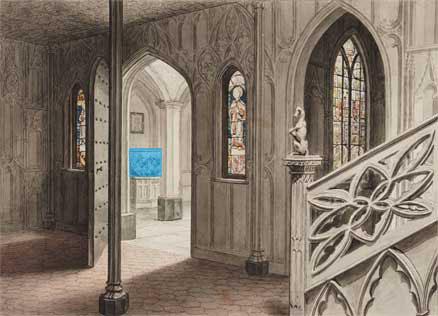
John Carter, "View from the Hall at Strawberry Hill," 1788, pen and ink, and watercolour on laid paper, from Horace Walpole’s extra-illustrated copy of "A Description of the Villa…at Strawberry-Hill" (Strawberry Hill, 1784). Lewis Walpole Library, Yale University. Folio 49 3582, fol. 24.
In 1818 William Hazlitt cruelly remarked that Horace Walpole’s ‘mind as well as his house, was piled up with Dresden china, and illuminated through painted glass’. Twenty-four years later the contents of his house, Strawberry Hill on the banks of the Thames at Twickenham, including the china, were sold. It took the auctioneer, George Robins, 24 days to complete the sale and gave the public the last opportunity to sample Walpole’s mind and taste – or not quite the last opportunity, as many of the rich, strange and beautiful lots have been reassembled in an exquisite exhibition . . . It is a display that sparkles, enchants and entrances. . . .
The full review can be found here»
◊ ◊ ◊ ◊ ◊
In conjunction with the exhibition, there is an outstanding digital component that includes virtual tours and immensely useful search functions for the database (including provenance). As noted on the site:

John Carter, "Tribune from Strawberry Hill", 1789
Horace Walpole’s Strawberry Hill Collection was initially developed by the Lewis Walpole Library to support research for the exhibition Horace Walpole’s Strawberry Hill and for the renovation of the house itself, undertaken by the Strawberry Hill Trust. Dispersed since the famous sale in 1842, Walpole’s collection was one of the most significant in eighteenth-century Britain, numbering several thousand items. This database encompasses the entire range of art and artifacts from Walpole’s collections, including all items whose location is currently known and those as yet untraced but known through a variety of historical records. This information is now made available for public access. The database is an ongoing project: the Library will continue to add and enhance records as further discoveries are made. Queries and comments are invited.
◊ ◊ ◊ ◊ ◊
Finally, it’s worth noting that Strawberry Hill will itself be open to visitors, starting in September, after extensive renovations (projected to cost £8.9 million). For details, see the website of the Strawberry Hill Trust.










 Enfilade
leave a comment