Walpole and Strawberry Hill
The March issue of Apollo Magazine includes a review by Hugh Belsey of the Walpole exhibition now at the V&A in London:
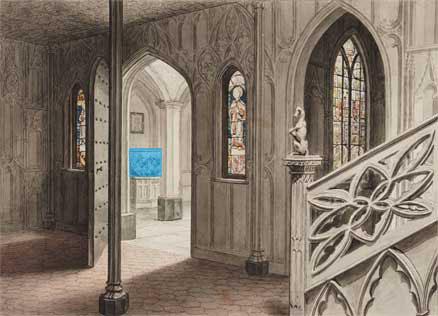
John Carter, "View from the Hall at Strawberry Hill," 1788, pen and ink, and watercolour on laid paper, from Horace Walpole’s extra-illustrated copy of "A Description of the Villa…at Strawberry-Hill" (Strawberry Hill, 1784). Lewis Walpole Library, Yale University. Folio 49 3582, fol. 24.
In 1818 William Hazlitt cruelly remarked that Horace Walpole’s ‘mind as well as his house, was piled up with Dresden china, and illuminated through painted glass’. Twenty-four years later the contents of his house, Strawberry Hill on the banks of the Thames at Twickenham, including the china, were sold. It took the auctioneer, George Robins, 24 days to complete the sale and gave the public the last opportunity to sample Walpole’s mind and taste – or not quite the last opportunity, as many of the rich, strange and beautiful lots have been reassembled in an exquisite exhibition . . . It is a display that sparkles, enchants and entrances. . . .
The full review can be found here»
◊ ◊ ◊ ◊ ◊
In conjunction with the exhibition, there is an outstanding digital component that includes virtual tours and immensely useful search functions for the database (including provenance). As noted on the site:

John Carter, "Tribune from Strawberry Hill", 1789
Horace Walpole’s Strawberry Hill Collection was initially developed by the Lewis Walpole Library to support research for the exhibition Horace Walpole’s Strawberry Hill and for the renovation of the house itself, undertaken by the Strawberry Hill Trust. Dispersed since the famous sale in 1842, Walpole’s collection was one of the most significant in eighteenth-century Britain, numbering several thousand items. This database encompasses the entire range of art and artifacts from Walpole’s collections, including all items whose location is currently known and those as yet untraced but known through a variety of historical records. This information is now made available for public access. The database is an ongoing project: the Library will continue to add and enhance records as further discoveries are made. Queries and comments are invited.
◊ ◊ ◊ ◊ ◊
Finally, it’s worth noting that Strawberry Hill will itself be open to visitors, starting in September, after extensive renovations (projected to cost £8.9 million). For details, see the website of the Strawberry Hill Trust.
Review of the Met’s Watteau Exhibition and Catalogue
Recently added to CAA Reviews:
Katherine Baetjer, ed., Watteau, Music, and Theater, exhibition catalogue (New York and New Haven: Metropolitan Museum of Art in association with Yale University Press, 2009), 176 pages, ISBN: 9780300155075, $35.
Reviewed by Sarah R. Cohen, University at Albany, State University of New York; posting added 24 March 2010.
The Metropolitan Museum of Art is ideally suited for an exhibition devoted to the theme of “Watteau, Music, and Theater” because two of Watteau’s most incisive treatments of these themes reside in its collection: the solitary singer “Mezzetin” (ca. 1718–20) and the tragic-comic “French Comedians” (ca. 1720–21). Both works also display Watteau’s ineffable fusion of performance and humanity, artifice and nature, and gestures both rote and heartfelt. The exhibition, rich in drawings as well as paintings loaned from a wide variety of institutions and private collections, allowed viewers to ponder the artist’s compelling transformation of music and theater into an exploratory pictorial language. But only about half of the exhibition featured works by Watteau himself; the rest comprised an eclectic mix drawn largely from the Metropolitan’s extensive collections of eighteenth-century objects, including paintings, graphic arts, porcelain figures, miniature boxes, and musical instruments. . . .
The exhibition catalogue, edited by Baetjer, features an essay on Watteau by Pierre Rosenberg as well as an account by Cowart of the multiple venues where eighteenth-century Parisians could encounter musical theater. Scholarly entries on all of the objects in the exhibition were contributed by the Metropolitan’s curators as well as outside experts, notably Mary Tavenor Holmes on Lancret and Kim de Beaumont on Gabriel de Saint-Aubin. . . .
For the full review (CAA membership required), click here»
Recent Reviews: ‘The Intimate Portrait’ and ‘Fuseli’s Milton Gallery’
Reviews from the current issue of The Journal for Eighteenth-Century Studies 33 (March 2010),
◊ ◊ ◊ ◊ ◊
The Intimate Portrait: Drawings, Miniatures and Pastels from Ramsay to Lawrence, curated by Kim Sloan and Stephen Lloyd, Scottish National Portrait Gallery, 25 October 2008 — 1 February 2009; British Museum, 5 March — 31 May 2009.
Reviewed by Kate Retford, Birkbeck College, University of London.
This exhibition brought together nearly 200 portrait drawings, pastels and miniatures from the rich collections of the British Museum and the Scottish National Portrait Gallery, billed as “more intimate types of Georgian and Regency portraiture.” These were not regularly exhibited works. Miniatures are hard to display, particularly in a way that will convey full experience of their qualities and functions. Drawings can only ever be shown for limited periods of time, owing to the threat of fading. The show included some exceptional images, not least Thomas Lawrence’s 1789 drawing of Mary Hamilton, enhanced with red and black chalk, used for the publicity materials. It was the export licence deferral and subsequent acquisition of this beautiful portrait by the British Museum which prompted the show. . . .
◊ ◊ ◊ ◊ ◊
Luisa Calè, Fuseli’s Milton Gallery: ‘Turning Readers into Spectators’ (Oxford: Oxford University Press, 2006), 273 pages, ISBN: 0199267383, $125.
Reviewed by Martin Myrone, Tate Britain.
The Swiss-born history painter Henry Fuseli (1741-1825) was a central figure in London’s cultural scene from the 1770s through to his death, both acclaimed and reviled for his extravagant paintings of supernatural, heroic and uncanny scenes. Approaching Fuseli from the perspective of a literary scholar armed with the lessons of narrative theory and reception studies, Luisa Calè’s new study makes a highly significant contribution to the literature on this artist, and seeks to establish his work in the context of a commercial culture of art that fostered complex dependencies and exchanges between the visual and the textual, the social and the aesthetic. The book focuses on Fuseli’s Milton Gallery – a scheme of ambitious paintings based on subjects drawn from the poet’s writings and life that preoccupied the artist through the 1790s – which opened, to almost complete public indifference, in 1799 and 1800. Calè offers an impressively thoughtful reconsideration of this major artistic project which has wide implications for our understanding of narrative painting and the commerce of art at the end of the eighteenth century. . . .
Review: ‘William Hogarth’s Surprising Cosmopolitanism’
Recently posted at H-Albion:
Robin Simon, Hogarth, France and British Art (London: Greenhill Books/Lionel Leventhal, 2007), 313 pages, ISBN 978-0-9554063-0-0, $90.
Reviewed by Douglas Fordham, Assistant Professor of Art History, University of Virginia; published on H-Albion, January 2010.
Since his death in 1764, William Hogarth has become a protean figurehead for a great many impulses in British culture. John Trusler’s “Hogarth Moralized” (1768) was an early and overt instance of the ends to which Hogarth’s life and oeuvre could be put, and Hogarth continues to be, if not moralized, then at least channeled into a disparate series of voices and roles. While the “New Art History” of the past two decades has turned its pragmatic sights on Hogarth the calculating businessman, it has also tended to reduce the artist to a somewhat bland spokesman for a polite and commercial age.[1] In the writings of David Solkin and David Bindman, in particular, Hogarth has been cast as a cultural latitudinarian, mainstream in his preoccupations and eager to please. To the extent that Hogarth’s works reveal contradictions, unpleasant truths, or impolite expressions they tend to be viewed as apt reflections of an anxious age. This view of the artist offered a calculated response to Ronald Paulson’s towering contribution to Hogarth scholarship, beginning in the 1970s, which emphasized the artist’s antinomian impulses and his empathetic eye for the sub-cultural. If Hogarth merges seamlessly into hegemonic discourses in the former, he activates a dizzying array of allusions and a daunting density of meaning in the voluminous writings of Paulson.[2] While each of these accounts, and a great many others, have transformed our understanding of the artist and his age, readers are ultimately tasked with choosing which Hogarth they prefer. For it hardly seems possible for one individual to embody so many contrary impulses.
Robin Simon makes a welcome contribution to this debate in “Hogarth, France and British Art,” where he offers a surprisingly fresh iteration of the artist and his milieu. Simon’s Hogarth is cosmopolitan in his understanding of European Old Masters and contemporary French art, sophisticated in his handling of oil paints, and a friend to “Tory wits” and Whig politicians alike. Hogarth emerges in Simon’s account as an intellectually serious artist and a deeply gifted painter who almost single-handedly elevated British art to a Continental level of refinement. In his desire to translate French theories and standards into a uniquely English vernacular, “Hogarth demands to be ranked with the literary giants of the ‘Augustan’ age in England” (p. 8). Simon shares with Paulson a propensity for making analogies between English literature and art, and some of Simon’s most compelling observations entail comparisons between Hogarth’s paintings and the English stage. . . .
The paradox latent in Simon’s approach is that Hogarth already had an English visual vernacular at his disposal in London printshops, on painted street signs, and in countless urban spectacles. While Simon deliberately challenges the “determinedly insular” (p. 3) quality of recent Hogarth scholarship, at what cost does Hogarth the cosmopolitan painter become divested from Hogarth the graphic satirist as Diana Donald and Mark Hallett, for example, have presented him?[3] This is a question of synthesis, however, rather than a legitimate critique of Simon’s stated aims. On its own terms, Simon’s book deserves to be read by everyone with an interest in British culture in the first half of the eighteenth century, and it dramatically improves our understanding of Anglo-French relations. It also manages to present us with yet another incarnation of the artist from which to choose. This is a significant accomplishment in itself, and if this new Hogarth sits uncomfortably alongside his forebearers, then it can only encourage us to look anew at Hogarth’s astonishingly diverse and provocative career.
For the full review, click here»
Notes (more…)
Catalogue of French Porcelain
From the March 2010 issue of Apollo Magazine:
Geoffrey de Bellaigue, French Porcelain in the Collection of Her Majesty The Queen, 3 volumes (London: The Royal Collection, 2009), 1291 pages, 2400 illustrations, ISBN 9781905686100, £500.
Reviewed by Selma Schwartz; Curator of Porcelain and Special Projects, Waddesdon Manor, The Rothschild Collection, Buckinghamshire, posting added 21 February 2010.
In the preface to his catalogue for the exhibition ‘Sèvres Porcelain from the Royal Collection,’ held at the Queen’s Gallery, Buckingham Palace, in 1979- 1980, Sir Geoffrey de Bellaigue wrote that “eventually a catalogue raisonné will be published” and that the catalogue “represents, in a sense, an interim report on a selection of pieces.”
Now, 30 years later, and over 100 years after the publication of Sir Guy Francis Laking’s ‘Sèvres Porcelain of Buckingham Palace and Windsor Castle,’ we finally have the monumental three-volume work (1,291 pages, with 2,400 illustrations – nearly all in colour) that scholars, collectors and amateurs of Vincennes/Sèvres porcelain have been anticipating eagerly for such a long time and the likes of which will probably never be seen again. Expectation and curiosity about the publication have been heightened principally for two reasons. The first being that although Windsor Castle and Buckingham Palace are open for public visits, a large quantity of the porcelain is not on display in public areas. The second is the renown that the author (or compiler, as he refers to himself in the text) rightly enjoys for meticulous and profound scholarly research.
The catalogue covers all the French porcelain in the Royal Collection, including that from Paris factories made in the 18th and 19th centuries, which, however, makes up only 37 of the 368 entries. Sèvres porcelain, as it was known after the manufactory moved to the town in 1756 from the château of Vincennes, is the star of the catalogue. The Royal Collection holds what is probably the finest and certainly the largest collection of this porcelain in the world, most of it acquired by that voracious collector George IV . . .
For the full review, click here»
Eighteenth-Century Religion between History and Art History
Recently added to caa.reviews:
Nigel Aston, Art and Religion in Eighteenth-Century Europe (London: Reaktion Books, 2009), 320 pages, ISBN: 9781861893772, $45.
Reviewed by Michael Yonan, University of Missouri–Columbia; posted 25 February 2010.
. . . Among crossdisciplinary connections, perhaps none is so elusive, so fraught with traps, as the boundary between history and art history. It is a boundary all the more striking for its invisibility. Art historians typically assume that they are partaking in historical study, that the tools they bring to cultural artifacts from the past illuminate an understanding comparable to that of their historian colleagues. All the greater their surprise, then, when they attend a history seminar or delve into historical journals and discover that their colleagues actually speak a different language and reach sometimes strikingly unfamiliar conclusions. Confusion and misunderstanding can happen in the opposite direction, too. Historians create knowledge about the past typically from texts, and it can seem a small step to translate that knowledge to images and spaces, visual constructions that likewise are products of the past and which ostensibly engage the same concerns. Nigel Aston recognizes the divide between his discipline, history, and art history and notes their differences in the introduction to his book “Art and Religion in Eighteenth-Century Europe.” He begins by registering his own interdisciplinarity, but reminds his readers that as a historian he brings a disciplinary perspective to the material at hand. That material is this period’s plentiful religious art, and he adds that in being fascinated by it he has been more or less alone among Anglo-American scholars. Certainly he is correct in noting that religious imagery desperately requires additional study and greater emphasis in our growing discourse on eighteenth-century art. . . .
For the full review, click here»
The Eighteenth Century in the Current Issue of ‘Art History’
Kate Retford, “A Death in the Family: Posthumous Portraiture in Eighteenth-Century England,” Art History 33 (February 2010): 74-97.
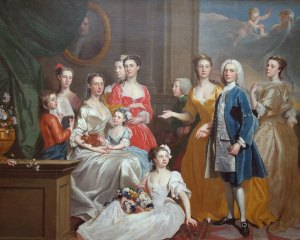
Joseph Highmore, "The Lee Family," 1736. Oil on canvas, 243.8 × 289.6 cm. (Wolverhampton Art Gallery)
Abstract: This article explores a number of unusual portraits produced in eighteenth-century England in which the realms of the posthumous and the living were mingled. In some cases, the dead were brought ‘back to life’ and restored to their rightful place in the family unit. In others, such as Joseph Highmore’s portrait of The Lee Family (1736), Thomas Gainsborough’s The Sloper Family (1787–88) or The Knatchbull Family by John Singleton Copley (1800–03), they were included in spiritualized form, hovering in a supernatural realm above the relatives they had left behind on terra firma. The article unpicks the particular circumstances that prompted these extraordinary commissions, exploring the personal and emotional histories of the sitters and artists. It also draws conclusions about the broader social, cultural, religious and artistic contexts that made these relatively rare, and frequently problematic images.
Kate Retford is Lecturer in History of Art at Birkbeck College, University of London. Her book, The Art of Domestic Life: Family Portraiture in Eighteenth-Century England, was published by Yale University Press in 2006. In addition, she has written a number of articles on topics relating to eighteenth-century portraiture, gender, and the country house art collection.
◊ ◊ ◊ ◊ ◊
Review of Ephemeral Bodies: Wax Sculpture and the Human Figure, with a translation of Julius von Schlosser’s “History of Portraiture in Wax,” edited by Roberta Panzanelli (Los Angeles: Getty Research Institute for the History of Art and the Humanities, 2008), pp. 170-72.
Reviewed by Matthew Bowman (lecturer at the University of Essex and co-founding editor of Rebus: Journal of Art History and Theory)
Most of the eight contributions in “Ephemeral Bodies” were originally presented in a workshop held at the Getty Research Institute in 2004. The texts examine the utilization of wax to depict the human body (in whole and in part, internally and externally) from a variety of methodological perspectives in accordance with the very different uses to which wax has been put. This includes considerations of wax sculpture from medical, anatomical, art-historical, philosophical, anthropological and political standpoints. From an art historian’s viewpoint, wax has not really figured in the discipline of art history. Indeed, it is curious that Julius von Schlosser’s stimulating “Geschichte der Porträtbildnerei in Wachs” (“History of Portraiture in Wax”), which originally came out in 1911 and which is published here for the first time in English, remains the central art-historical text on the production of wax sculptural objects. Ephemeral Bodies is, therefore, not only a useful scholarly collection on a neglected topic but also an opportunity to gauge and expand the theoretical presuppositions of art history as a discipline. . .
For additional contents, click here»
Picturing the West Indies
The following review appeared at caa.reviews in December (I’m sorry it slipped my notice earlier — C.H.).
Kay Dian Kriz, Slavery, Sugar, and the Culture of Refinement: Picturing the British West Indies, 1700–1840 (New Haven and London: Yale University Press in association with Paul Mellon Centre for Studies in British Art, 2008), 288 pages, ISBN: 9780300140620, $75.
Reviewed by Stephanie Shestakow, College of New Jersey; posted 15 December 2009.
A statue of Sir Hans Sloane stands at the center of London’s Chelsea Physic Garden where all variety of plants vie for attention. Sloane demonstrated his talent for gathering specimens (like those over which his statue presides) in his resplendently detailed title, ‘Voyage to the Islands Madera, Barbados, Nieves, S. Christophers, and Jamaica, with the Natural History of the Herbs and Trees, Four-footed Beasts, Fishes, Birds, Insects, Reptiles Etc. of the Last of those Islands’ (vol. 1, 1707; vol. 2, 1725) which serves as both travel log and visual natural history, a manifestation of the eighteenth-century desire to index the world. Kay Dian Kriz begins ‘Slavery, Sugar and the Culture of Refinement: Picturing the British West Indies, 1700–1840’ with Sloane’s folio in order to explore the visual strategies used to represent the West Indies in the eighteenth and early nineteenth century. In contrast to the abundance of scholarship addressing icons like the kneeling slave and the slave ship, Kriz’s study is aimed at the imagery designed to promote the colonial project in the West Indies, and it makes a remarkable new contribution to this area of study.
Through five chapters plus an introduction and afterword, Kriz charts both high and low artistic attempts to convey competing views of the Caribbean to the English public. She draws on a rich array of glossy color and black-and-white images ranging from graphic satires to natural history illustrations (and other images generally categorized outside the realm of “art”) as she discusses paintings and prints associated with the British West Indies that were produced around the campaign to abolish the slave trade. Just as raw sugar cane was refined into white crystals, artists portrayed island inhabitants as an often savage, overly sexualized, and unruly people who could be refined through colonials. Yet Kriz’s work also transcends the binary of metropolitan center and colonial outpost (the polite society of London versus the impolite colonial settlement) by addressing representations that confirmed and contested what she deems the dominant spatial model. These include paintings and prints that “proffered the possibility of social refinement in these British island colonies, not just economic profit and sexual pleasure” (4). . . .
For the full review click here»
Peering into the Peer Review Process
At The Long Eighteenth, Laura Rosenthal (Professor of English at the University of Maryland) reviews Michèle Lamont’s How Professors Think: Inside the Curious World of Academic Judgment, which studies how grants in multi-disciplinary committees are assessed:
In this well-written and relentlessly object study (in the sense that Lamont has no ax to grind as far as I can tell and treats her subjects with respect), the author mainly I think is offering a counterpoint to Pierre Bourdieu’s argument that academic awards constitute a system of self-reproduction. Instead, Lamont finds that even though evaluators certainly see the application through particular lenses, they nevertheless in general make a sincere effort to discover quality. This process, however, takes place contextually through a series of negotiations in which a variety of factors shape decisions. . .
For Rosenthal’s full review, click here»
Collecting in Eighteenth-Century Italy
Reviewed by Graham Perry in the February issue of Apollo Magazine:
Cinzia Sicca, ed., John Talman: An Early Eighteenth-Century Connoisseur (New Haven: Yale University Press/Paul Mellon Centre, 2009), ISBN: 978-0300123357 ($75).
Misfortune hangs over the Talman family like a cloud. William Talman the architect had a flourishing practice in the time of William III, but most of his work has perished. His son John formed one of the greatest collections of drawings ever seen in Britain, but was forced by financial necessity to begin dispersing it before he died. He designed architectural schemes for All Souls, Oxford, and for a new Whitehall Palace, all of which remained unbuilt. He knew more about contemporary Italian art than any man in England, and was mentor to William Kent, whom he took with him to Italy in 1709; yet his name remains virtually unknown. Only recently has his significance begun to be recognised, with an Italian team of scholars, headed by Cinzia Sicca, taking the lead in producing an on-line reconstruction of his dismembered collections, and now producing a volume that clearly illustrates his position in the early-18th-century art world. . .
For the full review, click here»










 Enfilade
leave a comment