The Eighteenth Century in the Current Issue of ‘Art History’
Kate Retford, “A Death in the Family: Posthumous Portraiture in Eighteenth-Century England,” Art History 33 (February 2010): 74-97.
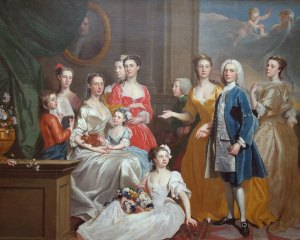
Joseph Highmore, "The Lee Family," 1736. Oil on canvas, 243.8 × 289.6 cm. (Wolverhampton Art Gallery)
Abstract: This article explores a number of unusual portraits produced in eighteenth-century England in which the realms of the posthumous and the living were mingled. In some cases, the dead were brought ‘back to life’ and restored to their rightful place in the family unit. In others, such as Joseph Highmore’s portrait of The Lee Family (1736), Thomas Gainsborough’s The Sloper Family (1787–88) or The Knatchbull Family by John Singleton Copley (1800–03), they were included in spiritualized form, hovering in a supernatural realm above the relatives they had left behind on terra firma. The article unpicks the particular circumstances that prompted these extraordinary commissions, exploring the personal and emotional histories of the sitters and artists. It also draws conclusions about the broader social, cultural, religious and artistic contexts that made these relatively rare, and frequently problematic images.
Kate Retford is Lecturer in History of Art at Birkbeck College, University of London. Her book, The Art of Domestic Life: Family Portraiture in Eighteenth-Century England, was published by Yale University Press in 2006. In addition, she has written a number of articles on topics relating to eighteenth-century portraiture, gender, and the country house art collection.
◊ ◊ ◊ ◊ ◊
Review of Ephemeral Bodies: Wax Sculpture and the Human Figure, with a translation of Julius von Schlosser’s “History of Portraiture in Wax,” edited by Roberta Panzanelli (Los Angeles: Getty Research Institute for the History of Art and the Humanities, 2008), pp. 170-72.
Reviewed by Matthew Bowman (lecturer at the University of Essex and co-founding editor of Rebus: Journal of Art History and Theory)
Most of the eight contributions in “Ephemeral Bodies” were originally presented in a workshop held at the Getty Research Institute in 2004. The texts examine the utilization of wax to depict the human body (in whole and in part, internally and externally) from a variety of methodological perspectives in accordance with the very different uses to which wax has been put. This includes considerations of wax sculpture from medical, anatomical, art-historical, philosophical, anthropological and political standpoints. From an art historian’s viewpoint, wax has not really figured in the discipline of art history. Indeed, it is curious that Julius von Schlosser’s stimulating “Geschichte der Porträtbildnerei in Wachs” (“History of Portraiture in Wax”), which originally came out in 1911 and which is published here for the first time in English, remains the central art-historical text on the production of wax sculptural objects. Ephemeral Bodies is, therefore, not only a useful scholarly collection on a neglected topic but also an opportunity to gauge and expand the theoretical presuppositions of art history as a discipline. . .
For additional contents, click here»
Picturing the West Indies
The following review appeared at caa.reviews in December (I’m sorry it slipped my notice earlier — C.H.).
Kay Dian Kriz, Slavery, Sugar, and the Culture of Refinement: Picturing the British West Indies, 1700–1840 (New Haven and London: Yale University Press in association with Paul Mellon Centre for Studies in British Art, 2008), 288 pages, ISBN: 9780300140620, $75.
Reviewed by Stephanie Shestakow, College of New Jersey; posted 15 December 2009.
A statue of Sir Hans Sloane stands at the center of London’s Chelsea Physic Garden where all variety of plants vie for attention. Sloane demonstrated his talent for gathering specimens (like those over which his statue presides) in his resplendently detailed title, ‘Voyage to the Islands Madera, Barbados, Nieves, S. Christophers, and Jamaica, with the Natural History of the Herbs and Trees, Four-footed Beasts, Fishes, Birds, Insects, Reptiles Etc. of the Last of those Islands’ (vol. 1, 1707; vol. 2, 1725) which serves as both travel log and visual natural history, a manifestation of the eighteenth-century desire to index the world. Kay Dian Kriz begins ‘Slavery, Sugar and the Culture of Refinement: Picturing the British West Indies, 1700–1840’ with Sloane’s folio in order to explore the visual strategies used to represent the West Indies in the eighteenth and early nineteenth century. In contrast to the abundance of scholarship addressing icons like the kneeling slave and the slave ship, Kriz’s study is aimed at the imagery designed to promote the colonial project in the West Indies, and it makes a remarkable new contribution to this area of study.
Through five chapters plus an introduction and afterword, Kriz charts both high and low artistic attempts to convey competing views of the Caribbean to the English public. She draws on a rich array of glossy color and black-and-white images ranging from graphic satires to natural history illustrations (and other images generally categorized outside the realm of “art”) as she discusses paintings and prints associated with the British West Indies that were produced around the campaign to abolish the slave trade. Just as raw sugar cane was refined into white crystals, artists portrayed island inhabitants as an often savage, overly sexualized, and unruly people who could be refined through colonials. Yet Kriz’s work also transcends the binary of metropolitan center and colonial outpost (the polite society of London versus the impolite colonial settlement) by addressing representations that confirmed and contested what she deems the dominant spatial model. These include paintings and prints that “proffered the possibility of social refinement in these British island colonies, not just economic profit and sexual pleasure” (4). . . .
For the full review click here»
Peering into the Peer Review Process
At The Long Eighteenth, Laura Rosenthal (Professor of English at the University of Maryland) reviews Michèle Lamont’s How Professors Think: Inside the Curious World of Academic Judgment, which studies how grants in multi-disciplinary committees are assessed:
In this well-written and relentlessly object study (in the sense that Lamont has no ax to grind as far as I can tell and treats her subjects with respect), the author mainly I think is offering a counterpoint to Pierre Bourdieu’s argument that academic awards constitute a system of self-reproduction. Instead, Lamont finds that even though evaluators certainly see the application through particular lenses, they nevertheless in general make a sincere effort to discover quality. This process, however, takes place contextually through a series of negotiations in which a variety of factors shape decisions. . .
For Rosenthal’s full review, click here»
Collecting in Eighteenth-Century Italy
Reviewed by Graham Perry in the February issue of Apollo Magazine:
Cinzia Sicca, ed., John Talman: An Early Eighteenth-Century Connoisseur (New Haven: Yale University Press/Paul Mellon Centre, 2009), ISBN: 978-0300123357 ($75).
Misfortune hangs over the Talman family like a cloud. William Talman the architect had a flourishing practice in the time of William III, but most of his work has perished. His son John formed one of the greatest collections of drawings ever seen in Britain, but was forced by financial necessity to begin dispersing it before he died. He designed architectural schemes for All Souls, Oxford, and for a new Whitehall Palace, all of which remained unbuilt. He knew more about contemporary Italian art than any man in England, and was mentor to William Kent, whom he took with him to Italy in 1709; yet his name remains virtually unknown. Only recently has his significance begun to be recognised, with an Italian team of scholars, headed by Cinzia Sicca, taking the lead in producing an on-line reconstruction of his dismembered collections, and now producing a volume that clearly illustrates his position in the early-18th-century art world. . .
For the full review, click here»
Early American Print Culture
Recently added to caa.reviews:
Trish Loughran, The Republic in Print: Print Culture in the Age of U.S. Nation Building, 1770–1870 (New York: Columbia University Press, 2007), 568 pages, $24.50 (9780231139090)
Reviewed by Jennifer Roberts, Department of History of Art and Architecture, Harvard University; posted 14 January 2010
. . . Standard accounts of print culture in the early national period stress the role of print as a telecommunication device; print networks connected people in time and space, forged communities out of disparate groups of disconnected citizens, and permitted something like a coordinated nation-state to develop and persist. Loughran’s brilliant and counterintuitive argument overturns this assumption. She argues instead that the illusion of national unification (the “virtual nation,” as she puts it) could take hold in reality only because the actual capacities of print dissemination networks were severely limited. . . .
What can art historians take from Loughran’s study? While the book devotes considerable attention to visual culture (more on which in a moment), its most profound potential as an art-historical contribution lies in its broad realignment of traditional ways of thinking about media and materiality. First: Loughran persistently redirects the definition of “print media” from their typical scope—ink, paper, etc.—to the broader geographical field through which print artifacts had to move. She emphasizes this in order to overturn persistent models of telecommunicative print culture that tend to ignore the actual heft of printed texts, imagining that they disseminate themselves weightlessly and simultaneously through space. . . .
Second: Loughran elegantly probes the relationship between the virtual spaces evoked by printed texts and the real spaces that they occupied and through which they were hauled and handled. She demonstrates that much of the historical power of these texts as both representations and performances emerged precisely in the cleavage between their “two bodies”: “On one hand, they served as symbols of unity; on the other, they were actual objects with limited circulations” (22). . .
For the full review, click here»
In the Latest ‘Art Bulletin’
The December issue of The Art Bulletin 91 (2009) includes the following items addressing the eighteenth century:
Emma Barker, “Imaging Childhood in Eighteenth-Century France: Greuze’s Little Girl with a Dog,” pp. 426-45.
Author’s Abstract: “During the artist’s lifetime, A Child Playing with a Dog was one of Jean-Baptiste Greuze’s most admired and best-known works. The painting represent the physical, instinctual nature of the child in a manner unprecedented in French art. The image of childhood that it offers has close parallels in the scientific and medical discourse of the later eighteenth century. Like many contemporary commentators, Greuze evokes not simply the innocence of children but also their vulnerability, above all, that of little girls. He thereby implicates the viewer in the child’s fate, both for good and ill.”
Meredith Martin, review of Diplomatic Tours in the Gardens of Versailles under Louis XVI by Robert Berger and Thomas Hedin (University of Pennsylvania Press, 2008)) and Carmontelle’s Landscape Transparencies: Cinema of the Enlightenment by Laurence Chatel de Brancion (J. Paul Getty Museum, 2008), pp. 511-15.

 “Both Diplomatic Tours and Carmontelle’s Landscape Transparencies attempt to shed light on an underexplored aspect of French gardens and how they were portrayed in the ancien régime. As in a growing number of garden history books, the authors foreground questions of reception and use and treat these landscapes as a dynamic field of social relations — in other words, as a contested terrain. Both books also share an inclination to animate the garden as a kinetic experience by way of descriptive texts and visual images. . .” (512).
At the Watteau Show with a Dance Critic
In today’s New York Times, Alastair Macaulay considers Frederick Wiseman’s new documentary La Danse alongside the Watteau exhibition now at the Met:

Nicolas Lancret, "La Camargo Dancing” ca. 1730 (DC: National Gallery)
. . . Many of us who love ballet have found our feelings on this film to be conflicted. By chance, I saw it a few hours before I attended the Metropolitan Museum’s exhibition “Watteau, Music and Theater.” What a difference! If you love dance, “La Danse” isn’t the place to see why; “Watteau, Music and Theater” certainly is. The display fills only two rooms. Many of its pictures, especially those by Watteau himself, are not related to dance. Yet it spans, and often illuminates, the first century of existence of the institution in the film, the Paris Opera Ballet. True, ballet then was almost a different species. The paintings here help show the impact of the most famous achievement of the celebrated Paris Opera ballerina Marie Camargo, seen in a classic Nicolas Lancret painting from about 1730: the shortening of her skirts to give full exposure to her ankles and lower calves. “Watteau, Music and Theater” makes the dance of that era feel pristine. Here is the sunrise of a tradition. . .
For the full article, click here»
Listening to Furniture
Recently added to caa.reviews:
Dena Goodman and Kathryn Norberg, eds., Furnishing the Eighteenth Century: What Furniture Can Tell Us about the European and American Past (New York: Routledge, 2007), 272 pages, $69.95 (9780415949538)
Reviewed by Stacey Sloboda, Assistant Professor of Art History, Southern Illinois University; posted 4 November 2009.
In a conceptually wide-reaching and useful introduction to “Furnishing the Eighteenth Century: What Furniture Can Tell Us about the European and American Past,” editors Dena Goodman and Kathryn Norberg ask, “Can the settee speak?” (2). That this question remains relatively novel suggests the importance of the book. Their answer, of course, is affirmative; and the twelve essays that constitute this collection provide ample new, thoughtful, and frequently surprising revelations about what exactly eighteenth-century furniture said to a broad range of makers, users, and audiences. Written by scholars in the fields of history, literary studies, and art history, the essays are methodologically diverse yet unified by an interest in the social and cultural uses and meanings of objects and interiors in the eighteenth century. . . .
In a revelatory essay that should become standard reading for students of eighteenth-century French visual and material culture, “The Joy of Sets: The Uses of Seriality in the French Interior,” Mimi Hellman explores multiple reasons why sets, serial designs, and matching objects became characteristic features of the eighteenth-century French interior. Deftly weaving formal, cultural, and historical approaches to specific objects, Hellman deploys a wide range of theoretical insights, from anthropology to psychoanalysis, to argue that, “serial design was a crucial site for the enactment of elite self-fashioning, an eloquent representational system that elicited performances of social mastery” (147). Furthering the concept of signifying objects, Mary Salzman’s careful analysis of Jean-François de Troy’s pendant paintings “The Garter” and “The Declaration of Love” (1724) argues that decorative objects in de Troy’s paintings constitute a form of visual rhetoric that communicated with savvy viewers for whom judgment was an important critical activity. . . .
◊ ◊ ◊ ◊ ◊
Sloboda, Hellman, and Salzman are all HECAA members. For CAA members, the entire review can be found here»
Happy Birthday, Angelica Kauffman!
Angelica Kauffman turns 268 today. The following comes from Meredith Martin’s 2007 review of Angela Rosenthal’s book on the artist. From caa.reviews:
Angela Rosenthal, Angelica Kauffman: Art and Sensibility (New Haven: Yale University Press in association with Paul Mellon Centre for Studies in British Art, 2005) 352 pages, $65.
Reviewed by Meredith Martin, Assistant Professor, Wellesley College; posted 1 May 2007.
Cover Image: Angelica Kauffman, "Self-Portrait," detail, 1784 (Munich: Bayerische Staatgemäldesammlung Neue Pinakothek)
Rosenthal’s monograph restores Kauffman’s own work to center stage. Her project is not simply one of “historical recovery,” for as the author notes, “unlike some other female artists, [Kauffman] never fully lost her position within the art-historical canon” (2). Generally speaking, Kauffman’s story is not one of isolation or exclusion, but rather of strong support, widespread influence, and international renown. One need only glance at her voluminous, multilingual correspondence with the leading cultural figures of eighteenth-century Europe—Goethe, Johann Caspar Lavater, and Izabella Czartoryska among them—to get a sense of the professionally rewarding and breathlessly glamorous life that Kauffman led. Zoffany’s painting notwithstanding, Angelica Kauffman was nobody’s wallflower. . .

Member News
Angela Rosenthal is associate professor at Dartmouth. She specializes in early modern European visual culture (especially British art within a global perspective), with an emphasis on cultural history, gender studies, feminist and post-colonial theory, and the history of art criticism. She studied art history, psychology and social anthropology at Trier University, Germany and in the UK (The Courtauld Institute of Art, University College London, and Westfield College). Before joining the faculty at Dartmouth College in 1997, she was curator of contemporary art at the Stadtgalerie in Saarbrücken (1994-95), and Andrew W. Mellon Assistant Professor of Art History at Northwestern University (1995-97). Rosenthal’s most recent research project emerged from her past work on the visual formulation of subjectivity, as well as from her engagement with contemporary post-colonial art theory. In this new book project, entitled The White of Enlightenment: Racializing Bodies in 18th-Century British Visual Culture, Rosenthal seek to complement the growing field of research on concepts of “race” and “ethnicity” in the visual arts.
Meredith Martin joined the Wellesley faculty in 2008. She received a BA in Art History from Princeton University in 1997 and a PhD in the History of Art and Architecture from Harvard University in 2006. Her research interests include: eighteenth- and nineteenth-century French visual and material culture, architectural theory and landscape design; gender, space, and the domestic interior; early neo-classicism; art and colonialism; and the historiography of the Rococo. She is the co-author, with Scott Rothkopf, of Period Eye: Karen Kilimnik’s Fancy Pictures (Serpentine Gallery/Koenig Books, 2007). Her book, Dairy Queens: Pastoral Architecture and Political Theater from Catherine de’ Medici to Marie-Antoinette, is forthcoming from Harvard University Press, and she is also co-editing a volume with Denise Baxter entitled Architecture Space in Eighteenth-Century Europe: Constructing Identities and Interiors to be published by Ashgate next spring. Her current research addresses diplomatic and material exchanges between France and India in the late eighteenth century.
Collecting and Display in Italy
Recently added to caa.reviews:
Carole Paul, The Borghese Collections and the Display of Art in the Age of the Grand Tour (Aldershot, UK: Ashgate, 2008), 358 pages, $124.95 (9780754661344)
Reviewed by Jason Kelly, Assistant Professor, Department of History, IUPUI; posted 23 September 2009.
Carole Paul’s ‘The Borghese Collections and the Display of Art in the Age of the Grand Tour’ is an analysis of the shifting attitudes toward collection and display—form, content, and contexts—in the world of Settecento Rome. With a focus on the Borghese’s Galleria Terrena, the suites where most of the family’s paintings hung, and the Casino Nobile, home to the sculptures, Paul examines the interrelated narratives of aristocratic patronage, grand tour sociability, the international aesthetic landscape, and the development of museums. Her arguments rest on a detailed reading of the redesign of the Borghese galleries under Prince Marcantonio Borghese IV and his architect, Antonio Asprucci, beginning in 1767 and continuing to 1800. Paul argues that the re-outfitting of the Galleria Terrena and the Casino Nobile was “one of the most significant cultural events in Rome during the age of the Grand Tour” (2). The analysis of this process sheds light on how these exhibition spaces became the high point of the princely display of antiquities and paintings in eighteenth-century Rome. As readers familiar with Paul’s earlier publications, especially ‘Making a Prince’s Museum: Drawings for the Late-Eighteenth-Century Redecoration of the Villa Borghese‘ (Los Angeles: Getty, 2000), will recognize, ‘The Borghese Collections’ is the culmination of work that has been developing for some time. It extends many of the themes discussed in the earlier book by examining the entire aesthetic, iconographic, and didactic program of the late Settecento Borghese estate. . . .
In common with Christopher Johns’s ‘Papal Art and Cultural Politics: Rome in the Age of Clement XI‘ (Cambridge, UK: Cambridge University Press, 1993), Peter Bowron and Joseph Rishel’s ‘Art in Rome in the Eighteenth Century’ (Philadelphia: Philadelphia Museum of Art, 2000), and Jeffrey Collins’s ‘Papacy and Politics in Eighteenth-Century Rome’ (Cambridge, UK: Cambridge University Press, 2004), ‘The Borghese Collections’ examines eighteenth-century Rome’s vibrant artistic climate. Whereas Johns and Collins are concerned with papal collections and display, Paul’s work reveals the extent to which Roman aristocrats both innovated and competed with the Vatican. When comparing Prince Marcantonio Borghese IV’s program to that sponsored by Pope Pius VI Braschi at the Pio-Clementino in the 1780s, it is clear that rivalries spurred, at least in part, both patronage and new schemes for display. Along with these earlier books, Paul’s work reveals the importance of collecting as a political strategy, and she explains the centrality of iconographic programs to their design. ‘The Borghese Collections and the Display of Art in the Age of the Grand Tour’ is essential reading for students of Settecento museums, architecture, design, and the Grand Tour. . . .
◊ ◊ ◊ ◊ ◊
Writing for the TLS (30 September 2009) on the topic of artistic plunder in antiquity, Mary Beard (Cambridge classics professor and author of the blog, A Don’s Life) invokes Paul’s book in connection with evaluating the lines between collecting as an act of cultural productivity and collecting as a form of cultural destruction:
For a start, the contested boundary between the cultured patron and the obsessive, rapacious collector is an almost universal one. This is nicely illustrated in Carole Paul’s meticulous account of the display of the Borghese collection of paintings and antiquities in eighteenth- century Rome, ‘The Borghese Collections and the Display of Art in the Age of the Grand Tour’. In discussing the formation of the collection she devotes a short section to the seventeenth-century Scipione Borghese – a “distinguished . . . patron of the arts,” “a great Maecenas.” It is only in the next paragraph that we learn that “Scipione was also a remarkable – and ruthless – collector, who would stoop to confiscation and theft to obtain paintings, and even had artists imprisoned when they displeased him.” Same person, same habits: it all depended which side of Scipione’s patronage you were on.










leave a comment