Assessing the Glow of ‘Blake’ and ‘Brilliant Women’
Recent pieces from CAA.reviews address exhibition publications on William Blake at the Petit Palais in Paris and bluestockings at the National Portrait Gallery in London:
◊ ◊ ◊ ◊ ◊
Catherine de Bourgoing, ed., William Blake: Le Génie visionnaire du romantisme anglais, exhibition catalogue (Paris: Petit Palais and Musée de la Vie Romantique, 2009), 256 pages, €39 (9782759600779)
Exhibition schedule: Petit Palais and Musée de la Vie Romantique, Paris, April 2–June 28, 2009
Meredith Davis writes that
This overdue exhibition was expansive and thorough, if not inspirational; it was beautifully installed in the Petit Palais’s well-appointed special exhibition rooms, but the roughly thematic groupings were at times opaque or barely articulated. Arguably, Blake is as much a poet as a visual artist, and with a museum show such as this, one inevitably favors the visual dimension of his art over the literary. Typically problematic in this sense are his “Illuminated Books.” Among his most important works, these hand-printed manuscripts are miniscule in some cases; many, including his Songs of Innocence and Experience (1789–94), were certainly not meant to be presented as individual framed sheets of paper, but rather as objects to be cradled in one’s hands or lap, like a book of hours or diary. . . .
Despite such inherent difficulties, the exhibition succeeded in creating several intimate spaces and in offering a comprehensive presentation of Blake’s range. Blake’s long absence from France was remedied, and French audiences did get a broad view of Blake’s world. However, it is not certain that they came away from the exhibition with anything like a clear vision of his art (to the extent that such a thing is possible). The exhibition did not begin with an introductory wall text as one typically finds in a similar exhibition in the United States. Instead viewers were launched straight into a series of modestly scaled rooms, arranged around major works, themes, or historical benchmarks. In some ways the exhibition seemed to take a cue from Blake himself. . . .
Michael Phillips’s excellent catalogue essay, “William Blake Graveur Visionnaire,” provides some much-needed and detailed information on Blake’s printing processes. Phillips offers a lucid discussion of Blake’s technical innovations in printmaking, as well as discusses the symbolic significance the medium took on for Blake, pointing out how the artist drew parallels, for example, between the corrosive action of the acid on the plate (in etching) and a similar corrosion of the soul. The catalogue’s overall format mirrors the exhibition itself in its avoidance of linear narrative, choosing again a thematic and multi-vocal presentation of the artist. It does not provide a roadmap to the exhibition in any sense, but is a stand-alone volume with high ambitions. There are, in all, a total of thirty essays in the volume, some of them as short as five hundred words, all of them in French. While some essays are informative, others seem to end abruptly, or to focus on esoteric topics. Nonetheless, this approach clearly demonstrates the many dimensions of Blake’s work, as well as the range of current approaches to it.
◊ ◊ ◊ ◊ ◊
Elizabeth Eger and Lucy Pelz, Brilliant Women: 18th-Century Bluestockings (New Haven: Yale University Press, 2008). 160 pages; 84 color illustrations; 64 b/w illustrations, cloth $50 (9780300141030)
Exhibition schedule: National Portrait Gallery, London, March 13–June 15, 2008
Wendy Wassyng Roworth writes that
Brilliant Women is not a catalogue; however, all the works in the exhibition are splendidly illustrated, many in high-quality color or as full-page reproductions. Portraits of the bluestockings, their associates, and followers, along with engravings, drawings, caricatures, and Wedgwood plaques provide an abundance of visual material not usually available in studies of literary figures. Intended primarily for general readers and exhibition visitors, Brilliant Women does not break major new ground but offers an excellent overview of the bluestocking phenomenon. However, the authors’ focus on visual representations of learned women in portraits, book illustrations, and other pictorial forms and their analyses of how and why bluestockings were depicted by both admirers and critics makes this study useful for scholars of eighteenth-century art, literature, and history. This consideration of visual imagery contributes to a larger understanding of the vital role women played in the eighteenth-century republic of letters through their images as well as their works in ways that textual accounts alone cannot achieve. Whether disparaged and mocked in caricature, elevated as allegorical personifications, or portrayed as graceful ladies in fashionable dress, these images call attention to the complex identities of intellectually ambitious women.
New Books: Recently Posted at caa.reviews
caa.reviews recently posted reviews of two late-eighteenth-century books. Brief excerpts are provided below; for the full texts, click on the picture of each book.
◊ ◊ ◊ ◊ ◊
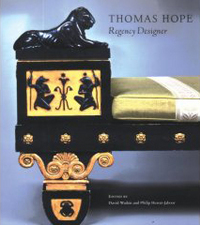 Philip Hewat-Jaboor and David Watkin, eds. Thomas Hope: Regency Designer, exhibition catalogue (New York and New Haven: Bard Graduate Center for Studies in the Decorative Arts, Design, and Culture and Yale University Press, 2008). 520 pages; 420 color ills.; 40 b/w ills. Cloth $100.00 (9780300124163).
Reviewed by Christopher Drew Armstrong, Assistant Professor, Department of History of Art & Architecture, University of Pittsburgh; posted 18 August 2009
An unparalleled glimpse into Hope’s world and by extension into the world of design and elite culture after the French Revolution was provided last fall by the exhibition Thomas Hope: Regency Designer, organized by the Bard Graduate Center for Studies in the Decorative Arts, Design, and Culture. The effort that went into assembling objects for the exhibition and texts for the accompanying catalogue was fully justified by the results, yielding the most complete panorama of Hope’s activities as a designer and collector since the contents of his residences were dispersed. Simultaneous to John Soane’s experiments in his house at Lincoln’s Inn Fields, and Percier’s and Fontaine’s renovation of La Malmaison, Hope was borrowing from the same sources and exploring similar ideas. Though his houses have been demolished, it is now possible to imagine the wealth of innovation that went into their planning and to appreciate how Hope’s interiors and furnishings were used to showcase his aspirations and ideals.
◊ ◊ ◊ ◊ ◊
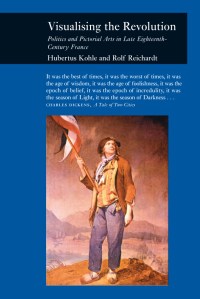 Hubertus Kohle and Rolf Reichardt, Visualizing the Revolution: Politics and Pictorial Arts in Late Eighteenth-Century France (London: Reaktion Books, 2008), 240 pages, 30 color ills.; 156 b/w ills. Cloth $45.00 (9781861893123)
Reviewed by Nina Dubin, Assistant Professor, Department of Art History, University of Illinois at Chicago; posted 19 August 2009
Among the strengths of Visualizing the Revolution: Politics and Pictorial Arts in Late Eighteenth-Century France—an ambitious new study co-authored by the historian Rolf Reichardt and the art historian Hubertus Kohle—is the compelling case it makes that prints comprised the art form par excellence of the age, less because of their representational force than because of the special capacity of the medium to embody the “message” of the Revolution. Published in newspapers, sold by street vendors, pirated, re-worked and re-circulated, printed pictures—particularly mass-produced etchings—asserted the new-found and irrepressible power of the many over the few, of the multiple over the singular. Prints, more than illustrating the events of the Revolution, decisively shaped them. . . .
While the authors are to be commended for the wealth of visual evidence they present, equally noteworthy is the book’s underlying provocation to the art historian: namely, that to prioritize the individual aesthetic achievement of works of Revolutionary art is to lose sight of their participation in a collective political project.
Prints of War
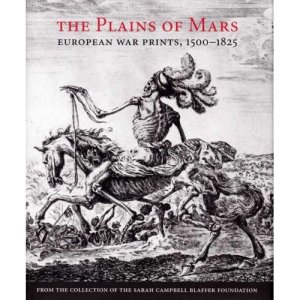 James Clifton, Leslie Scattone, Emine Fetvaci, Ira Gruber, and Larry Silver, The Plains of Mars: European War Prints, 1500-1825, from the collection of the Sarah Campbell Blaffer Foundation (Yale University Press), 254 pages, $65 (hardback) ISBN 9780300137224
Last week’s Art Newspaper includes a review by Alexander Adams of The Plains of Mars, the catalogue from a show that appeared at the Museum of Fine Arts, Houston earlier this year, February 7 – May 10, 2009.
◊ ◊ ◊ ◊ ◊
Editors have organised a diverse spectrum of material into themes, within which prints are sequenced chronologically. The catalogue section is preceded by enlightening essays dealing with the imagery of the Landsknecht (German mercenary of the 15th to 17th centuries), the recurrence of the Turk—as symbol of alien despotism and the exotic Orient—and the mixture of pictorial, cartographic and topographic modes in war prints. A concise survey by Professor Gruber deftly covers military developments in conflicts of this period. The catalogue section, complete with comparative figures, includes extensive commentaries necessary to contextualise individual prints . . .
The Plains of Mars presents a wealth of socially and historically important sources (some of them great artistic achievements) in a clear and authoritative fashion. A glossary, index and biographical notes of all featured artists conclude this impressive volume.
Read the full review at The Art Newspaper›
May I please . . .
 For many art historians, summer is the season for securing permissions for publishing images in forthcoming articles and books. Even without the copyright challenges that face our colleagues working on twentieth-century topics, the process is still often laborious and expensive. Susan Bielstein, Executive Editor for Art, Architecture, Classical Studies and Film at the University of Chicago Press, provides an essential starting point with her 2006 book, Permissions, A Survival Guide: Blunt Talk About Art as Intellectual Property.
Writing for caa.reviews, Christine Kuan, Senior Editor for Grove Art Online/Grove Dictionaries of Art, Oxford University Press, calls the book “concise, engaging, and digestible,” a valuable guide to a “convoluted and vexed subject.”
In thirteen chapters containing summaries of major court cases and their ramifications, countless hilarious anecdotes illustrative of copyright conundrums, footnotes, sample letters, useful sidebars, a sample image permissions log, a list of image sources, and suggested further reading, this book deftly interweaves explanations of intellectual property issues with real-life experiences in academic publishing.
Soon after the book’s release, Bielstein appeared on “The Library Café,” a weekly radio program from Vassar College then hosted by Dr. Thomas Hill. The website for WVKR FM 91.3 includes a ‘Listen Link’ for the 2007 episode featuring Bielstein. In addition to talking about her book, Bielstein addresses the state of the field of art history publishing more generally.
Versailles in the 18th Century
In a recent issue of the TLS (17 June 2009), John Rogister – author of Louis XV and the Parlement of Paris, 1737–1755 – reviews two new books on Versailles: Tony Spawforth, Versailles: A Biography of a Palace (St Martin’s Press, 2008); and William Ritchey Newton, Derrière la Façade: Vivre au château de Versailles au XVIIIe siècle (Librairie Académique Perrin, 2008) – along with a new printing of the 1886 English translation of Madam Campan’s memoirs (the original French edition appeared in 1822).


Baroque at the V&A

Massimiliano Soldani Benzi (1656-1740), Ewer Depicting the Triumph of Neptune Vase, Florence, ca. 1721, bronze (London: V&A Museum no. A.18-1959)

Catalogue edited by Michael Snodin and Nigel Llewellyn
BAROQUE 1620-1800: Style in the Age of Magnificence
Victoria and Albert Museum, London
April 4 – July 19
Robert Oresko’s review from Apollo (June 2009)
“Ever since Heinrich Wölfflin, the successor in Basel of Jacob Burckhardt, published his Renaissance und Barock (1888) and fixed the word ‘baroque’ into intellectual consciousness and discourse, its meaning has been a focal point of debate. The new and visually sumptuous exhibition at the Victoria & Albert Museum attempts a presentation attuned to concerns in the early 21st century.”
Robin Blake’s review from The Financial Times
“Baroque is certainly a conundrum, both superficial and profound, beautiful and ugly, ordered and chaotic, sexy and sacred. But for true devotees that is the essence of baroque charm – and they will find plenty to be charmed by in this show.”
Tom Lubbock’s review from The Independent
“Baroque 1620-1800: Style in the Age of Magnificence is the Victoria & Albert Museum’s spring blockbuster. . . And even before going through the door, you can see that it’s not going to narrow down the definition. Check that title: a movement generally set in the 17th century is extended through the whole of the following century, too.
What’s more, the show takes the Baroque out of Europe and across the world. Colonisation took it to Peru and to Indonesia. It was the first global style. And the exhibits go beyond art and artefacts – there’s every sort of luxury object, from an ornamental sled to an ornamental ostrich, an entire and huge Mexican altarpiece, and (on film) an authentic period firework display.
It does everything it can to imitate itself a Baroque spectacle. You proceed through galleries devoted to various places of display – the theatre, the public square, the church, the palace, the garden. Baroque music accompanies you. . . . There’s an obvious practical problem. The bigger the subject, the harder it is to exhibit it in a museum. . . .”










 Enfilade
leave a comment