In the Latest ‘Art Bulletin’
The December issue of The Art Bulletin 91 (2009) includes the following items addressing the eighteenth century:
Emma Barker, “Imaging Childhood in Eighteenth-Century France: Greuze’s Little Girl with a Dog,” pp. 426-45.
Author’s Abstract: “During the artist’s lifetime, A Child Playing with a Dog was one of Jean-Baptiste Greuze’s most admired and best-known works. The painting represent the physical, instinctual nature of the child in a manner unprecedented in French art. The image of childhood that it offers has close parallels in the scientific and medical discourse of the later eighteenth century. Like many contemporary commentators, Greuze evokes not simply the innocence of children but also their vulnerability, above all, that of little girls. He thereby implicates the viewer in the child’s fate, both for good and ill.”
Meredith Martin, review of Diplomatic Tours in the Gardens of Versailles under Louis XVI by Robert Berger and Thomas Hedin (University of Pennsylvania Press, 2008)) and Carmontelle’s Landscape Transparencies: Cinema of the Enlightenment by Laurence Chatel de Brancion (J. Paul Getty Museum, 2008), pp. 511-15.

 “Both Diplomatic Tours and Carmontelle’s Landscape Transparencies attempt to shed light on an underexplored aspect of French gardens and how they were portrayed in the ancien régime. As in a growing number of garden history books, the authors foreground questions of reception and use and treat these landscapes as a dynamic field of social relations — in other words, as a contested terrain. Both books also share an inclination to animate the garden as a kinetic experience by way of descriptive texts and visual images. . .” (512).
At the Watteau Show with a Dance Critic
In today’s New York Times, Alastair Macaulay considers Frederick Wiseman’s new documentary La Danse alongside the Watteau exhibition now at the Met:

Nicolas Lancret, "La Camargo Dancing” ca. 1730 (DC: National Gallery)
. . . Many of us who love ballet have found our feelings on this film to be conflicted. By chance, I saw it a few hours before I attended the Metropolitan Museum’s exhibition “Watteau, Music and Theater.” What a difference! If you love dance, “La Danse” isn’t the place to see why; “Watteau, Music and Theater” certainly is. The display fills only two rooms. Many of its pictures, especially those by Watteau himself, are not related to dance. Yet it spans, and often illuminates, the first century of existence of the institution in the film, the Paris Opera Ballet. True, ballet then was almost a different species. The paintings here help show the impact of the most famous achievement of the celebrated Paris Opera ballerina Marie Camargo, seen in a classic Nicolas Lancret painting from about 1730: the shortening of her skirts to give full exposure to her ankles and lower calves. “Watteau, Music and Theater” makes the dance of that era feel pristine. Here is the sunrise of a tradition. . .
For the full article, click here»
Listening to Furniture
Recently added to caa.reviews:
Dena Goodman and Kathryn Norberg, eds., Furnishing the Eighteenth Century: What Furniture Can Tell Us about the European and American Past (New York: Routledge, 2007), 272 pages, $69.95 (9780415949538)
Reviewed by Stacey Sloboda, Assistant Professor of Art History, Southern Illinois University; posted 4 November 2009.
In a conceptually wide-reaching and useful introduction to “Furnishing the Eighteenth Century: What Furniture Can Tell Us about the European and American Past,” editors Dena Goodman and Kathryn Norberg ask, “Can the settee speak?” (2). That this question remains relatively novel suggests the importance of the book. Their answer, of course, is affirmative; and the twelve essays that constitute this collection provide ample new, thoughtful, and frequently surprising revelations about what exactly eighteenth-century furniture said to a broad range of makers, users, and audiences. Written by scholars in the fields of history, literary studies, and art history, the essays are methodologically diverse yet unified by an interest in the social and cultural uses and meanings of objects and interiors in the eighteenth century. . . .
In a revelatory essay that should become standard reading for students of eighteenth-century French visual and material culture, “The Joy of Sets: The Uses of Seriality in the French Interior,” Mimi Hellman explores multiple reasons why sets, serial designs, and matching objects became characteristic features of the eighteenth-century French interior. Deftly weaving formal, cultural, and historical approaches to specific objects, Hellman deploys a wide range of theoretical insights, from anthropology to psychoanalysis, to argue that, “serial design was a crucial site for the enactment of elite self-fashioning, an eloquent representational system that elicited performances of social mastery” (147). Furthering the concept of signifying objects, Mary Salzman’s careful analysis of Jean-François de Troy’s pendant paintings “The Garter” and “The Declaration of Love” (1724) argues that decorative objects in de Troy’s paintings constitute a form of visual rhetoric that communicated with savvy viewers for whom judgment was an important critical activity. . . .
◊ ◊ ◊ ◊ ◊
Sloboda, Hellman, and Salzman are all HECAA members. For CAA members, the entire review can be found here»
Happy Birthday, Angelica Kauffman!
Angelica Kauffman turns 268 today. The following comes from Meredith Martin’s 2007 review of Angela Rosenthal’s book on the artist. From caa.reviews:
Angela Rosenthal, Angelica Kauffman: Art and Sensibility (New Haven: Yale University Press in association with Paul Mellon Centre for Studies in British Art, 2005) 352 pages, $65.
Reviewed by Meredith Martin, Assistant Professor, Wellesley College; posted 1 May 2007.
Cover Image: Angelica Kauffman, "Self-Portrait," detail, 1784 (Munich: Bayerische Staatgemäldesammlung Neue Pinakothek)
Rosenthal’s monograph restores Kauffman’s own work to center stage. Her project is not simply one of “historical recovery,” for as the author notes, “unlike some other female artists, [Kauffman] never fully lost her position within the art-historical canon” (2). Generally speaking, Kauffman’s story is not one of isolation or exclusion, but rather of strong support, widespread influence, and international renown. One need only glance at her voluminous, multilingual correspondence with the leading cultural figures of eighteenth-century Europe—Goethe, Johann Caspar Lavater, and Izabella Czartoryska among them—to get a sense of the professionally rewarding and breathlessly glamorous life that Kauffman led. Zoffany’s painting notwithstanding, Angelica Kauffman was nobody’s wallflower. . .

Member News
Angela Rosenthal is associate professor at Dartmouth. She specializes in early modern European visual culture (especially British art within a global perspective), with an emphasis on cultural history, gender studies, feminist and post-colonial theory, and the history of art criticism. She studied art history, psychology and social anthropology at Trier University, Germany and in the UK (The Courtauld Institute of Art, University College London, and Westfield College). Before joining the faculty at Dartmouth College in 1997, she was curator of contemporary art at the Stadtgalerie in Saarbrücken (1994-95), and Andrew W. Mellon Assistant Professor of Art History at Northwestern University (1995-97). Rosenthal’s most recent research project emerged from her past work on the visual formulation of subjectivity, as well as from her engagement with contemporary post-colonial art theory. In this new book project, entitled The White of Enlightenment: Racializing Bodies in 18th-Century British Visual Culture, Rosenthal seek to complement the growing field of research on concepts of “race” and “ethnicity” in the visual arts.
Meredith Martin joined the Wellesley faculty in 2008. She received a BA in Art History from Princeton University in 1997 and a PhD in the History of Art and Architecture from Harvard University in 2006. Her research interests include: eighteenth- and nineteenth-century French visual and material culture, architectural theory and landscape design; gender, space, and the domestic interior; early neo-classicism; art and colonialism; and the historiography of the Rococo. She is the co-author, with Scott Rothkopf, of Period Eye: Karen Kilimnik’s Fancy Pictures (Serpentine Gallery/Koenig Books, 2007). Her book, Dairy Queens: Pastoral Architecture and Political Theater from Catherine de’ Medici to Marie-Antoinette, is forthcoming from Harvard University Press, and she is also co-editing a volume with Denise Baxter entitled Architecture Space in Eighteenth-Century Europe: Constructing Identities and Interiors to be published by Ashgate next spring. Her current research addresses diplomatic and material exchanges between France and India in the late eighteenth century.
Collecting and Display in Italy
Recently added to caa.reviews:
Carole Paul, The Borghese Collections and the Display of Art in the Age of the Grand Tour (Aldershot, UK: Ashgate, 2008), 358 pages, $124.95 (9780754661344)
Reviewed by Jason Kelly, Assistant Professor, Department of History, IUPUI; posted 23 September 2009.
Carole Paul’s ‘The Borghese Collections and the Display of Art in the Age of the Grand Tour’ is an analysis of the shifting attitudes toward collection and display—form, content, and contexts—in the world of Settecento Rome. With a focus on the Borghese’s Galleria Terrena, the suites where most of the family’s paintings hung, and the Casino Nobile, home to the sculptures, Paul examines the interrelated narratives of aristocratic patronage, grand tour sociability, the international aesthetic landscape, and the development of museums. Her arguments rest on a detailed reading of the redesign of the Borghese galleries under Prince Marcantonio Borghese IV and his architect, Antonio Asprucci, beginning in 1767 and continuing to 1800. Paul argues that the re-outfitting of the Galleria Terrena and the Casino Nobile was “one of the most significant cultural events in Rome during the age of the Grand Tour” (2). The analysis of this process sheds light on how these exhibition spaces became the high point of the princely display of antiquities and paintings in eighteenth-century Rome. As readers familiar with Paul’s earlier publications, especially ‘Making a Prince’s Museum: Drawings for the Late-Eighteenth-Century Redecoration of the Villa Borghese‘ (Los Angeles: Getty, 2000), will recognize, ‘The Borghese Collections’ is the culmination of work that has been developing for some time. It extends many of the themes discussed in the earlier book by examining the entire aesthetic, iconographic, and didactic program of the late Settecento Borghese estate. . . .
In common with Christopher Johns’s ‘Papal Art and Cultural Politics: Rome in the Age of Clement XI‘ (Cambridge, UK: Cambridge University Press, 1993), Peter Bowron and Joseph Rishel’s ‘Art in Rome in the Eighteenth Century’ (Philadelphia: Philadelphia Museum of Art, 2000), and Jeffrey Collins’s ‘Papacy and Politics in Eighteenth-Century Rome’ (Cambridge, UK: Cambridge University Press, 2004), ‘The Borghese Collections’ examines eighteenth-century Rome’s vibrant artistic climate. Whereas Johns and Collins are concerned with papal collections and display, Paul’s work reveals the extent to which Roman aristocrats both innovated and competed with the Vatican. When comparing Prince Marcantonio Borghese IV’s program to that sponsored by Pope Pius VI Braschi at the Pio-Clementino in the 1780s, it is clear that rivalries spurred, at least in part, both patronage and new schemes for display. Along with these earlier books, Paul’s work reveals the importance of collecting as a political strategy, and she explains the centrality of iconographic programs to their design. ‘The Borghese Collections and the Display of Art in the Age of the Grand Tour’ is essential reading for students of Settecento museums, architecture, design, and the Grand Tour. . . .
◊ ◊ ◊ ◊ ◊
Writing for the TLS (30 September 2009) on the topic of artistic plunder in antiquity, Mary Beard (Cambridge classics professor and author of the blog, A Don’s Life) invokes Paul’s book in connection with evaluating the lines between collecting as an act of cultural productivity and collecting as a form of cultural destruction:
For a start, the contested boundary between the cultured patron and the obsessive, rapacious collector is an almost universal one. This is nicely illustrated in Carole Paul’s meticulous account of the display of the Borghese collection of paintings and antiquities in eighteenth- century Rome, ‘The Borghese Collections and the Display of Art in the Age of the Grand Tour’. In discussing the formation of the collection she devotes a short section to the seventeenth-century Scipione Borghese – a “distinguished . . . patron of the arts,” “a great Maecenas.” It is only in the next paragraph that we learn that “Scipione was also a remarkable – and ruthless – collector, who would stoop to confiscation and theft to obtain paintings, and even had artists imprisoned when they displeased him.” Same person, same habits: it all depended which side of Scipione’s patronage you were on.
Assessing the Glow of ‘Blake’ and ‘Brilliant Women’
Recent pieces from CAA.reviews address exhibition publications on William Blake at the Petit Palais in Paris and bluestockings at the National Portrait Gallery in London:
◊ ◊ ◊ ◊ ◊
Catherine de Bourgoing, ed., William Blake: Le Génie visionnaire du romantisme anglais, exhibition catalogue (Paris: Petit Palais and Musée de la Vie Romantique, 2009), 256 pages, €39 (9782759600779)
Exhibition schedule: Petit Palais and Musée de la Vie Romantique, Paris, April 2–June 28, 2009
Meredith Davis writes that
This overdue exhibition was expansive and thorough, if not inspirational; it was beautifully installed in the Petit Palais’s well-appointed special exhibition rooms, but the roughly thematic groupings were at times opaque or barely articulated. Arguably, Blake is as much a poet as a visual artist, and with a museum show such as this, one inevitably favors the visual dimension of his art over the literary. Typically problematic in this sense are his “Illuminated Books.” Among his most important works, these hand-printed manuscripts are miniscule in some cases; many, including his Songs of Innocence and Experience (1789–94), were certainly not meant to be presented as individual framed sheets of paper, but rather as objects to be cradled in one’s hands or lap, like a book of hours or diary. . . .
Despite such inherent difficulties, the exhibition succeeded in creating several intimate spaces and in offering a comprehensive presentation of Blake’s range. Blake’s long absence from France was remedied, and French audiences did get a broad view of Blake’s world. However, it is not certain that they came away from the exhibition with anything like a clear vision of his art (to the extent that such a thing is possible). The exhibition did not begin with an introductory wall text as one typically finds in a similar exhibition in the United States. Instead viewers were launched straight into a series of modestly scaled rooms, arranged around major works, themes, or historical benchmarks. In some ways the exhibition seemed to take a cue from Blake himself. . . .
Michael Phillips’s excellent catalogue essay, “William Blake Graveur Visionnaire,” provides some much-needed and detailed information on Blake’s printing processes. Phillips offers a lucid discussion of Blake’s technical innovations in printmaking, as well as discusses the symbolic significance the medium took on for Blake, pointing out how the artist drew parallels, for example, between the corrosive action of the acid on the plate (in etching) and a similar corrosion of the soul. The catalogue’s overall format mirrors the exhibition itself in its avoidance of linear narrative, choosing again a thematic and multi-vocal presentation of the artist. It does not provide a roadmap to the exhibition in any sense, but is a stand-alone volume with high ambitions. There are, in all, a total of thirty essays in the volume, some of them as short as five hundred words, all of them in French. While some essays are informative, others seem to end abruptly, or to focus on esoteric topics. Nonetheless, this approach clearly demonstrates the many dimensions of Blake’s work, as well as the range of current approaches to it.
◊ ◊ ◊ ◊ ◊
Elizabeth Eger and Lucy Pelz, Brilliant Women: 18th-Century Bluestockings (New Haven: Yale University Press, 2008). 160 pages; 84 color illustrations; 64 b/w illustrations, cloth $50 (9780300141030)
Exhibition schedule: National Portrait Gallery, London, March 13–June 15, 2008
Wendy Wassyng Roworth writes that
Brilliant Women is not a catalogue; however, all the works in the exhibition are splendidly illustrated, many in high-quality color or as full-page reproductions. Portraits of the bluestockings, their associates, and followers, along with engravings, drawings, caricatures, and Wedgwood plaques provide an abundance of visual material not usually available in studies of literary figures. Intended primarily for general readers and exhibition visitors, Brilliant Women does not break major new ground but offers an excellent overview of the bluestocking phenomenon. However, the authors’ focus on visual representations of learned women in portraits, book illustrations, and other pictorial forms and their analyses of how and why bluestockings were depicted by both admirers and critics makes this study useful for scholars of eighteenth-century art, literature, and history. This consideration of visual imagery contributes to a larger understanding of the vital role women played in the eighteenth-century republic of letters through their images as well as their works in ways that textual accounts alone cannot achieve. Whether disparaged and mocked in caricature, elevated as allegorical personifications, or portrayed as graceful ladies in fashionable dress, these images call attention to the complex identities of intellectually ambitious women.
New Books: Recently Posted at caa.reviews
caa.reviews recently posted reviews of two late-eighteenth-century books. Brief excerpts are provided below; for the full texts, click on the picture of each book.
◊ ◊ ◊ ◊ ◊
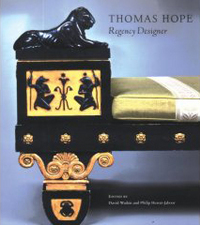 Philip Hewat-Jaboor and David Watkin, eds. Thomas Hope: Regency Designer, exhibition catalogue (New York and New Haven: Bard Graduate Center for Studies in the Decorative Arts, Design, and Culture and Yale University Press, 2008). 520 pages; 420 color ills.; 40 b/w ills. Cloth $100.00 (9780300124163).
Reviewed by Christopher Drew Armstrong, Assistant Professor, Department of History of Art & Architecture, University of Pittsburgh; posted 18 August 2009
An unparalleled glimpse into Hope’s world and by extension into the world of design and elite culture after the French Revolution was provided last fall by the exhibition Thomas Hope: Regency Designer, organized by the Bard Graduate Center for Studies in the Decorative Arts, Design, and Culture. The effort that went into assembling objects for the exhibition and texts for the accompanying catalogue was fully justified by the results, yielding the most complete panorama of Hope’s activities as a designer and collector since the contents of his residences were dispersed. Simultaneous to John Soane’s experiments in his house at Lincoln’s Inn Fields, and Percier’s and Fontaine’s renovation of La Malmaison, Hope was borrowing from the same sources and exploring similar ideas. Though his houses have been demolished, it is now possible to imagine the wealth of innovation that went into their planning and to appreciate how Hope’s interiors and furnishings were used to showcase his aspirations and ideals.
◊ ◊ ◊ ◊ ◊
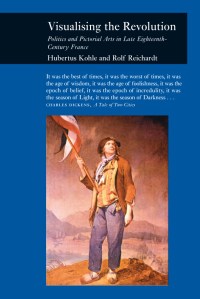 Hubertus Kohle and Rolf Reichardt, Visualizing the Revolution: Politics and Pictorial Arts in Late Eighteenth-Century France (London: Reaktion Books, 2008), 240 pages, 30 color ills.; 156 b/w ills. Cloth $45.00 (9781861893123)
Reviewed by Nina Dubin, Assistant Professor, Department of Art History, University of Illinois at Chicago; posted 19 August 2009
Among the strengths of Visualizing the Revolution: Politics and Pictorial Arts in Late Eighteenth-Century France—an ambitious new study co-authored by the historian Rolf Reichardt and the art historian Hubertus Kohle—is the compelling case it makes that prints comprised the art form par excellence of the age, less because of their representational force than because of the special capacity of the medium to embody the “message” of the Revolution. Published in newspapers, sold by street vendors, pirated, re-worked and re-circulated, printed pictures—particularly mass-produced etchings—asserted the new-found and irrepressible power of the many over the few, of the multiple over the singular. Prints, more than illustrating the events of the Revolution, decisively shaped them. . . .
While the authors are to be commended for the wealth of visual evidence they present, equally noteworthy is the book’s underlying provocation to the art historian: namely, that to prioritize the individual aesthetic achievement of works of Revolutionary art is to lose sight of their participation in a collective political project.
Prints of War
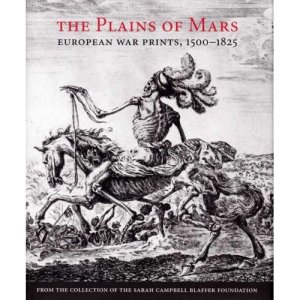 James Clifton, Leslie Scattone, Emine Fetvaci, Ira Gruber, and Larry Silver, The Plains of Mars: European War Prints, 1500-1825, from the collection of the Sarah Campbell Blaffer Foundation (Yale University Press), 254 pages, $65 (hardback) ISBN 9780300137224
Last week’s Art Newspaper includes a review by Alexander Adams of The Plains of Mars, the catalogue from a show that appeared at the Museum of Fine Arts, Houston earlier this year, February 7 – May 10, 2009.
◊ ◊ ◊ ◊ ◊
Editors have organised a diverse spectrum of material into themes, within which prints are sequenced chronologically. The catalogue section is preceded by enlightening essays dealing with the imagery of the Landsknecht (German mercenary of the 15th to 17th centuries), the recurrence of the Turk—as symbol of alien despotism and the exotic Orient—and the mixture of pictorial, cartographic and topographic modes in war prints. A concise survey by Professor Gruber deftly covers military developments in conflicts of this period. The catalogue section, complete with comparative figures, includes extensive commentaries necessary to contextualise individual prints . . .
The Plains of Mars presents a wealth of socially and historically important sources (some of them great artistic achievements) in a clear and authoritative fashion. A glossary, index and biographical notes of all featured artists conclude this impressive volume.
Read the full review at The Art Newspaper›
May I please . . .
 For many art historians, summer is the season for securing permissions for publishing images in forthcoming articles and books. Even without the copyright challenges that face our colleagues working on twentieth-century topics, the process is still often laborious and expensive. Susan Bielstein, Executive Editor for Art, Architecture, Classical Studies and Film at the University of Chicago Press, provides an essential starting point with her 2006 book, Permissions, A Survival Guide: Blunt Talk About Art as Intellectual Property.
Writing for caa.reviews, Christine Kuan, Senior Editor for Grove Art Online/Grove Dictionaries of Art, Oxford University Press, calls the book “concise, engaging, and digestible,” a valuable guide to a “convoluted and vexed subject.”
In thirteen chapters containing summaries of major court cases and their ramifications, countless hilarious anecdotes illustrative of copyright conundrums, footnotes, sample letters, useful sidebars, a sample image permissions log, a list of image sources, and suggested further reading, this book deftly interweaves explanations of intellectual property issues with real-life experiences in academic publishing.
Soon after the book’s release, Bielstein appeared on “The Library Café,” a weekly radio program from Vassar College then hosted by Dr. Thomas Hill. The website for WVKR FM 91.3 includes a ‘Listen Link’ for the 2007 episode featuring Bielstein. In addition to talking about her book, Bielstein addresses the state of the field of art history publishing more generally.
Versailles in the 18th Century
In a recent issue of the TLS (17 June 2009), John Rogister – author of Louis XV and the Parlement of Paris, 1737–1755 – reviews two new books on Versailles: Tony Spawforth, Versailles: A Biography of a Palace (St Martin’s Press, 2008); and William Ritchey Newton, Derrière la Façade: Vivre au château de Versailles au XVIIIe siècle (Librairie Académique Perrin, 2008) – along with a new printing of the 1886 English translation of Madam Campan’s memoirs (the original French edition appeared in 1822).












 Enfilade
leave a comment