Magnasco Painting for the Musée d’Art et d’Histoire du Judaisme
Writing for The Art Tribune (14 December 2010), Didier Rykner happily notes that the Musée d’Art et d’Histoire du Judaisme in Paris recently acquired The Jewish Funderal, “a superb painting” by Alessandro Magnasco (1667-1749). The downside is that

Alessandro Magnasco, "Homage to Pluto" (Photo: Galerie Canesso
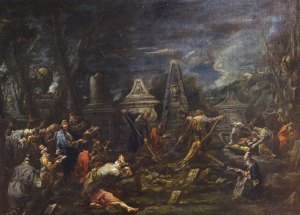
Alessandro Magnasco, "The Jewish Funeral" (Paris, Musée d’Art et d’Histoire du Judaïsme) Photo: Galerie Canesso
this canvas which had been reunited with its companion piece, Homage to Pluto, by the previous owner will once again find itself separated. Understandably, the museum was only interested in the first which was declared ‘a work of major importance to heritage’ by the Commission des tresors nationaux. It was the only one which could thus benefit from a contribution by a patron (who has for the time being remained anonymous), making it possible for it to join the museum collections.
The pairing of the two subjects, one representing a pagan ceremony, the other a Jewish rite, corresponds to the artist’s (and perhaps the person commissioning) wish to illustrate two non-Catholic religious events although their association may seem a bit strange. Despite the fact that this seems to be the only known scene of a Jewish funeral by Magnasco, the painter also represented synagogue interiors on various occasions such as, for example, in a painting held in Cleveland.
The full article is available here»
ICON Conservation Award Goes to Hanbury Hall
As noted by Emile de Bruijn at Treasure Hunt, ICON (The Institute of Conservation) presented the 2010 Pilgrim Trust Award for Conservation to Hanbury Hall for its care of Sir James Thornhill’s staircase wall paintings (ca. 1710). In addition to the official statement from ICON included below, additional information and photographs are available here»

Sir James Thornhill, Painted Walls of the Staircase at Hanbury Hall, ca. 1710 ©NTPL/John Hammond
Winner: Hanbury Hall staircase wall paintings of c.1710 by Sir James Thornhill – The Perry Lithgow Partnership.
A 10-year conservation project at the National Trust’s Hanbury Hall has re-established the unity of this historic painted space, enabling the trompe l’oeil effects to be appreciated as Thornhill intended, and adding considerably to our understanding of English Baroque wall painting techniques. It was a bold move to let the public view the paintings via scaffolding, thus creating an excellent model for public access.
The 2010 Georgian Group Architectural Awards
As noted at the Georgian Group’s website:
The 2010 Architectural Awards were presented by Baroness Andrews OBE, Chairman of English Heritage, on 3 November. The judges were Dr John Martin Robinson (architectural historian and historic buildings consultant); Lady Nutting OBE (Chairman of the Georgian Group); Professor David Watkin (Emeritus Professor of the History of Architecture, University of Cambridge); Charles Brooking (architectural historian and founder of The Brooking Collection); Charles Cator (Deputy Chairman, Christie’s International); and Crispin Holborow (Director of Country Property, Savills).
Our Architectural Awards, sponsored by international estate agents Savills, recognise exemplary conservation and restoration projects in the United Kingdom and reward those who have shown the vision and commitment to restore Georgian buildings and landscapes. Awards are also given for high-quality new buildings in Georgian contexts and new architecture in the Classical tradition.
T HE 2 0 1 0 W I N N E R S

Restoration of a Georgian Country House
- Winner: Buckland House, Faringdon, Oxon (Edmonts of Swindon for Summerstone Assco SA) — 1757 by John Wood the Younger. Conservation of stonework and comprehensive restoration of interiors.
- Commended: Sandridge Park, Stoke Gabriel, Devon (Watson Bertram & Fell for Mark and Rosemary Yallop) — 1805 by John Nash. Restoration since 2006 including rebuilding part of the house removed in the 1950s, removal of a 1980s glass pitched roof and 1980s garage, filling in of indoor swimming pool and re-creation of 1805 conservatory (lost in 1930s) using contemporary engraving.
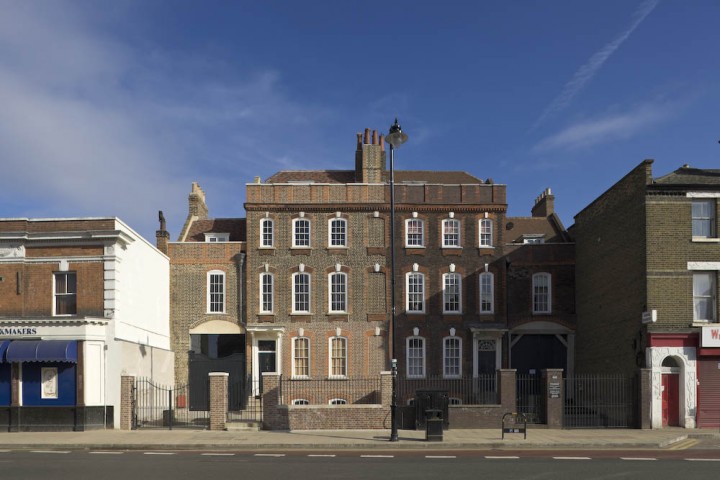
Commended: 810 Tottenham High Road, London, 1715
Restoration of a Georgian Building in an Urban Setting
- Winner: Buckingham Palace, Quadrangle (Martin Ashley Architects for Royal Household) — conservation of the east elevation of the quadrangle, including pediment containing Edward Baily’s 1827 Nine Muses tympanum sculpture, designed for the end gable of Nash’s south range and reused within Blore’s east range when that was added in 1847. Removal of paint and cement mortar, piecing in of new Caen stone.
- Winner: Lancaster House, London SW1 (Feilden & Mawson/Triton Building Restoration for Foreign & Commonwealth Office) — 1825. Façade cleaning, stone repair and redecoration, new lead weatherings and replacement wooden garden gates reusing original ironmongery.
- Commended: 42 King Street, Thorne, Doncaster, Yorks (Russell Light for South Yorkshire Building Preservation Trust) — 1747 merchants’ house, in state of collapse when acquired by trust in 2005. Refenestration, removal of cement render, reroofing, repair of surviving interior fitting and replacement where lost.
- Commended: 810 Tottenham High Road, London N15 (Butler & Hegarty for Haringay Building Preservation Trust) — 1715, part of earliest pair of Georgian townhouses in London (No808 was restored 2002/3 and received a Georgian Group award). Derelict and building at risk for 25 years. Stabilised, shops in front yard removed, street elevation and roof fully restored and reinstated.
- Commended: 55-57 Westgate Road, Newcastle-upon-Tyne (GWK Architects for Newcastle Arts Centre) — 1750 townhouse. Reinstatement of lost stone façade at ground floor level, lost dormers and sash windows, reroofing and interior refurbishment.
Reuse of a Georgian Building
- Winner: Dandridge’s Mill, East Hanney, Oxfordshire (LAPD for Hallidays Developments) — 1820s silk mill, derelict by 2007 when bought by current owners and now converted to apartments. Mill pond reused to generate hydro-electricity for the development, by means of an Archimedes Screw.
Restoration of a Georgian Church
- Winner: St Alkmund, Shrewsbury (Arrol & Snell for Church of England) — Multi-phase church, nave and chancel 1790s by John Carline in Gothic idiom. Extensive repair and restoration of cast iron traceried windows and boundary railings, all cast at Coalbrookdale; restoration of 1790s east window by Francis Eginton; new slate roof; and repair of fixtures such as Carline’s altar table.

Commended: Queen Anne’s Summerhouse, Old Warden Park, Bedfordshire, 1712
Restoration of a Georgian Garden or Landscape (includes garden buildings)
- Winner: Valentines Park, Ilford (Richard Griffiths Architects for London Borough of Redbridge) — Restoration of Rococo garden built by Robert Surman, deputy cashier to South Sea Company. Rescue of octagonal dovecote, silted-up Long Water, shell grotto, garden walls and flint alcove seat, all on verge of being lost.
- Commended: Chillington Hall, Codsall Wood, Staffs – the Dovecote (Horsley Huber Architects for Mr and Mrs John Giffard) — 1730 brick octagonal dovecote, centrepiece of service courtyard. Ruinous condition. Reinstatement of lost oak roof, cupola and windows.
- Commended: Lytham House, Lancs – the Privy (By and for Heritage Trust for the North-West) — Early C19, brick in Gothic style. Partly collapsed and at risk by 2008, conservatively repaired and rebuilt inside and out with project used to teach traditional building skills.
- Commended: Queen Anne’s Summerhouse, Old Warden Park, Beds (The Whitworth Co-Partnership for The Landmark Trust) — 1712 rubbed-brick folly on Shuttleworth Estate. Converted to Landmark Trust letting property. Comprehensive restoration using traditional methods.
◊ ◊ ◊ ◊ ◊
The photos used above are all drawn from The Georgian Group Blog. Information about the Georgian Group awards for new buildings projects in the classical tradition can be found here»
Jonathan Brown Is CAA’s 2011 Distinguished Scholar
From CAA:
 The study of Iberian art on both sides of the Atlantic from the sixteenth to nineteenth centuries has been immeasurably enriched by the scholarly efforts of Jonathan Brown. Through his writing and teaching he has made his academic home, the Institute of Fine Arts at New York University, a premier center for the study of visual arts of Spain and New Spain. Brown’s work has concerned painting, sculpture, and architecture—though painting has always held pride of place in his aesthetic imagination. His main interests have been the arts of Spain from the birth of the Golden Age in the sixteenth century and, more recently, painting in viceregal New Spain in the seventeenth and eighteenth. Among more modern artists, Francisco de Goya has also played a significant role in Brown’s scholarly profile, and his efforts in the history of collecting have brought his art-historical concerns up to the twenty-first century. . .
The full article is available here»
Anne Poulet, Director of The Frick, Announces Retirement
Press release from The Frick Collection:
Anne Poulet to Retire in September 2011

Director Anne L. Poulet (Photo: Christine A. Butler)
Margot Bogert, Chairman of The Frick Collection, announces that Director Anne L. Poulet will retire in the fall of 2011, following a remarkable tenure. “The Board of Trustees is deeply indebted to Anne Poulet for her leadership of The Frick Collection and accepts her retirement with enormous regret. Having served the institution with great distinction, commitment, and wisdom, Anne leaves the Frick—both the museum and the library—with a brilliant and multi-faceted legacy and a glowing and solid future. Principal among the long list of achievements associated with her leadership is a strong program of critically acclaimed exhibitions and publications, which provided visitors with new perspectives on artists and media represented in the collection and, in many cases, those complementary to it. Anne made remarkable acquisitions, by both purchase and gift, while maintaining an unwavering focus on the care and interpretation of the Frick’s existing holdings. Building on the strengths of the collection, she added staffing critical to the curatorial, conservation, education, and publications functions, most notably, creating an endowed position for the Frick’s first curator of decorative arts. Anne has directed a sensitive, systematic refurbishment of the 1914 mansion’s galleries and public spaces, a progression of initiatives that has often been cited as a model for museum custodianship. In the coming year, this work continues with the enclosure of the Fifth Avenue portico to create the first new gallery space added to the building in over thirty years. Under Anne Poulet, the Frick Art Reference Library has proactively pursued digitization and collection-sharing initiatives. The library’s mission to serve scholars has been enhanced by the continued development of its holdings and by the initiation of the ground-breaking creation of the Center for the History of Collecting in America. Finally, the overall health of The Frick Collection has been fortified by Anne’s successful fundraising program, through which she has fostered many avenues for support during challenging economic times. These include the formation of the Director’s Circle and a roster of fundraising events ranked highly on philanthropic and social calendars. With our supporters’ confidence in the future of the Frick at an all-time high, we owe Anne Poulet a huge debt of gratitude, knowing that as we move forward in the next year with the search for her successor, the institution is well-poised to make this transition and continue on a smooth and uncompromisingly productive path.” (more…)
Reattribution Points to Romney
Press release from the Dallas Museum of Art (8 September 2010) . . .

George Romeny, "Young Man with a Flute," ca. 1760s (Dallas Museum of Art) -- previously attributed to the American painter, Ralph Earl.
The Dallas Museum of Art announces the reattribution of the painting, Young Man with a Flute, to the artist George Romney. The work of art has been in the Museum’s collections for nearly 25 years and entered it in 1987 as part of a bequest of Mrs. Sheridan Thompson. At the time of the painting’s acquisition, the artist was unknown but the painting was thought to be by the American colonial era portrait painter Ralph Earl.
Then in 2000 on a visit to the Museum, British art dealer Phillip Mould suggested that the painting might be the oeuvre of English painter George Romney (1734–1802) but was not able to provide further evidence to the DMA. Ten years later, and soon after his arrival at the DMA from the Louvre, Olivier Meslay, Senior Curator of European and American Art and The Barbara Thomas Lemmon Curator of European Art, viewed the painting in the art storage area, learned of Mould’s earlier suspicion, and wanted to know more. He showed the work of art to another visiting expert, Piers Davies, Specialist of Old Master Paintings with Christie’s, New York. Davies, like Mould a decade earlier, immediately noted the likeness of Young Man with a Flute to the style of similar portraits by Romney from around the same time period, 1760–1770.
Meslay then contacted the internationally renowned Romney expert Alex Kidson, Consultant Curator with the National Museums Liverpool. Kidson analyzed the painting and determined the painter to be George Romney, a key figure in 18th-century British art. Romney was a contemporary of Sir Joshua Reynolds and Thomas Gainsborough and after Reynolds’ death in 1792 Romney became the most famous portrait painter in England. . . .
Mrs. Sheridan Thompson purchased Young Man with a Flute in 1961 from Hirschl & Adler Galleries in New York. Prior to that, the gallery had purchased the painting from a gentleman in 1960 who resided in London. It is unknown when the painting was wrongly attributed to Ralph Earl, but Earl did study in London for a number of years and focused in portrait paintings.
New British Studies Center Opens at Rutgers
As reported earlier this year by Fredda Sacharow in Rutgers Today. From the website of the new British Studies Center at Rutgers:
“What’s in a name?” Juliet famously asks in Shakespeare’s iconic tale of young love. For the Rutgers British Studies Center – nee the Rutgers British Studies Project – a name not only confers new, formal status, but also suggests that the state university is positioning itself to become a pre-eminent venue for interdisciplinary scholarship on topics from Beowulf to Tony Blair. Bolstered by a $407,000 grant from the Andrew W. Mellon Foundation, the Rutgers British Studies Center symbolically opened its doors earlier this semester with programs designed to attract academics across multiple fields, including history, English, anthropology, art history, and political science.
“We want to be a destination for the region – scholars based in New York and Pennsylvania, for example, will say, ‘Okay, here’s a place where you can come and interact with others in your field and outside of it,’ ” says Alastair Bellany, director of the fledgling center and a professor of history in Rutgers’ School of Arts and Sciences. “We hope to start a high-quality conversation: There will be arguments, there will be debates, but the interaction will all be productive. Colleagues from other fields will help you fill in the gaps in your own knowledge.”
They began modestly in the fall of 2006, a small band of English and history professors divided by disciplines but united in their passion for all things British. Hoping to turn intermittent conversations over coffee into something more formal, they began scheduling faculty workshops, importing visiting scholars, and co-sponsoring daylong conferences under the auspices of what became known as the British Studies Project.
Then, a milestone: The inaugural public lecture, by John Brewer, drew a substantial audience in October 2007, including a healthy contingent of graduate students. The professor of history at Cal Tech and an influential modern historian of 18th-century British politics, society, and culture spoke on “Taste and Modernity: Sensibility and Spectacle in Late Georgian Britain” . . . .
The full article is available here»
Revolutionary War Museum to Be Built in Philadelphia
As reported by Joann Loviglio for the Associated Press (10 September 2010) . . .

Independence Hall, Philadelphia (Photo by Dan Smith, Wikimedia Commons)
A spot for a Revolutionary War museum has finally been chosen after 11 years of planning and bureaucratic squabbling — about three years longer than it took the Colonies to win independence. Under an agreement that becomes official Friday, the National Park Service will hand over a site near Philadelphia’s Independence Hall, Liberty Bell and other landmarks to the American Revolution Center. In exchange, the Revolution Center will turn over 78 acres in Valley Forge to the National Park Service. Center officials say their project will be the first national museum dedicated to the Revolution. It will rotate its collection of thousands of 18th-century objects, artifacts and manuscripts and will offer programs, classes and lectures on the War for Independence. . . .
The full article is available here» An editorial from The Philadelphia Inquirer describes it as “revolutionary win-win.”
Will the Wedgwood Museum Survive?
As reported by Martin Bailey in The Art Newspaper (18 August 2010) . . .
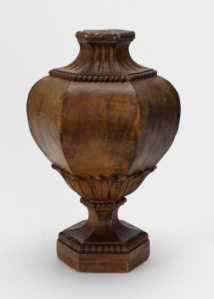
An 18th-century wooden block mould, © Wedgwood Museum
A fundraising campaign may be launched to save the Wedgwood Museum outside Stoke on Trent, if courts rule that its collection can be sold to pay the pensions liability of the Waterford Wedgwood company, which went into administration in January 2009.
Through a legal quirk, the Wedgwood Pension Fund trustees, who face a deficit of £134m for employees, may be able to claim against the museum. The museum had only six staff in the scheme, whose pension interest represented £60,000, but it could be liable for all of the fund’s 7,000 claimants.
Because of the pensions issue, the Wedgwood Museum Trust was itself put under administration in January, and it is temporarily run by insolvency practitioner Begbies Traynor. The next stage is for the courts to decide whether the museum’s assets could be seized. This is a complex legal matter and is likely to require a detailed hearing to resolve this autumn. In the meantime, the museum remains open to visitors, as normal.. . . .
The full story can be found here»
◊ ◊ ◊ ◊ ◊
Back in July, Lucy Ingliss provided a thoughtful response to the uncertain future of the Wedgwood Museum at Georgian London. Ironically, the Wedgwood Museum was awarded the Art Fund Prize in 2009, just after the completion of an extensive construction project. As noted on the museum’s website:
It’s official! The Wedgwood Museum is Britain’s best museum. The news that the independent Stoke on Trent museum has won the £100,000 Art Fund Prize 2009 – the UK’s largest single arts prize – was announced last night (18 June) at the Royal Institute of British Architects in London. The Art Fund Prize honours the most imaginative and original museum or gallery of the year and is a huge accolade for the museum, which only opened last October after the charitable Wedgwood Museum Trust spent nearly a decade raising funds to build it. . .
Communion Silver Acquired for Birmingham
Press release from the Art Fund (10 August 2010) . . .
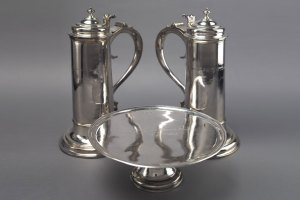 A rare collection of communion silver – with some pieces dating back over 500 years – has just been bought for Birmingham with the help of a £27,000 grant from the Art Fund. The collection consists of a rare pre-Reformation silver parcel-gilt paten engraved with the Manus Dei (‘Hand of God’) c.1450; a silver communion cup (1634) and a pair of silver flagons and standing paten by London silversmith Anthony Nelme. The flagons are engraved with the inscription: ‘A Gift to Castle Bromwich Chapple in the Year 1723’. The silver will initially go on display at Aston Hall, until the end of October, and will then move to its permanent home at Birmingham Museums & Art Gallery.
Stephen Deuchar, Director of the Art Fund, said: “This historic Anglican Communion highlights the history of the local Church and also shows off the work of a leading silversmith. We’re really pleased that Birmingham Museums & Art Gallery will now be its permanent home, so people can admire it for years to come.”
The other funding partners who helped reach the full £54,000 asking price were the MLA/V&A Purchase Grant Fund (£17,000), City of Birmingham Museums & Art Galleries Development Trust (£10,000) and Friends of Birmingham Museums & Art Gallery (£2,000).










 Enfilade
leave a comment