Installation | Nicolas Party and Rosalba Carriera
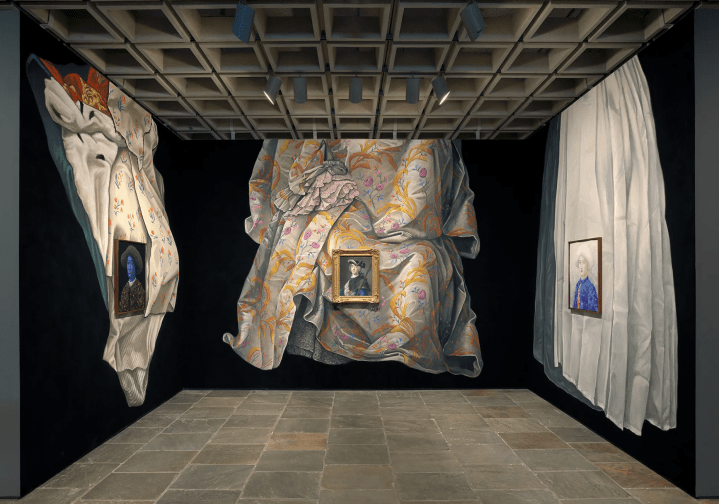
Installation View of Nicolas Party and Rosalba Carriera at Frick Madison, 2023
(Photo by Joseph Coscia Jr.)
◊ ◊ ◊ ◊ ◊
From the press release for the installation:
Nicolas Party and Rosalba Carriera
The Frick Madison, New York, 1 June 2023 — 3 March 2024
Organized by Xavier F. Salomon
The Frick Collection has unveiled a large pastel mural commissioned from the Swiss-born artist Nicolas Party at the museum’s temporary home, Frick Madison. This site-specific work was created in response to Rosalba Carriera’s Portrait of a Man in Pilgrim’s Costume—one of two eighteenth-century pastels by Rosalba bequeathed to the Frick by Alexis Gregory in 2020. The installation features Rosalba’s superb portrait at the center of a three-wall mural designed by Party, as well as two new related works specially created by Party for this presentation.
On view from 1 June 2023 through the remainder of the Frick’s residency at the Breuer building (until 3 March 2024), this installation will inspire the Frick’s summer and early fall programming as well as a new publication.
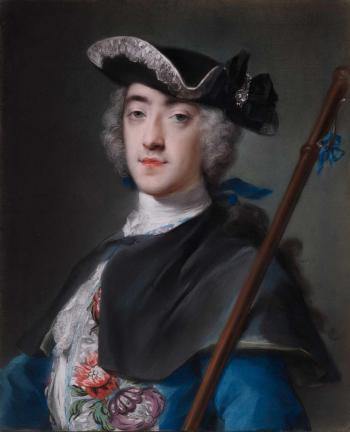
Rosalba Carriera, Portrait of a Man in Pilgrim’s Costume, ca. 1730. pastel on paper, glued to canvas, 59 × 48 cm (New York: The Frick Collection, Gift of Alexis Gregory, 2020.3.01).
The project, which also marks the 350th anniversary of Rosalba’s birth, is organized by Xavier F. Salomon, the Frick’s Deputy Director and Peter Jay Sharp Chief Curator. Salomon comments, “It has been a particular pleasure to work with Nicolas Party. I met Nicolas in April 2021 and since then have enjoyed an ongoing and enlightening conversation on pastels. Nicolas’s installation at Frick Madison is the result of our exchanges, and I am delighted with the result.”
Party adds, “When I first fell in love with pastels, some ten years ago, my research quickly led me to the queen of pastel, Rosalba. Her practice and love for the powdery sticks increased the popularity of the medium and were crucial to the development of the art form. I felt a powerful attraction to her pastels. Today, I like to think our approaches might not be all that different.”
Born in Venice, Rosalba Carriera (1673–1757) was celebrated throughout Europe during her lifetime for her portraiture. She was the preeminent portraitist in Venice in the mid-eighteenth century, at the same time the Venetian Carnival reached its zenith. During this period, foreign travelers flocked to Venice for the masked revelries that became synonymous with the city, and Rosalba’s studio was a popular stop for visiting foreigners, who often posed for her in their elegant Carnival costumes. Portrait of a Man in Pilgrim’s Costume (ca. 1730) is most likely one such work. The sitter is possibly French, British, or German, but his identity remains unknown. With his black cape, staff, and jaunty tricorn hat, he is depicted as a pilgrim.
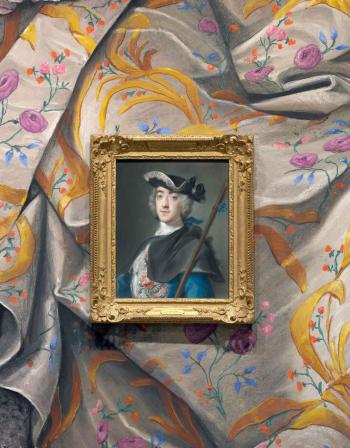
Installation View of Nicolas Party and Rosalba Carriera at Frick Madison, 2023 (Photo by Joseph Coscia Jr.)
Party’s mural includes elaborate draperies that highlight the Rosalba portrait along with two additional pastel portraits he created in response to it. These ornate draperies evoke the work of two other towering figures in European pastels—Jean-Étienne Liotard (1702–1789) and Maurice-Quentin de La Tour (1704–1788)—echoing the function of Venetian Carnival masks, designed to conceal and reveal the features of their wearers. Party’s installation engages devices of disguise and disclosure, from masks to draperies to makeup (often produced with the same chemical components used to make pastel sticks).
The large-scale murals created by Party, whose primary medium since 2013 has been pastel, are ephemeral, lasting only for the duration of a specific exhibition at a unique location. The historical nature of his practice aligns perfectly with the installation at Frick Madison, which has given the museum a unique opportunity to re-imagine its permanent collection display, presented for the first time outside the domestic setting of the Gilded Age mansion at 1 East 70th Street.
This project is part of a series of initiatives in recent years that invite contemporary responses to the Frick’s holdings. Party’s installation not only offers a fresh perspective on an important recent acquisition, but furthers Frick Madison’s prompting of visitors to question the impact of site and setting on their perception of historic objects in the collection.
Born in Lausanne in 1980, Party is a figurative painter who has achieved critical admiration for his familiar yet unsettling landscapes, portraits, and still lifes that simultaneously celebrate and challenge conventions of representational painting. His works are primarily created in soft pastel, which allows for exceptional degrees of intensity and fluidity in his depictions of objects both natural and manmade. Transforming these objects into abstracted, biomorphic shapes, Party suggests deeper connections and meanings. His unique visual language has coalesced in a universe of fantastical characters and motifs where perspective is heightened and skewed to uncanny effect.
Over the years, Party has created work in response to that of European painters including Louis-Léopold Boilly (1761–1845), Arnold Böcklin (1827–1901), and René Magritte (1898–1967). In 2019, Party organized the pastel exhibition at the FLAG Art Foundation in New York, where he created large—and ephemeral—pastel murals inspired by French eighteenth-century artists including François Boucher (1703–1770) and Jean-Honoré Fragonard (1732–1806), both of whom are represented in the Frick’s permanent collection.
Nicolas Party and Xavier Salomon, Rosalba Carriera’s Man in Pilgrim’s Costume (London: Giles, 2023), 80 pages, ISBN: 978-1913875510, £20 / $25.
Funding for the installation is generously provided by The Christian Humann Foundation and the David L. Klein, Jr. Foundation, with the support of the Swiss Arts Council Pro Helvetia.
◊ ◊ ◊ ◊ ◊
Note (added 25 August 2023) — The posting was updated with details on the publication.
Exhibition | Visions in Porcelain: A Rake’s Progress
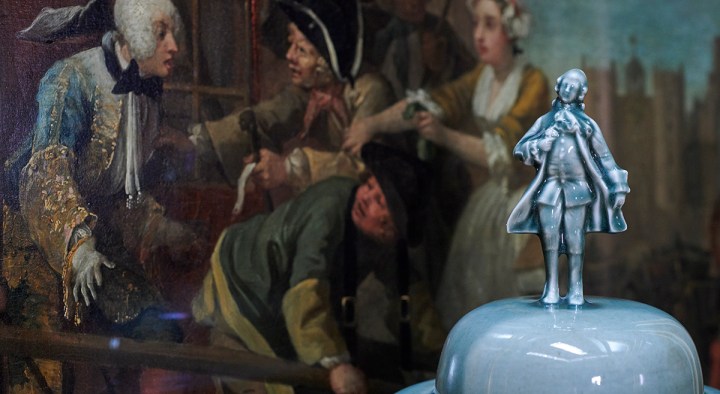
Opening this week at the Soane Museum:
Visions in Porcelain: A Rake’s Progress
Sir John Soane’s Museum, London, 7 June — 10 September 2023
Bouke de Vries’ latest work—beautifully displayed in the Museum’s Foyle Space— responds to William Hogarth’s A Rake’s Progress.
Inspired by Hogarth’s series of original paintings at the Soane Museum, de Vries draws on his love of storytelling, and talent for symbolism through ceramics, with eight newly created porcelain vases presented in various states of (dis)repair. Starting with an immaculate celadon vase, de Vries treats the following seven increasingly deteriorating vases with a variety of restoration processes and glazes, which parallel the moral and physical degeneration of Hogarth’s anti-hero Tom Rakewell. Cracks appear in the surface, the vessels slump and implode—with obvious and drastic methods of repair failing to save the vase or Rake from their ultimate demise.
Originally working in fashion before retraining as a restorer, Bouke de Vries began creating his works of art in 2008. He has since gained a significant following and now has work in an impressive range of international public collections, including the National Museum of Scotland; the National Museum of Art, Architecture, and Design in Oslo; and the Philadelphia Museum of Art. De Vries sees an inherent value in the discarded objects he reinvents, giving a new lease of life to a broad spectrum of ceramics otherwise destined to be thrown away.
Bouke de Vries in Conversation with Louisa Buck
13 June 2023, 7pm BST
To celebrate the opening of his new exhibition Visions in Porcelain: A Rake’s Progress, ceramic artist Bouke de Vries will discuss his latest work with Louisa Buck, a contributing editor and London contemporary art correspondent for The Art Newspaper and a regular reviewer and commentator on BBC radio and TV. The evening includes an exclusive out-of-hours viewing of the exhibition and the opportunity to view Hogarth’s paintings that inspired the series in the Picture Room.
Book tickets here»
British Art Studies, March 2023
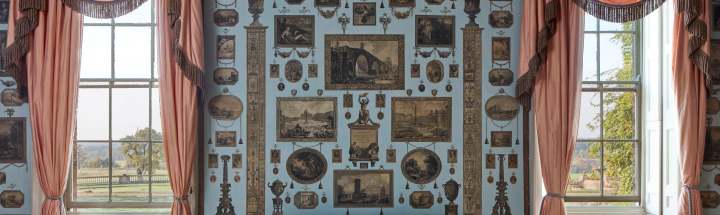
West Wall of the Print Room at Woodhall Park, Hertfordshire, created in 1782 by R. Parker.
Photographed in 2023 Matthew Hollow.
◊ ◊ ◊ ◊ ◊
The long eighteenth century in the latest issue of British Art Studies (lots of fascinating material; I’m especially taken by the videos that accompany Kate Retford’s article: they’re fabulous, particularly the one on ‘Making the Print Room’. –CH)
British Art Studies 24 (March 2023)
“Monuments Must Fall,” a ‘Conversation Piece’ convened by Edwin Coomasaru, with responses by Jodie Dowd and Nathan mudyi Sentance, Sasanka Perera, Wendy Bellion, Chrislyn Laurie Laurore, Stacy Boldrick, Joan Coutu, Emma Mahony, Nomusa Makhubu, Nickolas Lambrianou, and Raqs Media Collective.
‘Conversation Piece’ is a British Art Studies series that draws together a group of contributors to respond to an idea, provocation, or question.
Monumentality is an aesthetic form of social antagonism. . . . Many monuments are erected to do controversial work, and while they may proclaim a matter resolved or a problem consolidated, the reactions to them (sometimes long after they have been placed on pedestals) actually demonstrate the opposite is often the case. Monuments are not solely statues. Monumentality is the discursive space that surrounds certain public sculptures, including demands they be pulled down or protected, which can erupt into spontaneous or managed removal. Such a discursive space is inherently unstable, which is why most monuments ultimately must fall, physically or conceptually: either by being toppled or by having their original intentions obliterated and reimagined. . . .
Monuments are not simply physical structures, nor empty symbols, but are shaped by either social support systems that erect and conserve them, or by forms of social conflict which contest and topple them. The discursive space around a public statue, from protest to press coverage, and its translation into material conditions, is the making of its monumentality. . . .
Edwin Coomasaru’s essay and the ten responses are available here»
Kate Retford, “Cutting and Pasting: The Print Room at Woodhall Park.”
This article explores the exemplary surviving print room at Woodhall Park in Hertfordshire, created in 1782 for Sir Thomas Rumbold. A professional named “R. Parker” pasted more than 350 prints around the walls of this interior; the results were then carefully recorded in a catalogue and set of elevation diagrams. The first section, ‘Space’, analyses the print room within the broader context of the house, in order to connect exterior and interior, explore the relative qualities of ‘public’ and ‘private’ space, and consider neoclassical style as worked out in various media. The second, ‘Display’, unpacks the pasted scheme, looking at the relationship between ‘background’ images and ‘starring’ works, and that between iconography and pattern-making. The final part explores ‘Making’, analysing the processes by which prints were selected, trimmed, given paper borders, and arranged around the walls. This discussion considers both the degree to which the intermedial object of the reproductive print was translated into a trompe l’œil painting or sculpture in such schemes, and the creative work of collaging at play. The analysis in this article weaves together textual discussion with still and moving images, film, and animation. Combining these techniques, it aims to provide full documentation and analysis of the scheme, and to engage with embodied, mobile, and temporally determined viewing experience in both the house and the print room.
Article available here»
Melissa L. Gustin, “Do Sleeping Shepherds Dream of 3D-Printed Sheep: John Gibson, Oliver Laric, and Digital Neoclassicism.”
This article considers the relationship between John Gibson’s neoclassical sculpture The Sleeping Shepherd Boy [designed 1818] and Oliver Laric’s installations for the 2016 Liverpool Biennial using 3D models and prints of the Shepherd. These bodies of work allow us to think about their similarities in attitude towards imitation, the significance of the ‘neoclassical’ across different historic moments, and the cultures of copying or reproduction. It looks at the reproductive technologies of 3D scanning, printing, CNC milling, and digital remixing alongside historical reproductions such as casts and copies. These offer new potentially disruptive—but not destructive—opportunities within the legacy of neoclassical practices. The intellectual and artistic inheritance of neoclassical sculpture as an imitative practice after Greek and Roman antiquity informs Laric’s sculptural work. I draw on Alexander Nagel and Christopher Wood’s Anachronic Renaissance (2010) and George Kubler’s The Shape of Time (1968) to discuss Laric’s modular, large-scale 3D prints, which point towards issues of replacement, imitation, and wholeness. The open-source 3D models he produces as part of his practice are then used by other artists, including Zachary Eastwood-Bloom in his Divine Principles series, and the author, for making research objects.
Article available here»
Online Talk | Beckfords and the Transatlantic Slave Trade
From The Salisbury Museum and Eventbrite:
Amy Frost, The Beckfords and the Transatlantic Slave Trade
Online, Thursday, 16 March 2023, 7.30pm (GMT)
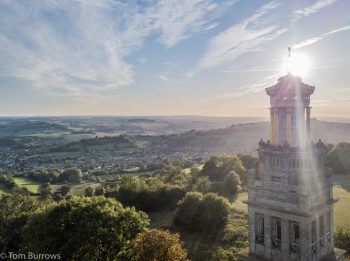
Beckford’s Tower, 1826–27 (photo by Tom Burrows).
From the purchase of Fonthill in Wiltshire by William Beckford in 1744 to the death of his son in Bath 100 years later, the social advancements and retreats of the Beckford family relied upon the profits of transatlantic slavery. This talk will explore the extensive collecting and architectural creations of the Beckfords, and highlight how they were made possible by a vast fortune built from the stolen labour of thousands of enslaved Africans. This is a fundraising talk for The Salisbury Museum: £12 (£9 members).
Dr Amy Frost is an expert on the life and work of William Beckford and curator of Beckford’s Tower in Bath.
◊ ◊ ◊ ◊ ◊
Press release (7 March 2023) from the Bath Preservation Trust:
Alex Wheatle and State of Trust Join Forces with Beckford’s Tower
As part of the ‘Our Tower’ regeneration plan, Beckford’s Tower and State of Trust join forces with author Alex Wheatle to deliver interpretive dance performance of Wheatle’s prize-winning 2020 novel Cane Warriors.
 Cane Warriors tells the story of Tacky’s Rebellion, an uprising of Akan people fighting for their freedom that took place in Jamaica in 1760, and included enslaved people on a plantation owned by the Beckford family. The new project will put a spotlight on the link between the Beckford family and the rebellion and engage with a wide cross section of people in the process, particularly young people in the community and online, in order to develop an interpretive dance performance of the novel. The research and development will build a team of exceptional performers. New choreography, music, photography, and film will be created, and there will also be a virtual gallery and film archive for future use.
The resulting performances will take place in March 2024. Beckford’s Tower will host one performance, with the other two to be held in other Bath and Bristol venues. The new production has been supported by The National Lottery Heritage Fund, thanks to money raised by National Lottery players.
The performance, which will be filmed for posterity, will encourage attendees to engage with one of the most troubling aspects of William Beckford’s legacy: his claiming in ownership enslaved people, which funded his lifestyle and his vast collections. The aim is to build awareness around the effects of enslavement and colonialism on the culture and psyche of modern Britain and improve community relations through greater understanding of the shared history.
Built between 1826 and 1827, Beckford’s Tower was intended to house the collections of books, furniture, and art that were owned by William Beckford, whose wealth was gained from his ownership of plantations and enslaved people in Jamaica. Beckford would ride up to the Tower from his townhouse in Bath’s Lansdown Crescent every morning before breakfast, and enjoyed its solitude and the panoramic views from the Belvedere at the top.
Today Beckford’s Tower is owned and run by Beckford Tower Trust, part of Bath Preservation Trust. The landmark is a Grade 1 listed monument and is the only museum in the world dedicated to the life and work of William Beckford. In 2019, the Tower was added to the National ‘At Risk’ Register, sparking a major project to raise the necessary funds to repair and restore the Tower, transform the museum, open up the landscape and create opportunities for volunteering, formal learning and community engagement. In 2022, thanks to a £3million grant from The National Lottery Heritage Fund, the fundraising target of £3.9 million was reached. £480,000 of partnership funding had already been secured, with support from Historic England, Garfield Weston Foundation, The Medlock Charitable Trust, Historic Houses Foundation, Pilgrim Trust, and several other organisations, as well as £50,000 in public donations. This second grant of £100,000 will enable Beckford’s Tower to deliver the Cane Warriors project, which will compliment the wider work taking place at the Tower.

State of Trust Cane Warriors Meeting
Commenting on the new project, Director of Museums Claire Dixon said: “One of our main priorities at Beckford’s Tower is to ensure the transparent and sensitive portrayal of William Beckford’s troubling legacy; as his building and collecting was funded through his ownership of plantations it is vital that this is made clear in the regeneration of the Tower and its new exhibition. We approached State of Trust owing to their reputation for delivering powerful performances that tackle challenging social themes, and we look forward to working with them on this exciting project. It will enable us to explore more creative and artistic events, engage new and more diverse audiences, and embed this approach in the new museum programme when it opens in 2024. I would like to thank The National Lottery Heritage Fund and National Lottery players for their support in helping us to fully contextualise and reconfigure the story of Beckford’s Tower for a modern-day audience.”
Deborah Baddoo MBE and Steve Marshall, the Directors at State of Trust and State of Emergency Limited, said: “We are delighted that Heritage Lottery has agreed to fund the R&D phase of Cane Warriors. When Alex Wheatle first approached us, nearly three years ago, with a view to our making a dance interpretation of his novel, we didn’t realise what an uphill struggle it would be to achieve funding. Thanks to Bath Preservation Trust, and the synergy between the story and the history of Beckford’s Tower, we are now able to start working on what we believe will be an important work of African contemporary dance theatre. This production will allow us to pursue a long-term artistic vision, which began with the foundation of State of Emergency Limited in 1986, and to hone our skills as directors and performers. For us Cane Warriors is the natural progression of all that has gone before. Working alongside the history of Beckford’s Tower, this project can make the connection between historic buildings in our local communities and the transatlantic slave trade, and reveal their hidden histories. We feel it is very important to reach and engage with people, particularly young people, on this subject, and through a range of activities, including workshops in schools, and online events, we know we can make a difference. Through the media of dance, music, and film, we aim to bring the story to life, to animate history in a way that is relevant and impactful to our contemporary lives, to get beyond the facts and to achieve a level of understanding and truth.”
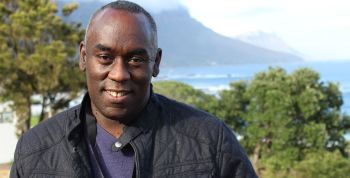
Alex Wheatle MBE
Alex Wheatle MBE, author of Cane Warriors, said: “The real story of Chief Tacky’s rebellion has been passed down through generations of my mother’s family who resided in Richmond, St Mary’s parish in Jamaica—very close to the plantations where Chief Tacky and his Cane Warriors toiled and planned their Easter rebellion in 1760. I was simply compelled to relate this story to the wider world, and I’m very proud that State of Emergency will tell the story in the art form of dance. Indeed, the Cane Warriors will be honoured.”
Stuart McLeod, Director England – London & South at The National Lottery Heritage Fund, said: “Inclusive heritage is very important to us at The National Lottery Heritage Fund which is why we are proud to support projects that engage people with the complexity of our history. This project will help broaden everyone’s understanding of Beckford and tell his story and its significance to Bath. Our history can teach us a great deal about ourselves and who we want to be, and we encourage people to explore, understand, and learn from it.”
Reception of Greenough’s Statue of George Washington

Stereo card view of the crowd at the inauguration of Rutherford B. Hayes, on the east front grounds of the U.S. Capitol, surrounding Horatio Greenough’s statue of George Washington, in 1877 (Brady’s National Portrait Gallery, Washington, D.C./Library of Congress). Commissioned in 1832 to mark Washington’s 100th birthday, Horatio Greenough’s sculpture of the first president was installed in the U.S. Capitol Rotunda in 1841. Two years later the 12-ton statue was moved outside to the building’s East Plaza, where it stood until 1908, when it was moved to the Smithsonian Institution castle on the National Mall.
◊ ◊ ◊ ◊ ◊
An interesting article from The Washington Post for the wider context of contested public sculpture (here presented for a large, general audience). Unfortunately, it doesn’t address this particular controversy in terms of people’s expectations of how a historic figure (in 1841, still a recent historic figure) should have been represented and thus might reinforce persistent misconceptions of nineteenth-century attitudes toward nudity in art generally. The larger question of monumentalizing the lives of real people could bring the history of Greenough’s work into conversation with the initial reception of Hank Willis Thomas’s recently installed memorial for Dr. Martin Luther King Jr. and Coretta Scott King, The Embrace, at Boston’s 1965 Freedom Plaza. For the latter, there has, of course, been lots of coverage, but I like this article by Jessica Shearer, “What Do Bostonians Think of the New MLK Monument?,” HyperAllergic (25 January 2023). –CH
◊ ◊ ◊ ◊ ◊
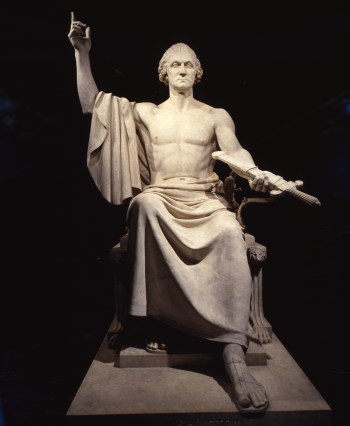
Horatio Greenough, President George Washington, completed in 1840, marble (Washington DC: Smithsonian Institution).
Ronald G. Shafer, “The First Statue Removed from the Capitol: George Washington in a Toga,” The Washington Post (22 January 2023).
Slowly, some of the U.S. Capitol’s many statues and other artworks honoring enslavers have been slated for removal, most recently a bust of Roger B. Taney, the chief justice who wrote the Supreme Court’s Dred Scott decision denying Black people citizenship. But the first statue Congress voted to remove from the Capitol was one of George Washington [in 1908]—not because Washington was an enslaver, but because the statue was scandalous. The first president was portrayed naked to the waist in a toga with his right finger pointing toward the sky and his left hand clasping a sheathed sword. . . .
The full article is available here»
Tallying Enslavers and Confederates Depicted at the U.S. Capitol

John Trumbull, General George Washington Resigning His Commission, 23 December 1783, installed in the Capitol in 1824, oil on canvas, 12 × 18 feet (Washington, DC: Capitol Rotunda). As noted in The Post article, 19 of the 31 people identified in the painting were enslavers.
◊ ◊ ◊ ◊ ◊
From The Washington Post:
Gillian Brockell, “Art at Capitol Honors 141 Enslavers and 13 Confederates. Who Are They?,” The Washington Post (27 December 2022). The Post examined more than 400 statues, paintings, and other artworks in the U.S. Capitol. This is what we found.
As part of a year-long investigation into Congress’s relationship with slavery, The Washington Post analyzed more than 400 artworks in the U.S. Capitol building, from the Crypt to the ceiling of the Capitol Rotunda, and found that one-third honor enslavers or Confederates. Another six honor possible enslavers—people whose slaveholding status is in dispute. . . .
Just as governments and institutions across the country struggle with the complex and contradictory legacies of celebrated historical figures with troubling racial records, so too does any effort to catalogue the role of the Capitol artworks’ subjects in the institution of slavery. This analysis, for example, includes at least four enslavers—Benjamin Franklin, John Dickinson, Rufus King, and Bartolomé de las Casas—who voluntarily freed the people they enslaved and publicly disavowed slavery while they were living. Other people, such as Daniel Webster and Samuel Morse, were vocal defenders of slavery but did not themselves enslave people; artworks honoring them are not counted in The Post’s tally. . . .
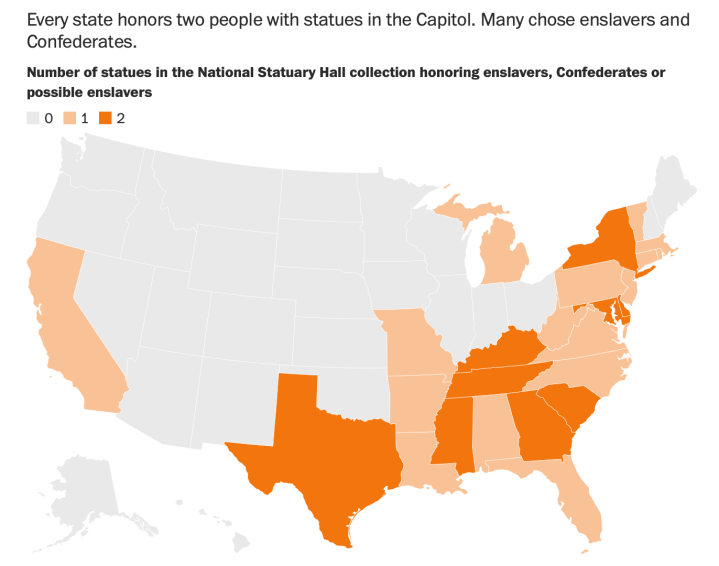
All 11 states that joined the Confederacy have at least one statue depicting an enslaver or Confederate. But the homages to enslavers are by no means restricted to these states: Except for New Hampshire, all of the original 13 states have statues depicting enslavers or possible enslavers.
Massachusetts, for example, is represented by John Winthrop, who is best known for proclaiming a “shining city on a hill” but who also enslaved at least three Pequot people and, as colonial governor, helped legalize the enslavement of Africans.
Both of New York’s statues honor enslavers. One is Declaration of Independence co-writer Robert R. Livingston, who came from a prominent slave-trading family and personally enslaved 15 people in 1790. He also owned brothels that housed Black women who may have been enslaved. The other is former vice president George Clinton, who served under Jefferson and Madison and enslaved at least eight people in his lifetime. . . .
The full article is available here»
Journal18, Fall 2022 — Silver
In the latest issue of J18:
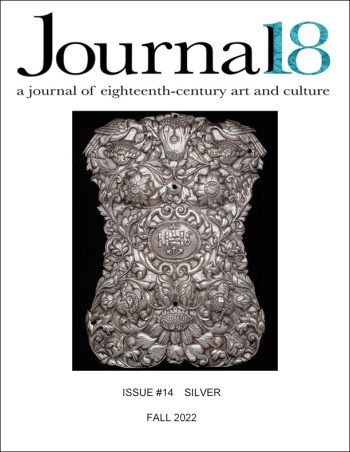
Journal18, Issue #14 (Fall 2022) — Silver
Issue edited by Agnieszka Anna Ficek and Tara Zanardi
I N T R O D U C T I O N
Agnieszka Anna Ficek and Tara Zanardi
In his 1656 treatise El Paraíso en el Nuevo Mundo, Antonio de León Pinelo contends that the amount of silver extracted from Potosí’s Cerro Rico was enough to build a bridge of silver from the top of the mountain to the doors of Madrid’s Royal Palace: 2,070 leagues long, 14 rods wide, and 4 fingers thick.[1] The vivid imagery of León Pinelo’s account encapsulates the magnitude of silver’s potential as the material foundation for a fantastical building project that could physically scale the earth much like the Spanish Empire did politically, militarily, and financially. Silver’s beauty, mutability, and strength coveted by Spanish colonists led to the production of spectacular objects, such as the ornamental plaque from a Jesuit Mission in the Andean highlands that serves as this issue’s cover image. At once luxurious and symbolic, the plaque’s decoration features tulips and other plants cultivated in Europe, interwoven in a repouséd floral ground with indigenous passion flowers (mburucuyà), nibbled by native birds, to create an image of a harmonious colonial society. Both the imaginary bridge and the ornamental plaque belie the violence the Spanish Crown and the Church exerted in subjugating native populations and instituting a system of forced labor to extract this precious metal.
Within and beyond the Spanish Empire, silver financed wars, upheld dynasties, and cemented political alliances. Forged into currency, silver funded slavery and the institution’s production of goods such as sugar and cacao. Silver was also valued around the globe for its pliability and sheen. From Beijing to Versailles, Mexico City to Lisbon, it furnished grand homes, glittering on dinner tables and dressing tables alike. Skilled artists manipulated silver into opulent objects, capitalizing on its luster to fabricate sinuous forms in small-scale decorative artworks as well as ambitious commissions that communicated wealth and political might.
This issue probes silver’s capacity for metamorphosis—from raw material into objects and currency. Such transformative characteristics made it a valuable medium for artists, a tool for global expansion, and a form of income for rebuilding state treasuries. . . .
A R T I C L E S
• Dani Ezor — ‘White when Polished’: Race, Gender, and the Materiality of Silver at the Toilette
• Christina K. Lindeman — Silver Thread Textiles: Industry, Dynasty, and Political Power in Eighteenth-Century Prussia
• Susan Eberhard — The Asian Silver Chocolatière: The Transpacific World in a Diplomatic Gift
E X P L O R A T I O N S
• James Middleton — An Eighteenth-Century Portrait Miniature on Silver: An Artifact from the Silver Age of Mexico
• José Andrés De Leo Martínez — La distinción del cáliz de Puebla de los Ángeles en el s. XVIII, entre dos Mundos
• Christina Clarke — Reanimating the Goldsmith: An Artisanal Reading of the Archive
Cover image: Ornamental Plaque (mariola or maya), one of a pair, 1725–50, Moxos or Chiquitos missions, Alto Peru (present-day Bolivia), silver, 42 × 31 × 3 cm (Museum of Fine Arts Boston, 1992.346).
◊ ◊ ◊ ◊ ◊
R E C E N T N O T E S & Q U E R I E S
• Jessica L. Fripp — Review of Raphaël Barontini’s show Blue Lewoz (Paris: Mariane Ibrahim Gallery, summer 2022), published in J18 October 2022. Link»
The title Blue Lewoz brings together léwoz, the music and dance created by the enslaved people on Guadaloupe, and indigo blue, a dye that was a staple of the transatlantic slave trade. Barontini writes on his Instagram that Creole Dancer was inspired by a 1950 collage by Matisse of the same name, and a tribute to the “Caribbean women and the place of the dance in the Guadeloupean léwoz tradition.” From this twentieth-century inspired work, viewers quickly moved into an alternative history of fashion and luxury of early modern Europe: collages that incorporate Jean-Marc Nattier’s eighteenth-century dresses, Bronzino’s elaborate fabrics, and Elizabethan ruffs. While Barontini’s appropriation and sources stretch wider than the long eighteenth century, many of the fashions in those portraits were the product of, as Alicia Caticha notes, “Atlantic slave trade and a host of other exploitative global networks.” And, as scholars such as Anne Lafont and Mechtild Fend have shown, portraits were often used to construct and highlight whiteness.[1] Barontini’s work reinvents those portraits and, through collage, tapestries, and textiles, celebrates resistance and Caribbean festivals. . .
• Michelle Sylliboy — “Artist’s Notes: Nm’ultes is an Active Dialogue: I Reclaiming Komqwejwi’kasikl, II An Autobiographical Creative Inquiry, and III forthcoming” published in J18 in three parts, June 2022, October 2022. Link»
Published in three installments, this intervention by L’nu interdisciplinary artist, poet, and scholar Michelle Sylliboy offers an Indigenous perspective on the colonial archive. Sylliboy responds to the dehumanizing accounts of her ancestors in Nouvelle Relation de la Gaspésie (Paris, 1691) and reclaims the komqwejwi’kasikl language from its author, French missionary Chrestien Le Clercq, who culturally appropriated its writing system. Using autobiographical creative inquiry and Nm’ultes theory, Sylliboy addresses the ongoing impact of settler colonialism on her people, the L’nuk. As a survivor of intergenerational trauma, she tells the intersecting stories of healing and reconnecting with the worldview of her ancestors, who have been caretakers of a land that stretches from the Gaspé peninsula to Newfoundland since immemorial times.
In the News | Russia Steals Potemkin’s Bones
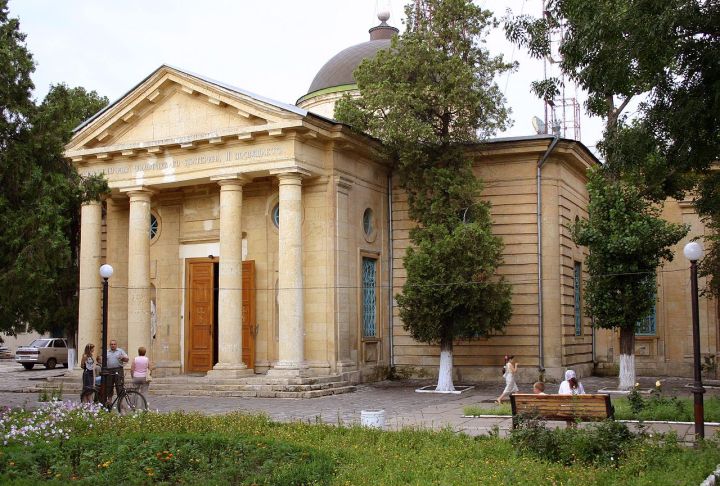
Cathedral of St. Catherine, Kherson, Ukraine, 1781–86. Dedicated to Catherine of Alexandria, the patron saint of the reigning empress, it was one of the earliest churches built in ‘New Russia’ (Photo by Sven Teschke, July 2004, from Wikimedia Commons).
◊ ◊ ◊ ◊ ◊
So many twenty-first stories are also eighteenth-century stories. From The NY Times:
Marc Santora, “Why Russia Stole Potemkin’s Bones From Ukraine,” The New York Times (27 October 2022). The 18th-century military commander and lover of Catherine the Great helped conquer Ukraine and looms large in the version of history the Kremlin uses to justify the war.
With Ukrainian forces bearing down on the occupied port city of Kherson this week, the Kremlin’s puppet rulers dispatched a team to an 18th-century stone cathedral on a special mission—to steal the bones of Prince Grigory Aleksandrovich Potemkin.
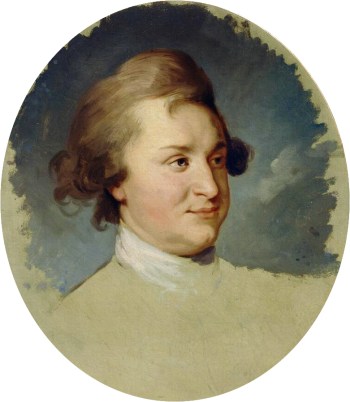
Johann Baptist von Lampi the Elder, Portrait of Russian Fieldmarshal Grigory Potemkin, 1790s (Moscow: State Tretyakov Gallery).
The memory of the 18th-century conqueror is vivid for those in the Kremlin bent on restoring the Russian imperium. It was Potemkin (1739–1791) who persuaded his lover, Catherine the Great, to annex Crimea in 1783. The founder of Kherson and Odesa, he sought the creation of a ‘New Russia’, a dominion that stretched across what is now southern Ukraine along the Black Sea.
When Russian President Vladimir Putin invaded Ukraine in February with the goal of restoring part of a long-lost empire, he invoked Potemkin’s vision. Now, with Putin’s army having failed in its march toward Odesa and threatened with ouster from Kherson, his grand plans are in jeopardy. But among Kremlin loyalists, the belief in what they view as Russia’s rightful empire still runs deep.
So it was that a team descended into a crypt below a solitary white marble gravestone inside St. Catherine’s Cathedral. To reach Potemkin’s remains, they would have opened a trapdoor in the floor and climbed down a narrow passageway, according to people who have visited the crypt. There they would have found a simple wooden coffin on a raised dais, marked with a single cross. Under the lid of the coffin, a small black bag held Potemkin’s skull and bones, carefully numbered.
Kremlin proxies have made no effort to hide the theft—quite the contrary. The Russian-appointed head of the Kherson region, Vladimir Saldo, said that Potemkin’s remains were taken from the city, on the west bank of the Dnieper River, to an undisclosed location east of the Dnieper, as Ukrainian troops edge closer.
“We transported to the left bank the remains of the holy prince that were in St. Catherine’s Cathedral,” Saldo said in an interview broadcast on Russian television. “We transported Potemkin himself.”
Local Ukrainian activists confirmed that the church had been looted and that, along with the bones, statues of venerated Russian heroes had been removed. By the count of historian Simon Sebag Montefiore, author of the book Catherine the Great and Potemkin, it was the ninth time Potemkin’s restful peace had been interrupted. . .
The full article is available here»
Exhibition | (Re)Inventing the Americas
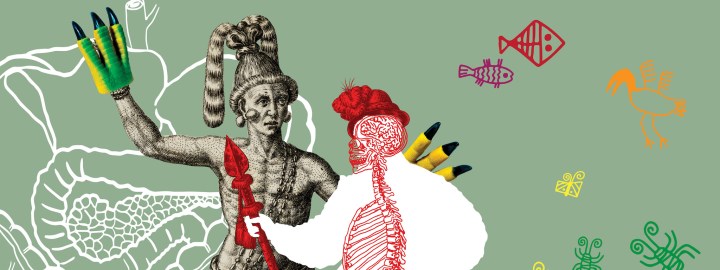
Denilson Baniwa, The Celebration of the Lizard (detail), Spirit Animals (detail), 2022, digital intervention on Columnam à Praefecto prima navigation locatam venerantur Floridenses (Column in Honor of the First Voyage to Florida) (detail), from Jacques de Morgues Le Moyne (French, ca. 1533–before 1588), Brevis narratio eorum quae in Florida Americæ provincia Gallis acciderunt (Frankfurt, 1591), pl. 8 (Getty Research Institute, 87-B24110). Courtesy the artist. Design © 2022 J. Paul Getty Trust.
◊ ◊ ◊ ◊ ◊
From the press release (via Art Daily) for the exhibition:
(Re)Inventing the Americas: Construct. Erase. Repeat.
Getty Center, Los Angeles, 23 August 2022 — 8 January 2023
Curated by Idurre Alonso with Denilson Baniwa
America is a European invention. Between 1492 and the late 1800s, European conquistadors, travelers, and artists produced prints, books, and objects that illustrated the natural resources and Native peoples of the Americas, often constructing fantastic and fictional ideas. Mixing reality with their own conventions and interpretations, they created portable and reproducible images that circulated around the world, fueling the spread of stereotypes and prejudices. (Re)Inventing the Americas: Construct. Erase. Repeat., on view from 23 August 2022 until 8 January 2023, analyzes the creation of the mythologies that arose during the conquest and exploration of the continents and reveals the influence that those myths and utopian visions have had on defining the Americas.
“This exhibition reframes the colonial and 19th-century materials in the Getty Research Institute collections, challenging European representations of the American continents,” says Mary Miller, director of the Getty Research institute. “It proposes that the Americas were reinvented utilizing European conventions and imaginaries.”
Re)Inventing the Americas is divided into five thematic sections. The first one examines the allegorical construction of America and the sources and evolution of these images. The second section explores the natural wealth of the Americas, while highlighting the exploitation of those resources. The third part looks at the construction of archetypes by analyzing recurring topics, such as the depiction of local people with feathers and hammocks and the portrayal of idolatry and cannibalism. The fourth section is devoted to images of the conquest, emphasizing the political overtones of certain narratives. The final section looks at the work of European travelers, stressing the differences and commonalities with previous constructions.
The exhibition features a collaboration with Denilson Baniwa, a contemporary artist from the Brazilian Amazon region who will generate different artistic interventions throughout the show. Baniwa’s work prompts us to critically reevaluate the materials from the past to help us navigate the colonial traumas, generating new reinventions of the Americas. Additionally, commentary on exhibition objects by Latinx and Indigenous members of the Los Angeles community gives a multi-perspectival approach to the pieces.
“Our collections illustrate the construction of an image of the Americas based on the European perspective,” says Idurre Alonso, curator at the Getty Research Institute. “Thus, it was important to me to analyze and counter that European view by introducing a multilayered presentation of the exhibition objects. To do that, I collaborated with Denilson Baniwa and our local Latin American and Latinx community. Their voices became part of the narrative of the show, challenging the persistence of certain notions. The outcome of these collaborations is a multifaceted exhibition that showcases the complex reinventions of the Americas from the Colonial time to today.”
Denilson Baniwa (born 18 April 1984) is an Indigenous artist who was born in the village of Darí, in Rio Negro, Amazonas, in the tri-border area between Brazil, Colombia and Venezuela. His artistic practice includes graphic design, drawings, performances, and urban interventions. His oeuvre seeks points of intersection between Indigenous culture and the contemporary art world. Through his art he questions the colonial past and stereotypical representations of Indigenous people, often layering components from colonial and nineteenth-century art with elements from his own cultural traditions. Some of the themes he approaches include the relationships of Indigenous peoples and technology as well as the harmful effects of agri-business for Native peoples.
Esta exhibición se presenta en inglés y en español.
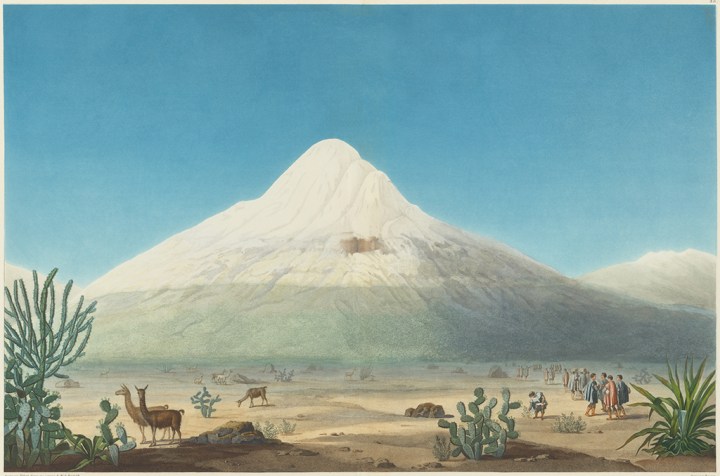
Louis Bouquet, Chimborazo Seen from the Plain of Tapia, engraving from Alexander von Humboldt, Vues des Cordillères, et monumens des peuples indigènes de l’Amérique (Paris, 1810), between pp. 200 and 201 (Getty Research Institute, 85-B1535).
Exhibition | 25 Artists Fascinated by Piranesi
Opening next week in Dublin; from Hélène Bremer’s website:
For the Love of the Master, 25 Artists Fascinated by Piranesi
The Coach House Gallery, Dublin Castle and the Casino Marino, 17 June — 18 September 2022
Curated by Hélène Bremer
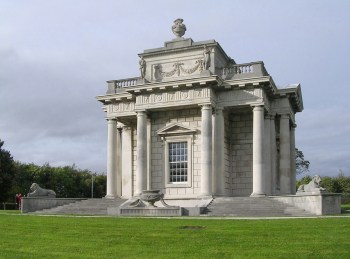
William Chambers, Casino Marino in Dublin, designed for James Caulfeild, the 1st Earl of Charlemont, starting in the late 1750s and finishing around 1775.
2020 marked the tricentenary of the birth of Giovanni Battista Piranesi (1720–1778). The Italian architect, antiquarian, etcher, vedutista, designer, and writer was one of the foremost artistic personalities of 18th-century Rome. His interpretation of the classical world was of great significance not only during his lifetime, but also long after his death. Ireland’s Office of Public Works presents the international exhibition For the Love of the Master: 25 Artists Fascinated by Piranesi to celebrate his legacy in the 21st century, with work from a group of international artists including Emily Allchurch, Pablo Bronstein, Léo Caillard, and Michael Eden. Many of the pieces on display were made specifically for this occasion. One of the show’s locations, the Casino Marino, an important 18th-century neo-classical building, serves to link Piranesi and Ireland, present and past.










 Enfilade
leave a comment