Colonial Williamsburg Collaborates with Benjamin Moore
Up to now, Enfilade has reported on The Met’s relationship with Farrow & Ball and The Cleveland Museum of Art’s relationship with Glidden. The Colonial Williamsburg Foundation has just launched an alliance in the other direction with Benjamin Moore. My hunch is that color consultant Patrick Baty (interviewed for Enfilade in 2011 by Courtney Barnes), will see the range as emphatically leaning toward ‘trend’ rather than ‘tradition’. And yet, there are some lovely drab hues with charming names. -CH
Press release (16 May 2013) from the Colonial Williamsburg Foundation . . .

Benjamin Moore, one of North America’s most respected paint manufacturers and color authorities, has joined with the Colonial Williamsburg Foundation’s Williamsburg brand to launch the Williamsburg® Color Collection by Benjamin Moore – an assortment of paint colors authentically rooted in the history of our nation and its founding. The new, 144-color palette represents a unique intersection of history, science and design that reflects actual colors that existed in the 18th and 19th century, brought to customers through the most advanced paint technology in the industry from Benjamin Moore.
“This work showcases the close collaboration between two firms steeped in a rich heritage, both having passion for bringing history into the home,” said Carl Minchew, Benjamin Moore’s vice president of color innovation and design. “The Williamsburg® Color Collection by Benjamin Moore offers our customers beautiful shades in a palette of amazing, accurate colors that are as stylish today as they were 250 years ago.”
Colonial Williamsburg’s unparalleled research team of historians and conservators examined period documents, paint samples, wallpaper and architectural fragments that led to fresh and unexpected color findings. The Benjamin Moore team then carefully studied pigment compositions in order to precisely match these colors using the latest scientific methods to ensure the highest degree of authenticity to the original hues. As a result, the Williamsburg® Color Collection by Benjamin Moore presents vibrant yet complex shades as they appeared more than 250 years ago that can be effortlessly incorporated into the modern home.
“It has been very exciting to work with Benjamin Moore developing a paint palette based on historic precedent,” said Matthew Webster, director of the Grainger Department of Historic Architectural Resources for the Colonial Williamsburg Foundation. “Together we developed the colors using almost 90 years of paint research and an understanding of historic production methods creating a palette that embodies the Williamsburg ‘trend meets tradition’ theme. It’s personally satisfying to see research become reality with a palette that is consistent with colors that would have been found in the 18th century.”
Chrisman-Campbell, “When Fashion Set Sail” at Worn Through
It’s been too long since I’ve noted offerings at Worn Through, a blog that addresses apparel from an academic perspective. In addition to a Call for Papers for the Annual Meeting of the Costume Society of America (Midwest Region) on the theme of Uncommon Beauty, recent postings include an interesting contribution from Kimberly Chrisman-Campbell on maritime headdresses: “When Fashion Set Sail.” -CH
◊ ◊ ◊ ◊ ◊
Kimberly Chrisman-Campbell, “When Fashion Set Sail,” Worn Through (20 March 2013).

Anonymous, Coëffure à l’Indépendance ou le Triomphe de la liberté, ca. 1778, Musée franco-américain du château de Blérancourt
One of the most iconic images of eighteenth-century extravagance is a fashion plate depicting a lady wearing a miniature ship in her powdered and pomaded hair.
But this much-misunderstood hairstyle was not just an eye-catching novelty. It was one of many ship-shaped headdresses that celebrated specific French naval victories and, more importantly, advertised their wearers’ patriotism and political acumen.
Far from being the whimsical caprice of bored aristocrats, these maritime modes were directly inspired by one of the defining political and philosophical issues of the day: America’s struggle for independence, in which France was a key military and political ally.
The full posting is available here»
Eighteenth-Century Art and the Marketing of Classical CDs
B Y M I C H A E L Y O N A N
The visuals that adorn classical recordings are not usually of terribly high quality. CD packaging often seems an afterthought, and when designers try to be creative, bad things sometimes happen (as demonstrated by this Pinterest collection of Worst Classical Album Covers Ever). The age of early stereo LPs probably marked the peak of production values. The famous Dario Soria series of recordings on RCA, issued in the 1960s, featured deluxe packaging with lavish booklets printed on embossed cardstock and brimming with reproductions of art works, recording session photos, and scholarly essays. They remain prized collectors’ items.
The 1970s saw packaging standards decline, and the advent of CDs in the 1980s just made things worse. The smaller format of compact discs reduces the impact of visuals, and the paper inserts are typically flimsy and poorly printed. You might be buying good music, but you typically get an ugly object.
 Why does it matter, one might ask? Isn’t the music the point? It is, but the visual aspects still work to entice buyers and, in the case of obscure classical music, to suggest what they’re buying. For many, the real item on offer is a mood. Music creates mood, and savvy music marketers know that the right packaging helps. You might even say that since handling the packaging precedes listening to the music, it inflects how one comprehends what one hears.
Recent moves to improve the physical character of classical CDs have enlisted eighteenth-century art to work its magic. Exceptionally successful in this regard is an independent publisher from Belgium, Out There Music. One of its labels, Alpha, notably pairs excellently performed music and strikingly beautiful packaging. In fact, Alpha claims to make “records that are as beautiful to look at as to listen to…”, striving to “shape each production into a unique object reflecting the centuries-old links between various forms of artistic expression.”
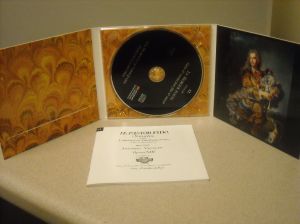 Take, for example, the CD, “Le Berger poète” (Alpha 148), which features eighteenth-century French music for flute and musette de cour. On the cover is a detail of Hyacinthe Rigaud’s Portrait of Gaspard de Gueidan Playing the Musette de cour, 1738. This image on a simple level helps the buyer visualize a musette, an instrument most of us have never seen. It’s a small bagpipe that enjoyed great popularity among French nobles with rustic proclivities. Its sound is reminiscent of an oboe’s or, less charitably, a kazoo’s. Inside there is a full reproduction of Rigaud’s painting and an additional detail from Gueidan’s garments, both framed by richly colored marbling. Included is a 45-page booklet introduced by a reproduction of an eighteenth-century musical title page. If the recording aims to evoke the world out of which this music comes, then the pictures help, and as someone who loves recorded music, I can say that the combination of visual and aural together powerfully suggest a long lost ambience.
 “Le Berger poète” isn’t unique. Other Alpha CDs feature high-resolution details of images by Vigée-Lebrun, Goya, Nattier, Liotard, and Tiepolo in equally creative and often gorgeous packaging. Ramée, another label from Out There, uses a similar design principle but shifts the focus from images to objects. Ramée’s covers feature pictures of early modern textiles, metalwork, silver, furniture, architectural elements, and machines. Both labels make frequent use of cropping and details, design choices that counteract the CD’s physical limitations. I’d like to think that such choices are especially apposite for the eighteenth century, an era so fascinated by fragments, ruins, and oblique views. Ramée’s mission statement is even bolder than Alpha’s in that they seek to “create CDs as complete objets d’art,
because we believe the ear’s pleasure is intimately tied together
with that of the eye and the hand.” I agree.
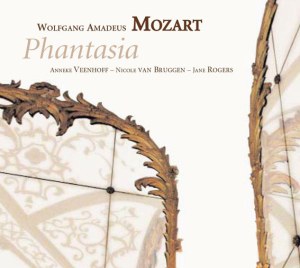 I find it interesting that as we increasingly download our music, a process that would indicate the obsolescence of the CD altogether, not only is the CD not (yet?) going away, but in fact it is becoming more and more beautiful (Out There offers recordings both as digital downloads and as CDs). Even with downloaded music, art can remain a component of the musical experience. The new iTunes redesign continues to let you pair every song with a picture, be it the album cover or an image of one’s choice. It’s another way of doing what Soria did earlier and Alpha and Ramée do now, namely setting the tone for the ear’s experience.
Exhibition | Measuring the Universe and the Transit of Venus
The last transit of Venus was in 2004, but the next one won’t occur until 2117. From Captain Cook’s first voyage to the construction of the Kew Observatory, these celestial events were enormously important in the eighteenth century: 1761 and 1769 (click on either date for details at the Royal Society’s website). For a sense of just how important, see the eighteenth-century bibliography compiled by Utrecht’s Institute for History and Foundations of Science. -CH
◊ ◊ ◊ ◊ ◊
From Royal Museums Greenwich:
Measuring the Universe: From the Transit of Venus to the Edge of the Cosmos
Royal Observatory Greenwich, London, 1 March — 2 September 2012

Royal Observatory, Greenwich, photographed on 24 July 2006 (Wikimedia Commons)
On 5-6 June 2012 a very rare astronomical event takes place: the planet Venus will pass directly between the Earth and the Sun, appearing as a small black dot against the face of our parent star. These transits of Venus occur in pairs eight years apart, but each pair is separated by more than a century. The last one was in 2004 and, after June 2012, the next won’t be until December 2117.
Historically, transits of Venus were used by astronomers to give the first accurate measure of the distance between the Earth and the Sun. To be sure of observing these twice-in-a-lifetime events expeditions were sent around the world in the 18th and 19th centuries and the story involves many famous characters. Captain Cook was sent to Tahiti to observe the transit of 1769, and King George III had Kew Observatory built so that he could view the transit himself (the telescope he used will be on display in the Royal River exhibition at the National Maritime Museum).
By the 21st century the distance to the Sun was well-established, with confirmation by radar studies and space missions. But the 2004 transit still excited the interest of the press and public and was even the subject of a series of photographs by Turner Prize-winning artist Wolfgang Tillmans, some of which can be seen in the Royal Observatory’s free exhibition Measuring the Universe. And now the idea of transits has acquired a new significance for astronomers as they are used to discover new planets orbiting distant stars.
◊ ◊ ◊ ◊ ◊
As Paul Cockburn writes for Time Out London (28 May 2012) . . .

2004 transit of Venus taken from the Royal Observatory
‘This one really is your “last chance to see”,’ explains Dr Marek Kukula, public astronomer at the Royal Observatory, Greenwich. ‘The next one is not until December 2117 – very few, if any, people alive today are going to see that.’
‘When watching a planet slide in front of the Sun, the mechanics of the heavens are laid open for anyone to see,’ Kukula says. And, as the exhibition Measuring the Universe, currently running at the Royal Observatory, explains, the transit of Venus has played an important historical role in helping astronomers calculate the size of the solar system.
‘In the eighteenth century, the transits were among the first examples of international big science collaborations,’ says Kukula. ‘Despite a lot of national tensions within Europe, scientists were communicating with each other across borders. These were also early examples of government-sponsored science; Captain Cook’s first voyage to the South Seas was funded so that he could observe the 1769 transit from Tahiti.’ On the way back, of course, he went on to discover New Zealand and Australia.
There were practical considerations in all this. ‘By measuring the transit accurately, you gained a new level of understanding in how the heavens worked, and that actually was very useful for navigation,’ says Kukula. ‘Even in the eighteenth century, though, the observations were not quite good enough to really nail it. For the nineteenth-century transits – in 1874 and 1882 – you have Greenwich sending out numerous expeditions around the world. Armed with photography, they can at last make accurate observations.’ . . .
The full article, with directions for safe viewing, is available here»
‘Gloriana’ to Lead the Flotilla for the Diamond Jubilee in London

The Gloriana launched in April 2012; from Leon Watson’s
story for the Mail Online, 19 April 2012; Photo by David Parker
◊ ◊ ◊ ◊ ◊
From The BBC (19 April 2012)
The £1m boat that will the lead the Thames Diamond Jubilee Pageant has been launched on the river. The 94ft (28.6m) royal barge Gloriana was escorted through the streets of London on the back of a truck. It had been transported from a unit in Brentford to Isleworth, west London, where it was placed in the Thames. A pageant of more than 1,000 boats involving some 20,000 people will sail down the river on 3 June to mark the Queen’s 60 years on the throne. . . .
Lord Sterling said: “I became enamoured with the idea of building something timeless and got inspiration from Canaletto’s paintings that showed the great barges of the 18th Century and decided to build one. If we had to give it a style, it would be Regency. Including 18 rowers, it will carry 52 people. No-one’s really built anything like this for 200 years and the way we’ve built it, it will last for 200 years if looked after” . . .
◊ ◊ ◊ ◊ ◊
From the official event website:

Photo from ‘Luxatic’; click image to access the article.
On Sunday 3rd June 2012, over one thousand boats will muster on the River Thames in preparation for Her Majesty The Queen to take part in the Thames Diamond Jubilee Pageant. The formal river procession will be between 2pm and 6pm, starting upriver of Battersea Bridge and finishing downriver of Tower Bridge. The boats will muster between Hammersmith and Battersea and disperse from Tower Bridge to West India Docks.
It will be one of the largest flotillas ever assembled on the river. Rowed boats and working boats and pleasure vessels of all shapes and sizes will be beautifully dressed with streamers and Union Flags, their crews and passengers turned out in their finest rigs. The armed forces, fire, police, rescue and other services will be afloat and there will be an exuberance of historic boats, wooden launches, steam vessels and other boats of note.
The flotilla will be bolstered with passenger boats carrying flag-waving members of the public placed centre stage (or rather mid-river) in this floating celebration of Her Majesty’s 60 year reign. The spectacle will be further enhanced with music barges and boats spouting geysers. Moreover, there will be specially constructed elements such as a floating belfry, its chiming bells answered by those from riverbank churches.
The opening ceremony of London’s Olympic Games will be just six weeks away and the public that crowd the riverbanks and bridges will give a rousing reception to the many boats that have travelled from far and wide to represent UK port cities, the Commonwealth countries and other international interests. Downriver of London Bridge, there will be a gun salute and the flotilla will pass through a spectacular Avenue of Sail made by traditional Thames sailing boats, oyster smacks, square riggers, naval vessels and other impressive ships.
The Thames Diamond Jubilee Pageant celebrates Her Majesty’s 60 years of service by magnificently bringing the Thames to life; making it joyously full with boats, resounding with clanging bells, tooting horns and sounding whistles; recalling both its royal heritage and its heyday as a working, bustling river.
Ceilings of Versailles as You’ve Never Seen Them Before
Thanks to Mia Jackson for passing along this story by Tony Cross from Radio France Internationale (16 May 2012): “Louis XIV Railway Carriages Take to Paris-Versailles Line,” . . .
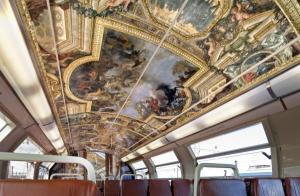
Inside one of the carriages with a reproduction of a ceiling from Versailles, Christophe Recoura/SNCF
They may look like any old beat-up railway train on the outside but inside they are decorated with reproductions of interiors from the royal château of Versailles. For the modest price of a local network ticket passengers travelling to Versailles, just outside Paris, will have a décor fit for a king. The first of five carriages decorated with reproductions of the château’s world-famous royal apartments built by Louis XIV, Louis XVI’s library and similar sumptuous scenes started running Wednesday. The others will all be in operation by the end of the year. . .
The full article is available here»
◊ ◊ ◊ ◊ ◊
Note (added 8 December 2012) — Eleanor Beardsley reported on the story for NPR’s Weekend Edition Saturday (8 December 2012).
The 2011 Georgian Group Architectural Awards
The annual Georgian Group Architectural Awards were held on 31 October 2011. As noted at the Georgian Group’s website (for an overview of last year’s awards, see Enfilade’s previous post) . . .
◊ ◊ ◊ ◊ ◊
Our Architectural Awards, sponsored by international estate agents Savills, recognise exemplary conservation and restoration projects in the United Kingdom and reward those who have shown the vision and commitment to restore Georgian buildings and landscapes. Awards are also given for high-quality new buildings in Georgian contexts and new architecture in the Classical tradition.
The 2011 Awards were presented by Viscount Linley on 31 October 2011. The judges were the architectural historians Dr John Martin Robinson (Chairman), Professor David Watkin and Emeritus Professor John Wilton-Ely; the architecture critic Jonathan Glancey; Lady Nutting (Chairman of the Georgian Group); Charles Cator (Deputy Chairman of Christie’s International); and Crispin Holborow (Director of Country Property at Savills).
2011 WINNING AND COMMENDED SCHEMES
A record eighty entries were received, of which nineteen were shortlisted and eight were selected as award winners. The remaining shortlisted schemes were commended.
Restoration of a Georgian Country House
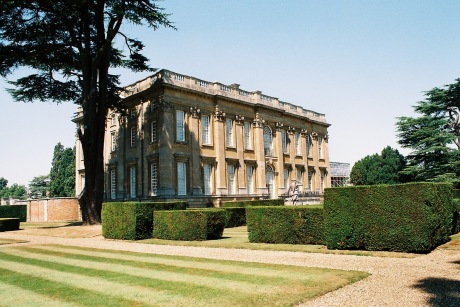
Easton Neston, Towcester, Northants
JOINT WINNER Easton Neston, Towcester, Northants (Ptolemy Dean Architects for Leon Max) 1702 by Hawksmoor for Fermor-Heskeths, who sold up in 2005. External repairs; restoration where possible of Hawksmoor’s original plan form; removal of tanking and cement render in basement; rebuilding of roof of fire-damaged Wren wing and reinstatement of lost dormers; relandscaping of north courtyard.
JOINT WINNER Strawberry Hill, Twickenham (Inskip & Jenkins for The Strawberry Hill Trust) 1750s for Horace Walpole. Building at Risk by 1993. Restoration of fabric, reinstatement of Walpole plan form and decorative scheme. Recreation of selected furnishings, including bespoke damask. External colour scheme reinstated.
COMMENDED Wilton House, near Salisbury, Wiltshire (Coade Ltd, David Mlinaric et al for the Earl of Pembroke) Restoration of cloisters, conservation of stonework and re-display of sculpture collection.
Restoration of a Georgian Building in an Urban Setting
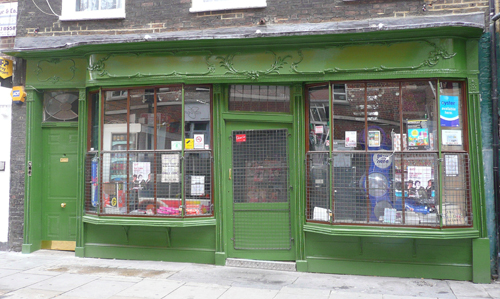
88 Dean Street, Soho
JOINT WINNER Cockermouth Shopfront Heritage Scheme, Cumberland (By and for Allerdale Borough Council) Sensitive local authority-led restoration of shopfronts in Main Street and Market Place following the severe flooding of November 2009. Concerted effort to emerge from the adversity of flooding with a visually enhanced historic centre. Fifteen shopfronts restored to traditional designs by July 2011.
JOINT WINNER 88 Dean Street, Soho (David Bieda et al for Romil Patel) Meticulous restoration of 1791 shopfront, in particular the overpainted and dilapidated gesso fascia board and the damaged fanlight, backed by extensive research, including paint research.
COMMENDED Creative Ropewalks scheme, Liverpool Coordinated grant and enforcement action by Liverpool City Council to rescue and restore disused and derelict Georgian properties in the Ropewalks. Several properties in Seel Street, a notoriously derelict Georgian street with numerous buildings at risk, have been externally restored.
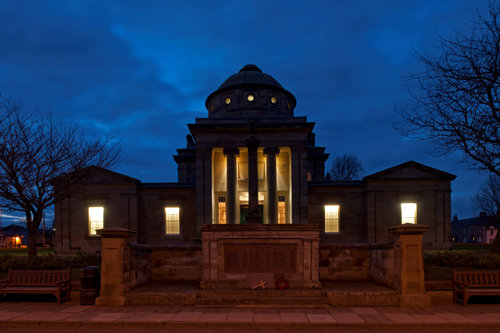
WINNER Greenlaw Town Hall, Berwickshire (Adam Dudley Architects for the Scottish Historic Buildings Trust) 1831 by John Cunningham as Berwickshire Courthouse. Redundant and a building at risk since 2001, now restored and reused as office space for local businesses and a community hall.
Restoration of a Georgian Church
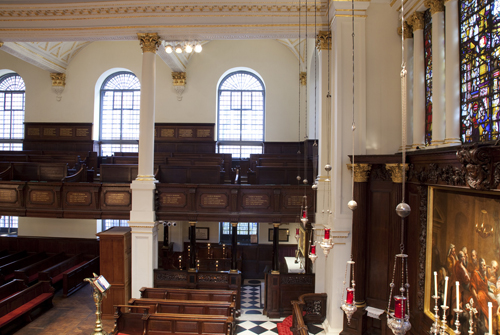
St George’s Hanover Sq, London
WINNER St George’s Hanover Sq, London (Molyneux Kerr Architects for the Rector and PCC of St George’s Church) 1720s by John James. Roof and plasterwork repairs, servicing and lighting renewal, restoration of reredos, cleaning of woodwork, reinstatement of original decorative scheme, restoration of clock faces, restoration of gallery pews with reinstatement where lost.
COMMENDED St Peter and St Paul, Wolverhampton (Rodney Melville & Partners for Roman Catholic Church)1729, oldest surviving post-Reformation public urban chapel for Catholics; disguised as townhouse. Extended and altered 1826 by Joseph Ireland as memorial to Bishop Milner. Blighted by 1960s ring road and at risk of demolition; derelict by late 1980s. Restoration since then, now completed with reorganisation of interior; new altar, confessional and crucifix, the last by Rory Young.
Restoration of a Georgian Garden and Landscape
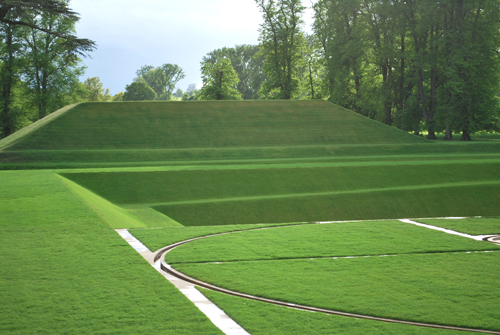
Boughton House, near Kettering, Northants
WINNER Boughton House, near Kettering, Northants (The Landscape Agency and Kim Wilkie Associates for Buccleuch Estates) Restoration of the main structure of the canal system, key water and earthworks features and the grand avenues (over a mile of lime avenues using home grown stock has been planted); repair of garden railings and gates; creation of a new formal landscape element, Orpheus by Kim Wilkie.
COMMENDED Hagley Hall, Hagley, Worcestershire (Reading Designs for Viscount Cobham) 1756-60 by Sanderson Miller for Lord Lyttleton. Restoration of 1764 obelisk in park.
COMMENDED Stourhead, Wiltshire (Temple of Apollo) (Caroe & Partners for The National Trust) 1765 by Flitcroft. Reroofing (replacement of 1950s roof, with original shallower dome profile reinstated) and interior redecoration (recreation of lost ‘gilt representation of the solar rays’ described in contemporary correspondence and partly based on a surviving Flitcroft design at Woburn).
Special Award
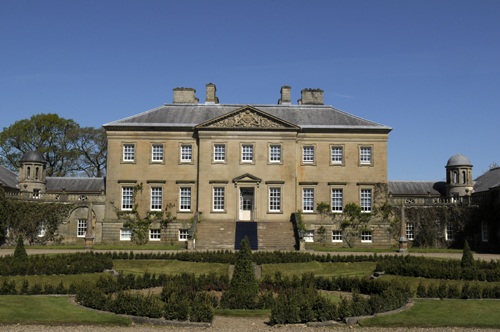
Dumfries House, Cumnock, Ayrshire (By and for Great Steward of Scotland’s Dumfries House Trust) 1750s by Adam Brothers for Earl of Dumfries. Restoration and conservation of interiors and contents (saved from dispersal in 2007). Recreation of original paint scheme and Adam decorative scheme, recreation of furnishings using archival records.
◊ ◊ ◊ ◊ ◊
The photos are drawn from The Georgian Group Blog, which also provides additional information about the individual awards, as well as the categories of New Building in the Classical Tradition and the Giles Worsley Award for a New Building in a Georgian Context.
Francesco Vezzoli Transforms Hip-Hop Star into Rococo Icons
From the November 2011 issue of W Magazine:
Agents Provocateurs: Nicki Minaj Transformed by Francesco Vezzoli
Klaus Biesenbach interviews Francesco Vezzoli

Francesco Vezzoli (styled by Edward Enninful), "Rococo Portrait of Nicki Minaj as Jeanne Antoinette Poisson, Marquise de Pompadour," 2011
In the space of two years, hip-hop star Nicki Minaj has made the leap from little known Lil Wayne protégée to object of national obsession, via a number-one album, seven singles simultaneously on the Billboard Hot 100—a first for any artist—and a series of scene-stealing cameos, including an epic verse on the Jay-Z and Kanye West track “Monster.” Along the way, she’s established a zany look (all neon, all the time), introduced countless alter egos, and become the first female rapper since Missy Elliott to be cast not as a sidekick but as a bona fide swaggering leading lady.
Powerful female figures have always been a draw for the artist Francesco Vezzoli, who has produced a trailer for a mock remake of Gore Vidal’s Caligula featuring Courtney Love and made a fake-fragrance commercial starring Natalie Portman and Michelle Williams. Through film, performance, and images often enhanced with embroidery, the 40-year-old Italian links contemporary icons to historic representations of women in art. He transformed Eva Mendes into Bernini’s masterpiece The Ecstasy of Saint Teresa for his Prada Foundation installation at this year’s Venice Biennale and, for MOCA’s 30th-anniversary gala in 2009, he reimagined Lady Gaga as a latter-day Ballets Russes star. Now Vezzoli has remade Minaj as an 18th-century courtesan. To discuss the project, he sat down for a lively tête-à-tête with Klaus Biesenbach, director of MoMA PS1, who is organizing a touring retrospective of Vezzoli’s work that will land at the New York venue in 2013.
BIESENBACH (W Magazine): How have you transformed [Nicki Minaj]?
VEZZOLI: In her performances, Minaj makes very explicit and challenging use of her beauty and her body, so I thought of comparing her to some of the most famous courtesans in history: the Marquise de Montespan, Comtesse du Barry, Madame de Pompadour, and Madame Rimsky-Korsakov. My idea was to reproduce four iconic portraits of some of the most fascinating females of the past in a series starring an American pop-culture role model. We tried to re-create those original portraits using similar furniture, props, and clothing, à la Visconti. Luckily enough, the result came out as surreal as it could be, just as I wished. . . .
To see the slideshow of Minaj in the guise of eighteenth-century women of the court, read the full interview here»
Exhibition: American Colonial Revival Style in New York
From the Museum of the City of New York:
The American Style: Colonial Revival and the Modern Metropolis
Museum of the City of New York, 14 June — 30 October 2011
Curated by Donald Albrecht and Thomas Mellins
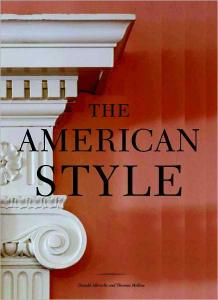 The American Style: Colonial Revival and the Modern Metropolis brings together extraordinary furniture, decorative objects, and photographs to survey, in New York City and beyond, the Colonial Revival movement in the realms of architecture and design. The exhibition covers the fertile period from the 1890s to the present, focusing on the years from 1900 to the 1930s, when New York City, through department stores, museums, and more, was the center for the style’s promotion nationwide.
Exhibition Catalogue: Donald Albrecht and Thomas Mellins, The American Style: Colonial Revival and the Modern Metropolis (New York: Monacelli Press, 2011), 224 pages, ISBN: 9781580932851, $50. Easily the most recognizable architectural style in America, with its brick or shingled facades trimmed in white and ornamented with restrained classical detail, the Colonial Revival emerged in the late nineteenth century and is still the basis for classical
design today. The American Style surveys the evolution of the Colonial Revival from the 1890s to the present, focusing on the period from 1900 to the 1930s when New York City was a major center of architecture and decorative arts. Leading architects, including McKim Mead & White, Delano & Aldrich, and Mott B. Schmidt, used its vocabulary for private residences and clubs as well as institutional buildings—banks, schools, churches, and museums.
◊ ◊ ◊ ◊ ◊
As Edward Rothstein writes in his review for The New York Times (13 June 2011) . . .
National Design That’s Hidden in Plain Sight
One sign of a powerful style is its invisibility. It is so familiar it is scarcely noticed. It is so natural, how could things be otherwise? We don’t really pay attention to the style itself. Instead we notice contrasts, variations, violations.
One of the achievements of the illuminating exhibition “The American Style,” which opens on Tuesday at the Museum of the City of New York, is that it helps make the invisible visible. With photographs of grand mansions and suburban residences; with images of high schools, apartment buildings, town halls and post offices; with examples of mass-market furniture and finely made cabinetry; with pewter candlesticks and pictorial wall murals and floor plans, the exhibition gradually helps us see what is all around us. Its subtitle defines the terrain: “Colonial Revival and the Modern Metropolis.”. . .
The style embraces both authority and intimacy, proclaiming the hopes of ordinary citizens as well as the heritage of those well established.
There is also a historical aspect to its appeal. The revival developed after the nation’s centennial celebrations in 1876, when the scars of the Civil War and the struggles of Reconstruction were salved by these allusions to an almost pastoral colonial past. Reproductions were made of early furniture. Paintings, vases and decorative plates incorporated images of Washington.
On display here is a hand-tinted photograph from the studio of Wallace Nutting, a minister who at the turn of the 20th century became something of a revival missionary, staging domestic tableaus in colonial-era homes and photographing them. The style gained another wave of energy from the renovation of Colonial Williamsburg in the 1930s, which even influenced architects of new urban developments.
The style, as the exhibition shows, eventually evolved into a national style meant “to invoke a national experience and express national values.” When the Metropolitan Museum of Art opened its American Wing in 1924, its first curator, R. T. H. Halsey, said the displays of early decorative arts would counter “the influx of foreign ideas” and present traditions “invaluable in the Americanization of many of our people.” . . .
The full review is available here»
Elisabeth Badinter: Feminism Here and There, Then and Now
I think it’s safe to say that the history of feminism looks considerably different in France and the United States. Last week’s issue of The New Yorker includes an instructive profile by Jane Kramer on the powerful intellectual Elisabeth Badinter, whose scholarly interests are anchored in the eighteenth century. Badinter has taught philosophy in Paris for twenty-eight years at the École Polytechnique. Her academic books include Les Remonstrances de Malesherbes, an account of the trial of Louis XVI, Les Passions Intellectuelles, and a biography of Nicolas de Condorcet, co-authored with her husband Robert Badinter, an established fixture in French politics. In 2006 she co-curated an exhibition at the Bibliothèque Nationale on Émilie du Châtelet. -CH
◊ ◊ ◊ ◊ ◊
From The New Yorker:

Elisabeth Badinter, photograph by Lise Sarfati (The New Yorker, 25 July 2011, p. 45).
Badinter once told me that she lived in two centuries and commuted between them, a reluctant tenant in her own. She is convinced that young Frenchwomen have been undermining their hard-won claims to equality — a universalist principle enshrined in the Declaration of the Rights of Man and of the Citizen, written by the revolutionary elite of 1789 as the founding document of a new republic. Never mind that the citoyennes of 1789 lost those rights before they ever had them, or that they got to vote only after the Second World War, or, for that matter, that until they took to the streets two months ago, in protest, they were expected to accept the extraordinary sexual prerogatives of their republic’s male leaders. Legally, Frenchwomen have those rights now, and Badinter thinks they are starting to renounce them. She believes that, in the name of “difference,” young women are falling victim to sociobiological fictions that reduce them to the status of female mammals, programmed to the “higher claims” of womb and breast. She has written five blunt, admonitory best-sellers on the subject of those women and their men. They have made her a household name. She calls
them “my contrarian feminist politics.” . . .
◊ ◊ ◊ ◊ ◊
 Though little of Badinter’s work has been translated into English, the American edition of her latest book, Le conflit, la femme et la mère is scheduled to be released in January 2012.










 Enfilade
leave a comment