A Note on the Name
◊ ◊ ◊ ◊ ◊
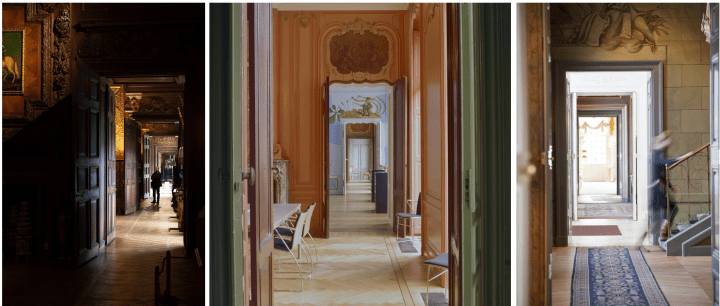
The site’s name, Enfilade, is intended to suggest the way that entries are threaded together along a central axis. A common early modern device for arranging rooms by aligning their doorways, the enfilade persisted in grand houses throughout the eighteenth century as a means for organizing space, as well as social interactions. Etymologically, the term suggests being ‘strung together in a line’–an apt metaphor for a blog that unfolds incrementally, day by day. In many instances, thematic coherence will hold a series of posts together—perhaps on gardens or country houses, porcelain or portraiture—while in other cases, the logic of the order depends upon contrast or just the coincidences of time itself.
Postings address recent or upcoming books, exhibitions, journal articles, conferences, calls for papers, and other opportunities as related to the art, architecture, and visual culture of the long 18th century (1680s to 1820s). Apart from job postings, almost anything is fair game. Nearly all of the content is aggregated from other sources: press releases and other promotional materials. It is my assumption that producers of such content welcome its wider distribution. If that’s ever not the case, I certainly want to know in order to remedy the situation.
Founded in June of 2009, the site originally served as the official newsletter for the Historians of Eighteenth-Century Art & Architecture (HECAA). At some point, however, as the site developed its own identity and audience, it made sense to rethink that relationship. Enfilade continues to be informally affiliated with HECAA, and news from HECAA members tends to take priority. But the site in no way represents HECAA in any official capacity.
The success of Enfilade still surprises me. After 14 years, it continues to find readers–over 10,000 hits each month is now typical (with 1.3 million total hits as of January 2024). While it skews toward the scholarly, it is intended for anyone interested in the art and visual culture of the 18th century.
–Craig Hanson
CraigAshleyHanson@gmail.com
Tips for new users: The site uses a consistent system of labels. Thus, if you’re interested in information related to books, you would simply click on books from the list of labels in the right-hand column. You also can search the entire site by keyword (the search box is also found in the right-hand column). To receive posts via email, look for the ‘subscribe’ button in the lower right hand corner (or send me an email and I’ll add your address manually).
Left: Chatsworth State Apartments, ca. 1687–1702 (Derbyshire; photo by Tom Parnell, Wikimedia Commons, 2019). Center: Jan Pieter van Baurscheidt de Jonge, Van de Perrehuis, ca. 1765, (Middelburg, Zeeland; photo by Gerard Dukker, Wikimedia Commons, 2000). Right: Slot Zeist, ca. 1677–87, with interiors by Daniël Marot (Zinzendorflaan, Utrecht; photo by Kris Roderburg, Wikimedia Commons, 2009).
◊ ◊ ◊ ◊ ◊
Note (added 4 January 2023) — This page was updated with a more complete description. The original version looked a lot like this posting from 2009.










 Enfilade