New Book | Lady Caroline Lamb
From Simon & Schuster:
Antonia Fraser, Lady Caroline Lamb: A Free Spirit (New York: Pegasus Books, 2023), 224 pages, ISBN: 978-1639364053, $29.
 The vivid and dramatic life of Lady Caroline Lamb, whose scandalous love affair with Lord Byron overshadowed her own creativity and desire to break free from society’s constraints.
From the outset, Caroline Lamb had a rebellious nature. From childhood she grew increasingly troublesome, experimenting with sedatives like laudanum, and she had a special governess to control her. She also had a merciless wit and talent for mimicry. She spoke French and German fluently, knew Greek and Latin, and sketched impressive portraits. As the niece of Georgiana, Duchess of Devonshire, she was already well connected, and her courtly skills resulted in her marriage to the Hon. William Lamb (later Lord Melbourne) at the age on nineteen. For a few years they enjoyed a happy marriage, despite Lamb’s siblings and mother-in-law detesting her and referring to her as “the little beast.” In 1812 Caroline embarked on a well-publicised affair with the poet Lord Byron—he was 24, she 26. Her phrase “mad, bad and dangerous to know” became his lasting epitaph. When he broke things off, Caroline made increasingly public attempts to reunite. Her obsession came to define much of her later life, as well as influencing her own writing—most notably the Gothic novel Glenarvon—and Byron’s. Antonia Fraser’s vividly compelling biography animates the life of ‘a free spirit’ who was far more than mad, bad, and dangerous to know.
Antonia Fraser is the author of many widely acclaimed historical works which have been international bestsellers. She was awarded the Medlicott Medal by the Historical Association in 2000 and was made a DBE in 2011 for services to literature. Her previous books include Mary Queen of Scots; King Charles II; The Weaker Vessel: Woman’s Lot in Seventeenth-Century England, which won the Wolfson History Prize; Marie Antoinette: The Journey; Perilous Question; The King and the Catholics; and The Wives of Henry VIII. Must You Go?, a memoir of her life with Harold Pinter, was published in 2010, and My History: A Memoir of Growing Up in 2015. Fraser’s The Case of the Married Woman is available from Pegasus Books. She lives in London.
Byron 200 Years after His Death
George Gordon Byron (1788–1824) died 200 years ago on Friday (19 April). Writing this week for The Washington Post, Michael Dirda reviews two new books about the poet (noted below), while Benjamin Markovits, in a New York Times essay, grapples with how (and whether) people still read him. A Byron Festival is being held at Trinity College, Cambridge (yesterday and today) while the Keats-Shelley House presents the exhibition, Byron’s Italy: An Anglo-Italian Romance, along with a series of talks and other events throughout the year. Finally (for now), Liverpool UP has discounted some of its Byron books.
The Byron Festival at Trinity
Trinity College Cambridge 19–20 April 2024
 Trinity College Cambridge will host a two-day festival to coincide with the 200th anniversary of Lord Byron’s death on 19 April 1824, in Missolonghi, Greece. Byron was a student at Trinity College and is one of its most celebrated alumni. While enrolled as an undergraduate, Byron published his collection of poetry, Hours of Idleness, and began the satirical poem that would become English Bards and Scotch Reviewers, a scathing provocation of the literary establishment.
Described by the College’s Senior Tutor of the time as a “young man of tumultuous passions,” Byron became one of the most controversial, celebrated, and influential poets of his age. When Westminster Abbey declined to accept the magnificent statue of Byron, created after his death by the Danish sculptor Thorvaldsen, Trinity gave it a home in the Wren Library, where the poet still stands—an impressive presence for students, scholars, and visitors.
But what kinds of presence does Byron have now? This question is the focus of an exciting programme of talks, readings, music, and exhibited work, which will address, and mediate, the legacy and status of Byron now, within the contexts of today’s culture and scholarship. The Byron Festival Conference programme includes talks about Byron, by academics and writers including Bernard Beatty, Drummond Bone, Clare Bucknell, Will Bowers, Christine Kenyon Jones, Mathelinda Nabugodi, Seamus Perry, Diego Saglia, Dan Sperrin, Jane Stabler, Fiona Stafford, A.E. Stallings, Andrew Stauffer, Corin Throsby, Clara Tuite, Ross Wilson.
◊ ◊ ◊ ◊ ◊
Fiona Stafford, ed., Byron’s Travels: Poems, Letters, and Journals (New York: Everyman’s Library, 2024), 728 pages, ISBN: 978-1101908426, $35.
 George Gordon, Lord Byron, was one of the leading figures of British Romanticism. The Byronic hero he gave his name to—the charming, dashing, rebellious outsider—remains a powerful literary archetype. Byron was known for his unconventional character and his extravagant and flamboyant lifestyle: he had numerous scandalous love affairs, including with his half-sister Augusta Leigh. Lady Caroline Lamb, one of his lovers, famously described him as “mad, bad and dangerous to know.”
His letters and journals were originally published in two volumes; this new one-volume selection includes poems and provides a vivid overview of his dramatic life arranged to reflect his travels through Scotland, Italy, Spain, Turkey, Albania, Switzerland, and of course Greece, where he died. It contains a new introduction by scholar Fiona Stafford highlighting Byron’s enduring significance and the ways in which he was ahead of his time.
Fiona Stafford is a professor of English literature at Oxford University. The author of many books, including a biography of Jane Austen, she also wrote and presented the highly acclaimed The Meaning of Trees for BBC Radio 3’s The Essay. Her book The Long, Long Life of Trees, published in 2017, was a Sunday Times Nature Book of the Year.
◊ ◊ ◊ ◊ ◊
Andrew Stauffer, Byron: A Life in Ten Letters (Cambridge: Cambridge University Press, 2024), 300 pages, ISBN: 978-1009200165, $30.
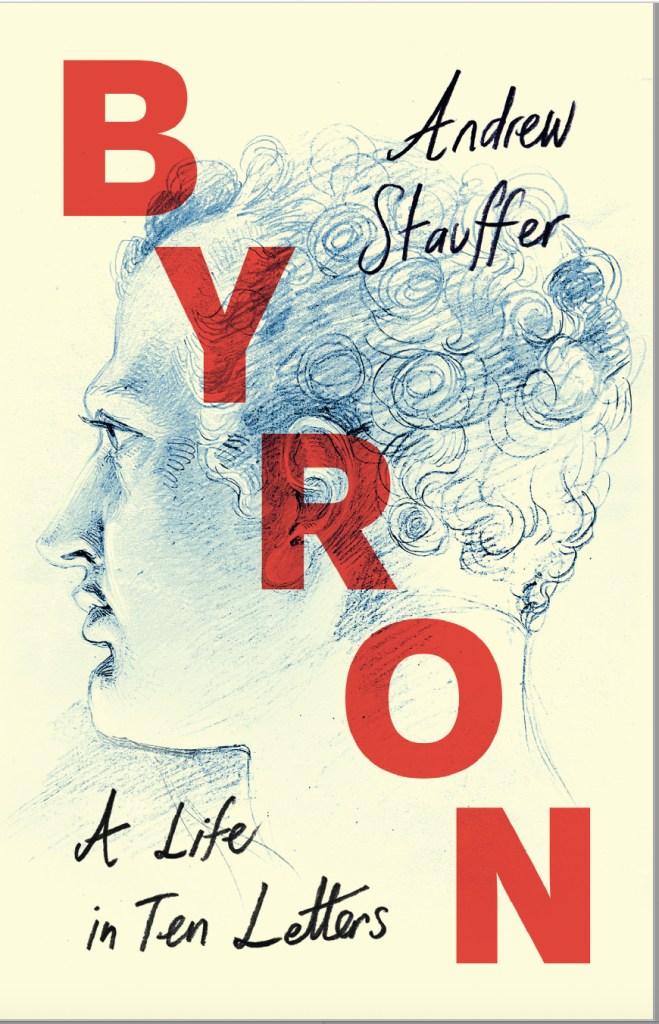
Lord Byron was the most celebrated of all the Romantic poets. Troubled, handsome, sexually fluid, disabled, and transgressive, he wrote his way to international fame—and scandal—before finding a kind of redemption in the Greek Revolution. He also left behind the vast trove of thrilling letters (to friends, relatives, lovers, and more) that form the core of this remarkable biography. Published to coincide with the 200th anniversary of Byron’s death, and adopting a fresh approach, it explores his life and work through some of his best, most resonant correspondence. Each chapter opens with Byron’s own voice—as if we have opened a letter from the poet himself—followed by a vivid account of the emotions and experiences that missive touches. This gripping life traces the meteoric trajectory of a poet whose brilliance shook the world and whose legacy continues to shape art and culture to this day.
Andrew M. Stauffer is a professor in the English Department at the University of Virginia, where he specializes in nineteenth-century literature, especially poetry.
New Book | Antiquity in Print
Forthcoming from Bloomsbury:
Daniel Orrells, Antiquity in Print: Visualizing Greece in the Eighteenth Century (London: Bloomsbury Academic, 2024), 368 pages, ISBN: 978-1350407763 (hardback), $95 / ISBN: 978-1350407770 (paperback), $31.
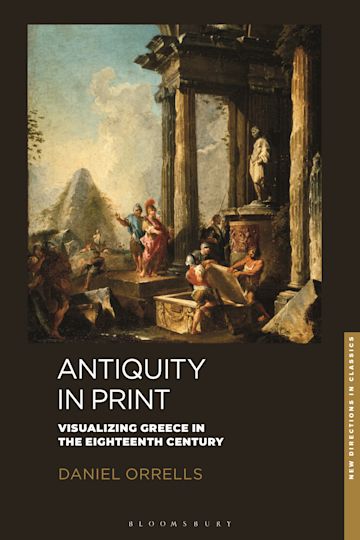 Daniel Orrells examines the ways in which the ancient world was visualized for Enlightenment readers and reveals how antiquarian scholarship emerged as the principal technology for envisioning ancient Greek culture, at a time when very few people could travel to Greece which was still part of the Ottoman Empire. Offering a fresh account of the rise of antiquarianism in the 18th century, Orrells shows how this period of cultural progression was important for the invention of classical studies. In particular, the main focus of this book is on the visionary experimentalism of antiquarian book production, especially in relation to the contentious nature of ancient texts. With the explosion of the Quarrel between the Ancients and the Moderns, eighteenth-century intellectuals, antiquarians, and artists such as Giambattista Vico, Johann Joachim Winckelmann, the Comte de Caylus, James Stuart, Julien-David Leroy, Giovanni Battista Piranesi, and Pierre-François Hugues d’Hancarville all became interested in how printed engravings of ancient art and archaeology could visualize a historical narrative. These figures theorized the relationship between ancient text and ancient material and visual culture—theorizations which would pave the way to foundational questions at the heart of the discipline of classical studies and neoclassical aesthetics.
Daniel Orrells is Professor of Classics at King’s College London. He is author of Sex: Antiquity and Its Legacy (2015) and Classical Culture and Modern Masculinity (2011), and is co-editor of The Mudimbe Reader (2016) and African Athena: New Agendas (2011).
c o n t e n t s
Introduction: Historicity, Disciplinarity, and Materiality
1 Achilles’ Shield and Vico’s Frontispiece
2 Visualising Philhellenism
3 Putting Ancient Greece into the Picture
Epilogue: From Lessing to Kauffmann: Awaiting the Return of Ancient Greece
Notes
Bibliography
Index
Workshop | The Reception of the Belvedere Torso

William Hogarth, The Analysis of Beauty, Plate 1, detail, 1753.
◊ ◊ ◊ ◊ ◊
From ArtHist.net and the Freie Universität Berlin:
Centre/Pieces: De- and Recentring the Belvedere Torso
Berlin, 25–26 April 2024
Organized by Anna Degler and Katherine Harloe
Registration due by 22 April 2024
This two-day workshop is held as a cooperation between the EXC 2020 project The Travelling Torso by Anna Degler (EXC 2020, Freie Universität Berlin) and Katherine Harloe (Institute of Classical Studies, University of London School of Advanced Study). It is dedicated to the post-antique reception of one of the most canonised and well-known antique sculptures within ‘Western’ culture, the so-called Belvedere Torso, which is kept in the Vatican Museums in Rome. Since at least the early sixteenth century, this larger-than-life marble sculpture has been the centrepiece of a classical canon. It has also at the same time always only been known in its fragmentary state, as a powerful body in pieces.
Exploring scholarly, artistic, and curatorial engagement with this centrepiece of classical Greco-Roman antiquity allows for a deeper insight into complex temporal, normative, and political reference systems that are constitutive of classical receptions. The workshop will focus on the relation of body politics and classical sculpture over the five centuries since the Torso entered the European art historical canon in order to explore the entanglements of these engagements with ideals of freedom, humanity, and gender, as well as racial and ableist discourses.
Following the research agenda of EXC 2020, the reception of the Belvedere Torso serves as one paradigmatic case study of intermediary literary and artistic practices. In the workshop we will discuss how its reception within art, literature, scholarship, and museums have produced or reproduced a variety of (political) temporalities and a set of norms. We will examine collection displays, the history of copies in plaster casts and other media, the Torso’s material transformations, and the many literary and artistic attempts at its completion, as well as comparing its reception with that of other famous antique sculptures (such as Laocoön and Venus of Milo). Invited practitioner Stephe Harrop will engage with the Torso from the perspective of contemporary storytelling with a new piece, to be performed during the workshop.
This two-day workshop—held on split sites between the Cluster Villa and the Abguss-Sammlung Antiker Plastik in Charlottenburg—will bring together international and local guest speakers working at the interface of a variety of disciplines (classics, literary studies, art history, archaeology, and performance studies) to investigate and reflect upon the manifold temporalities and asynchronies that constitute and complicate processes of classical reception. Given the Belvedere Torso’s central position in ‘Western’ canons up until today, the workshop aims at de- and possibly recentring the Torso by self-critically exploring classical reception and canonisation as a powerful practice. The workshop hereby raises the question how those practices actively shape temporal communities. This free event will be conducted in English. Please register with anna.degler@fu-berlin.de before 22 April 2024.
t h u r s d a y , 2 5 a p r i l
Morning at Cluster Villa, Otto-von-Simson Strasse 15
9.30 Registration
9:45 Introduction by Katherine Harloe (London, Institute of Classical Studies) and Anna Degler (Berlin, EXC 2020)
10.15 Morning Presentations
Chair: Anna Degler (Berlin)
• Elisabeth Décultot (Halle) — Winckelmann’s Invention of the Belvedere Torso: Epistemological Foundations and Strategic Interests
• Andrew James Johnston (Berlin, EXC 2020) — Making the Torso Move: The Torso Belvedere, the Uffizi Wrestlers, and Courbet
12.30 Lunch at Clustervilla
Afternoon at the Abguss-Sammlung Antiker Plastik (Greek and Roman Plaster Cast Collection), Freie Universität, Schloss Charlottenburg
2.30 Check-in
3.00 Afternoon Presentations
• Lorenz Winkler-Horaček (Berlin) — The Belvedere Torso in Berlin: Between Display, Distribution, and Disappearance
• Stephe Harrop (Liverpool) — Storytelling Performance Speaking Stone: Broken Stories from the Belvedere Torso
• Leonard Barkan (Princeton) — If the Torso Belvedere Could Talk, What Would It Say?
6.30 Reception
f r i d a y , 2 6 a p r i l
Cluster Villa, Otto-von-Simson Strasse 15
9.15 In conversation with Stephe Harrop
10.00 Morning Presentations
• Allannah Karas (Miami) — Black Artists and ‘White’ Sculptures: Reconfiguring the Classical Tradition
• Ryan Sweet (Swansea) — Prosthesis Narratives: Constructing and Complicating Physical Wholeness in Victorian Literature and Culture
12.15 Lunch
1.00 Afternoon Presentations
• Anna Degler (Berlin) — Modes of Thinking or Thinkers beyond Rodin: The Torso Belvedere in the United States, c. 1853–63
• Closing Discussion
Exhibition | The Tiepolos: Invention and Virtuosity in Venice
Now on view at the Beaux-Arts de Paris:
The Tiepolos: Invention and Virtuosity in Venice
Beaux-Arts de Paris, 22 March — 30 June 2024
Curated by Hélène Gasnault and Giulia Longo
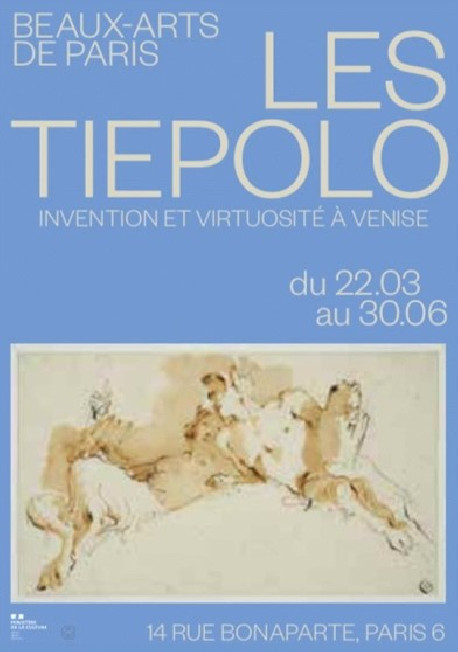 This exceptional exhibition brings together drawings and etchings by Giambattista Tiepolo and his two sons, Giandomenico and Lorenzo Tiepolo, a family of virtuoso artists in 18th-century Venice.
The Beaux-Arts de Paris owns a remarkable collection of ten works by Giambattista Tiepolo (1696–1770), making it the second-largest public collection of the artist’s drawings in France. Above all, this collection is the only one in France to include drawings not only by Giambattista, but also by his two painter sons, Giandomenico (1727–1804) and Lorenzo (1736–1776), as well as another of Tiepolo’s assistants in the 1730s, Giovanni Raggi. This collection alone provides an overview of graphic practices within the family and the studio.
The study of these sheets and prints, combined with works by other artists—sources of inspiration such as Rembrandt, masters such as Piazzetta, and contemporaries such as Canaletto, Guardi, and Novelli—highlights the great modernity of their art. This is particularly evident in their ability to produce variations on the same theme, both in traditional religious and mythological subjects and in figure studies, particularly caricatures, as well as scenes from Venetian life. The exhibition also explores the relationship between the father and his sons, and the work within a family of artists.
The exhibition opens with a series of studies of heads and faces that raise the question of training in the Tiepolo studio. It then moves on to religious paintings and large-scale secular decors produced by the Tiepolos and their contemporaries in Venice, followed by autonomous graphic works conceived outside of any painted project, as pure graphic exercises or pleasures, based on iconographic themes repeated almost obsessively, in multiple variants. It is the exceptional inventiveness of Giambattista and Giandomenico Tiepolo, one of the most fascinating facets of their artistic personalities, that these drawings and prints allow us to rediscover.
Curated by Hélène Gasnault, curator of drawings at Beaux-Arts de Paris, and Giulia Longo, curator of engravings and photos at Beaux-Arts de Paris.
Hélène Gasnault, ed., with additional texts by Catherine Loisel and Giulia Longo, Les Tiepolo: Invention et virtuosité à Venise (Paris: Beaux-Arts de Paris éditions, 2024), 112 pages, ISBN: 978-2840568780, €25.
Exhibition | Disegno Disegni
This exhibition of over 100 Italian drawings closed on Sunday, though there is a catalogue:
Disegno Disegni
Musée Jenish, Vevey, Switzerland, 8 December 2023 — 14 April 2024
Curated by Emmanuelle Neukomm et Pamella Guerdat

Pietro Palmieri, Trompe-l’oeil with eight copied engravings and study drawings stacked on top of each other, 1783, pen, black and brown inks, brown wash, and blue watercolor on paper, 45 × 60 cm (Vevey: Musée Jenish; photo by David Quattrocchi).
Avec Guerchin, Novelli, Piola, Tiepolo ou encore Zuccari, le dessin italien ancien et moderne est au coeur de l’exposition Disegno disegni.
Dans le sillage du legs de René de Cérenville en 1968, qui faisait la part belle à la création graphique de la Péninsule, les fonds italiens du Musée Jenisch Vevey n’ont cessé de s’enrichir au fil des années, constituant aujourd’hui l’un des noyaux essentiels du patrimoine veveysan. Plus de 100 feuilles issues d’une collection particulière déposée au musée depuis 2003 sont mises en lumière pour l’occasion, dans un dialogue fécond avec les propres fonds de l’institution. Les pièces ainsi réunies invitent à voyager à travers les grands centres artistiques d’Italie, de Venise à Rome, en passant par Bologne et Florence. Autant d’écoles à l’origine d’une production dessinée placée sous le signe de la diversité technique et matérielle. Sujets religieux et profanes, pages d’études et dessins autonomes célèbrent la pluralité qui caractérise le médium et ses multiples fonctions, entre la fin du XVe siècle et les premières décennies du XIXe siècle.
Une exposition sous le commissariat de Emmanuelle Neukomm et Pamella Guerdat, conservatrice et conservatrice adjointe Beaux-Arts, assistées de Leïla Thomas, collaboratrice scientifique.
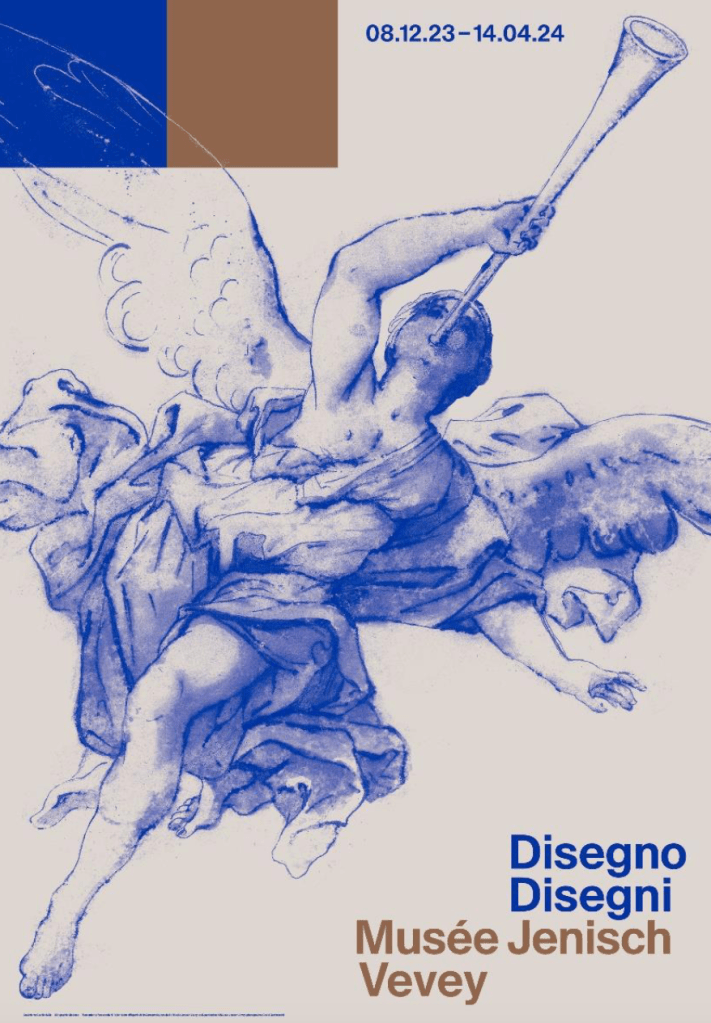
Marcantonio Franceschini, Allegory of Fame, before 1696 (Private Collection).
Pamella Guerdat et Emmanuelle Neukomm, eds., Disegno disegni: Dessins italiens de la Renaissance au XIXe siècle (Milan: Silvana Editoriale, 2024), 340 pages, ISBN: 978-8836654727, €45.
Préface — Nathalie Chaix
Le dédale des provenances — Ètienne Dumont
Connoisseurship et marché de l’art — Frédéric Elsig
Avertissement
Catalogue: Dessins italiens de la Renaissance au XIX siècle
Du dessin, la part maudite — Jérémie Koering
Index
Bibliographie sélective
Remerciements
Impressum
On Display | Quapaw Treaty of 1818
From the press release:
Nation to Nation: Treaties between the United States and American Indian Nations — Quapaw Treaty of 1818
National Museum of the American Indian, Washington, DC, April–October 2024
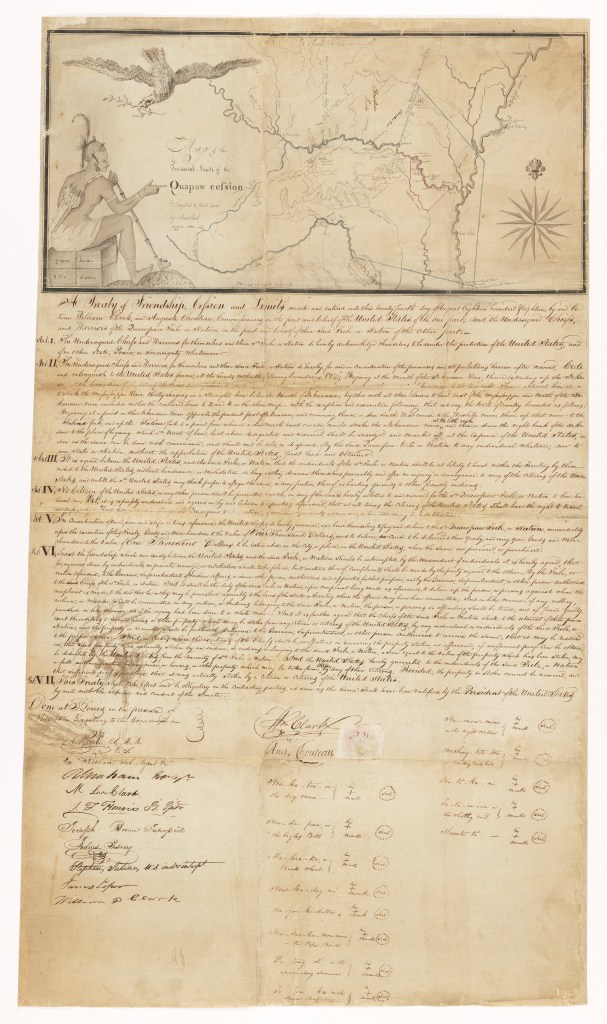
Quapaw Treaty, 24 August 1818 (Washington, DC: National Archives). Transcript originally published in Indian Affairs: Laws and Treaties, compiled and edited by Charles J. Kappler, 1904; digitized by Oklahoma State University.
The National Museum of the American Indian, in partnership with the National Archives and Records Administration, is displaying the Quapaw Treaty of 1818 as part of the exhibition Nation to Nation: Treaties between the United States and American Indian Nations (2014–28). The Quapaw Treaty will be on view until October 2024.
When the U.S. negotiated the Treaty of 1818, the Quapaw lived in four towns along the lower Arkansas River, although their hunting territories extended broadly to the west. The U.S. wished to acquire rights to these territories, which they considered excess Quapaw land, with the idea that those lands might be used for the resettlement of eastern tribes dispossessed by removal. The U.S. offered a lump-sum payment, promises of more payments annually for perpetuity, and a reservation composed of the territories occupied by the Quapaw towns. Just six years after the treaty was ratified, U.S. negotiators returned in 1824 at the behest of white settlers who desired the prime agricultural land of the lower Arkansas. The Quapaw were forced to abandon the 1818 reservation and move further west. Quapaw leader Heckaton, who felt compelled to agree to removal, said, “Since you have expressed a desire for us to remove, the tears have flowed copiously from my aged eyes.”
Displaying original treaties in Nation to Nation is made possible by the National Archives and Records Administration, an exhibition partner. Several of the treaties required extensive conservation treatment by the National Archives’ conservator prior to loan. Treaties can only be displayed for a short amount of time in order to conserve them for the future. There are a total of more than 370 ratified Indian treaties in the National Archives; more information about these treaties is available through its website.
Treaty Exhibition Schedule
September 2014–February 2015 — Treaty of Canandaigua, 1794
March–August 2015 — Muscogee Treaty, 1790
September 2015–February 2016 — Horse Creek (Fort Laramie) Treaty, 1851
March–August 2016 — Treaty with the Potawatomi, 1836
September 2016–February 2017 — Unratified California Treaty K, 1852
March–August 2017 — Medicine Creek Treaty, 1854
September 2017–January 2018 — Treaty of Fort Wayne, 1809
February–April 2018 — Navajo Treaty, 1868
May–October 2018 — Treaty with the Delawares, 1778
November 2018–March 2019 — Fort Laramie Treaty, 1868
April–September 2019 — Treaty of New Echota, 1835
October 2019–March 2020 — Treaty of Fort Stanwix, 1784
October 2020–March 2021 — Treaty of Fort Jackson, 1814
November 2021–May 2022 — Treaty of Fort Harmar with the Six Nations, 1789
May–November 2022 — Treaty with the Nez Perce, 1868
November 2022–April 2023 — Prairie du Chien Treaty, 1829
May–October 2023 — Treaty with Cheyenne and Arapaho, 1865
October 2023–April 2024 — Medicine Lodge Creek Treaty, 1867
April–October 2024 — Treaty with the Quapaw, 1818
Museum of the American Revolution Acquires Continental Army Drawing
Press release (26 March) from the Museum of the American Revolution, with coverage appearing in The Washington Post over the weekend (14 April 2024) . . .

Attributed to Pierre Eugène du Simitière, Soldiers and Camp Followers of the Continental Army’s North Carolina Brigade Marching through Philadelphia on 25 August 1777, pen and ink on paper (Philadelphia: Museum of the American Revolution).
◊ ◊ ◊ ◊ ◊
An eyewitness pen-and-ink sketch depicting Continental Army soldiers and camp followers marching through Philadelphia on 25 August 1777, which has never been documented or published by historians, has been donated to the Museum of the American Revolution. This sketch is the first wartime depiction of North Carolina troops known to exist, and only the second-known depiction of female camp followers of the Continental Army drawn by an eyewitness.
“This sketch is extremely important to our understanding of the daily operations of the Continental Army,” said Matthew Skic, Curator of Exhibitions at the Museum, who worked to authenticate the sketch and identify its creator after discovering it in a private collection. “It helps us visualize the everyday lives of these troops—the joyous, the difficult, and the mundane.”
This discovery brings to light a lively scene that newspaper accounts confirm occurred the morning of 25 August 1777, as the North Carolina Brigade and its commander, Brigadier General Francis Nash, marched to join the rest of General George Washington’s army before seeing action in both the Battle of Brandywine (11 September 1777) and the Battle of Germantown (4 October 1777).
The drawing shows two soldiers marching alongside an open-sided wagon, as well as a commissioned officer and a wagon driver mounted on horseback. Inside the wagon sit two women, one holding an infant, amongst various equipment and baggage of the brigade. Two men are also depicted riding on the back of the wagon. The inclusion of female camp followers—who shared life on campaign with enlisted husbands and fathers and supported the troops by sewing, doing laundry, and selling food—exemplifies a direct defiance of known regulations at the time about how women following the army could use wagons. Earlier in August, before the march depicted in the sketch took place, Washington himself brought up issues of women and children slowing down his troops, calling them “a clog upon every movement.”

Reverse side of the sketch of the North Carolina Brigade showing five male figure studies.
◊ ◊ ◊ ◊ ◊
On the reverse of the North Carolina Brigade sketch are five studies of two male figures, one brandishing a sword and the other engaged in a fist fight. Artists frequently sketched studies like these when they were working on larger works, as it allowed them to try out different poses or details and to get a sense of the scale of the larger drawing or painting.
The sketch was acquired by Judith Hernstadt, a Manhattan-based urban and regional planner and former television executive, in the late 1970s from a New York City antiques dealer. Hernstadt donated the sketch to the Museum in 2023, but at the time, the identity of the artist who drew it was still unknown. An ink inscription below the vignette of the North Carolina Brigade reads, “an exact representation of a waggon belonging to the north carolina brigade of continental troops which passed thro Philadelphia august done by …” with the rest of the lettering cut away due to an old paper repair.
After detailed research, handwriting analysis, and comparison to similar sketches, Skic identified the sketch’s creator as Switzerland-born artist and collector Pierre Eugène du Simitière (1737–1784), who settled in Philadelphia in about 1774 and is now known for documenting the rising American Revolution as it happened. Du Simitière went on to create from-life profile portraits of prominent Revolutionary leaders including Washington and he suggested the motto “E Pluribus Unum” through his rejected design for the Great Seal of the United States in 1776. In 1782, he founded the first museum in the United States that was open to the public.
Many of Du Simitière’s significant manuscripts and drawings still exist and are available for researchers to study at both The Library Company of Philadelphia and the Library of Congress. It is yet to be determined if either sketch relates to another work by du Simitière, but research is ongoing.
We were thrilled to piece together the many illuminating and significant parts of this sketch’s history through our unparalleled scholarship here at the Museum of the American Revolution,” said Dr. R. Scott Stephenson, President and CEO of the Museum. “As we round out our celebration of Women’s History Month, we revel in the discovery of this new depiction of female camp followers as highlighting the lesser-known stories and critical roles of women throughout the American Revolution are at the heart of the Museum’s offerings.”
The sketch was conserved due to generous contributions from the North Carolina Society of the Cincinnati, which is comprised of descendants of officers of the North Carolina Continental Line.
“The North Carolina Society of Cincinnati is proud to support the conservation and framing of this important discovery, which serves as an important reminder that the intricate history of both our state and our nation is still unfolding,” said Society President George Lennon.
New Installation | The Calculated Curve: 18th-C. American Furniture
Now open at The Met:
The Calculated Curve: Eighteenth-Century American Furniture
The Metropolitan Museum of Art, New York, 5 April 2024 — ongoing
 The 2024 reinstallation of the Anthony W. and Lulu C. Wang Galleries of Eighteenth-Century American Art of The Met’s American Wing elevates a pivotal moment in American furniture design between 1720 and 1770. This fresh installation encourages us to look closer at the materials and sculptural expression of this period, as well as the sensuality and ergonomics embedded in furniture design. The reinstalled galleries will feature iconic American furniture from the H. Eugene Bolles and Natalie Knowlton Blair collections, in addition to more recent gifts from premier collectors such as the Wangs as well as Erving and Joy Wolf. This striking display offers a counterpoint to the contextual installations of eighteenth-century furniture in the American Wing’s period rooms.
Major support for The Calculated Curve: Eighteenth-Century American Furniture is provided by The Edward John and Patricia Rosenwald Foundation.
Image: High chest of drawers (detail), 1730–50, American (New York: The Metropolitan Museum of Art, Bequest of Cecile L. Mayer, 1962).
Exhibition | Pocket Luxuries
Now on view at the Cognacq-Jay:
Pocket Luxuries: Small Precious Objects in the Age of Enlightenment
Luxe de poche: Petits objets précieux au siècle des Lumières
Musée Cognacq-Jay, Paris, 28 March — 29 September 2024
Curated by Sixtine de Saint Léger and Gabrielle Baraud
 L’exposition Luxe de poche au musée Cognacq-Jay présente une collection exceptionnelle de petits objets précieux et sophistiqués, en or, enrichis de pierres dures ou de pierres précieuses, couverts de nacre, de porcelaine ou d’émaux translucides, parfois ornés de miniatures. Les usages de ces objets varient, mais ils ressortent tous des us et coutumes d’un quotidien raffiné, signe de richesse, souvenir intime. Au siècle des Lumières comme aux suivants, ils suscitent un véritable engouement en France d’abord puis dans toute l’Europe. Luxe de poche a pour ambition de renouveler le regard que l’on porte sur ces objets, en adoptant une approche plurielle, qui convoque à la fois l’histoire de l’art et l’histoire de la mode, l’histoire des techniques, l’histoire culturelle et l’anthropologie en faisant résonner ces objets avec d’autres œuvres : des accessoires de mode, mais aussi les vêtements qu’ils viennent compléter, le mobilier où ils sont rangés ou présentés et enfin des tableaux, dessins et gravures où ces objets sont mis en scène. Ce dialogue permet d’envisager ces objets dans le contexte plus large du luxe et de la mode au XVIIIe et au début du XIXe siècle.
Point de départ de cette nouvelle exposition, la remarquable collection d’Ernest Cognacq est enrichie de prêts importants—d’institutions prestigieuses comme le musée du Louvre, le musée des Arts décoratifs de Paris, le Château de Versailles, le Palais Galliera, les Collections royales anglaises ou le Victoria and Albert Museum à Londres—afin d’offrir une nouvelle lecture de ces accessoires indispensables du luxe.
Commissariat scientifique
• Vincent Bastien, collaborateur scientifique au Château de Versailles
• Ariane Fennetaux, professeure des universités, Université Sorbonne Nouvelle
• Pascal Faracci, conservateur en chef du patrimoine
Sixtine de Saint-Léger, ed., Luxe de poche: Petits objets précieux au siècle des Lumières (Paris: Musée Cognacq-Jay, 2024), 96 pages, ISBN: 978-2759605798, €19. With contributions by Gabrielle Baraud, Vincent Bastien, Ariane Fennetaux, and Alice Minter.










 Enfilade
leave a comment