Call for Papers | Textiles and Masculinities
From ArtHist.net and the Design History Society:
Textiles and Masculinities
Online, Design History Society, 15 June 2024
Proposals due by 11 April 2024
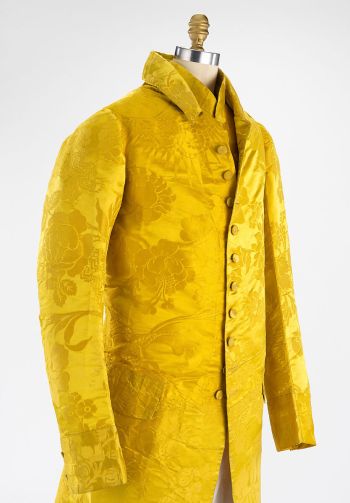
Banyan, British, ca. 1780, silk (New York: The Metropolitan Museum of Art, 1978.135.1).
The complex and evolving relationships between masculinities and textiles have been underrepresented in histories of design to date. This picture contrasts with the cultural and social importance textiles have in maintaining, contesting, and performing masculinities. This online symposium will share international research on historical and contemporary textiles in global contexts. We invite researchers at any level who investigate some aspect of masculinities and textiles to submit an abstract.
Themes include but are not limited to:
• Fashion textiles and masculinities
• Maintaining, performing, or contesting masculinities through textiles
• Queer, non-binary, and fluid gender identities and textiles
• Masculinities, textiles, and interior design
• Decolonising textiles and masculinities
• Textiles for menswear in fashion for all
• Design, production, and consumption of textiles and masculinities
Due to the language limits of the organisers, the symposium will take place in English. We acknowledge that information/knowledge can be disseminated in different ways, and so we are open to different presentation styles and formats. To be considered for a 15-minute presentation, please submit a 300-word abstract and a 50- to 100-word biography to the DHS Senior Administrator Jenna Allsopp at designhistorysociety@gmail.com by 11 April 2024. Applicants will be notified of the outcome of the submission within two weeks of the closing deadline. Please contact Dr Fiona Anderson (Glasgow School of Art) at f.anderson@gsa.ac.uk with any questions.
Exhibition | The Doering Fashion Collection

Shoes, made in England or America, ca. 1800, leather, silk, and linen
(Mary Doering Fashion Collection)
◊ ◊ ◊ ◊ ◊
From the press release for the exhibition:
Elegance, Taste, and Style: The Mary D. Doering Fashion Collection
DeWitt Wallace Decorative Arts Museum, Colonial Williamsburg, opening 22 February 2024 (with three rotations)
More than 150 objects from one of the greatest private collections of early textiles, accessories, and historic dress assembled in the United States will go on view over the next several years at the DeWitt Wallace Decorative Arts Museum, one of the Art Museums of Colonial Williamsburg. Elegance, Taste, and Style: The Mary D. Doering Fashion Collection will take visitors through 50 years of this collector’s passion and feature gowns, jackets, waistcoats, shoes, textile documents, and more dating between 1700 and 1840. Due to light sensitivity, the objects will be shown in three parts. The first installment displays approximately 40 objects and is the inaugural exhibition to be shown in the Mary Turner Gilliland and Clinton R. Gilliland Gallery, the Art Museums’ first dedicated gallery to historic costume. The dates for the second and third rotation of objects on view are still to be determined.
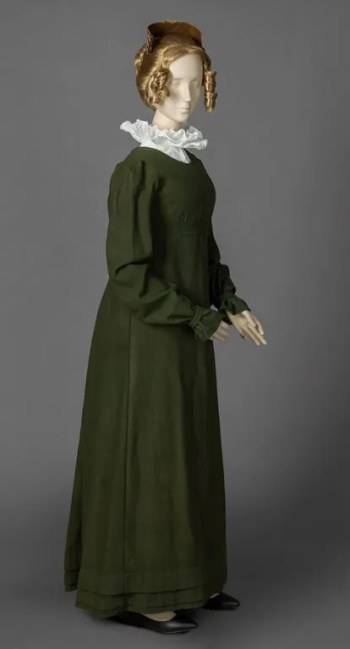
This green gown, made of wool, ca. 1815, is remarkable to have survived, because many woolen garments of the day were destroyed by moths and carpet beetles (Mary Doering Fashion Collection).
“Examples of historic dress are among the most human of artifacts from the past, providing windows into the lives and tastes of our forebearers,” said Ronald Hurst, the Foundation’s Carlisle H. Humelsine chief curator and senior vice president. “Mary Doering’s superb collection is particularly rich in such opportunities, and it is highly fitting that the Doering Collection constitutes the first exhibition in the new Gilliland Gallery for historic dress.”
When Mary D. Doering (b. 1952), a lifelong curator, educator, and researcher, was sixteen years old, she received a trunk filled with early 20th-century clothing as a bequest from her great aunt. This small gift was the impetus for what became a lifelong passion for historic dress. Throughout her career, Doering used her collection, which ultimately grew to thousands of pieces (there are approximately 800 pieces dating before 1840 alone), to educate hundreds of students and researchers about changing fashions, taste, design, and style. From the early collecting days when she went picking at local flea markets and antiques stores, to her first trip to the United Kingdom and her eventual meeting with the legendary antiques dealer Cora Ginsburg, who became Doering’s mentor, she thoughtfully and carefully selected every object in her collection. Over the nearly 50 years that she built the collection, Doering gained expertise to create a truly comprehensive assemblage ranging from underwear to the finishing accessories.
“It has been an absolute pleasure working with Mary’s collection, especially using objects so near and dear to her heart, to tell her lifelong story of collecting historic dress,” said Neal Hurst, Colonial Williamsburg’s curator of historic dress and textiles. “Every object that Mary acquired was carefully hand-selected based on her research and what she saw in other museums. Visitors to the new historic dress gallery will love seeing the range of clothing from the fine and fancy to the plain and every day.”

One highlight of the collection is a blue silk Englishman’s waistcoat, likely embroidered in the 1760s in China (Mary Doering Fashion Collection).
Among the highlights of Elegance, Taste, and Style is one of the first waistcoats Doering purchased of what was to become more than 100 examples dating between 1700 and 1840. This stunning blue silk waistcoat was probably embroidered in China in the 1760s for the Western market. Chinese embroidery is distinctive in that it uses twisted threads rather than single stranded floss. The object, the first of several Doering purchased at Christie’s in South Kensington, London, on 11 June 1974, was bought with money she saved to travel to Europe. Doering remembered the auctioneer saying, “Sold to the enthusiastic young woman on the aisle.”
Another featured object in the exhibition is an ivory, silk satin round gown in nearly perfect condition. Believed to be a wedding gown worn in the West Country of England, the style was popular in the mid-18th century; it integrates the petticoat into the structure of the skirt rather than it being a separate garment. Doering purchased this round gown along with two other gowns from Cora Ginsburg in honor of her mother who died in January 1978. Doering used the small sum of money her mother left to her to fund the gowns.
Although the Doering Collection is strong in American and English objects and focused heavily on women’s dress from the 18th and early 19th centuries, it also includes important pieces from Europe, such as the 1780s Dutch jacket that is another star piece in the exhibition. Jackets of this era, such as this one, were very low cut, even under the bust, with a large handkerchief worn over the top. Dutch women often dressed with many different prints and patterns, which varied greatly depending on the region. This example is unusual in that it uses two different block-printed cotton fabrics with black or dark blue backgrounds in the lower skirts and under the sleeves. It is important to note the careful use of textiles here with two different but very similar textiles used in obvious places; textiles were more expensive than the labor to construct the jacket, so this indicates a level of frugality.
The Doering Collection features numerous accessories, including shoes, buttons, work bags, hats, caps, and buckles. One example among the shoe collection is another highlight of Elegance, Taste, and Style. Although James B. Patterson’s identity is lost to history, he saw value in this pair of ivory, silk satin slippers with a small Italian-style heel popular in the 1780s. He affixed a paper label to the bottom that reads: “Shoes worn in 1782” along with his name. This pair shows very little wear on the soles and heels perhaps indicating that they were worn as wedding slippers.

Designed by Jean-Baptist Huet between 1800 and 1805, this piece of French-printed cotton includes amphora, Apollo’s lyre, and the mythical harpee enclosed within medallions (Mary Doering Fashion Collection).
Mary Doering also collected many textile documents to use in her class on design, manufacturing techniques, and the change in taste over time, which she taught at The Smithsonian Institution’s Master’s Program in the History of Decorative Arts in 2001. One such rare example to be seen in the exhibition is an early 19th-century cylinder print that shows the new style and taste desired across England and Europe. With the discovery of Pompeii and Herculaneum in the 1730s and Napoleon’s Egyptian Campaign at the turn of the century, ancient relics and symbols quickly became popular. Designed by Jean-Baptist Huet between 1800 and 1805, this print includes amphora, Apollo’s lyre and the mythical beast known as a Harpee, or half woman-half bird, enclosed within different medallions. The print, known as a furniture, was primarily used for bed hangings, window curtains, and slip covers. It is especially rare in that the designer, the printer, the date, and the place of production are all known.
Also included in the exhibition is a larger-than-life video panel that will be sure to delight visitors and highlight a practice we share with our 18th-century ancestors. It will show people of all races and classes, from Native Americans to soldiers, enslaved Africans to members of the top echelons of colonial society, tradesmen, and women, getting dressed.
In celebration of Elegance, Taste, and Style, a symposium on historic dress, Collections, Collectors, and Collaborations, will be held at The Colonial Williamsburg Foundation, 14–16 November 2024. The symposium will not only celebrate the opening of the Mary Turner Gilliland and Clinton R. Gilliland Gallery at the Art Museums of Colonial Williamsburg but also 90 years of historical dress and costumed interpretation at Colonial Williamsburg (since 1934), 70 years of the Margaret Hunter Shop, which was the first curated exhibition of clothing and accessories at Colonial Williamsburg (in 1954), and 40 years of mantua making in the Colonial Williamsburg’s department of historic trades (begun in 1984). Registration for the conference will launch later this spring.
Elegance, Taste, and Style: The Mary D. Doering Fashion Collection is generously funded by the Thomas L. and Nancy S. Baker Museum Exhibitions Support Fund. The exhibition’s video component, men’s accessories, and other essential aspects of the exhibition are funded by Charles and Ellan Spring.
New Book | François Le Moyne (1688–1737)
From Silvana Editoriale (and on sale until 10 March) . . .
Jean-Luc Bordeaux, François Le Moyne (1688–1737), Opera completa: New Findings and Legacy (Milan: Silvana Editoriale, 2024), 352 pages, ISBN: 978-8836652310, €95.
 First Painter to the king in 1736 for only a few months before his tragic death, François Le Moyne had a career as short as it was prolific. A large number of works by this exceptional representative of French Rococo had been commissioned by the high clergy, the powerful Duke of Antin—official representative of King Louis XV—by members of the high aristocracy like the Prince of Conti or the Duke of Rohan or rich fermiers généraux like François Berger or Abraham Peyrenc de Moras, or even by the elite of great collectors or connoisseurs like Mariette, La Live de July, and Lempereur.
Teacher of Charles-Joseph Natoire and François Boucher and a contemporary of Antoine Watteau and Jean-François de Troy, Le Moyne reached the height of his glory with his Apotheosis of Hercules, painted between 1732 and 1736 on the immense ceiling of the Salon d’Hercule, located between La Chapelle Royale and the royal apartments of the Château de Versailles. After so many years spent in oblivion, Le Moyne is finally recognized today as one of the major artists of the 18th century, exerting a seminal influence on the following generations.
Unfortunately, only few of the works that Le Moyne realized at the beginning of his career, between 1710 and 1715, have been identified. Nonetheless, he left an important corpus of landscapes, religious works, and courtship scenes. He is considered one of the greatest draftsmen of all time and one of the best European artists of illusionistic ceiling painting since the time of Pietro da Cortona and Charles Le Brun. Moreover, Le Moyne contributed with his easel paintings and his technique to the creation of a new, more seductive model for the representation of the female nude in Europe. Lastly, on a technical level, he brightened the palette of French painting and realized sketches with a particularly quick and agile brushstroke.
Nearly forty years after his first monograph devoted to the painter, Professor Jean-Luc Bordeaux proposes a renewed survey of the oeuvre of François Le Moyne (1688–1737). Bordeaux analyses Le Moyne’s contributions to the French rococo as well as lesser-known aspects of his artistic production and career. With almost 140 paintings and 250 drawings, this new catalogue raisonné is an extended edition of the one published in 1984, with significant additions. It also includes an appendix of around twenty pages that describes a considerable amount of works by Le Moyne, now lost but attributed to him by famous collectors of the time and 18th century experts such as Gersaint, Mariette, Paillet, and Remy.
New Book | Colonial Watteau
From De Gruyter:
Charlotte Guichard, Watteau – kolonial: Herrschaft, Handel und Galanterie im Frankreich des Régence / Colonial Watteau: Empire, Commerce, and Galanterie in Regency France (Berlin: Deutscher Kunstverlag, 2022), 128 pages, ISBN: 978-3422990463, €17 / $20. English and German.
 What were the early visions of Empire in Regency France? The book offers a interpretation of Jean-Antoine Watteau’s Pilgrimage to the Isle of Cythera (1717) by framing it in the context of French colonial expansion in the years of the Regency. Born in Louis XIV’s reign, galant aesthetics contributed to frame the colonial encounter in French America. Fantasies of maritime departure, embarkation and/or debarkation, also expressed a longing for colonial travel and exploration. The imperial imagination fueled with codes of galanterie was very developed in the circles of Watteau’s amateurs. From Watteau’s Pilgrimage to the Isle of Cythera (1717) to its visual reenactment in 1763, the book argues that galanterie served as a visual and conceptual model of French commercial and colonial relations.
Wie sahen die frühen imperialen Visionen im Frankreich der Régence aus? Das Buch bietet eine neue und auch provokative Deutung von Jean-Antoine Watteaus Pilgerfahrt zur Insel Cythera (1717), indem es das Werk in den Kontext der französischen kolonialen Expansion in den Jahren der Régence stellt. Die galante Ästhetik, die während der Herrschaft und im Imperium Ludwigs XIV. entstand, trug dazu bei, die koloniale Begegnung in Französisch-Amerika zu gestalten. Die Fantasien vom Aufbruch zur See, vom Einschiffen oder Ausschiffen, allesamt Merkmale des Gemäldes, drückten auch die Sehnsucht nach kolonialen Reisen und Entdeckungen aus. Die imperiale Imagination, die sich aus den Codes der Galanterie speiste, war in den Kreisen von Watteaus amateurs, die ihrerseits den Modernen nahestanden, die neue ästhetische Formen in Kunst und Literatur förderten, sehr ausgeprägt. Von Watteaus Pilgerfahrt zur Insel Cythera (1717) bis zu ihrer visuellen Nachstellung im Jahr 1763 diente die Galanterie als visuelles und konzeptionelles Modell der französischen Handels- und Kolonialbeziehungen.
Charlotte Guichard, Research Professor at the Centre National de la Recherche Scientifique, Paris.
Oxford Art Journal, December 2023
The 18th century in the latest issue of the Oxford Art Journal:
Oxford Art Journal 46.3 (December 2023)
a r t i c l e s
• Aaron Wile, “Absolutism, the Royal Body, and the Origins of Mythologie galante: Charles de La Fosse at the Trianon,” pp. 327–55.

Charles de La Fosse, The Rest of Diana, 1688, oil on canvas, 128 × 160 cm (Versailles, Châteaux de Versailles et de Trianon).
Mythologie galante, a sensual mode of mythological painting that is one the defining developments of eighteenth-century French art, is usually associated with aristocratic resistance to Louis XIV. This article examines three mythological paintings created by Charles de La Fosse for one of the king’s pleasure palaces in 1688, long identified as a major turning point towards mythologie galante, in order to reassess the origins and meaning of the genre. Situating the paintings within the long arc of Louis XIV’s representational politics, I propose that the collapse of the fiction of the king’s two bodies during the second half of his reign and the subsequent redefinition of the king’s public and private spheres allowed La Fosse to develop a new mythological idiom based in touch, intimacy, and sentiment. The resulting works contravened painting’s traditional role under absolutism to form royal subjects, redefining it as a medium of sympathetic encounter. La Fosse’s paintings open up, from this perspective, an alternate account of modern art and subjectivity—one that took shape not in opposition to absolutist culture but from its very heart.
• Robert Jones, “Joshua Reynolds and Deafness: Listening, Hearing, and Not Hearing in Eighteenth-Century Portraiture,” pp. 357–77.
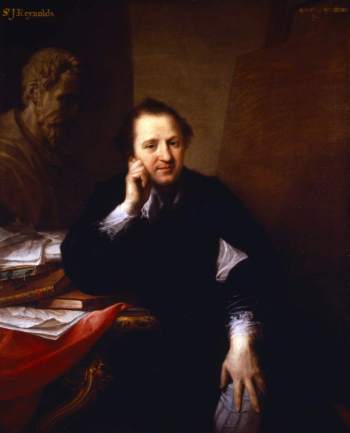
Angelica Kauffman, Portrait of Joshua Reynolds, 1767, oil on canvas, 127 × 102 cm (National Trust, Saltram).
This article examines the significance of deafness in painting and proposes a new trope for the form of picturing undertaken by eighteenth-century art, ‘the listening portrait’. As a first step it recovers and explores the significance of Sir Joshua Reynolds’s own deafness, as represented by his self-portraits as well as images by Nathanial Dance, Angelica Kauffman, and Johan Zoffany. Sound is necessarily absent from painting, audible speech impossible. Having explored these apparent limits (found in eighteenth-century theorizations of art) the essay asks more fundamentally what work is done by the representation of someone striving to listen. By considering this question, it is possible to understand these images as engaging in a more sensitive ethical enquiry concerned with what an aural impairment might mean, and how it is distinct from a refusal or unwillingness to listen. Deafness is consequently shown to be not merely something that paintings show, rather the issue of hearing or not hearing frames their pictorial and moral purpose. Throughout the article recognition of the specificity of Georgian sociability on the one hand, and eighteenth-century artistic theory and practice on the other, seeks to enable the claims of Medical Humanities to recognize previously hidden narratives.
r e v i e w s
• Andrew McClellan, “Purpose, Power, and Possibility: A History of Museums Past and Present,” pp. 493–501.
Review of Krzysztof Pomian, Le musée, une histoire mondiale, 3 volumes (Paris: Gallimard, 2020–22), volume 1: Du trésor au musée, 687 pages, ISBN: 978-2070742370, €35; volume 2: L’ancrage européen, 1789–1850, 546 pages, ISBN: 978-2072924705, €35; volume 3: À la conquête du monde, 1850–2020, 936 pages, ISBN: 978-2072982781, €45.
Lecture | Annette Richards on the ‘Blind Virtuosa, Mademoiselle Paradis’
In March at the Yale University Art Gallery, from The Walpole Library:
Annette Richards | Music on the Dark Side of 1800:
Listening to the Blind Virtuosa, Mademoiselle Paradis
Yale University Art Gallery, New Haven, 28 March 2024, 5.30pm
 The 26th Lewis Walpole Library Lecture will be delivered by Annette Richards, the Given Foundation Professor in the Humanities and University Organist at Cornell University.
In concerts across Europe in the 1780s, the young Viennese virtuosa Maria Theresia Paradis made blindness visible, even audible. Her performances invited listeners and viewers primed by horror ballads and literary romance to experience her story of trauma and misfortune within the frame of fictional narratives of doomed innocence and victimized Gothic heroines. Yet her outspoken views on blindness—informed by her own experience and contemporary philosophical discourse (by Diderot, Condillac, and Herder, among many others)—explicitly resisted the language of victimization, even as she sold pity for profit. This lecture brings to sounding life the Paridisian contradiction between performing disability for money and resisting pity. It asks what 18th-century music culture can tell us about contemporary views on blindness and explores the ways the public performances of a young female virtuoso simultaneously embraced and critiqued a culture of gawking spectatorship, freak show aesthetics, and the ethics and economics of pity. How did this Gothic musical heroine capture the public imagination, and what does she reveal about how music looked and sounded on the dark side of 1800?
Annette Richards is Professor of Music and University Organist at Cornell, and the Executive Director of the Westfield Center for Historical Keyboard Studies. She is a performer and scholar with a specialty in 18th-century music and aesthetics, and interdisciplinary research into music, literature, and visual culture. Dr. Richards was educated at Oxford University (BA, MA), Stanford University (PhD), and the Sweelinck Conservatorium Amsterdam (Performer’s Diploma, Uitvoerend Musicus).
Summer Seminar | Disability Histories in the Visual Archive
This week-long summer seminar will take place at the American Antiquarian Society:
Disability Histories in the Visual Archive: Redress, Protest, and Justice
American Antiquarian Society, Worcester, Massachusetts, 9–14 June 2024
Led by Jennifer Van Horn and Laurel Daen
Applications due by 8 April 2024
The seminar will focus on the visual and material cultures of disability in eighteenth and nineteenth-century North America. Participants will hone their skills in visual and material culture analysis, learn key methods and theories, including cripping, and gain experience working closely with archives and visual materials that support disability history. We will explore the unparalleled collections of the AAS, especially the library’s exemplary graphic arts collection of prints, photographs, and ephemera as well as collections materials on related topics such as education and printing for the blind.
The seminar will interrogate disability as lived experience, analytical category, and site for creativity and protest. Centering the histories of diverse peoples, we will explore topics such as enslavement, colonization, indigeneity, gender, education, warfare, and disability rights. Participants will actively work toward disability justice by attending to understudied and obscured histories, by questioning how we can use visual and material things to redress past injustices and dismantle ableism, and by considering equitable archival access.
Interdisciplinary in approach, the seminar welcomes scholars across multiple fields and areas of expertise that might include art history, Black studies, design history, disability studies, medical humanities, histories of vast early America, Native and Indigenous studies, and visual and material culture studies. Librarians, museum professionals, and public historians are encouraged to apply. No previous experience in disability studies or visual culture is required.
Guest speakers will include Jenifer Barclay, Associate Professor of History, University of Buffalo and author of The Mark of Slavery: Disability, Race, and Gender in Antebellum America (University of Illinois Press, 2020), and Erin Corrales-Diaz, Curator of American Art, Toledo Museum of Art.
Please follow this link for more information and instructions on how to apply.
The tuition fee for each seminar is $800, which includes meals throughout the week and evening receptions. Modest aid may be available for graduate students and early-career scholars to assist with travel and housing costs. Please feel free to reach out to Jennifer Van Horn with any questions (jvanhorn@udel.edu), or questions can be addressed to John J. Garcia, AAS Director of Scholarly Programs and Partnerships, jgarcia@mwa.org.
The seminar is sponsored by the Center for Historic American Visual Culture (CHAViC).
New Book | Yale and Slavery: A History
From Yale UP:
David Blight, with Yale and Slavery Research Project, foreword by Peter Salovey, Yale and Slavery: A History (New Haven: Yale University Press, 2024), 448 Pages, ISBN: 978-0300273847, $35.
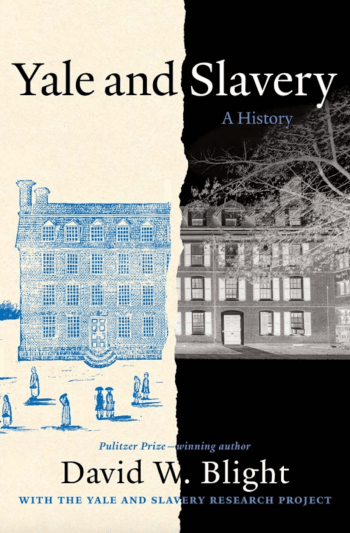 A comprehensive look at how slavery and resistance to it have shaped Yale University
Award-winning historian David W. Blight, with the Yale and Slavery Research Project, answers the call to investigate Yale University’s historical involvement with slavery, the slave trade, and abolition. This narrative history demonstrates the importance of slavery in the making of this renowned American institution of higher learning.
Drawing on wide-ranging archival materials, Yale and Slavery extends from the century before the college’s founding in 1701 to the dedication of its Civil War memorial in 1915, while engaging with the legacies and remembrance of this complex story. The book brings into focus the enslaved and free Black people who have been part of Yale’s history from the beginning—but too often ignored in official accounts. These individuals and their descendants worked at Yale; petitioned and fought for freedom and dignity; built churches, schools, and antislavery organizations; and were among the first Black students to transform the university from the inside.
Always alive to the surprises and ironies of the past, Yale and Slavery presents a richer and more complete history of Yale, the third-oldest college in the country, showing how pillars of American higher education, even in New England, emerged over time intertwined with the national and international history of racial slavery.
David W. Blight is Sterling Professor of History and director of the Gilder Lehrman Center for the Study of Slavery, Resistance, and Abolition at the MacMillan Center at Yale. The Yale and Slavery Research Project was convened in 2020.
TEFAF Maastricht 2024
TEFAF Maastricht opens soon, with lots of interesting 18th-century offerings, including these catalogues from Zebregs & Röell, one of which focuses on a rediscovered portrait of Gustav Badin, a well-known Black African at the court of Maria Louisa of Prussia, Queen of Sweden.
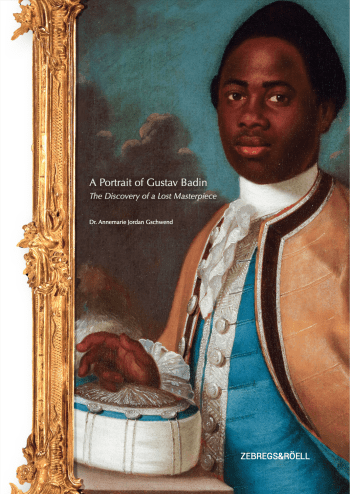
Jakob Björk, after Gustav Lundberg, Portrait of Fredrik Adolf Ludvig Gustav Albert Badin Couschi (ca. 1750–1822), 1776, oil on canvas.
Guus Röell and Dickie Zebregs, Uit verre Streken / From Distant Shores (Maastricht: Zebregs & Röell, 2024), 146 pages. Link»
Annemarie Jordan-Gschwend, A Portrait of Gustav Badin: The Discovery of a Lost Masterpiece (Maastricht: Zebregs & Röell, 2024), 20 pages. Link»
◊ ◊ ◊ ◊ ◊
TEFAF Maastricht
Maastricht, 9–14 March 2024
The European Fine Art Foundation, TEFAF Maastricht, is widely regarded as the world’s premier fair for fine art, antiques, and design, bringing together 7,000 years of art history under one roof. Featuring over 260 prestigious dealers from some 20 countries, TEFAF Maastricht is a showcase for the finest art works currently on the market. Alongside the traditional areas of Old Master paintings, antiques, and classical antiquities that cover approximately half of the fair, you can also find modern and contemporary art, photography, jewelry, 20th century design, and works on paper.
Online Workshop | European Frames, 15th–21st Centuries
From ArtHist.net:
Hubert Baija | Picture Frames in Europe, 15th–21st Centuries
Online, Beloit College Center for Collections Care, 10–24 September 2024
In a series of five online workshops Hubert Baija, an experienced frame scholar retired from the Rijksmuseum, presents the history of picture frames since the Late Middle Ages. Stylistic and technical characteristics are highlighted for distinguishing original frame manufacture from later production. This online course presents half a millennium of European picture framing by discussing the history of frame styles in connection to architecture, painting, and the decorative arts. The course will review the history of picture frames from the International Gothic style to the Italian and Northern Renaissance, via the Dutch Golden Age and the French frame styles, into 19th- and 20th-century framing. Participants will be shown tools for distinguishing styles and periods of frame manufacture. This online course serves first-time learners and professionals needing to refresh their knowledge. $500.
Tuesday, 10 September 2024
Late Medieval picture framing was influenced by architecture and illuminated manuscripts. Paintings and frames formed designed units, often emphasized by extending the pictorial space with trompe l’oeil painting on frames. The interplays between Gothic and Renaissance influences resulted in gradual transitions of frame shapes and profiles until the Iconoclasms finally ended the medieval frame styles.
Thursday, 12 September 2024
Italian art and architecture led to European frame designs during the 16th and 17th centuries. Renaissance frame profiles evolved in the Lowlands and eventually became more refined by embellishing with highly polished ebony, fruitwood, and even whalebone veneers, sometimes combined with Southern German ripple molding techniques.
Tuesday, 17 September 2024
The flamboyant Italian influences on woodcarving continued in 17th-century Europe, particularly in France and Holland. The Dutch Golden Age produced baroque frames and cartouches, including classicist, trophy, and auricular-style frames. The post-1685 Huguenot exodus from France paradoxically increased the French influence on the European decorative arts, including picture frames.
Thursday, 19 September 2024
The French decorative arts were renowned for their exceptional aesthetic and technical refinements during the reigns of Louis XIII, Louis XIV, Louis XV, and Louis XVI. Mold-made ornamentation began in Paris during the early 1700s, which would eventually lead to industrialized frame-making. French frame styles influenced frame styles for three centuries in England, Europe, and North America.
Tuesday, 24 September 2024
Empire frames with purely mold-made ornaments were followed by a dazzling variety of 19th-century neo-styles frames, like Biedermeier, Neo-Rococo, Neo-Gothic, Neo-Classical, Eclectic, and Barbizon frames. Arts and Crafts and Art Nouveau frames were contrasted to industrialization, while 20th-century Art Deco and Minimalist framing echoed modernism. During the 20th and 21st centuries, museum re-framing has changed from less informed approaches to studying original framing.
Target audience: Students and beginning/advanced professionals in art history or the conservation of paintings and picture frames.
Participants: Maximum of 20. After registration, you will be asked to provide a brief CV and motivation for enrolling in this course.
Times (in daylight savings time):
San Francisco 10.00am–noon
Chicago noon–2.00pm
New York 1.00–3.00pm
London 6.00–8.00pm
Amsterdam 7.00–9.00pm
This course was first given by the University of Amsterdam in 2021 and is available again this year via the Beloit College Center for Collections Care. Please, use this link to register.










 Enfilade
leave a comment