Exhibition | Berthe Morisot and the Art of the 18th Century
Now on view at the Musée Marmottan Monet:
Berthe Morisot et l’art du XVIIIe siècle: Watteau, Boucher, Fragonard, Perronneau
Dulwich Picture Gallery, London, 31 March — 10 September 2023
Musée Marmottan Monet, Paris, 18 October 2023 — 3 March 2024
Curated by Marianne Mathieu and Dominique d’Arnoult, with Claire Gooden
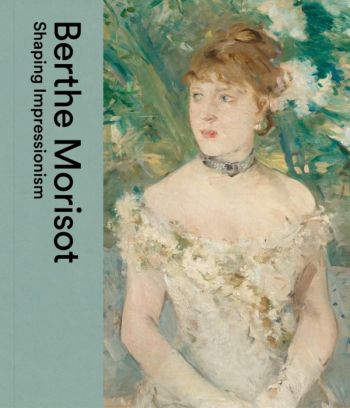 From 18 October 2023 to 3 March 2024, the Musée Marmottan Monet will present a very special exhibition, entitled Berthe Morisot and the Art of the 18th Century: Watteau, Boucher, Fragonard, Perronneau. The exhibition is curated by art historians Marianne Mathieu and Dominique d’Arnoult, with the participation of Claire Gooden, Head of Conservation at the Musée Marmottan Monet. Sixty-five art works from French and international museums, as well as private collections are brought together here for the first time to highlight the links between the work of the first female Impressionist Berthe Morisot (1841-1895) and the art of Antoine Watteau (1684–1721), François Boucher (1703–1770), Jean-Honoré Fragonard (1732–1806), and Jean-Baptiste Perronneau (1715–1783). Based on an analysis of mainly unpublished sources (letters, press clippings, and notebooks belonging to Berthe Morisot and her husband Eugène Manet and their entourage) and an in-depth genealogical study, this exhibition and the corresponding catalogue shed new light on a subject often mentioned by historians yet never having been the focus of dedicated and exhaustive research. While it has been demonstrated that Berthe Morisot is not Fragonard’s great-grand-niece and had no family ties to him, the exhibition nevertheless emphasizes the veritable foundations of their artistic affinities, retracing the chronology of their development, as well as their main characteristics.
Berthe Morisot: Shaping Impressionism (London: Dulwich Picture Gallery, 2023), 210 pages, ISBN: 978-1898519485, $40.
New Book | Practices of Ephemera in Early Modern England
The volume focuses on materials produced before 1700, though the final essay addresses 18th-century trade cards. From Routledge:
Callan Davies, Hannah Lilley, and Catherine Richardson, eds., Practices of Ephemera in Early Modern England (New York: Routledge, 2023), 252 pages, ISBN: 978-0367528362 (hardback), $160 / ISBN: 978-1003058588 (ebook), $40.
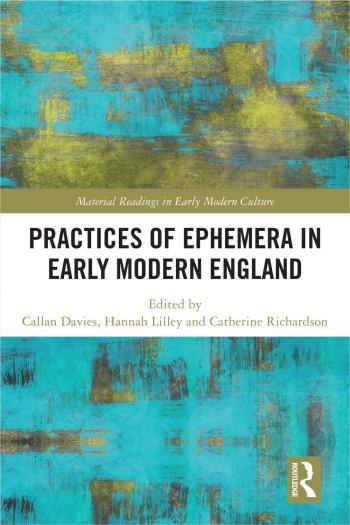 This collection is the first to historicise the term ephemera and its meanings for early modern England and considers its relationship to time, matter, and place. It asks: how do we conceive of ephemera in a period before it was routinely employed (from the eighteenth century) to describe ostensibly disposable print? In the sixteenth and seventeenth centuries—when objects and texts were rapidly proliferating—the term began to acquire its modern association with transitoriness. But contributors to this volume show how ephemera was also integrally related to wider social and cultural ecosystems. Chapters explore those ecosystems and think about the papers and artefacts that shaped homes, streets, and cities or towns and their attendant preservation, loss, or transformation. The studies here therefore look beyond static records to think about moments of process and transmutation and accordingly get closer to early modern experiences, identities, and practices.
c o n t e n t s
Acknowledgements
List of Illustrations
Biographies
1 Introduction: Spawning
Concepts/ Emerging
2 Megan Heffernan — Expired Time: Archiving Waste Manuscripts
3 Anna Reynolds — What Do Texts and Insects Have in Common?; or, Ephemerality before Ephemera
3 Bruce Boehrer — Time’s Flies: Ephemerality in the Early Modern Insect World
4 Robert Bearman — What Is an ‘Ephemeral Archive’? Stratford-upon-Avon, 1550–1650: A Case Study
5 Alison Wiggins — Paper and Elite Ephemerality
Matter / Metamorphosing
6 Elaine Leong — Recipes and Paper Knowledge
7 Katherine Hunt — More Lasting than Bronze: Statues, Writing, and the Materials of Ephemera in Ben Jonson’s Sejanus His Fall
8 Hannah Lilley — Uncovering Ephemeral Practice: Itineraries of Black Ink and the Experiments of Thomas Davis
9 Helen Smith — Things That Last: Ephemerality and Endurance in Early Modern England
Environments / Buzzing
10 Michael Lewis — Toy Coach from London
11 Jemima Matthews — Maritime Ephemera in Walter Mountfort’s The Launching of the Mary
12 Callan Davies — Playing Apples and the Playhouse Archive
13 William Tullet — Extensive Ephemera: Perfumer’s Trade Cards in Eighteenth-Century England
Lecture | Maxime Georges Métraux on Jean-Michel Papillon
As noted at the blog for the ApAhAu:
Maxime Georges Métraux | Jean-Michel Papillon: Artiste, encyclopédiste et historien de l’estampe
Online and in-person, École du Louvre, Paris, 6 December 2023, 10am
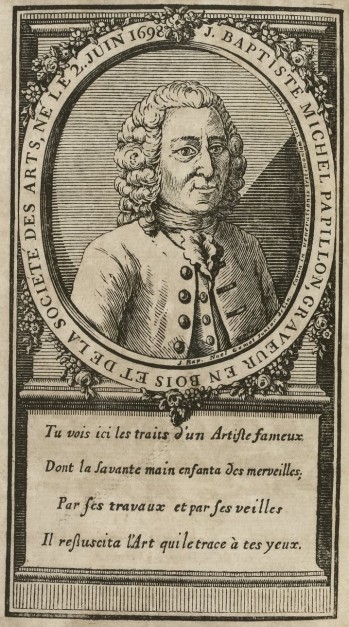 Issu d’une importante dynastie de graveurs, Jean-Michel Papillon (1698–1776) ambitionne de redonner du prestige à la gravure sur bois durant la première moitié du XVIIIe siècle. Outre sa foisonnante production graphique, cette entreprise se concrétise principalement par une volonté de transmettre les savoirs liés à son art. Il s’est notamment fait théoricien en rédigeant un imposant Traité historique et pratique de la gravure en bois. Bien qu’à manier aujourd’hui avec parcimonie, celui-ci n’en demeure pas moins une ressource extraordinaire et constitue une référence essentielle pour l’histoire de l’estampe et plus largement pour la culture visuelle du XVIIIe siècle.
Cette vaste somme de connaissances n’est pourtant pas sa seule contribution à l’histoire de l’art puisque Jean-Michel Papillon est aussi rédacteur de nombreuses entrées dans l’Encyclopédie de Diderot et d’Alembert. Il est non seulement l’auteur de plusieurs articles dédiés à la gravure mais il fournit également des ornements typographiques pour celle-ci.
Conscient de l’importance de l’accès au savoir et du rôle de l’écrit dans la transmission des techniques artistiques, Jean-Michel Papillon est une figure dont l’étude permet de saisir pleinement le phénomène de « réduction en art », concept théorisé par Hélène Vérin et Pascal Dubourg-Glatigny. Membre de la Société des Arts, le graveur s’est grandement intéressé aux monogrammes mais aussi à de nombreux domaines en lien avec la pratique de la gravure. Son riche témoignage sur sa formation d’historien autodidacte renseigne avec précision sur sa manière d’acquérir ses connaissances, de restituer son savoir et d’écrire sur son art en tant que praticien, dans un champ alors majoritairement dominé par les hommes de lettres.
Séminaire de recherche en partenariat entre l’École du Louvre, l’Université de Poitiers (Criham) et l’Université Rennes 2, adossé au projet « Amateurs et réseaux savants en France (1700–1914). Histoire intellectuelle, culturelle et sociale des amateurs et collectionneurs d’images gravées et enluminées » (UR Histoire et critique des Arts, Université Rennes 2). Les séances ont lieu simultanément à l’École du Louvre et en visio-conférence. Pour tout renseignement et inscription, merci d’écrire à pascale.cugy@univ-rennes2.fr.
Organisation
• Pascale Cugy (Université Rennes 2)
• Estelle Leutrat (Université de Poitiers, Criham)
• François-René Martin (École du Louvre)
Colloquium | Secrets of Painting
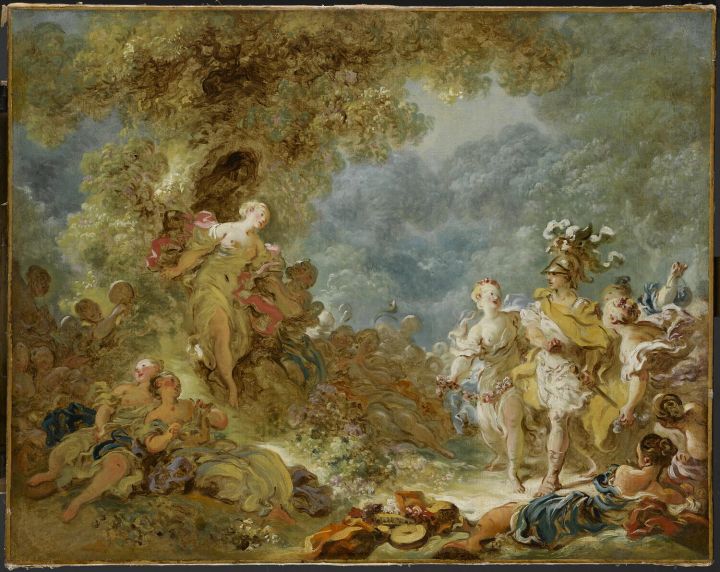
Jean-Honoré Fragonard, Renaud in the Gardens of Armide / Renaud dans les jardins d’Armide, ca. 1761–65, oil on canvas, 72 × 91 cm
(Paris, Musée du Louvre, RF2003 11)
◊ ◊ ◊ ◊ ◊
From ArtHist.net and the DFK:
Les Secrets de la peinture: Pratique et théorie de la peinture, de la manière et de la matérialité dans l’art du XVIIIe siècle français
Les Secrets de la peinture: Zu Praxis und Theorie von Malfarbe, Manier und Materialität in der Kunst des französischen 18. Jahrhunderts
Online and in-person, Deutsches Forum für Kunstgeschichte, Paris, 7–8 December 2023
Que peut légitimement dire la peinture, en tant que travail artistique technique, des conditions sociologiques de l’art, et que dit de la peinture des tableaux, du fecit, la réflexion théorique formulée dans les témoignages critiques—salons, conférences d’académie, traités ? Le colloque se consacre, à l’exemple de la peinture française du XVIIIe siècle, aux questions de la théorie et de la pratique de l’image et de la description de l’image. Il se veut une première tentative de reset de la perspective empirique dans le regard porté sur la peinture en tant que legs matériel spécifique des beaux-arts. Participation en ligne ou sur place au DFK Paris, pas d’inscription nécessaire.
j e u d i , 7 d é c e m b r e 2 0 2 3
10.00 Ouverture par Léa Kuhn (directrice adjointe du DFK Paris)
Introduction par les organisateurs — Markus Castor (DFK Paris), Deborah Schlauch (HAB Wolfenbüttel/ Université Marbourg), et Marie Isabell Wetcholowsky (Université Marbourg)
10.30 Théorie et langage autour de la peinture
• Comment la reconnaissance de la matière en peinture a renversé les paradigmes de la théorie artistique — Jérôme Delaplanche (Paris)
• The Sublime: Theory and Practice in French Painting after Charles Le Brun — Aaron Wile (Washington DC)
• Une Relation Instructive: Aesthetic and Socio-Political Dimensions of the ‘tout ensemble’ in Fête Galante Paintings — Elisabeth Fritz (Berlin)
12.45 Déjeuner
13.45 Visite du Salon Louis XV au Musée de la BnF site Richelieu
15.00 Les artistes et la pratique de la peinture
• Le rythme du ‘repos’ en peinture: Entre contemplation esthétique et expérience vécue — Susanna Caviglia (Durham/Milan)
• Les secrets d’un père à son fils: L’Epître à mon fils sur la peinture d’Antoine Coypel (1721) et sa postérité — Anthony Saudrais (Rouen)
• Dans l’atelier des fêtes galantes: Antoine Watteau, maître de Lancret et Pater — Axel Moulinier (Paris)
• Antonio Pellegrini, François Lemoyne et l’adaptation de la sprezzatura vénitienne: Le décor de la Galerie des Mississipiens et la critique du comte de Caylus — Marie Isabell Wetcholowsky (Paris/Marbourg)
• Au service de Dieu, la peinture selon Louis Galloche — Marine Roberton (Dijon)
18.45 Buffet dinatoire
v e n d r e d i , 8 d é c e m b r e 2 0 2 3
9.00 Visite du choeur de la Basilique Notre-Dame-des-Victoires de Paris La diversité de la couleur, des pigments et de la matérialité
10.00 Les artistes et la pratique de la peinture
• Learning How to Paint, Pigment by Pigment: Catherine Perrot’s Leçons Royales (1686) — Tori Champion (St Andrews)
• Fragonard’s Stalled Cart and Formless Landscape in 18th-Century France — Camilla Pietrabissa (Venise)
• Pigment, Puder, poussière précieuse: Metaphorik und visuelle Topik in der Pastellmalerei des 18. Jahrhunderts — Iris Brahms (Tübingen)
• « Fille de la peinture » Farbdruck von Le Blon bis Bonnet — Astrid Reuter (Francfort-sur-le-Main)
13.00 Déjeuner
14.00 La critique de la peinture
• “’Un des plus grans coloristes de l’école Francoise.’ He might be so and not very excellent”: English Critiques of French Painters in Britain after 1700 — Deborah Schlauch (Marbourg/Wolfenbüttel)
• Le langage des arts: Kunstkritik am Beispiel von Gemälden zu antiken Themen der Salons, 1747–1789 — Alexandra Röckel (Munich)
• La capacité olfactive de la couleur et la langue: Les taches de Bachelier, l’attaque de Diderot et les propos de Caylus sur la couleur — Markus Castor (Paris)
• « Fondre les effets » Diderot et la loi des nuances — Marie Schiele (Paris)
Paul Mellon Centre Book Night

From the PMC:
Winter Book Night
Paul Mellon Centre, London, 13 December 2023, 5.30pm
Join us for our winter Book Night to celebrate our latest publications. Each author will give a short talk discussing the research behind their book, followed by the opportunity to ask questions. Afterwards, there will be drinks, canapes, and a chance to meet the authors.
Session 1
• Finola O’Kane, Landscape Design and Revolution in Ireland and the United States
• Mark Crinson, Shock City: Image and Architecture in Industrial Manchester
Session 2
• Tim Clayton, James Gillray: A Revolution in Satire
• Tom Young, Unmaking the East India Company: British Art and Political Reform in Colonial India, c. 1813–1858
• Kirsty Sinclair Dootson, The Rainbow’s Gravity: Colour, Materiality and British Modernity
◊ ◊ ◊ ◊ ◊
And Clayton’s book was recently named Book of the Year by Apollo.
New Book | The Art of the Illustrated Book
From Thames & Hudson:
Julius Bryant, ed., The Art of the Illustrated Book: History and Design (London: Thames & Hudson, 2022), 288 pages, ISBN: 978-0500480694, £45 / $60.
 This is the story of the illustrated book, from the earliest printed examples to the present day, told through the collections of the National Art Library at the Victoria and Albert Museum, London—a library that was created to bring together examples of superlative book-making on almost every subject. Gathered here are some of the most influential, compelling and striking examples of the illustrated book, arranged thematically in chapters devoted to subjects such as art, literature, religion, architecture, natural history, fashion, and shopping. Brimming with innovative and beautiful examples, ranging from well-known titles, such as Owen Jones’s Grammar of Ornament and James Audubon’s Birds of America, to other wonderful but less familiar publications, this collection offers a fascinating overview of some of the finest illustrated books ever created—demonstrating their enduring appeal.
Julius Bryant is the Emeritus Keeper of the Victoria and Albert Museum.
c o n t e n t s
Introduction
1 Religion
2 Natural History
3 Travel
4 Fables & Folk Tales
5 Literature
6 Art Making
7 Art History
8 Architecture
9 Ornament and Pattern
10 Festivals
11 World Fairs
12 Fashion
13 Shopping
New Book | In the Shadow of St. Paul’s Cathedral
Now available in paperback from Yale UP:
Margaret Willes, In the Shadow of St. Paul’s Cathedral: The Churchyard that Shaped London (New Haven: Yale University Press, 2022), 320 pages, ISBN: 978-0300249835 (hardcover), $35 / ISBN: 978-0300273380 (paperback), $17.
 The extraordinary story of St. Paul’s Churchyard—the area of London that was a center of social and intellectual life for more than a millennium
St. Paul’s Cathedral stands at the heart of London, an enduring symbol of the city. Less well known is the neighborhood at its base that hummed with life for over a thousand years, becoming a theater for debate and protest, knowledge, and gossip. For the first time Margaret Willes tells the full story of the area. She explores the dramatic religious debates at Paul’s Cross, the bookshops where Shakespeare came in search of inspiration, and the theater where boy actors performed plays by leading dramatists. After the Great Fire of 1666, the Churchyard became the center of the English literary world, its bookshops nestling among establishments offering luxury goods. This remarkable community came to an abrupt end with the Blitz. First the soaring spire of Old St. Paul’s and then Wren’s splendid Baroque dome had dominated the area, but now the vibrant secular society that had lived in their shadow was no more.
Margaret Willes, formerly publisher at the National Trust, is author of several books, including The Curious World of Samuel Pepys and John Evelyn, Reading Matters, and The Gardens of the British Working Class. She lives in London.
New Book | The Notebook
From Profile Books:
Roland Allen, The Notebook: A History of Thinking on Paper (London: Profile Books, 2023), 416 pages, ISBN: 978-1788169325, £25.
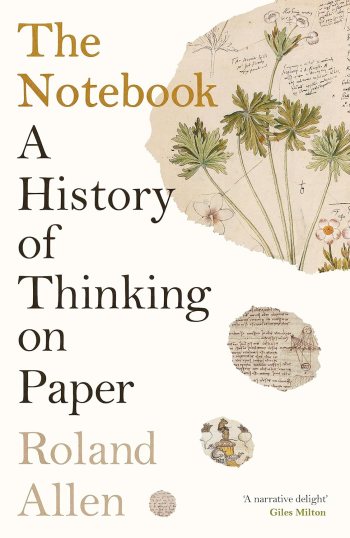 Diaries, sketchbooks, common-places, notebooks, ledgers, and ships’ logs: how the blank book changed the way we think, and helped us change the world. The first history of the notebook, a simple invention that changed the way the world thinks.
We see notebooks everywhere we go. But where did this simple invention come from? How did they revolutionise our lives, and why are they such powerful tools for creativity? And how can using a notebook help you change the way you think? In this wide-ranging story, Roland Allen reveals all the answers. Ranging from the bustling markets of medieval Florence to the quiet studies of our greatest thinkers, he follows a trail of dazzling ideas, revealing how the notebook became our most dependable and versatile tool for creative thinking. He tells the notebook stories of artists like Leonardo and Frida Kahlo, scientists from Isaac Newton to Marie Curie, and writers from Chaucer to Henry James. We watch Darwin developing his theory of evolution in tiny pocketbooks, see Agatha Christie plotting a hundred murders in scrappy exercise books, and learn how Bruce Chatwin unwittingly inspired the creation of the Moleskine. On the way we meet a host of cooks, kings, sailors, fishermen, musicians, engineers, politicians, adventurers, and mathematicians, who all used their notebooks as a space for thinking and to shape the modern world. In an age of AI and digital overload, the humble notebook is more relevant than ever. Allen shows how bullet points can combat ADHD, journals can ease PTSD, and patient diaries soften the trauma of reawakening from coma. The everyday act of moving a pen across paper can have profound consequences, changing the way we think and feel: making us more creative, more productive—and happier.
Roland Allen is a publisher and author who lives in Hove. He studied at Manchester University and works in book (and notebook) publishing. He has written about subjects as diverse as bicycles and bread, kept a diary for decades, and enjoys stationery a little too much.
Exhibition | Superb Line: Prints and Drawings from Genoa, 1500–1800
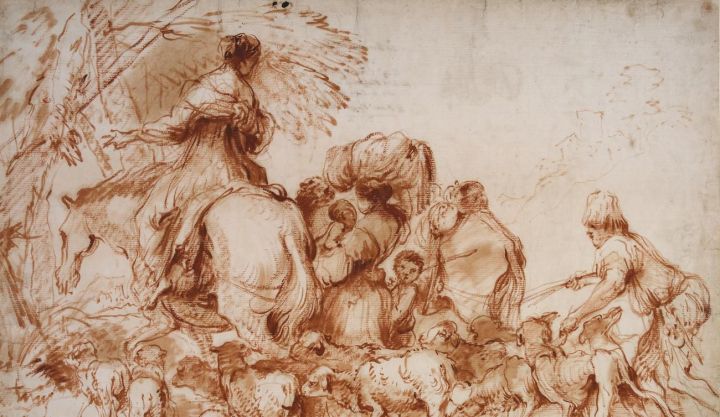
Giovanni Benedetto Castiglione, A Group of Shepherds and Their Animals, detail, ca.1650, brush and red-brown paint on paper with three crescents watermark, 43 × 57 cm (London: The British Museum, 1997,0607.10). The drawing was presented by Padre Antonio Piaggio to Sir William Hamilton and then sold at Christie’s in 1801. The subject is likely a biblical journey scene, a favorite of the artist.
◊ ◊ ◊ ◊ ◊
Now on view at The British Museum:
Superb Line: Prints and Drawings from Genoa, 1500–1800
The British Museum, London, 5 October 2023 — 1 April 2024
Showcasing prints and drawings from Genoa’s golden age, this display spotlights an artistic powerhouse that rivalled Venice, Florence, and Rome.
From the 16th to the 18th centuries, the port city of Genoa was one of Italy’s major artistic centres. Nicknamed ‘La Superba’ (‘the proud one’) by the Medieval poet Petrarch, it was among the wealthiest cities on the Italian peninsula, with strong trade links across Europe and beyond. These links and the riches they brought made Genoa a desirable destination for painters and sculptors wanting to study or find lucrative work. Superb Line opens with works by the first major arrival, Raphael’s pupil Perino del Vaga, who transformed the artistic scene when he came in 1528, introducing a new, modern manner seen in drawings like the Venus and Aeneas, which typifies his distinctive blend of graphic confidence and courtly stylishness.
Other prominent artists soon followed Perino’s lead and, over the next 150 years, the city continued to attract even bigger names like Rubens and van Dyck. This constant injection of new blood kept Genoa at the cutting edge of artistic trends, creating a nurturing environment for homegrown talents to develop in their own right. In the following centuries the city produced a steady stream of internationally renowned painters, among them Luca Cambiaso, Bernardo Strozzi, and Giovanni Benedetto Castiglione, who were especially feted for their innovative, often experimental graphic works, wowing collectors with dazzling displays of line. Featuring highlights from the British Museum’s longstanding holdings of Genoese prints and drawings, this display celebrates the virtuosity and originality of the city’s artists.
Fellowships | Morgan Drawing Institute
From The Morgan:
Morgan Drawing Institute Fellowships
The Morgan Library & Museum, New York, 2024–25
Applications due by 3 December 2023
The Morgan Library & Museum invites applications for Drawing Institute fellowships for the 2024–25 term. The application deadline is December 3, 2023. More information is available at The Morgan’s website.
Predoctoral Fellowship
The Morgan Drawing Institute will award one nine-month Predoctoral Research Fellowship to an advanced-level graduate student who has completed all course work and exams. The student should be currently engaged in carrying out research leading to the completion of a doctoral dissertation in the history of art, a significant component of which pertains to the history, theory, collecting, function, or interpretation of drawings.
Morgan-Menil Fellowship
The Morgan Drawing Institute and the Menil Drawing Institute, Houston, will award one research fellowship of three to nine months to support independent projects on some aspect of the history, theory, interpretation, or cultural meaning of drawing throughout the history of art. Preference will be given to projects that would benefit from the resources of the Morgan Library & Museum and the Menil Collection.
Postdoctoral Fellowship
The Morgan Drawing Institute will award one nine-month Postdoctoral Research Fellowship to a scholar in the first decade of their career following the completion of the PhD or equivalent advanced degree. The Postdoctoral Research Fellowship supports an independent research project, ideally working toward a clearly defined publication relating to some aspect of the history, theory, collecting, function, or interpretation of drawings.










 Enfilade
leave a comment