An 18th-C. Japanese Shōya House Arrives at The Huntington

Shōya House, ca. 1700, moved to The Huntington from Marugame, Kagawa prefecture, Japan
(San Marino: The Huntington Library, Art Museum, and Botanical Gardens, from Los Angeles residents Yohko and Akira Yokoi)
◊ ◊ ◊ ◊ ◊
Opening next month at The Huntington, from the press release (25 July 2023) . . .
Japanese Shōya House
The Huntington Library, Art Museum, and Botanical Gardens, San Marino, opening 21 October 2023
The Huntington Library, Art Museum, and Botanical Gardens will offer visitors a unique opportunity to see a restored residential compound from 18th-century rural Japan. Opening 21 October 2023, the Japanese Heritage Shōya House, a 3,000-square-foot residence built around 1700, served as the center of village life in Marugame, Japan. The compound has been reconstructed on a 2-acre site, which includes a newly constructed gatehouse and courtyard based on the original structures, as well as a small garden with a pond, an irrigation canal, agricultural plots, and other landscape elements that closely resemble the compound’s original setting. Visitors will be able to walk through a portion of the house and see how inhabitants lived their daily lives within the thoughtfully designed and meticulously crafted 320-year-old structure.

Illustrated aerial view of the Shōya House.
Los Angeles residents Yohko and Akira Yokoi offered their historic family home to The Huntington in 2016. Huntington representatives made numerous visits to the structure in Marugame and participated in study sessions with architects in Japan before developing a strategy for moving the house and reconstructing it at The Huntington. Since 2019, artisans from Japan have been working alongside local architects, engineers, and construction workers to assemble the structures and re-create the traditional wood and stonework features, as well as the roof tiles and plaster work, prioritizing the traditions of Japanese carpentry, artisanship, and sensitivity to materials.
“The new Japanese Heritage Shōya House will offer a glimpse into rural Japanese life some 300 years ago and provide insights into that culture and its sustainability practices,” Huntington president Karen Lawrence said. “We are very grateful to the Yokoi family for giving The Huntington the opportunity to tell this important story as an immersive experience for visitors.”
The historic house was the residence for successive generations of the Yokoi family, who served as the shōya, or village leaders, of a small farming community near Marugame, a city in Kagawa prefecture, Japan. Chosen by the feudal lord, a shōya acted as an intermediary between the government and the farmers. His duties included storing the village’s rice yield, collecting taxes, and maintaining census records, as well as settling disputes and enforcing the law. He also ensured that the lands remained productive by preserving seeds and organizing the planting and harvesting. The residence functioned as the local town hall and village square.
Sustainability is a major theme of the interpretive scheme. “We aim to present a working model of Edo period permaculture and regenerative agriculture,” said Robert Hori, the gardens cultural curator and programs director at The Huntington. “It represents real-life circumstances. An authentically constructed Japanese house using natural materials, combined with careful attention to agricultural practices, will demonstrate how a community became self-sufficient. We will show how emphasis was placed on reducing waste and repairing items so they could be reused or repurposed. Visitors will see how this 18th-century Japanese village maintained a symbiotic relationship between humans and the surrounding landscape.”
The compound occupies a recently developed area along the north end of The Huntington’s historic Japanese Garden. While the garden has featured an iconic Japanese House for the last 100 years, this new structure and surrounding elements will provide visitors with a fully immersive experience, allowing them to walk through it and learn about 18th-century rural Japanese life.
◊ ◊ ◊ ◊ ◊
The landscape surrounding the Japanese Heritage Shōya House is based on rural Japan in the preindustrial, mid–Edo period (1700–1760). Before arriving at the main house, visitors will pass through a small orchard of persimmon, citrus, and mulberry trees and a formal gatehouse, featuring black clay roof tiles and exterior walls adorned with a lattice design made of plaster. The original Shōya House was surrounded by solid walls, and the gates were locked at night for privacy and to shield the residents from a possible attack. Most villagers lived outside the gates and would pass through the gatehouse for community gatherings or business dealings with the shōya. The gatekeeper lived in one of the rooms in the structure. Servants and horses occupied the other spaces. A typhoon in the 1970s destroyed the majority of the original gatehouse, so The Huntington re-created the structure, which, in its new iteration, includes office space for Shōya House staff and docents, as well as public restrooms.
After visitors walk past the gatehouse, they will find themselves in a courtyard of compacted soil, where such life events as weddings, funerals, and annual celebrations would have been held; it was also where crops were dried before storage. The exterior of the home is made of wood and plaster that is punctuated by entryways and windows of glass and rice paper. The gradually sloping roof is adorned with clay tiles; around the edge of the roof are decorative tiles illustrated with a symbol representing a seed and sprout. On the corners of the roof, visitors can spot the Yokoi family crest, which includes sword blades and katabami, or wood sorrel, to symbolize their military might, abundance, and continued family line.

Exterior view of the Shōya House.
The house has two main entryways: The formal entrance on the left was originally for samurai and government officials, and the doorway on the right, which Huntington visitors will use, was for daily use by farmers and craftspeople. Inside the main house, visitors will first see the front rooms, which were used for official functions. The shoya carried out duties for the community, met with government officials, and hosted religious ceremonies and celebrations in these rooms. The house has multiple levels: The earthen-floored entryway was used by farmers as a workspace, while the higher levels were for more prestigious guests and used by the shōya for record keeping and tax payments. Sliding doors can divide the space into small rooms or be opened to create one large room.
The Shōya House experience will include interpretive materials, such as a video showing the disassembly and relocation of the house and its integration with the surroundings at The Huntington. In addition, visitors will be able to learn about the traditional skills and tools of Japanese carpentry, such as the wood joinery that was used in constructing the house.

Illustration looking down into the front rooms of the Shōya House.
Wide-open doorways toward the back of the house allow visitors to see the more private rooms where daily family life occurred; these spaces include a rustic kitchen and rooms used for eating, entertaining, and sleeping. Evidence of fine craftsmanship abounds throughout the house: Tatami mats, similar to those used in the original home, will cover the floors; decorative plates hide joinery; and ornate ranmas, or panels made of carved wood, are positioned to allow for ventilation in the home.
The room where special guests were once received, at the front west side of the residence, looks onto a formal garden containing carefully shaped pines and camellias, as well as cycads, a plant that was considered a symbol of luxury in 18th-century Japan. The rocks in the garden came directly from the original property and were placed in the exact same spots in relation to the house and a koi pond.
Outside of the house, visitors can peek into what was once the pit lavatory. A water drainage canal nearby will show how water runs from a reserve to the crops, which include rice, buckwheat, and sesame. Signage about traditional sustainable water systems will illustrate how the residential area connects to the surrounding agricultural plots.
Note: The Shōya House will be open from noon to 4pm.
Exhibition | Paintings in Print: Studying Art in China
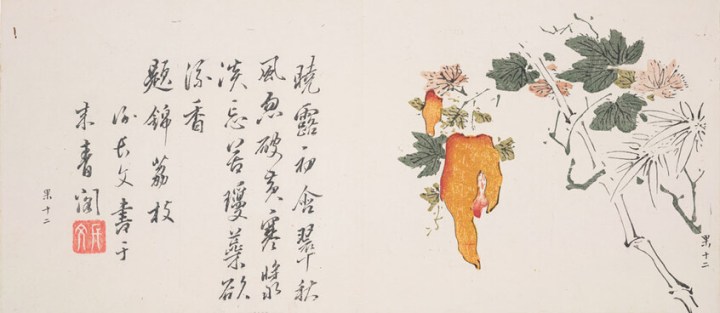
Bitter Melon in Ten Bamboo Studio Collection of Calligraphy and Painting, ca. 1633–1703, woodblock-printed book mounted as album leaves, ink and colors on paper (multi-block technique), published in Nanjing (San Marino: The Huntington Library, Art Museum, and Botanical Gardens).
◊ ◊ ◊ ◊ ◊
Opening next month at The Huntington:
Paintings in Print: Studying Art in China
The Huntington Library, Art Museum, and Botanical Gardens, San Marino, 7 October 2023 — 27 May 2024
The exhibition Paintings in Print: Studying Art in China examines the ways painting manuals published in the 17th and 18th centuries used innovative printing methods to introduce the techniques, history, and appreciation of painting to widening audiences in early modern China.
In the 16th century, Chinese publishers began creating educational art manuals filled with colorful prints of paintings and texts on the history and methods of brush arts. The manuals were unprecedented because they taught aspiring painters and collectors from the growing merchant class how to create and appreciate literati art—a combination of painting, calligraphy, and poetry long practiced by elite scholars. Drawing from The Huntington’s collection, the exhibition focuses on two books: The Mustard Seed Garden Manual of Painting and Ten Bamboo Studio Collection of Calligraphy and Painting. The books will be displayed together, in their entirety, for the first time in the United States. The texts will be presented in their original form as well as digitized to allow visitors to explore the materials more closely. They will be complemented with paintings—including recent donations from the Berman Foundation—that exemplify how artists studied manuals like these to learn the basics of their art.
New Book | Art and Architecture of Sicily
From Lund Humphries:
Julian Treuherz, Art and Architecture of Sicily (London: Lund Humphries, 2023), 320 pages, ISBN: 978-1848226043, £40 / $80.
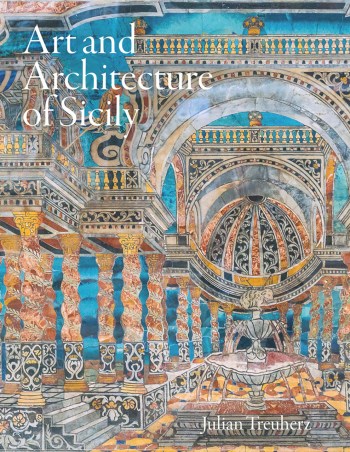 Sicily’ s strategic position in the centre of the Mediterranean led to settlement or conquest by a succession of different peoples—Phoenicians, Greeks, Romans, Byzantines, Muslims, Normans, Germans, French, Spanish—each one leaving its traces on Sicilian culture. This book provides a chronological survey, each section opening with a brief historical overview which is followed with an authoritative and engaging account of the development of the period’ s art and architecture. The leading architects, artists and stylistic currents are all discussed and outstanding individual buildings and works of art are analysed in detail, while archaeology, urban development, patronage and decorative arts are also covered. This is not a story of artistic conquests, but as a successive layering of different cultures: the way each one interacted with its predecessors produced art and architecture quite distinct from anywhere else in Europe.
Julian Treuherz is an art historian who was Keeper of Art Galleries for National Museums Liverpool between 1989 and 2007. He has written many books, articles and exhibition catalogues, and over the last twenty years he has spent part of each year in Sicily studying its art and architecture.
c o n t e n t s
• Introduction
• Prehistoric Sicily
• The Greeks come to Sicily: The Archaic Period
• The Greeks in Sicily: The Classical Period
• Punic Sicily
• The Greeks in Sicily: The late Classical and Hellenistic Periods
• Sicily, Province of Rome
• Early Christian, Byzantine, and Arabic Sicily
• The Normans in Sicily: A New Architectural Style
• The Normans in Sicily: The Royal Workshops, the Pleasure Pavilions, and the Later Cathedrals
• Sicily under the Hohenstaufen Emperors
• Late Medieval Sicily: German, French, and Aragonese Rule
• Sicily under the Spanish Viceroys: The 15th Century
• Sicily under the Spanish Viceroys: The 16th Century
• The Coming of the Baroque to Western Sicily
• The Earthquake of 1693 and the Rebuilding of Eastern Sicily
• Late Baroque Architecture in Western Sicily
• Baroque Painting, Sculpture, and Decorative Arts
• Neoclassicism in Sicily
• The Search for a New Style: Sicily, 1840–1918
• Sicily after 1918
Call for Papers | Architectural Ideas between Malta and Europe
From ArtHist.net:
People, Books and Models: The Order of St John and the Circulation of Architectural Ideas between Malta and Europe, 16th–18th Centuries
Online and in-person, Valletta, 17–19 April 2024
Proposals due by 30 September 2023
This conference aims at encouraging a multidisciplinary discussion, set in a broad European and Mediterranean context, of the spread of ideas, models for architecture, and construction techniques in Malta during the early modern age, via the networks of the Order of St John. In particular, it intends to investigate this dissemination of architectural theoretical and technical knowledge through the circulation of sources such as books, treatises, manuals of mathematics and geometry, catalogues, and collections of architectural images and drawings, as well as people, from architects to patrons, from engineers to intellectuals. The conference also aims to address a thorny methodological issue: the origin, dispersion, and fragmentation of the Hospitaller conventual library and, at the same time, the genesis of the library collections in Malta that include architectural sources, especially (but not only) at the National Library, for a better understanding of their provenance and context.
Taking Valletta and its civil architecture and historical construction sites as the main starting point of this investigation, the key role played by the city-convent was twofold. On one hand, the city was the core of the Hospitaller network, mirroring in its palaces, construction sites, and library collections the European dimension of the Order’s political, social, and cultural relationships. For this reason, the intense exchange between Malta and the Hospitaller offices in Europe will also be considered as well as the reciprocal influences between the Order and various political powers. On the other hand, there were also in Malta other important political stakeholders—from the Diocese to the Inquisition, from the many religious orders (like the Jesuits) to private individuals and travellers—that diversified the cultural scenario in Malta. These all need to be further investigated.
Finally, interpreting the Order as a powerful engine for the European circulation of drawings, books, and architectural models, the conference aims at serving as a forum where new research and methodologies can be discussed and fostered, not only to explore Malta and the other European nodes of the Hospitaller network, but also to better understand the broader European context from an original perspective.
Contributions delving into the following key topics are very welcome: migration of architectural languages, construction techniques, and circulation of drawings for architectural projects between the Maltese environment and Europe; analysis of architectural models from printed sources in the context of Hospitaller patronage; and the genesis of the Maltese and Hospitaller libraries and book circulation and production (with a focus on architectural sources).
The conference will be held as a hybrid event, with a Zoom link provided closer to the date of the conference. After the conference, participants will be invited to contribute to an edited volume to be proposed for inclusion in a peer-reviewed publication. Participants who wish to contribute are invited to send their text in English, along with related illustrations (including permission for publication) by 1 June 2024.
Abstract submissions will be open from 21 August 2023 to 30 September 2023. The submitted abstracts will be evaluated by the scientific committee and acceptance will be communicated by 23 October 2023. Selected speakers are invited to prepare 20-minute contributions. To apply, please send the following items to peoplebooksmodels2024@um.edu.mt
• 400-word abstract in English
• Contact information and affiliation
• Short CV (max 150 words) in English
The conference is the first step in an international project entitled Malta & Europe, Europe & Malta: Dissemination of Knowledge, Sources, and Architectural Models through the Network of the Order of St John run jointly by the University of Palermo (Dr Armando Antista), Politecnico di Torino (Dr Valentina Burgassi), and the University of Malta (Dr Valeria Vanesio).
Conference Directors
• Armando Antista (University of Palermo)
• Valentina Burgassi (Politecnico di Torino)
• Heléna Perez Gallardo (Complutense University of Madrid)
• Valeria Vanesio (University of Malta)
Scientific Committee Chairs
• Fernando Bouza Álvarez
• Sabine Frommel
• Marco Rosario Nobile
• William Zammit
New Book | Nobility and the Making of Race in 18th-C. Britain
From Bloomsbury:
Tim McInerney, Nobility and the Making of Race in Eighteenth-Century Britain (London: Bloomsbury Academic, 2023), 264 pages, ISBN: 978-1350346383, $115.
 Nobility and the Making of Race in Eighteenth-Century Britain focuses on Britain and Ireland at a time when race theory as we know it today was steadily emerging in the realm of natural philosophy to examine the structural relationship between nobility and race. This ground-breaking book examines texts from the fields of naturalism, political philosophy, medicine, and colonial venture, as well as interrogating works of drama and literature, in order to track how climate-based understandings of human variety at this time became increasingly imbued with noble traditions of genealogical purity and hierarchies of descent.
This process, the book argues, allowed British naturalists and wider society to understand global populations according to an already familiar pattern of genealogical inequality and offered the proponents of race theory a ready made model of natural supremacy. Tim McInerney explains why nobility and race developed in the way they did and how the premise of each promoted a certain idea of superiority. The result is an in-depth understanding of how genealogical exclusivity works as a power strategy.
Tim McInerney is Senior Lecturer in British and Irish civilisation at Université Paris 8 – Vincennes Saint Denis.
c o n t e n t s
Introduction
1 The Race Myth in Retrospect
2 Performing Nobility in Eighteenth-Century Britain
3 Human Hierarchy and the Great Chain of Being
4 The Noble Body in Ethno-national and Medical Discourse
5 Civilised Anatomies in Eighteenth-Century Human Variety Theory
6 Creating a Global Nobility: The Rise of Genealogical Race Theory
7 Ireland: A Nation of Nobilities
8 The South Seas: Laboratory of the Noble Physique
9 ‘Royal Slaves’: Abolitionism and the Fantasy of Slave Nobility
10 Noble Race in a Time of Revolution
Conclusion: How Nobility Shaped the Concept of Race
Online Symposium | J. M. W. Turner: State of the Field
From ArtHist.net and YCBA:
J. M. W. Turner: State of the Field
Online, 22–23 September 2023

J.M.W. Turner, Staffa, Fingal’s Cave, 1831–32, oil on canvas, 91 × 121 cm (New Haven: Yale Center for British Art, Paul Mellon Collection).
This symposium will consider the state and meaning of scholarship on J. M. W. Turner (1775–1851), one of Britain’s most celebrated artists. Thinking through the extensive Turner historiography, this symposium will explore some of the key ideas, underlying assumptions, and future directions of research. Panelists will consider the place of their research within the broader field of British studies.
To join us on September 22, please register here»
To join us on September 23, please register here»
f r i d a y , 2 2 s e p t e m b e r 2 0 2 3
All times Eastern Standard Time
9.00 Welcome by Courtney J. Martin (Yale Center for British Art)
9.10 Introduction: Turner in 2025 at the Yale Center for British Art — Lucinda Lax (Yale Center for British Art)
9.25 Keynote Conversation
• Amy Concannon (Tate Britain) in conversation with Richard Johns (University of York), moderated by Tim Barringer (Yale University)
10.25 Break
10.35 Panel 1 | Works on Paper and in the Environment
• Turner’s Pencil: Graphite Landscapes and Extractive Industry — Tobah Aukland-Peck (The Graduate Center, CUNY)
• ‘To Be Broken Up’: Turner, English Landscape, and the Anthropo(s)cenic — Frédéric Ogée (Université Paris Cité)
• A Historiographical Lacuna: Turner’s Prints — Gillian Forrester (independent scholar)
11.55 Break
12.05 Panel 2 | Sharing Turner
• Technical Studies for Turner: How Well Do We Share Knowledge? — Joyce Townsend (Tate Britain)
• The J. M. W. Turner Database: New Approaches to Documenting Turner for the 21st Century — Ian Warrell (independent scholar) and David Hill (University of Leeds)
• Cataloging Turner’s Sketchbooks, Drawings, and Watercolours — Turner Cataloging staff (Tate Britain)
s a t u r d a y , 2 3 s e p t e m b e r 2 0 2 3
9.00 Panel 3 | Early Turner
• Whither Early Turner? — Leo Costello (Rice University)
• Turner and the Landed Estate — John Bonehill (University of Glasgow)
10.05 Break
10.15 Panel 4 | Curating Turner
• Turner at Petworth: Past Approaches and Future Directions — Emily Knight (National Trust)
• The Young Turner: Ambitions in Architecture and the Art of Perspective — Helen Cobby (Bath Spa University)
11.15 Break
11.25 Panel 5 | Varied Approaches: Language, Economy, and Ecology
• The Ecological Turn(er) — Sarah Gould (Université Paris 1, Panthéon Sorbonne)
• ‘The Sun is God’: Turner, Angerstein, and Insurance — Matthew Hunter (McGill University)
• Translating Turner: The French Edition of the Correspondence — Aurélie Petiot (Université Paris Nanterre)
Printmaking for Change: Past and Present

Thomas Rowlandson, The Contrast (detail), 1793, hand-coloured etching and letterpress, 25 × 35 cm
(London: The British Museum)
◊ ◊ ◊ ◊ ◊
From the Paul Mellon Centre:
Printmaking for Change: Past and Present
In-person and online, London, 2–12 October 2023
Join us for a festival of free events exploring how different communities have used, and continue to use, printmaking to enact change, share knowledge, and challenge ideas. With talks, workshops, and behind-the-scenes visits, the two-week festival will explore the potential of printmaking as both a means of mass communication and a radical art form. From the fifteenth century to the present day, the programme will cover a broad range of topics from gender, sexuality and race, to politics, activism, and health. The programme is an introduction to the subject and is open to all. Talks and workshops will take place at the Paul Mellon Centre, the British Museum, PageMasters, and the Royal College of Physicians. Talks at the Paul Mellon Centre will be streamed live via Zoom. Off-site workshops will be in person only.
Registration (required) via Eventbrite opens 8 September.
◊ ◊ ◊ ◊ ◊
Monday, 2 October, 6–8pm
Introductory Session | Printmaking for Change, with Ben Thomas and Marcelle Hanselaar at the Paul Mellon Centre
Prints are multiple yet individual, unpredictable and hard to regulate, often critical, funny, ephemeral, frightening, irreverent, angry or just plain weird. They can be popular or obscure, sophisticated or clumsy, beautiful or ugly or, when responding to market demand, repetitive and dull. They are hard to define and categorise and for that reason tend to be ignored by curators in their displays, yet every national art collection will have far more prints than paintings. Prints are also cheap by comparison with other artworks and can be collected by ordinary people, disseminating their message widely. In this introductory session, art historian Ben Thomas and painter and printmaker Marcelle Hanselaar will discuss the properties of prints that challenge our expectations, and how as an artform they can be democratic, undisciplined and consequently forces for change.
Wednesday, 4 October, 2–4pm
Collections Visit | Printmaking and Politics, with Esther Chadwick and Richard Taws at the Prints and Drawings Study Room of The British Museum
Go behind the scenes at the British Museum to experience a selection of prints from the eighteenth and nineteenth centuries that explore the varied and complex relationships between printmaking and politics. We will look at prints designed to persuade and effect political change and consider printmaking as a link between politics and ‘high art’. Ranging from woodcut to lithography, line engraving to aquatint, our selection will also highlight how print was used around the world at a time of social, political, and economic unrest.
Saturday, 7 October, 10am–12.30pm or 1.30–4pm
Risograph Workshop | Printmaking and Protest at PageMasters, Lewisham
This workshop will introduce you to risograph printing—a technique often described as a cross between screen printing and photocopying, which uses spot colours and stencils to create multiple prints. Taking place at PageMasters in Lewisham, the session will begin with an introduction to risograph and tour of the studio. This will be followed by an exploration of PageMasters’ archive of protest prints and the opportunity to create your own two-colour A4 print to take home.
Monday, 9 October, 10.30am–noon and 1–2.30pm
Collections Visit | Printmaking and Health, with Jack Hartnell and Katie Birkwood at the Royal College of Physicians
Using the fascinating early print collections of the Royal College of Physicians, this session will explore the roles played by printing, printers and print technology in the world of health. From diagrams in surgical manuals to moveable flap books demonstrating the body’s inner anatomical workings, printed objects have long helped medics debate how to care for changing bodies. The Royal College of Physician’s materials will provide us with a window into how bodies past were understood by artists, physicians, midwives and surgeons alike.
Tuesday, 10 October, 6–8pm
Talk | Mezzotint Engraving and the Making of Race, with Jennifer Chuong, Martin Myrone, and Mechthild Fend at the Paul Mellon Centre
How have prints shaped our understanding of bodies and, specifically, our understanding of race as a bodily attribute? In this session we will explore how a particular print technique, mezzotint engraving, contributed to racial theories between the sixteenth and eighteenth centuries. The mezzotint, which can produce smooth tonal areas with dots or lines, became hugely popular in Britain in the second half of the eighteenth century as a means of reproducing portraits. We will discuss how this technique resonated with new anatomical and racial ideas in this period and subsequently how we can better understand print’s role in developing ideas of race and the body.
Thursday, 12 October, 6–8pm
Talk | Printmaking and LGBTQIA+ Communities, with Zorian Clayton at the Paul Mellon Centre
Join V&A curator of prints, Zorian Clayton, to explore LGBTQIA+ liberty and visibility through the varied history of printmaking. Via seventeenth-century radicals, eighteenth-century flamboyance, and nineteenth-century scandal, to contemporary understandings around diverse gender and sexuality, prints and ephemera, Zorian will provide a unique snapshot into a rich and radical history. Through looking at portraits and zines celebrating pioneering activists, writers and artists, as well as highlighting significant Queer spaces in Britain through the centuries, this session will provide an overview of the considerable contribution to printmaking made by the LGBTQIA+ community and its many ancestors.
Exhibition | William Blake: Visionary
Opening this fall at The Getty:
William Blake: Visionary
Getty Center, Los Angeles, 7 October 2023 — 14 January 2024
 A remarkable printmaker, painter, and poet, William Blake (1757–1827) developed a wildly unconventional world view, representing universal forces of creation and destruction—physical, psychological, historical—through his own cast of characters. By combining his poetry and images on the page through radical graphic techniques, Blake created some of the most striking and enduring imagery in British art. This major international loan exhibition explores the artist-poet’s imaginative world through his most celebrated works.
Organized by the J. Paul Getty Museum in cooperation with Tate.
Edina Adam and Julian Brooks, with an essay by Matthew Hargraves, William Blake: Visionary (Los Angeles: J. Paul Getty Museum, 2020), 168 pages, ISBN: 978-1606066423, $35.
Celebrated for his boundless imagination and unique vision, William Blake (1757–1827) created some of the most striking and distinctive imagery in art, often combining his poetry and visual images on the page through innovative graphic techniques. He has proven an enduring inspiration to artists, musicians, poets, and performers worldwide and a fascinating enigma to generations of admirers. Featuring over 130 color images, this catalogue brings together many of Blake’s most iconic works. Organized by theme, it explores Blake’s work as a professional printmaker, his roles as both painter-illustrator and poet-painter, his relationship to the medieval, Renaissance, and Baroque artists that preceded him, and his legacy in the United States. It also examines his visionary prophetic books, including all eighteen plates of America a Prophecy.
A specialist in works on paper, Edina Adam is assistant curator of drawings at the J. Paul Getty Museum. Julian Brooks is senior curator and head of the Department of Drawings at the J. Paul Getty Museum and is the author of many books, most recently The Lure of Italy: Artists’ Views (Getty Publications, 2017) and Andrea del Sarto: The Renaissance Workshop in Action (Getty Publications, 2015). Now the director of the Wadsworth Atheneum Museum of Art, Matthew Hargraves was previously chief curator of art collections and head of collection information and access at the Yale Center for British Art.
Conference | Rethinking British and European Romanticisms, Part II
From ArtHist.net and the University of York:
Rethinking British and European Romanticisms in Transnational Dimensions, Part II
University of York, King’s Manor, 19–21 September 2023
Organized by Elisabeth Ansel, Johannes Grave, Richard Johns, Christin Neubauer, and Elizabeth Prettejohn
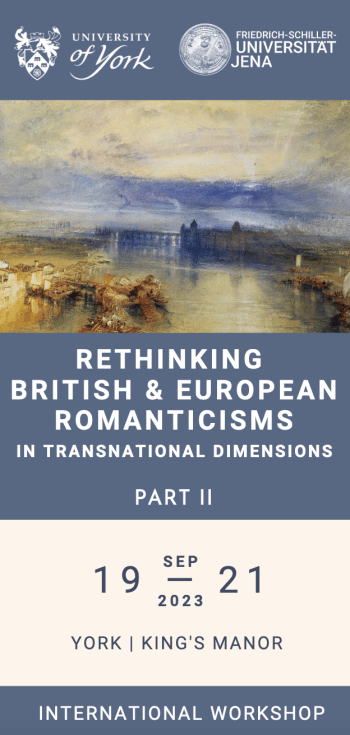 The event is the second part of a cooperative two-part workshop between the History of Art Departments of the University of York and the Friedrich Schiller University Jena. Considering the institution’s main research areas, the event aims to discuss the different concepts of Europe present in the art and culture of Romanticism.
In recent years, national tendencies have challenged the European idea, exemplified by the wake of Brexit and its aftermath. In this context, the question arises to what extent European and national identity concepts can be reconciled. Today’s debate between Britain and Europe still roots in the divergent notions of national identity that manifested in several European countries in the 1800s.
Therefore, the workshop addresses the relationship between visual images and constructions of nationality and questions how European Romanticism can be understood. In contrast to literary studies, investigating transnational transfer processes of Romantic movements has been a desideratum in art historical research. Considering transcultural methods, the participants will reflect national patterns of thought and Romantic identities not as fixed but as processual and hybrid phenomena within the framework of the binational exchange. Based on individual case studies, the event aims to reevaluate the complex interplay of alterity and reciprocity of the relations between cultural spaces.
Funded by University of York and Deutsche Forschungsgemeinschaft (German Research Foundation)
t u e s d a y , 1 9 s e p t e m b e r 2 0 2 3
9.45 Welcome and Introduction — Richard Johns
10.15 Morning Papers
• Marte Stinis (York) — ‘Sound Resounded from All the Treetops’: The Musical Landscape
• Sammi Lukic-Scott (York) — The Language of the Copy
• David Grube-Palzer (Jena) — Copy and Self-Repetition in the Age of Genius: Using the Example of Caspar David Friedrich
13.00 Lunch
14.30 Afternoon Papers
• Christin Neubauer (Jena) — Debts to German Romanticism in Joseph Noel Paton’s Luther: Dawn at Erfurt (1861)
• Miguel Angel Gaete Cáceres (York) — Johann Moritz Rugendas’ Picturesque Slavery: Denounce or Morbid Sublime Pleasure?
17.00 Evening Presentation
• Elizabeth Prettejohn (York) — Romanticism and Renaissance: Ideas for an Exhibition
18.30 Reception at King’s Manor
w e d n e s d a y , 2 0 s e p t e m b e r 2 0 2 3
10.00 Greeting
10.15 Morning Papers
• Richard Johns (York) — Further Thoughts on the Artist’s Bequest as a Romantic Phenomenon
• Elisabeth Ansel (Jena) — Heroic Femininity and the ‘Joy of Grief’ in Elizabeth Harvey’s Malvina Lamenting the Death of Oscar (1806)
• Mira Claire Zadrozny (Jena) — Emergent Pictoriality: Images of Ruins in 19th-Century France
13.00 Lunch
14.30 Afternoon Papers
• Helena Cox (York) — The Mánes Family: Bohemian Romanticism and (Inter)National Belonging
• Kayleigh Williams (York) — ‘Her Eyes Were Wild’: Transmediation of Gender and Gaze in Rossetti’s La Belle Dame Sans Merci
16.45 York Museum Garden
18.00 Evening Presentation
• Johannes Grave (Jena) — Duality and Temporality: Evocations of the Sublime in Romantic Paintings
20.00 Dinner at House of Trembling Madness
t h u r s d a y , 2 1 s e p t e m b e r 2 0 2 3
9.15 Greeting
9.30 Morning Papers
• Johannes Rössler (Jena) — An Imagined Journey? Caspar David Friedrich and Switzerland
• Wanda Sue Warning (Jena) — Romanticising Youth: Sir Henry Raeburn’s Boy and Rabbit (1814) and the Portraiture of Anonymous Children
• Justus Hierlmeier (Jena) — Ligne et couleur in Théophile Thoré’s Des envois de Rome
12.15 Concluding Discussion
14.30 Afternoon Field Trip
• York Art Gallery
• Stroll through York
20.00 Dinner at Côte Brasserie
Call for Papers | HNA Conference 2024, Britain and the Low Countries

From HNA:
HNA Conference | Britain and the Low Countries: Cultural Exchange Past, Present, and Future
London and Cambridge, 10–13 July 2024
Proposals due by 29 September 2023
2024 marks the first time in the forty-year history of the Historians of Netherlandish Art that the biennial conference will be held in the UK. Cultural, political, and economic exchange has been pivotal to the histories of the UK and the Low Countries, and these relationships have taken on new significance and have new potential as the UK renegotiates its relationship with Europe after Brexit. Britain and the Low Countries: Cultural Exchange Past, Present & Future considers the extraordinary depth and breadth of the relationships between the constituent nations of the UK, Belgium, and The Netherlands.
The conference is comprised of workshops in London and Cambridge on 10 and 13 July and 40 paper sessions to be delivered at West Road Concert Hall in Cambridge on 11 and 12 July. Thirteen of the sessions relate to the subject of Britain and the Low Countries. These fall under three broad themes: technology and the natural sciences, key themes in scholarship on British-Netherlandish culture, and medium-based scholarship in the British-Netherlandish context. There are 25 further sessions on a broad range of themes and 2 career-development sessions.
The call for papers is now open for all sessions. Each session is 90-minutes long and, unless otherwise specified, will comprise three 20-minute papers and 30 minutes for discussion. Applicants must be HNA members and are allowed to submit multiple proposals but may not participate in more than one session. We ask that applicants inform the session chairs about the other sessions they are applying to. Unless specified otherwise, please send proposals of about 500 words, clearly stating the goals of the paper, along with a CV (no longer than one page) to the email address(es) ascribed to the session descriptions below.
The deadline for proposals is Friday, 29 September 2023. Applicants will be notified by the programme committee no later than four weeks after the submission deadline.
Please consider contributing to HNA IDEA’s appeal for contributions to an equitable conference.
s e s s i o n s a t a g l a n c e
• Copies and Reproductions in Netherlandish Art, 1400–1800
• Existential In(ter)ventions: Modernity as Makeability in the Dutch Republic
• Infinite Concordances: Elaborating on Visual Typology in Early Modern Netherlandish Art
• The ‘Inventions’ of Early Netherlandish Painting: Thirty Years since Hans Belting and Christiane Kruse’s Die Erfindung des Gemäldes: Das erste Jahrhundert der niederländischen Malerei (1994)
• Embracing the Digital Age: New Prospects for Researching Northern European Art with Computational Methods
• The ‘More-Than-Human World’ in 17th-Century Dutch Visual and Material Culture
• The Multidimensionality of Netherlandish Grotesques
• What is Anglo-Dutchness?
• Netherlandish-isms: Making Nationhood and Art History
• Reading Pendants and Multiples in Dutch and Flemish Art
• Gender and the Home across Cultures
• Remarkable Women Artists, 1500–1700
• Multiple Masculinities in Netherlandish Art
• Sound and Silence: Soundscapes, Noise, Music, and Quiet Pauses in Dutch and Flemish Art
• New Views on Vermeer: Reflections, Opinions, Reconsiderations
• Moving Dutch Knowledge: Collections as Knowledge Repositories and Sites of Transformation and Transfiguration (ANKK sponsored session)
• Museums in Conflict: Lessons Learned, 1930–1950
• Technical Art History: Material Stories – Object Itineraries
• Do We Belong Together? Case Studies into Portrait Pendants
• The Interconnected Nature between Britain and the Low Countries in the Production and Decorating of Glass
• Art and Nature in the Dutch Colonial World
• Worldly Images and Images of the World in Netherlandish Art
• Half the World Away: Cultural Circulations between Isfahan and the Early Modern Low Countries
• Mutual Appreciation and Exchanges between Artists of Northern and Southern Europe, 1590–1725
• Culture and Climate Change
• The Landscapes of Artists from the Netherlands Who Worked in Britain during the Long 17th Century
• ‘Soft Power’: The Material Legacy of William and Mary
• Netherlandish Migrant Artists and the emergence of Creativity in Late 17th-Century London
• Collecting and Exchange between North Sea Neighbours
• Netherlandish Art in Renaissance Florence: Architectural Exchanges from North to South?
• Print Culture between the UK and the Low Countries
• Print Exhibitions in the Making and Related Research
• New Research on Dutch and Flemish Drawings in the UK
• Immigrants and Excellence: Sculptors from the Low Countries at the English and Scottish Courts in the 17th and 18th Centuries
• Connecting Threads: Tapestries and Cultural Exchange in the Low Countries and England
• Material Depiction and (Cut-out) Trompe l’oeils: The Enchantment of Material Depiction by Netherlandish Painters and the Development of British Traditions
• Visual Sovereignty in Dutch and Indigenous Histories
• Visual Cultures of Cartography in the Low Countries, 1500–1800
• Professional Insights and Practical Advice for Early Career Researchers
• Pecha Kucha Workshop for Graduate Students and Early Career Researchers
Session descriptions are available here»










 Enfilade
leave a comment