New Book | The Tsarina’s Lost Treasure
First published in 2020, the book appeared in paperback in 2022; from Simon & Schuster:
Gerald Easter and Mara Vorhees, The Tsarina’s Lost Treasure: Catherine the Great, a Golden Age Masterpiece, and a Legendary Shipwreck (New York: Pegasus Books, 2020), 400 pages, ISBN: 978-1643135564 (hardback), $30 / ISBN: 978-1643139425 (paperback), $19.
 A riveting history and maritime adventure about priceless masterpieces originally destined for Catherine the Great.
On October 1771, a merchant ship out of Amsterdam, Vrouw Maria, crashed off the stormy Finnish coast, taking her historic cargo to the depths of the Baltic Sea. The vessel was delivering a dozen Dutch masterpiece paintings to Europe’s most voracious collector: Catherine the Great, Empress of Russia. Among the lost treasures was The Nursery, an oak-paneled triptych by Leiden fine painter Gerrit Dou, Rembrandt’s most brilliant student and Holland’s first international superstar artist. Dou’s triptych was long the most beloved and most coveted painting of the Dutch Golden Age, and its loss in the shipwreck was mourned throughout the art world. Vrouw Maria, meanwhile, became a maritime legend, confounding would-be salvagers for more than two hundred years. In July 1999, a daring Finnish wreck hunter found the ship, upright on the sea floor and perfectly preserved. The Tsarina’s Lost Treasure masterfully recounts the fascinating tale of Vrouw Maria—her loss and discovery—weaving together the rise and fall of the artist whose priceless masterpiece was the jewel of the wreckage. Gerald Easter and Mara Vorhees bring to vivid life the personalities that drove (and are still driving) this compelling tale—evoking Robert Massie’s depiction of Russian high politics and culture, Simon Schama’s insights into Dutch Golden Age art and art history, and Gary Kinder’s spirit of, danger and adventure on the beguiling Archipelago Sea.
Gerald Easter is a Professor at Boston College who has been teaching and writing about Russian/East European politics and history for more than two decades.
Mara Vorhees is a travel writer with an expertise in Russia, New England, and Central America. She has written or contributed to more than 40 guidebook editions, published by Lonely Planet.
Call for Papers | A Different Perspective for the Atlantic Routes
The Call for Papers for three related workshops, from ArtHist.net:
Traveling Objects: The Material Culture of the Atlantic Routes
Institut national d’histoire de l’art, Paris, 21 February 2024
New Towns and Old Settlements in Latin America: City Planning, Architecture, and Building Decorations in the Shadow of European Influence
Institut national d’histoire de l’art, Paris, 17 April 2024
Leaving a Trail: Memories, Reports, and Maps beyond the Fascination and Fear of the New World
Palacio de Maldonado – Centro de Estudios Brasileños, Universidad de Salamanca, 15 May 2024
Organized by Maddalena Bellavitis and José Manuel Santos Pérez
After more than two years of careful and laborious preparation (slowed down and hindered several times by the difficulties that have arisen due to the global pandemic), this project finally gets underway. A Different Perspective for the Atlantic Routes intends to go back once more to questioning issues that already count important in-depth studies, like the transoceanic relations between the sixteenth and nineteenth centuries, but also has the ambition of wanting to integrate the results already obtained with new reflections and achievements, and above all with a different point of view.
The idea, in fact, is not to propose an approach which is purely targeted to how European society had received and used the travel reports and products arrived from American lands, but to also to evaluate on the one hand the influences and consequences—cultural, technical, artistic, and social—that the exchanges had had overseas on local populations, and on the other how items and symbols closely linked to the cultures of the American territories after being brought to Europe had been reinterpreted and deprived of their original meaning in the new environment in which they had been introduced to, thus also involving the sphere of memory and the Intangible Cultural Heritage. If the common thread proposed is that of the activity of the Dutch West India Company, the project also aims to consider the whole vast cultural, diplomatic, artistic, scientific, anthropological, and gastronomic panorama that the approach to such a topic necessarily brings with itself, and will therefore also evaluate the tangencies and interactions with travels and exchanges also made by other European states and kingdoms in the period considered.
The first opportunity for comparison will be dedicated to the material aspects—that is the objects that have been used and obtained in exchanges, explorations or raids—and to the engineering aspects of the ships used to transport them. The second meeting will focus on the urban installations and the architectural and social aspects of the new settlements, while the third session will concern travelers, travel impressions, and cartography. Workshops will be held in Paris and Salamanca, hosted by the Institut national d’histoire de l’art and the Centro de Estudios Brasileños of the Universidad de Salamanca.
In addition to those who have already been involved in the discussions and in the preparation of the preliminary phases of this project, scholars interested in any discipline that can offer points of contact with the proposed theme—from collecting to memory, from travel literature to material culture, from engineering to anthropology—are encouraged to send a proposal for a contribution.
Please submit an abstract for an unpublished contribution and a short bio by 30 September 2023 to maddalena.bellavitis@gmail.com, specifying the title of the workshop you are applying for. Presentations will be in English, French, Spanish, or Portuguese and will last a maximum of 20 minutes. The organizers, Maddalena Bellavitis and José Manuel Santos Pérez, director of the Centro de Estudios Brasileños of the Universidad de Salamanca, will notify the selected proposals by the second week of October 2023.
Conference | Garden Artist Friedrich Ludwig von Sckell (1750–1823)

Carl von Zimmermann, Portrait Friedrich Ludwig von Sckell, detail, ca. 1810 (Münchner Stadtmuseum)
From the website marking the 200th anniversary of the landscape gardener’s death: www.sckell2023.de
◊ ◊ ◊ ◊ ◊
From ArtHist.net:
Der Gartenkünstler Friedrich Ludwig von Sckell und seine Werke: Geschichte und Aktualität
Zentralinstitut für Kunstgeschichte, Munich, 13–14 October 2023
Organized by Jost Albert and Iris Lauterbach
Registration due by 8 October 2023
Friedrich Ludwig von Sckell war der bedeutendste deutsche Gartenkünstler seiner Generation. Seine Ausbildung in Schwetzingen, in Frankreich und in England verhalf ihm zu einem internationalen Netzwerk. Als kurfürstlicher Hofgärtner und seit 1804 bayerischer Hofgartenintendant sowie in privatem Auftrag realisierte Sckell zahlreiche und bedeutende Gartenanlagen. Als weitsichtiger Stadtplaner legte er die Grundlage für die Erweiterung Münchens zur königlichen Residenzstadt. Der Englische Garten und die Umgestaltung des Nymphenburger Schlossgartens sind die Hauptwerke seiner Münchner Phase. Mit klassisch schönen „Bildern der Natur“ entwarf Sckell Landschaftsgärten, die sich durch große Dimensionen, ausgefeilte räumliche Gestaltungen und einen respektvollen Umgang mit dem Vorhandenen auszeichnen. Die Tagung nimmt das Sckell-Jubiläum zu seinem 200. Todestag zum Anlass, um neue gartenhistorische Forschungsaspekte sowie aktuelle gartendenkmalpflegerische Herausforderungen vorzustellen. Anmeldung zur Tagung bitte bis 8. Oktober 2023 unter: sckell@zikg.eu. Die Teilnahme ist kostenfrei.
Konzeption: Jost Albert und Iris Lauterbach, in Kooperation mit dem AK Historische Gärten der Deutschen Gesellschaft für Gartenkunst und Landschaftskultur (DGGL)
Partnerinstitutionen des Webauftritts www.sckell2023.de:
Natur wird Kunst: Auf den Spuren des Gartenkünstlers Friedrich Ludwig von Sckell (1750–1823)
f r e i t a g , 1 3 o k t o b e r 2 0 2 3
8.30 Anmeldung zur Tagung
9.00 Iris Lauterbach, München — Begrüßung und Einführung
9.15 Friedrich Ludwig von Sckell: Gartenkünstler, Verwalter, Organisator
Moderation: Iris Lauterbach
• Rainer Herzog, München — Friedrich Ludwig von Sckell als königlicher Beamter: Die Hofgarten-Intendanz unter organisatorischen, personellen und finanziellen Aspekten
• Gabriele Ehberger, München — Corporate Identity für die Hofgartenintendanz: Sckells Entwurf einer Gärtneruniform
• Thorsten Marr, München — Der Publikumsverkehr im Nymphenburger Garten zur Zeit Sckells
• Brigitte Huber, München — Eine Stadt im Umbruch: München 1795 bis 1825
• Heike Palm, Hannover — „Überhaupt ist diese Parthie noch zu erweitern und unter die Gruppen me[h]r Deutlichkeit zu bringen.“ Sckells Begleittexte zu seinen Entwürfen
12.30 Mittagspause
14.00 Zu Sckells Pflanzenverwendung
Moderation: Jost Albert
• Clemens Alexander Wimmer, Potsdam — Die Pflanzenverwendung Sckells in ihrer Zeit und ihre Rezeption
• Hans Joachim Klemmt, München — Sckells Baumartenwahl: Eine forstliche Einwertung aus heutiger Sicht vor dem Hintergrund des Klimawandels
15.00 Kaffeepause
15.30 Gartenkunst in der Nachfolge von Friedrich Ludwig von Sckell
• Michael Schwahn, München — Carl August Sckell und der Englische Garten in Neuburg an der Donau
• Peter Lack, Güstrow — Ein Gärtner auf Grand Tour: Die zweijährige Reise des Fritz Sckell von 1826 bis 1828
• Dietger Hagner, Rudolstadt — Wilhelmsthal bei Eisenach: Die Transformation zum Landschaftsgarten und das Wirken der Thüringer Hofgärtnerfamilie Sckell
17.00 Pause und Ortswechsel
19.00 Abendveranstaltung (Max-Joseph-Saal der Residenz)
• Bernd Schreiber, Präsident der Bayerischen Verwaltung der staatlichen Schlösser, Gärten und Seen — Begrüßung
• Jost Albert, München — Sckells Arbeitsschwerpunkte in den letzten Lebensjahren
• Iris Lauterbach, München — Der Zauberstab des Gartenkünstlers: Sckells „Methode, in der Natur zu zeichnen“
• Udo Weilacher, Freising/München — Die Landschaft von Morgen: Impulse von Sckell
s a m s t a g , 1 4 o k t o b e r 2 0 2 3
Sckells Gärten heute: Herausforderungen und Ziele der Gartendenkmalpflege
Exkursionen mit Mitarbeiter:innen der Gärtenabteilung der Bayerischen Schlösserverwaltung. Teilnahme nur für angemeldete Teilnehmer:innen der Tagung
◊ ◊ ◊ ◊ ◊
d o n n e r s t a g , 1 2 o k t o b e r 2 0 2 3
12.00–16.00 Mitgliederversammlung des AK Historische Gärten der Deutschen Gesellschaft für Gartenkunst und Landschaftskultur (DGGL), nicht öffentlich
19.00 Öffentliche Abendveranstaltung (Bayerische Akademie der Schönen Künste)
Vergabe des Sckell-Rings durch die Bayerische Akademie der Schönen Künste und Laudatio
Vergabe der Sckell Students Awards, Preisvergabe durch Udo Weilacher, Technische Universität München
New Book | The Women Who Saved the English Countryside
From Yale UP:
Matthew Kelly, The Women Who Saved the English Countryside (New Haven: Yale University Press, 2022), 400 pages, ISBN: 978-0300232240 (hardback), $35 / ISBN: 978-0300270396 (paperback), $24.
 A vibrant history of English landscape preservation over the last 150 years, told through the lives of four remarkable women.
In Britain today, a mosaic of regulations protects the natural environment and guarantees public access to green spaces. But this was not always so. Over the last 150 years, activists have campaigned tirelessly for the right to roam through the countryside and the vital importance of preserving Britain’s natural beauty. Matthew Kelly traces the history of landscape preservation through the lives of four remarkable women: Octavia Hill, Beatrix Potter, Pauline Dower, and Sylvia Sayer. From the commons of London to the Lake District, Northumberland, and Dartmoor, these women protected the English landscape at a crucial period through a mixture of environmental activism, networking, and sheer determination. They grappled with the challenges that urbanization and industrial modernity posed to human well-being as well as the natural environment. By tirelessly seeking to reconcile the needs of particular places to the broader public interest they helped reimagine the purpose of the English countryside for the democratic age.
Matthew Kelly is professor of modern history at Northumbria University. He is the author of Finding Poland: From Tavistock to Hurzdowa and Back Again and Quartz and Feldspar: Dartmoor—A British Landscape in Modern Times.
c o n t e n t s
List of Illustrations
Acknowledgments
Maps
Introduction: The Four
Octavia Hill: Gathering in the Givers
Beatrix Potter: A Farm of One’s Own
Pauline Dower: ‘Inconspicuous Good’
Sylvia Sayer: Segregating Dartmoor
Epilogue: Fifty Years On
Notes
Further Reading
Index
New Book | The Invention of the English Landscape, c. 1700–1939
Peter Borsay died in 2020 at the age of 70; his last book, prepared for publication by Rosemary Sweet, has just been published by Bloomsbury:
Peter Borsay, with Rosemary Sweet, The Invention of the English Landscape, c. 1700–1939 (London: Bloomsbury Academic, 2023), 304 pages, ISBN: 978-1350031678, $115.
 Since at least the Reformation, English men and women have been engaged in visiting, exploring and portraying, in words and images, the landscape of their nation. The Invention of the English Landscape examines these journeys and investigations to explore how the natural and historic English landscape was reconfigured to become a widely enjoyed cultural and leisure resource.
Peter Borsay considers the manifold forces behind this transformation, such as the rise of consumer culture, the media, industrial and transport revolutions, the Enlightenment, Romanticism, and the Gothic revival. In doing so, he reveals the development of a powerful bond between landscape and natural identity, against the backdrop of social and political change from the early modern period to the start of the Second World War. Borsay’s interdisciplinary approach demonstrates how human understandings of the natural world shaped the geography of England, and uncovers a wealth of valuable material, from novels and poems to paintings, that expose historical understandings of the landscape. This innovative approach illuminates how the English countryside and historic buildings became cultural icons behind which the nation was rallied during war-time, and explores the emergence of a post-war heritage industry that is now a definitive part of British cultural life.
Peter Borsay was Professor of History at Aberystwyth University, a member of the advisory boards of Urban History and the Journal of Tourism History, and a committee member of the British Pre-Modern Towns Group. His books include The English Urban Renaissance (1989); The Image of Georgian Bath, 1700–2000: Towns, Heritage, and History (2000); and A History of Leisure: the British Experience since 1500 (2006). He co-edited Resorts and Ports: European Seaside Towns since 1700 (2011) and Leisure Cultures in Urban Europe, c. 1700–1870: A Transnational Perspective (2016).
Rosemary Sweet is Professor of Urban History and Director of the Centre of Urban History at the University of Leicester. She is the author of The English Town, 1680–1840 and The Writing of Urban Histories in Eighteenth-Century England.
c o n t e n t s
List of Illustrations
Foreword
Acknowledgments
1 Introduction
2 Revealing the Early Modern Landscape
3 Ideas and Representations
4 Reconfiguring the Landscape
5 New Geographies and Topographies
6 Timescapes
7 Economic and Social Change
8 The Transport Revolution and the Journey
9 Identities
10 Conclusion: The Second World War and Beyond
Select Bibliography
Index
Book Launch in Honour of Peter Borsay
From Eventbrite:
Book Launch in Honour of Peter Borsay
Online and in-person, University of Leicester, 29 September 2023, 3pm
The Centre for Urban History at the University of Leicester will mark the publication of Peter Borsay’s last book, The Invention of the English Landscape c. 1700–1939, with a symposium in honour of the late professor, who passed away in 2020. Free and open to all, the event will take place on Friday, 29th September 2023, from 15.00 until 17.00, via Teams Live and in person in the Attenborough Film Theatre. Please contact hypirfinance@le.ac.uk with any questions.
The symposium will be chaired by Professor Rosemary Sweet with the following panel of speakers:
• Penelope J. Corfield (President of the International Society of Eighteenth-Century Studies)
• Richard Coopey (Emeritus Senior Lecturer, Department of History & Welsh History, Aberystwyth University)
• Katy Layton Jones (School of History, Open University)
• Keith Snell (Emeritus Professor of English Local History, University of Leicester)
Online Talks | Digital Art History
From the series webpage:
Narrowing the Divide: A Dialogue between Art History and Digital Art History
Artl@s Conversation Series in Digital Art History, Visual Contagions, 2023–24
Organized by Béatrice Joyeux-Prunel, Catherine Dossin, and Nicola Carboni
The the Artl@s Lectures are a series of conversations that Artl@s will organize throughout the 2023–2024 academic year on the theme of Narrowing the Divide: A Dialogue between Art History and Digital Art History.
The field of Digital Art History (DAH) is currently experiencing a notable shift towards establishing its autonomy as a distinct discipline. However, its survival is challenged by the limitations of its investigations. The lack of relationships between computational effort and traditional analysis often limits the generation of novel insight. Digital art history risks becoming a mere spectacle when it relies solely on stunning visualizations without engaging in rigorous research questions. Conversely, art history limits itself from harnessing robust methodologies by disregarding computational approaches.
The digital approach increasingly demands advanced technical skills, thereby often placing art historians in a position where they lack the means and expertise to engage with it. Yet, art historians possess a keen awareness of the pressing issues within the discipline and possess the knowledge of which corpuses are relevant for addressing them. They could potentially provide their questions and corpuses to experts in digital art history. Hence, it is crucial to establish more frequent and substantive opportunities for collaboration between these two approaches. The 2023–2024 Artl@s Conversation Series aims to cultivate a convergence between the field of digital art history and the discipline of art history. The exchange of ideas and results among digital art history specialists, art historians, and the audience will foster a deeper understanding of the possibilities and implications of computational methodologies in the study of art history.
Each event will facilitate a unique encounter between two experts engaged in overlapping subject areas but employing markedly different methodologies. Within this framework, art historians will put forth inquiries and collections to experts in digital approaches, while scholars in digital art history will present the outcomes of their methodologies, along with the aspects they would readily suggest for monographic or non-digital explorations. The aim is to foster collaborations and a heightened mutual understanding of the outcomes between the realms of art history and digital art history. These gatherings provide valuable opportunities for aspiring PhD students in digital humanities and art history to discover new subjects and gain insights into the notable progress being made in both disciplines.
Organizers: Béatrice Joyeux-Prunel (UNIGE), Catherine Dossin (Purdue University), and Nicola Carboni (UNIGE)
s e s s i o n s
AI for Art History, Art History of AI
Online, Friday, 8 September 2023, 14.15–15.45 (Paris and Geneva time) / 8.15–9.30am (EST)
• Leonardo Impett, University of Cambridge
• Pascal Griener, Université de Neuchatel
Click here to join us on Zoom || Read more about the speakers.
◊ ◊ ◊ ◊ ◊
Do We Need Digital Visual Studies?
Online, Friday, 29 September 2023, 14.15–15.45 (Paris and Geneva time) / 8.15–9.30am (EST)
• Béatrice Joyeux-Prunel, Université de Geneve
• Leora Auslander, University of Chicago
Click here to join us on Zoom || Read more about the speakers.
New Book | The A–Z of Regency London, 1819
From the London Topographical Society:
Sheila O’Connell, ed., with an introduction by Paul Laxton and indexes by Roger Cline, The A–Z of Regency London 1819 (London: London Topographical Society, 2023), 159 pages, £36.
 The A–Z of Regency London 1819 reproduces at two-thirds actual size the 4th and last edition of Richard Horwood’s map of London. As a guide to the topography of early-nineteenth-century London it is unequalled. The 40 sheets of the map are accompanied by an introductory essay describing its making, assessing its qualities, and casting new light on the life of the map-maker, as well as indexes to streets and buildings showing the juxtaposition of residential and industrial premises.
As described in a recent issue of Salon (the newsletter of The Society of Antiquaries of London, 30 August 2023):
In about 1790, Richard Horwood (1758–1803) embarked on what was to be the largest map of London ever published. He told his subscribers that it would be “on a Scale so extensive and accurate as to exhibit, not only every Street, Square, Court, Alley, and Passage therein, but also each individual House, the Number by which it is distinguished.” It was completed in 32 sheets in 1799. William Faden reissued the map in 1807, 1813, and 1819, adding eight new plates to cover developments to the east. The publication reproduces at two-thirds actual size the 4th and last edition of Richard Horwood’s map of London. As a guide to the topography of early-nineteenth-century London it is unequalled. The 40 sheets of the map are accompanied by an introductory essay describing its making, assessing its qualities, and casting new light on the life of the map-maker (including a surprising link with the emerging United States of America), as well as indexes to streets and buildings showing the juxtaposition of residential and industrial premises.
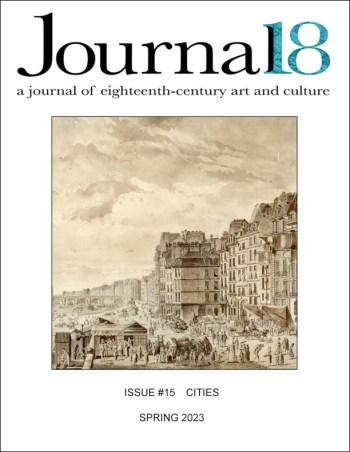
Journal18, Spring 2023 — Cities
For anyone who may have missed it, the latest issue of J18, along with lots of interesting reviews:
Journal18, Issue #15 (Spring 2023) — Cities
Issue edited by Katie Scott and Richard Wittman
Katie Scott and Richard Wittman — “Introduction”
Art history has traditionally narrated the early modern city through the monuments and buildings that constituted its environment and with reference to its spatial distribution. This special issue invites readers to consider the city instead via the social: to think about the people who once inhabited those buildings, admired those monuments, those who shared the spaces and resources of the city, and the ideas, beliefs, and practices invested in and inspired by it.
 For Aleksandr Bierig, the social is social life literally speaking, and that which the city must foster through clean air. In a close reading of Timothy Nourse’s 1700 critique of London’s coal-induced smog, and his proposal to purify the capital’s atmosphere by reverting to wood, Bierig shows that Nourse’s “restoration” acknowledged various trade-offs between social needs and industry but did not propose to turn back the clock, either socially or ecologically. Rather than retreat to pastoral, Nourse envisioned the relocation of industry to the city limits, as well as the plantation of an orbital forest to supply London. He viewed nature as a resource—in the modern sense of an object uniquely for commercial exploitation—of the good city.
Stacey Sloboda’s essay on London’s St. Martin’s Lane engages with the social on the scale and in the terms of neighborhood, a concept in which the built and the social are united. By following inhabitants of St. Martin’s Lane through rent registers and other sources, she explores the imbrication of artistic and artisanal practices that academies and art theory often obscure. Moreover, she complicates the binaries we draw to distinguish the modern and pre-modern city: between an older world of dense, low-rise housing and inward-looking community living, and the modern, outward-facing city produced by industrialization and migration. The St. Martin’s Lane school drew both some of its agents and some its artistic ideas from Europe and thought its taste modern.
Questions of place and emplacement are key also to Anne Hultzsch’s essay. However, she explores not the community and the rootedness associated with neighborhoods, but the individual’s embodied relationship to site. She reviews Sophie von La Roche’s writings on the city as “situated criticism,” situated both in the literal sense of point of view, and sociologically as a woman of a certain class. What distinguishes Hultzsch’s take on the social and sets it apart from late twentieth-century social and political histories of art criticism is her discussion of La Roche’s experience of the visual, and her use of biography to lay bare her subject’s identity in its intersectional complexity.
The two shorter pieces, each with a more historiographical focus, center on the figure of the urban observer. Richard Wrigley argues that the personage of the flâneur, normally characterized as disengaged and associated with the July Monarchy, had in fact originated in the political culture of the French Revolution, and as an effect of self-determined mobility within the city enabled by liberty. In so doing, he restores an essential political context to the phenomenon of flânerie that has long been obscured by its limiting association with the burgeoning consumer culture emblematized by the Paris passages. Sigrid de Jong, meanwhile, analyses the eighteenth-century literary trope of urban comparison. Situating such description in relation to current scholarly recourse to comparative history, she focuses on Paris and London in texts by Louis Sebastien Mercier and Helen Maria Williams, respectively. She suggests that their kind of explicitly situated subjectivity offers a privileged entry to the specifically social limitations and possibilities that structure real experiences of the city.
By variously answering such historical questions as—How did the city make room for sharing (air, ideas, experiences, space)? How did different kinds of urbanites (writers, artists, tourists, women) use, exploit and otherwise appropriate urban space? And how were the limits and possibilities of city social life made sensible in word and image (maps, views, description)?—these case studies collectively propose a richer yet less stable view of the proto-modern European city.
a r t i c l e s
• Aleksandr Bierig — “Restorations: Coal, Smoke, and Time in London, circa 1700”
• Stacey Sloboda — “St. Martin’s Lane: Neighborhood as Art World”
• Anne Hultzsch — “The City ‘en miniature’: Situating Sophie von La Roche in the Window”
s h o r t p i e c e s
• Richard Wrigley — “The Revolutionary Origins of the Flâneur”
• Sigrid de Jong — “The City and its Significant Other: Lived Urban Histories beyond the Comparative Mode”
All articles are available here»
Call for Articles | Fall 2024 Issue of J18: Craft
From the Call for Papers:
Journal18, Issue #18 (Fall 2024) — Craft
Issue edited by Jennifer Chuong and Sarah Grandin
Proposals due by 15 September 2023; finished articles will be due by 31 March 2024
When, where, and why does craft matter? Craft, by definition, is any activity involving manual skill. But in the modern western world, the term typically implies specific kinds of activities that produce specific kinds of objects: things like baskets, lace, and lacquerware. In a culture that has historically privileged rationality and innovation, craft’s commitment to tradition, reliance on haptic knowledge, and association with marginalized subjects have rendered it the minor counterpart to more ‘serious’ forms of material production. As a subsidiary to art and industry, craft has often occupied a circumscribed role in accounts of modern art and modernity’s origins in the eighteenth century. Recently, however, craft—as a more capacious category of material production—has become a crucial term in efforts to expand and diversify the study of eighteenth-century art.

Spouted bowl, stoneware with orange markings, Japan, Bizen kilns, 1700–1850, 20cm diameter (London: V&A, 199-1877). Possibly intended as a fresh water jar, of stoneware with streaks of glaze resulting from wrapping in saltwater-soaked straw.
This special issue builds on recent investigations while considering how craft’s ancillary role within the Anglo-European tradition has limited its capacity to transform the field. Drawing inspiration from the absence of an art/craft divide in many cultures, we are interested in exploring craft’s potential to radically reframe, reconceptualize, and globalize the history of art. By investigating craft, we also aim to shed new light on related questions of value, skill, and creativity in the making of different kinds of objects. We are inspired by recent scholarship that has asked, for example, how the repetitive nature of American schoolgirl samplers challenges celebrations of the individual maker, or how the meaningfully protracted time of wampum-making diverges from industry’s strict calculations of time and labor. Looking at the issue from a different angle, what would be the implications of discussing academic painting and sculpture as forms of craft?
By bringing together a range of studies that critically engage with handwork, we aim to highlight both the distinctive and shared concerns of craft in different making traditions. We welcome proposals for full-length articles as well as shorter pieces that explore new methods of studying craft. Taking advantage of Journal18’s online platform, the latter could take the form of photo essays, videos, interviews, or other formats that grapple with the complexities of documenting, understanding, and communicating craft-based knowledge.
To submit a proposal, send an abstract (250 words) and brief biography to editor@journal18.org and journal18craft@gmail.com by 15 September 2023. Articles should not exceed 6000 words (including footnotes) and will be due by 31 March 2024. For further details on submission and Journal18 house style, see Information for Authors.
Issue Editors
Jennifer Y. Chuong, Harvard University
Sarah Grandin, Clark Art Institute










 Enfilade
leave a comment