New Book | The Women Who Saved the English Countryside
From Yale UP:
Matthew Kelly, The Women Who Saved the English Countryside (New Haven: Yale University Press, 2022), 400 pages, ISBN: 978-0300232240 (hardback), $35 / ISBN: 978-0300270396 (paperback), $24.
 A vibrant history of English landscape preservation over the last 150 years, told through the lives of four remarkable women.
In Britain today, a mosaic of regulations protects the natural environment and guarantees public access to green spaces. But this was not always so. Over the last 150 years, activists have campaigned tirelessly for the right to roam through the countryside and the vital importance of preserving Britain’s natural beauty. Matthew Kelly traces the history of landscape preservation through the lives of four remarkable women: Octavia Hill, Beatrix Potter, Pauline Dower, and Sylvia Sayer. From the commons of London to the Lake District, Northumberland, and Dartmoor, these women protected the English landscape at a crucial period through a mixture of environmental activism, networking, and sheer determination. They grappled with the challenges that urbanization and industrial modernity posed to human well-being as well as the natural environment. By tirelessly seeking to reconcile the needs of particular places to the broader public interest they helped reimagine the purpose of the English countryside for the democratic age.
Matthew Kelly is professor of modern history at Northumbria University. He is the author of Finding Poland: From Tavistock to Hurzdowa and Back Again and Quartz and Feldspar: Dartmoor—A British Landscape in Modern Times.
c o n t e n t s
List of Illustrations
Acknowledgments
Maps
Introduction: The Four
Octavia Hill: Gathering in the Givers
Beatrix Potter: A Farm of One’s Own
Pauline Dower: ‘Inconspicuous Good’
Sylvia Sayer: Segregating Dartmoor
Epilogue: Fifty Years On
Notes
Further Reading
Index
New Book | The Invention of the English Landscape, c. 1700–1939
Peter Borsay died in 2020 at the age of 70; his last book, prepared for publication by Rosemary Sweet, has just been published by Bloomsbury:
Peter Borsay, with Rosemary Sweet, The Invention of the English Landscape, c. 1700–1939 (London: Bloomsbury Academic, 2023), 304 pages, ISBN: 978-1350031678, $115.
 Since at least the Reformation, English men and women have been engaged in visiting, exploring and portraying, in words and images, the landscape of their nation. The Invention of the English Landscape examines these journeys and investigations to explore how the natural and historic English landscape was reconfigured to become a widely enjoyed cultural and leisure resource.
Peter Borsay considers the manifold forces behind this transformation, such as the rise of consumer culture, the media, industrial and transport revolutions, the Enlightenment, Romanticism, and the Gothic revival. In doing so, he reveals the development of a powerful bond between landscape and natural identity, against the backdrop of social and political change from the early modern period to the start of the Second World War. Borsay’s interdisciplinary approach demonstrates how human understandings of the natural world shaped the geography of England, and uncovers a wealth of valuable material, from novels and poems to paintings, that expose historical understandings of the landscape. This innovative approach illuminates how the English countryside and historic buildings became cultural icons behind which the nation was rallied during war-time, and explores the emergence of a post-war heritage industry that is now a definitive part of British cultural life.
Peter Borsay was Professor of History at Aberystwyth University, a member of the advisory boards of Urban History and the Journal of Tourism History, and a committee member of the British Pre-Modern Towns Group. His books include The English Urban Renaissance (1989); The Image of Georgian Bath, 1700–2000: Towns, Heritage, and History (2000); and A History of Leisure: the British Experience since 1500 (2006). He co-edited Resorts and Ports: European Seaside Towns since 1700 (2011) and Leisure Cultures in Urban Europe, c. 1700–1870: A Transnational Perspective (2016).
Rosemary Sweet is Professor of Urban History and Director of the Centre of Urban History at the University of Leicester. She is the author of The English Town, 1680–1840 and The Writing of Urban Histories in Eighteenth-Century England.
c o n t e n t s
List of Illustrations
Foreword
Acknowledgments
1 Introduction
2 Revealing the Early Modern Landscape
3 Ideas and Representations
4 Reconfiguring the Landscape
5 New Geographies and Topographies
6 Timescapes
7 Economic and Social Change
8 The Transport Revolution and the Journey
9 Identities
10 Conclusion: The Second World War and Beyond
Select Bibliography
Index
Book Launch in Honour of Peter Borsay
From Eventbrite:
Book Launch in Honour of Peter Borsay
Online and in-person, University of Leicester, 29 September 2023, 3pm
The Centre for Urban History at the University of Leicester will mark the publication of Peter Borsay’s last book, The Invention of the English Landscape c. 1700–1939, with a symposium in honour of the late professor, who passed away in 2020. Free and open to all, the event will take place on Friday, 29th September 2023, from 15.00 until 17.00, via Teams Live and in person in the Attenborough Film Theatre. Please contact hypirfinance@le.ac.uk with any questions.
The symposium will be chaired by Professor Rosemary Sweet with the following panel of speakers:
• Penelope J. Corfield (President of the International Society of Eighteenth-Century Studies)
• Richard Coopey (Emeritus Senior Lecturer, Department of History & Welsh History, Aberystwyth University)
• Katy Layton Jones (School of History, Open University)
• Keith Snell (Emeritus Professor of English Local History, University of Leicester)
Online Talks | Digital Art History
From the series webpage:
Narrowing the Divide: A Dialogue between Art History and Digital Art History
Artl@s Conversation Series in Digital Art History, Visual Contagions, 2023–24
Organized by Béatrice Joyeux-Prunel, Catherine Dossin, and Nicola Carboni
The the Artl@s Lectures are a series of conversations that Artl@s will organize throughout the 2023–2024 academic year on the theme of Narrowing the Divide: A Dialogue between Art History and Digital Art History.
The field of Digital Art History (DAH) is currently experiencing a notable shift towards establishing its autonomy as a distinct discipline. However, its survival is challenged by the limitations of its investigations. The lack of relationships between computational effort and traditional analysis often limits the generation of novel insight. Digital art history risks becoming a mere spectacle when it relies solely on stunning visualizations without engaging in rigorous research questions. Conversely, art history limits itself from harnessing robust methodologies by disregarding computational approaches.
The digital approach increasingly demands advanced technical skills, thereby often placing art historians in a position where they lack the means and expertise to engage with it. Yet, art historians possess a keen awareness of the pressing issues within the discipline and possess the knowledge of which corpuses are relevant for addressing them. They could potentially provide their questions and corpuses to experts in digital art history. Hence, it is crucial to establish more frequent and substantive opportunities for collaboration between these two approaches. The 2023–2024 Artl@s Conversation Series aims to cultivate a convergence between the field of digital art history and the discipline of art history. The exchange of ideas and results among digital art history specialists, art historians, and the audience will foster a deeper understanding of the possibilities and implications of computational methodologies in the study of art history.
Each event will facilitate a unique encounter between two experts engaged in overlapping subject areas but employing markedly different methodologies. Within this framework, art historians will put forth inquiries and collections to experts in digital approaches, while scholars in digital art history will present the outcomes of their methodologies, along with the aspects they would readily suggest for monographic or non-digital explorations. The aim is to foster collaborations and a heightened mutual understanding of the outcomes between the realms of art history and digital art history. These gatherings provide valuable opportunities for aspiring PhD students in digital humanities and art history to discover new subjects and gain insights into the notable progress being made in both disciplines.
Organizers: Béatrice Joyeux-Prunel (UNIGE), Catherine Dossin (Purdue University), and Nicola Carboni (UNIGE)
s e s s i o n s
AI for Art History, Art History of AI
Online, Friday, 8 September 2023, 14.15–15.45 (Paris and Geneva time) / 8.15–9.30am (EST)
• Leonardo Impett, University of Cambridge
• Pascal Griener, Université de Neuchatel
Click here to join us on Zoom || Read more about the speakers.
◊ ◊ ◊ ◊ ◊
Do We Need Digital Visual Studies?
Online, Friday, 29 September 2023, 14.15–15.45 (Paris and Geneva time) / 8.15–9.30am (EST)
• Béatrice Joyeux-Prunel, Université de Geneve
• Leora Auslander, University of Chicago
Click here to join us on Zoom || Read more about the speakers.
New Book | The A–Z of Regency London, 1819
From the London Topographical Society:
Sheila O’Connell, ed., with an introduction by Paul Laxton and indexes by Roger Cline, The A–Z of Regency London 1819 (London: London Topographical Society, 2023), 159 pages, £36.
 The A–Z of Regency London 1819 reproduces at two-thirds actual size the 4th and last edition of Richard Horwood’s map of London. As a guide to the topography of early-nineteenth-century London it is unequalled. The 40 sheets of the map are accompanied by an introductory essay describing its making, assessing its qualities, and casting new light on the life of the map-maker, as well as indexes to streets and buildings showing the juxtaposition of residential and industrial premises.
As described in a recent issue of Salon (the newsletter of The Society of Antiquaries of London, 30 August 2023):
In about 1790, Richard Horwood (1758–1803) embarked on what was to be the largest map of London ever published. He told his subscribers that it would be “on a Scale so extensive and accurate as to exhibit, not only every Street, Square, Court, Alley, and Passage therein, but also each individual House, the Number by which it is distinguished.” It was completed in 32 sheets in 1799. William Faden reissued the map in 1807, 1813, and 1819, adding eight new plates to cover developments to the east. The publication reproduces at two-thirds actual size the 4th and last edition of Richard Horwood’s map of London. As a guide to the topography of early-nineteenth-century London it is unequalled. The 40 sheets of the map are accompanied by an introductory essay describing its making, assessing its qualities, and casting new light on the life of the map-maker (including a surprising link with the emerging United States of America), as well as indexes to streets and buildings showing the juxtaposition of residential and industrial premises.
Journal18, Spring 2023 — Cities
For anyone who may have missed it, the latest issue of J18, along with lots of interesting reviews:
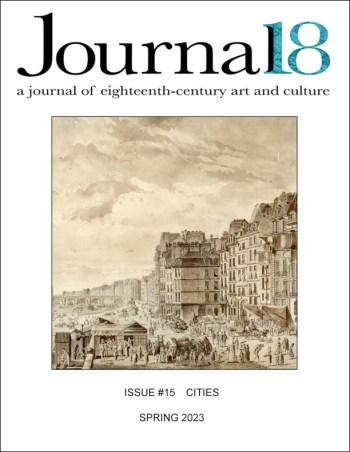
Journal18, Issue #15 (Spring 2023) — Cities
Issue edited by Katie Scott and Richard Wittman
Katie Scott and Richard Wittman — “Introduction”
Art history has traditionally narrated the early modern city through the monuments and buildings that constituted its environment and with reference to its spatial distribution. This special issue invites readers to consider the city instead via the social: to think about the people who once inhabited those buildings, admired those monuments, those who shared the spaces and resources of the city, and the ideas, beliefs, and practices invested in and inspired by it.
 For Aleksandr Bierig, the social is social life literally speaking, and that which the city must foster through clean air. In a close reading of Timothy Nourse’s 1700 critique of London’s coal-induced smog, and his proposal to purify the capital’s atmosphere by reverting to wood, Bierig shows that Nourse’s “restoration” acknowledged various trade-offs between social needs and industry but did not propose to turn back the clock, either socially or ecologically. Rather than retreat to pastoral, Nourse envisioned the relocation of industry to the city limits, as well as the plantation of an orbital forest to supply London. He viewed nature as a resource—in the modern sense of an object uniquely for commercial exploitation—of the good city.
Stacey Sloboda’s essay on London’s St. Martin’s Lane engages with the social on the scale and in the terms of neighborhood, a concept in which the built and the social are united. By following inhabitants of St. Martin’s Lane through rent registers and other sources, she explores the imbrication of artistic and artisanal practices that academies and art theory often obscure. Moreover, she complicates the binaries we draw to distinguish the modern and pre-modern city: between an older world of dense, low-rise housing and inward-looking community living, and the modern, outward-facing city produced by industrialization and migration. The St. Martin’s Lane school drew both some of its agents and some its artistic ideas from Europe and thought its taste modern.
Questions of place and emplacement are key also to Anne Hultzsch’s essay. However, she explores not the community and the rootedness associated with neighborhoods, but the individual’s embodied relationship to site. She reviews Sophie von La Roche’s writings on the city as “situated criticism,” situated both in the literal sense of point of view, and sociologically as a woman of a certain class. What distinguishes Hultzsch’s take on the social and sets it apart from late twentieth-century social and political histories of art criticism is her discussion of La Roche’s experience of the visual, and her use of biography to lay bare her subject’s identity in its intersectional complexity.
The two shorter pieces, each with a more historiographical focus, center on the figure of the urban observer. Richard Wrigley argues that the personage of the flâneur, normally characterized as disengaged and associated with the July Monarchy, had in fact originated in the political culture of the French Revolution, and as an effect of self-determined mobility within the city enabled by liberty. In so doing, he restores an essential political context to the phenomenon of flânerie that has long been obscured by its limiting association with the burgeoning consumer culture emblematized by the Paris passages. Sigrid de Jong, meanwhile, analyses the eighteenth-century literary trope of urban comparison. Situating such description in relation to current scholarly recourse to comparative history, she focuses on Paris and London in texts by Louis Sebastien Mercier and Helen Maria Williams, respectively. She suggests that their kind of explicitly situated subjectivity offers a privileged entry to the specifically social limitations and possibilities that structure real experiences of the city.
By variously answering such historical questions as—How did the city make room for sharing (air, ideas, experiences, space)? How did different kinds of urbanites (writers, artists, tourists, women) use, exploit and otherwise appropriate urban space? And how were the limits and possibilities of city social life made sensible in word and image (maps, views, description)?—these case studies collectively propose a richer yet less stable view of the proto-modern European city.
a r t i c l e s
• Aleksandr Bierig — “Restorations: Coal, Smoke, and Time in London, circa 1700”
• Stacey Sloboda — “St. Martin’s Lane: Neighborhood as Art World”
• Anne Hultzsch — “The City ‘en miniature’: Situating Sophie von La Roche in the Window”
s h o r t p i e c e s
• Richard Wrigley — “The Revolutionary Origins of the Flâneur”
• Sigrid de Jong — “The City and its Significant Other: Lived Urban Histories beyond the Comparative Mode”
All articles are available here»
Call for Articles | Fall 2024 Issue of J18: Craft
From the Call for Papers:
Journal18, Issue #18 (Fall 2024) — Craft
Issue edited by Jennifer Chuong and Sarah Grandin
Proposals due by 15 September 2023; finished articles will be due by 31 March 2024
When, where, and why does craft matter? Craft, by definition, is any activity involving manual skill. But in the modern western world, the term typically implies specific kinds of activities that produce specific kinds of objects: things like baskets, lace, and lacquerware. In a culture that has historically privileged rationality and innovation, craft’s commitment to tradition, reliance on haptic knowledge, and association with marginalized subjects have rendered it the minor counterpart to more ‘serious’ forms of material production. As a subsidiary to art and industry, craft has often occupied a circumscribed role in accounts of modern art and modernity’s origins in the eighteenth century. Recently, however, craft—as a more capacious category of material production—has become a crucial term in efforts to expand and diversify the study of eighteenth-century art.

Spouted bowl, stoneware with orange markings, Japan, Bizen kilns, 1700–1850, 20cm diameter (London: V&A, 199-1877). Possibly intended as a fresh water jar, of stoneware with streaks of glaze resulting from wrapping in saltwater-soaked straw.
This special issue builds on recent investigations while considering how craft’s ancillary role within the Anglo-European tradition has limited its capacity to transform the field. Drawing inspiration from the absence of an art/craft divide in many cultures, we are interested in exploring craft’s potential to radically reframe, reconceptualize, and globalize the history of art. By investigating craft, we also aim to shed new light on related questions of value, skill, and creativity in the making of different kinds of objects. We are inspired by recent scholarship that has asked, for example, how the repetitive nature of American schoolgirl samplers challenges celebrations of the individual maker, or how the meaningfully protracted time of wampum-making diverges from industry’s strict calculations of time and labor. Looking at the issue from a different angle, what would be the implications of discussing academic painting and sculpture as forms of craft?
By bringing together a range of studies that critically engage with handwork, we aim to highlight both the distinctive and shared concerns of craft in different making traditions. We welcome proposals for full-length articles as well as shorter pieces that explore new methods of studying craft. Taking advantage of Journal18’s online platform, the latter could take the form of photo essays, videos, interviews, or other formats that grapple with the complexities of documenting, understanding, and communicating craft-based knowledge.
To submit a proposal, send an abstract (250 words) and brief biography to editor@journal18.org and journal18craft@gmail.com by 15 September 2023. Articles should not exceed 6000 words (including footnotes) and will be due by 31 March 2024. For further details on submission and Journal18 house style, see Information for Authors.
Issue Editors
Jennifer Y. Chuong, Harvard University
Sarah Grandin, Clark Art Institute
Exhibition | French Revolution Style: Furniture, Art, and Wallpaper
Now on view at the Museum of the French Revolution (near Grenoble):
French Revolution Style: Furniture, Works of Art, and Wallpapers
Style Révolution française: Mobilier, objets d’art et papiers peints
Musée de la Révolution française, Vizille, 30 June 2023 — 11 March 2024

Arabesque wallpaper, manufacture Réveillon, Paris, 1790 (Vizille, Musée de la Révolution française).
Prétendument qualifiés de style Louis XVI ou de style Directoire, les arts décoratifs de la dernière décennie du XVIIIe siècle ont été dépouillés de leur spécificité historique par rejet de la Révolution française, au profit du dernier règne de l’Ancien Régime et de la période post thermidorienne. Tout découpage de ce genre est arbitraire, mais justement pourquoi ne pas mettre en avant un « style Révolution française » qui couvrirait les années de Liberté après la prise de la Bastille (1789–1792) et les premières années de la République (1792–1799) ?
Pour la première fois, le public découvre une partie du décor de papier peint en arabesque de la manufacture Réveillon à Paris, produit en 1790 et donné par la famille Benoist en 2004. Ce papier peint est l’écrin d’un ensemble exceptionnel de sièges de Georges Jacob (1739–1814), qui excelle dans la sculpture sur bois, ainsi qu’un bureau d’Adam Weisweiller (1746–1820) déposés par le Mobilier national.
Call for Papers | The Professional Worlds of Architectural Ornament
From INHA (where one can also find the French version):
The ‘Professional Worlds’ of Architectural Ornament: Actors and Practices from the 18th Century to the Present Day
Les mondes professionnels de l’ornement d’architecture: Acteurs et pratiques du XVIIIe siècle à nos jours
Institut national d’histoire de l’art, Paris, 13–14 March 2024
Proposals due by 30 September 2023

Levin Corbin Handy, N.C. 1st Story, Marble Carving Shop, July 19, 1894. In the album Photographs of the Construction of the Library of Congress Thomas Jefferson Building, volume 3, after leaf 64.
At the crossroads of art history and architecture, the study of ornament nowadays constitutes a specific field of research. Although studies had already been devoted to this question from the 1980s onwards (Hamburger, Thiebault, 1983; Durant, 1986), ornament was the subject of renewed interest during the 1990s and at the turn of the 21st century, thanks to collective publications often stemming from large-scale scientific events (Grabar, 1992; Collomb, Raulet, 1992; Ceccarini et al., 2000). More recently, France saw a remarkable revival in this field of research. Without claiming to draw up an exhaustive historiographical assessment of the question, one could for instance think of the numerous journal issues devoted to the question of ornament in the early 2010s–Perspective in 2010, Images Re-Vues in 2012, or Livraisons d’Histoires de l’architecture in 2015. Several events were also organized during that period, such as the symposium Questionner l’ornement (Questioning Ornament), which took place at the Musée des Arts Décoratifs (Paris) in 2011, or the series of public lectures organized at the École de Chaillot in 2014. In recent years, essential studies on ornament have been published (Picon, 2016; Necipoglu, Payne, 2016), sometimes tackling more definite topics: theoretical considerations (Varela Braga, 2017; Thibault, 2020); the use of certain materials (Dobraszczyk, 2014); or the roles and functions of ornaments on specific surfaces or in specific building types, such as farms (Ripatti, 2019) or tenements (Violette, 2019). Far from being limited to the contemporary period, the interest in ornament is also evident in publications and events relating to the Renaissance, such as the colloquia organized in Azay-le-Rideau (2014) or Lausanne (2017, 2022).
Concomitantly, a significant amount of research has been devoted to the organization of professions and the relationships between professional groups in the field of architecture and construction. In this field, several historical studies also draw on sociological perspectives that can be borrowed from both functionalism and interactionism, in a context in which the sociology of professions has itself undergone noteworthy renewal (Vézinat, 2010).
Recent publications have thus questioned the evolution of architects’ status and practices, particularly in the context of their public missions (Bruant, Callais, Lambert, 2022). The concrete organization of their work has also been the subject of several studies, focusing on construction sites (Nègre, 2018), or more recently on the architectural firm (Cahiers de la recherche architecturale, urbaine et paysagère, 2020; Livraisons d’histoire de l’architecture, 2021). Such questions also raise issues related to the relationships between professions and to professional strategies (Prina, 2020). These studies echo broader research undertakings, focusing on sectors of activity such as expertise (ANR research programme ‘Experts’) or on the issue of architectural education (Lucan, 2009; Diener, 2022; ANR research programme ‘EnsArchi’).
Despite their common dynamism, these two fields of study—the history of ornament and the history of professions related to architecture—have so far rarely been connected to one another. The ambition of this colloquium is therefore to foster such a dialogue, to move towards a better understanding of the ‘professional worlds’ of ornament.
The interdependence with architecture being a crucial question here, papers should thus focus on ornaments directly linked to architectural surfaces. However, resolutely positioned on the side of the actors and professional practices, this colloquium does not have the vocation to give a strict definition of what ornament is. It will thus look at a wide range of productions, from ornamental sculpture to mosaic, mural painting, and up to parquetry, marble features, or stained glass: in short, any finishes helping to develop sensibility to architecture. Issues related to the forms, functions and uses of ornaments, especially in a world increasingly marked by the imperatives of sobriety and sustainability (Körner, 2020), could be addressed in a subsidiary way but should not constitute the heart of the presentations.
Papers are invited that consider themes including (but not limited to):
The spectrum of ornament professionals: training, status, regulations
• Who are the professionals creating architectural ornaments (sculptors, industrial designers, architects…)?
• What contributions have women made in this field? What opportunities were open to them in comparison with architectural practice?
• How have the names and regulations of these professions changed over time?
• Do they benefit from the same status and social recognition? Is there a hierarchy between them?
• What is the training of these professionals, and in which institutions does it take place (drawing schools, schools of fine arts, schools of decorative arts, artisans’ workshops…)?
The relationship between professions in the fields of ornament, architecture and construction
• How are tasks divided between professions?
• What are the discrepancies or similarities in the material exercise of these crafts (remuneration, place of work…)?
• How do the collaborations—between individuals or with construction companies —work?
• What degree of freedom is allowed to ornament professionals in the exercise of their art (choice of subjects represented, materials, techniques…)?
• What agency do the clients have?
• How are technical questions (such as patent registration) dealt with?
The production lines
• How are ornaments concretely made (in the workshop or in situ)? What roles do drawing and molding play?
• What sources (especially photographic) do we have to document the concrete organization of the building sites?
• How and why do actors, materials, and even entire decorative elements circulate (locally, nationally, or transnationally)?
• What were the changes brought about by the development and diffusion of catalogs and pattern books (which are publications that can play a key role in the construction process, but also have a life of their own)?
• Can discrepancies be highlighted between the conditions of production of elite decorations and those of more ordinary buildings?
• What were the working methods and conditions of the men and women in the workshops and on the building sites?
Papers may cover a wide contemporary period, encompassing the 18th century and extending to the present day. The choice of this chronology stems from a will to study diachronically the evolution of the professional dynamics of the field during a long period marked by three crucial phenomena: significant changes in the professional worlds of architecture and construction (Picon, 1988; Woods, 1999; Decommer, 2017); the development of mass-produced ornaments (Nègre, 2006); and finally, frequent debates around ornamentation (Payne, 2012), in the 19th century, at the turn of the 20th century, or during the postmodern period.
Any cultural and geographical area is likely to be studied. Indeed, questions related to transportation and circulations invite reflection on spatial interactions, for instance, between European nations and colonized territories. These questions also echo the phenomenon of internationalization of the Beaux-Arts architectural culture, particularly in the Americas. Proposals for papers with a transnational dimension are therefore particularly encouraged.
Papers may be presented in English or French and will last 25 minutes. Proposals, along with a brief CV should be sent to Justine Gain (justine.gain@gmail.com), Elsa Jamet (elsa.jamet@hotmail.fr), and Lucie Prohin (lucie.prohin@inha.fr) before 30 September 2023. Financial support is available for speakers whose home institution would be unable to cover travel expenses.
The symposium is supported by the Institut national d’histoire de l’art, the Centre André Chastel, the HiCSA research laboratory (Université Paris 1 Panthéon-Sorbonne) and the Histara research laboratory (École pratique des hautes études, PSL).
Organizing Committee
• Justine Gain, EPHE (Histara), École du Louvre, Institut national d’histoire de l’art
• Elsa Jamet, Centre André-Chastel
• Lucie Prohin, université Paris 1-Panthéon Sorbonne (HiCSA), Institut national d’histoire de l’art
Scientific Committee
• Basile Baudez, Princeton University
• Jean-François Bédard, Syracuse University
• Ariane Varela Braga, Villa Médicis
• Jérémie Cerman, université d’Artois (CREHS)
• Sophie Derrot, Institut national d’histoire de l’art
• Jean-Philippe Garric, université Paris 1-Panthéon Sorbonne (HiCSA)
• Valérie Nègre, université Paris 1 Panthéon-Sorbonne (IHMC)
• Estelle Thibault, ENSA Paris-Belleville (IPRAUS / AUSser)
Selected Bibliography
• BÉDARD, Jean-François, Decorative Games: Ornament, Rhetoric, and Noble Culture in the Work of Gilles-Marie Oppenord (1672–1742), Newark, University of Delaware Press and Rowman and Littlefield, 2011.
• BRUANT, Catherine, CALLAIS, Chantal, LAMBERT, Guy (dir.), Les architectes et la fonction publique. XIXe–XXIe siècles, Rennes, Presses universitaires de Rennes, 2022.
• CECCARINI, Patrice, CHARVET, Jean-Loup, COUSINIÉ, Frédéric, LERIBAULT, Christophe (dir.), Histoires d’ornement, Paris/Rome, Klincksieck/Villa Médicis, 2000.
• COLLOMB, Michel, RAULET, Gérard (dir.), Critique de l’ornement de Vienne à la Postmodernité, Paris, Klincksieck, 1992.
• DECOMMER, Maxime, Les Architectes au travail. L’institutionnalisation d’une profession, 1795–1940, Rennes, Presses universitaires de Rennes, 2017.
• DE FINANCE, Laurence, LIÉVAUX, Pascal, Ornement : vocabulaire typologique et technique, Paris, Éditions du Patrimoine/Centre des monuments nationaux, 2014.
• DIENER, Amandine, Enseigner l’architecture aux Beaux-Arts (1863–1968). Entre réformes et traditions, Rennes, Presses universitaires de Rennes, 2022.
• DOBRASZCZYK, Paul, Iron, Ornament and Architecture in Victorian Britain: Myth and Modernity, Excess and Enchantment, Farnham, Ashgate, 2014.
• DURANT, Stuart, Ornament. From the Industrial Revolution to Today, New York, The Overlook Press, 1986.
• EDGAR, Brenda Lynn, Le motif éphémère : ornement photographique et architecture au XXe siècle, Rennes, Presses universitaires de Rennes, 2021.
• GAYLE, Margot, GAYLE, Carol, Cast-Iron Architecture in America: The Significance of James Bogardus, New York, Norton, 1998.
• GRABAR, Oleg, The Mediation of Ornament, Princeton, Princeton University Press, 1992.
• HAMBURGER, Bernard, THIEBAULT, Alain, Ornement, architecture et industrie, Bruxelles, Mardaga, 1983
• KÖRNER, Andreas, « Durabilité ornée. Crise climatique, articulations du temps et autres manifestations de la nature », Faces, n° 77, printemps 2020, p. 28–35.
• LENDING, Mari, Plaster Monuments: Architecture and the Power of Reproduction, Princeton, Princeton University Press, 2017.
• LUCAN, Jacques, Composition, non-composition. Architecture et théories, XIXe–XXe siècles, Presses polytechniques et universitaires romandes, Lausanne, 2009.
• NECIPOGLU, Gülru, PAYNE, Alina (dir.), Histories of Ornament: From Global to Local, Princeton, Princeton University Press, 2016.
• NÈGRE, Valérie, L’ornement en série. Architecture, terre-cuite et carton-pierre, Bruxelles, Mardaga, 2006.
• NÈGRE, Valérie (dir.), L’Art du chantier : construire et démolir du XVIe au XXIe siècle, Paris/Gand, Cité de l’Architecture/Snoeck, 2018.
• PAYNE, Alina, From Ornament to Object: Genealogies of Architectural Modernism, New Haven, Yale University Press, 2012.
• PICON, Antoine, Architectes et ingénieurs au Siècle des Lumières, Marseille, Éditions Parenthèses, 1988.
• PICON, Antoine, L’ornement architectural. Entre subjectivité et politique, Lausanne, PPUR, 2016.
• PRINA, Daniela (dir.), L’architecture et l’urbanisme du long XIXe siècle en Belgique. Lieux, protagonistes, rôles, enjeux et stratégies professionnelles, Liège, Presses universitaires de Liège, 2020.
• RIPATTI, Anna, « Modernizing Architecture and Ornament on Mid-Nineteenth-Century Scandinavian Farms », Journal of the Society of Architectural Historians, 2019, vol. 78 , n° 1, p. 68–89.
• THIBAULT, Estelle, « Jules Bourgoin’s Theory of Ornament. Intuitive Geometry, Order and Permutations », Figurationen. Gender – Literatur – Kultur, 2020, n° 2, p. 90–106.
• UPTON, Dell, « Pattern Books and Professionalism: Aspects of the Transformation of Domestic Architecture in America, 1800–1860 », Winterthur Portfolio, 1984, vol. 19, n° 2/3, p. 107–150.
• VARELA BRAGA, Ariane, Une théorie universelle au milieu du XIXe siècle: “La Grammar of Ornament” d’Owen Jones, Rome, Campisano Editore, 2017.
• VÉZINAT, Nadège, « Une nouvelle étape dans la sociologie des professions en France », Sociologie [en ligne], 2010, vol. 1, n° 3. http://journals.openedition.org/sociologie/517 [consulté le 17 mars 2023]
• VIOLETTE, Zachary, The Decorated Tenement, Minneapolis, University of Minnesota Press, 2019.
• WOODS, Mary, From Craft to Profession: The Practice of Architecture in Nineteenth-Century America, Berkeley, University of California Press, 1999.
Lecture | Pascal Bertrand on Boucher and the Decorative Arts
From BGC:
Pascal Bertrand | Boucher and the Decorative Arts: Promoting and Maintaining His Fame
A Françoise and Georges Selz Lecture on Eighteenth- and Nineteenth-Century French Decorative Arts and Culture
Bard Graduate Center, New York, 20 September 2023, 6.00pm
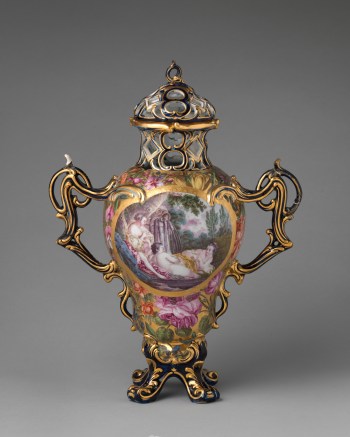
One of a pair of perfume vases, Chelsea Porcelain Manufactory (British, Gold Anchor Period, 1759–69), ca. 1761, soft-paste porcelain, burnished gold ground, 36 cm high (New York: The Metropolitan Museum of Art, 64.101.509a, b). The vase depicts three nymphs after the painting La Source by Francois Boucher.
In this lecture, Pascal Bertrand will explore the role of the decorative arts in the process of making and maintaining an artist’s fame, using the example of the quintessentially Rococo painter François Boucher. Boucher’s art was translated to a wide range of mediums—primarily tapestry and porcelain, but also gold and lacquer objects as well as printed fabrics and fans. How did he use these decorative arts to build his own reputation? And how did the decorative arts transmediate his paintings, prints, and drawings to disseminate them during his lifetime and preserve them after his death, right up to the present day? While the first question has been the subject of specific in-depth studies in one medium or another (porcelain in particular), Dr. Bertrand’s lecture considers the second question and the significance of intermediality.
Registration is available here»
Pascal Bertrand is Professor of Art History at the Université Bordeaux Montaigne in Pessac. His areas of research include the history of European tapestries, furniture, and the decorative arts generally.
Bard Graduate Center is grateful for the generous support of the Selz Foundation.










 Enfilade
leave a comment