Lecture | Peter Burke on the Invention of Connoisseurship
From BGC:
Peter Burke | The Invention of Connoisseurship
Bard Graduate Center, New York, 6 September 2023, 6.00pm
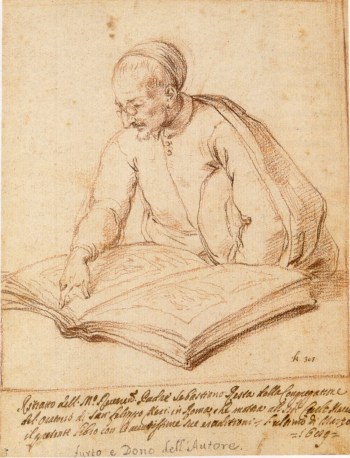
Carlo Maratti, Padre Sebastiano Resta Examining a Folio of Drawings (The Devonshire Collections). The drawing was included in the exhibition Lines of Beauty: Master Drawings from Chatsworth, on view in the fall of 2021 at The Lightbox in Woking, Surrey.
Connoisseurship—a bundle of practices combining a sense of the quality of works of art, the ability to attribute them to their makers, and to discriminate between originals, copies, and forgeries—is a contested term with a contested history. In this lecture, Peter Burke argues that the ‘invention’ of connoisseurship happened gradually rather than suddenly and took place in the West neither, as has sometimes been argued, in the nineteenth century, nor—perhaps surprisingly—in the Renaissance, but in the seventeenth century when treatises on the subject begin to appear.
Registration is available here»
Peter Burke is a cultural and social historian who was born in 1937, studied at Oxford (1957–62), and taught at the Universities of Sussex (1962–78) and Cambridge (1979–2004). He is a Life Fellow of Emmanuel College. His publications have focused in turn on historiography, the Renaissance, popular culture, and the history of knowledge, including the distinctive roles of exiles and polymaths. His latest book is a history of ignorance, and his next will be a history of connoisseurship.
New Book | Small Spaces: Recasting the Architecture of Empire
From Bloomsbury:
Swati Chattopadhyay, Small Spaces: Recasting the Architecture of Empire (London: Bloomsbury Visual Arts, 2023), 360 pages, ISBN: 978-1350288225 (hardback), $100 / ISBN: 978-1350288232 (paperback), $35. Also available as an ebook.
 Small Spaces recasts the history of the British empire by focusing on the small spaces that made the empire possible. It takes as its subject a series of small architectural spaces, objects, and landscapes and uses them to narrate the untold stories of the marginalized people-the servants, women, children, subalterns, and racialized minorities-who held up the infrastructure of empire. In so doing it opens up an important new approach to architectural history: an invitation to shift our attention from the large to the small scale. Taking the British empire in India as its primary focus, the book presents eighteen short, readable chapters to explore an array of overlooked places and spaces. From cook rooms and slave quarters to outhouses, go-downs, and medicine cupboards, chapters reveals how and why these kinds of minor spaces are so important to understanding colonialism. With the focus of history so often on the large scale—global trade networks, vast regions, and architectures of power and domination—Small Spaces shows instead how we need to rethink this aura of magnitude so that our reading is not beholden to such imperialist optics. With chapters that can be read separately as individual accounts of objects, spaces, and buildings and introductions showing how this critical methodology can challenge the methods and theories of urban and architectural history, Small Spaces is a must-read for anyone wishing to decolonize disciplinary practices in the field of architectural, urban, and colonial history. Altogether, it provides a paradigm-breaking account of how to ‘unlearn empire’, whether in British India or elsewhere.
Swati Chattopadhyay is Professor in the Department of History of Art and Architecture with an affiliated appointment in the Department of Comparative Literature at the University of California, Santa Barbara.
c o n t e n t s
Preface and Acknowledgments
I | Small Spaces
1 Of Small Spaces
2 Empire of Small Spaces
II | Trade and Labor
3 Dependency
4 Locating the Bottlekhana
5 Potable Empire
6 Europe Goods
7 Strange Tongues
8 Making Invisible
III | Land Imagination
9 Vantage
10 Connective Spaces
11 Anomalous Spaces
12 An Aesthetic Episode
13 Roofscape
IV | A Geography of Small Spaces
14 Collections and Containment
15 Portable Geographies
16 A Good Shelf
17 A Box of Medicine
18 Epilogue
Appendix A
Index
Exhibition | The World Made Wondrous
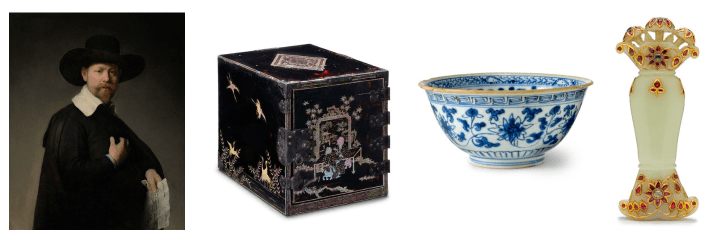
From left to right: Rembrandt Harmensz. van Rijn, Portrait of Marten Looten, 1632 (LACMA, gift of J. Paul Getty); Chest with Figures, Flowers, and Birds, Ryukyu Islands, ca. 1650–1750 (LACMA, gift of Mr. and Mrs. Leo Krashen); Bowl (Wan) with Floral Scrolls, China, Qing dynasty, Kangxi period, 1662–1722 (LACMA, gift of Ambassador and Mrs. Edward E. Masters); Dagger Hilt with Triple Lotus Bud Pommel, India, Mughal empire, ca. 1700–50 (LACMA, from the Nasli and Alice Heeramaneck Collection, Museum Associates Purchase).
◊ ◊ ◊ ◊ ◊
The World Made Wondrous may initially sound like a 17th-century exhibition, but the fact that three of the four objects used to publicize the show may actually have been made in the 18th century underscores the value of holding century designations loosely. –CH
From the press release for the exhibition:
The World Made Wondrous: The Dutch Collector’s Cabinet and the Politics of Possession
Los Angeles County Museum of Art, 17 September 2023 — 3 March 2024
Curated by Diva Zumaya
The Los Angeles County Museum of Art (LACMA) presents The World Made Wondrous: The Dutch Collector’s Cabinet and the Politics of Possession, an immersive exploration of the economic and political structures that laid the groundwork for today’s museums. Assembling an imagined 17th-century Dutch collector’s cabinet, the exhibition brings together over 300 artworks, animal and mineral specimens, scientific instruments, books, and maps, with a rich landscape of multivocal narratives by experts ranging from environmental historians and zoologists to contemporary artists and Indigenous activists.
Across Europe in the 16th and 17th centuries, wealthy people established collector’s cabinets, vast collections that they claimed contained art and natural specimens representing the entirety of the known world. As Europeans amassed these collections, they ordered the world in deliberate ways, asserting judgments and hierarchies on the value of natural materials, craftsmanship, and human worth. In many ways, these cabinets acted as prototypes for—and in some cases direct predecessors of—modern encyclopedic museums, including LACMA. Using the 17th-century Dutch example as a starting point, The World Made Wondrous unpacks the mercantile and colonial contexts that facilitated these foundational collections. While previous studies of collector’s cabinets have centered the narrative of the owner, this exhibition investigates the journey of the objects and the stories of those who produced them. The exhibition is curated by Diva Zumaya, Assistant Curator, European Painting and Sculpture, at LACMA.
“In engaging these objects through an expansive historical lens, we hope to shine a light on how the interconnected legacies of capitalism and colonialism that began in Europe in the 16th and 17th centuries continue to this day and how the human and environmental devastation that they enact affect not only museums and the collections they care for, but the entire world,” said Zumaya. “By uncovering and critically examining these legacies, museums can find new pathways forward that allow us to serve our communities while building futures together outside of colonial frameworks.”
“This exhibition reveals how new connections and critical histories arise from deep collaboration across our departments,” said Michael Govan, LACMA CEO and Wallis Annenberg Director. “While many museums have global collections, LACMA is one of the few taking such an approach. This allows us to meaningfully reconsider the topic of the collector’s cabinet and the relationships between collecting, global trade, and the environment in contemporary Los Angeles.”
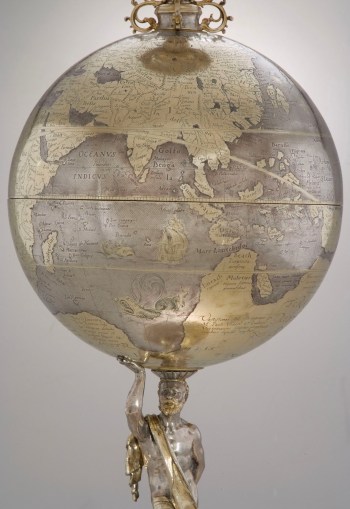
Abraham Gessner, Globe Cup (detail), ca. 1600 (Los Angeles County Museum of Art, William Randolph Hearst Collection).
Staged with dynamic lighting, warm colors, and other design elements that transport the visitor to a 17th-century collector’s cabinet, The World Made Wondrous examines over 170 works from LACMA’s permanent collection, including examples from Brazil, China, Egypt, India, Iran, Japan, Peru, Turkey, and Sri Lanka, and never-before-shown objects such as Francesco da Castello’s miniature Salvator Mundi (c. 1580–90), a large 16th-century Belgian tapestry, a recently acquired Rembrandt etching, and two Chinese cups from the late Ming dynasty, carved from rhinoceros horn.
Marking one of the largest collaborations between LACMA and the Natural History Museum of Los Angeles to date, the exhibition also draws 80 gems and minerals, shells, taxidermy, and other objects from the Natural History Museum, as well as rare books and maps from the Getty Research Institute, the UCLA Biomedical Library, and the Huntington Library, Art Museum, and Botanical Gardens, and scientific instruments from Chicago’s Adler Planetarium. In addition to these historical objects and natural specimens, works by four contemporary artists—Jennifer Ling Datchuk, Todd Gray, Sithabile Mlotshwa, and Uýra Sodoma—act as cornerstones for the exhibition. These contemporary works offer significant political and personal reflections on the histories that unfold in the exhibition.
Exhibition Guide
The World Made Wondrous features an interactive exhibition guide that creates an immersive journey through the exhibition. Accessible as audio via personal mobile devices and in-gallery printed handouts, visitors can engage with a series of commentaries accompanying select objects. These narratives are voiced by a wide range of speakers, including contemporary artists, scientists, Indigenous activists, and environmental historians. Through this diverse breadth of expertise, the exhibition guide encourages visitors to question dominant historical perspectives and consider the broader contexts surrounding the objects on view.
Exhibition Organization
The World Made Wondrous is organized into four sections: The Collector, Water, Earth, and Fire.
In the exhibition’s first section visitors are introduced to the figure of the Dutch collector and how his cabinet has been assembled to reflect his character and position. This section features heraldic imagery, portraits of historical figures to whom the collector seeks to liken himself—such as Rembrandt’s Portrait of Dirck Jansz. Pesser (c. 1634) and Portrait of Marten Looten (1632)—religious images signifying his faith, and objects that represent his access to leisure. The section provides a social and political foundation for the ways the collector has constructed the world through his collection, with the Dutch Republic at its center.
Water explores narratives around the ocean, materials extracted from it, and images of Dutch maritime power. When encountering a Japanese lacquer chest, visitors can listen to Japanese artist Shinya Yamamura discuss the particularities of working with lacquer, and a malacologist explain the function of mother of pearl as a part of a living organism. Responding to specimens from the Natural History Museum, LA-based artist Todd Gray reflects on the role of the cowrie shell in the slave trade, while a labor and migration historian discusses the process of shipping such specimens on Dutch East India Company ships.
Earth engages the natural world through a series of landscape and still life paintings, land-based natural specimens, and objects that incorporate materials like ebony, ivory, and feathers. Here, visitors are prompted to compare Frans Post’s Imagined Landscape of Dutch Brazil (c. 1655) with a work by Indigenous Brazilian artist Uýra Sodoma that addresses the contemporary deforestation of the Amazon rainforest. In the audio guide, visitors can engage with the artist’s account of the far-reaching effects of settler colonialism on her land, a sociologist’s discussion of deforestation in the Amazon, and an art historian’s discussion of Post’s motives. The visitor is also invited to consider Abraham van Beyeren’s painting Banquet Still Life (1667) in concert with artist Sithabile Mlotshwa’s response to its representation of Dutch wealth. Other narratives in this section address the practice of European natural history, Indigenous Brazilian foodways, and rhinoceros conservation.
The final section, Fire, spotlights earthenware, metals, minerals, porcelain, and gems. While viewing a Chinese porcelain bowl from the late Ming dynasty, visitors can listen to American artist Jennifer Ling Datchuk discuss her relationship with the fraught history of this material and its role in her own works Ache Like a Girl (2021) and Break Like a Woman (2021), which are featured in the gallery. As they engage with a selection of gems and minerals from the Natural History Museum and a Mughal gem-inlaid dagger hilt from LACMA’s collection, visitors can hear experts discuss the geological origins of gems and the human consequences of mining practices. Additional discussions in this section highlight the ecological effects of mining, the environmental and human costs of tobacco cultivation, and the shipping of porcelain from China to Europe.
The World Made Wondrous is accompanied by a Collator publication—available as a PDF or a printed book—through which readers can explore essays and entries by curator Diva Zumaya alongside high-resolution images of thirty-five objects from across LACMA’s collection featured in the exhibition.
Exhibition | Eternal Medium: Seeing the World in Stone
From the press release for the exhibition:
Eternal Medium: Seeing the World in Stone
Los Angeles County Museum of Art, 20 August 2023 — 11 February 2024
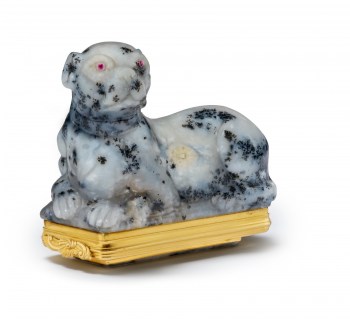
Snuffbox in the Shape of a Dog, ca. 1740–50, Dresden (LACMA, gift of The Rosalinde and Arthur Gilbert Foundation and the 2022 Decorative Arts and Design Acquisitions Committee).
The Los Angeles County Museum of Art presents Eternal Medium: Seeing the World in Stone, an exhibition that focuses on the role of the imagination in perceiving images in the natural markings of stones. The product of a collaboration between LACMA, the Rosalinde and Arthur Gilbert Collection, and the Victoria and Albert Museum in London, this exhibition brings together objects that utilize the natural features of stones and places them alongside similar works in other mediums for context and comparisons. Objects range from historical to contemporary, from ca. 2200–1800 BCE to recent pieces by Analia Saban, Alma Allen, and Ben Gaskell. Featuring a selection of 125 works, the exhibition is drawn from LACMA’s collection with loans from the Rosalinde and Arthur Gilbert Collection on loan to the V&A and the V&A’s own collections, as well as public and private collections in California.
“Making sense of enigmatic visual phenomena such as the moon, clouds, and inkblots is a fundamental human ability that excites curiosity and inspires creativity,” said Rosie Mills, The Rosalinde and Arthur Gilbert Foundation Associate Curator, Decorative Arts and Design. “Stone, especially vividly colored and richly patterned stone, is an impressive medium because the right stone can be difficult to source and carve. Eternal Medium: Seeing the World in Stone invites visitors to look for themselves as well as consider the works in their cultural and historical contexts.”
“This exhibition is the result of a meaningful collaboration between LACMA, the Rosalinde and Arthur Gilbert Collection, and the Victoria and Albert Museum in London,” said Michael Govan, LACMA CEO and Wallis Annenberg Director. “Through the sharing of collections and expertise, this partnership has facilitated new approaches to established subjects. The LACMA/V&A Staff Exchange Program was created in 2017, thanks to the generous support from The Rosalinde and Arthur Gilbert Foundation in Los Angeles, and the Gilbert Trust for the Arts in London. This exchange program is intended to encourage the exploration of new models for research, audience engagement, and scholarship. Eternal Medium is the result of this groundbreaking program.”

Dagger of Emperor Aurangzeb, India, Mughal Empire, 1660–61, nephrite (LACMA).
Tristram Hunt, Director of the V&A and Gilbert Trust for the Arts Trustee said, “The Gilbert collection of works of art made of stone is iconic and comprehensive. It is wonderful to see so many of these treasures come back to LACMA for this exhibition, alongside other works of art from the V&A, and all set in a wider context where visitors can understand the visual and artistic power of stones across continents and centuries.”
The exhibition is comprised of nine interrelated sections: ‘Hard’ stones, Sourcing Specimens, Manipulating Multicolored Stones, Seeing Images in Stones, Fooling the Eye, Flora and Fauna, Heaven and Earth, Stone for Stone, and Transcending Stone. Each section considers where the materials came from, demonstrates how their innate characteristics were translated into illusionistic stone pictures and coloristic stone sculptures, and encourages visitors to understand the works in relation to similar images in other media as well as use their own imaginations to complete the imagery suggested by the stones and their markings.
Claus Benjamin Freyinger and Andrew Holder of The Los Angeles Design Group (LADG) have created an immersive and contemplative installation design that supports an intimate viewing of the sumptuous and detailed artworks in the exhibition. The collaboration between LACMA and LADG is one of many examples of the museum working with renowned L.A. architects on exhibition design.
Exhibition Highlights
Dagger of Emperor Aurangzeb, India, Mughal empire, 1660–61
Imperial khanjars, like this one belonging to the Mughal Emperor, were typically made of precious materials. This particular specimen of nephrite jade retains its burnt-orange skin to add contrast to the horse’s meticulously delineated mane.
Snuffbox in the Shape of a Dog, Germany, ca. 1740–50
In the 18th century, Dresden’s lapidary artists incorporated the naturally occurring patterns of Saxony’s unusually rich and varied minerals into some of the most ingenious designs. For this exquisite snuffbox in the shape of a dog, the stone specimen was carefully selected for the shape and distribution of its dark inclusions that evoke the hound’s spotted fur.
Table, Italy, ca. 1870
Contoured stone mosaics are pieced together like a jigsaw puzzle, except that each piece is individually shaped to correspond to the image’s outlines (making the joins invisible). The still life on this tabletop demonstrates the extraordinary illusionism achieved using this technique.
Ben Gaskell, Breakbox with Split Crystal, United Kingdom, London, 2016
The exceedingly beautiful fracture in the transparent rock crystal cube was achieved by applying immense force at just the right angle. It celebrates the material’s physical properties as well as the artist’s technical mastery.
New Book | The Book of Marble

From Taschen:
Jan Christiaan Sepp, Marmora / The Book of Marble, edited by Geert-Jan Koot (Cologne: Taschen, 2023), 312 pages, ISBN: 978-3836594349 (English, French, and German), $125.
An exhaustive compendium of marble, Afbeelding der Marmor Soorten (A Representation of Marble Types) depicted 570 samples across 100 colour plates, accompanied by texts in five languages. Published in 1776 at the peak of the Enlightenment, it is regarded, rightly, as one of the finest illustrated scientific books of the era.
 Over the course of the 18th century, beautiful books that categorised, annotated, and illuminated the Enlightenment pursuit of learning across Europe had become increasingly popular. Knowledge was everything and everywhere, and these books provided it for those not wealthy enough to build their own personal collections of rare and exotic objects. Marmor Soorten, one such edition, took the standards of both aesthetics and categorisation to a whole new level.
Jan Christiaan Sepp and his father Christian—himself a respected collector—had already earned a reputation for luxury publications on scientific themes, starting with Christian’s own Nederlandsche Insecten (Insects of the Netherlands). But it was his son who created the visual masterpiece Marmor Soorten, revising an existing German publication from 1775 by Adam Ludwig Wirsing. The result, published in 11 installments to a print run of around 100, was among the finest examples of its kind.
Featuring new photography to depict the intricate details of the marble samples, this edition brings an unknown treasure back to relevance. The plates, each meticulously hand-coloured and arranged with painstaking precision, have an abstract-art feel that gives this volume an almost modern slant. This edition reproduces the pages from two copies of Marmor Soorten held at the State and University Library in Dresden and the Getty Research Institute in Los Angeles. Reprinting the work in full for the first time, The Book of Marble brings that rare blend of beauty and encyclopedic knowledge to a wider audience.
Geert-Jan Koot holds an MA in Art History and Archaeology from the Radboud University, Nijmegen. From 1988, he was the head of the Rijksmuseum’s Research Library and curator of library collections, as well as chair of the Working Group for Specialist Academic Libraries (Werkgroep Speciale Wetenschappelijke Bibliotheken), until his retirement in 2021. Koot now works as a consultant for book collectors and auction houses. He has also spearheaded the WorldCat Art Discovery project, a new search tool for art libraries hosting over 250 million articles.
New Book | The Wood that Built London
From Sandstone Press:
C. J. Schüler, The Wood that Built London: A Human History of the Great North Wood (Sheffield: Sandstone Press, 2021), 368 pages, ISBN: 978-1913207496 (hardcover) / ISBN: 978-1914518164 (paperback), £20.
 It is hard to imagine that the busy townscape of South London was once a great wood, stretching almost seven miles from Croydon to Deptford or that, scattered through the suburbs, from Dulwich to Norwood, a number of oak woodlands have survived since before the Norman Conquest. These woods were intensively managed for a thousand years, providing timber for construction, furniture and shipbuilding, and charcoal for London’s blacksmiths, kilns, and bakeries. Now they afford important green space, a vital habitat for small mammals, birds, and insects. Drawing on a wealth of documents, historic maps, and environmental evidence, The Wood That Built London charts the fortunes of the North Wood from its earliest times: its ecology, ownership, management, and the gradual encroachment of the metropolis.
Chris Schüler is the author of three illustrated histories of cartography: Mapping the World, Mapping the City, and Mapping the Sea and Stars and co-author of the best-selling Traveller’s Atlas. His most recent book, Writers, Lovers, Soldiers, Spies: A History of the Authors’ Club of London, 1891–2016 was published in 2016. He has also written on literature, travel, and the arts for The Independent, The Independent on Sunday, The Tablet, The Financial Times, and New Statesman.
C O N T E N T S
Foreword by Rachel Licthenstein
Introduction
Measurements, Money, and Other Matters
1 Taming the Wildwood, ca. 8000 BC–1485
2 Surveys, Ships, and Statutes, 1485–1600
3 The World Turned Upside Down, 1600–1700
4 Faith or Science? 1700–1790
5 Industry and Enclosure, 1790–1850
6 The Palace and the Railway, 1850–1910
7 The Home Front, 1910–1945
8 A Design for Living, 1945–1970
9 Save the Woods! 1970–1997
10 A New Millennium, 1997–2021
11 A Tour of the Woods Today
12 Ways through the Woods, 2021–?
Acknowledgments
A Woodland Glossary
Notes
Bibliography
Chris Schüler on the Wood that Built London
An evening lecture at the Society of Antiquaries:
Chris Schüler, The Wood That Built London
In-person and online, Society of Antiquaries of London, 12 October 2023, 5pm
Drawing on historic documents, maps and environmental evidence, The Wood That Built London charts the fortunes of the Great North Wood that once covered much of what is now South London [‘north’ relative to Croydon]. It records its botany, ecology, ownership and management, the gradual encroachment of the metropolis, and the battles fought by locals and the London Wildlife Trust to save what remained.
The lecture will discuss the documentary research into historic land ownership and management in the medieval and early modern periods that informed the book, which draws on a wide range of primary sources, some never previously cited. These include 16th-century Court of Exchequer depositions in a dispute over land ownership in the National Archives at Kew; Archbishop Morton’s 1492 survey of the Manor of Croydon and a 1678 plan of the Archbishop’s woods in Croydon Museum; Archbishop Cranmer’s 1552 survey of the Manor of Croydon in the Bodleian Library; estate maps in the British Library and London Metropolitan Archives; parish accounts; and records of woodland management in Dulwich College Archive and Lambeth Palace Library. Considered together, these scattered records combine to create a picture of the former extent of the wood, which stretched from Deptford to Croydon, its ownership by religious bodies such as Bermondsey Abbey and the Archbishopric of Canterbury, and its management by rotational coppicing, which generated income for its owners over several centuries. Tudor Acts of Parliament and the publications of 16th– and 17th-century agronomists such as Thomas Tusser and Barnaby Googe are examined to provide insight into the theory and practice of woodland management at this period.
The book also records how that income dwindled as the Industrial Revolution rendered many woodland products obsolete, leading landowners to grub up coppices, at first for farmland and then, as the railways brought the area within commuting distance of London, for housing development, to the fury of commentators such as John Ruskin and John Stuart Mill.
Presented both in-person at Burlington House and online, the event is free and open to the public. Please reserve tickets here.
Conference | Dressing the Interior
From the conference programme:
Dressing the Interior in the Early Modern Period: Textiles in Domestic Settings
Dressing the Early Modern Network Conference
Leiden University Centre for the Arts in Society (LUCAS), 23 September 2023
Organised by Jola Pellumbi, Sara van Dijk, and Alexander Dencher
Registration due by 20 September 2023
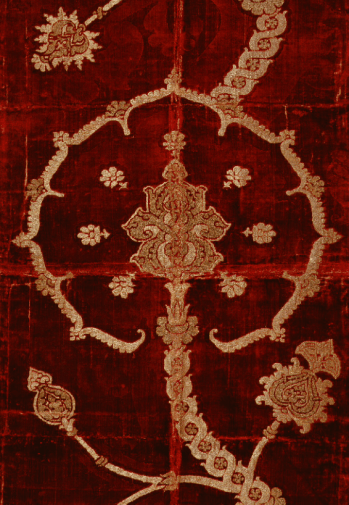
Length of velvet, 16th century, Spanish or Italian; pile on pile cut, voided, and brocaded velvet of silk and gold metallic thread with bouclé details (New York: The Metropolitan Museum of Art, 46.156.120).
Textiles, wall and furniture coverings played an important role in dressing interiors in the early modern period. From curtains to chairs, tables and beds, a variety of textiles were needed to protect, adorn, and transform rooms, homes, and palaces. They were an important part of the dwelling as they linked the interiors together and showcased the taste and material means of the owners. Different rooms served diverse purposes, from more public spaces such as waiting rooms, reception rooms, and ballrooms, to more private rooms such as the bedroom with its antechambers. In other households, rooms had multiple functions, and in many cases the distinctions between private and public spaces were more flexible. Textiles played an important role in distinguishing and modifying these spaces while giving a glimpse of the relationships that owners had with those interiors.
While extant textiles have been frequently altered to fit new purposes denoting both their durability and the costly aspects of this medium, ledgers provide further examples of repairs and replacements. On the other hand, inventories give a more accurate picture of the changes in fashion over time. Fashions played an important role in the dressing of interiors, from certain more desirable fabrics and colours being favoured over others, while also being altered according to seasons. This conference aims to generate a discussion about the use of various textiles in early modern interiors, focusing on their function, durability, colour, texture and pattern, and how they were made to fit a specific purpose and give meaning to every room.
The conference is organised by Jola Pellumbi and Sara van Dijk of Dressing the Early Modern Network and by Alexander Dencher of Leiden University and the Rijksmuseum.
Registration is available here»
p r o g r a m m e
10.00 Registration
10.30 Welcome
10:45 Session 1 | Interior and Experience
• Dangerous Liaisons Revisited: Drapery and Dress in 18th-Century French Interiors — Mei Mei Rado (Bard Graduate Center, New York)
• Tiny Textiles: Dressing the Interiors of 18th-Century English Baby Houses — Amy Craig (Cambridge University)
• 18th-Century Global Domesticity — Valeria Viola (University of Palermo)
12.15 Lunch Break
13.00 Session 2 | Objects’ Pasts and Futures
• Reduce, Reuse, Recycle ….Restore? A Case Study of Re-Using ‘Original’ Fabrics in the Collection of the Rijksmuseum — Marjolein Koek (Rijksmuseum, Amsterdam)
• Bed of White Satin with Silk Embroidery and Bobbin Made Silver Edgings — Lena Dahrén (affiliated with Uppsala University)
• Title to be confirmed — Alexander Dencher (Rijksmuseum, Amsterdam)
14.30 Coffee and Tea
15.00 Session 3 | Materials and Materiality
• Strong Weave, Soft Texture, Crisp White: The Unravelling of Fustian in Dutch Interiors in the Early 17th Century — Sara Wieman (University of Amsterdam)
• Re-Materialising Walls through Intermedial Design: Chinese Silk and Paper Wall Hangings in 18th-Century European Interiors — Erika Riccobon (Leiden University)
16.00 Keynote Lecture
• The Seemingly Original Interior — Anna Jolly (Abegg-Stiftung, Riggisberg)
16.45 Closing Remarks
New Book | The Jesuits: A History
From Princeton UP:
Markus Friedrich, The Jesuits: A History, translated by John Noël Dillon (Princeton: Princeton University Press, 2022), 872 pages, ISBN: 978-0691180120 (hardback), $40 / ISBN: 978-0691226200 (paperback), $28.
 The most comprehensive and up-to-date exploration of one of the most important religious orders in the modern world.
Since its founding by Ignatius of Loyola in 1540, the Society of Jesus—more commonly known as the Jesuits—has played a critical role in the events of modern history. From the Counter-Reformation to the ascent of Francis I as the first Jesuit pope, The Jesuits presents an intimate look at one of the most important religious orders not only in the Catholic Church, but also the world. Markus Friedrich describes an organization that has deftly walked a tightrope between sacred and secular involvement and experienced difficulties during changing times, all while shaping cultural developments from pastoral care and spirituality to art, education, and science.
Examining the Jesuits in the context of social, cultural, and world history, Friedrich sheds light on how the order shaped the culture of the Counter-Reformation and participated in the establishment of European empires, including missionary activity throughout Asia and in many parts of Africa in the sixteenth and seventeenth centuries. He also explores the place of Jesuits in the New World and addresses the issue of Jesuit slaveholders. The Jesuits often tangled with the Roman Curia and the pope, resulting in their suppression in 1773, but the order returned in 1814 to rise again to a powerful position of influence. Friedrich demonstrates that the Jesuit fathers were not a monolithic group and he considers the distinctive spiritual legacy inherited by Pope Francis. With its global scope and meticulous attention to archival sources and previous scholarship, The Jesuits illustrates the heterogeneous, varied, and contradictory perspectives of this famed religious organization.
Markus Friedrich is professor of early modern history at the University of Hamburg. His books include The Birth of the Archive. He lives in Hamburg, Germany.
C O N T E N T S
List of Illustrations
List of Abbreviations
Prologue: Ignatius Loyola Founds an Order
1 The Inner Life and Structure of the Society
2 The Society, the Churches, and the Faithful
3 Saeculum and the Kingdom of God: The The Jesuits ‘in the World’
4 The Global Society
5 A World without the Society of Jesus: Hostility, Suppression, Revival
Epilogue: The Modern Society
Acknowledgments
Afterword to the English Edition
Translator’s Note
Notes
Works Cited
Names Index
Subject Index
New Book | The Image of the Black in Latin American and Caribbean Art
From Harvard University Press:
David Bindman, Alejandro de la Fuente, and Henry Louis Gates, Jr., eds., The Image of the Black in Latin American and Caribbean Art, Book 1: From Colony to Nation (Cambridge, MA: Hutchins Center for African and African American Research, 2024), 400 pages, ISBN: 978-0674248861, £87 / €91 / $100.
 The Image of the Black in Latin American and Caribbean Art is the first comprehensive survey of the visual representation of people of African descent in Latin America and the Caribbean, some twelve million of whom were forcibly imported into the Americas during the transatlantic slave trade. This first volume spans four centuries, from the first Spanish occupation of Latin America and the Caribbean in the fifteenth century; through the establishment of slave colonies on the mainland and islands by the British, French, and Danish; to the revolutionary emergence of independence, first in Haiti in 1804, and then across Latin America. Essays by leading scholars and superb illustrations bring to light a remarkable range of imagery that provides vivid insights into the complex racial history of the period.
The two volumes complement the vision of Dominique and Jean de Menil, art patrons who, during the 1960s, founded an archive to collect images depicting the myriad ways that people of African descent have been represented in Western art from the ancient world to modern times. The Image of the Black in Latin American and Caribbean Art continues the de Menil family’s original mission and brings to the fore a renewed focus on a rich and understudied area.
David Bindman is Professor of the History of Art, Emeritus, at University College London.
Alejandro de la Fuente is Robert Woods Bliss Professor of Latin American History and Economics, and Professor of African and African American Studies and History, at Harvard University.
Henry Louis Gates, Jr., is the author of numerous books and has written extensively on the history of race and anti-Black racism in the Enlightenment. His most recent works include Stony the Road and The Black Church. He is the Alphonse Fletcher University Professor and Director of the Hutchins Center for African and African American Research at Harvard University.










 Enfilade
leave a comment