Call for Applications | Getty Residential Scholars: Extinction
From ArtHist.net:
Getty Residential Scholars: Extinction
Getty Research Institute, Los Angeles, 2023–24
Applications due by 2 October 2023
The Getty Research Institute is pleased to announce the theme for residential grants and fellowships for pre-docs, post-docs, and scholars at the Getty Center and Villa for the 2024/25 academic year. Applications will open on 1 July 2023 and are due by 2 October 2023.
In this moment of extreme environmental decay and monumental epidemic loss, the Getty Scholars Program invites applications on the pressing topic of extinction and its bearing on the visual arts and cultural heritage. Scholars are asked to contemplate how representational practices are deployed to cope with the precarious survival of plants, animals, and humans; the ever-present specter of species-level extinction and resource exhaustion; and, at the most extreme pole, the brutality of mass atrocity. On another level, atrophy, decay, and obsolescence constitute the temporal dimensions of certain artistic practices, especially as creative approaches, technologies, media, formats, and ideals become outmoded or superseded. The finality of disappearance may also portend a certain amount of hope for rebirth, innovation, or recovery. We invite proposals on these topics from art historians and those from related to disciplines. Please find the full call for applications and theme text on the Scholars Program webpage.
Applicants need to complete and submit the online Getty Scholar Grant application form by the deadline, which requires the following attachments:
• Project Proposal (not to exceed five pages, typed and double-spaced), which must include a description of the applicant’s proposed plan of study. The description should indicate 1) how the project addresses the annual theme and 2) how it would benefit from the resources at the Getty, including its library and collections. Applicants for the AAAHI Fellowship are not required to address the annual theme. Rather, they should describe how their projects will generate new knowledge in the field of African American art history.
• Curriculum Vitae
• Optional Writing Sample
Applicants will be notified of their application outcome approximately six months after the deadline.
Contact
researchgrants@getty.edu
Attn: Getty Scholar Grants
Call for Papers | Materialising Loss: Absence and Remaking

From CIHA, whose 2024 conference is organized around the theme ‘Matter Materiality’:
Materialising Loss: Absence and Remaking in Art History
36th Congrès du Comité International d’Histoire de l’Art (CIHA), Lyon, 23–28 June 2024
Chaired by Francesca Borgo and Felicity Bodenstein
Proposals due by 15 September 2023
Paper proposals are currently invited for the session “Materialising Loss: Absence and Remaking in Art History” at the 36th Congrès du Comité International d’Histoire de l’Art (CIHA) in Lyon, 23–28 June 2024, co-chaired by Francesca Borgo (University of St Andrews/ Bibliotheca Hertziana) and Felicity Bodenstein (Université Sorbonne).
The material turn in art history has reinstated a sensibility for the ‘thingness’ of things (Brown, 2001), the properties of their constitutive materials (Ingold, 2007), and the activity of their matter (Miller & Poh, 2022; Latour 1991; Gell 1998; Bennett, 2010). More recently still, interest has extended beyond making and materials: processes of unmaking, deterioration, care, and preservation have become subjects of investigation, accompanied by growing critical engagement with conservation (Fowler, 2019; Fowler & Nagel, 2023) and increasing attention to the behaviour of matter across the deep time of geological history (Borgo & Venturi, CIHA 2019).
But what happens when—despite all our best efforts to conserve, protect, and make last—things disappear? Taking this question as its starting point, we invite papers that reconsider matter and materiality from an unusual point of view: the object’s loss or inaccessibility and the practices undertaken to compensate for its absence, via physical replicas or virtual reconstructions. In centring itself on what has long been considered an epistemological endpoint in art historical studies—the disappearance of the original object—the session proposes a critical assessment of material and virtual remaking as site of art-historical knowledge. It asks how we might integrate that knowledge into the analytical methods of art history.
Looking at materiality from the seemingly paradoxical standpoint of absence reveals how much material studies takes for granted in terms of the object’s presence, permanence, and accessibility. Loss forcefully confronts us with the enabling operations and grounding conditions that go into writing material art history. It permeates everything we do, and yet it is distinctively undertheorized (Fricke & Kumler, 2022). What are the stakes of absence and reclamation? How does loss help us rethink the relationship between matter and form beyond the hylomorphic model? How do art historians deal with missing evidence, and how does its resurfacing or remaking change the canon and the narrative? Whose loss is worth talking about and why?
The threats of war, climate change and mass tourism give these questions a pressing relevance today, amplified by debates over sustainability, inclusion, and property rights. But art history seems sceptical of efforts to work against these risks: despite recent calls for ‘militant reproductions’ (Bredekamp, 2016), campaigns to widen the notion of originality (Lowe & Latour, 2010) and emphasize the seriality of the Classic (Settis & Anguissola, 2015), and appeals to the greater inclusivity of digital heritage (Terras, 2022; Michel, 2016), much of the discipline remains ambivalent about the remade, regarding it as ludic and nostalgic.
We live in a world in which heritage is constantly de- and re-materialised, formed and reformed in an unprecedented interplay between the material, immaterial, and neomaterial. And although the implications for objects and their histories are manifold, they remain largely unexplored. This session aims at remedying that imbalance, reflecting on the impact of physical loss on material art history and examining the value of remaking as historical method. In the interests of crafting a more inclusive narrative of loss and remaking and of fostering exchange between scholars from different geographical and professional backgrounds, we especially welcome papers offering global perspectives.
Proposals are due 15 September 2023 and must be submitted via the CIHA platform. Instructions on how to submit your proposal can be found here.
London Art Week, Summer 2023
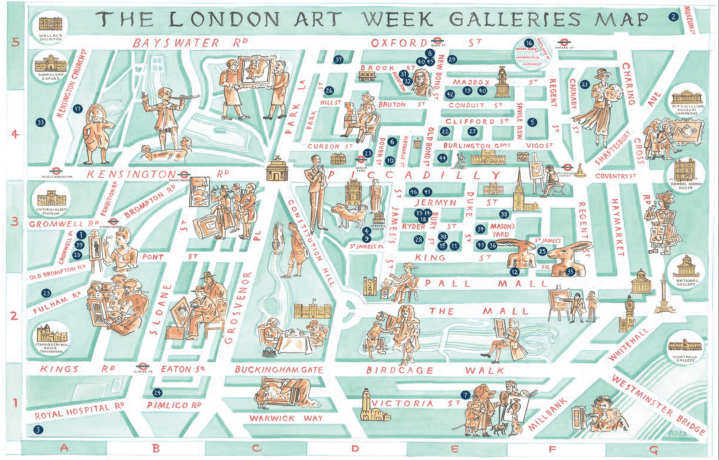
The London Art Week Galleries Map, drawn by Adam Gant; the map with a key to exhibitors is available here.
◊ ◊ ◊ ◊ ◊
From the art fair’s website:
London Art Week, Summer 2023
30 June — 7 July 2023
The UK’s leading fine arts selling event is held both in galleries around central London and as exhibitions online. This summer it features 53 participants, all internationally-acknowledged specialists in their chosen fields. Expert dealers offer museum-quality examples of decorative arts, paintings, sculpture, and works on paper of all periods from antiquity to contemporary, as well as—for the first time this year—rare books, maps, and manuscripts. The week coincides with the summer series of Old Master and Classic auctions held by Christie’s, Bonhams, and Sotheby’s. LAW provides a happy art-filled opportunity to explore the city’s major gallery areas such as St. James’s, Mayfair, and South Kensington, whilst browsing, admiring, and learning about works from antiquity to the present day. All works on show are for sale. Soak up the unique flavour of each locality and individual gallery, whilst enjoying unparalelled access to works of museum calibre as well as entry-level examples and rediscovered masters.
◊ ◊ ◊ ◊ ◊
A selection of gallery offerings:
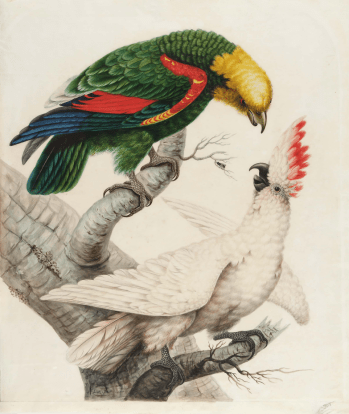
Sarah Stone, Yellow-Headed Amazon Parrot (Amazona ochrocephala oratrix) with Hybrid Cockatoo, 1801, 45 × 37 cm.
Sarah Stone’s Unseen World: A Rare Collection of 18th-Century Ornithological Watercolours
Finch & Co
The exhibition presents 23 watercolours by the trailblazing 18th-century artist Sarah Stone, accompanied by a new book on the artist. Written by Errol Fuller and Craig Finch, the publication will be the first major work on Stone since Christine Jackson’s 1999 book Sarah Stone: Natural Curiosities from the New Worlds. Although long highly acclaimed for their historical and artistic importance, Sarah Stone’s paintings in private hands are rare, and this important collection has only recently come to light. Stone might be compared to her contemporary Mary Anning, the woman from Lyme Regis who kick-started the science of palaeontology. Like the activities of Anning, Sarah Stone’s work proved to be of enormous historical and scientific value.
European and British Paintings, Watercolours, and Drawings, 1780–1860
James Mackinnon
Works include portrait drawings made in Italy by Jean-Baptiste Wicar, whose remarkable career encompassed fame as a neo-classical painter, collector, and dealer in Italian master paintings and drawings by Michelangelo and Raphael among others. After 1896, Wicar served as Napoleon’s Commissioner for Science and Arts in Italy.
Travel, 1600–1900
Nonesuch Gallery
We are pleased to present this second iteration of our catalogues on the theme of travel, accompanied by an exhibition coinciding with London Art Week. The Nonesuch Gallery was set up by Tom Mendel in 2020 to provide high-quality, fully researched and above all interesting pictures to established collectors, institutional collections, and first-time buyers. The gallery specialises in works on paper from the 16th to 19th centuries; with a focus on landscape and topographical subjects, particularly as related to the Grand Tour.
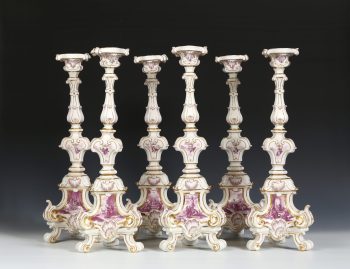
Giovanni Caselli and Gaetano Fumo, Set of Six Altar Candlesticks 1745–52, soft-paste porcelain, each about 50 cm high, fleur-de-lys marks in blue, £85,000.
A Survey of European Ceramics, 1500–1800
E&H Manners
Established in 1986 when Errol and Henriette left Christie’s after working in the Chinese and European ceramic departments. Henry joined in 2015. We deal in ceramics, glass and enamels of the world from the Middle Ages to the 20th century. We focus on European pottery and porcelain of the 17th and 18th century and East Asian, Middle-Eastern and Mexican colonial period wares and ceramics of the Arts and Crafts and Modern Movement. We take pride in the quality and rarity of the pieces that we offer, many of which are now in the great museums and collections of the world.
The Chinese Export Interior
Thomas Coulborn & Sons (digital participant)
Thomas Coulborn & Sons has a reputation for producing eclectic collections of exceptional furniture and works of art. The stock is centred by superb examples of English furniture and works of art ranging from the Tudor period through to Regency, interwoven with stellar items from the Continent. Jonathan Coulborn has a particular interest in objects which reflect the historic intersection of cultures and design. In recent years we have become one of the world’s leading dealers in Chinese export furniture.
Face to Face: Portraits Spanning Five Centuries
Moretti Fine Art
The Galleria Moretti was founded in 1999 in Florence by Fabrizio Moretti. It opened to the public and private collectors with the inaugural exhibition From Bernardo Daddi to Giorgio Vasari and immediately distinguished itself with its specialization in Italian old masters paintings. Moretti Fine Art opened in London in 2005 and it became a point of reference for collectors who seek a confidential and discreet approach. In 2022, the gallery moved in the new building in Duke Street, St. James’s.
◊ ◊ ◊ ◊ ◊
A sampling of particular works on offer:
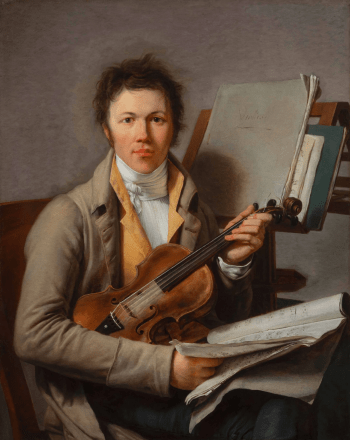
Attributed to Jacques Antoine Marie Lemoine, Portrait of the Violinist Jacques Pierre J. Rode, ca. 1810, oil on canvas, 92 × 72 cm.
• Antonio Gionima, Mucius Scaevola before Lars Porsenna, ca. 1720–25, oil on canvas, 156 × 198 cm. Offered by Fondantica di Tiziana Sassoli (digital participant) as part of a selection of Emilian Old Master paintings.
• Thomas Bardwell, Portrait of Henry Herbert, 10th Earl of Pembroke, 1757, oil on canvas, 137 × 168 cm. Offered by Lowell Libson & Jonny Yarker Ltd.
• Paul Sandby, Capriccio Landscape, 1792, pencil and watercolour. Offered by Abbott & Holder, the drawing once belonged to King Willam IV (and then to his illegitimate son, Lord Frederick Fitzclarence).
• Attributed to Jacques Antoine Marie Lemoine, Portrait of the Violinist Jacques Pierre J. Rode, ca. 1810, oil on canvas, 92 × 72 cm. Offered by Maurizio Nobile Fine Art (digital participant).
U of Buckingham | MA in French and British Decorative Arts
From the University of Buckingham:
MA in French and British Decorative Arts and Historic Interiors
University of Buckingham (study based in London), starting September 2023
Bursary applications due by 10 July 2023
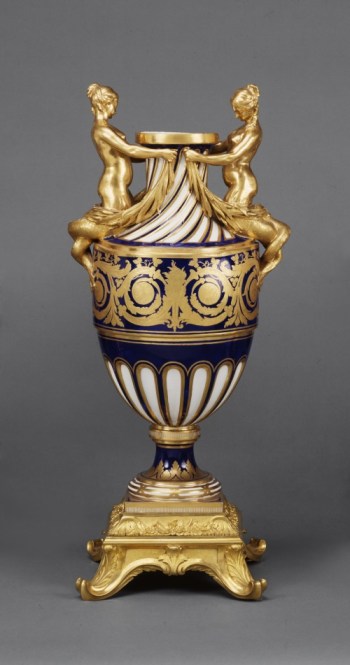
Vase ‘sirènes’, Manufacture de Sèvres, probably Josse-François-Joseph Le Riche, designer; Etienne-Henry Le Guay, the Elder, gilder, ca. 1776, soft-paste porcelain, gilded, 49 cm high (London: The Wallace Collection, C333).
Applications are invited for a bursary on the University of Buckingham’s MA in Decorative Arts and Historic Interiors starting September 2023. Generously funded by The Leche Trust, the award is worth £7,500 and will contribute towards course fees. The deadline for bursary applications is Monday, 10 July, 4pm UK time.
This unique MA in French and British Decorative Arts and Interiors, taught in collaboration with the curatorial and conservation teams at the Wallace Collection, focuses on the development of interiors and decorative arts in England and France in the ‘long’ eighteenth century (c.1660–c.1830) and their subsequent rediscovery and reinterpretation in the nineteenth and twentieth centuries. A key element of the course is the emphasis on the first-hand study of furniture, silver, and ceramics, where possible in the context of historic interiors. Based in central London, it draws upon the outstanding collections of the nearby Wallace Collection and the Victoria and Albert Museum as well as the expertise of leading specialists who participate in the teaching.
Bursary priority will be given to applicants:
• with excellent academic qualifications, seeking, or currently pursuing careers in museums, the built heritage or conservation,
• in need of financial assistance,
• have a strong interest in the decorative arts and historic buildings,
• or, for those wishing to go on to pursue academic research in the decorative arts and historic interiors.
The bursary is also open to part-time students commencing their studies in 2023 for whom the funding would be spread over two years. To be eligible for the bursary, students will need to have applied for and been offered a place on the course.
Call for Articles | Queerness in 18th- and 19th-C. European Art
From Arts:
Queerness in 18th- and 19th-Century European Art
Special Issue of Arts, edited by Andrew Shelton
Proposals due by 15 August 2023; final manuscripts due by 30 November 2023
A special issue of the international, peer-reviewed, open-access journal Arts dedicated to Queerness in 18th- and 19th-Century European Art and edited by Andrew Carrington Shelton (Department of History of Art, The Ohio State University) seeks essays on a wide variety of topics that subvert or disrupt heteronormative interpretations of the art and visual culture of this period. Topics to be addressed include, but are not limited to:
• Works of art produced by or under the auspices of personages who can plausibly be identified as attracted to members of the same sex
• Works or creative situations that can be construed as expressing or eliciting same-sex sexual desire or attraction
• Works or creative situations in which the heteronormative polarity of the processes of identification and desire can be perceived as having been collapsed or scrambled
• Works or creative situations that involve gender-bending or gender fluidity
• Works or creative situations that either deepen or complicate our understanding of sexuality and/or sexual identity
• Works that eroticize individuals or situations that are normally regarded as lying outside the realm of the erotic
Interested scholars should send an abstract (maximum 250 words) and CV to shelton.85@osu.edu, copying sylvia.hao@mdpi.com, by 15 August 2023. Final manuscripts must be submitted for blind peer-review no later than 30 November 2023. Due to journal restrictions, all articles must be submitted in English. Questions or concerns can be addressed to shelton.85@osu.edu or sylvia.hao@mdpi.com. More information is available here.
Exhibition | Object Lessons in American Art
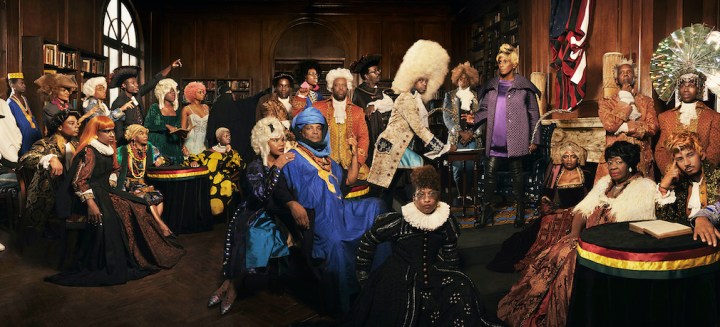
Renee Cox, The Signing, 2018, inkjet print, 122 × 213 cm
(Princeton University Art Museum)
◊ ◊ ◊ ◊ ◊
From Princeton University Art Museum:
Object Lessons in American Art: Selections from the Princeton University Art Museum
Georgia Museum of Art, University of Georgia, Athens, 4 February — 14 May 14 2023
Florence Griswold Museum, Old Lyme, Connecticut, 3 June — 10 September 2023
Speed Art Museum, Louisville, 29 September 2023 — 7 January 2024
Curated by Karl Kusserow

Henry Inman, O-Chee-Na-Shink-Ka a, 1832–33, oil on canvas, 78 × 645 cm (Promised gift from a Private Collection, member of Class of 1982).
Object Lessons in American Art features four centuries of works from the Princeton University Art Museum that collectively explore American history, culture, and society. Inspired by the concept of the object lesson—the study of a material thing to communicate a larger idea—the exhibition brings groups of objects together to ask fundamental questions about artistic significance, materials, and how meaning changes across time and contexts. With a focus on race, gender, and the environment, these pairings demonstrate the value of juxtaposing diverse objects to generate new understanding. Object Lessons presents Euro-American, Native American, and African American art from contemporary perspectives, illustrating how fresh investigations can inform and enrich its meaning, affording new insights into the American past and present. Curated by Karl Kusserow, John Wilmerding Curator of American Art.
Karl Kusserow, ed., with contributions by: Horace Ballard , Kirsten Pai Buick , Ellery Foutch , Karl Kusserow , Jeffrey Richmond-Moll, and Rebecca Zorach, Object Lessons in American Art (Princeton: Princeton University Press, 2023), 200 pages, ISBN: 978-0691978857, £35 / $40.
Object Lessons in American Art explores a diverse gathering of Euro-American, Native American, and African American art from a range of contemporary perspectives, illustrating how innovative analysis of historical art can inform, enhance, and afford new relevance to artifacts of the American past. The book is grounded in the understanding that the meanings of objects change over time, in different contexts, and as a consequence of the ways in which they are considered. Inspired by the concept of the object lesson, the study of a material thing or group of things in juxtaposition to convey embodied and underlying ideas, Object Lessons in American Art examines a broad range of art from Princeton University’s venerable collections as well as contemporary works that imaginatively appropriate and reframe their subjects and style, situating them within current social, cultural, and artistic debates on race, gender, the environment, and more.
C O N T E N T S
Foreword
Preface and Acknowledgments
• Introduction — Lenticular: Subject and Object in American Art — Karl Kusserow
• ‘Race’ as Object Lesson: Objects of Rebellion — Kirsten Pai Buick
• Looking Back and Looking Forward: A Feminist Lens on a Collection of American Art — Ellery E. Foutch
• Oblique Assemblies: Toward Queer Ecologies in American Art — Horace D. Ballard
• Intimations of Ecology: Varieties of Environmental Experience in American Art — Karl Kusserow
• Material Echoes, Traumatic Histories, and Liquid Transformations: The Romance of the Sea in American Art — Rebecca Zorach
• Learning from Object Lessons: Toward a Curatorial Pedagogy of Unfixing and Defamiliarizing the Past — Jeffrey Richmond-Moll
Contributors
Index
Photography Credits
Exhibition | Peter Brathwaite: Rediscovering Black Portraiture
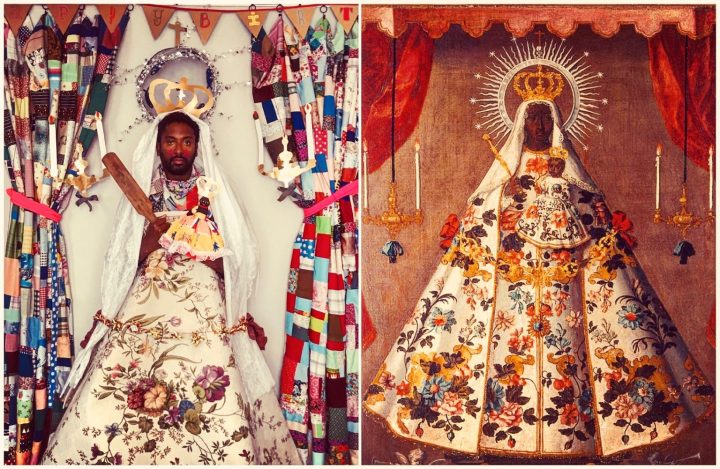
Left: Peter Brathwaite’s restaged version of The Virgin of Guadalupe. Right: Unknown painter, The Virgin of Guadalupe, oil painting, 1745 (London: Wellcome Collection), cropped from original and colour saturated.
◊ ◊ ◊ ◊ ◊
From the Bristol Museum & Art Gallery:
Peter Brathwaite: Rediscovering Black Portraiture
King’s College London, Strand Campus, October 2021 — February 2022
Bristol Museum & Art Gallery, 14 April — 3 September 2023
During the first lockdown in 2020, with all his performances cancelled, baritone, artist, broadcaster, and writer Peter Brathwaite began researching and reimagining more than 100 artworks. These artworks featured portraits of Black sitters, as part of the online #GettyMuseumChallenge to use household objects to restage famous paintings. He called the photographic series Rediscovering Black Portraiture. Alongside this project he also intensified his research into his dual heritage Barbadian roots, uncovering a wealth of detail about his enslaved and enslaver ancestors and their history, including an uprising of enslaved people in 1816 and songs of resistance they sang. Three years on, with a London exhibition behind him and a book out with Getty Publications, Peter Brathwaite brings his whole practice to the history of Georgian House Museum and the collections of Bristol Museum & Art Gallery. New interventions and sound installations reveal the Black presence hidden at the heart of our spaces and objects. The exhibition opened to coincide with the anniversary of the Barbados insurrection, 14 April 1816.
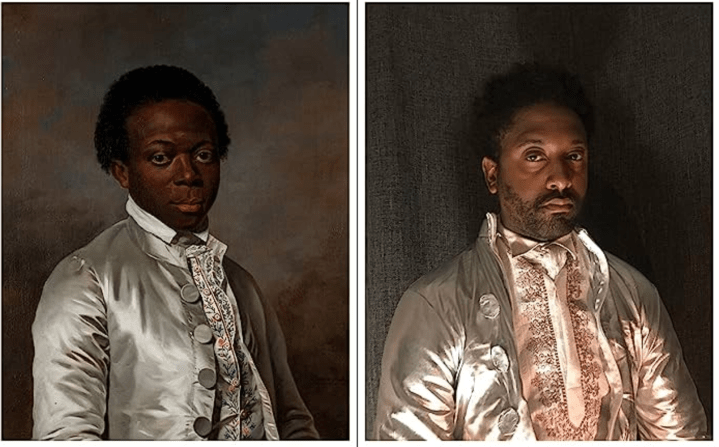
Left: Marie-Victoire Lemoine, Portrait of a Youth in Embroidered Vest, 1785, oil on canvas, 68 × 50 cm (Jacksonville, Florida: Cummer Museum of Art & Gardens). Right: Peter Brathwaite’s restaged version of a Youth in Embroidered Vest.
◊ ◊ ◊ ◊ ◊
From The Getty:
Peter Brathwaite, with contributions by Cheryl Finley, Temi Odumosu, and Mark Sealy, Rediscovering Black Portraiture (Los Angeles, Getty Publications, 2023), 168 pages, ISBN: 978-1606068168, $40.
 Join Peter Brathwaite on an extraordinary journey through representations of Black subjects in Western art, from medieval Europe through the present day. Since the beginning of the COVID-19 pandemic, Peter Brathwaite has thoughtfully researched and reimagined more than one hundred artworks featuring portraits of Black sitters—all posted to social media with the caption “Rediscovering #blackportraiture through #gettymuseumchallenge.”
Rediscovering Black Portraiture collects more than fifty of Brathwaite’s most intriguing re-creations. Introduced by the author and framed by contributions from experts in art history and visual culture, this fascinating book offers a nuanced look at the complexities and challenges of building identity within the African diaspora and how such forces have informed Black portraits over time. Artworks featured include The Adoration of the Magi by Georges Trubert, Portrait of an Unknown Man by Jan Mostaert, Rice n Peas by Sonia Boyce, Barack Obama by Kehinde Wiley, and many more. This volume also invites readers behind the scenes, offering a glimpse of the elegant artifice of Brathwaite’s props, setup, and process. An urgent and compelling exploration of embodiment, representation, and agency, Rediscovering Black Portraiture serves to remind us that Black subjects have been portrayed in art for nearly a millennium and that their stories demand to be told.
Peter Brathwaite is an acclaimed baritone who performs in operas and concerts throughout Europe. He is a presenter on BBC Radio 3 and has been shortlisted for a Royal Philharmonic Society Award. Cheryl Finley is inaugural distinguished visiting director of the Atlanta University Center Art History and Curatorial Studies Collective and the author of Committed to Memory: The Art of the Slave Ship Icon (2018). Temi Odumosu is an art historian, curator, and assistant professor at University of Washington Information School and the author of Africans in English Caricature 1769–1819: Black Jokes, White Humour (2017). Mark Sealy is director of Autograph and professor of photography, race, and human rights at University of the Arts London. His numerous publications include Different (2001), coauthored with Stuart Hall; Decolonising the Camera: Photography in Racial Time (2019); and Photography: Race, Rights, and Representation (2022).
New Book | The Nation That Never Was
From The University of Chicago Press:
Kermit Roosevelt, The Nation That Never Was: Reconstructing America’s Story (Chicago: The University of Chicago Press, 2022), 256 pages, ISBN: 978-0226817613, $25.
 Our idea of the Founders’ America and its values is not true. We are not the heirs of the Founders, but we can be the heirs of Reconstruction and its vision for equality.
There’s a common story we tell about America: that our fundamental values as a country were stated in the Declaration of Independence, fought for in the Revolution, and made law in the Constitution. But, with the country increasingly divided, this story isn’t working for us anymore—what’s more, it’s not even true. As Kermit Roosevelt argues in this eye-opening reinterpretation of the American story, our fundamental values, particularly equality, are not part of the vision of the Founders. Instead, they were stated in Lincoln’s Gettysburg Address and were the hope of Reconstruction, when it was possible to envision the emergence of the nation committed to liberty and equality.
We face a dilemma these days. We want to be honest about our history and the racism and oppression that Americans have both inflicted and endured. But we want to be proud of our country, too. In The Nation That Never Was, Roosevelt shows how we can do both those things by realizing we’re not the country we thought we were. Reconstruction, Roosevelt argues, was not a fulfillment of the ideals of the Founding but rather a repudiation: we modern Americans are not the heirs of the Founders but of the people who overthrew and destroyed that political order. This alternate understanding of American identity opens the door to a new understanding of ourselves and our story, and ultimately to a better America.
America today is not the Founders’ America, but it can be Lincoln’s America. Roosevelt offers a powerful and inspirational rethinking of our country’s history and uncovers a shared past that we can be proud to claim and use as a foundation to work toward a country that fully embodies equality for all.
Kermit Roosevelt III is a professor of constitutional law at the University of Pennsylvania Law School. A former law clerk to Supreme Court Justice David Souter, he is the author of The Myth of Judicial Activism, as well as two novels, Allegiance and In the Shadow of the Law.
C O N T E N T S
Introduction
1 Stories of America
2 Questioning the Standard Story: Dissenters
3 The Exclusive Declaration
4 The Ambiguous Revolution
5 The Geostrategic Constitution
6 The Story of Continuity
7 The March of the Declaration
8 Why We Tell the Standard Story
9 Why We Shouldn’t Tell the Standard Story
10 Magic Tricks and Revolutions
11 Why, How, and Who We Are
12 Redemption Songs: Inclusive Equality and Exclusive Individualism in Modern America
13 The Better Story
Bibliographical Essay
Acknowledgments
Notes
At Bonhams | Old Master Paintings

Lot 80: J.M.W. Turner, East Cliff Lodge, Ramsgate, the Seat of Lord Keith, 1796–97, pencil and watercolour. 31 × 41 cm.
Estimate: £30,000–50,000.
◊ ◊ ◊ ◊ ◊
Press release, via Art Daily, for Turner’s View of East Cliff Lodge, included in the July 5 sale at Bonhams:
Old Master Paintings
Bonhams, London, 5 July 2023
An early architectural watercolour, East Cliff Lodge, Ramsgate, the Seat of Lord Keith, by J.M.W. Turner (1775–1851) is to be offered at Bonhams Old Master Paintings sale in London on Wednesday 5 July 2023 (Lot 80). It is estimated at £30,000–50,000.
Bonhams Director of Old Master Paintings, Caroline Oliphant, said: “East Cliffe Lodge dates from 1796–97 when the artist was in his early 20s and is one of several architectural watercolours Turner executed around this time. Topographical commissions were a good and dependable way of earning a living for young aspiring painters but, this being Turner, the results are, of course, rather special.”
East Cliff Lodge was designed in the gothic revival style by Charles Boncey and completed by 1794. Early owners included George Elphinstone, 1st Viscount Keith (1764–1823), a Scottish-born naval officer who served in the American Revolutionary and Napoleonic Wars. He was Commander in Chief of the North Sea Squadron while living at Cliff Lodge; the house gave him an excellent view of the Downs anchorage.
In 1831, East Cliff was acquired by Moses Haim Montefiore (1784–1885), a British financier, banker, activist, and philanthropist. Sheriff of London, Fellow of the Royal Society, President of the Board of Deputies of British Jews, and a key figure in British Jewish history. He was knighted in 1837. Moses and his wife Judith spent their honeymoon in Ramsgate, fell in love with the area, and rented East Cliff Lodge for some years before buying it. Montefiore built a private synagogue in the grounds of East Cliff and, following his wife’s death in 1862, commissioned a mausoleum where they both now lie. On nearby land he founded the Judith Montefiore College. Most of the house was demolished in 1954, but the synagogue, mausoleum, and college remain.
At Auction | ‘Charles Monro’s House at Finchley’ by Turner

Lot 2143: J.M.W. Turner, Charles Monro’s House at Finchley, 1793–94, 22 × 29 cm
(Estimate: £30,000–50,000)
◊ ◊ ◊ ◊ ◊
From the press release (via Art Daily) for the sale:
Fine Art and Silver
Ewbank’s, Surrey, 22 June 2023
An early watercolour by J.M.W. Turner, consigned by the descendants of the patron for whom it was painted, comes to auction at Ewbank’s in Surrey on 22 June 2023 (Lot 2143: estimated at £30,000–50,000). Charles Monro’s House at Finchley (1793–94) is a signed corner view of an imposing mansion set among trees. It depicts the home of the brother of Turner’s patron Dr. Thomas Monro (1759–1833), a serious collector who also supported Peter De Wint, Thomas Girtin, and John Sell Cotman, among others, and established an academy and what became known as ‘The Monro Circle’ of artists. Dr. Monro rose to prominence, not just as a patron and art collector, but also as one-time consulting physician to King George III.
The painting, whose subject was the home of Dr. Monro’s elder brother Charles, passed to Charles’s son and namesake, before descending through the family to the current day. It was exhibited at the Royal Academy in 1887 and in the Monro Academy Exhibition at the Victoria & Albert Museum in 1976. The house is identified by a signed inscription to the reverse of the artwork by his son, the younger Charles, reading: “Original drawing of my father’s House Nether Street Finchley made for him about the year 1793 or 4. Charles Monro.” The reverse of the frame bears an inscription by Robert W. Monro, nephew of the younger Charles Monro and the son of Thomas Monro, dated 23rd July 1874 and alluding to the main inscription by Charles Monro to the reverse.
Partner Andrew Ewbank said: “This is a delightful painting packed with detail and character, as well as demonstrating considerable draughtsmanship. Turner would have been about 18 when he painted it, and his assured hand in its composition makes this an important historical document in the story of the artist, as its inclusion in distinguished public exhibitions has shown.”










 Enfilade
leave a comment