New Installation | Joana Vasconcelos’s Wedding Cake at Waddesdon
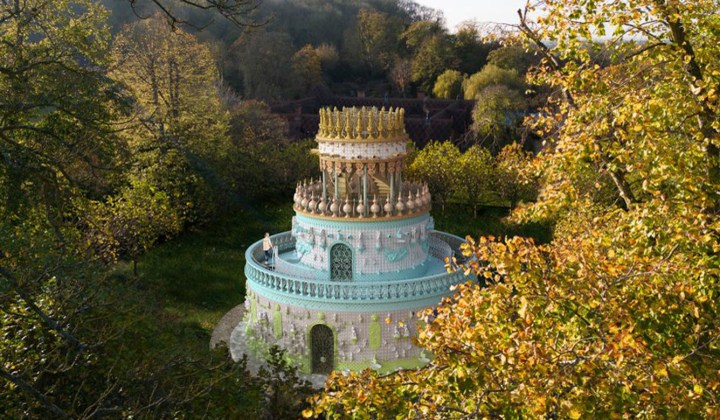
Joana Vasconcelos, Wedding Cake, at Waddesdon Manor in Aylesbury, installed 2023.
◊ ◊ ◊ ◊ ◊
From the press release for the new installation at Waddesdon:
Joana Vasconcelos: Wedding Cake at Waddesdon
The Dairy at Waddesdon Manor, open from 8 June 2023, with tours available until 26 October
Wedding Cake—a 12-metre-high sculptural pavilion in the form of a three-tiered wedding cake, clad entirely in ceramic tiles—is a major new work at Waddesdon by celebrated Portuguese artist Joana Vasconcelos (b. 1971). Almost five years in the making, Wedding Cake was commissioned by the Rothschild Foundation for Waddesdon, prompted by the relationship between visionary collector Lord Rothschild and Vasconcelos.
Part sculpture, part architectural garden folly, Wedding Cake is an extraordinary, enormous, fully immersive sculpture that combines pâtisserie and architecture. Gleaming and icing-like outside and in, it offers an intricate and richly sensory experience—glazed in pale pinks, greens, and blues, beset with sculptural ornament, and complete with the sounds of trickling water and a site-specific lighting scheme. Wedding Cake is Vasconcelos’s most ambitious commission to date, described by the artist as “a temple to love” celebrating festivity and marriage.
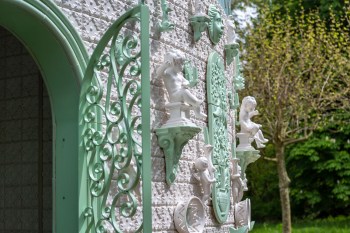
Joana Vasconcelos, Wedding Cake, at Waddesdon, detail of the ground level.
The history of the wedding cake is long and varied, full of symbolism and tradition—from ancient Rome where bread was broken over the bride’s head to bring good fortune to the couple, to contemporary confections that embody celebration and social status. Vasconcelos’s Wedding Cake is a playful addition to this rich history. Inspired by the exuberant Baroque buildings and highly decorative ceramic traditions of Lisbon—where Vasconcelos lives and works—the work is also a contemporary response to the great Rothschild traditions of hospitality with echoes of 18th-century garden pavilions.
At Waddesdon Wedding Cake will stand in a grove of trees alongside the 19th-century Dairy, built by Baron Ferdinand de Rothschild to entertain and charm guests at his famous house parties, and described by contemporaries as “a treasure house of what is beautiful, curious, or ancient.” It reminds us of the long European history of placing fanciful buildings in gardens and landscapes and forms part of a growing collection of significant contemporary and historic sculpture, brought together by Lord Rothschild. Today, the Dairy is still a much sought-after entertaining space, and the presence of the Wedding Cake, a symbol of love and happiness, is a perfect complement.
Wedding Cake is emblematic of Vasconcelos’s practice. She is deeply influenced by the artistic traditions of her home country, and the way in which she combines her materials reflects international influences on Portuguese culture over centuries—born from a history of exploring and seafaring, from Chinese and Japanese ceramics to Brazilian carnival, incorporating colour and light. Her work is often playful, manipulating scale to dramatic effect and using familiar daily objects in surprising, charming, and inventive ways. On a deeper level, her work explores notions of domesticity, femininity, empowerment, and the tension between private and public realms.
Vasconcelos’s work often challenges the assumptions of traditional hierarchies of ‘noble’ materials, such as marble, used frequently to embellish grand structures and often set above more everyday substances like ceramics and textiles. Her practice champions traditional, hand-made objects and techniques, and the ceramics for Wedding Cake have been made by the Viúva Lamego manufactory, which has been operating in Sintra for 170 years. The company’s standard 14×14cm tiles determined the size of the overall structure of Wedding Cake, whose 11m diameter is the smallest circle that can be made with whole tiles.
At Waddesdon, this combination of materials and the exploration of scale and technique is a perfect fit. The house is famous for its ceramics, particularly Sèvres and Meissen porcelain. The fashions and traditions of 18th- and 19th-century dining, entertaining, and festivity are also deeply embedded in the collections, whether a silver dinner service made for King George III, an 18th-century book recording the festivities laid on to mark a royal wedding, or a manual illustrating sugar sculpture. The sumptuous decoration of the Wedding Cake also speaks to the architecture of the house, itself covered in ornament and designed to complement the collections inside and the carefully laid out garden and landscape. These include the fanciful buildings in Waddesdon’s grounds like the Dairy, Flint House, and the Aviary, all intended to surprise and delight visitors.
According to Joana Vasconcelos, “An enormous project such as this one could only happen with the vision and encouragement provided by a generous and extraordinary patron such as Lord Rothschild. He could see its dreamlike potential, believe in it, and provide the means to make it come true. I have been addressing the subject of love through my career for almost 30 years now, but this is my biggest challenge so far. Many artists have the ‘impossible project’ and this is mine. I wanted people to have three different approaches to it: looking from the outside, enjoying the surroundings from the different levels or balconies, and rising to the top, finally completing the artwork with their presence. Above all, I always thought of it as a temple to love.”
Lord Rothschild says, “We are delighted to be collaborating again with Joana Vasconcelos, whose work is already magnificently represented at Waddesdon by her giant candlesticks, Lafite. The vision, imagination, and ambition exemplified in the Wedding Cake is a perfect match for the passion which drove Baron Ferdinand, the creator of Waddesdon, to build the Manor and the Dairy, where he intended that his many friends would be surprised and delighted at every turn. I am sure that the Wedding Cake will have just as great an impact on visitors and wedding guests today.”
Pippa Shirley, Director of Waddesdon says, “Waddesdon was built to entertain; so, what better way to mark the continuity today of that spirit of hospitality, artistic creativity, and Rothschild family patronage than through the commission of this magical object, an emblem of love and celebration. Projects like this require a leap of faith from both artist and patron, and we are proud to have been a partner in this innovative work.”
Recipe for Wedding Cake
• 1 creative artist
• 1 visionary patron
• 2 international teams
• Pinch of experts
• 3500 wrought iron parts
• 21,815kg iron sheet
• Approximately 25,150 Viúva Lamego ceramic tiles (99 different types) and 1,238 Viúva Lamego ceramic pieces (52 different types). Ceramic tile area: 365 m2
• Plethora of ornaments — mermaids, dolphins, candles, globes, etc
• Indoor and outdoor lights — 350 glass flames receiving optical fiber (about 3,000 meters)
• 592 light points
• Rivers of glaze
• Sprinklings of water
• Hope, belief, and effort
Blend the circa 50 tons with generous amounts of creativity and patience. Bind into different panels; raise tier by tier to height of 12 meters. Assemble at Waddesdon. Serve with love.
Joana Vasconcelos’s Lafite, two giant candlesticks made of illuminated Chateau Lafite Rothschild magnums (commissioned in 2015 by the Rothschild Foundation in celebration of the family associations with the world of great Bordeaux wine), will be moving to the Dairy. In 2012, her Pavillon de Thé, a giant wrought-iron tea pot, was the focal point of House of Cards, a contemporary sculpture exhibition in the gardens, and in 2016 her Cup Cake (2011) was exhibited on the North Front.
Vasconcelos’s work is also represented in major collections around the world, such as those of Calouste Gulbenkian, François Pinault, and the Louis Vuitton Foundation. She has exhibited regularly since the mid-1990s. Her work became known internationally after her participation in the 51st Venice Biennale in 2005, with the work A Noiva [The Bride] (2001–05). She was the first woman and the youngest artist to exhibit at the Palace of Versailles, in 2012. Other highlights of her career include a solo exhibition at Guggenheim Museum Bilbao (2019); the project Trafaria Praia for the Pavilion of Portugal at the 55th Venice Biennale (2013); the participation in the group exhibition The World Belongs to You at the Palazzo Grassi/François Pinault Foundation, Venice (2011); taking part in Un Certain Etat du Monde? A Selection of Works from the François Pinault Foundation at the Garage Center for Contemporary Culture in Moscow (2013); and her first retrospective Sem Rede held at the Museu Coleção Berardo, Lisbon (2010). Her solo show Time Machine was on view at Manchester Art Gallery in 2014; in London she exhibited at Royal Academy of Arts’ Summer Exhibition in 2018; and she was given a major show at the Yorkshire Sculpture Park, Beyond in 2021.
Visitors to Waddesdon will be able to visit Wedding Cake on a guided tour that will include the impressive collection of contemporary sculpture situated in the Water Garden at the Dairy. Wedding Cake tours will run from 8 June until 26 October on Thursdays and selected Sundays.
Enfilade turns 14!
From the Editor
As Enfilade turns fourteen (22 June), I write with keen appreciation: thanks to you all for still reading. And so, as is the custom, please celebrate by buying an art book! Yale UP is offering 50% off books with free shipping (some restrictions apply), until the 23rd. Now is also a fine time to renew your HECAA membership and sign up for this fall’s HECAA@30 conference.
Best for a good summer!
Craig Hanson
Symposium | Belatedness and Historiographies of N. American Art
The last event in the Belatedness and North American Art series, from The Courtauld:
Belatedness and Historiographies of North American Art
Courtauld Institute, Vernon Square Campus, London, 16–17 June 2023
Focused on historiographies of North American Art, the symposium asks, how has belatedness shaped the historiography of the arts of North America? How have projections of belatedness shaped the inclusion or exclusion of African American, Latinx, Caribbean, and Native American art in the canon of ‘American art’, as well as art from regions outside the Northeast? How have the arts of Canada and Mexico been framed in dialogue with the art of the United States? Has visual studies recentred these hierarchies? In the context of the United States, how has the discipline’s emergence in dialogue with the American Mind school of American studies continued to shape the sub-field’s relationships with the wider field and canons of the history of art? How have narratives of modernist progress in abstraction shaped critics’ constructions of belatedness around artists who retain figuration? How have artists operating outside geographic and cultural ‘centres’ of art production taken up, mimicked, or inverted expectations of cultural belatedness?
Abstracts and registration information can be found here»
F R I D A Y , 1 6 J U N E 2 0 2 3
12.45 Registration
1.15 Welcome and Introductory Comments
1.30 Session 1 | Belatedness as Difference
• Emmanuel Ortega — From New Spain to Mexico, Belatedness as a Tool of Empire
• Alexis L. Boylan — Always Late to the Party: North American Art, Science, and Epistemological Anxiety in the Twentieth Century
2.45 Coffee Break
3.15 Session 2 | Belatedness as Positionality
• Jessica L. Horton — Tipi and Dome: Indigenous Futurism at Expo 70
• Leon Wainwright — Between the United States, Britain and the Caribbean: A Historiography of Belatedness
4.30 Reception
S A T U R D A Y , 1 7 J U N E 2 0 2 3
10.00 Registration
10.30 Welcome and Introductory Comments
10.45 Session 3 | Belated Inclusions
• Elizabeth Hutchinson — When Did Indigenous Art Become ‘American’?
• Tanya Sheehan — American Art Historiography, Slavery, and Its Aftermath
12.00 Lunch Break
1.30 Session 4 | Belatedness and American Art Histories
• Juliet Sperling — The Late Jacob Lawrence
• Martha Langford — Belatedness, Near and Far
• Nicholas Robbins — ‘Yet-to-be-dismantled’: Elizabeth Bishop and Winslow Homer in 1974
3.15 Concluding Remarks
Symposium | Rethinking Methodologies in British Art Research
From the Mellon Centre and Eventbrite:
Expanding the Field: Rethinking Methodologies in British Art Research
Online and in-person, Paul Mellon Centre, London, 23 June 2023
This hybrid event has been programmed by the Early Career Researchers Network (ECRN) and Doctoral Researchers Network (DRN). All interested parties are welcome to attend. You can find out more about the networks here.
This annual symposium offers an opportunity for doctoral and early career researchers to share and discuss their research creative methods, varied approaches, ethics, and methodologies on topics related to British art and art history (broadly defined). By questioning ‘how we come to know what we know’, we aim to reflect on the current possibilities, dilemmas, and challenges in academic research, participatory engagement, or creative practice. Join us to hear from speakers presenting on a variety of topics that cover decolonial, postcolonial, feminist, or queer perspectives; address the impact of quantitative and data-driven methodologies; report on practice-based, curatorial, or collaborative research; or reflect on the role of different media, including digital, audio, and filmmaking.
Travel grants are available for DRN and ECRN members travelling to London from within the UK to join us for the day. Please contact us at doctoralresearchers@gmail.com to be considered for a travel grant.
P R O G R A M M E
10.00 Opening Remarks
10.15 Panel 1 | Transnational Identities
Chair: Lauren Houlton (University of Westminster)
• Rahila Haque (University of the Arts, London) — In Rehearsal: A Methodology for Diasporic Feminist Worlds
• Helena Cuss (Kingston University) — Transnational Art Markets, 1948–57
• Excellent Hansda (University of Liverpool) — Exploring Modern Identity in Twentieth-Century Residential Architecture in Mumbai through ‘Contrapuntal Reading’
• Lucy Shaw (University of Birmingham) — Travel, Sexuality, and Nation in John Minton’s Post-War Work
11.35 Break
11.50 Panel 2 | Perception, Practice, and Participation
Chair: Alex Gushurst-Moore (University of Cambridge)
• Layla Khoo (University of Leeds) — Exploring Practice-based Methodologies in Creating and Evaluating Participatory Contemporary Art within Heritage Sites and Collections
• Antonio Capelao (University College London) — Our Children Will Change the Built Environment
• Adam Benmakhlouf (University of Dundee, Dundee Contemporary Arts) —‘The Work before the Work’
• Alex Culshaw (Arts University Bournemouth) — Listening Lounge Q&A
1.10 Lunch
2.00 Panel 3 | Reconsidering Visual Culture (Virtual)
Chair: Claudia di Tosto (University of Warwick and The Paul Mellon Centre)
• Lea Stephenson (University of Delaware) — Egyptomania, Experiential Research, and the Senses
• Sonal Singh (University of Delhi) — Colonial Cities in British Art, Late Eighteenth to Mid-Nineteenth Century
• Jessica Johnson (University of Oregon) — Of the Wrong Class and Complexion: James Northcote’s Ira Aldridge as Othello, the Moor of Venice
• Tania Cleaves (University of Warwick) — The Ethics of Exclusion: On (Not) Representing Photographs of Child Nudists
• Nora Epstein, (Independent Scholar) — Carving New Lines of Investigation: Material and Digital Methods for Tracing the Use of Tudor Relief Blocks
3.35 Break
3.50 Panel 4 | Creation: Media, Technology, and Representation
Chair: Nick Mols (Welsh School of Architecture, Cardiff University)
• Dawn Kanter (The Open University) — A Digital Approach to the Portrait Sitting in Enhancing Knowledge and Understanding of British Portraiture, 1900–1960
• Clare Chun-yu Liu (Manchester Metropolitan University) — Reinterpreting English Chinoiserie from a Postcolonial Perspective through Fiction Filmmaking / Trailers for Clare Chun-yu Liu’s films: This is China of a Particular Sort, I Do Not Know (trailer) and Another Beautiful Dream (trailer)
• Richard Müller (University College London) — Depictions of the Para-City: Art and Practice as Methodology in Informal Taiwan
4.50 Closing Remarks
5.00 Reception at the Paul Mellon Centre
Call for Papers | Material and Visual Culture Seminar Series, Edinburgh
From ArtHist.net:
Material and Visual Culture Seminar Series
Online, University of Edinburgh, Autumn 2023
Proposals due by 31 July 2023
The Material and Visual Culture of the Seventeenth and Eighteenth Centuries Research Cluster is pleased to announce that the Material and Visual Culture Seminar Series (MVCS) will be continuing for a fifth year. We therefore invite proposals for twenty-minute papers from PhD candidates, early-career researchers, and cultural heritage professionals addressing any aspect of material and visual culture studies.
The seminars aim to explore a wide variety of themes, and localities within the long seventeenth and eighteenth centuries (broadly defined) to foster methodological and interdisciplinary dialogue. Topics might include but are not limited to: object or subject case studies, material/visual culture and identity especially with respect to marginalized peoples or communities, material/visual culture and literature, craft, consumer cultures, global ‘things’, etc. Please submit a title and abstract of no more than 250 words, with a short biography (about 100 words) to materialcultureresearcheca@ed.ac.uk by 31 July.
The seminars are scheduled for Wednesday evenings online, at 5pm BST/GMT fortnightly throughout semester one of the 2023/24 academic year.
Twitter: @mvcseminar
Instagram: mvccluster
Decorative Arts Trust Announces 2023 Research Grant Recipients
From The Decorative Arts Trust:
The Decorative Arts Trust announced that the 2023 Research Grants will be awarded to 15 recipients, the largest number of recipients since the program began 20 years ago.

Alyse Muller is studying Sévres porcelain, such as this Lidded pot-pourri vase, from around 1760 (Los Angeles: The J. Paul Getty Museum, 75.DE.11). The painting on front panel is attributed to Charles-Nicolas Dodin, after an engraving of a painting by David Teniers the Younger.

Damiët Schneeweisz is studying Caribbean miniatures. Pictured: Eliab Metcalf, Benjamin Turo of Bermuda, ca. 1825, probably painted in the Caribbean islands, watercolor on ivory (Smithsonian American Art Museum, 1986.64.2).
• Elliot Camarra (MA student, History of Design and Material Culture, Bard Graduate Center) Brauronian votive mirrors
• Graham Feyl (PhD student, History of Art and Architecture, University of California, Santa Barbara), queer craft in San Francisco
• Isabella J. Galdone (PhD student, History of Art, Yale University), paintings and textile works by women
• Cara Marie Green (MA student, Fashion & Textile Studies: Theory, History, Museum Practice, Fashion Institute of Technology), Norwegian folk dress
• Andrew Grider (BA student, Interior Design, Virginia Commonwealth University), furnishings in the Hill House Museum
• Lily Higgins (PhD student, History of Art, Yale University), bilingual samplers
• Alida R. Jekabson (PhD student, History of Art and Architecture, University of California Santa Barbara), indigenous craft displays in the 1915 Panama Pacific International Exposition in San Francisco
• Laura C. Jenkins (PhD student, History of Art, The Courtauld Institute of Art), French 18th-century interiors in 19th-century New York
• Sybil F. Joslyn (PhD student, History of Art and Architecture, Boston University), furniture made of reclaimed ship materials, scrimshaw, and ship figureheads
• Tracy Meserve (MA student, Decorative Arts and Design History, George Washington University), the silk industry in Calabria, Italy
• Alyse B. Muller (PhD student, Art History, Columbia University), port scenes on Sévres porcelain
• Damiët Schneeweisz (PhD student, History of Art, The Courtauld Institute of Art), Caribbean miniatures
• Krishna Shekhawat (PhD student, Art History, University of California, Berkeley), an 18th-century gilded palanquin (DARTS Grant)
• Hampton Smith (PhD student, History, Theory, and Criticism of Art and Architecture, Massachusetts Institute of Technology), tools created by Black craftspeople
• Lea C. Stephenson (PhD student, Art History, University of Delaware), Egyptian-inspired textiles and jewelry (Marie Zimmermann Grant)
The application deadline for Research Grants is April 30 annually. For more information on grants and scholarships from the Decorative Arts Trust, read about our Emerging Scholars Program, generously supported by many Trust members and donors. For grant announcements and deadline reminders, sign up for our e-newsletter and follow us on Facebook and Instagram. The deadline for the 2023 Prize for Excellence and Innovation is approaching on 30 June 2023.
New Book | Media and the Mind
To mark the book’s launch, Matthew Eddy will give a 45-minute talk this Friday (16 June, 5pm) at the University of Edinburgh Main Library to mark the book’s launch; there will also be on view a small exhibition of student manuscripts that Eddy used in writing the book. From The University of Chicago Press:
Matthew Daniel Eddy, Media and the Mind: Art, Science, and Notebooks as Paper Machines, 1700–1830 (Chicago: The University of Chicago Press, 2023), 512 pages, ISBN: 978-0226183862, $65.
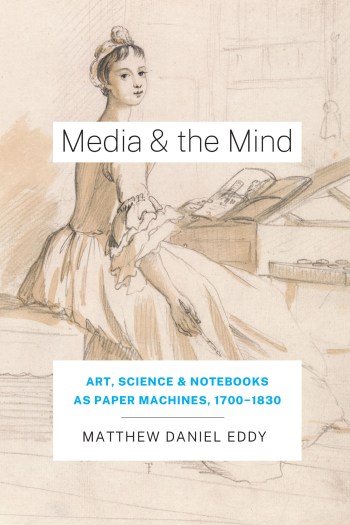 A beautifully illustrated argument that reveals notebooks as extraordinary paper machines that transformed knowledge on the page and in the mind.
Information is often characterized as facts that float effortlessly across time and space. But before the nineteenth century, information was seen as a process that included a set of skills enacted through media on a daily basis. How, why, and where were these mediated facts and skills learned? Concentrating on manuscripts created by students in Scotland between 1700 and 1830, Matthew Daniel Eddy argues that notebooks functioned as workshops where notekeepers learned to judge the accuracy, utility, and morality of the data they encountered. He shows that, in an age preoccupied with ‘enlightened’ values, the skills and materials required to make and use notebooks were not simply aids to reason—they were part of reason itself.
Covering a rich selection of material and visual media ranging from hand-stitched bindings to watercolor paintings, the book problematizes John Locke’s comparison of the mind to a blank piece of paper, the tabula rasa. Although one of the most recognizable metaphors of the British Enlightenment, scholars seldom consider why it was so successful for those who used it. Eddy makes a case for using the material culture of early modern manuscripts to expand the meaning of the metaphor in a way that offers a clearer understanding of the direct relationship that existed between thinking and notekeeping. Starting in the home, moving to schools, and then ending with universities, the book explores this argument by reconstructing the relationship between media and the mind from the bottom up.
Matthew Daniel Eddy is professor and chair in the history and philosophy of science at Durham University. He is the author and editor of numerous works on the cultural history of Britain and its former empire.
C O N T E N T S
Bibliographic Note
Prologue
Introduction
1 Recrafting Notebooks
The Tabula Rasa and Media Interface
Notebooks as Artifacts
Notekeeping as Artificing
Notekeepers as Artificers
Thought as a Realtime Activity
Science as a System
Book Outline
Part I | Inside the Tabula Rasa
2 Writing
Writing as a Knowledge-Creating Tool
The Place of Writing within Literacy
Script and Observational Learning
Grids and Verbal Pictures
Copies and the Exercise of Memory
3 Codexing
Paper Machines as Material Artifacts
Paper as an Informatic Medium
Quires and Knowledge Management
Books and Customized Packaging
4 Annotating
Revisibilia Made through Annotation
Marginalia as Scribal Interface
Paratexts and Editorial Training
Ciphers and the Acquisition of Numeracy
Part II | Around the Tabula Rasa
5 Categorizing
Headings as Realtime Categories
Headings as Mnemonic Labels
Headings as Visual Cues
Headings as Coordinates for Scanpaths and Sightlines
6 Drawing
Description and Movement across a Page
Learning to Draw a Picture
Figures as Developmental Tools
Scenes as Observational Training
Observation and the Utility of Perception
7 Mapping
Mapkeepers and Knowledge Systems on Paper
Map-Mindedness and Embodied Experience
Desk Maps as Crafted Constructions
Field-Mindedness in the Classroom
Field Maps and Visualized Data
Maps as Mnemonic Devices
Part III | Beyond the Tabula Rasa
8 Systemizing
The Syllabus as a System and a Machine
Lecture Notebooks and Knowledge Formation
The Syllabus and Its Organizational Technologies
Scroll Books and the Strategies of Realtime Learning
Transcripts and the Extension of Memory
Lines and the Media of the Mind
9 Diagramming
Paths and Diagrammatic Knowledge
Schemata as Useful Mnemonic Aids
Shapes as Repurposed Perceptual Devices
Pictograms and Visual Judgment
Tables as Kinesthetic Diagrams
Traces and Realtime Observation
10 Circulating
Local and Global Networks
Personal and Institutional Libraries
Commodities within Knowledge Economies
Courts of Law and Public Opinion
Conclusion
11 Rethinking Manuscripts
The Tabula Rasa and Manuscripts
Manuscripts as Dynamic Artifacts
Manuscript Skills as Artifice
Manuscript Keepers as Artificers
Acknowledgments
Bibliography
Abbreviations
Primary Sources
Manuscripts and Ephemera
Printed Primary Sources
Secondary Sources
Index
New Book | Great Irish Households: Inventories
From Distributed by ACC Art Books:
Tessa Murdoch, ed., with a foreword by Toby Barnard, a preface by Leslie Fitzpatrick, inventory transcriptions by Jessica Cunningham and Rebecca Campion, and inventory preambles by Jessica Cunningham Rebecca Campion, Edmund Joyce, Alec Cobbe, and John Adamson, Great Irish Households: Inventories from the Long Eighteenth Century (Cambridge: John Adamson, 2022), 436 pages, ISBN: 978-1898565178, £75.00 / $115.
 Inventories of fourteen great Irish country houses, three Dublin town houses, and one London town house yield remarkable insights into the lifestyle of leading families across Ireland and the households that supported them. With startling directness, they record in detail the goods and chattels inherited, accumulated, or acquired for enjoyment or everyday use.
Two sections in colour feature likenesses of many of the owners or householders of the properties at the time, including portraits by Pompeo Batoni, Michael Dahl, Thomas Gainsborough, Godfrey Kneller, Thomas Lawrence, and Joshua Reynolds, as well as the Irish artists Hugh Douglas Hamilton and Charles Robertson.
The value of inventories in charting how houses were arranged, furnished and used is now widely appreciated. Typically, the listings and valuations were occasioned by the death of an owner and the consequent need to deal with testamentary dispositions. That was not always so. The inventory for Castlecomer House, Co. Kilkenny, for example, was drawn up to make a claim following the house’s devastation in the 1798 uprising. Mostly hitherto unpublished, the inventories chosen give new-found insights into the lifestyle and taste of some of the foremost families of the day. Above stairs, the inventories show the evolving collecting habits and tastes of eighteenth-century patrons across Ireland and how the interiors of great town and country houses were arranged or responded to new materials and new ideas. The meticulous recording of the contents of the kitchen and scullery likewise sheds light on life below stairs. Itemized equipment required for the brewhouse, dairy, stables, garden and farmyard reflects the at times significant scale of the communities the houses supported and the remarkable degree of self-sufficiency at some of the demesnes.
A comprehensive index facilitates access to the myriad items within the inventories, while the books listed at three of the houses are tentatively identified in separate appendices. A foreword, together with preambles to the inventories, sets the households in their historical context. Illustrated with historical engravings of the houses and with portraits of the owners of the time, the inventories will appeal to country-house visitors, historians of interiors, patronage, collecting and material culture as well as to scholars, curators, collectors, creative designers, film directors, bibliographers, lexicographers, and historical novelists.
The eighteenth century is the period onto which the Knight of Glin directed his penetrating gaze as art historian. The book is dedicated to his memory.
Tessa Murdoch, FSA, is Research Curator, Rosalinde and Arthur Gilbert Collection at the Victoria and Albert Museum. Toby Barnard, FBA, is Emeritus Fellow in History at Hertford College, University of Oxford, and a specialist in the political, social and cultural histories of Ireland and England, c. 1600–1800. Leslie Fitzpatrick is the former Samuel and M. Patricia Grober Associate Curator, European Decorative Arts, at the Art Institute of Chicago.
C O N T E N T S
1 Lismore Castle, Co. Waterford, 1702/3
2 Kilkenny Castle, Co. Kilkenny, 1705
3 Dublin Castle, 1707
4 The Duke of Ormonde’s House, London, c. 1710
5 Bishop’s mansion house, Elphin, Co. Roscommon, 1740
6 Captain Balfour’s town house, auction sale, Dublin, 1741/2
7 Hillsborough Castle, Co. Down, 1746 and 1777
8 Kilrush House, Freshford, Co. Kilkenny, 1750
9 No. 10 Henrietta Street, Dublin (Luke Gardiner’s house), 1772
10 Morristown Lattin, Co. Kildare, 1773
11 Baronscourt, Co. Tyrone, 1782
12 Castlecomer House, Co. Kilkenny, 1798
13 Killadoon, Co. Kildare, 1807–29
14 Shelton Abbey, near Arklow, Co. Wicklow, 1816
15 Borris House, Co. Carlow, 1818
16 Carton House, Co. Kildare, 1818
17 Newbridge House, Co. Dublin, 1821
18 Mount Stewart, Co. Down, 1821
Glossary
Appendix I: Buyers at Captain Balfour’s Town House Sale, 1741/2
Appendix II: Books in the Second Duchess of Ormonde’s Closet at Kilkenny Castle, 1705
Appendix III: Books in the Study at the Bishop’s Mansion House, Elphin, Co. Roscommon, 1740
Appendix IV: Books in the Library at Newbridge House, Co. Dublin, 1821
List of Inventory Sources
List of Plates
Bibliography
Index of Personal Names
General Index
Print Quarterly, June 2023

Left: Edmé Jeaurat after Antoine Watteau, Talagrepo, Monk of Pégou, ca. 1731, etching and engraving, 24 × 17 cm (Cambridge, MA, Harvard Art Museums / Fogg Museum). Right: Gabriel Huquier after François Boucher, Flautist and Child Timpanist, ca. 1742, etching and engraving, sheet, trimmed 30 × 24 cm (New York, The Metropolitan Museum of Art).
◊ ◊ ◊ ◊ ◊
The long eighteenth century in the latest issue of Print Quarterly:
Print Quarterly 40.2 (June 2023)
A R T I C L E S

Roger Vandercruse Lacroix, Secretaire with Marquetry, ca. 1765, tulipwood, stained marquetry with bronze mounts and marble top, 114 × 73 × 38 cm (Private collection, Image courtesy Christie’s, London).
• Kee Il Choi Jr., “Watteau and Boucher Conjoined: Imagining China in Marquetry,” pp. 138–49.
This article examines the previously unknown pairing of Chinoiserie prints based on designs by Antoine Watteau (1684–1721) and François Boucher (1703–70) to create the pictorial marquetry veneered onto two nearly identical writing desks (secrétaires en armoire) attributed to the cabinetmaker Roger Vandercruse called La Croix or Lacroix (1727–99). Each cabinet retains traces of either the original engraving or the colour deployed to bring these ‘paintings in wood’ to life. This discovery not only exemplifies the role of prints in disseminating the chinoiseries of both Watteau and Boucher but also sheds light on the working practices of marqueteurs in eighteenth-century Paris.
• Lesley Fulton, “Johann Heinrich Wilhelm Tischbein’s Album of Prints in the British Museum,” pp. 150–69.
Fulton explores the Homeric subject matter and scenes depicted in the British Museum’s album of 81 previously unidentified etchings and engravings. Intended for Tischbein’s Vases and Homer projects, the etchings and engravings were prepared in Naples towards the end of the eighteenth century. Connections are made to motifs derived from painted vases and their relationship to Tischbein’s project for Sir William Hamilton’s Collection of Engravings from Ancient Vases (Naples and Germany, 1791–1803). Further analysis links the prints to the artist’s massive Illustrated Homer project in the first quarter of the 19th century. The paper highlights the discrepancy between the identification of an antique motif made in the late eighteenth century and how it is interpreted today. A contemporary document—probably a stocklist—from the Tischbein archive at Oldenburg in Germany, undated but drawn up between 1799 and 1808, has made it possible to identify the subject of each print and also to explain its original place in the album. The Appendix correlates the British Museum prints with their description as given in the Oldenburg document and also their correspondence with Tischbein’s various publication projects. Fulton concludes that the British Museum album probably served as a sales catalogue to which new material could be added as it arrived in the artist’s workshop.
N O T E S A N D R E V I E W S
• An Van Camp, Review of Gitta Bertram, Nils Büttner, and Claus Zittel, eds., Gateways to the Book: Frontispieces and Title Pages in Early Modern Europe (Brill, 2021), pp. 175–76. This edited volume presents fifteen essays on frontispieces and title-pages found in books printed between 1500 and 1800. Written by established academics as well as PhD candidates, the contributions explore how frontispieces intersect art and literature and how the printed images can be interpreted (contributions by Malcolm Baker, Martijn van Beek, Miranda L. Elston, Alison C. Fleming, Daniel Fulco, Lea Hagedorn, Constanze Keilhoz, Fabian Kolb, Hole Rößler, Delphine Schreuder, Alice Zamboni, and Cornel Zwierlein).
• Séverine Lepape, Review of Małgorzata Łazicka, ed., Old Master Prints from the 15th Century to the 1820s: German School, Barthel Beham and Sebald Beham. The Print Room of the University of Warsaw Library, Catalogue of the Collection (University of Warsay Library, 2019), pp. 176–78.
 • Michael Matile, Review of the exhibition catalogue, Kurt Zeitler, ed., Venedig, La Serenissima: Zeichnungen und Druckgraphik aus vier Jahrhunderten (Deutscher Kunstverlag, 2022), pp. 180–83. The Staatliche Graphische Sammlung in Munich recently presented a cross-section of its rich treasures of Venetian prints and drawings from the late fifteenth to the eighteenth century.
• Antony Griffiths, Review of Joyce Zelen, Blinded by Curiosity: The Collector-Dealer Hadriaan Beverland (1650–1716) and his Radical Approach to the Printed Image (Primavera Pers, 2021), pp. 186–89. The book focuses on Hadriaan Beverland’s activities during his last years, from 1680, which he spent as a ‘paranoid alcoholic drifting through the pubs and brothels of London’. He also assembled at least two little known manuscripts with new images composed of cut-out fragments of prints. The review highlights two portrait prints seemingly commissioned by Beverland himself which Griffiths believes ‘stand far outside the traditional canons of portraiture’, as well as the discovery by Zelen of a major sale of Beverland’s print collection held in 1690.
• Kristel Smentek, Review of Marianne Grivel, Estelle Leutrat, Véronique Meyer and Pierre Wachenheim, eds., Curieux d’Estampes. Collections et collectionneurs de gravures en Europe, 1500–1815 (Universitaires de Rennes, 2020), pp. 189–91. This review presents a swift overview of newly found documentary insights relating to individual and institutional collections of prints, largely focusing on French collectors and on the eighteenth century. Of the latter, mention is made of Albert Duke of Saxe-Teschen correspondences, Joseph-Dominique d’Inguimbert’s display practices, which included mounting between rollers, the collecting and marketing of French fashion prints, and the formation of print collections documenting the history of France, as was the case with Charles-Marie Fevret de Fontette.
• Mark McDonald, Review of Jessica Maier, The Eternal City: A History of Rome in Maps (University of Chicago Press, 2020) pp. 192–94. This review highlights interesting anachronistic features in topographical depictions of a reinvented Rome, for example, in Leonardo Bufalini’s woodcut map from 1551, the Baths of Trajan are depicted as a complete structure when it was in fact ruinous at the time. Further analysis pertains to the functions of printed maps, often as guides for pilgrims and secular tourists visiting important churches and historic sites.
• Christian Rümelin, Review of the exhibition catalogue, Celia Haller-Klinger, and Anette Michels, eds., Graphiksammler Ernst Riecker (1845–1918) und Otto Freiherr von Breitschwert (1829–1910) (Graphik-Kabinett Backnang, 2018), pp. 194–95. A review relating to two German collections formed around the turn of the nineteenth century, one of which focused on eighteenth- and nineteenth-century regional artists.
• Michael Matile, Review of the exhibition catalogue, Anne Buschoff, Marcus Dekiert and Sven Schütte, eds., Linie lernen: Die Kunst zu zeichnen (Wallraf-Richartz Museum & Fondation Corboud, 2021), pp. 195–96. This review pertains to a catalogue illustrating the history of drawing education from Cennino Cennini to their depictions in sixteenth- to eighteenth-century prints.
◊ ◊ ◊ ◊ ◊
Note (added 12 June 2023) — The original posting was updated to include reproductions of the two prints after Watteau and Boucher.
New Book | Danish-British Consort Portraiture, c.1600–1900
From Lund Humphries:
Sara Ayres, Danish-British Consort Portraiture, c.1600–1900 (London: Lund Humphries, 2023), 176 pages, ISBN: 978-1848225183, £60 / $100.
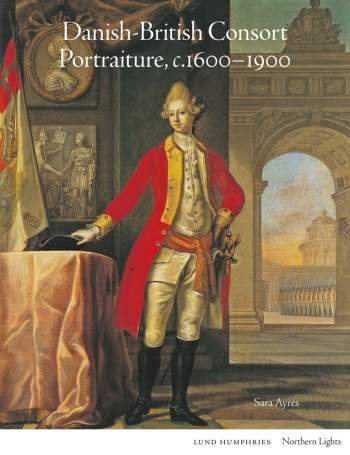 This is the first book to address the long art history of dynastic marriage exchange between Denmark and Britain between 1600 and 1900. It explores an intersection of three themes trending in early modern studies: portraiture, gender, and the court as a centre of cultural exchange. This work re-evaluates the construction and staging of gender in Northern consort portraiture over a span of three hundred years, examining the development of the scientific and social paradigms inflecting consort portraiture and representation, with a view to excavating portrait images’ agency at the early modern moment of their conception and making. The consort’s liminal position between royal houses, territories, languages, and sometimes religion has often been equated with political weakness, but this new work argues that this position endowed the consort with a unique space for innovation in the representation of elite identity. As such, consort imagery drew upon gender as a generative resource of motifs and ideas. Each chapter is informed by new archival research and introduces the reader to little known, yet astonishing works of art. Collectively, they seek to trace a shift in practices of identity formation over time: the transition from an emphasis on rank to an increasingly binary emphasis on gender.
• The book builds on the recent interest around the quatercentenary in 2019 of Anna of Denmark’s death, and the burgeoning interest in Nordic history and art history.
• Anna of Denmark was born 12 December 1574; so the year 2024 will mark the 450th anniversary of that occasion.
• The tercentenary of Louise of Great Britain’s birth takes place in 2024.
• The centenary of Alexandra of Denmark’s death takes place in 2025.
Sara Ayres obtained her doctorate in Art History from Birkbeck College, University of London, in 2012. She has published in the Oxford Art Journal, the Journal of Historians of Netherlandish Art, and the Court Historian. Between 2016 and 2018 she held the position of the Queen Margarethe II Distinguished Postdoctoral Fellow at the National Portrait Gallery in London. Recent publications include the co-edited volume Sculpture and the Nordic Region (2017).
C O N T E N T S
Acknowledgements
Figure List
Introduction
1 Anna of Denmark (1574–1619)
2 Prince George of Denmark (1653–1708)
3 Louisa of Great Britain (1724–1751)
4 Caroline Matilda of Great Britain (1751–1775)
5 Alexandra of Denmark (1844–1925)
Bibliography
Endnotes










 Enfilade
leave a comment