New Book | The Wager
From Penguin Random House:
David Grann, The Wager: A Tale of Shipwreck, Mutiny, and Murder (New York: Doubleday, 2023), 352 pages, ISBN: 978-0385534260, $30.
 On January 28, 1742, a ramshackle vessel of patched-together wood and cloth washed up on the coast of Brazil. Inside were thirty emaciated men, barely alive, and they had an extraordinary tale to tell. They were survivors of His Majesty’s Ship the Wager, a British vessel that had left England in 1740 on a secret mission during an imperial war with Spain. While the Wager had been chasing a Spanish treasure-filled galleon known as “the prize of all the oceans,” it had wrecked on a desolate island off the coast of Patagonia. The men, after being marooned for months and facing starvation, built the flimsy craft and sailed for more than a hundred days, traversing nearly 3,000 miles of storm-wracked seas. They were greeted as heroes.
But then … six months later, another, even more decrepit craft landed on the coast of Chile. This boat contained just three castaways, and they told a very different story. The thirty sailors who landed in Brazil were not heroes—they were mutineers. The first group responded with countercharges of their own, of a tyrannical and murderous senior officer and his henchmen. It became clear that while stranded on the island the crew had fallen into anarchy, with warring factions fighting for dominion over the barren wilderness. As accusations of treachery and murder flew, the Admiralty convened a court martial to determine who was telling the truth. The stakes were life-and-death—for whomever the court found guilty could hang.
The Wager is a grand tale of human behavior at the extremes told by one of our greatest nonfiction writers. Grann’s recreation of the hidden world on a British warship rivals the work of Patrick O’Brian, his portrayal of the castaways’ desperate straits stands up to the classics of survival writing such as The Endurance, and his account of the court martial has the savvy of a Scott Turow thriller. As always with Grann’s work, the incredible twists of the narrative hold the reader spellbound.
David Grann is the author of the #1 New York Times bestsellers Killers of the Flower Moon and The Lost City of Z. Killers of the Flower Moon was a finalist for the National Book Award and won an Edgar Allan Poe Award. He is also the author of The White Darkness and the collection The Devil and Sherlock Holmes. Grann’s investigative reporting has garnered several honors, including a George Polk Award. He lives with his wife and children in New York.
New Book | A Treatise on Civil Architecture
From Rizzoli:
William Chambers, with a preface by Frank Salmon, A Treatise on Civil Architecture (Stockholm: Bokförlaget Stolpe, 2023), ISBN: 978-9189696358, $80.
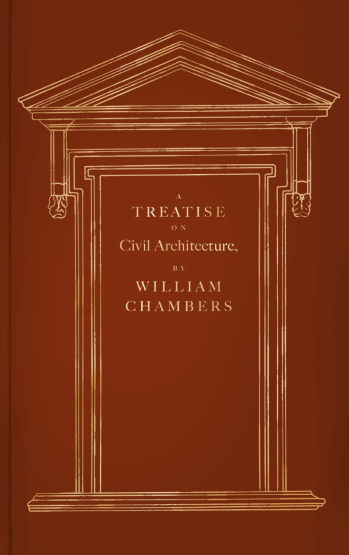 A gorgeous, oversize, clothbound facsimile of the classic 18th-century guide to the vocabulary of Western architecture
Sir William Chambers (1723–1796) was a Swedish British architect who designed imaginative castle buildings and luxurious interiors as well as simple and rational utilitarian architecture: some of his most famous works include the Roehampton Villa, Great Pagoda, and Somerset House (all located in London). Originally published in 1756, A Treatise on Civil Architecture is an architecture handbook in which Chambers explains the basics of the art of building, aiming “to collect into one volume what is now dispersed in a great many, and to select, from mountains of promiscuous Materials, a Series of Sound Precepts and good Designs.” The guidebook is supplemented by concise texts and beautiful illustrations of classical building types and their functions. Received with considerable acclaim upon its release, A Treatise on Civil Architecture quickly became the most popular practical work on architecture in the English language and has since been republished several times. This handsome clothbound edition is published in conjunction with the 300th anniversary of Chambers’ birth.
William Chambers (1723–1796) was an architect mainly active in and around London. Chambers was a founder member of the Royal Academy of Arts in 1768 and he published a number of both practical and theoretical books on architecture, gardening, and interior design.
Frank Salmon is Associate Professor (Senior Lecturer) in History of Art, University of Cambridge and a Fellow at St John’s College, Cambridge. Since 2021 Dr. Salmon has served as the director at the Cambridge based The Ax:son Johnson Centre for the Study of Classical Architecture.
New Book | Georgian Arcadia
From Yale UP:
Roger White, Georgian Arcadia: Architecture for the Park and Garden (New Haven: Yale University Press, 2023), 352 pages, ISBN: 978-0300249958, $65.
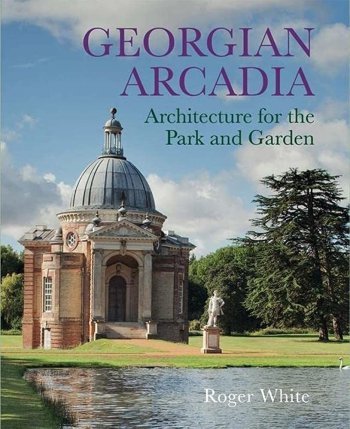 An exploration of the origins and evolution of Georgian landscape architecture, a period of innovative and diverse garden structures in which some of the era’s greatest architects experimented with form, style, and technology
The invention and evolution of the Georgian landscape garden liberated garden buildings from the corset of formality, allowing them to structure much more extensive areas of garden and park. One of the leading authorities on Georgian landscape architecture, Roger White explores a genre in which some of the era’s greatest architects experimented with different forms, styles, and new technology. Covering not just the obvious adornments of parks and gardens such as temples, summerhouses, grottoes, towers, and ‘follies’, the book also explores structures with predominantly practical functions, including mausolea, boathouses, dovecotes, stables, kennels, deer pens, barns, and cowsheds, all of which could be dressed up to make an architectural impact. White examines these structures not only architecturally but from a functional and cultural viewpoint, considering questions of stylistic origins and development. Focussing on the contributions of Britain’s leading eighteenth-century architects—Vanbrugh, Hawksmoor, Gibbs, Kent, Adam, Chambers, Wyatt, and Soane—Georgian Arcadia provides a richly illustrated account of a period of innovative and diverse garden building.
Roger White is an architectural historian specialising in the Georgian period. He is a Fellow of the Society of Antiquaries of London and has been Secretary of both the Georgian Group and the Garden History Society.
New Book | Visions of Arcadia
From Rizzoli:
Bernd H. Dams and Andrew Zega, Visions of Arcadia: Pavilions and Follies of the Ancien Régime (New York: Rizzoli, 2023), 280 pages, ISBN: 978-0-8478-9916-6, $85.
 Astonishing buildings created for casual amusements, the splendid pavilions and garden follies of prerevolutionary France are the glorious productions of an age now past—but they continue to speak to us through the dazzling artistry of Dams and Zega.
Spanning 150 years and the reigns of four kings, the pleasure pavilions, garden follies, and châteaux of Ancien Régime France are fascinating for the stories that surround their creation as well as a visual feast and a delight. Typically the realm of scholars, the subject is given extraordinary life at the hands of the authors, through whose historically accurate, meticulously rendered watercolors the reader comes to see the sometimes grand, sometimes playful, always beautiful buildings, sculpture, and ornament as they were meant to be seen. Dams and Zega have devoted much of a lifetime to rediscovering and illuminating these great treasures of world heritage, and this volume is the fruit of more than thirty years of passionate investigation. Intensive original research and devoted exploration informs the work, capturing the genius of these buildings through the medium of watercolor, which the author-artists harness to render building materials and surfaces with sensitivity and great range. From the mannerist and early baroque guard pavilions at Blérancourt to the Château de Rosay, a fantasy realized in the form of an Anglo-Chinese folly park, this volume is a revelation, sure to captivate architects, historians, landscape designers, and garden lovers.
Bernd H. Dams is an architect and architectural historian. Andrew Zega is an architectural illustrator, designer, and writer. Together, they have authored and illustrated a number of successful books, including Palaces of the Sun King, Chinoiseries, and Central Park NYC for Rizzoli.
New Book | Lazzari’s Discrizione della Villa Pliniana
Francesco Ignazio Lazzari’s Discrizione della Villa Pliniana is the 2023 winner of the Elisabeth Blair MacDougall Book Award, from the Society of Architectural Historians. Members of the award committee—Kathleen John-Adler, Sonja Dümpelmann, and Tracy Ehrlich—note in their citation: “given that Lazzari lived until the year 1717, we are reminded that his dedication to the Plinian tradition was not simply an outgrowth of a narrow Renaissance antiquarianism, it reflected a broader pan-European concern for the classical language of architecture that flourished in the eighteenth century.”
Distributed by Harvard UP:
Anatole Tchikine, Pierre de la Ruffinière du Prey, and Taylor Ellis Johnson, Francesco Ignazio Lazzari’s ‘Discrizione della Villa Pliniana’: Visions of Antiquity in the Landscape of Umbria (Washington, DC: Dumbarton Oaks Research Library and Collection, 2021), 241 pages, ISBN: 978-0884024873, £35 / €37 / $40.
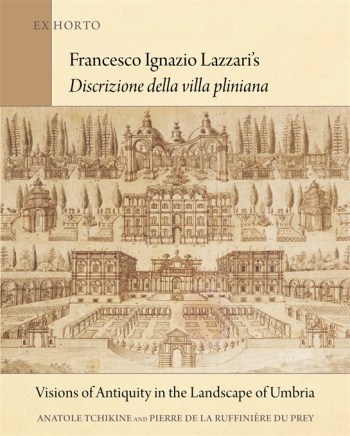 A cultivated patrician, a prolific playwright, and a passionate student of local antiquity, Francesco Ignazio Lazzari (1634–1717) was a mainstay of the artistic and intellectual life of Città di Castello, an Umbrian city that maintained a remarkable degree of cultural autonomy during the early modern period. He was also the first author to identify the correct location of the lost villa ‘in Tuscis’ owned by the Roman writer and statesman Pliny the Younger and known through his celebrated description. Lazzari’s reconstruction of this ancient estate, in the form of a large-scale drawing and a textual commentary, adds a unique document to the history of Italian gardens while offering a fascinating perspective on the role of landscape in shaping his native region’s identity. Published with an English translation for the first time since its creation, this manuscript is framed by the scholarly contributions of Anatole Tchikine and Pierre de la Ruffinière du Prey. At the core of their discussion is the interplay of two distinct ideas of antiquity—one embedded in the regional landscape and garden culture of Umbria and the other conveyed by the international tradition of Plinian architectural reconstructions-that provide the essential context for understanding Lazzari’s work.
Series | Ex Horto: Dumbarton Oaks Texts in Garden and Landscape Studies
Anatole Tchikine is Curator of Rare Books at Dumbarton Oaks Research Library and Collection.
Pierre de la Ruffinière du Prey is Professor in the Department of Art at Queen’s University, Kingston, Ontario.
C O N T E N T S
Foreword
Acknowledgments
Prologue: Fitting Together the Pieces of the Lazzari Puzzle — Pierre de la Ruffinière du Prey
1 Repatriating Pliny: Lazzari and His Reconstruction — Anatole Tchikine
2 ‘So That the Memory of This Villa…’: Lazzari’s Two Antiquities — Anatole Tchikine
3 ‘Tuscos Meos’: Visions of Pliny’s Villas by Lazzari, His Predecessors, and His Contemporaries — Pierre de la Ruffiniere du Prey
Epilogue: Local Memory and National Myth — Anatole Tchikine
Description of Pliny’s Villa — Francesco Ignazio Lazzari, translated with notes from Italian and Latin by Anatole Tchikine and Taylor Ellis Johnson
Discrizione della Villa Pliniana — Francesco Ignazio Lazzari, transcription by Anatole Tchikine and Taylor Ellis Johnson
Appendices
1 Pliny the Younger, Letter to Apollinaris — translated from Latin by Taylor Ellis Johnson
2 Nine Latin Inscriptions Found in the Area of Città di Castello (Appendix to the Città di Castello Manuscript) — transcription by Anatole Tchikine
3 Legend to Lazzari’s Drawing — transcription by Anatole Tchikine
4 Chronology of Lazzari’s Writings — Anatole Tchikine
Contributors
Index
Call for Essays | Studi Neoclassici
From ArtHist.net:
Studi Neoclassici: Rivista internazionale 11 (2023)
Submissions due by 30 June 2023
The journal Studi Neoclassici—created to publish the results of the activity promoted by the ‘Istituto di ricerca per gli studi su Canova e il Neoclassicismo’ (‘Research Institute for Studies on Canova and Neoclassicism’) of Bassano del Grappa—has been a tool for disseminating research of the Edizione Nazionale delle Opere di Antonio Canova (‘’National edition of the works of Antonio Canova’), that converges in the critical editions of the enormous Canova’s epistolary, with the historical, biographical, stylistic insights that matter requires. The major scholars of Neoclassicism constitute the scientific and editorial council of the journal. The magazine proposes itself to the attention of scholars in various fields of research, from history to literature, from archeology to art history, from the history of culture to art criticism to the history of collecting, from the history of music to that of dance and costume. Journal articles follow the same methodological approach that characterized the “Canovian Weeks”, that is connecting different artistic and cultural experiences, from literature to art history, to history and to other arts included in the historical period between second half of the eighteenth and the first decades of the twentieth century, with the intention of proposing a complete and not only specialized picture of the theme.
Studi Neoclassici publishes monographic numbers and free topic numbers relating to the historical period of the journal, the texts of which, selected through a Call for Papers procedure, are all—except for rare and justified exceptions—subject to peer review by a ‘double blind’ procedure. In the case of the aforementioned exceptions it is the management, in its collegiality, that after careful examination assumes the responsibility of accepting the texts. Issue number 11 (2023) will host free articles and one / two reviews of volumes relating to the period covered by the magazine, edited in 2021 and 2023.
The editorial rules are available here. Texts can be presented in Italian, German, French, English, or Spanish; must not exceed 35,000 characters (spaces and notes included); and must be sent by 30 June 2023 to the journal’s scientific directors: giuliana.ericani@gmail.com and gianpavese@gmail.com.
Fellowship | Reception of Antiquity, 1350–1900
From ArtHist.net:
Census Fellowship: Reception of Antiquity
Berlin, Rome, and London, 2023–24
Applications due by 31 May 2023
The Institut für Kunst- und Bildgeschichte, Humboldt-Universität zu Berlin, the Bibliotheca Hertziana – Max Planck Institute for Art History, and the Warburg Institute, School of Advanced Study, University of London, are pleased to announce a fellowship in Berlin, Rome, and London, offered at either the predoctoral or postdoctoral level. These fellowships grow out of the longstanding collaboration between the Humboldt, the Hertziana, and the Warburg in the research project Census of Antique Works of Art and Architecture Known in the Renaissance.
The fellowships extend the traditional chronological boundaries of the Census and are intended for research and intellectual exchange on topics related to the reception of antiquity in the visual arts between ca.1350 and ca. 1900. In the context of the fellowships, the topic of the reception of antiquity is also broadly conceived without geographical restriction. Proposals can optionally include a digital humanities perspective, engage with the database of the Census, or make use of the research materials of the Census project available in Berlin, Rome, and London.
The Humboldt, the Hertziana, and the Warburg co-fund a research grant of 6–9 months for students enrolled in a PhD program, or 4–6 months for candidates already in possession of a PhD Fellows can set their own schedule and choose how to divide their time between the three institutes, but they should plan to spend at least one month in residence at each of the three institutions. The stipend will be set at about 1500 EUR per month at the predoctoral level and about 2500 EUR per month at the postdoctoral level, plus a travel stipend. The fellowship does not provide housing.
Candidates can apply via the Hertziana recruitment platform by uploading the requested PDF documents in English, German, or Italian by 31 May 2023, with details of their proposed dates for the fellowship during the academic year 2023/24 (July 2023–July 2024).
New Book | American Latium: American Artists and Travelers
From the Accademia Nazionale di San Luca:
Christopher M.S. Johns, Tommaso Manfredi, and Karin Wolfe, eds., American Latium: American Artists and Travelers in and around Rome in the Age of the Grand Tour (Rome: Accademia Nazionale di San Luca, 2023), ISBN: 978-8897610373.
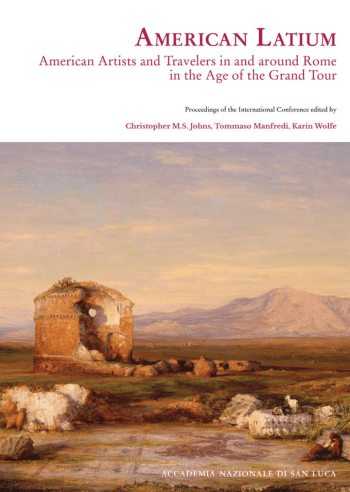 This volume brings together the proceedings of the international conference American Latium: American Artists and Travelers in and around Rome in the Age of the Grand Tour, sponsored by the Accademia Nazionale di San Luca and hosted by the Centro Studi Americani in Rome on the 7–8 June 2018, convened by Christopher M.S. Johns, Tommaso Manfredi, and Karin Wolfe. The conference examined the concept of cultural exchange between America and Rome and its surrounding territory not as a bilateral transfer of culture, but rather as an entangled and reciprocal history of cultural transmission, including the importance of London with its powerful art academies as an intermediate destination for Americans making their way to the continent. Travel to Rome engaged American artists, collectors, scientists, writers, and diplomats in dialogue with a network of European artists, intellectuals, and statesmen. The remarkable degree of cosmopolitanism found in Rome signalled its importance not simply as a cultural destination, but as a place of experiment and creativity for travelers of differing nationalities who gathered there—a place where ancient history and tradition was cross-pollinated with the experience of the modern. American Latium addresses the pioneering origins of the artistic relations between America, Rome, and its environs from the eighteenth century up until 1870. Interdisciplinary in nature, these proceedings present new, and at times unexpected, research on the experience of reciprocal cultural exchange.
C O N T E N T S
Introduction — Karin Wolfe
The American Grand Tour: From Old Masters to the New World
• Copying Old Masters for the New World: American Painters in Eighteenth-Century Rome — Jonny Yarker
• James Bowdoin III and Ward Nicholas Boylston in Italy: American Collectors in the Later Eighteenth Century — Sarah Cantor
• John Singleton Copley in Rome: The Challenge of the Old Masters Accepted — Christopher M.S. Johns
• London Between America and Continental Europe: Art and Academies — Martin Postle
• The Prince and the President: Antonio Canova and Benjamin West at the Royal Academy in London — Francesco Moschini
• John Neal, the Old Masters, and the American Muse — Francesca Orestano
• ‘In the Beginning There Was the Word’: American Writings on Raphael from the Founding Fathers to the Gilded Age — Linda Wolk-Simon
American Latium: Sites and Itineraries in and around Rome
• American Itineraries in Rome and the Campagna — Fabrizio Di Marco
• A Grave in a Foreign Land: Early American Presence at the Protestant Burying-Ground in Rome — Nicholas Stanley-Price
• Thomas Cole and the Aqueducts: Plein Air Painting in the Roman Campagna — Lisa Beaven
• Thomas Cole, Desolation, and the Ruins of Rome — David R. Marshall
• Scenery Found: John Gadsby Chapman and Open- Air Oil Sketching in and around Rome, 1830–1882 — Mary K. McGuigan
• American and European Artists and Intellectuals in Nineteenth-Century Latium: The ‘School of the Castelli Romani’ and the Locanda Martorelli in Ariccia — Francesco Petrucci
• Living and Creating in Antiquity: Roman Residences and Studios of Thomas Gibson Crawford, William Wetmore Story, and Moses Jacob Ezekiel — Pier Paolo Racioppi
Americans and the Artistic Culture of Rome: Toward an American Art
• Americans on the Grand Tour and Angelica Kauffman in Rome — Wendy Wassyng Roworth
• Championing Liberty: The Roman Sculptor Giuseppe Ceracchi in Britain and in America — Karin Wolfe
• The Rome of Charles Bulfinch — Tommaso Manfredi
• Thomas Jefferson: Rome in America — Maria Cristina Loi
• A Painter and Diplomat: The Two Careers of James Edward Freeman and Their Correspondences — John F. McGuigan Jr
• Forgotten Fervor: Paul Akers in Rome — Arlene Palmer
• Undressing America: Nineteenth-Century Expatriate Sculptors in Rome and the Problem of Nudity — Kevin Salatino
Bibliography
In Memoriam and Acknowledgements
Exhibition | Connecting Worlds: Artists and Travel

Carlo Labruzzi, The Colosseum seen from the Palatine Hill, Rome, graphite, pen and brown and grey ink, watercolour.
◊ ◊ ◊ ◊ ◊
On view this summer at the Kupferstich-Kabinett of the SKD:
Connecting Worlds: Artists and Travel / Ferne, so nah: Künstler, Künstlerinnen und ihre Reisen
Kupferstich-Kabinett, Staatliche Kunstsammlungen Dresden, 8 July – 8 October 2023
Artists and travel have for centuries been intertwined where the desire to explore beyond the confines of one’s home has provoked a truly astonishing outpouring of creativity, much of which was captured through drawings and prints. Comprising over 100 such works, Connecting Worlds: Artists & Travel will be the first exhibition to approach the subject through the lens of artists’ experiences of travel from the Renaissance to the nineteenth century. Select works by contemporary artists offer further inspiring perspectives on the topic of travel and connectivity.
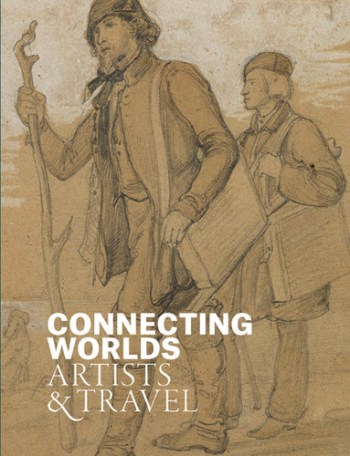 Why did artists travel? What did they take with them? With whom did they travel and meet? How did they record their journey? Addressing such questions, the exhibition invites visitors on their own creative journey by confronting them with works by major artists, amongst them Albrecht Dürer, Hans Holbein the Younger, Pieter Bruegel the Elder, Maria Sibylla Merian, and Angelika Kauffmann, for whom travel expanded their artistic and intellectual horizons and circles of friendship.
Divided into three sections ‘On the Road’, ‘Destination Rome’, and ‘Dresden’, the exhibition begins by exploring artists on the road and what they regarded as important to record in sketchbooks and individual sheets. Primary amongst these are nature studies reflecting a fascination with the outdoors but also architecture and local inhabitants. The main destination was Rome, with its incomparable remains of antiquity and as the seat of the Catholic Church that celebrated its religious and institutional life through processions and public spectacle.
Upon returning to their homelands, artists often used their drawings as the source for prints and paintings, thereby disseminating knowledge of their experience to a wider audience. The exhibition ends with Dresden under Augustus the Strong, a center of glamorous festivities, ambitiously competing with other international courts. This last chapter of the exhibition explores a different kind of travel through images and stories of landscapes, plants, animals, and cultures previously unknown in Europe that were brought back by courtly and military expeditions. The visual recordings of distant worlds in books and prints allowed for imaginary travel and enabled a sense of connectivity with places and people from near and far.
This international exhibition project is a collaboration between the Kupferstich-Kabinett and the Katrin Bellinger Collection, London, and is made possible by the complementary strengths of the two collections: the Kupferstich-Kabinett, with its extensive holdings on the themes of travel and science in the early modern period, and the Katrin Bellinger Collection, with its focus on representations of artists engaged in the creative process. The project is supplemented by prominent loans from national and international collections.
The catalogue is published by Paul Holberton and distributed by The University of Chicago Press:
Anita Viola Sganzerla and Stephanie Buck, eds., Connecting Worlds: Artists and Travel (London: Paul Holberton Publishing, 2023), 274 pages, ISBN: 978-1913645489, £45 / $55.
Exhibition | Refugee Silver: Huguenots in Britain
From The Fitzwilliam:
Refugee Silver: Huguenots in Britain
The Fitzwilliam Museum, Cambridge, 2 August 2022 — 30 July 2023
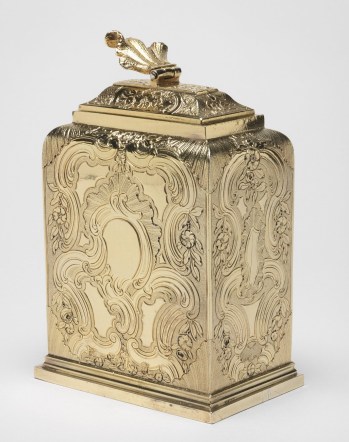
Silver gilt tea caddy, marked London, Aymé Videau, 1745–46 (Cambridge: The Fitzwilliam Museum, given by the estate of the late Olive and Peter Ward).
Escaping persecution in France, Huguenot silversmiths changed the visual arts in Britain and brought with them exciting new ideas and techniques. For more than a century from the late 1600s, these French Protestants made an immeasurable contribution to British cultural life.
Protestants living in Catholic France had long faced religious persecution. Its increase forced them to seek new lives in the Netherlands, Germany, South Africa, and North America. Between 1680 and 1720, more than 50,000 Huguenots sought refuge in Britain, introducing the word ‘refugee’ to the English language.
This display of silver, ceramics, sculpture, and ivories, reframes objects from the Fitzwilliam Museum’s historic collections through the lens of the migration of Huguenot refugees to Britain. Many were skilled craftspeople: metalworkers, sculptors, carvers, weavers, and printers, with the necessary skills to make luxury goods and a knowledge and understanding of French fashions. Huguenot silversmiths sometimes adapted their designs to suit British tastes although it was important that they retained distinctive elements of their modern and fashionable style. The results proved especially attractive to a growing British middle class. The Huguenots’ sophisticated techniques, dynamic forms, and intricate sculptural decoration were so widely imitated that eventually their style became dominant in Britain, transforming forever the appearance of silver and other decorative arts in this country.










 Enfilade
leave a comment