Conference | Favorite Palace: Interior Decoration and Collections

Johann Michael Ludwig Rohrer, Favorite Palace (Schloss Favorite), Rastatt (12 km north of Baden-Baden), 1710–30. Located near the primary residential palace at Rastatt, Schloss Favorite was created as a ‘porcelain palace’ for Margravine Sibylla Augusta and used mainly in the summer months for festivities including concerts and banquets. Schloss Favorite now houses the world’s largest collection of early Meissen porcelain.
◊ ◊ ◊ ◊ ◊
From the conference programme:
Favorite Palace: Interior Decoration and Collections
Schloss Favorite: Ausstattung und Sammlungen
In person and online, Residenzschloss Rastatt, 17–19 September 2023
Registration due by 28 August 2023
Favorite Palace in Rastatt, built between 1710 and 1729 by Margravine Sibylla Augusta of Baden-Baden (1675–1733), is the only almost unchanged Baroque ‘porcelain palace’ in Germany. This conference will present recent scientific findings on the history of the palace, its interior decoration, and its collections. A special focus will be on the chinoiserie furnishings, as well as on Asian and European ceramics. The conference aims to honor the ensemble created by the builder and collector, Sibylla Augusta, in the context of early 18th-century European art.
 There is no conference fee, but advanced registration is essential (by 28 August 2023). The conference will be translated by interpreters and streamed online in German and English. Please indicate when registering whether you would like to attend in person or online. You will receive the participation link as well as information on hotels and parking spaces after registration.
s u n d a y , 1 7 s e p t e m b e r 2 0 2 3
10.00–1.00 Guided tours of Favorite Palace (optional, by appointment)
1.15 Reception Desk Open
2.00 Welcome by Patricia Alberth (Geschäftsführerin der Staatlichen Schlösser und Gärten Baden-Württemberg) and Anton Schweizer (Kyushu University, Japan)
2.15 Section 1 | Chinoiseries in the Decoration and Festive Culture of Sibylla Augusta
Moderation: Anton Schweizer (Kyushu University)
• ‘Dan die Chinesisch und Japanische Kajser würden selber in vergnügteste Entzückung gesezet werden’: Zur Chinoiserie in der Favorite — Ulrike Grimm (Oberkonservatorin a. D., Karlsruhe)
• Die japanischen Textilappliken im Schlafzimmer des Erbprinzen Ludwig Georg: Kontext und Bedeutung — Anton Schweizer (Kyushu University, Japan)
• ‘China-Mode’ and Court Culture in Early 18th-Century Europe: Sibylla Augusta’s Chinese Banquet in Ettlingen in 1729 — Kristel Smentek (MIT, Cambridge, Massachusetts)
• ‘Admirable Abzeichnungen’: Herstellung, Verbreitung und Überlieferung der Stichserie zum Chinesischen Fest 1729 in Ettlingen von Johann Christian Leopold — Christian Katschmanowski (SSG)
5.45 Refreshments
7.30 Evening Lecture
• Zwischen Botschaft und Typologie: Die Bildprogramme der Decken, Wände und Textilien — Ulrike Seeger (Universität Stuttgart / Ludwig-Maximilians-Universität München)
m o n d a y , 1 8 s e p t e m b e r 2 0 2 3
8.30 Reception Desk Open
9.00 Section 2 | Porcelain and Stoneware from Asia and Europe
Moderation: Ulrike Grimm (Oberkonservatorin a. D., Karlsruhe)
• Asian Art in the Collections of the Sachsen-Lauenburg Family in the Context of Inventories from Other Collections in the Czech Lands — Filip Suchomel (Regional Gallery, Liberec / UMPRUM, Prague)
• The Redwares of Sibylla Augusta of Baden-Baden and Their Global Context — Errol Manners (E & H Manners Ltd., London)
• Eine Eremitage in Blau: Ostasiatisches Porzellan, Exotismus und Weltflucht à la Chine in Schloss Favorite — Stephan Graf von der Schulenburg (Museum für Angewandte Kunst, Frankfurt)
• Meissen Porcelain in Schloss Favorite: Revisiting and Rethinking a Legendary Collection — Maureen Cassidy-Geiger (Independent Scholar and Curator, New York)
12.45 Lunch Break
2.00 Section 3 | Special Equipment Pieces in Focus
Moderation: Petra Pechaček (SSG)
• Baden-badische ‘Masquera- und Comodianten Kleyder’: Die Kostümbilder als Ausdruck fürstlichen Ranges und wirtschaftlicher Leistungskraft — Hertha Schwarz (Freie Historikerin, München)
• Mixed media und eine Welt von Bedeutungen: Die textile Ausstattung von Schloss Favorite — Birgitt Borkopp-Restle (Universität Bern)
• Licht ins Dunkel: Der böhmische Kronleuchter aus dem Schlafzimmer des Erbprinzen Ludwig Georg — Käthe Klappenbach (Kustodin a. D., SPSG, Potsdam)
5.00 Guided tour of the palace church accompanied by organ music — Sigrid Gensichen and Jürgen Ochs
t u e s d a y , 1 9 s e p t e m b e r 2 0 2 3
8.30 Reception Desk Open
9.00 Section 4 | The Palace and Its Collections after Sibylla Augusta
Moderation und Einführung: Sandra Eberle (SSG)
• Produkte der kurbayerischen Verwandtschaft: Ein Porzellangarten zur Hochzeit Ludwig Georgs 1755 und eine Parforcejagd aus Terracotta — Katharina Hantschmann (Bayerisches Nationalmuseum München)
• Das Straßburger Fayence-Service aus Schloss Favorite, 1748–1753 — Jacques Bastian (Antiquités Bastian, Straßburg)
10.30 Wrap-up
11.45 Shuttle to Favorite Palace
12.00 Lunch Snack at Favorite Palace
1.00 Tours of Favorite Palace (guided by speakers)
New Book | The Turkish Boudoir of Marie-Antoinette and Joséphine
From Éditions d’art Monelle Hayot:
Vincent Cochet and Alexia Lebeurre, The Turkish Boudoir of Marie-Antoinette and Joséphine at Fontainebleau / Le Boudoir Turc de Marie-Antoinette et Joséphine à Fontainebleau (Saint-Rémy-en-l’Eau: Éditions d’art Monelle Hayot, 2023), 208 pages, ISBN: 979-1096561384 (English) / ISBN: 979-1096561407 (French), €43.
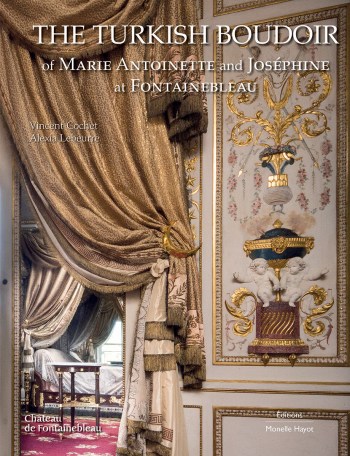 Within ten years, Marie-Antoinette ordered the achievement of two exquisite rooms in Fontainebleau: the Turkish Boudoir (1777) and the Silver Boudoir (1786). Two peaceful refuges allowing her to escape the laws of «Étiquette». When Joséphine became Empress, the craze for turqueries and chinoiseries, had not faded. Both a lover of Marie-Antoinette and of her style, she made hers the Turkish Boudoir emptied at the Revolution. She enhanced the luxury of the oriental atmosphere adding sumptuous and highly creative pieces of furniture by the finest artists of her time. Mahogany and gilt bronzes accompanied masterpieces of upholstery and curtains made of brocade, silk and gold. After a painstaking seven-year restoration completed in 2015, the graceful carved, painted, and gilded panelings of Marie Antoinette’s boudoir are once again the setting for Joséphine’s luxurious furniture in an environment of rewoven textiles.
Heritage curator Vincent Cochet devoted seven years to the restoration of the Turkish Boudoir. Alexia Lebeurre is Associate Professor in the History of Art Department at the Université Bordeaux Montaigne.
Exhibition | Seduction and Power

Now on view at Marly:
Séduction et Pouvoir: L’art de s’apprêter à la Cour
Musée du Domaine royal de Marly, 14 April — 27 August 2023
Curated by Anne Camilli and Karen Chastagnol
Une exposition consacrée à l’art du paraître aux 17e et 18e siècles.
Se vêtir et accessoiriser sa tenue révèle les usages sociaux et politiques des élites. Si l’usage de la parure et l’envie d’embellir le corps sont présents dans toutes les sociétés et à toutes les époques, il s’accompagne sous Louis XIV d’une véritable stratégie d’affirmation du pouvoir motivée par la centralisation politique. Le règne du Roi-Soleil se caractérise par un souci de l’apparence et de la représentation. L’accessoire, tout comme le vêtement, contribue à la nécessité de paraitre et de tenir son rang.
Qu’on les appelle ornements ou encore parures, les accessoires du vêtement, de la coiffure et de la beauté deviennent les outils d’une communication non verbale entre les individus et le lieu d’un investissement symbolique. Ces ornements et ces parures reflètent les courants de la mode mais témoignent également des valeurs et des préférences de la société française de l’époque.
 Chaque accessoire, chaque geste, chaque attitude répond à des normes, à des codes qui ne cessent d’évoluer attestant ainsi des changements de modes et de mœurs. Cette construction de l’apparence requiert de connaître les usages et les règles et de s’y conformer pour bénéficier de la faveur royale et attester de son identité sociale.
Aussi, cette culture du paraître s’accompagne d’une parfaite maîtrise de soi et des expressions du visage : fards, poudres, mouches et parfums concourent à une monotonie d’apparence. L’impératif de séduction s’inscrit dans un double mouvement : un mimétisme envers le roi et le pouvoir d’une part, et la nécessité de s’en affranchir pour se faire remarquer et mieux révéler son rang d’autre part. Le corps se pare alors de divers artifices : perruques, maquillage, bijoux, parfums, dentelles, et objets de poche et de galanterie. Les costumes sont complétés par différents atours : broderies, dentelles, rubans qui rivalisent de sophistication et de raffinement.
Objets luxueux, réalisés par des métiers d’art, ces accessoires subliment le vêtement, deviennent des objets de distinction et s’accompagnent pour certains d’une gestuelle propre qui révèle un langage codifié et marquent le corps modifiant la posture, le déplacement, la prestance du courtisan. Qu’elles soient rhétoriques ou esthétiques, ces armes de séduction servent l’esprit d’une société élitiste où se mêlent des enjeux amoureux, politiques et religieux.
L’exposition vous emmène à la découverte de ces objets qui participent à ce jeu de la séduction et du pouvoir à la cour. Éléments de la mise en scène du théâtre de la cour, les accessoires de mode, les produits de beauté et l’art du parfum révèlent les attentes des femmes et des hommes nobles tout au long des XVIIe et XVIIIe siècles. Le visiteur découvre les œuvres dans un parcours qui évoque de la tête au pied les différents objets auquel recourt le courtisan et reflète les évolutions de ces accessoires au cours des règnes successifs de Louis XIV, Louis XV et Louis XVI, période d’activité du château de Marly, instrument de la politique royale.
Anne Camilli and Karen Chastagnol, eds., with additional contributions by Alice Camus, Georgina Letourmy-Bordier, Grégory Maugain, and Corinne Thépaut-Cabasset, Séduction & Pouvoir: L’art de s’apprêter à la Cour (Fine éditions d’art, 2023), 104 pages, ISBN: 978-2382031179, €25.
Entre les règnes de Louis XIV et de Louis XVI, Versailles puis Paris se disputent le titre de capitale de la mode. Entre désir de séduction, affirmation du pouvoir et désir de signifier un statut social, les accessoires de mode et de beauté viennent appuyer sous l’Ancien Régime une nouvelle mise en scène de soi. Chaque parure, chaque geste, chaque attitude répond à des codes qui ne cessent d’évoluer et accompagnent ainsi les modes et les mœurs. Le corps est paré de divers artifices qui rivalisent d’audace et de distinction. Quels rôles jouent ces ornements dans le contexte de la cour ? L’exposition du Musée du Domaine royal de Marly retrace les usages de ces objets, de la tête aux pieds : coiffes, perruques, maquillage, parfums, ornements du vêtement, bijoux, objets de galanterie, chaussures.
s o m m a i r e
• Introduction — Être et paraître : Accessoires de mode, parures & ornements — Karen Chastagnol
• Boucles, dentelles, bonnets et édifices de la mode capillaire — Corinne Thépaut-Cabasset
• Mouche et rouge : Les attributs de la mode et de la beauté — Corinne Thépaut-Cabasset
• L’apparat olfactif du courtisan — Alice Camus
• Orner le vêtement et ses accessoires à la cour : Dentelles, broderies et boutons — Géraldine Bidault
• Le bijou et la montre pour briller à la cour — Anne Camilli et Grégory Maugain
• La galanterie de poche — Anne Camilli et Georgina Letourmy-Bordier
• Le soulier et ses parures — Anne Camilli
Annexes
Notices des œuvres exposées
Sources & bibliographie
Crédits photographiques
New Book | Jane Austen’s Wardrobe
From Yale UP:
Hilary Davidson, Jane Austen’s Wardrobe (New Haven: Yale University Press, 2023), 240 Pages, ISBN: 978-0300263602, $35.
 What did Jane Austen wear? Acclaimed dress historian and Austen expert Hilary Davidson reveals, for the first time, the wardrobe of one of the world’s most celebrated authors. Despite her acknowledged brilliance on the page, Jane Austen has all too often been accused of dowdiness in her appearance. Drawing on Austen’s 161 known letters, as well as her own surviving garments and accessories, this book assembles examples of the variety of clothes she would have possessed—from gowns and coats to shoes and undergarments—to tell a very different story. The Jane Austen Hilary Davidson discovers is alert to fashion trends but thrifty and eager to reuse and repurpose clothing. Her renowned irony and wit peppers her letters, describing clothes, shopping, and taste. Jane Austen’s Wardrobe offers the rare pleasure of a glimpse inside the closet of a stylish dresser and perpetually fascinating writer.
Hilary Davidson is associate professor and chair of MA Fashion and Textile Studies at the Fashion Institute of Technology, New York. She has curated, lectured, broadcast, and published extensively in her field and is author of Dress in the Age of Jane Austen: Regency Fashion.
2-Day Course | Reynolds and His Circle

Joshua Reynolds, Self-Portrait of Sir Joshua Reynolds, PRA, detail, ca. 1780, oil on panel, 127 × 102 cm
(London: Royal Academy of Arts, 03/1394)
◊ ◊ ◊ ◊ ◊
This fall at the RA in London:
Reynolds and His Circle: A Weekend Course
Royal Academy of Arts, London, 30 September and 1 October 2023, 10.00–5.00 each day
2023 is the 300th anniversary of the birth of the Royal Academy’s first President, Sir Joshua Reynolds (1723–1792). This two-day art history weekend explores the life and work of one of Britain’s most important artists. The course offers participants an in-depth insight into Sir Joshua Reynolds and his work—via lectures, talks, and archive visits with leading art historians and experts.
The weekend will contextualise the many paintings and prints of Reynolds, looking at his work through various prisms: from the importance of portraiture and the rise of celebrity culture, to questions of Britishness and empire. We will explore what it meant to be Britain’s leading artist at the end of the eighteenth century and learn about his intrinsic role in the creation of the Royal Academy of Arts. The course will also address Reynolds’s artistic contemporaries and followers including Thomas Gainsborough, Angelica Kauffman, and Sir Thomas Lawrence. As well as providing a snapshot of the artistic life of eighteenth-century society, the course takes an object-based approach—looking at some of Reynolds’s most famous works in depth, along with a visit to the RA archive to see ephemera related to the artist and the founding of the RA.
No prior knowledge is required and debate and discussion are encouraged. The course fee of £420 includes light refreshments and a wine reception at the end of the first day.
Yale Launches LUX to Search Collections
As announced earlier this summer, from Yale News:
Mike Cummings, “17 Million Reasons to Love ‘LUX,’ Yale’s New Collections Search Tool,” Yale News (1 June 2023). Yale introduces LUX, a groundbreaking custom search tool for exploring the university’s unparalleled holdings of artistic, cultural, and scientific objects.
Yale University’s museums, libraries, and archives contain vast troves of cultural and scientific heritage that fire curiosity and fuel research worldwide. Now there’s a simple new way to make astonishing connections among millions of objects.
Starting today, anyone can explore the university’s unparalleled holdings online through LUX: Yale Collections Discovery—a groundbreaking discovery and research platform that provides single-point access to more than 17 million items, including defining specimens of dinosaur fossils, illuminated medieval manuscripts, paintings by Vincent van Gogh and J. M. W. Turner, and the archives of Langston Hughes, Gertrude Stein, and other renowned literary figures.
Free and easy to use, the platform—a powerful kind of database that maps relationships—helps users find clear pathways through the collections and uncover links between objects that might otherwise seem unconnected, such as a fish fossil and an 18th-century sketch of a young woman. Previously there was no easy way to search multiple collections at once or discern associations among the objects within them.
Developed by Yale over the past five years, LUX encompasses the collections of the Yale Center for British Art (YCBA), the Yale University Art Gallery, the Yale Peabody Museum, and Yale University Library, which includes the Beinecke Rare Book and Manuscript Library, the Lewis Walpole Library, and specialized collections devoted to the arts, music, film, history of medicine, and religion. The Mellon Foundation, the nation’s largest funder of the arts and humanities, funded key aspects of the project and was instrumental in its completion. . . .
Ayesha Ramachandran, associate professor of comparative literature in Yale’s Faculty of Arts and Sciences, has experimented with LUX, and calls it a “terrific tool” for teaching and conducting research.
“I was struck by the way LUX is constructed to be a tool of exploration and not just a database,” Ramachandran said. “It is extremely intuitive and conceptually organized to allow you to drill down to learn more about the object of your search.”
Call for Papers | 2024 Wallace Seminars in the History of Collecting
From the Call for Papers:
Seminars in the History of Collecting, 2024
The Wallace Collection, London, last Monday of the Month
Proposals due by 1 September 2023
The seminar series was established as part of the Wallace Collection’s commitment to the research and study of the history of collections and collecting, especially in the 18th and 19th centuries in Paris and London. We are keen to encourage contributions covering all aspects of the history of collecting, including:
• Formation and dispersal of collections
• Dealers, auctioneers, and the art market
• Collectors
• Museums
• Inventory work
• Research resources
The seminars, which are normally held on the last Monday of every month during the calendar year, excluding August and December, act as a forum for the presentation and discussion of new research into the history of collecting. Seminars are open to curators, academics, historians, archivists, and all those with an interest in the subject. Papers should generally be 45–60 minutes long. Seminars take place between 5.30 and 7.00pm. The seminars will take place jointly at the Wallace Collection and Bonhams, and online.
If interested, please send a short text (500 words), a brief CV, and indicate any months when you would not be available to speak, by Friday 1 September 2023. Please note: if your paper is accepted, you will need to send us your paper’s title (maximum 90 characters with spaces), a 200-word abstract, a 50-word bio, and one image with its caption for promotional purposes. For more information and to submit a proposal, please contact: History.OfCollecting@wallacecollection.org
Please note that we are able to contribute up to the following sums towards speakers’ travelling expenses on submission of receipts:
• Speakers within the UK – £100
• Speakers from Continental Europe – £180
• Speakers from outside Europe – £300
The series is supported by Bonhams.
Laure Marest Named Curator of Ancient Coins at Harvard Art Museums
From the press release (4 August 2023) . . .

Laure Marest’s research interests include ancient Greek art, especially coins, engraved gems, and Hellenistic portraits, as well as the reception of antiquity in the 18th and 19th centuries. Photo by Mike Ritter.
Martha Tedeschi, the Elizabeth and John Moors Cabot Director of the Harvard Art Museums, today announced the appointment of Laure Marest as the new Damarete Associate Curator of Ancient Coins—one of the few numismatic positions based at a U.S. university museum. Marest will lead the charge in rethinking the presentation of the museums’ sizable collection of ancient Greek, Roman, Byzantine, and other coins, as well as related objects, and in proposing fresh perspectives for the field through programs and publishing. She will begin her new role at Harvard on 18 September 2023.
Marest is currently the Cornelius and Emily Vermeule Associate Curator of Greek and Roman Art at the Museum of Fine Arts, Boston, where she was previously assistant curator from 2017 to 2022. While at the MFA, she co-curated The Marlborough Gem (2023) and worked with colleagues to renovate and install five new permanent collection galleries featuring the art of ancient Greece, Rome, and the Byzantine Empire, which opened in December 2021. Marest was the lead curator for the Gods and Goddesses Gallery, a major display of large-scale sculptures of ancient Greek and Roman deities—including the MFA’s monumental Juno—and more intimate objects used for religious rituals. She also is author of a forthcoming publication on the collection of ancient Greek and Roman engraved gems at the MFA.
In her role at the Harvard Art Museums, Marest will join the Division of Asian and Mediterranean Art and oversee the museums’ numismatic collection. Working with colleagues across the museums and the Harvard campus, as well as with community stakeholders, she will participate in a museum-wide rethinking and reframing of the museums’ permanent collections galleries and contribute to exhibitions and publications. She will research the current numismatic holdings and make acquisitions to diversify the collection. She will also work closely with students and faculty to continue to expand use of the collection in undergraduate and graduate teaching across disciplines; she will mentor students and curatorial fellows, training and nurturing the next generation in her field.
“We are delighted to welcome Laure to the Harvard Art Museums,” said Tedeschi. “Harvard students and our public audiences have long been fascinated with ancient coins, which feature prominently in our collection galleries. Laure’s expertise across different media and her wide-ranging interests and passion for inclusive storytelling will further expand our efforts to connect visitors to the peoples and cultures of the ancient Mediterranean and Middle East.”
“I am excited to join the Harvard community and to work closely with colleagues across the museums and faculty to animate the numismatic collection and rethink the permanent displays,” said Marest. “And it is a great honor to succeed Carmen Arnold-Biucchi, a grande dame in the field, in this position, which itself was named after Damarete, an exemplary female ruler of Syracuse whose deeds were praised in antiquity.”
Marest has previously held teaching positions at the University of California, Berkeley, and California State University, Northridge, as well as curatorial assistant and intern positions in the Department of Antiquities at the J. Paul Getty Museum, Los Angeles. At the Getty, she assisted with several exhibitions, including Modern Antiquity: Picasso, De Chirico, Léger and Picabia in the Presence of the Antique (2011–12), The Art of Ancient Greek Theater (2010–11), Collector’s Choice: J. Paul Getty and His Antiquities (2009–10), and Carvers and Collectors: The Lasting Allure of Ancient Gems (2009).
Marest received her PhD at the University of California, Berkeley, and holds degrees from California State University, Northridge, and the Sorbonne, Paris. She has participated in excavations in Albania and Italy and was previously involved as a researcher and photographer for the Pompeii Artifact Life History Project and as a gem specialist and photographer for the Pompeii Archaeological Research Project: Porta Stabia. Her research interests include ancient Greek art, especially coins, engraved gems, and portraiture of the Hellenistic period, as well as the reception of antiquity in the 18th and 19th centuries. She has presented at numerous conferences throughout the United States and has published in the American Journal of Numismatics and contributed to Hellenistic Sealings & Archives: Proceedings of The Edfu Connection, an International Conference (2021) for the Studies in Classical Archaeology series, and to Proceedings of the XV International Numismatic Congress (2017).
Comprising over 20,000 coins, the numismatic collection of the Harvard Art Museums is comprehensive and ideally suited for teaching. Greek, Roman, and Byzantine coins from c. 630 BCE to 1453 CE form the core of the collection, but it also features examples of (west) Asian, Islamic, western medieval, and later coins. Thanks to the long-term loan of the Arthur Stone Dewing Collection, the museums’ holdings of Greek coinage are particularly strong and include the world’s largest collection of Syracusan decadrachms. The coin collection has grown steadily through bequests, gifts, and purchases over the last 125 years. Among these, the Thomas Whittemore bequest of Byzantine coins is especially notable. The bequest of Frederick M. Watkins contains Greek and Roman coins of exceptional quality. The 2005 acquisition of the collection of Margarete Bieber, the 2008 acquisition of the Zvi Griliches Collection, and the transfer of the Alice Corinne McDaniel Collection from Harvard University’s Department of the Classics have significantly enriched the holdings of ancient Greek, Roman, and Jewish coins.
The Magazine of the Decorative Arts Trust, Summer 2023
The Decorative Arts Trust has shared select articles from the summer issue of their member magazine as online articles for all to enjoy. The following pieces are relevant to the eighteenth century:
The Magazine of the Decorative Arts Trust, Summer 2023

The magazine cover features Ickworth Hall, a site which Decorative Arts Trust members visited during a recent study trip to East Anglia.
• Matthew A. Thurlow, “Hervey Silver at Ickworth” Link»
• Debbie Miller, “Privies, Puzzles, and Pots: The Archaeology of Philadelphia Ceramics” Link»
• Jorge F. Rivas Pérez, “The Material World of the Spanish Colonial Estrado” Link»
• Foong Ping, “Chronicles of a Global East: Seattle Art Museum Exhibition Examines Silk Roads and Maritime Routes” Link»
• William Keyse Rudolph, “Luxury and Passion: Inventing French Porcelain at the Nelson-Atkins Museum of Art” Link»
• Bethany McGlyn, “Completing the Picture: New Research into Craft, Slavery, and Servitude in Early Lancaster” Link»
• Susan Eberhard, “Chinese Metalwork and English Restoration Silver in the ‘Chinese Taste’” Link»
The print Magazine of the Decorative Arts Trust is mailed to Trust members twice per year. Memberships start at $50, with $25 student memberships.
Exhibition | Luxury and Passion: Inventing French Porcelain
Now on view at The Nelson-Atkins:
Luxury and Passion: Inventing French Porcelain
The Nelson-Atkins Museum of Art, Kansas City, 13 August 2022 — 12 August 2024
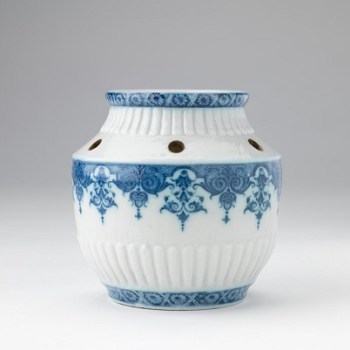
Designed by Louis Poterat, made by Louis Poterat Manufactory (Rouen, France, 1690–1696), potpourri jar, ca. 1690–96, soft-paste porcelain with underglaze enamel decoration, 12.4 × 11.4 cm (Kansas City, Missouri: The Nelson-Atkins Museum of Art, 2021.10).
Luxury and Passion celebrates the debut of a new acquisition, one of the earliest pieces of soft-paste porcelain made in France in the late 17th century. A potpourri jar, one of the handful of experimental pieces made by the Poterat Manufactory in Rouen, France, is one of only about a dozen surviving works by this brief-lived company, and only the second example in a US museum–only four exist in museums worldwide. The new acquisition gives us the opportunity to feature almost the entire collection of the museum’s important 18th-century French porcelain holdings. In this focus installation, the Nelson-Atkins explores how France launched itself into the domestic porcelain industry in the 17th and 18th centuries. This beautiful, durable type of ceramic was the focus of intense competition among European superpowers, all who raced to discover how to make this ‘white gold’ for themselves, after falling in love with imported Asian wares.










leave a comment