Exhibition | The Sassoons
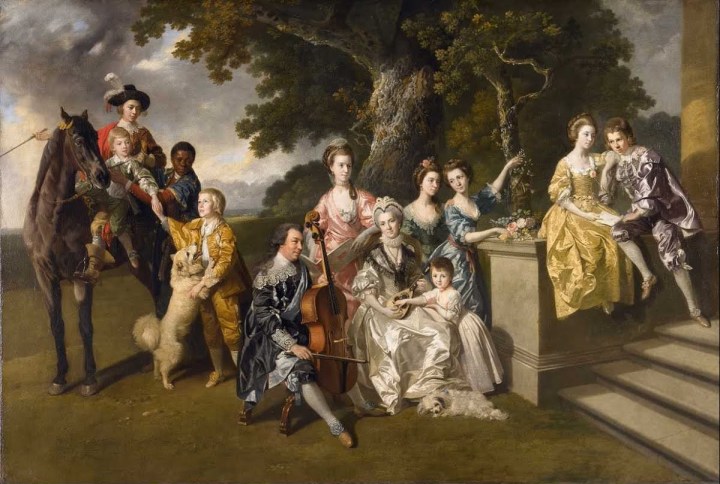
Johan Zoffany, The Family of Sir William Young, 1767–69, oil on canvas; 45 × 66 inches (National Museums Liverpool, Walker Art Gallery). Formerly in the Philip Sassoon Collection.
◊ ◊ ◊ ◊ ◊
From the press release (17 November 2022) for the exhibition:
The Sassoons
The Jewish Museum, New York, 3 March — 13 August 2023
Organized by Claudia Nahson and Esther da Costa
The Jewish Museum presents The Sassoons, an exhibition that reveals the fascinating story of a remarkable Jewish family, highlighting their pioneering role in trade, art collecting, architectural patronage, and civic engagement from the early 19th century through World War II. The exhibition follows four generations from Iraq to India, China, and England, featuring a rich selection of works collected by family members over time.
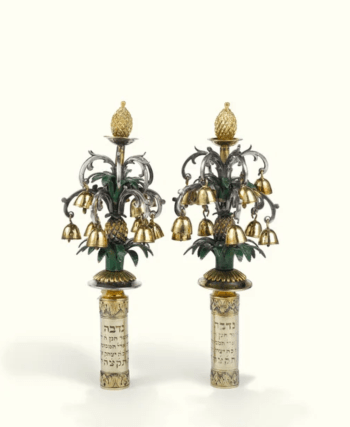
Torah finials, England, probably London, 1804, dedicated in 1834/35 (Hebrew inscription date), silver parcel gilt, and enamel, 6 inches (Collection of Jane and Stuart Weitzman). Formerly in the Reuben and Flora Sassoon Collections.
Over 120 works—paintings, Chinese art, illuminated manuscripts, and Judaica—amassed by Sassoon family members and borrowed from numerous private and public collections are on view. Highlights include Hebrew manuscripts from as early as the 12th century, many lavishly decorated; Chinese art and ivory carvings; rare Jewish ceremonial art; and Western masterpieces including paintings by Thomas Gainsborough and Jean-Baptiste-Camille Corot, and magnificent portraits by John Singer Sargent of various Sassoon family members. The Sassoons explores themes such as discrimination, diaspora, colonialism, global trade, and war that not only shaped the history of the family but continue to define our world today.
The exhibition narrative begins in the early 1830s when David Sassoon, the patriarch of the family, was forced to leave his native Baghdad due to the increasing persecution of the city’s Jewish population. Establishing himself in Mumbai (then Bombay) and initially involved in the cotton trade, his vision led the family from Iraq to India, China, and finally England where his descendants gradually settled over the decades. His activities soon grew to include the opium trade, which had escalated after the collapse of the East India Company in the mid-19th century, ending its monopoly and allowing private companies to engage in this profitable enterprise. He aligned with and benefitted from British colonial interests soon extending his business to China and England by deploying his eight sons to oversee new branches in Shanghai, Hong Kong, and London.
Although less known, the Sassoon women were discerning collectors. The exhibition will pay special attention to these unsung patrons of art. Rachel Sassoon Beer became the first woman in Britain to edit two newspapers, The Sunday Times and The Observer, and played a crucial role reporting on the Dreyfus affair in Britain. Her painting collection, sold at auction in 1927, listed, among other great works, one drawing and 15 paintings by Corot, a Constable, and a Peter Paul Rubens. Of a younger generation, Hannah Gubbay, a Sassoon on both her father’s and her mother’s side, was a major collector of 18th-century art, furniture, and porcelain, as was her cousin, Mozelle Sassoon.
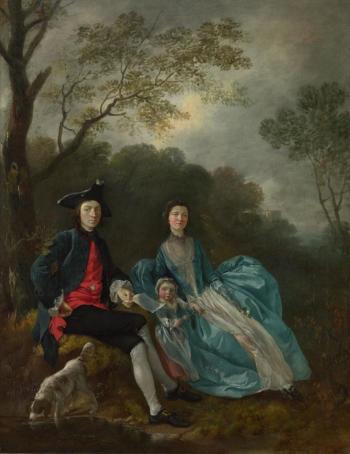
Thomas Gainsborough, Portrait of the Artist with His Wife and Daughter, ca. 1748, oil on canvas, 36 × 28 inches (London: National Gallery; acquired under the acceptance-in-lieu scheme at the wish of Sybil, Marchioness of Cholmondeley, in memory of her brother, Sir Philip Sassoon, 1994). Formerly in the Philip Sassoon Collection.
The exhibition also highlights the distinguished properties of the Sassoons in the United Kingdom. A Member of Parliament for the Conservative Party, Sir Philip Sassoon made active use of his three great residences, Park Lane (now destroyed) and Trent Park in London, and Port Lympne in Kent. Surrounded by landscaped gardens (in the case of Trent Park and Port Lympne) and filled with priceless works of art, all three were used by the government for high-profile cabinet meetings and receptions of foreign dignitaries and celebrities. Paintings of Port Lympne by Sir Winston Churchill, a frequent visitor, are featured.
The last section of the exhibition focuses on the service of a younger generation of Sassoons in the First World War. Sir Victor Sassoon served in the Royal Flying Corps, barely surviving an airplane crash that left him permanently disabled. Sir Philip Sassoon, private secretary to Field Marshal Douglas Haig, recruited his artist friends including John Singer Sargent to cover the war, and several of these works will be on display. A very different war is experienced through the poetry of Siegfried Sassoon. Though a brave and much decorated soldier, his graphic and shocking portrayal of the trenches and fierce criticism of the establishment were emblematic of a generation scarred by war’s brutality. Some of the journals he wrote and illustrated during battle, including his famous anti-war statement, will be on view.
 During the Second World War, some 18,000 Jewish refugees arrived in Shanghai fleeing Nazi Europe. They were able to survive the war thanks to the money raised by members of the Baghdadi Jewish community who resided in the city at the time. Prominent among them was Sir Victor Sassoon who donated considerable funds and placed several buildings at the disposal of the International Committee for European Immigrants.
Numerous private and public collections have contributed loans to the exhibition including His Majesty King Charles III, the British Museum, the National Gallery of London, the National Trust of Britain, the Tate, the Victoria & Albert Museum, the British Library, the Houghton Hall Collection, the Cambridge University Library, the Fitzwilliam Museum, the National Gallery of Ireland, the Israel Museum, the Metropolitan Museum of Art, the Museum of Fine Arts Boston, the Cleveland Museum of Art, and the Yale Center for British Art.
The Sassoons is organized by Claudia Nahson, Morris and Eva Feld Senior Curator at the Jewish Museum, New York, and Esther da Costa Meyer, Professor Emerita at Princeton University. The exhibition design is by Leslie Gill and Adam Johnston, Leslie Gill Architect; graphic design by Miko McGinty.
Esther da Costa Meyer and Claudia J. Nahson, The Sassoons (New Haven: Yale University Press, 2023), 256 pages, ISBN: 978-0300264302, $60.
British Art Studies, March 2023
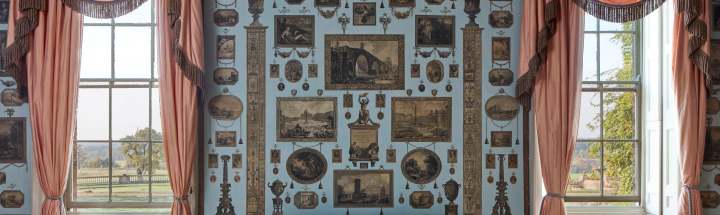
West Wall of the Print Room at Woodhall Park, Hertfordshire, created in 1782 by R. Parker.
Photographed in 2023 Matthew Hollow.
◊ ◊ ◊ ◊ ◊
The long eighteenth century in the latest issue of British Art Studies (lots of fascinating material; I’m especially taken by the videos that accompany Kate Retford’s article: they’re fabulous, particularly the one on ‘Making the Print Room’. –CH)
British Art Studies 24 (March 2023)
“Monuments Must Fall,” a ‘Conversation Piece’ convened by Edwin Coomasaru, with responses by Jodie Dowd and Nathan mudyi Sentance, Sasanka Perera, Wendy Bellion, Chrislyn Laurie Laurore, Stacy Boldrick, Joan Coutu, Emma Mahony, Nomusa Makhubu, Nickolas Lambrianou, and Raqs Media Collective.
‘Conversation Piece’ is a British Art Studies series that draws together a group of contributors to respond to an idea, provocation, or question.
Monumentality is an aesthetic form of social antagonism. . . . Many monuments are erected to do controversial work, and while they may proclaim a matter resolved or a problem consolidated, the reactions to them (sometimes long after they have been placed on pedestals) actually demonstrate the opposite is often the case. Monuments are not solely statues. Monumentality is the discursive space that surrounds certain public sculptures, including demands they be pulled down or protected, which can erupt into spontaneous or managed removal. Such a discursive space is inherently unstable, which is why most monuments ultimately must fall, physically or conceptually: either by being toppled or by having their original intentions obliterated and reimagined. . . .
Monuments are not simply physical structures, nor empty symbols, but are shaped by either social support systems that erect and conserve them, or by forms of social conflict which contest and topple them. The discursive space around a public statue, from protest to press coverage, and its translation into material conditions, is the making of its monumentality. . . .
Edwin Coomasaru’s essay and the ten responses are available here»
Kate Retford, “Cutting and Pasting: The Print Room at Woodhall Park.”
This article explores the exemplary surviving print room at Woodhall Park in Hertfordshire, created in 1782 for Sir Thomas Rumbold. A professional named “R. Parker” pasted more than 350 prints around the walls of this interior; the results were then carefully recorded in a catalogue and set of elevation diagrams. The first section, ‘Space’, analyses the print room within the broader context of the house, in order to connect exterior and interior, explore the relative qualities of ‘public’ and ‘private’ space, and consider neoclassical style as worked out in various media. The second, ‘Display’, unpacks the pasted scheme, looking at the relationship between ‘background’ images and ‘starring’ works, and that between iconography and pattern-making. The final part explores ‘Making’, analysing the processes by which prints were selected, trimmed, given paper borders, and arranged around the walls. This discussion considers both the degree to which the intermedial object of the reproductive print was translated into a trompe l’œil painting or sculpture in such schemes, and the creative work of collaging at play. The analysis in this article weaves together textual discussion with still and moving images, film, and animation. Combining these techniques, it aims to provide full documentation and analysis of the scheme, and to engage with embodied, mobile, and temporally determined viewing experience in both the house and the print room.
Article available here»
Melissa L. Gustin, “Do Sleeping Shepherds Dream of 3D-Printed Sheep: John Gibson, Oliver Laric, and Digital Neoclassicism.”
This article considers the relationship between John Gibson’s neoclassical sculpture The Sleeping Shepherd Boy [designed 1818] and Oliver Laric’s installations for the 2016 Liverpool Biennial using 3D models and prints of the Shepherd. These bodies of work allow us to think about their similarities in attitude towards imitation, the significance of the ‘neoclassical’ across different historic moments, and the cultures of copying or reproduction. It looks at the reproductive technologies of 3D scanning, printing, CNC milling, and digital remixing alongside historical reproductions such as casts and copies. These offer new potentially disruptive—but not destructive—opportunities within the legacy of neoclassical practices. The intellectual and artistic inheritance of neoclassical sculpture as an imitative practice after Greek and Roman antiquity informs Laric’s sculptural work. I draw on Alexander Nagel and Christopher Wood’s Anachronic Renaissance (2010) and George Kubler’s The Shape of Time (1968) to discuss Laric’s modular, large-scale 3D prints, which point towards issues of replacement, imitation, and wholeness. The open-source 3D models he produces as part of his practice are then used by other artists, including Zachary Eastwood-Bloom in his Divine Principles series, and the author, for making research objects.
Article available here»
Conference | Arts and Culture in the Capuchin Order
From ArtHist.net:
De habitudine Ordinis ad artem: Arts, Religion, and Culture in the Capuchin Order between the 16th and 18th Centuries
In-person and online, University of Teramo, 12–14 April 2023
The international conference De habitudine. Ordinis ad artem. Arts, Religion, and Culture in the Capuchin Order between the 16th and 18th Centuries aims to deepen the relationship between the arts, culture, religion, and the Capuchin Order on an international level, with a particular focus on the historical context and the religious dimension as an essential prerequisite for understanding artists, the production of art objects, commissions, and relations with the secular world on a global scale.
 The conference is divided into six sessions:
• The role of the Order in the context of the post-Tridentine Church
• Artistic practice between norms, prohibitions, and customs
• The cultural objects of the Capuchin world: use and circulation
• Capuchin patronage
• Capuchin painters and marangoni
• Images, knowledge, and preaching between devotion and catechesis
The conference will be held in-person and online in Italian. For both modalities, registration is required here. Links to access the conference in webinar mode will be sent by email in the days following registration.
W E D N E S D A Y , 1 2 A P R I L 2 0 2 3
9.00 Saluti Istituzionali
• Dino Mastrocola (Magnifico Rettore)
• Christian Corsi (Direttore Dip. Scienze della Comunicazione)
• fr. Roberto Genuin (Ministro Generale dei Frati Minori Cappuccini)
• fr. Carlo Maria Chistolini (Vicario provinciale della Prov. Serafica Immacolata Concezione OFM Cap.)
• fr. Daniel Kowalewski (Presidente Istituto Storico dei Cappuccini)
• Massimo Carlo Giannini (Università degli Studi di Teramo, Universidad Complutense de Madrid)
• Raffaella Morselli (Università degli Studi di Teramo)
9.30 Prolusione
• Mons. Felice Accrocca (Arcivescovo di Benevento, docente di Storia Francescana)
10.00 I Sessione | Il ruolo dell’Ordine nel contesto della Chiesa post-tridentina
Presiede: Grado Giovanni Merlo (Università degli Studi di Milano)
• Paolo Cozzo (Università degli Studi di Torino) — Fra corte e missioni: i cappuccini nella politica religiosa degli Stati sabaudi (sec. XVI–XVII)
• Massimo Carlo Giannini (Università degli Studi di Teramo, Universidad Complutense de Madrid) — ‘Las obligaciones de Religiosos y buenos Vassallos’: l’ordine dei cappuccini e la Monarchia spagnola (1671–1698)
• Giovanni Pizzorusso (Università degli Studi di Chieti-Pescara) — La controversa attività missionaria del cappuccino francese Pacifique de Provins dalla Persia al Nuovo Mondo (prima metà XVII secolo)
• Maria Teresa Fattori (Humboldt, Universität zu Berlin) — Cronologia e casi di frati cappuccini contrari alla schiavitù (XVII–XVIII secolo)
• Giuseppe Patisso (Università del Salento) — ‘I cappuccini di Richelieu’: Missioni ed evangelizzazione nella Nuova Francia durante la prima metà del XVII secolo
• Carlo Pelliccia (Università degli Studi Internazionali di Roma) — L’esperienza religiosa e missionaria di Onofrio Villiani (1715–1789) tra la Compagnia di Gesù e l’Ordine dei Frati Minori Cappuccini
13.15 Pausa pranzo
15.00 II Sessione | La pratica artistica tra norme, divieti e consuetudini
Presiede: Raffaella Morselli (Università degli Studi di Teramo)
• Yuri Primarosa (Roma, Gallerie Nazionali di Arte Antica) — Per un’estetica cappuccina nella Roma del primo Seicento. Caravaggio e Orazio Gentileschi
• Alessandro Zuccari (Sapienza Università di Roma) — Sviluppi dell’arte cappuccina tra Roma e Bologna
• Claudio Sagliocco (Sapienza Università di Roma) — Originale e copia nella pittura cappuccina
• Arianna Petraccia (Liceo Scientifico ‘D’Ascanio’, Montesilvano, PE) — I dipinti di Baccio Ciarpi per i cappuccini: Affinità elettive tra un pittore ed un Ordine religioso
• Attilio Maria Spanò (Liceo Classico ‘Campanella’, Reggio Calabria) — Controriforma e pauperismo francescano: L’esperienza architettonica e insediativa dei frati minori cappuccini
T H U R S D A Y , 1 3 A P R I L 2 0 2 3
9.30 III Sessione | Gli oggetti culturali del mondo cappuccino: uso e circolazione
Presiede: Luca Siracusano (Università degli Studi di Teramo)
• Roberto Rusconi (Università di Roma Tre) — Le parole e le pagine: I Cappuccini e i libri ovvero i libri dei Cappuccini
• Mario Tosti (Università degli Studi di Perugia) — Gli Atlanti cappuccini e l’immagine dell’Ordine nell’età della Controriforma
• Giovanna Granata (Università degli Studi di Cagliari) — Il patrimonio librario antico dei Cappuccini: Il caso della Sardegna
• Andrea Pezzini (Universität Bern) — Il culto di S. Ignazio da Santhià (1686–1770): Oggetti di devozione come cultura materiale
• Jason Di Resta (Wesleyan University) — Os ex ossibus meis et caro de carne mea: Giving Shape to Collective Identity in the Crypts of the Capuchin Order
12.45 Pausa pranzo
15.00 IV Sessione | La committenza cappuccina
Presiede: Anna Orlando (Advisor Cultura Comune di Genova)
• Donatella Biagi Maino (Università di Bologna) — L’arte per i cappuccini in Emilia-Romagna
• Laura Facchin (Università degli Studi dell’Insubria) — Arti figurative nelle chiese cappuccine dalla capitale ai territori della Provincia Pedemontana
• Vincenzo Sorrentino (Fondazione 1563 per l’Arte e la Cultura) — Alessandro, Giovanni e Cherubino Alberti nella chiesa dei Cappuccini di Frascati
• Ondřej Slanina (Universität Bern) — Unique Large Pearl Monstrance from the Capuchin Loreto in Hradčany, Prague
• Pietro Costantini (Università degli Studi di Teramo) — Insediamenti e patrimonio culturale: Donazioni e committenze per i frati cappuccini in Abruzzo (sec. XVI–XVIII)
F R I D A Y , 1 4 A P R I L 2 0 2 3
9.30 V SESSIONE | Pittori, marangoni e fabbricieri cappuccini
Presiede: Giorgio Fossaluzza (Università degli Studi di Verona)
• Isabella Di Liddo (Università degli Studi di Bari Aldo Moro) — Le botteghe dei cappuccini in Puglia tra Sei e Settecento: Prime tracce per uno studio
• Anna Orlando (Advisor Cultura Comune di Genova) — Bernardo Strozzi sperimentatore: Un pittore cappuccino dal convento genovese alla fuga a Venezia
• Miriam Kreischer (Ludwig-Maximilians-Universität) — The impact and importance of Paolo Piazza on the European art landscape of the 17th and 18th centuries: Paolo Piazza in Bavaria
• Luca Calenne (Archivio storico diocesano ‘Innocenzo III’, Segni, RM) — Un risarcimento per Fra’ Antonio Borgognone
• Daniele Giglio (Archivio storico Prov. Serafica Immacolata Concezione OFM Cap. – sez. di Assisi) — Fabbriche, arti e mestieri dei cappuccini umbri nel Settecento
12.45 Pausa pranzo
15.00 VI Sessione | Le immagini, i saperi e la predicazione tra devozione e catechesi
Presiede: Cecilia Paolini (Università degli Studi di Teramo)
• Francesco Nocco (Archivio storico Prov. dei Cappuccini di Puglia, Università degli Studi di Bari Aldo Moro) — Predicatori della Terra di Bari e della Terra d’Otranto nell’Archivio storico della Provincia dei Cappuccini di Puglia (sec. XVI–XVIII)
• Tereza Horáková (Masaryk University) — Possibilities and ‘offer’ of devotional practice in Capuchin monasteries in the Czech lands during the 18th century
• Javier González Torres (Fundación Victoria) Sergio Ramírez González (Universidad de Málaga) — La promoción cultual de un santoral eucarístico propio: Concreción conceptual y praxis artística en los conventos capuchinos andaluces
• Daniela Caracciolo (Università del Salento) — ‘Le cose spirituali non si possono dipingere’: La questione delle immagini sacre negli scritti di Bernardino Ochino
• Martina Leone (Università degli Studi di Teramo) — Iconografia cappuccina da Roma alla Serenissima: Francesco Ruschi tra innovazione e tradizione
Predoctoral Fellow | Decay, Loss and Conservation in Art History
From the Bibliotheca Hertziana:
Predoctoral Fellow for the Research Group ‘Decay, Loss and Conservation in Art History’
Led by Francesca Borgo at the Bibliotheca Hertziana – Max Planck Institute for Art History in Rome
Applications due by 31 May 2023
The Lise Meitner Research Group “Decay, Loss and Conservation in Art History” led by Francesca Borgo at the Bibliotheca Hertziana – Max Planck Institute for Art History in Rome seeks to appoint a Predoctoral Fellow (M/F/D). The Max Planck Society is Germany’s premier research organization. The 86 Max Planck Institutes conduct research at the highest level in the service of the general public in the natural sciences, life sciences, social sciences, and the humanities. The deadline for application is 31 May 2023, 12pm CEST. Interviews will be held virtually in June 2023. Candidates should propose a funding period of desired length within the academic year 2023/2024. Motivations for the length of period proposed should be made clear in the cover letter.
The Predoctoral Fellow will conduct their own research within the framework of the Research Group, which focuses on European and Colonial art histories from the fifteenth to the eighteenth century, a period during which techniques and media were ranked based on their ability to last, and decay was first recognized as a subject worthy of aesthetic and scientific attention.
Excellence in research, commitment to pursue new insights through original scholarship, and willingness to become part of a group of young, international scholars are essential. Fellows will actively participate in the Group’s activities and are invited to contribute to its publication output while benefitting from editorial and image licensing support. They will be responsible for planning and organizing seminars, workshops, visits, and fieldtrips in collaboration with other team members and under the supervision of the Group Leader. Candidates must be conversant in English and familiar with Italian and/or German.
This position is intended for a PhD student enrolled at any university worldwide who is in the finishing stages of their dissertation. In addition to clarifying how residence in Rome benefits their PhD research, candidates should include in their cover letter a statement of how their work advances the goals of the research group. Candidates should also seek the approval of their doctoral advisor. Candidates are expected to review the Research Group’s research agenda, past initiatives and event series, as well as the broader structure of the Bibliotheca Hertziana into which the Research Group fits. We welcome applications from doctoral students in every field within the history of art, technical art history, conservation history, and museum studies, with preference given to projects spanning traditional disciplinary boundaries. The selection committee aims to assess the ability of candidates to contribute in a collegial way to the intellectual life of the Research Group.
This is a residential fellowship. By the start of the appointment, candidates are expected to have taken up residence in Rome. The fellowship may not be held concurrently with another major fellowship award; applicants must disclose any supplementary funding and may not take on other obligations during their fellowship period.
The Max Planck Society offers a fixed-term contract of employment. Stipend and benefits are determined according to the German Civil Service Collective Agreement (65% TVöD Bund E 13) or equivalent, depending on individual personal circumstances. Fellows enjoy all the privileges of the Institute, including library access seven days a week, a research budget, and their own carrel or desk.
We encourage women and individuals from communities that are underrepresented in academia to apply. The Max Planck Society is committed to fostering equal opportunities and diversity and welcomes applicants from all parts of society, regardless of gender, ethnicity, disabilities, or sexual orientation.
To apply the candidate must upload the following documents as separate PDF files to the application portal:
• Cover letter that clearly states the candidate’s contribution to the Research Group’s objectives
• Description of proposed research project (max. 1000 words), accompanied by a bibliography
• Curriculum vitae with list of publications (including those forthcoming, under revision, submitted, or in preparation)
• One reference letter
• Output proposal (max. 500 words). This could be a site visit, a collaboration with a local collection, a research seminar, a publishable piece of writing, or a contribution to a national or international conference. The proposal should detail specific names and locations and specify how the output aligns with the Research Group’s themes.
New Book | Uproar! Scandal and Satire in Georgian London
From Icon Books:
Alice Loxton, Uproar! Scandal and Satire in Georgian London (London: Icon Books, 2023), 416 pages, ISBN: 978-1785789540, £25.
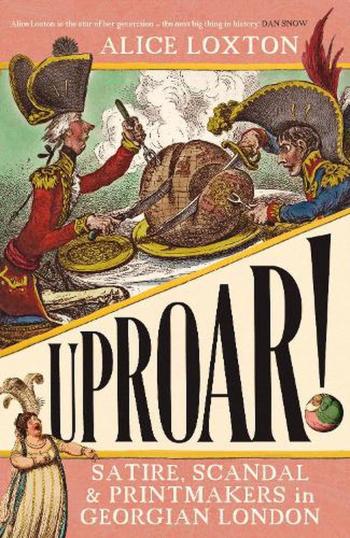 London, 1772: a young artist called Thomas Rowlandson is making his way through the grimy backstreets of the capital, on his way to begin his studies at the Royal Academy Schools. Within a few years, James Gillray and Isaac Cruikshank would join him in Piccadilly, turning satire into an artform, taking on the British establishment, and forever changing the way we view power.
Set against a backdrop of royal madness, political intrigue, the birth of modern celebrity, French revolution, American independence and the Napoleonic Wars, UPROAR! follows the satirists as they lampoon those in power, from the Prince Regent to Georgiana, Duchess of Devonshire. Their prints and illustrations deconstruct the political and social landscape with surreal and razor-sharp wit, as the three men vie with each other to create the most iconic images of the day.
UPROAR! fizzes with energy on every page. Alice Loxton writes with verve and energy, never failing to convince in her thesis that Gillray and his gang profoundly altered British humour, setting the stage for everything from Gilbert and Sullivan to Private Eye and Spitting Image today. This is a book that will cause readers to reappraise everything they think they know about genteel Georgian London, and see it for what it was—a time of UPROAR!
Alice Loxton is a 27-year-old historian and the lead female presenter at History Hit TV, where she regularly co-presents documentaries with Dan Snow. She is also a well-loved face of the History Hit YouTube channel, and shares her passion for history with over a million followers on TikTok and Instagram. Follow her at @history_alice.
New Book | The Artist’s Studio
From Thames & Hudson:
James Hall, The Artist’s Studio: A Cultural History (London: Thames & Hudson, 2023), 288 pages, ISBN: 978-0500021712, $40.
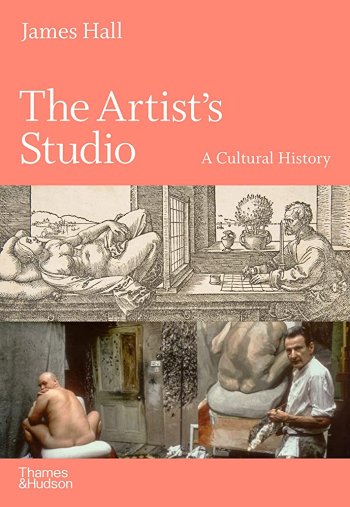 A revealing chronicle and visual history of the artist’s studio, examining the myth and reality of the creative space from early times to the present day.
The artist’s workplace has always been an idealized utopia as well as the domain of dirty, backbreaking work. Written descriptions, paintings, prints, and even photographs of the artist’s atelier distort as much as they document. This illuminating cultural history of the artist’s studio charts the myth and reality of the creative space from ancient Greece to the present.
Tracing a history that extends far beyond the bohemian, romantic, and renaissance cults of the artist, each chapter focuses on key developments of the studio space as seen in a variety of familiar and unfamiliar images. Mythical and divine makers and some amateurs are included, alongside craftspeople―potters, illuminators, weavers, embroiderers, and architects―along with artists such as Artemisia Gentileschi, Claude Monet, Michelangelo, Rosa Bonheur, and Diego Rivera. Each carefully chosen example places the studio within a cultural and political context, with the aim of correcting the historical imbalance that has distorted the picture by leaving out the many artisans who collaborated with artists. Leading authority James Hall also extends the discussion to the artist’s museum and the artist’s house, as well as the development of portable studios, with sections on ‘plein air’ painting and drawing in the East. Visually appealing, featuring images of the artist’s studio from around the world, this compelling, eye-opening history identifies key studios, individuals, trends, and turning points in the history of the creative space.
James Hall is an art critic, historian, lecturer, and broadcaster. He was formerly chief art critic for the Sunday Correspondent and The Guardian. He contributes to The Guardian Saturday Review, The Times, and Times Literary Supplement, as well as well as to magazines and catalogues. He is the author of several books, including The Self-Portrait: A Cultural History.
C O N T E N T S
Introduction
1 Luxury and Lameness: The Shield of Achilles
2 Wisdom’s Workshop: Simon the Shoemaker
3 Struggles in the Scriptorium: Waging War on Dead Skin
4 Pure Gold: Doing God’s (or the Devil’s) Work
5 The Velvet Revolution: Cennini’s Studietto
6 Piety and Pretentiousness: Saint Luke Paints the Virgin
7 ‘Always Keeping Paper in His Hand’: A School for Art and Scandal
8 In and Out of the Comfort Zone: Leonardo versus Michelangelo
9 Creatures of the Night: ‘Only the Dark Serves to Plant Man’
10 Making a Spectacle: The Systematic Studio
11 Mirroring the Process: Velázquez to Reynolds
12 Women in the Studio: Inspiration, Destitution, Cleaning, Crimes of Passion
13 Chaste Space: Friedrich to Mondrian
14 Eliminating Easels: Workshop and Factory
15 Inside / Outside: Studios for Nomads
Notes
Select Bibliography
Picture Credits
Index
Acknowledgments
The Burlington Magazine, March 2023
The eighteenth century in the March issue of The Burlington . . .
The Burlington Magazine 165 (March 2023)
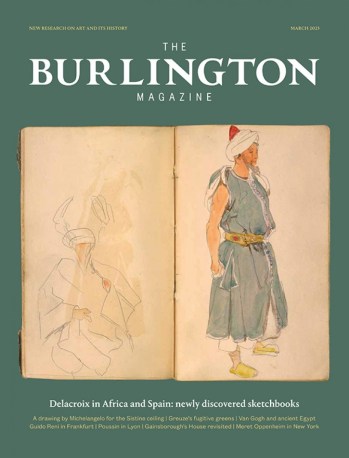 E D I T O R I A L
• “Omai,” p. 219.
Given his undisputed central place in the history of British art, it is surprising that the three-hundredth anniversary of the birth of Joshua Reynolds is not being celebrated this year with more éclat. The principal tribute will be an exhibition Reframing Reynolds: A Celebration (24 June – 29 October 2023) at the Box in Plymouth, the city where Reynolds made his reputation—he was born on 16th July 1723 at Plympton, on its outskirts. The exhibition will explore the patronage he enjoyed from the Eliot family of Port Eliot, St Germans, and will be supplemented by the museum’s collection of paintings by Reynolds, the largest outside London.
Reynolds’s reputation rests largely on his portraits, so it might have been expected that the museum that contains the largest number, the National Portrait Gallery, London (NPG), would have marked the occasion with an exhibition of its own, but given that it has been closed for the past three years for a comprehensive redevelopment and redisplay, due to be unveiled on 22nd June, it has had other priorities. Yet any disappointment that the NPG is neglecting Reynolds in his anniversary year was allayed by the announcement last August that it is seeking to raise £50 million to acquire one of his greatest paintings, the full-length portrait of Omai, the first Polynesian to visit Britain. Universally praised ever since it was first seen in public, at the Royal Academy of Arts in 1776, it is a work both of great beauty and of compelling historic interest as a document of the earliest European encounter with Pacific cultures. . . Keep reading here»
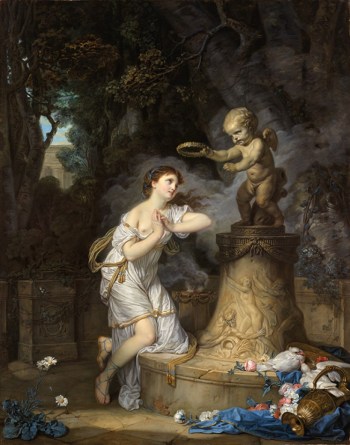
Jean-Baptiste Greuze, A Young Woman Praying at the Altar of Love (Votive Offering to Cupid), 1767, oil on canvas, 146 × 113 cm (London: The Wallace Collection).
A R T I C L E S
• Yuriko Jackall, Barbara H. Berrie, John K. Delaney, and Michael Swicklik, “Greuze’s Greens: Ephemeral Colours, Classical Ambitions,” pp. 268–79.
Jean-Baptiste Greuze was criticized in his lifetime for the unduly muted palette of some of his paintings. New technical analysis, combined with the recent discovery of a list in his handwriting of pigments he used, has revealed that his greens have faded because they incorporate fugitive yellow lakes, a practice Greuze continued even after its disadvantages were obvious.
R E V I E W S
• Roko Rumora, Review of the exhibition Chroma: Ancient Sculpture in Color (The Metropolitan Museum of Art, 2022–23), pp. 312–15.
• Desmond Shawe-Taylor, Review of the newly opened, expanded Gainsborough’s House (Sudbury), pp. 322–25.
• Friso Lammertse, Review of the newly renovated Royal Museum of Fine Arts, Antwerp (KMSKA), pp. 332–35.
• Simon Swynfen Jervis, Review of Jean-Pierre Fournet, Cuirs dorés, ‘Cuirs de Cordoue’: un art européen (Éditions d’art Monelle Hayot, 2019), pp. 342–43.
• Gauvin Alexander Bailey, Review of Aaron Hyman, Rubens in Repeat: The Logic of the Copy in Colonial Latin America (Getty Research Institute, 2021), pp. 343–44.
• Stephen Bann, Review of Joanthan Ribner, Loss in French Romantic Art, Literature, and Politics (Routledge, 2022), pp. 344–45.
• Charlotte Gere, Review of Julius Bryant, Enriching the V&A: A Collection of Collections, 1862–1914 (Lund Humphries and V&A Publishing, 2022), pp. 345–46.
• Jennifer Johnson, Review of Sam Rose, Interpreting Art (UCL Press, 2022), p. 350.
New Book | Intimate Interiors
From Bloomsbury:
Tara Zanardi and Christopher M. S. Johns, eds., Intimate Interiors: Sex, Politics, and Material Culture in the Eighteenth-Century Bedroom and Boudoir (London: Bloomsbury, 2023), 296 pages, ISBN: 978-1350277601, $120.
 A desire for intimacy in domestic spaces—motivated by a growing sense of individualistic expression, an incentive to conceal the labor or enslavement taking place, and an appetite for solace and comfort—led to interiors taking on more specific roles in the eighteenth century. By examining the architectural, visual, and material culture of eighteenth-century spaces, Intimate Interiors foregrounds the interrelated concepts of intimacy, privacy, informality, and sociability in order to show how these ideas played an increasingly integral role in the period’s architectural and material design. Across eleven innovative chapters that explore issues of gender, politics, travel, exoticism, imperialism, sensorial experiences, identity, interiority, and modernity, this volume demonstrates how intimacy was a fundamental goal in the planning of private quarters. In doing so, the political nature of private spaces is uncovered, whilst highlighting the contradictions and complexities of these highly performative ‘private’ interiors. Employing distinct methodological perspectives across various geographical sites, from Turkey to Versailles, Britain to Benin, Intimate Interiors draws as-yet untraced connections between Enlightenment Europe, imperial outposts, and major metropolitan centers across the globe.
The volume is part of the Material Culture of Art and Design series, edited by Michael Yonan.
Tara Zanardi is Associate Professor of Art History at Hunter College, CUNY. She publishes on eighteenth-century Spanish visual and material culture, including “Silver” (Journal18 special issue, 2022), Visual Typologies from the Early Modern to the Contemporary: Local Practices and Global Contexts (co-edited with Lynda Klich, 2018), and Framing Majismo: Art and Royal Identity in Eighteenth-Century Spain (2016). She has received fellowships from NEH, the Metropolitan Museum of Art, the Fulbright Program, and the John Carter Brown Library.
Christopher M. S. Johns was the Norman L. and Roselea J. Goldberg Professor of History of Art at Vanderbilt University in Nashville. He began his teaching career at the University of Virginia in 1985 and rose to the position of endowed chair at Vanderbilt in 2003. A specialist in eighteenth-century Italian art, decorative art, material culture, and architecture, he published widely on the relationship between art, politics, and religion in early modern Italian culture in particular. He was a founding member of the Historians of Eighteenth-Century Art and Architecture. Sadly, Johns passed away in 2022.
C O N T E N T S
List of Contributors
List of Plates
List of Figures
Foreword
Introduction — Tara Zanardi (Hunter College, CUNY) and Christopher M.S. Johns (Vanderbilt University, until 2022)
Part 1: Power, Authority, Agency, Privacy
1 Sex, Lies, and Books: Staging Identity in the Comte d’Artois’s Cabinet Turc — Ashley Bruckbauer (Independent Scholar)
2 Enlightenment Naples Imagines Imperial China: Queen Maria Amalia’s Chinoiserie Boudoir — Christopher M. S. Johns (Vanderbilt University, until 2022)
3 Who Let the Dogs In?: The Hundezimmer in the Amalienburg Palace — Christina Lindeman (University of South Alabama)
4 Material Temptations: Isabel de Farnesio and the Politics of the Bedroom — Tara Zanardi (Hunter College, CUNY)
Part 2: Staging Identity and Performing Sociability
5 A Stage for Wealth and Power in Eighteenth-Century Lima: The Estrado of Doña Rosa Juliana Sánchez de Tagle, First Marchioness of Torre Tagle — Jorge Rivas (Denver Art Museum)
6 An Artist’s Bedrooms: Angelica Kauffman in London and Rome — Wendy Wassyng Roworth (University of Rhode Island)
7 The Mask in the Dressing Room: Cosmetic Discourses and the Masquerade Toilet in Eighteenth-Century British Print Culture — Sandra Gómez Todo (Independent Scholar)
Part 3: Hidden Lives and Interiority
8 Mythologies of the Boudoir: Jacques-Louis David’s The Loves of Paris and Helen — Dorothy Johnson (University of Iowa)
9 Political Interiority and Spatial Seclusion in West African Royal Sleeping Rooms — Katherine Calvin (Kenyon College)
10 On the Wings of Perfumed Reverie: Multisensory Construction of Elsewhere and Elite Female Authority in Marie-Antoinette’s Boudoir Turc — Hyejin Lee (Independent Scholar)
11 ‘Virginian Luxuries’ at Thomas Jefferson’s Monticello — Maurie McInnis (Stony Brook University)
Index
New Book | All Walks of Life
From Arnoldsche:
Vanessa Sigalas and Meredith Chilton, eds., with additional contributions by André van der Goes, Jennifer Mass, and Aaron Shugar, and photography by Melissa Shimmerman, All Walks of Life: A Journey with The Alan Shimmerman Collection, Meissen Porcelain Figures of the Eighteenth Century (Stuttgart: Arnoldsche Art Publishers, 2023), 672 pages, ISBN: 978-3897906419, €68 / £75 / $115.
 All Walks of Life offers a unique opportunity to get to know the eighteenth-century people of Saxony, Paris, London, and St. Petersburg through the Meissen porcelain sculpture of the Alan Shimmerman Collection. Readers will become participants in a tour through Dresden and Meissen with Johann Joachim Kaendler as their guide, with excursions to London, Paris, and St. Petersburg also on the itinerary. Kaendler, along with his fellow modellers and painters at Meissen, captured glimpses of everyday life by paying meticulous attention to the smallest details: the carefully arranged tray of a trinket seller, the personal writing of a love letter, the larding tools of a cook preparing a hare. Whimsical glimpses into the lives of these everyday characters are created by inserting the porcelain figures into their eighteenth-century setting, using period illustrations and engravings as a backdrop.
The outstanding porcelain figures and groups of the Alan Shimmerman Collection form an unrivalled assemblage of the finest creations from one of the most famous porcelain manufactories in the world. The collection, which includes not only the most excellent examples of courtly and commedia dell’arte figures, but also lesser known and under-researched representations of everyday people, presents an aspect of Meissen production missing from many other collections. Alan Shimmerman’s focus on collecting complete series of figures, such as the Criers and Artisans, enables a fresh look at the creation, output, and distribution of Meissen porcelain. The publication includes the first comprehensive large-scale scientific analysis of a major collection of Meissen figures revealing new and unexpected findings.
Vanessa Sigalas is the David W. Dangremond Associate Curator for Collections Research at the Wadsworth Atheneum Museum of Art in Hartford, Connecticut. Her research focuses on European decorative arts, especially German porcelain and ivory. She also serves as the Managing Editor of the American Ceramic Circle Journal.
Meredith Chilton, C.M., is an independent art historian and curator who lives in Warwickshire, UK. She is a specialist in European ceramics of the 1700s, court and theatre history, and food and dining culture. Her publications include Harlequin Unmasked (2001), Fired by Passion (2009), and The King’s Peas (2019).
Melissa Shimmerman is a Toronto-based freelance photographer. Specializing in fine art and in commercial and portrait photography, her work is featured in art publications and catalogues for museums, galleries, and private collectors. Her oeuvre includes photography of art by Pablo Picasso, Marc Chagall, and the collections of the Gardiner Museum in Toronto.
André van der Goes is a former director of the Museum of Applied Arts, Staatliche Kunstsammlungen Dresden, and lecturer of the History of Art at the Technische Universität Dresden. Since 2012 he has been organizing study tours to museums, collections, and palaces in Dresden and other important European cultural cities for Grand Tour Dresden. His publications principally cover the history of material and nonmaterial culture.
Jennifer Mass is the Andrew W. Mellon Professor of Cultural Heritage Science at Bard Graduate Center and the President and Founder of Scientific Analysis of Fine Art. She also leads the scientific vetting committee at TEFAF New York and has co-authored several publications on Meissen porcelain colorants and technologies.
Aaron Shugar is the Andrew W. Mellon Professor of Conservation Science in the Art Conservation Department at Buffalo State College, New York. He received his PhD in Archaeometallurgy from the Institute of Archaeology, University College London. He has published and conducted extensive scientific analysis on a wide range of art and archaeological materials for over twenty years.
Mount Vernon Symposium | Decorative Arts in the French Atlantic World

French porcelain tea and coffee service made for George and Martha Washington, and gifted by the Comte de Custine de Sarreck, ca. 1782.
◊ ◊ ◊ ◊ ◊
From Mount Vernon:
‘Very elegant & much admired’: Decorative Arts in the French Atlantic World
George Washington Presidential Library, Mount Vernon, Virginia, 2–4 June 2023
After the American Revolution, George Washington resolved that he would no longer “send to England (from whence I formerly had all my goods) for anything I can get upon tolerable terms elsewhere.” He instead turned to the United States’ greatest ally, France, where he found the furniture, ceramics, textiles, and decorative objects to be “very elegant” and “much admired.”

The symposium will take place at the George Washington Presidential Library at Mount Vernon, in Virginia. The library opened in 2013.
The 2023 Mount Vernon Symposium will examine George and Martha Washington’s adoption of the French taste, as a catalyst to further explore the complex interchange of culture, decorative styles, and objects in the French-Atlantic World. Join leading curators and historians as they examine the diffusion of French style, from the Ancien Régime through the French Revolution to the French Empire, and from Paris to London, Philadelphia, Port-au-Prince, and New Orleans, to 20th-century Los Angeles. In-person participation cost is $400 ($375 for members and donors), which includes all lectures, meals, and tours. Virtual participation (in real-time or through recordings available until 4 July 2023) is $40.
F R I D A Y , 2 J U N E 2 0 2 3
1:00 Registration
1:30 Welcome and Introductions
1:45 The Garde-Meuble de la Couronne: From its Creation to Revolutionary Sales — Stéphane Castelluccio
The Garde-Meuble de la Couronne was the administration in charge of furnishing the apartments of the members of the royal family in the residences of the French sovereign. King Henry IV created it in 1604 as part of his policy to reorganize the kingdom after the Wars of Religion. This talk will present the management, exercised by only three different families during a century and a half, as well as the functioning of this administration which took an increasing importance throughout the 18th century. It will explain the changes in its organization during the Revolution, and end with the reasons, principles and organization of the revolutionary sales of the Crown’s furniture, decided by the new Republic from 1793.
2:45 ‘A little French ease adopted would be an improvement”: Lessons in Sociability and Decorative Arts from 1780s Paris — Amy Hudson Henderson
After the American Revolution, an increasing number of American diplomats, businessmen, students, artists, and tourists found themselves in Paris mixing amongst themselves in the upper echelons of French society. It was a heady time, ripe with opportunities for forging new relationships and identities. Here, in 1784, a young Nabby Adams observed that Americans would do well to adopt “a little French ease” as an antidote to the stiffness and reserve that seemed to mar their social circles back home. What did she mean? This paper answers that question by exploring extant correspondence and household furnishings. By focusing on the acquisitions and behaviors of the prominent Americans who spent time in Paris during the 1780s, we deepen our understanding of the role of French decorative arts in both sociability and diplomacy and discover why these objects appealed to George and Martha Washington.
3:45 Break
4:00 Adam T. Erby – TBA
5:00 Henry Auguste: A Goldsmith in Revolutionary Paris — Iris Moon
This talk explores the unlikely career trajectory of the Parisian goldsmith Henry Auguste (1759–1816) during the French Revolution, drawing on new research published in Luxury after the Terror. Crafty, wily, and untrustworthy, but obviously talented with a hammer and chisel, Auguste started off as an apprentice to his well-known goldsmith father, who worked for Louis XVI. Beyond the French court, Auguste acquired a number of prestigious clients, including the British connoisseur William Beckford, for whom he fashioned an ewer made out of pure gold. Just as the volatile politics of the French Revolution sought to overturn the values of the Ancien Régime in favor of new ones, Auguste sought to refashion himself as more than a goldsmith during a moment of tremendous opportunity—and great risk.
6:30 Reception
7:15 Dinner
S A T U R D A Y , 3 J U N E 2 0 2 3
7:30 Breakfast
8:45 Welcome and Introductions
9:00 Emerging Scholars’ Panel
10:00 Break
10:15 Revolutionary Things — Ashli C. White
During the late 18th century, a wide range of objects associated with the American, French, and Haitian revolutions crisscrossed the ocean. Furniture and ceramics; clothing and accessories; maps, prints, and public amusements—all circulated among diverse actors who wrestled with the political implications of these items. In this presentation we will examine the unique ways that transatlantic revolutionary things shaped how people understood contested concepts like equality, freedom, and solidarity. And, we will explore how these objects became a means through which individuals—enslaved and free, women and men, poor and elite—promoted, and sometimes tried to thwart, the realization of these ideals on the ground.
11:15 À la française: Designing French North America, 1700–1820 — Philippe Halbert
At its height, New France extended from eastern Canada, across the Great Lakes, and down the Mississippi River to Louisiana. Although its population remained small, French North America was no less dynamic in terms of artistic originality or creative output. Even after New France’s fall in 1763, areas of French settlement held fast to creole syntheses of Gallic aesthetics and vernacular tradition. This presentation will introduce a cross-section of objects and buildings whose stories reveal the vibrant legacies of French cultural identity as it took root in North America before 1800.
12:15 Lunch
1:45 An American in Paris: Walt Disney and France — Wolf Burchard
Walt Disney was about to turn 17 when he first set foot in France in December 1918. The buildings, the art and the atmosphere had a lasting impact on the animated world he would go on to create. Inspiring Walt Disney: The Animation of French Decorative Arts, an exhibition shown at the Metropolitan Museum of Art in New York, the Wallace Collection in London and the Huntington Art Gallery in Pasadena, brought together the seemingly disparate worlds of 20th-century hand-drawn animation and 18th-century decorative arts, which upon closer inspection reveal remarkable similarities. Wolf Burchard will relate how the exhibition explored Disney’s fascination with European art and the impact it had on the studio’s output, especially the three French fairytales retold in hand-drawn animation: Cinderella (1950), Sleeping Beauty (1959), and Beauty and the Beast (1991).
2:45 Break
3:15 A Passion for Porcelain: Sèvres in the Wallace Collection — Helen Jacobsen
Ever since the early days of its development in the mid-18th century, the porcelain produced at the Sèvres Manufactory outside Paris has been a magnet for collectors, attracted by its vibrant colours, rich gilding, and innovative designs. The Sèvres collection at the Wallace Collection was put together in the 19th century, but its collectors were no less beguiled by its flamboyant luxury and exquisite craftsmanship. This lecture will follow the evolution of some of the most celebrated pieces ever produced at the manufactory and will explore the passions that gave shape to what is now one of the finest collections of Sèvres porcelain in the world, a testament to its enduring fascination.
4:15 James Monroe’s Use of French Furnishings in the White House and the Restoration of the Bellangé Suite — Melissa Naulin
Following its burning during the War of 1812, the President’s House required almost all new furnishings before it could reopen for President James Monroe’s use in 1817. Relying on his extensive knowledge of fashionable home goods gained through his two European diplomatic appointments, Monroe worked to secure a large number of these new furnishings from Paris. My talk will focus on these government-purchased French goods, many of which remain amongst the most-treasured objects in the White House collection. I will also detail the recent effort to restore the furniture suite made by Pierre Antoine Bellangé and purchased for Monroe’s “large oval room” (today’s Blue Room) to its original splendor.
5:45 Reception
7:00 Dinner
S U N D A Y , 4 J U N E 2 0 2 3
9:00 Breakfast
9:30 From West to East: Huguenot Craft Communities in London’s Soho and Spitalfields — Tessa Murdoch
Drawing on research undertaken for her recent publication, Tessa will speak about the formation of Huguenot artisan communities in Soho and Spitalfields. Leading personalities, include engraver Simon Gribelin, resident in West London who married into the Spitalfields based Mettayer family. The complex history of the Courtauld family, established in West London, gravitates from silversmithing in Soho and the City to textile production in Spitalfields and beyond. Craft communities centered on conformist and non-conformist French speaking churches and were gradually assimilated into Anglican churches. Huguenot refugees developed mutual support systems, friendly societies, the French Hospital which still flourishes as almshouses and the Westminster French Protestant Charity School. These Huguenot charities document the contribution of Huguenot craftsmen and women to British culture.
10:15 Forging a New Vernacular: The Transformation and Triumph of a French Ébéniste in Federal New York — Peter M. Kenny
Charles-Honoré Lannuier (1779–1819) arrived in New York in the spring of 1803 a thoroughly-trained Parisian ébéniste who, according to his inaugural newspaper advertisement, had “worked at his trade with the most celebrated Cabinet Makers of Europe.” Well-versed in the elegant forms of the late Louis XVI period, which still held sway during the earliest period of his training in Paris, Lannuier’s design vocabulary at the time of his arrival also included the harder edged yet brilliant neoclassical style of post-Revolutionary France known as Directoire (1795–99), and the Consulat (1799–1804), a heavier more monumental style featuring the more archaeologically correct forms of le goût antique. This was Lannuier’s Parisian stylistic legacy. How he transformed this legacy, ultimately becoming one of the two principal leaders of the New York school of cabinetmaking alongside his greatest rival, Duncan Phyfe, is an inspiring and uniquely American story.
11:00 Break
11:15 Elizabeth Patterson Bonaparte and the Material Creation of an Imperial Legacy — Alexandra Deutsch
Elizabeth Patterson Bonaparte (1785–1879) is often remembered for her short, but remarkable marriage in 1803 to Napoleon’s youngest brother, Jerome Napoleon Bonaparte. Although their mésalliance resulted in divorce, their union set her and future generations of American Bonapartes on a path that allied them with France and an imperial legacy. Drawing from thousands of documents and a collection of more than 600 objects associated with the Bonapartes, this lecture charts the history of Elizabeth’s long life during which she meticulously created and documented a material world tethered to France. From her fashion to her silver, jewels, and furniture, Elizabeth’s self-presentation proclaimed her French connection. Her obsessive documentation of her possessions reveals a fascinating and complex narrative that spans multiple generations and reaches far beyond Baltimore.










 Enfilade
leave a comment