Call for Papers | Intellectual Histories of Art and the Archive
From the Paul Mellon Centre:
The Intellectual Histories of Art and the Archive
Paul Mellon Centre, London, 10 May 2023
Proposals due by 15 March 2023
Organized by Chloe Julius and Ambra D’Antone
For those interested in art’s intellectual histories, the archive offers a multitude of possibilities—especially those archives that hold the papers of art historians and critics. While the development of an idea can be traced through drafts, notes, and annotations, correspondence allows a wider intellectual context to be mapped. Yet these archives also pose certain problems, raising questions around authorship, authority, and authenticity. Given the selective and often partial nature of archive collections, what place should the discoveries they yield be afforded in a wider research project? Moreover, given the move from paper to a digital record, are the same kinds of research journeys still possible with email?
This event will bring together scholars working directly with the archives of art historians and critics to discuss the methodological questions and issues posed by archive-driven intellectual histories. While there is no geographical or historical restriction for the presentations, they should be rooted in a discussion of a particular archive. Presentations on early-stage research projects are encouraged.
This event has been organised in conjunction with the workshop Abiding Present: Challenges of Time in Art History, which will take place 11–12 May 2023 at The Warburg Institute. The workshop will explore anew art history’s complex dealings with time and the relationship between the present and the past in art history, initiating a dialogue that critically considers old and new methods in our field.
Please submit a one-hundred word abstract for a fifteen-minute presentation by 11.59pm (GMT) on Monday, 15 March 2023 listing “The Intellectual Histories of Art and the Archive” as the subject line to: events@paul-mellon-centre.ac.uk. Incomplete or late submissions will not be considered.
This is a collaboration between the Paul Mellon Centre for Studies in British Art and the Warburg Institute, London. The co-convenors of this workshop are Chloe Julius, current holder of the PMC’s Archive & Library Fellowship, and Ambra D’Antone, Research Associate, Bilderfahrzeuge International Research Project, Max Weber Stiftung.
New Book | Edward Geoffrey Stanley, A Grand Tour Journal, 1820–22
From Fonthill Media:
Edward Geoffrey Stanley, with an introduction and notes by Angus Hawkins, A Grand Tour Journal, 1820–1822: The Awakening of the Man (Stroud: Fonthill Media, 2022), 224 pages, ISBN: 978-1781558904, £25 / $35.
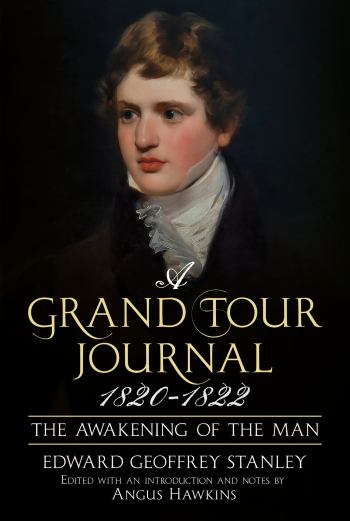 In December 1820, at twenty-one years old, Edward Geoffrey Stanley, the future 14th earl of Derby and three-times prime minister, began an extensive tour of continental Europe. By the time of his return to England twenty months later, he had visited many of the foremost centres for art and culture in Europe, and mostly in Italy. In his travel diaries he recorded his intensive social life, his visits to historical sites, his viewings of art collections, his comments on architecture, his admiration of landscapes, and his impressions of foreign societies. He was energetic, enthusiastic, and discerning: the bridge of Augustus in Umbria gave him “a stupendous idea of Roman grandeur”; the charm of the towns crowning the Tuscan hills struck him with the same delight that he felt when gazing at one of Poussin’s paintings; the waterfall at Terni, which dropped 370 feet into an abyss of spray, was “awfully magnificent”; while the ceremonies of the Italian Catholic Church he judged to be a blend of mummery, superstition, and bigotry. Sights and experiences like these influenced him for the rest of his life. This precious collection of diaries—found only recently and published here for the first time—reveal Edward Stanley to have been a young man of diligence, courage, and decisiveness: a future leader with a conspicuous and burgeoning sense of political and social justice. It was these characteristics, seen in early development within these pages, that shaped the man and the extraordinary career to come.
Edward Geoffrey Stanley (1799–1869), later Lord Stanley and the 14th earl of Derby, was the first British statesman to become prime minister three times and remains the longest serving party leader in modern British politics.
Angus Hawkins (1953–2020) was a fellow of the Royal Historical Society and director of the Research Centre in Victorian Political Culture at Keble College, University of Oxford. Professor Hawkins wrote an acclaimed two-volume biography of Edward Geoffrey Stanley, The Forgotten Prime Minister, published by Oxford University Press in 2007 and 2008.
New Book | Politics and the English Country House, 1688–1800
From McGill-Queen’s University Press:
Joan Coutu, Jon Stobart, and Peter Lindfield, eds., Politics and the English Country House, 1688–1800 (Montreal: McGill-Queen’s University Press, 2023), 344 Pages, ISBN: 978-0228014027, $95.
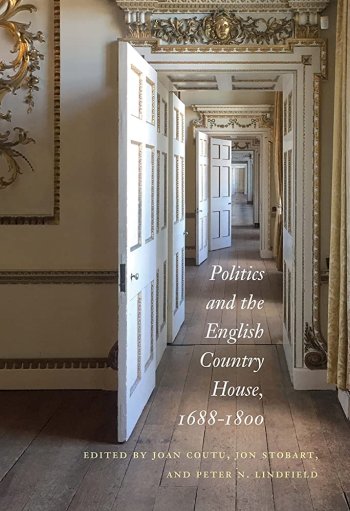 Politics has always been at the heart of the English country house, in its design and construction, as well as in the activities and experiences of those who lived in and visited these places. As Britain moved from an agrarian to an imperial economy over the course of the eighteenth century, the home mirrored the social change experienced in the public sphere. This collection focuses on the relationship between the country house and the mutable nature of British politics in the eighteenth century. Essays explore the country house as a stage for politicking, a vehicle for political advancement, a symbol of party allegiance or political values, and a setting for appropriate lifestyles. Initially the exclusive purview of the landed aristocracy, politics increasingly came to be played out in the open, augmented by the emergence of career politicians—usually untitled members of the patriciate—and men of new money, much of it created on Caribbean plantations or in the employ of the East India Company. Politics and the English Country House, 1688–1800 reveals how, during this period of profound change, the country house remained a constant. The country house was the definitive tangible manifestation of social standing and, for the political class, owning one became almost an imperative. In its consideration of the country house as lived and spatial experience, as an aesthetic and symbolic object, and as an economic engine, this book offers a new perspective on the complexity of political meaning embedded in the eighteenth-century country house—and on ourselves as active recipients and interpreters of its various narratives, more than two centuries later.
Joan Coutu is professor of art history and visual culture at the University of Waterloo.
Jon Stobart is professor of social history at Manchester Metropolitan University.
Peter Nelson Lindfield is lecturer in history at Manchester Metropolitan University.
C O N T E N T S
Table and Figures
Acknowledgements
1 Introduction — Joan Coutu, Jon Stobart, and Oliver Cox
Part One: Political Positioning after the Glorious Revolution
2 Introduction — Oliver Cox
3 For Politics, Progresses, or Posterity? Some Alternative Reasons for Building State Apartments — Amy Lim
4 Holding Court at Marlborough House: The London Residence of Sarah, Duchess of Marlborough — Juliet Learmouth
Part Two: The Question of Style
5 Introduction — Anne Bordeleau
6 Gothic Architecture and the Liberty Trope — Matthew M. Reeve
7 ‘Whig Gothic’: An Antidote to Houghton Hall — Peter N. Lindfield
8 The House with Two Faces: From Baroque to Palladian at Wentworth Woodhouse — Dylan Wayne Spivey
Part Three: The Social Politics of the Country House
9 Introduction — Jon Stobart
10 Burke’s Exemplum: The ‘Natural Family Mansion’ and Wentworth Woodhouse — Joan Coutu
11 House Painting: Place and Position in Estate Portraiture, circa 1770 — John Bonehill
12 The House and Estate of a Rich West Indian: Two Slaveholders in Eighteenth-Century East Anglia — Elisabeth Grass
Part Four: Houses and Homes
13 Introduction — Kate Retford
14 The Clives at Home: Self-Fashioning, Collecting, and British India — Kieran Hazzard
15 William Pitt the Younger, 1759–1806: Reshaping the Political Home — Rowena Willard-Wright
Afterword: Whose Country House? — Dana Arnold
Bibliography
Contributors
Index
New Book | The Story of Follies
Distributed by The University of Chicago Press:
Celia Fisher, The Story of Follies: Architectures of Eccentricity (London: Reaktion Books, 2023), 398 pages, ISBN: 978-1789146356, $50.
 Are they frivolous or practical? Follies are buildings constructed primarily for decoration, but they suggest another purpose through their appearance. In this visually stunning book, Celia Fisher describes follies in their historical and architectural context, looks at their social and political significance, and highlights their relevance today. She explores follies built in protest, follies in Oriental and Gothic styles, animal-related follies, waterside follies and grottoes, and, finally, follies in glass and steel. Featuring many fine illustrations, from historical paintings to contemporary photographs and prints, and taking in follies from Great Britain to Ireland, throughout Europe, and beyond, The Story of Follies is an amusing and informative guide to fanciful, charming buildings.
Celia Fisher has lectured and written widely on the history of plants and gardens in art. Her books include Flower: Paintings by Forty Great Artists and Tulip, the latter also published by Reaktion Books.
C O N T E N T S
Preface
Introduction: A Taste of Follies
1 Seeking out the Origins
2 Some Names to Conjure with
3 Telling a Story
4 Concepts of Freedom and Victory
5 Hunting and Husbandry
6 Waterside Follies and Grottos
7 The Lure of the East
8 From Ruins to Gothic and Picturesque
9 Hermitages and Tree Hoses
10 Into the Future
References
Further Reading
Acknowledgments
Photo Acknowledgments
Index
New Book | The Bridges of Robert Adam
From Triglyph Books:
Benjamin Riley, The Bridges of Robert Adam: A Fanciful and Picturesque Tour (London: Triglyph Books, 2023), 156 pages, ISBN: 978-1916355477, £45 / $60.
 The bridge has always stood as a transitional structure—not purely a work of engineering, nor simply a work of architecture. Its functional requirements are more stringent than those of the average building; it not only must stand up; it must stand up, support those who cross it, and effectively span the space over which it stands. As Samuel Johnson said, “the first excellence of a bridge is strength … for a bridge that cannot stand, however beautiful, will boast its beauty but a little while.” The Scottish architect Robert Adam (1728–1792) understood these precepts well, continually building bridges that were not just structurally sound, but also aesthetically pleasing. Unlike his contemporaries, Adam did not view bridges as mere skeletons upon which to apply ornament. Rather, he sought to achieve architectural totality, incorporating his bridge designs into greater architectural programs, thereby producing aesthetically pleasing and contextually specific designs. From the Pulteney Bridge in Bath to the ruined arch and viaduct at Culzean Castle in Ayrshire, The Bridges of Robert Adam: A Fanciful and Picturesque Tour will take the reader across Britain, shedding new light on an understudied aspect of the great architect’s career.
Benjamin Riley is the managing editor of The New Criterion, a monthly review of the arts and intellectual life based in New York. He holds degrees from Dartmouth College and the Courtauld Institute of Art, where his dissertation focused on the bridges of Robert Adam, becoming the basis for this book. His writing has appeared in The Georgian Group Journal, The New Criterion, The Spectator, and The Wall Street Journal, among other outlets. He lives in New York.
New Book | Enriching Architecture
From UCL Press: (also see the CraftValue project website). . .
Christine Casey and Melanie Hayes, eds., Enriching Architecture: Craft and Its Conservation in Anglo-Irish Building Production, 1660–1760 (London: UCL Press, 2023), 396 pages, ISBN: 978-1800083561 (hardback), £55 / ISBN: 978-1800083554 (paperback), £35. Available as a free PDF file here»
 Refinement and enrichment of surfaces in stone, wood, and plaster is a fundamental aspect of early modern architecture which has been marginalised by architectural history. Enriching Architecture aims to retrieve and rehabilitate surface achievement as a vital element of early modern buildings in Britain and Ireland. Rejected by modernism, demeaned by the conceptual ‘turn’, and too often reduced to its representative or social functions, craft skill here is presented as a primary agent in architectural production. In contrast to the connoisseurial and developmental perspectives of the past, this book is concerned with how surfaces were designed, achieved, and experienced. Contributors draw upon the major rethinking of craft and materials within the wider cultural sphere in recent years to deconstruct traditional, oppositional ways of thinking about architectural production. This is not a craft for craft’s sake argument but an effort to embed the tangible findings of conservation and curatorial research within an evidence-led architectural history that illuminates the processes of early modern craftsmanship. The book explores broad themes of surface treatment such as wainscot, rustication, plasterwork, and staircase embellishment, together with chapters focused on virtuoso buildings and set pieces which illuminate these themes.
Christine Casey is Professor in Architectural History and a fellow of Trinity College Dublin.
Melanie Hayes is Post-Doctoral Research Fellow of the Irish Research Council CraftValue project at Trinity College Dublin.
C O N T E N T S
List of figures
List of contributors
List of abbreviations
Foreword by Glenn Adamson
Acknowledgements
Introduction, Enriching Architecture: Craft and Its Conservation in Anglo-Irish Architectural Production, 1660–1760 — Christine Casey and Melanie Hayes
Part 1 | Loss and Retrieval
1 ‘Onslow Palace’: New Evidence of Eighteenth-Century Craft Technique at Clandon Park — Sophie Chessum
2 Piercing the Surface: Virtuoso Wooden Staircases from Cassiobury Park and Eyrecourt Castle — Mechthild Baumeister and Andrew Tierney
3 Fragments of Eighteenth-Century Craftsmanship: The Pearson Collection — Peter Pearson
4 Experiments with Historic Light in Kensington Palace’s Early Eighteenth-Century Interiors — Lee Prosser
5 Retrieving Craft Practice on the Early Eighteenth-Century Building Site — Melanie Hayes
6 Conserving Craft in Eighteenth-Century Buildings: The Role of the Conservation Architect — Tony Barton
Part 2 | Design and Making
7 The Geometry of Rustication: An Eighteenth-Century Case Study — Edward McParland
8 The Rough and the Smooth: Stone Use in Dublin, 1720–60 — Patrick Wyse Jackson and Louise Caulfield
9 Drawing out a Surface in Lime and Hair — Jenny Saunt
10 ‘Agreeable to Live in’: The Wainscoted Interior in Eighteenth-Century Britain and Ireland — Christine Casey
11 A Glorious Ascent: Staircase Design, Construction, and Craft in the Circle of Richard Castle — Andrew Tierney
Index
Symposium | The Power and Prestige of Collecting
From Haughton International, where one can find full speaker and lecture descriptions:
The Power and Prestige of Collecting: Private and Museum Collections and Their Survival
Haughton International Seminar
Society of Chemical Industry, 14–15 Belgrave Square, London, 28–29 June 2023

Jingdezhen (Jiangxi Province, China), The ‘Kylin’ Clock, 2nd half of the 18th century; mounts, ca.1700–1822; porcelain, gilt bronze, 112 × 81 × 37 cm (whole object) (Royal Colleciton Trust, 2867).
This year’s Haughton International Seminar will address the power and prestige of collecting. It will include a tour of the Royal Collection as well as private and museum collections, focusing on how such works of art might be presented to future generations and what lessons the past might contain to direct the future.
Cost of the two day seminar: £110. Cost of the two-day seminar with champagne reception and dinner at The Athenaeum (Wednesday, 28th June): £190. Student tickets for the two-day seminar (on production of ID): £60. Booking in advance through the website is essential due to limited numbers. Box office now open.
Copies of lectures from past seminars are available at the videos and articles section of the symposium website.
L E C T U R E S , 2 8 – 2 9 J U N E 2 0 2 3
• Private and Public Museums in China — Rose Kerr, Honorary Associate of the Needham Research Institute in Cambridge, previously Keeper of the Far Eastern Department at the Victoria and Albert Museum, 1978–2003
• One Family’s Legacy: The Treasures of Burghley House — Miranda Rock, Executive Chair of the Burghley House Preservation Trust
• The Royal Collection in the Reign of Queen Elizabeth II — Caroline de Guitaut, Deputy Surveyor of The King’s Works of Art
• Medici Porcelain — Timothy Wilson, Honorary Curator, Department of Western Art, Ashmolean Museum
• ‘… Let No Man Put Asunder’: How Much Do Collections Matter? — Timothy Schroder, FSA, Former Curator, Lecturer, and Author
• Has Collecting Really Died or Just Changed Direction? — Anna Somers Cocks OBE, Founder editor of The Art Newspaper
• The Corning Museum of Glass: Nearly 75 Years of Collecting, Research, and Inspiration — Karol Wight, President and Executive Director, The Corning Museum of Glass
• Heaven on Earth: The Phenomenon of Baroque Austrian Monasteries — Claudia Lehner-Jobst, Director, Augarten Porcelain Museum, Vienna
• ‘You, That Way; We, This Way’: Whither the Future of Public Collections in the United States? — Matthew Hargraves, Director, Wadsworth Atheneum Museum of Art
• Kings & Queens and Soup Tureens: The Evolution of the Campbell Collection — Patricia Halfpenny, Vice President Northern Ceramic Society, Curator Emerita Ceramics and Glass, Winterthur Museum
• A Prince’s Treasure: From Buckingham Palace to the Royal Pavilion, The Return of the Royal Collection to Brighton — David Beevers, FSA, Former Keeper Royal Pavilion, Brighton
• Hungry for the Past: Baroque Buffets, Ducal Desserts, and Rococo Suppers — Ivan Day, Food Historian, Museums and Country House Consultant
• The Soane Museum and What Is to Come of It? — Bruce Boucher, Director, Sir John Soane’s Museum
• A Manufactury‘s Past, Present, and Future: The Collection of Museum Schloss Fürstenberg — Christian Lechelt, Director, Museum Fürstenberg
New Book | Women Artists in the Reign of Catherine the Great
From Lund Humphries:
Rosalind P. Blakesley, Women Artists in the Reign of Catherine the Great (London: Lund Humphries Publishers, 2023), 152 pages, ISBN: 978-1848225459, £45.
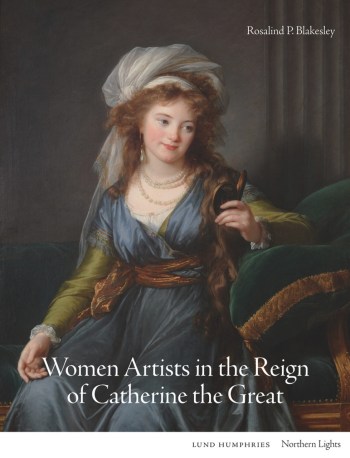 Catherine the Great’s audacious power grab in 1762 marked a watershed in imperial Russian history. During a momentous 34-year reign, her rapacious vision and intellectual curiosity led to vast territorial expansion, cultural advancement, and civic, educational and social reform. In this pioneering book, Rosalind Blakesley reveals the remarkable role women artists played in her pursuit of these ambitions. With challenging commissions for an elite cast of Russian patrons, their work underscores the extent to which cultural enrichment co-existed with the empress’s imperial designs.
Catherine’s acquisitions propelled renowned artists to new heights. The history paintings that she purchased from Angelica Kauffman brought the Swiss artist to the attention of keen new patrons, while Elisabeth Louise Vigée Le Brun found in Russia safe refuge from the horrors of revolutionary France. Just as important were Catherine’s relationships with lesser-known artists. The young sculptor Marie-Anne Collot made the arduous journey from Paris to St Petersburg to assist on the equestrian monument to Peter the Great and enthralled Russian society with her portrait busts, while Grand Duchess Maria Fedorovna, wife of Catherine’s troubled son Paul, sculpted cameos which the empress sent to distinguished correspondents abroad. With stories of extraordinary artistic endeavour intertwined with the intrigue of Catherine’s personal life, Women Artists in the Reign of Catherine the Great uncovers the impact of these and other artists at one of Europe’s most elaborate courts.
Rosalind Polly Blakesley, a prize-winning writer and academic, is Professor of Russian and European Art and a Fellow of Pembroke College at the University of Cambridge. A Trustee of the V&A and Syndic of the Fitzwilliam Museum, she has authored books including The Russian Canvas (Yale University Press, 2016) and The Arts and Crafts Movement (Phaidon Press, 2006), and curated exhibitions at the National Portrait Gallery, London, and the National Museum of Women in the Arts, Washington DC.
C O N T E N T S
Conventions and Abbreviations
Introduction
1 Inscribing a Future Empress
2 Catherine Enthroned
3 The Academy and the Hermitage
4 A Parisian Find
5 The Chisel and the Mallet
6 Unexpected Treasures
7 The Doyenne of Rome
8 An Artist in the Family
9 The Triumphant Refugee
Epilogue
Acknowledgements
List of Illustrations
Bibliography
Index
Study Day | Women Collectors at the Turn of the 20th Century
From the conference programme:
Her Discerning Eye: Women Collectors at the Turn of the 20th Century
The National Trust and Waddesdon Manor Annual Conference
Waddesdon Manor, 28 March 2023
We are delighted to announce the programme for Her Discerning Eye: Women Collectors at the Turn of the 20th Century. The conference will be held at Waddesdon Manor on Tuesday, 28th March. Our invited speakers will be talking on Joséphine Bowes, Yolande Lyne Stephens, Charlotte Schreiber, Hannah Gubbay, Queen Alexandra, and Queen Mary. The study day was inspired by our work on Margaret Greville and Alice de Rothschild. To book a place please email enquiries@waddesdon.org.uk. The conference is free; a charge for lunch will be payable on the day (please let us know of any dietary requirements). If you have any questions please do email us: Mia.Jackson@waddesdon.org.uk and Alice.Strickland@nationaltrust.org.uk.
–Mia Jackson and Alice Strickland
P R O G R A M M E
10.30 Registration and Coffee
11.00 Session One
• Tom Stammers (Associate Professor in Modern European Cultural History, University of Durham) — Recovering Female Collectors: Paradigms and Challenges
• Lindsay Macnaughton (Lecturer, University of Buckingham) — Some Fragments from the Boweses’ Collection and the Difficulties of Singling out Joséphine’s Taste
• Laure-Aline Griffith-Jones (Independent Art Historian) — Yolande Lyne Stephens: A French Collection in Victorian England
12.30 Lunch
13.30 Session Two
• Caroline McCaffrey-Howarth (Lecturer in French and British History of Art c.1650–1900, University of Edinburgh) — Charlotte Schreiber: Becoming a Ceramics Collector
• Mia Jackson (Curator of Decorative Arts, Waddesdon Manor) and Pippa Shirley (Director of Waddesdon Manor) — Alice de Rothschild’s Dishes and Daggers
• Patricia F. Ferguson (Independent Scholar) — Shaping Ceramic Connoisseurship: Mrs. David Gubbay, ‘Collector of Genius’
15.00 Session Three
Tour of the exhibition Alice’s Wonderlands: Alice as a Collector
16.00 Final Session
• Alice Strickland (Curator, National Trust) — ‘Full of Rare China and Expensive Treasures’: The Collection of Margaret Greville at Polesden Lacey, Surrey
• Caroline de Guitaut (Deputy Surveyor of The King’s Works of Art) — Embracing the Modern and Fashionable: Queen Alexandra as Collector
• Kathryn Jones (Senior Curator of Decorative Arts, Royal Collection Trust) — ‘Quite a Creditable Collection’: Queen Mary as Collector and Curator
17.30 Closing Comments — Mia Jackson and Alice Strickland
Exhibition | Muse or Maestra? Women in Italian Art, 1400–1800

Rosalba Carriera, Self-Portrait of the Artist, detail, 1707–08
(Staatliche Museen zu Berlin, Kupferstichkabinett / Jörg P. Anders)
◊ ◊ ◊ ◊ ◊
From the Staatliche Museen zu Berlin:
Muse or Maestra? Women in the Italian Art World, 1400–1800
Muse oder Macherin? Frauen in der italienischen Kunstwelt 1400 – 1800
Kupferstichkabinett, Berlin, 8 March — 4 June 2023
Curated by Dagmar Korbacher
Featuring some 90 works, this special exhibition organised by Berlin’s Kupferstichkabinett elucidates the lives and impact of women such as Rosalba Carriera, Artemisia Gentileschi, Elisabetta Sirani, Diana Scultori, Isabella d’Este, Christina, Queen of Sweden, and others. Their works, fates and enormous influence on the art world of their times have in part been forgotten today.
During the Renaissance and Baroque periods, the art of these women outshone that of their fathers, brothers, and husbands. They created and collected oeuvres that were sought after throughout Europe. They knew how to market themselves and how to network. The protagonists in the exhibition comprise not only women artists who created works in demand, but also wives who supported their husbands and posed for them as models and female patrons who gave commissions for artworks and supported women artists, as well as preservationists and collectors who kept and passed on the works.
Not only does the exhibition show the art of these women, it also provides details about the circumstances of their lives to the extent that this information is known. A number of issues are addressed. These include determining what influence being a woman had on these women’s roles in the art world, whether or not they married and became mothers, and which strategies they pursued to assert themselves in a man’s world, thus making it possible for us to still find traces of their respective impacts.
Women’s diverse, active roles in Italian art are presented with drawings and prints until 1800 from the Kupferstichkabinett’s vast collection, as well as some outstanding loans. In various interventions in the exhibition and catalogue, the youth advisory panel of the Staatliche Museen zu Berlin, Achtet AlisMB, contributes the younger generation’s perspective on this topic.
Muse or Maestra?: Women in the Italian Art World, 1400–1800 is curated by Dagmar Korbacher, director of the Kupferstichkabinett. A catalogue accompanies the exhibition.










 Enfilade
leave a comment