Study Day | Women Collectors at the Turn of the 20th Century
From the conference programme:
Her Discerning Eye: Women Collectors at the Turn of the 20th Century
The National Trust and Waddesdon Manor Annual Conference
Waddesdon Manor, 28 March 2023
We are delighted to announce the programme for Her Discerning Eye: Women Collectors at the Turn of the 20th Century. The conference will be held at Waddesdon Manor on Tuesday, 28th March. Our invited speakers will be talking on Joséphine Bowes, Yolande Lyne Stephens, Charlotte Schreiber, Hannah Gubbay, Queen Alexandra, and Queen Mary. The study day was inspired by our work on Margaret Greville and Alice de Rothschild. To book a place please email enquiries@waddesdon.org.uk. The conference is free; a charge for lunch will be payable on the day (please let us know of any dietary requirements). If you have any questions please do email us: Mia.Jackson@waddesdon.org.uk and Alice.Strickland@nationaltrust.org.uk.
–Mia Jackson and Alice Strickland
P R O G R A M M E
10.30 Registration and Coffee
11.00 Session One
• Tom Stammers (Associate Professor in Modern European Cultural History, University of Durham) — Recovering Female Collectors: Paradigms and Challenges
• Lindsay Macnaughton (Lecturer, University of Buckingham) — Some Fragments from the Boweses’ Collection and the Difficulties of Singling out Joséphine’s Taste
• Laure-Aline Griffith-Jones (Independent Art Historian) — Yolande Lyne Stephens: A French Collection in Victorian England
12.30 Lunch
13.30 Session Two
• Caroline McCaffrey-Howarth (Lecturer in French and British History of Art c.1650–1900, University of Edinburgh) — Charlotte Schreiber: Becoming a Ceramics Collector
• Mia Jackson (Curator of Decorative Arts, Waddesdon Manor) and Pippa Shirley (Director of Waddesdon Manor) — Alice de Rothschild’s Dishes and Daggers
• Patricia F. Ferguson (Independent Scholar) — Shaping Ceramic Connoisseurship: Mrs. David Gubbay, ‘Collector of Genius’
15.00 Session Three
Tour of the exhibition Alice’s Wonderlands: Alice as a Collector
16.00 Final Session
• Alice Strickland (Curator, National Trust) — ‘Full of Rare China and Expensive Treasures’: The Collection of Margaret Greville at Polesden Lacey, Surrey
• Caroline de Guitaut (Deputy Surveyor of The King’s Works of Art) — Embracing the Modern and Fashionable: Queen Alexandra as Collector
• Kathryn Jones (Senior Curator of Decorative Arts, Royal Collection Trust) — ‘Quite a Creditable Collection’: Queen Mary as Collector and Curator
17.30 Closing Comments — Mia Jackson and Alice Strickland
Exhibition | Muse or Maestra? Women in Italian Art, 1400–1800

Rosalba Carriera, Self-Portrait of the Artist, detail, 1707–08
(Staatliche Museen zu Berlin, Kupferstichkabinett / Jörg P. Anders)
◊ ◊ ◊ ◊ ◊
From the Staatliche Museen zu Berlin:
Muse or Maestra? Women in the Italian Art World, 1400–1800
Muse oder Macherin? Frauen in der italienischen Kunstwelt 1400 – 1800
Kupferstichkabinett, Berlin, 8 March — 4 June 2023
Curated by Dagmar Korbacher
Featuring some 90 works, this special exhibition organised by Berlin’s Kupferstichkabinett elucidates the lives and impact of women such as Rosalba Carriera, Artemisia Gentileschi, Elisabetta Sirani, Diana Scultori, Isabella d’Este, Christina, Queen of Sweden, and others. Their works, fates and enormous influence on the art world of their times have in part been forgotten today.
During the Renaissance and Baroque periods, the art of these women outshone that of their fathers, brothers, and husbands. They created and collected oeuvres that were sought after throughout Europe. They knew how to market themselves and how to network. The protagonists in the exhibition comprise not only women artists who created works in demand, but also wives who supported their husbands and posed for them as models and female patrons who gave commissions for artworks and supported women artists, as well as preservationists and collectors who kept and passed on the works.
Not only does the exhibition show the art of these women, it also provides details about the circumstances of their lives to the extent that this information is known. A number of issues are addressed. These include determining what influence being a woman had on these women’s roles in the art world, whether or not they married and became mothers, and which strategies they pursued to assert themselves in a man’s world, thus making it possible for us to still find traces of their respective impacts.
Women’s diverse, active roles in Italian art are presented with drawings and prints until 1800 from the Kupferstichkabinett’s vast collection, as well as some outstanding loans. In various interventions in the exhibition and catalogue, the youth advisory panel of the Staatliche Museen zu Berlin, Achtet AlisMB, contributes the younger generation’s perspective on this topic.
Muse or Maestra?: Women in the Italian Art World, 1400–1800 is curated by Dagmar Korbacher, director of the Kupferstichkabinett. A catalogue accompanies the exhibition.
New Book | Afterlives: Recovering the Lost Stories of Looted Art
The exhibition was at the Jewish Museum in New York from August 2021 until January 2022. From Yale UP:
Darsie Alexander and Sam Sackeroff, with contributions by Julia Voss and Mark Wasiuta, Afterlives: Recovering the Lost Stories of Looted Art (New Haven: Yale University Press, 2022), 280 pages, ISBN: 978-0300250701, $50.
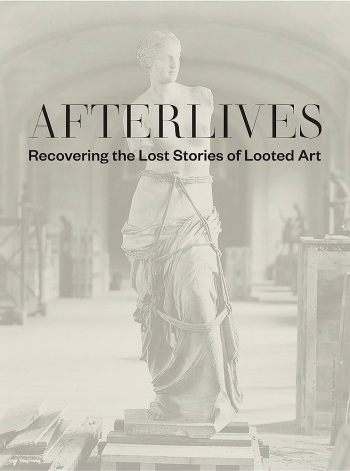 A strikingly original exploration of the profound impact of World War II on how we understand the art that survived it
By the end of World War II an estimated one million artworks and 2.5 million books had been seized from their owners by Nazi forces; many were destroyed. The artworks and cultural artifacts that survived have traumatic, layered histories. This book traces the biographies of these objects—including paintings, sculpture, and Judaica—their rescue in the aftermath of the war, and their afterlives in museums and private collections and in our cultural understanding. In examining how this history affects the way we view these works, scholars discuss the moral and aesthetic implications of maintaining the association between the works and their place within the brutality of the Holocaust—or, conversely, the implications of ignoring this history. Afterlives offers a thought-provoking investigation of the unique ability of art and artifacts to bear witness to historical events. With rarely seen archival photographs and with contributions by the contemporary artists Maria Eichhorn, Hadar Gad, Dor Guez, and Lisa Oppenheim, this catalogue illuminates the study of a difficult and still-urgent subject, with many parallels to today’s crises of art in war.
Darsie Alexander is the Susan and Elihu Rose Chief Curator, and Sam Sackeroff is the Lerman-Neubauer Assistant Curator at the Jewish Museum, New York.
Workshop | Provenance Research in Action
From the Society for the History of Collecting:
Provenance Research in Action: Theory, Tools and Implementation
London, 12–16 June 2023
Organized by Adriano Ayomino, Silvia Davoli, Lisa de Zoete, and Barbara Furlott
Applications due by 10 March 2023
 Join a week-long, hands-on workshop on provenance research and due diligence in the heart of the London art world. Run by the Society for the History of Collecting in partnership with some of the most relevant London-based museums, libraries, and academic institutions, the workshop aims to introduce students and young professionals to the tools, good practices, and best methodologies involved in researching provenance for paintings, decorative arts, books, archives, etc. Small group workshops, run by professionals in the sector, have been designed to provide an effective method of teaching of the theoretical and practical aspects of provenance research today.
Applicants should send a letter of motivation (no longer than 750 words) and a brief CV (no longer than 1 page) to barbara.furlotti@courtauld.ac.uk by 10 March, 2023. The workshop does not include travel, accommodation, or food (unless specified in the program). Cost for participation is £150 for the full workshop.
A pdf version of the schedule is available here»
Robbie Richardson and Ruth Phillips on Indigenous Objects Abroad

Smoking-pipe, 1600–1750, soapstone, 9.5 × 10 × 5.5 cm (London: The British Museum, Am1991,09.1). As noted in the catalogue entry: “The pipe bowl is from the painter Benjamin West’s studio, and was used as a model in both Death of Wolfe and Penn’s Treaty with the Indians.”
◊ ◊ ◊ ◊ ◊
From the Mellon Centre:
Robbie Richardson and Ruth Phillip on Indigenous Objects Abroad
Online and in-person, Paul Mellon Centre, London, Wednesday, 1 March 2023, 5–7pm
Part of the series ‘In Conversation: New Directions in Art History’, which will explore the changing modes and methodologies of approaching visual and material worlds. Book tickets here.
Robbie Richardson | ‘Peace Pipes’ in Europe: Collecting the Calumet in the Eighteenth Century
This talk will consider early European collections of Indigenous tobacco pipes, often called ‘peace pipes’ or calumets (a word of French origin). Described as “the most mysterious thing in the world” by seventeenth-century Jesuits for their perceived power and significance among south-eastern nations, pipes would over time become one of the ubiquitous icons of Indigeneity in western eyes. Part of their inscrutability from the British perspective was that their own tobacco pipes were ephemeral and disposable, with many even still washing up daily on the shores of the Thames.
Towards the end of the eighteenth century, one of the most popular trade goods which Europeans brought to Indigenous nations were steel European-manufactured ‘pipe-tomahawks’, which blended metaphors of peace and war. The manifestation of this transcultural object is itself revealing of the complex dynamics of material cultural production. Notwithstanding their provenance in Sheffield and Birmingham steel mills, pipe-tomahawks became widely collected as Indigenous curiosities by British soldiers and collectors. This talk will discuss British representations of Indigenous diplomacy and spirituality through their understanding and collecting of the calumet. It will look at several of the pipes that found their ways into European collections, to unravel Indigenous practices and agency.
Robbie Richardson is Assistant Professor of English at Princeton University and the author of The Savage and Modern Self: North American Indians in Eighteenth-Century British Literature and Culture (University of Toronto Press, 2018). He has recent chapters in Material Literacy in Eighteenth-Century Britain: A Nation of Makers (Bloomsbury, 2020) and in Small Things in the Eighteenth Century: The Political and Personal Value of the Miniature (Cambridge University Press, 2022), and forthcoming pieces in Studies in Romanticism, Eighteenth-Century Studies, and Eighteenth Century: Theory and Interpretation. He is currently working on a monograph about Indigenous objects from the Americas and South Pacific in Europe up until the end of the eighteenth century. He is a citizen of Pabineau Mi’kmaq First Nation in New Brunswick, Canada.
◊ ◊ ◊ ◊ ◊
Ruth Phillips | Curiosity and Belonging: Legacies of Eighteenth-Century Collecting in the Twenty-First Century
This talk will examine two contrasting modes of engagement between Europeans and Indigenous peoples in eighteenth-century North America and how these interactions led to the formation of public and private collections. It will urge that in the twenty-first century developing accurate understandings of eighteenth-century collecting practices can usefully disrupt assumptions about the restitution of Indigenous cultural belongings.
The periodic wars waged for colonial control of eastern North America brought tens of thousands of British, French, German and Swiss soldiers into the region. Both officers and common soldiers were avid collectors of curiosities for themselves, to present to patrons and family members, and to resell at a profit. Indigenous makers, for their part, actively produced finely made ornaments, pipes, moccasins and other items for the trade, acquiring in return: guns and tools that made hunting and warfare more effective; rum, tea, pottery, woollen cloth and printed cottons that made life more enjoyable; and silk ribbons, woollen yarn, glass beads, needles, thread and manufactured wampum beads that stimulated artistic creativity. There could also, however, have been other reasons for an Indigenous maker to produce these items for outsiders, for they were also presented in diplomatic negotiations to ratify treaty agreements and in ritual adoptions that transformed a military officer or a colonial official into a member of an Indigenous kin group who could be expected to support its interests.
Contemporary Indigenous peoples are actively tracing their cultural belongings in museum collections as part of a larger process of decolonisation that aims to recover histories of Indigenous agency and heal the damages and losses enacted by centuries of colonial rule. This talk argues that restitution, if conducted in ignorance of the historical circumstances of gifting or trade, risks, on the one hand, denying the agency of Indigenous peoples who chose to engage in curiosity production and, on the other, disappearing the material embodiments of agreements that, although made long ago, still demand to be recognised and honoured.
Ruth B. Phillips is Professor of Art History Emerita at Carleton University, Ottawa where she was also appointed to a Canada Research Chair in Modern Culture. She earned her PhD in African art history at SOAS, University of London, and has since focused on Indigenous North American arts and museology. As director of the Museum of Anthropology, University of British Columbia from 1997 to 2002 she initiated a major renewal of the museum’s digital and physical research infrastructure adapted to collaborative research with Indigenous peoples. She is the author of Trading Identities: The Souvenir in Native North American Arts from the Northeast, 1700–1900; Museum Pieces: Toward the Indigenization of Canadian Museums; and Native North American Art, with Janet Catherine Berlo. With Nicholas Thomas she organised the Multiple Modernisms project to address Indigenous modernisms in a global comparative framework, co-editing its first publication, Mapping Modernisms: Art, Indigeneity, Colonialism with Elizabeth Harney, and its second, Mediating Modernisms: Indigenous Artists, Modernist Mediators, Global Networks, with Norman Vorano. She is a fellow of the Royal Society of Canada and recipient of lifetime achievement awards from the American Anthropological Society and the Universities Art Association of Canada.
New Book | Twelve Caesars: Images of Power
From Princeton UP:
Mary Beard, Twelve Caesars: Images of Power from the Ancient World to the Modern (Princeton: Princeton University Press, 2021), 392 pages, ISBN: 978-0691222363, $35. The A. W. Mellon Lectures in the Fine Arts, volume 60.
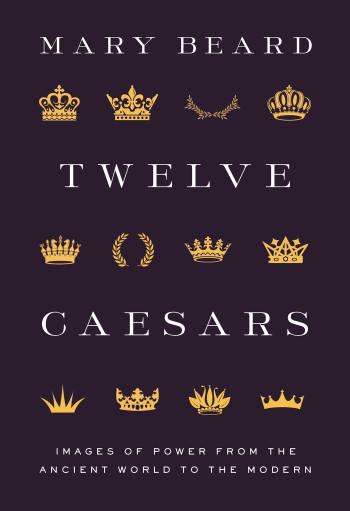 From the bestselling author of SPQR: A History of Ancient Rome, the fascinating story of how images of Roman autocrats have influenced art, culture, and the representation of power for more than 2,000 years.
What does the face of power look like? Who gets commemorated in art and why? And how do we react to statues of politicians we deplore? In this book―against a background of today’s ‘sculpture wars’―Mary Beard tells the story of how for more than two millennia portraits of the rich, powerful, and famous in the western world have been shaped by the image of Roman emperors, especially the ‘Twelve Caesars’, from the ruthless Julius Caesar to the fly-torturing Domitian. Twelve Caesars asks why these murderous autocrats have loomed so large in art from antiquity and the Renaissance to today, when hapless leaders are still caricatured as Neros fiddling while Rome burns.
Beginning with the importance of imperial portraits in Roman politics, this richly illustrated book offers a tour through 2,000 years of art and cultural history, presenting a fresh look at works by artists from Memling and Mantegna to the nineteenth-century American sculptor Edmonia Lewis, as well as by generations of weavers, cabinetmakers, silversmiths, printers, and ceramicists. Rather than a story of a simple repetition of stable, blandly conservative images of imperial men and women, Twelve Caesars is an unexpected tale of changing identities, clueless or deliberate misidentifications, fakes, and often ambivalent representations of authority. From Beard’s reconstruction of Titian’s extraordinary lost Room of the Emperors to her reinterpretation of Henry VIII’s famous Caesarian tapestries, Twelve Caesars includes fascinating detective work and offers a gripping story of some of the most challenging and disturbing portraits of power ever created.
Published in association with the Center for Advanced Study in the Visual Arts, National Gallery of Art, Washington, DC.
Mary Beard is one of the world’s leading classicists and cultural commentators. A specialist in Roman history and art, she is professor of classics at the University of Cambridge and the author of bestselling and award-winning books, including SPQR: A History of Ancient Rome and Women and Power: A Manifesto. She has also written and presented many television programs, from Civilisations and Meet the Romans to The Shock of the Nude. She lives in Cambridge, England.
C O N T E N T S
List of Tables
Preface
1 The Emperor on the Mall: An Introduction
2 Who’s Who in the Twelve Caesars
3 Coins and Portraits, Ancient and Modern
4 The Twelve Caesars, More or Less
5 The Most Famous Caesars of Them All
6 Satire, Subversion, and Assassination
7 Caesar’s Wife . . . Above Suspicion?
8 Afterword
Acknowledgments
Appendix: The Verses underneath Aegidius Sadeler’s Series of Emperors and Empresses
Notes
Bibliography
List of Illustrations
Index
Reception of Greenough’s Statue of George Washington

Stereo card view of the crowd at the inauguration of Rutherford B. Hayes, on the east front grounds of the U.S. Capitol, surrounding Horatio Greenough’s statue of George Washington, in 1877 (Brady’s National Portrait Gallery, Washington, D.C./Library of Congress). Commissioned in 1832 to mark Washington’s 100th birthday, Horatio Greenough’s sculpture of the first president was installed in the U.S. Capitol Rotunda in 1841. Two years later the 12-ton statue was moved outside to the building’s East Plaza, where it stood until 1908, when it was moved to the Smithsonian Institution castle on the National Mall.
◊ ◊ ◊ ◊ ◊
An interesting article from The Washington Post for the wider context of contested public sculpture (here presented for a large, general audience). Unfortunately, it doesn’t address this particular controversy in terms of people’s expectations of how a historic figure (in 1841, still a recent historic figure) should have been represented and thus might reinforce persistent misconceptions of nineteenth-century attitudes toward nudity in art generally. The larger question of monumentalizing the lives of real people could bring the history of Greenough’s work into conversation with the initial reception of Hank Willis Thomas’s recently installed memorial for Dr. Martin Luther King Jr. and Coretta Scott King, The Embrace, at Boston’s 1965 Freedom Plaza. For the latter, there has, of course, been lots of coverage, but I like this article by Jessica Shearer, “What Do Bostonians Think of the New MLK Monument?,” HyperAllergic (25 January 2023). –CH
◊ ◊ ◊ ◊ ◊
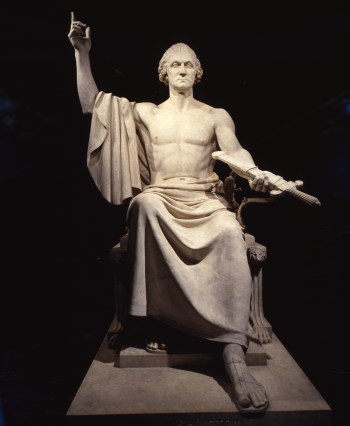
Horatio Greenough, President George Washington, completed in 1840, marble (Washington DC: Smithsonian Institution).
Ronald G. Shafer, “The First Statue Removed from the Capitol: George Washington in a Toga,” The Washington Post (22 January 2023).
Slowly, some of the U.S. Capitol’s many statues and other artworks honoring enslavers have been slated for removal, most recently a bust of Roger B. Taney, the chief justice who wrote the Supreme Court’s Dred Scott decision denying Black people citizenship. But the first statue Congress voted to remove from the Capitol was one of George Washington [in 1908]—not because Washington was an enslaver, but because the statue was scandalous. The first president was portrayed naked to the waist in a toga with his right finger pointing toward the sky and his left hand clasping a sheathed sword. . . .
The full article is available here»
Tallying Enslavers and Confederates Depicted at the U.S. Capitol

John Trumbull, General George Washington Resigning His Commission, 23 December 1783, installed in the Capitol in 1824, oil on canvas, 12 × 18 feet (Washington, DC: Capitol Rotunda). As noted in The Post article, 19 of the 31 people identified in the painting were enslavers.
◊ ◊ ◊ ◊ ◊
From The Washington Post:
Gillian Brockell, “Art at Capitol Honors 141 Enslavers and 13 Confederates. Who Are They?,” The Washington Post (27 December 2022). The Post examined more than 400 statues, paintings, and other artworks in the U.S. Capitol. This is what we found.
As part of a year-long investigation into Congress’s relationship with slavery, The Washington Post analyzed more than 400 artworks in the U.S. Capitol building, from the Crypt to the ceiling of the Capitol Rotunda, and found that one-third honor enslavers or Confederates. Another six honor possible enslavers—people whose slaveholding status is in dispute. . . .
Just as governments and institutions across the country struggle with the complex and contradictory legacies of celebrated historical figures with troubling racial records, so too does any effort to catalogue the role of the Capitol artworks’ subjects in the institution of slavery. This analysis, for example, includes at least four enslavers—Benjamin Franklin, John Dickinson, Rufus King, and Bartolomé de las Casas—who voluntarily freed the people they enslaved and publicly disavowed slavery while they were living. Other people, such as Daniel Webster and Samuel Morse, were vocal defenders of slavery but did not themselves enslave people; artworks honoring them are not counted in The Post’s tally. . . .
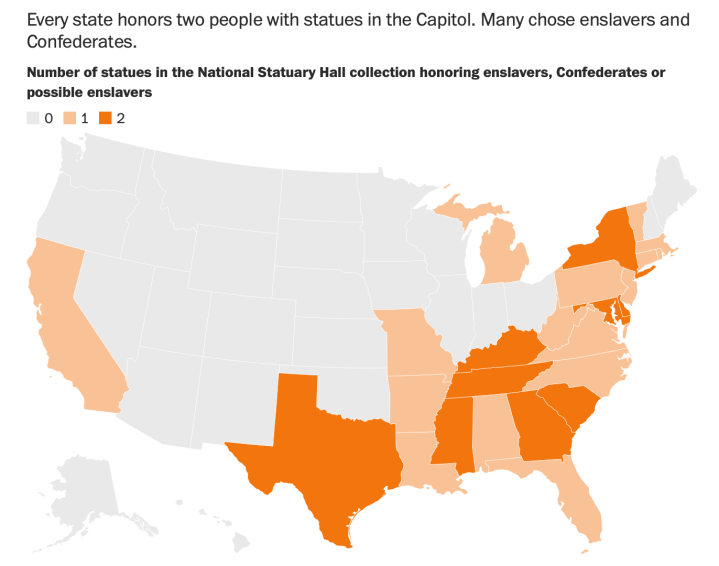
All 11 states that joined the Confederacy have at least one statue depicting an enslaver or Confederate. But the homages to enslavers are by no means restricted to these states: Except for New Hampshire, all of the original 13 states have statues depicting enslavers or possible enslavers.
Massachusetts, for example, is represented by John Winthrop, who is best known for proclaiming a “shining city on a hill” but who also enslaved at least three Pequot people and, as colonial governor, helped legalize the enslavement of Africans.
Both of New York’s statues honor enslavers. One is Declaration of Independence co-writer Robert R. Livingston, who came from a prominent slave-trading family and personally enslaved 15 people in 1790. He also owned brothels that housed Black women who may have been enslaved. The other is former vice president George Clinton, who served under Jefferson and Madison and enslaved at least eight people in his lifetime. . . .
The full article is available here»
New Book | American Inheritance: Liberty and Slavery
From Norton:
Edward Larson, American Inheritance: Liberty and Slavery in the Birth of a Nation, 1765–1795 (New York: W. W. Norton & Company, 2023), 368 pages, ISBN: 978-0393882209, $32.
 From a Pulitzer Prize winner, a powerful history that reveals how the twin strands of liberty and slavery were joined in the nation’s founding.
New attention from historians and journalists is raising pointed questions about the founding period: was the American revolution waged to preserve slavery, and was the Constitution a pact with slavery or a landmark in the antislavery movement? Leaders of the founding who called for American liberty are scrutinized for enslaving Black people themselves: George Washington consistently refused to recognize the freedom of those who escaped his Mount Vernon plantation. And we have long needed a history of the founding that fully includes Black Americans in the Revolutionary protests, the war, and the debates over slavery and freedom that followed.
We now have that history in Edward J. Larson’s insightful synthesis of the founding. With slavery thriving in Britain’s Caribbean empire and practiced in all of the American colonies, the independence movement’s calls for liberty proved narrow, though some Black observers and others made their full implications clear. In the war, both sides employed strategies to draw needed support from free and enslaved Blacks, whose responses varied by local conditions. By the time of the Constitutional Convention, a widening sectional divide shaped the fateful compromises over slavery that would prove disastrous in the coming decades. Larson’s narrative delivers poignant moments that deepen our understanding: we witness New York’s tumultuous welcome of Washington as liberator through the eyes of Daniel Payne, a Black man who had escaped enslavement at Mount Vernon two years before. Indeed, throughout Larson’s brilliant history it is the voices of Black Americans that prove the most convincing of all on the urgency of liberty.
Edward J. Larson is the author of many acclaimed works in American history, including the Pulitzer Prize–winning history of the Scopes Trial, Summer for the Gods. He is University Professor of History and Hugh and Hazel Darling Chair in Law at Pepperdine University, and lives with his family near Los Angeles.
Online Symposium | Design, Description, and Discovery in Cataloging
From the Hood Museum of Art:
Terms of Art: Design, Description, and Discovery in Cataloging
Online, Hood Museum of Art, Dartmouth, 22–24 February 2023
Institutions such as museums, libraries, and archives have a mission to preserve, interpret, and disseminate cultural heritage. In addition to new acquisitions for their collections, these institutions must also update the tools with which researchers access and study these holdings, objects, and works of art. Increasingly, stakeholders like academics, educators, and the public treat a collection’s digital representation—its metadata records—as an entry point for discovery. Paradoxically, these web-based experiences meant to expose collections to broad audiences often assume users have specialized knowledge of the terms and processes GLAM (Galleries, Libraries, Archives, and Museums) institutions use to describe their own work, making them inaccessible to the majority of visitors. Additionally, variation and evolution of language often outpaces or does not align with public understanding. For example, someone interested in 17th-century Dutch art might not know that the phrase “Dutch Golden Age” has colonialist implications and has been removed from many museums’ internal databases. The search language isn’t wrong, it’s just outmoded.
The Hood Museum of Art and Dartmouth Research Computing have organized a virtual symposium to bring together museums, libraries, and archives to discuss issues of access and ethical vocabularies in cultural heritage. The goal is to develop the debate about how the language we use to describe collections impacts the communities that create and seek out art. The organizers hope to prompt dialogue on the issues curators and researchers face in trying to maintain equitable and anti-racist progress and research. Additionally, this symposium will emphasize the role of technologists who specialize in user-centered design as critical to promoting equity in information systems. In combining subject-matter specialists and user-centered design technologists, we aim to bridge the communication gap between institutions and the publics they serve, allowing each to educate the other about how they describe collections. The symposium is free and open to all. Click here to register.
More information about each session is available here»
W E D N E S D A Y , 2 2 F E B R U A R Y 2 0 2 3
Times are Eastern Standard Time (UTC-5)
9.30 Welcome
• Ashley Offill, Associate Curator of Collections, Hood Museum of Art, Dartmouth
• Elizabeth Rice Mattison, Andrew W. Mellon Associate Curator of Academic Programming, Hood Museum of Art, Dartmouth
• John Bell, Program Director, Data Experiences and Visualizations Studio, Dartmouth
• Meredith Steinfels, Assistant Director, Digital Platforms, Media & Archives, Hood Museum of Art, Dartmouth
10.00 Reparative Archival Description at Rauner Library
• Caro Langenbucher, Processing Specialist, Rauner Special Collections Library, Dartmouth
• Joshua Shaw, Library Web and Application Developer, Digital Library Technologies Group, Dartmouth
• Richel Cuyler, Cultural Heritage Technical Developer, Dartmouth
Moderator: Peter Carini, Archivist, Rauner Special Collections Library, Dartmouth
11.00 Continuing the Conversation
This informal 30-minute Zoom session is intended to provide a space for attendees to continue the dialogue from the previous session. Participants are encouraged to connect, brainstorm, and ideate. This session will not be recorded.
12.00 The Spectacle of Bodily Difference in Georgian England: A Case Study in Describing Visual and Textual Representations of Bodily Differences in Historic Printed Materials
• Alex Kither, Curator of Printed Heritage Collections, The British Library
12.30 Case Study: Leveraging the Authority of Labels to Align Design with Diverse Audiences
• Kiersten Thamm, Collections Curator, Museum of 21st-Century Design
1.30 Trouble with the Curve: Describing and Cataloguing Ornament
• Elizabeth Saari Browne, Remote Senior Research Cataloguer, Cooper Hewitt Smithsonian Design Museum
• Adrienne Childs, Independent Scholar, Art Historian, Curator
• Rachel Jacobs, Remote Senior Research Cataloger, Cooper Hewitt Smithsonian Design Museum
• Hazel Wilkinson, Associate Professor, University of Birmingham
2.30 Continuing the Conversation
T H U R S D A Y , 2 3 F E B R U A R Y 2 0 2 3
9.30 Open Office Hours with Elizabeth Rice Mattison: Cataloguing Complex Heritage and Data
10.00 Alt Text Power Hour
• Amelia Mylvaganam, Curatorial Research Aide, The Block Museum of Art, Northwestern University
• Melanie Garcia Sympson, Curatorial Associate for Collections Information and Digital Interpretation, The Block Museum of Art, Northwestern University
11.00 Continuing the Conversation
12.00 Case Study: Tag Along with Adler
• Jessica BrodeFrank, Senior Manager of Digital Management Services, the Academy of Motion Picture Arts and Sciences; Doctoral Candidate the University of London School of Advanced Studies
12.30 Case Study: Assessing the Application of a Locally-Developed Controlled Vocabulary
• Hannah M. Jones, 2022 LEADING Fellow, Dominican House of Studies in Washington, DC
• Mark E. Phillips, Associate Dean for Digital Libraries, University of North Texas Libraries
• Hannah Tarver, Head, Digital Projects Unit, University of North Texas Libraries
• Ana Krahmer, Director, Texas Digital Newspaper Program, University of North Texas Libraries
1.30 Case Study: Casting Terms
• Milena Gallipoli, Head of Research, Museo de la Cárcova and Postdoctoral Research Fellow, Universidad Nacional de San Martín, Argentina
2.00 Case Study: The Office of Art and Archives, US House of Representatives
• Michelle Strizever, Photography and Digital Content Specialist, U.S. House of Representatives, Office of Art and Archives
• Mackenzie Miessau, Registrar, U.S. House of Representatives, Office of Art and Archives
2.30 Open Office Hours with Brinker Ferguson: 3D Documentation, Archiving, and Dissemination of Cultural Heritage Objects
F R I D A Y , 2 4 F E B R U A R Y 2 0 2 3
9.00 Designing and Curating East Asia Art in the Digital Age
• Janet Fong, Research Assistant Professor (Curating), Academy of Visual Arts, Hong Kong Baptist University
• Harald Kraemer, Curator, University of Hong Kong, University Museum and Art Gallery
• Shuo Sue Hua, Assistant Curator (Postdoc Research Fellow), University of Hong Kong, University Museum and Art Gallery
• Ying Liu, Curator (Director of Digital Archive Department), Zhejiang Art Museum (ZJAM) and Associate Director, Chinese Artists Association Print Art Committee – Zhejiang Province, China
• Zhu Yi, Ph.D. Candidate, Lingnan University
10.00 Continuing the Conversation
10.30 Roundtable and Workshop: Curationist.org
• Sharon Mizota, DEI Metadata Consultant
• Amanda Acosta, Digital Archivist, MHz Foundation
• Christina Stone, Digital Archivist, MHz Foundation
• Ravon Ruffin, Educational Programs Manager, MHz Foundation
11.30 Continuing the Conversation
12.00 Open Office Hours: Media Preservation with John Bell
12.30 Open Office Hours: Student-Led Projects and Initiatives with Ashley Offill
1.30 Terms of Art: Reflection, Dialogue, and Facilitating Change










 Enfilade
leave a comment