Lecture Series | Catholic Chapels in N. England / Adam and Chippendale
Upcoming lectures from the York Georgian Society:
Jan Graffius | From Borneo to York: The 18th-Century Chapels at Stonyhurst and the Bar Convent
York Medical Society, Saturday, 11 February 2023, 2.30pm
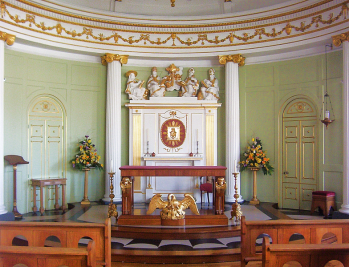
Bar Convent Chapel, completed in 1769. Established in 1686, the Convent of the Institute of the Blessed Virgin at Micklegate Bar in York is the oldest surviving convent in England.
This talk will examine the history and contents of two extraordinary 18th-century chapels in the North of England. Both chapels were hidden from view, but both reflected very different aspects of English Catholicism. The 1713 Stonyhurst Shireburn inventory lists luxury artefacts from China along with those of the European baroque, salvaged medieval material culture, and the latest English Georgian fashions, all demonstrating a confident seigneurial Catholicism in a deeply rural setting. The flamboyant but hidden 1769 Bar Convent chapel of Mother Ann Aspinal and its associated 16th- and 17th-century relics and vestments speaks of a different community—religious sisters and recusant schoolgirls—navigating the political challenges associated with an all-female community in a volatile urban setting.
Jan Graffius is Curator of Collections and Historic Libraries at Stonyhurst College.
◊ ◊ ◊ ◊ ◊
Kerry Bristol | Robert Adam and Thomas Chippendale at Nostell: A Matter of Equals?
York Medical Society, Saturday, 11 March 2023, 2.30pm
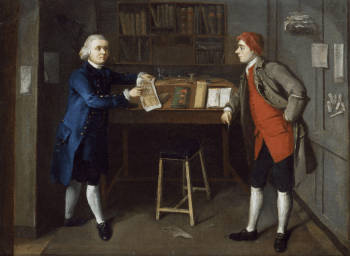
Unknown British artist, A Cabinet Maker’s Office, ca. 1770, oil on canvas, 53 × 70 cm (London: V&A, P.1-1961).
Nostell, the ancestral home of the Winn family near Wakefield, has long been recognised as an important commission for both Robert Adam and Thomas Chippendale, one indicative of a close friendship between architect and patron and suggestive of a special relationship between the Otley-born cabinetmaker and a family who reputedly promoted his interests early in his career. Based on a fresh reading of the Nostell archive, this lecture will investigate the nature of the business relationship between Adam and Chippendale and query how and where they worked together at Nostell and when they worked independently of each other. Did the late 18th-century architect always have the upper hand, or could those who furnished a house exert more control?
Kerry Bristol is Senior Lecturer in the School of Fine Art at the University of Leeds.
Podcast | 18th-Century Dining with Ivan Day
From Spotify:
Neil Buttery and Ivan Day, “18th-Century Dining with Ivan Day,” The British Food History Podcast, Season 5 (22 January 2023), 43 minutes.

Martha Bradley, The British Housewife (1760). From Ivan Day’s Instagram account.
For this episode, Neil’s guest is esteemed food historian Ivan Day. Ivan is a social historian of food culture and a professional chef and confectioner. He has contributed to dozens of TV and radio programmes over the years. He is the author of numerous books and papers on the history of food, and he has curated major exhibitions on food history in the UK, US, and Europe. This special episode compliments Neil’s upcoming book, a biography the 18th-century cookery writer Elizabeth Raffald. Ivan kindly invited Neil into his home to talk about all things 18th-century dining: ostentatious coronation feasts; the rise of female food writers, including Elizabeth Raffald; market gardens; the presentation of food at the table; jelly; flummery moulds; authenticity; and the practicalities of spit roasting—how crockery, cutlery and, well, the whole dining experience changed going into and out of the 18th century.
Information on Day’s courses for October, November, and December, offered through The School of Artisan Food, is available here»
Forthcoming from Pen and Sword History:
Neil Buttery, Before Mrs Beeton: Elizabeth Raffald, England’s Most Influential Housekeeper (Barnsley: Pen and Sword History, 2023), 224 pages, ISBN: 978-1399084475, £20 / $40.
Exhibition | Flora Danica: The World’s Wildest Dinnerware

From the Royal Danish Collection:
Flora Danica: The World’s Wildest Dinnerware / Verdens Vildeste Stel
Library Hall, Koldinghus, Kolding, 7 October 2022, ongoing
With 1,530 intact pieces, the Flora Danica dinnerware is not only the best-preserved luxurious porcelain service from the 18th century but also undoubtedly the world’s wildest dinnerware in terms of splendour, storytelling, and decorations. This grand exhibition of the Flora Danica dinnerware at Koldinghus offers a close look at the magnificent set and tells the story of the fascinating ideas and myths associated with it and their connections to national and international politics. With its numerous pieces and painstaking reproductions of wild Danish botany on fragile white porcelain, the service offers an important key to understanding Denmark during the Enlightenment. Like the Danish crown jewels, the dinnerware is still in use today for very special occasions in the Royal House.
The Origins of Flora Danica
The exhibition explores the origins of this historic porcelain service, which is inextricably linked with Flora Danica, the world’s most ambitious reference work on wild plants, which took more than 122 years to complete and features beautiful copperplate prints and precise descriptions of more than 3,240 plant species. The goal of the project was to collect knowledge and facilitate the use of wild plants, lending lustre to the absolute monarchy. Around 1789, it was decided to transplant this prestigious project to precious porcelain. No specific information has been preserved about when this wild idea first arose, who came up with the almost absurd notion of decorating porcelain with wild plants, or for whom this lavish service was intended. Indeed, our knowledge about the early chapters in the story of this magnificent service is as limited as the myths about it are numerous!
Wild Rumours and International Drama
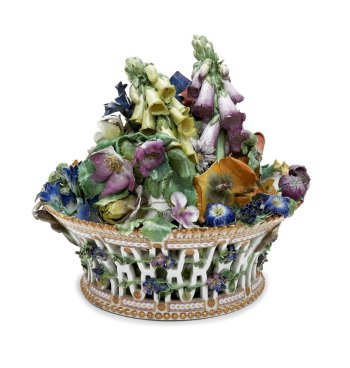
Flower Basket from the Flora Danica set (Photo by Iben Kaufmann).
Even while the service was in production, rumours abounded about the purpose of this lavish dinnerware decorated with wild plants. Rumor spread like wildfire throughout Europe, and there was persistent speculation that it was intended for the Russian Empress Catherine the Great, a porcelain enthusiast. Indeed, the Flora Danica service may have been intended for her, as a diplomatic gift in a time of international tension. Or perhaps, the dinnerware with the wild plants were created for the table of the Danish king as a wild act of political nudging to promote a particular policy.
At the time, the dramatic state of international politics was easily matched by the drama surrounding the political direction of the monarchy in the Danish realm, where a fierce political battle was playing out between pro- and anti-reformists. The exact role and position of the Flora Danica service in the cross-fire of reforms, diplomacy, and wild rumour remain a mystery to this day. Around 1879, that mystery put forth an outstanding flower in the form of this stunning service, unparalleled in scale and wondrous decorations.
Poisonous Mushrooms and Sophisticated Advertising
Each of the many pieces of the Flora Danica service features images from one of the copperplate prints from the reference work, carefully reproduced in full scale. Tureens, wine coolers, and plates are covered in wild flora: from humble algae on Norwegian rocks to poisonous mushrooms in Danish forests and long grasses on the moors of Holstein.
While the copperplate images were easily transferred to the larger pieces, such as tureens and serving dishes, the porcelain painters needed all their skill and ingenuity when it came to the smaller pieces. Long stalks were cut, grasses were laid horizontally, and leaves were twisted to fit the floral decorations onto round and curvy small dishes, custard cups, and salt cellars. The mantra was accuracy above all else, with correct representations taking precedence over beauty. Thus, despite its impressive volume and splendour, the service was mainly conceived as PR for the underlying publication. In fact, it is so inextricably linked to the reference work that the service should not be seen as an independent artistic achievement by the Royal Danish Porcelain Factory but rather as a sophisticated advertising stunt.
The World’s Wildest Dinnerware
Since the large exhibition about the Flora Danica dinnerware in 1990 at Christiansborg Palace, it has not been possible to stage a comprehensive presentation of this wild service, which is almost as storied as it is voluminous. The upcoming exhibition will shed light on the wild myths surrounding the service and offer the audience an up-close look at the unusual decorations and the use of the historical service, which was first used in 1803 at the birthday banquet for Christian VII. Since then, it has been used on very special occasions in the Royal House. Most recently, it was in use at the golden jubilee of HM Queen Margrethe II in January 2022. No other Danish service can boast as long a legacy or a presence at such historic banquets as the Flora Danica service, which remains the world’s wildest dinnerware—in terms of history, storytelling, and decoration.
The exhibition is made possible by loans of items from the State Inventory and contributions from Royal Copenhagen and Georg Jensen Damask. It opened at Koldinghus on 7 October 2022 and will be followed up by events and communication initiatives to shed light on the history, use, and continued relevance of the porcelain service.
Jesper Munk Andersen, Flora Danica: The World’s Wildest Dinnerware (Copenhagen: Kongernes Samling / The Royal Danish Collection, 2022), 104 pages, ISBN: 978-8789542256. Also available in Danish.
More information is available here»
At Sotheby’s | From the Collection of Jacques Garcia

Salon-Tapisseries in the Château du Champ de Bataille
(Photo from Sotheby’s)
◊ ◊ ◊ ◊ ◊
Auction puffery is always interesting. The press release (via Art Daily) for the sale explains that Garcia’s “perfect knowledge of history is treasured by some of the greatest museums and institutions . . . [including] Versailles” and declares that the sale will “present the most important group of Sèvres ever to appear on the market.” We’re likely to hear a lot about it between now and May. [Note (added 22 May 2023) — Sale results are summarized in this press release, via Art Daily.] –CH
At Auction: Jacques Garcia, Intemporel, Sale PF2361
Sotheby’s, Paris, 16 May 2023 (works on view in Paris, 11–15 May 2023)
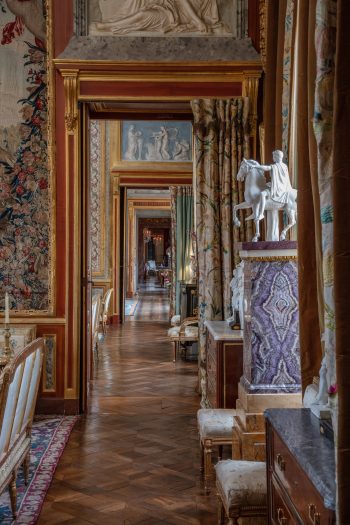
Enfilade at Château du Champ-de-Bataille (Photo from Sotheby’s).
“The power of exceptional residences lies in the unforgettable feeling that stays with those who have visited them. As with all of Jacques Garcia’s creations, Champ de Bataille is one such memorable place. This setting leaves an indelible mark from the first visit, from the initial shock of its beauty to the awe when you realise the mammoth effort that has gone into its construction and renovation. Nowhere is Garcia’s mastery of atmosphere more evident.” –Mario Tavella, Président of Sotheby’s France, Chairman of Sotheby’s Europe
On 16 May, 75 prestigious works of art—handpicked by French interior designer and collector Jacques Garcia from the project of a lifetime—will be offered at Sotheby’s in Paris. The proceeds will benefit Champ de Bataille, preserving its legacy for future generations. Garcia is the creative force behind many of the most lavish and opulent settings in the world—from the La Mamounia Hotel in Marrakech and Hotel Costes in Paris, to painstakingly decorated rooms in the Louvre and Versailles. Most recently in the limelight has been his Villa Elena in Noto, a magnificent Sicilian villa featured in the US series The White Lotus, a labour of love for Garcia who painstakingly restored the baroque interiors, which were destroyed by an earthquake in 1693.
In 1992, Garcia acquired the Château du Champ de Bataille, one of the most charming and inventive buildings of its kind, designed by Louis le Vau (the architect behind Versailles) and boasting the grandest private garden in Europe. By the late twentieth century, only two of the rooms were in usable condition; and so, began a titanic project of renovating the site spanning the next three decades and then opening its doors to the public.
The collection assembled by Jacques Garcia for the Champ de Bataille is a tribute to the finest decorative arts of the 17th, 18th and 19th centuries, bringing together exceptional furniture, porcelain, and sculpture. Among the many masterworks are items that belonged to royalty and nobility—including Kings Louis XV and Louis XVI, Queens Marie Leszczynska and Marie-Antoinette, King William III and Queen Mary II, the Count of Provence, and the Dukes of Penthièvre and Lorraine. The selection continues into the 19th century with provenances including the Emperor Napoleon and dynastic collectors such as the Rothschilds.
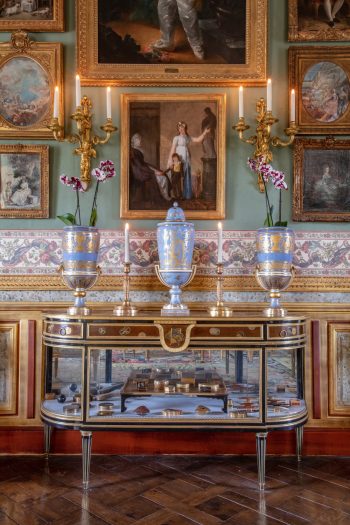
The sale’s 75 lots will mark Garcia’s 75th birthday. Many pieces within the collection have a royal provenance, with Kings Louis XV and Louis XVI and Queens Marie Leszczynska and Marie-Antoinette among the previous owners (Photo from Sotheby’s).
The sale will offer several pieces of Neoclassical furniture crafted by prominent Parisian maker Georges Jacob and delivered for Queen Marie-Antoinette. These include two pairs of armchairs and a canapé thought to have been ordered for Marie-Antoinette’s Turkish Boudoir at Fontainebleau (each estimated at €400,000–600,000).
Among the most remarkable pieces is a console table by Parisian marchand-mercier and ébéniste Adam Weisweiler (estimated €1–2 million). The magnificent piece of furniture bears the hallmarks of the innovations towards the end of Louis XVI’s reign, bringing together precious materials such as Japanese lacquer and porcelain plates. The use of painted sheet metal, juxtaposed with the marble top, is unique in Weisweiler’s corpus, whilst paying homage to the work of his predecessor Martin Carlin.
A floral marquetry commode from the Louis XV period, attributed to Antoine-Robert Gaudreau (the principal supplier of furniture for the royal châteaux early in the reign of Louis XV), bears the mark of Louis XIV’s grandson, the Duke of Penthièvre (estimated at €400,000–700,000). Penthièvre was one of the wealthiest men of his day, living in the Château de Bizy in Normandy, which he partly decorated with furniture from the Marquise de Pompadour.
The sale also offers a daybed likely made for the wedding of Napoleon Bonaparte to Empress Marie-Louise in 1810 (estimated €100,000–200,000). Attributed to Jacob Desmalter, it follows the design from a drawing by French architects Percier and Fontaine and decorated with a medallion by Bertrand Andrieu (created to commemorate the marriage and associated Napoleon with a centuries-old dynasty).
A pair of cabinets, decorated with remarkable finesse with Japanese laquer and silver mounts from the Edo period (ca. 1640–80), hail from the collection of King William III and Queen Mary II of England (estimated €800,000–1,200,000). The decor reflects the strong Flemish and Dutch influences during their reign, as well as a penchant for East Asian elements.

The table service featured in the sale is decorated with images of 400 different birds after drawings by Buffon (Photo from Sotheby’s).
The sale will present the most important group of Sèvres ever to appear on the market. Among them is a pair of vases with Turkish-inspired decor from 1773, the compositions inspired by painter Jean-Baptiste Le Prince (estimated €200,000–300,000)—reflecting the contemporary craze of transposing fashionable artworks onto vases intended for the royal court. The collection also includes part of a table service with the Suddell family coat of arms, decorated with more than 400 different birds after the natural history drawings by Georges-Louis Le Clerc de Buffon, keeper of the Royal Garden in Paris (estimated €600,000– 1,000,000). Among the most spectacular of all is a pair of large ‘Lagrenée’ vases, with a vibrant purple background, dated 1797 (estimated €800,000– 1,200,000). Over its long history, this pair has belonged to a number of the most prestigious European collections: purchased at the Sèvres factory in December 1799 before being presented to King Charles IV of Spain in about 1800, acquired by Alexander Hamilton (the 10th Duke of Hamilton) in 1807–08, and passed on by descent to the 12th Duke of Hamilton, William Alexander Louis Stephen Douglas-Hamilton.
Recognised the world-over, Jacques Garcia has long been one of the most sought-after interior designers, reinventing himself with each project and dedicated to innovation through the bringing together of the classic and the modern. His influence is multi-faceted, spanning interior design, patronage of the arts, and technical and artistic advisor. Garcia was awarded the Legion of Honour in 1997, before being made a Commander of the Order of Arts and Letters in 2002, as well as the Knight of the Order of Agricultural Merit.
From the 1990s, Garcia has worked for major international hoteliers, from Barrière-Desseigne to Costes; his standout achievements include La Réserve in Paris (a 5-star palace voted as the best hotel in the world in 2017) and the mythic La Mamounia in Marrakech. His innate talent for matching styles and his perfect knowledge of history is treasured by some of the greatest museums and institutions, many of which have entrusted him with their spaces. These include the Musée de la Vie Romantique in Paris, the grand apartments of Versailles, and the rooms of François I at the Château de Chambord. He has also played the rôle of scenographer for several exhibitions, the most spectacular of which was a recreation of the throne room in Versailles’ Hall of Mirrors in 2007.

Château du Champ-de-Bataille, built 1653-65 (Photo from Sotheby’s).
An art lover from his childhood, Garcia is also an eminent collector, buying his first works at the age of 25. His erudition, curiosity, and encyclopedic knowledge of inventories, as well as an overriding quest for excellence, has enabled him to assemble the finest examples of art and antiques. In 1992, Garcia acquired the Château de Champ de Bataille and set about on the project of a lifetime, renovating the residence in the image of the Grand Siècle. Inspired by the Universal Exhibitions, he also populated the garden with multiple follies, bringing together influences from China and India.
Built in the 17th century, the Château du Champ de Bataille is one of the most beautiful estates in France. Its first proprietor, Count Alexandre de Créqui, was exiled from court and placed under house arrest by Cardinal Mazarin during the Fronde (a series of civil wars in France between 1648 and 1653). De Créqui set upon building this home on his land in Normandy to remind himself of the splendour of the French court.
The castle then passed through the hands of a number of different families, including several cousins of the noble Harcourt family, each of whom made profound changes. In the 19th century, the almost derelict castle even became a hospital and then a prison.
At the time that Jacques Garcia acquired the property, only two of the rooms had retained their original decor. Remaining true to the grand spirit of the 17th and 18th centuries, Garcia redesigned and restored all of the other rooms, acquiring a wealth of furniture, paintings, and works of art from great collections to furnish and bring the space to life.
Alongside the interiors, Garcia also completely recreated the gardens, with the assistance of master landscaper Patrick Pottier. The result is a marriage of a historic garden and a contemporary vision, drawing inspiration from ancient and philosophical themes. The garden presents several architectural follies, including the ‘Temple of Leda’ and the ancient theatre or ‘Pavillion of Dreams’ (inspired by Mughal India and furnished with original pieces from Indian palaces). Today, the Champ de Bataille estate—covering an area of 45 hectares—is the largest private park in Europe, its gardens recognised for their wonder by the French government.
◊ ◊ ◊ ◊ ◊
For more information on the house, see Jacques Garcia and Alain Stella, with photographs by Eric Sander, Jacques Garcia: Twenty Years of Passion: Chateau du Champ de Bataille (Paris: Flammarion, 2014), 400 pages, ISBN: 978-2080201690.
Symposium | Rococo across Borders: Designers and Makers

Commode designed by Jean-François Cuvilliés, the Elder, pine partially painted and gilded, German, ca. 1735–40 (New York: The Metropolitan Museum of Art, 28.154).
◊ ◊ ◊ ◊ ◊
Registration now open at Eventbrite:
Rococo across Borders: Designers and Makers
In-person and live-streamed, Victoria and Albert Museum, London, 24–25 March 2023
Organized by the Furniture History Society and the French Porcelain Society, this two-day symposium on Rococo ceramics and furniture across Europe and beyond aims to examine the geographical spread of the Rococo style, the interaction between designers and makers, and the significant role played by print culture in its dissemination. It will go beyond the traditional geographical, chronological, and conceptual fields of Rococo design to explore how the style evolved throughout the long eighteenth century and to reflect on wider discussions about the historical contexts for Rococo ceramics and furniture, alongside the place of the ‘Rococo’ in museums and art historical scholarship today. Tickets: £30–142.
 F R I D A Y , 2 4 M A R C H 2 0 2 3
10.00 Registration
10.20 Welcome and Introduction from Dame Rosalind Savill DBE, FSA, FBA, President of the French Porcelain Society
10.35 Session One | Origins and Circulation of the Rococo
Moderated by Helen Jacobsen
• Form versus Function: The Rococo Contradiction and Its Application to French Eighteenth-Century Decorative Arts — John Whitehead (Independent Scholar)
• The Diplomatic Gifts of Louis XV (working title) — Marie-Laure Buku-Pongo (Assistant Curator of Decorative Arts, The Frick Collection, New York
• From Cathay to Paris: Trade with Asia, Its Actors, and Its Influence on the Arts in Paris — Stéphane Castelluccio (Directeur de recherche au CNRS, Centre André Chastel, Paris)
• The Rococo Diaspora: Wandering Craftsmen, Objects, Patronage, and Diplomacy — Sarah Coffin (Independent Curator, Former Senior Curator, Cooper Hewitt Museum, New York)
12.40 Discussion
12.55 Lunch including ’Object in Focus Sessions’ with V&A Collections and Curators (separate tickets required)
14.25 Session Two | Virtuoso Rococo: England and the Netherlands
Moderated by David Oakey
• ‘A Peculiarity in the Lines’: Drawing and Carving ‘Rococo’ in Mid-Eighteenth-Century England — Jenny Saunt (Curatorial Research Fellow, V&A Museum, London)
• Chelsea’s Extreme Rococo: A Perspicuous Misunderstanding or a Calculated Risk — Patricia Ferguson (Independent Scholar)
• Designing or Making: On the Role of Craftsmen as Designers — Reinier Baarsen (Curator Emeritus of Decorative Arts at the Rijksmuseum)
• Rococo Silver in the Austrian Netherlands: A Virtuoso Kaleidoscope? — Wim Nys (Head of Collections and Research, DIVA Museum, Antwerp)
16.35 Discussion
16.50 Closing Remarks
18.00 Ticket holders are invited to a drinks reception, supported by Bonhams, at Montpelier St, London SW7 1HH; spaces are limited so early booking is advised.
S A T U R D A Y , 2 5 M A R C H 2 0 2 3
10.00 Registration
10.20 Welcome and Introduction from Christopher Rowell FSA, Chairman of the Furniture History Society
10.30 Session Three | Inspiration and Emulation: Ireland, Germany, and Russia
Moderated by Caroline McCaffrey-Howarth
• The Prints of Carl Pier (b. 1717): Visions and Potentialities in Southern German Rococo Design — Michael Yonan (Professor of Art History, University of California)
• Frederician Furniture in Berlin and Potsdam, ca. 1740–1775 — Henriette Graf (Curator of Furniture, Stiftung Preußische Schlösser und Gärten Berlin-Brandenburg)
• The Englishness of Irish Rococo: The Dublin School of Stucco Workers — Conor Lucey (Associate Professor in Architectural History, University College Dublin)
• Pineau le Russe: A French Sculptor in Service to the Tsars— Turner Edwards (Collaborateur Scientifique, Musée des Arts Décoratifs, Paris)
12.40 Discussion
12.55 Lunch
14.25 Session Four | Across the Seas: China, the Americas, and back to France
Moderated by Adriana Turpin
• Persistence, Resistance, and Canadian Rococo Furniture — Philippe Halbert (Curator of American Decorative Arts at the Wadsworth Atheneum, Hartford)
• Ornaments from the Western Ocean: Rococo as a Qing Imperial Style in the Decorative Arts — Mei Mei Rado (Assistant Professor, History of Textiles, Dress, and Decorative Arts, Bard Graduate Center, New York)
• The French Rococo Style in Colonial Latin America — Dennis Carr (Virginia Steele Scott Chief Curator of American Art, Huntington Library, Art Museum, and Botanical Gardens, Los Angeles)
• Colonial Fantasy and Rococo Regressions: Porcelain in the Time of Louis-Philippe — Iris Moon (Assistant Curator of European Sculpture and Decorative Arts, Metropolitan Museum of Art, New York)
16.35 Discussion
16.50 Closing Remarks
Images: Top left to bottom right, Flower vase (cuvette Mahon), probably designed by Jean-Claude Duplessis, Sèvres Manufactory, French, soft-paste porcelain, ca. 1757–60 (New York: The Metropolitan Museum of Art, 1974.356.592); Girandole à branche de porcelaine garnie d’or, from Oeuvres de Juste-Aurèle Meissonnier, engraved by Gabriel Huquier, French, 1738–49 (New York: Cooper-Hewitt, Smithsonian Design Museum, 1921-6-212-29-b); Commode designed by Jean-François Cuvilliés, the Elder, pine partially painted and gilded, German, ca. 1735–40 (New York: The Metropolitan Museum of Art, 28.154).
Handling Session | Hausmaler at the V&A
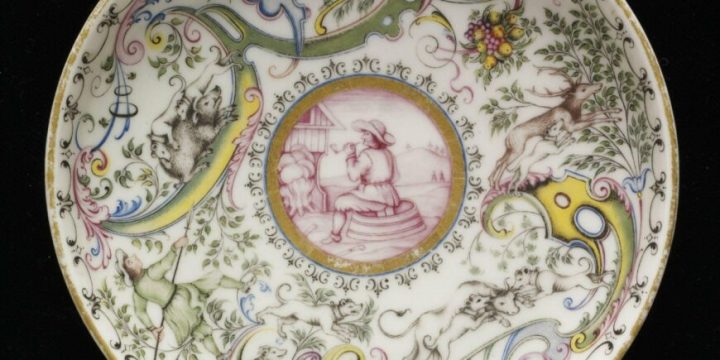
Saucer, made at the Meissen Porcelain Manufactory, ca. 1720–25 and then painted by an unknown ‘hausmaler’ painter, ca. 1720–30
(London: Victoria and Albert Museum, C.218A-1938)
◊ ◊ ◊ ◊ ◊
A good reason to join The French Porcelain Society:
Hausmaler at the V&A
Victoria and Albert Museum, London, 23 February 2023
The French Porcelain Society’s handling session examining German Hausmalerei—faïence and porcelain painted in small workshops outside their factories (Hausmaler, ‘home painter’)—from the V&A collection will take place on Thursday, 23 February, in the morning. The session will be led by Simon Spier, Curator of Ceramics and Glass 1600–1800, and Errol Manners. Numbers will be limited, and the cost is £25, with a reduced rate available for emerging scholars. If interested, please contact FPS administrator Kelsey Weeks, FPSmailing@gmail.com.
New Book | China and the West: Chinese Reverse Glass Painting
From De Gruyter:
Elisa Ambrosio, Francine Giese, Alina Martimyanova, and Hans Bjarne Thomsen, eds., China and the West: Reconsidering Chinese Reverse Glass Painting (Berlin: De Gruyter for the VitroCentre Romont, 2022), 292 pages, ISBN: 978-3110711752, $58. With contributions by Thierry Audric, Kee Il Choi Jr., Patrick Conner, Karina H. Corrigan, Elisabeth Eibner, Patricia F. Ferguson, Lihong Liu, William H. Ma, Alina Martimyanova, Christopher L. Maxwell, Rupprecht Mayer, Jessica Lee Patterson, Michaela Pejčochová, Jérôme Samuel, Hans Bjarne Thomsen, Jan van Campen, and Rosalien van der Poel. Now digitally available for free as open access.
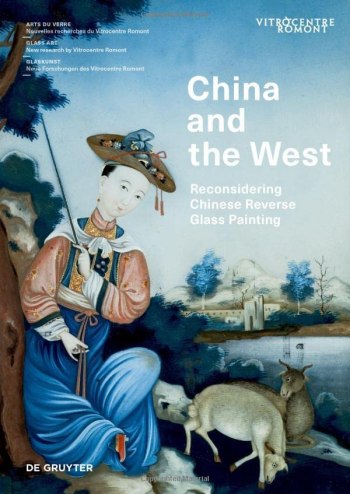 With contributions from outstanding specialists in glass art and East Asian art history, this edited volume opens a cross-cultural dialogue on the hitherto little-studied medium of Chinese reverse glass painting. The first major survey of this form of East Asian art, the volume traces its long history, its local and global diffusion, and its artistic and technical characteristics. Manufactured for export to Europe and for local consumption within China, the fragile artworks studied in this volume constitute a paramount part of Chinese visual culture and attest to the intensive cultural and artistic exchange between China and the West. This book is volume 1 in the series Arts du verre / Glass Art / Glaskunst.
C O N T E N T S
Preface — Danielle Elisseeff
Introduction — Francine Giese, Hans Bjarne Thomsen, Elisa Ambrosio, and Alina Martimyanova
Chinese Reverse Glass Painting and Its Materiality
1 From Virtuosity to Vernacularism: Reversals of Glass Painting — Lihong Liu
2 People in Glass House: The Polite and Polished in Georgian Britain — Christopher L. Maxwell
3 Illusionistic Practices among les Arts du Feu in Mid-Eighteenth-Century Canton — Kee Il Choi Jr.
4 Light, Reflection, and Reverse Glass Painting at the Nguyên Court — William H. Ma
Trasnfer and Transmediality
5 Glass Painting in the Collection of Andreas Everardus Van Braam Houckgeest (1739–1801) — Jan van Campen
6 The Governor of Surat and the Apotheosis of Washington Cantonese Reverse Glass Paintings for Early Nineteenth-Century American Markets — Karina H. Corrigan
7 Regarding the Transfer of Vernacular Motifs and Other Common Features of Chinese New Year Prints and Chinese Reverse Glass Painting — Alina Martimyanova
8 The Nightmare Case Study of a Deliberately Inaccurate Transmission to Glass — Elisabeth Eibner
Contextual Studies of Reverse Glass Painting
9 Varieties of Replication in Chinese Reverse Glass Painting — Jessica Lee Patterson
10 Reflecting Asia: The Reception of Chinese Reverse Glass Painting in Britain, 1738–1770 — Patricia F. Ferguson
11 Japanese Reverse Glass Painting: The Other East Asian Tradition — Hans Bjarne Thomsen
12 ‘In All of Beijing, There Are No More than Four Paintings on Glass That Would Fall within Our Consideration’: Chinese Reverse Glass Paintings from Czech Collections and Their Contexts — Michaela Pejčochová
Regional Receptions of Reverse Glass Painting
13 Reflections in a Chinese Mirror: Westerners Reinterpreted in Early Cantonese Glass Painting — Patrick Conner
14 Eighteenth-Century Chinese Reverse Glass Painting in a Dutch Collection: Art and Commodity — Rosalien van der Poel
15 China and Its South Chinese Ladies on Glass and Other Topics in Nineteenth- and Twentieth-Century Java and Bali — Jérôme Samuel
Pioneering Research in Chinese Reverse Glass Painting
16 A Brief History of Chinese Reverse Glass Painting — Thierry Audric
17 Some Styles in Nineteenth- and Twentieth-Century Chinese Glass Painting: A First Approach — Rupprecht Mayer
List of Authors
Index of Places and People
Credits
New Book | Imagining Sculpture: A Short Conjectural History
Published by Hirmer and distributed by The University of Chicago Press:
Stanley Abe, Imagining Sculpture: A Short Conjectural History (Munich: Hirmer Verlag, 2023), 384 pages, ISBN: 978-3777437583, $45.
 A new critical approach to understanding sculpture across cultures.
Imagining Sculpture is the story of the absence of a powerful European idea: Sculpture. In China statues, stele, and other figural objects were made for millennia but were not categorized as Sculpture. Imagining Sculpture explains how they were seen in China as objects beyond the category of Sculpture. The book is a series of short vignettes—historical and fictional. Travellers, scholars, collectors, and antiquarians encounter statues, figures, and effigies in China, Japan, England, Germany, France, Italy, and the United States from the fourteenth to the beginning of the twentieth century. The book is visual, cinematic, and sumptuous—told with rare photographs, paintings, sketches, letters, and ephemera. With little text, images propel the narrative, offering a different way of seeing and knowing.
Stanley Abe is associate professor in the Department of Art, Art History, and Visual Studies at Duke University. He is the author of Ordinary Images and served as editor in chief of Archives of Asian Art from 2011 to 2018.
Exhibition | Johann Gottfried Schadow: Embracing Forms

Johann Gottfried Schadow, Double Portrait Statue of Princesses Luise and Friederike of Prussia, detail, 1795–97, marble
(Staatliche Museen zu Berlin, Nationalgalerie)
◊ ◊ ◊ ◊ ◊
From the Staatliche Museen zu Berlin:
Johann Gottfried Schadow: Embracing Forms / Berührende Formen
Alte Nationalgalerie, Berlin, 21 October 2022 — 19 February 2023
Curated by Yvette Deseyve
The life-size double statue of Princesses Louise and Frederica of Prussia, known as the Princess Group, is the magnum opus of Johann Gottfried Schadow (1764–1850). Seen as the founder of the Berlin School of sculpture, Schadow came to epitomize German neoclassicism, with this work being emblematic of the movement. As the first sculpture depicting two female historical figures, this work wrote art history, and continues to be a highlight for visitors to Berlin from around the world. The first retrospective in some 30 years, this exhibition presents Schadow’s major sculptural, graphic, and art-theoretical works, arranged into 11 thematic sections. Following extensive conservation and restoration work, the original plaster model of the Princess Group (from 1795) is exhibited alongside the original marble rendering (1797) for the first time ever.
 With more than 150 works, the collection of the Nationalgalerie is home to the world’s largest selection of Schadow’s sculptural works, including both originals of the Princess Group. Since the last retrospective almost 30 years ago (which was first exhibited at the Alte Nationalgalerie), a great deal has been uncovered about the artist, his oeuvre, the functioning of his workshop, and his working methods. This knowledge comes in large part from the major research and restoration project focused on the original plaster model of the Princess Group, the findings of which are here presented to the public for the first time. Numerous international loans of sculptures, paintings, and graphic works, as well as art-theoretical writings, offer insights into the genesis and critical reception of the Princess Group. The exhibition also features works by some of Schadow’s contemporaries, including Gainsborough, Tischbein, Weitsch, Chodowiecki, and Begas.
Johann Gottfried Schadow: Embracing Forms is curated by Yvette Deseyve and is accompanied by catalogues in both English and German. The exhibition was made possible by the Freunde der Nationalgalerie, the Ernst von Siemens Kunststiftung, and the Cultural Foundation of the German Federal States. The three-year conservation and restoration project on the original plaster model of the Princess Group was funded by the Hermann Reemstma Stiftung, the Rudolf-August Oetker-Stiftung, and the Cultural Foundation of the German Federal States. The Bern University of Applied Sciences and the Bern Academy of the Arts supported the project as cooperation partners.
Yvette Deseyve, ed., with contributions by Sintje Guericke, Johann Gottfried Schadow: Embracing Forms (Munich: Hirmer Verlag, 2023), 304 pages, ISBN: 978-3777440873, $65.
Exhibition | Ridolfo Schadow: The Judgment of Cupid

Ridolfo Schadow, Cupid, detail, 1821/22, marble
(Berlin: SPSG Skulpt.slg. 2800, photo by Daniel Lindner)
◊ ◊ ◊ ◊ ◊
Now on view at Charlottenburg Palace:
Ridolfo Schadow: The Judgment of Cupid / Das Urteil des Amor
Schloss Charlottenburg, Berlin, 28 May 2022 — 31 December 2023
Special presentation on the 200th anniversary of the death of Ridolfo Schadow
On the occasion of the 200th anniversary of the death of the sculptor Ridolfo Schadow (1786–1822) an idea of the artist will be realized for the first time within a presentation in the vestibule of the New Wing in Charlottenburg Palace. Three young girls sit opposite Cupid, the winged god of love. Engrossed in their respective activities, they don’t appear to have noticed his presence. Cupid is undecided: on whom should he bestow the floral wreath in his hand? This arrangement of four marble sculptures awakens associations with the ‘Judgement of Paris’, the story from Greek mythology in which Zeus, the father of the gods, assigned Paris, the son of the Trojan king, the task of deciding who is the most beautiful of the goddesses: Hera, Athena, or Aphrodite.

Ridolfo Schadow, Girl Spinning, 1818, marble (SPSG Skulpt.slg. 5579).
Schadow, however, presents viewers with sensitively observed adolescents in poses capturing everyday situations: the young Cupid, the Girl with Doves (Innocence), the Girl Tying Her Sandal, and the Girl Spinning. King Frederick Wilhelm III of Prussia purchased the four sculptures produced by Ridolfo Schadow in Rome. Three of them stood in the Royal Palace (Kronprinzenpalais), while the fourth was displayed in the Berlin Palace. Thus, with this presentation, the original intention of the sculptor—arranging the four figures as a group—has been fulfilled for the first time.
What real circumstances could have inspired this idea of the prematurely deceased Ridolfo Schadow? Living in the Casa Buti, a type of artists’ guesthouse in Rome, the sculptor not only met fellow artists such as Bertel Thorvaldsen (1770–1844) and Antonio Canova (1757–1822), but also the three daughters of the Buti household. They were probably the models for the charming genre scenes, which were very popular at the time. This small exhibition addresses the origin, interpretation, and later influence of the figures.
Visitors can find additional details of Ridolfo Schadow’s work and life in Rome on the SPSG website, as well as information on further works acquired by the Prussian ruling house through the mediation of Ridolfo’s father and teacher, the famous Berlin sculptor, Johann Gottfried Schadow (1764–1850)—himself the subject of considerable attention in 2022 and 2023 with exhibitions at the Alte Nationalgalerie SMB PK, the Gipsformerei SMB PK (Replica Workshop), the Schadow Gesellschaft Berlin e.V., and the Stiftung Stadtmuseum Berlin.










 Enfilade
leave a comment