New Book | China and the West: Chinese Reverse Glass Painting
From De Gruyter:
Elisa Ambrosio, Francine Giese, Alina Martimyanova, and Hans Bjarne Thomsen, eds., China and the West: Reconsidering Chinese Reverse Glass Painting (Berlin: De Gruyter for the VitroCentre Romont, 2022), 292 pages, ISBN: 978-3110711752, $58. With contributions by Thierry Audric, Kee Il Choi Jr., Patrick Conner, Karina H. Corrigan, Elisabeth Eibner, Patricia F. Ferguson, Lihong Liu, William H. Ma, Alina Martimyanova, Christopher L. Maxwell, Rupprecht Mayer, Jessica Lee Patterson, Michaela Pejčochová, Jérôme Samuel, Hans Bjarne Thomsen, Jan van Campen, and Rosalien van der Poel. Now digitally available for free as open access.
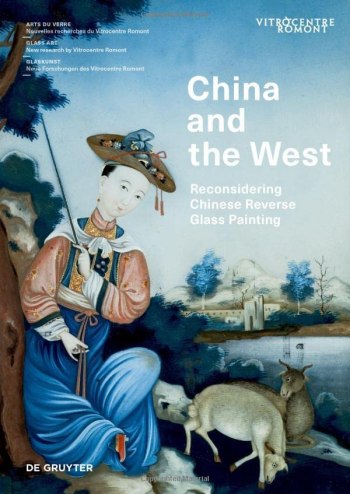 With contributions from outstanding specialists in glass art and East Asian art history, this edited volume opens a cross-cultural dialogue on the hitherto little-studied medium of Chinese reverse glass painting. The first major survey of this form of East Asian art, the volume traces its long history, its local and global diffusion, and its artistic and technical characteristics. Manufactured for export to Europe and for local consumption within China, the fragile artworks studied in this volume constitute a paramount part of Chinese visual culture and attest to the intensive cultural and artistic exchange between China and the West. This book is volume 1 in the series Arts du verre / Glass Art / Glaskunst.
C O N T E N T S
Preface — Danielle Elisseeff
Introduction — Francine Giese, Hans Bjarne Thomsen, Elisa Ambrosio, and Alina Martimyanova
Chinese Reverse Glass Painting and Its Materiality
1 From Virtuosity to Vernacularism: Reversals of Glass Painting — Lihong Liu
2 People in Glass House: The Polite and Polished in Georgian Britain — Christopher L. Maxwell
3 Illusionistic Practices among les Arts du Feu in Mid-Eighteenth-Century Canton — Kee Il Choi Jr.
4 Light, Reflection, and Reverse Glass Painting at the Nguyên Court — William H. Ma
Trasnfer and Transmediality
5 Glass Painting in the Collection of Andreas Everardus Van Braam Houckgeest (1739–1801) — Jan van Campen
6 The Governor of Surat and the Apotheosis of Washington Cantonese Reverse Glass Paintings for Early Nineteenth-Century American Markets — Karina H. Corrigan
7 Regarding the Transfer of Vernacular Motifs and Other Common Features of Chinese New Year Prints and Chinese Reverse Glass Painting — Alina Martimyanova
8 The Nightmare Case Study of a Deliberately Inaccurate Transmission to Glass — Elisabeth Eibner
Contextual Studies of Reverse Glass Painting
9 Varieties of Replication in Chinese Reverse Glass Painting — Jessica Lee Patterson
10 Reflecting Asia: The Reception of Chinese Reverse Glass Painting in Britain, 1738–1770 — Patricia F. Ferguson
11 Japanese Reverse Glass Painting: The Other East Asian Tradition — Hans Bjarne Thomsen
12 ‘In All of Beijing, There Are No More than Four Paintings on Glass That Would Fall within Our Consideration’: Chinese Reverse Glass Paintings from Czech Collections and Their Contexts — Michaela Pejčochová
Regional Receptions of Reverse Glass Painting
13 Reflections in a Chinese Mirror: Westerners Reinterpreted in Early Cantonese Glass Painting — Patrick Conner
14 Eighteenth-Century Chinese Reverse Glass Painting in a Dutch Collection: Art and Commodity — Rosalien van der Poel
15 China and Its South Chinese Ladies on Glass and Other Topics in Nineteenth- and Twentieth-Century Java and Bali — Jérôme Samuel
Pioneering Research in Chinese Reverse Glass Painting
16 A Brief History of Chinese Reverse Glass Painting — Thierry Audric
17 Some Styles in Nineteenth- and Twentieth-Century Chinese Glass Painting: A First Approach — Rupprecht Mayer
List of Authors
Index of Places and People
Credits
New Book | Imagining Sculpture: A Short Conjectural History
Published by Hirmer and distributed by The University of Chicago Press:
Stanley Abe, Imagining Sculpture: A Short Conjectural History (Munich: Hirmer Verlag, 2023), 384 pages, ISBN: 978-3777437583, $45.
 A new critical approach to understanding sculpture across cultures.
Imagining Sculpture is the story of the absence of a powerful European idea: Sculpture. In China statues, stele, and other figural objects were made for millennia but were not categorized as Sculpture. Imagining Sculpture explains how they were seen in China as objects beyond the category of Sculpture. The book is a series of short vignettes—historical and fictional. Travellers, scholars, collectors, and antiquarians encounter statues, figures, and effigies in China, Japan, England, Germany, France, Italy, and the United States from the fourteenth to the beginning of the twentieth century. The book is visual, cinematic, and sumptuous—told with rare photographs, paintings, sketches, letters, and ephemera. With little text, images propel the narrative, offering a different way of seeing and knowing.
Stanley Abe is associate professor in the Department of Art, Art History, and Visual Studies at Duke University. He is the author of Ordinary Images and served as editor in chief of Archives of Asian Art from 2011 to 2018.
Exhibition | Johann Gottfried Schadow: Embracing Forms

Johann Gottfried Schadow, Double Portrait Statue of Princesses Luise and Friederike of Prussia, detail, 1795–97, marble
(Staatliche Museen zu Berlin, Nationalgalerie)
◊ ◊ ◊ ◊ ◊
From the Staatliche Museen zu Berlin:
Johann Gottfried Schadow: Embracing Forms / Berührende Formen
Alte Nationalgalerie, Berlin, 21 October 2022 — 19 February 2023
Curated by Yvette Deseyve
The life-size double statue of Princesses Louise and Frederica of Prussia, known as the Princess Group, is the magnum opus of Johann Gottfried Schadow (1764–1850). Seen as the founder of the Berlin School of sculpture, Schadow came to epitomize German neoclassicism, with this work being emblematic of the movement. As the first sculpture depicting two female historical figures, this work wrote art history, and continues to be a highlight for visitors to Berlin from around the world. The first retrospective in some 30 years, this exhibition presents Schadow’s major sculptural, graphic, and art-theoretical works, arranged into 11 thematic sections. Following extensive conservation and restoration work, the original plaster model of the Princess Group (from 1795) is exhibited alongside the original marble rendering (1797) for the first time ever.
 With more than 150 works, the collection of the Nationalgalerie is home to the world’s largest selection of Schadow’s sculptural works, including both originals of the Princess Group. Since the last retrospective almost 30 years ago (which was first exhibited at the Alte Nationalgalerie), a great deal has been uncovered about the artist, his oeuvre, the functioning of his workshop, and his working methods. This knowledge comes in large part from the major research and restoration project focused on the original plaster model of the Princess Group, the findings of which are here presented to the public for the first time. Numerous international loans of sculptures, paintings, and graphic works, as well as art-theoretical writings, offer insights into the genesis and critical reception of the Princess Group. The exhibition also features works by some of Schadow’s contemporaries, including Gainsborough, Tischbein, Weitsch, Chodowiecki, and Begas.
Johann Gottfried Schadow: Embracing Forms is curated by Yvette Deseyve and is accompanied by catalogues in both English and German. The exhibition was made possible by the Freunde der Nationalgalerie, the Ernst von Siemens Kunststiftung, and the Cultural Foundation of the German Federal States. The three-year conservation and restoration project on the original plaster model of the Princess Group was funded by the Hermann Reemstma Stiftung, the Rudolf-August Oetker-Stiftung, and the Cultural Foundation of the German Federal States. The Bern University of Applied Sciences and the Bern Academy of the Arts supported the project as cooperation partners.
Yvette Deseyve, ed., with contributions by Sintje Guericke, Johann Gottfried Schadow: Embracing Forms (Munich: Hirmer Verlag, 2023), 304 pages, ISBN: 978-3777440873, $65.
Exhibition | Ridolfo Schadow: The Judgment of Cupid

Ridolfo Schadow, Cupid, detail, 1821/22, marble
(Berlin: SPSG Skulpt.slg. 2800, photo by Daniel Lindner)
◊ ◊ ◊ ◊ ◊
Now on view at Charlottenburg Palace:
Ridolfo Schadow: The Judgment of Cupid / Das Urteil des Amor
Schloss Charlottenburg, Berlin, 28 May 2022 — 31 December 2023
Special presentation on the 200th anniversary of the death of Ridolfo Schadow
On the occasion of the 200th anniversary of the death of the sculptor Ridolfo Schadow (1786–1822) an idea of the artist will be realized for the first time within a presentation in the vestibule of the New Wing in Charlottenburg Palace. Three young girls sit opposite Cupid, the winged god of love. Engrossed in their respective activities, they don’t appear to have noticed his presence. Cupid is undecided: on whom should he bestow the floral wreath in his hand? This arrangement of four marble sculptures awakens associations with the ‘Judgement of Paris’, the story from Greek mythology in which Zeus, the father of the gods, assigned Paris, the son of the Trojan king, the task of deciding who is the most beautiful of the goddesses: Hera, Athena, or Aphrodite.

Ridolfo Schadow, Girl Spinning, 1818, marble (SPSG Skulpt.slg. 5579).
Schadow, however, presents viewers with sensitively observed adolescents in poses capturing everyday situations: the young Cupid, the Girl with Doves (Innocence), the Girl Tying Her Sandal, and the Girl Spinning. King Frederick Wilhelm III of Prussia purchased the four sculptures produced by Ridolfo Schadow in Rome. Three of them stood in the Royal Palace (Kronprinzenpalais), while the fourth was displayed in the Berlin Palace. Thus, with this presentation, the original intention of the sculptor—arranging the four figures as a group—has been fulfilled for the first time.
What real circumstances could have inspired this idea of the prematurely deceased Ridolfo Schadow? Living in the Casa Buti, a type of artists’ guesthouse in Rome, the sculptor not only met fellow artists such as Bertel Thorvaldsen (1770–1844) and Antonio Canova (1757–1822), but also the three daughters of the Buti household. They were probably the models for the charming genre scenes, which were very popular at the time. This small exhibition addresses the origin, interpretation, and later influence of the figures.
Visitors can find additional details of Ridolfo Schadow’s work and life in Rome on the SPSG website, as well as information on further works acquired by the Prussian ruling house through the mediation of Ridolfo’s father and teacher, the famous Berlin sculptor, Johann Gottfried Schadow (1764–1850)—himself the subject of considerable attention in 2022 and 2023 with exhibitions at the Alte Nationalgalerie SMB PK, the Gipsformerei SMB PK (Replica Workshop), the Schadow Gesellschaft Berlin e.V., and the Stiftung Stadtmuseum Berlin.
New Book | Thorvaldsen: Collector of Plaster Casts
From Aarhus UP:
Jan Zahle, Thorvaldsen: Collector of Plaster Casts from Antiquity and the Early Modern Period (Copenhagen: Thorvaldsens Museum and Aarhus University Press, 2020), 3 volumes, 828 pages, ISBN: 978-8771843590, $112.
 The Danish neoclassical sculptor Bertel Thorvaldsen (1770–1844), who lived most of his life in Rome, was not only one of Europe’s most sought-after artists; he was also a collector. In addition to his own works and drawings, he built extensive collections of paintings, prints, drawings, and books—and of ancient artefacts from Egyptian, Greek, and Roman antiquity: coins, lockets, containers, vases, lamps, fragments of sculpture, and more. He also acquired a large collection of plaster casts, primarily after ancient sculptures and reliefs, but also of works dating from the Renaissance and up until his own lifetime. Thanks to Thorvaldsen’s bequest to the city of Copenhagen, his birthplace, all of these collections are still largely intact and well preserved at his museum.
Home to a total of 657 plaster casts, the Thorvaldsen Museum’s cast collection is unique for several reasons: The collection offers us insight into the sculptor’s working methods and the development of his work because it served a clear function as an image bank of forms, motifs and subjects for Thorvaldsen’s own endeavours. Furthermore, the dual fact that the collection is so well preserved and was established over a relatively brief period of time makes it a valuable example illuminating the trade and distribution of plaster casts during the first half of the nineteenth century.
These areas of study form the central focal point of Volume I of this publication. Volume II contains a catalogue of the individual objects in the cast collection, while Volume III collects the overviews, inventories, concordances, and primary sources referred to in the first two volumes. Arising out of many years of study of Thorvaldsen’s cast collection conducted by their author, the classical archaeologist Jan Zahle, these books contain comprehensive source material from the period, much of it previously unknown.
The table of contents is available as a PDF file here»
New Book | Ten Kings’ Clothes: Royal Danish Dress, 1596–1863
Distributed by Yale UP:
Katia Johansen, Ten Kings’ Clothes: Royal Danish Dress, 1596–1863 (Denmark: Aarhus University Press, 2022), 496 pages, ISBN: 978-0300266764, $80.
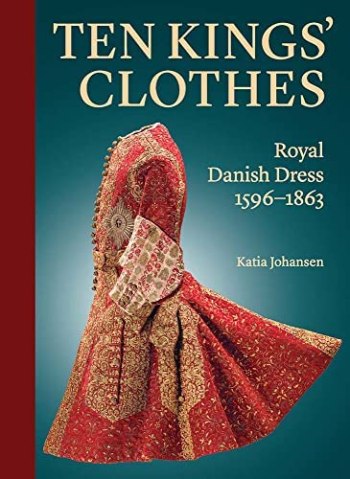 A richly illustrated glimpse into the magnificent collection of seventeenth-century men’s dress from the Danish kings’ wardrobes
Ten Kings’ Clothes: Royal Danish Dress, 1596–1863 presents the unparalleled collection of male dress belonging to the Danish kings from Christian IV to Frederik VII. The incomparable research showcases the collection of each monarch, put into context against the backdrop of pivotal moments in Danish history, the networks of supply, and the production and circulation of luxury goods. Richly illustrated with portraits, prints, and the stunning garments, extended entries and hand-drafted patterns allow a detailed and technical appreciation of each item. The historical garments tell the story not only of the kings’ coronations and weddings but also of everyday life at court, including the contributions of tailors, embroiderers, valets, portrait artists, castle stewards, and laundresses. The book includes a foreword written by Her Majesty Queen Margrethe II of Denmark.
Katia Johansen is a renowned author, lecturer, and teacher of textile conservation, exhibition techniques, and costume history. She is the former textile conservator and costume curator at The Royal Danish Collections at Rosenborg Castle, Denmark, where she worked for over 35 years.
Research Group | French Cultural Seminar, University of Warsaw

◊ ◊ ◊ ◊ ◊
From the University of Warsaw’s Centre de civilisation française (which includes the invitation in French) . . .
Dear Doctoral Students,
The French Cultural Center at the University of Warsaw invites you to participate in the Outils et méthodes de la recherche en sciences humaines doctoral seminar. This doctoral seminar aims to bring together young researchers dealing with aspects related to French culture. Representatives of all fields of the humanities are invited to cooperate. Our goal is to create a research group that will meet regularly and conduct joint cross-disciplinary research. The seminar is open to all members of the academic community.
The meetings will be held twice a month from February 2023 to June 2023 in the Center’s Library from 4.30 to 7.00pm. The seminar will be held in English or French. The topics of the meetings will vary depending on the needs and interests of the participants. Proposed topics include:
• Discussions of new scientific literature
• Discussions on new methodologies in French research
• Presentations prepared by seminar participants
• Short lectures by invited guests — discussions of publications, methodological lectures, lectures explaining the practical aspects of scientific research related to French culture (e.g. French archives, scientific databases, etc.)
The seminar will end with a round-table discussion summarizing the cycle and the publication of peer-reviewed texts presented by PhD students.
The first organizational meeting will take place on 10 February 2023 at 10.00am in the Library of the French Cultural Center or via Zoom. Willingness to participate in the seminar, along with any questions, should be sent to Emma Kołodziejek, e.kolodziejek@uw.edu.pl.
The Art Bulletin, December 2022
The eighteenth century in the latest issue of The Art Bulletin 104 (December 2022), along with the methodological ‘perspective’ conversation from Fricke and Flood:
A R T I C L E S
 • Beate Fricke and Finbarr Barry Flood, “Premodern Globalism in Art History: A Conversation,” pp. 6–19.
A conversation took place in 2021 between two art historians whose research focuses on different regions of the premodern world and who have recently collaborated on a project dealing with early histories of globalism. The discussion considers the potential archival value of ‘flotsam’—that is, extant artifacts and images lacking extensive textual metadata—for (re)constructing transcultural and transregional histories of circulation and reception. It addresses divergences in the nature of the available archival materials and the ethical and methodological challenges this poses. The discussants consider the need to move beyond earlier, largely celebratory narratives of the global to engage the ways in which transregional and transcultural networks intersected with more rooted or regional traditions of art making and material culture.
• Paris A. Spies-Gans, “Why Do We Think There Have Been No Great Women Artists? Revisiting Linda Nochlin and the Archive,” pp. 70–94.
In 1971 Linda Nochlin published her quickly canonical “Why Have There Been No Great Women Artists?” (ARTnews 69, no. 9). She offered a powerful narrative, claiming that Western institutional structures and a lack of access to vital educational opportunities had historically prevented women from becoming ‘great’ artists—indeed from even having the potential to achieve greatness. I suggest new visual and textual lenses through which we can update Nochlin’s narrative and reconsider women artists on their own societies’ terms, arguing that by returning to the archive, we can identify greatness and professionalism where they have eluded us before.
R E V I E W S
• Amy Knight Powell, Review of Aaron Hyman, Rubens in Repeat: The Logic of the Copy in Colonial Latin America (Getty Publications, 2021), pp. 120–23.
• Amanda Lahikainen, Review of Joseph Monteyne, Media Critique in the Age of Gillray: Scratches, Scraps, and Spectres (University of Toronto Press, 2022), pp. 123–26.
New Book | Media Critique in the Age of Gillray
From Toronto UP:
Joseph Monteyne, Media Critique in the Age of Gillray: Scratches, Scraps, and Spectres (Toronto: University of Toronto Press, 2022), 316 pages, ISBN: 978-1487527747, $75.
 In the late 1790s, British Prime Minister William Pitt created a crisis of representation when he pressured the British Parliament to relieve the Bank of England from its obligations to convert paper notes into coin. Paper quickly became associated with a form of limitless reproduction that threatened to dematerialize solid bodies and replace them with insubstantial shadows. Media Critique in the Age of Gillray centres on printed images and graphic satires which view paper as the foundation for the contemporary world. Through a focus on printed, visual imagery from practitioners such as James Gillray, William Blake, John Thomas Smith, and Henry Fuseli, the book addresses challenges posed by reproductive technologies to traditional concepts of subjective agency.
Joseph Monteyne shows that the late eighteenth-century paper age’s baseless fabric set the stage for contemporary digital media’s weightless production. Engagingly written and abundantly illustrated, Media Critique in the Age of Gillray highlights the fact that graphic culture has been overlooked as an important sphere for the production of critical and self-reflective discourses around media transformations and the visual turn in British culture.
Joseph Monteyne is an associate professor in the Department of Art History, Visual Art, and Theory at the University of British Columbia.
C O N T E N T S
List of Illustrations
Acknowledgments
Introduction: Making and Unmaking the Paper World
1 Dark Media and the Materiality of Nothing
Dark Media and Graphic Materiality
Smoked Images and Night Pieces: Touching Nothing
Form and Formlessness in Blake’s Embedded Media
2 Haunted Media
Conjuring Dead Painters
The Baseless Fabric of Print
Dematerializing Media
3 Good Copies, Bad Copies
Counterfeit Masks
Repetition with Difference
Pairs of Portraits
4 Social Detritus, Paper Detritus
Blind Beggars and Printed Images
Cobbling, Patching, Translating
The Gatherer of Scraps
Notes
Bibliography
Index
Cleveland Announces New Acquisitions
From the CMA press release (17 January 2023). . .
Recent acquisitions by the Cleveland Museum of Art (CMA) include a Korean abstract expressionist painting by Yun Hyong-keun 윤형근; a ten-panel folding screen by Kim Yoon-bo 김윤보; an early masterpiece by James Tissot from his English period; and a recently discovered full-length pastel portrait by Hugh Douglas Hamilton, the most celebrated Irish portraitist of the Grand Tour. . . .
Hugh Douglas Hamilton’s Portrait of George Clavering Cowper

Hugh Douglas Hamilton, Portrait of George Clavering Cowper, 3rd Earl Cowper, 1785, pastel on paper stretched on linen; sheet: 94 × 69 cm (The Cleveland Museum of Art, Leonard C. Hanna Jr. Fund).
Preserved in remarkable condition, this portrait has remained in the sitter’s family—and was discovered only recently in the collection of the descendants of its sitter, George Clavering Cowper, 3rd Earl Cowper (1738–1789), of Great Britain. The full-length pastel was a type developed during the 18th century that appealed to English tourists on the Grand Tour to Italy. The earl, a cultural paragon in Italy and a patron of artists and composers, sat for the most celebrated Irish portraitist of the Grand Tour, Hugh Douglas Hamilton, in Florence, where he made his home.
Cowper prominently wears the sash and star of the which he had received in March 1785. The Order of Saint Hubertus was founded in 1695, a knightly order of aristocratic hunters from throughout the Hapsburg empire, whose motto was “Honoring God by Honoring his Creatures.” Evoking the emotion of this motto, Hamilton featured Cowper’s hunting dog, who receives a tender pat on the head and wears a collar inscribed with Cowper’s name.
The portrait enhances the CMA’s collection of pastels, a strength of its drawings collection. The acquisition was made possible by the Leonard C. Hanna Jr. Fund.
More information on the portrait is available at Lowell Libson & Jonny Yarker.
The full press release describing the other three acquisitions is available here»










 Enfilade
1 comment