New Book | Images on a Mission in Early Modern Kongo and Angola
From Penn State UP:
Cécile Fromont, Images on a Mission in Early Modern Kongo and Angola (University Park: The Pennsylvania State University Press, 2022), 336 pages, ISBN: 978-0271092188, $110. Also available as an ebook.
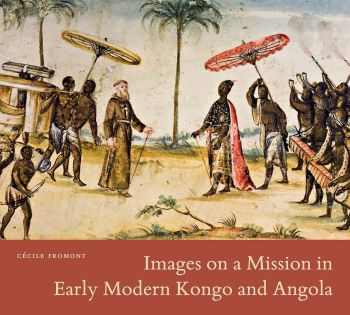 Early modern central Africa comes to life in an extraordinary atlas of vivid watercolors and drawings that Italian Capuchin Franciscans, veterans of Kongo and Angola missions, composed between 1650 and 1750 for the training of future missionaries. These ‘practical guides’ present the intricacies of the natural, social, and religious environment of seventeenth- and eighteenth-century west-central Africa and outline the primarily visual catechization methods the friars devised for the region. Images on a Mission in Early Modern Kongo and Angola brings this overlooked visual corpus to public and scholarly attention.
This beautifully illustrated book includes full-color reproductions of all the images in the atlas, in conjunction with rarely seen related material gathered from collections and archives around the world. Taking a bold new approach to the study of early modern global interactions, art historian Cecile Fromont demonstrates how visual creations such as the Capuchin vignettes, though European in form and crafstmanship, emerged not from a single perspective but rather from cross-cultural interaction. Fromont models a fresh way to think about images created across cultures, highlighting the formative role that cultural encounter itself played in their conception, execution, and modes of operation. Centering Africa and Africans, and with ramifications on four continents, Fromont’s decolonial history profoundly transforms our understanding of the early modern world. It will be of substantial interest to specialists in early modern studies, art history, and religion.
Cécile Fromont is Professor in the History of Art department at Yale University. She is the author of the award-winning book The Art of Conversion: Christian Visual Culture in the Kingdom of Kongo (2014) and the editor of Afro-Catholic Festivals in the Americas: Performance, Representation, and the Making of Black Atlantic Traditions (2019), the latter also published by Penn State University Press.
C O N T E N T S
List of Illustrations
List of Tables
Acknowledgements
Introduction
1 ‘Nonsense’: Capuchin Images of Kongo and Angola Against Italian Preconceptions
2 Practical Guides to the Mission: The Capuchin Central-African Corpus
3 Images and Devotion
4 Images as Method
5 Images against Idolatry
6 With ‘the Consent of the People, and the Secular Arm of the Prince’
7 Penned by Encounter: Capuchins, Central Africans, and the Making of a Cross-Cultural Discourse
Conclusion
Notes
Bibliography
Index
Call for Papers | Arts and Culture in the Capuchin Order
From ArtHist.net:
De habitudine Ordinis ad artem: Arts, Religion, and Culture in the Capuchin Order between the 16th and 18th Centuries
University of Teramo, 12–14 April 2023
Proposals due by 19 February 2023
Officially founded in 1528 with the bull Religionis Zelus by Pope Clement VII, the Order of the Friars Minor Capuchin lived the twenty years preceding the Council of Trent imitating St Francis and his first companions through preaching and the teaching of young people. Despite the escape to Switzerland of the famous Vicar and preacher Bernardino Ochino in 1542, the Order survived, and the Council of Trent (1547–63) gave great impetus to the Order’s spread, thanks partly to the participation of the Vicar General Bernardino da Asti as consultant. In 1574 Pope Gregory XIII allowed the Capuchins to found convents outside the Italian peninsula. Friars went to France, Spain, and the German-speaking regions; and new settlements were founded in Switzerland, Belgium, Austria, Bohemia, Bavaria, Westphalia, and Ireland. A century after their founding, the Capuchins had more than 40 provinces, 1200 friaries, and nearly 20,000 brothers. As missionaries, the Order was extremely active, evangelizing throughout the world; from Northern Europe to Brazil, from Congo to the Middle East, from North Africa to the West Indies, they were one of the main players, in close contact with sovereigns and the Holy See.
While many Capuchins had studied the visuals arts before entering the Order, especially in the years between 1618 and 1761, the Capuchin way of life was often antithetical to artistic practice. In fact, in the General Chapter of 1627, friars were forbidden to accept any painting or carving work requested by laymen. And yet, although the culture of the arts was not originally part of the Order’s activities and artistic practice was in many cases hindered, there were many who reached high levels in the cloister, especially in painting and wooden sculpture. During the 17th and 18th centuries, many Capuchins devoted themselves to painting, driven by different motivations: for pleasure and in response to commissions from nobles and benefactors. Sculpture was practised even more frequently, often for decorating the small churches that, according to the Constitutions, were not allowed to be sumptuous, but decorated only with poor and simple ornaments. The right combination of simplicity of material and preciousness of form was expressed in the works of the friar cabinet-makers (marangoni).
While numerous studies have addressed the relationship between the arts and the Capuchin Order, many questions remain under unexplored. This conference De habitudine Ordinis ad artem: Arts, Religion and Culture in the Capuchin Order between the 16th and 18th Centuries—organised by the University of Teramo with the patronage of the Seraphic Province of the Immaculate Conception of the Capuchin Friars Minor, the International Society of Franciscan Studies, and the Capuchin Historical Institute—will consider the difficult and elusive relationship between art, culture, religion, and the Capuchin Order on an international level, with particular attention paid to historical contexts and religious dimensions—a prerequisite for understanding Capuchin artists, the production of art objects, patronage, and Capuchin relations with the secular world globally. With the aim of fostering discussion and scientific debate, other topics relevant to the theme of the conference are also welcome. The most significant contributions will be considered for publication.
The conference will be divided into five sessions:
• the Capuchin Order in the context of the post-Tridentine Church
• artistic practice between norms, prohibitions, and customs
• cultural objects of the Capuchin world: use and circulation
• capuchin patronage
• images, knowledge, and preaching between devotion and catechesis
Each proposal must consist of two parts: the paper abstract (max 2000 characters including spaces) and a speaker profile (max 1500 characters including spaces) highlighting the curriculum vitae and professional position. The two parts must be combined in a single Word or PDF file. Interested parties must submit proposals by 19 February 2023, by uploading the documents here.
Scientific Committee
Massimo Carlo Giannini (University of Teramo) president
Raffaella Morselli (University of Teramo)
Alessandro Zuccari (Sapienza University of Rome)
Giorgio Fossaluzza (University of Verona)
Vincenzo Criscuolo (Capuchin Historical Institute)
Grado Giovanni Merlo (University of Milan)
Luigi Pellegrini (University of Chieti-Pescara)
Luca Siracusano (University of Teramo)
Cecilia Paolini (University of Teramo)
Organisation and scientific coordination
Pietro Costantini, pcostantini@unite.it
New Book | Material Cultures of the Global Eighteenth Century
From Bloomsbury:
Wendy Bellion and Kristel Smentek, eds., Material Cultures of the Global Eighteenth Century: Art, Mobility, and Change (London: Bloomsbury Visual Arts, 2023), 288 pages, ISBN: 978-1350259034, $115. Also available as an ebook.
 Things change. Broken and restored, reused and remade, objects transcend their earliest functions, locations, and appearances. While every era witnesses change, the eighteenth century experienced artistic, economic, and demographic transformations that exerted unique pressures on material cultures around the world. Locating material objects at the heart of such phenomena, Material Cultures of the Global Eighteenth Century expands beyond Eurocentric perspectives to discover the mobile, transcultural nature of eighteenth-century art worlds. From porcelain to betel leaves, Chumash hats to natural history cabinets, this book examines how objects embody imperialism, knowledge, and resistance in various ways.
By embracing things both elite and everyday, this volume investigates physical and technological manipulations of objects while attending to the human agents who shaped them in an era of accelerating global contact and conquest. Featuring ten essays, the volume foregrounds diverse scholarly approaches to chart new directions for art history and cultural history. Ranging from California to China, Bengal to Britain, Material Cultures of the Global Eighteenth Century illuminates the transformations within and between artistic media, follows natural and human-made things as they migrate across territories, and reveals how objects catalyzed change in the transoceanic worlds of the early modern period.
Material Cultures of the Global Eighteenth Century is part of the Material Culture of Art and Design series, edited by Michael Yonan.
Wendy Bellion is Sewell C. Biggs Chair in American Art History and Associate Dean for the Humanities at the University of Delaware. Her research focuses on North American art and the Atlantic World in the eighteenth and nineteenth centuries. She is the author of Citizen Spectator: Art, Illusion, and Visual Perception in Early National America (2011) and Iconoclasm in New York: Revolution to Reenactment (2019).
Kristel Smentek is Associate Professor of Art History in the Department of Architecture at the Massachusetts Institute of Technology. Her research engages eighteenth-century European graphic and decorative arts in their transcultural contexts. She is the author of Mariette and the Science of the Connoisseur in Eighteenth-Century Europe (2014), co-editor of Dare to Know: Prints and Drawings in the Age of Enlightenment (2022), and co-curator of the accompanying exhibition at the Harvard Art Museums.
C O N T E N T S
List of Illustrations
Notes on Contributors
Acknowledgements
Introduction, ‘Things Change’ — Wendy Bellion, University of Delaware and Kristel Smentek, MIT
1 ‘A Sort of Picture or Image of my Self’: Amoy Chinqua’s Almost Ancestral Portrait of Joseph Collet — Winnie Wong, University of California, Berkeley
2 Shooting for Freedom: Examining the Material World of Self-Emancipated Persons — Tiffany Momon, Sewanee: The University of the South
3 Something Old, Something New: Repurposing and the Production of Ephemeral Festival Architecture in Eighteenth-Century Paris — Matthew Gin, University of North Carolina at Charlotte
4 Botanical Fantasy in Silk: Transformations of a Rococo Floral Design from England to China — Mei Mei Rado, Los Angeles County Museum of Art
5 Making Marble Edible: Madame de Pompadour, Friendship, and the Multiple Lives of Porcelain — Susan M. Wager, University of New Hampshire, Durham
6 The Sovereign Betel in Eighteenth-Century Bengal and Bihar — Zirwat Chowdhury, University of California, Los Angeles
7 Isaiah Thomas’s Stamp Acts at the Halifax Gazette: Printers and Tacit Protest in Revolutionary America — Jennifer Y. Chuong, Humboldt-Universität zu Berlin
8 Between Art and Nature: The Dauphin’s Treasure at the Royal Cabinet of Natural History in Madrid — Tara Zanardi, Hunter College, CUNY
9 California Indian Basket Weavers, Spanish Imperialism, and Eighteenth-Century Global Networks — Yve Chavez, University of California, Santa Cruz
10 British Prints between Caricature and Ethnography — Douglas Fordham, University of Virginia
Index
At Christie’s | Interracial Double Portrait Purchased by Philip Mould
Press release via Art Daily (22 January 2023) . . .
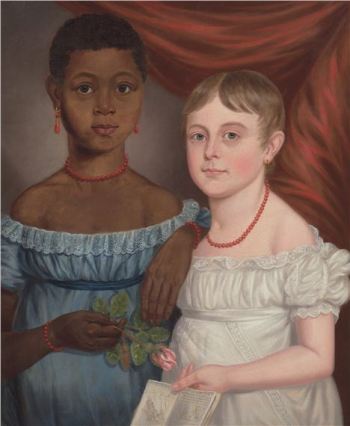
American School, A Portrait of Two Girls, ca. 1820, oil on canvas, 24 × 20 inches (Philip Mould & Co). Estimated to sell for $50–100K, the portrait sold at auction for nearly $1million.
An extraordinarily rare image of two children—one
White, one African American—was purchased by London art dealers Philip Mould & Company this evening (Friday, 20 January 2023) at Christie’s in New York for just under one million dollars.
Painted by an unknown artist in America in about 1820, and estimated at $50–100k, the double portrait attracted heated competition from collectors and museums on both sides of the Atlantic, eventually making ten times its top estimate with premium included.
Mould, who is also known as the art expert on BBC1’s Fake or Fortune, believes it to be unprecedented for this date in American portrait painting. “We are very excited to have bought it. I know of no painting of this date or earlier quite like it. The unselfconscious depiction of two racially distinct girls, who were clearly deeply attached, is extraordinarily rare for this period, as well as very affecting. The constraints and social protocol in painted portraiture of the period make such palpable depiction of interracial attachment almost without precedent.”
In their description of the painting Christie’s acknowledged its rarity, stating: “This double portrait presents its subjects as equals at a time of pervasive racial inequality. If anything, the pose and props cast the African American girl as the superior figure.” [Sale 21026, Lot 460]
The only painting that Mould knows which could be described as comparable is the portrait of Dido Belle and her cousin Elizabeth Murray painted around 1770 in England (on display as part of the collection at Scone Palace, Perth, Scotland)—a work that was the focus of an episode of Fake or Fortune in 2018. Dido was the daughter of a Black slave and White father. Mould identified the artist, after considerable research, as the Scottish portraitist, David Martin. “This however goes considerably further. Although, as yet, we don’t know the artist, nor the identity of the subjects, the relationship of equality is emphatically expressed” says Mould “The normal objectifications in the depiction of racial distinction have been set aside.”
A most unusual and revealing aspect of the painting is the book of the story of Cinderella held by the younger child. As the Christie’s cataloguer pointed out: “The inclusion of a reference to a well-known story with stepsister characters raises the possibility that in the absence of blood ties, the artist was nonetheless deliberately conveying sisterhood.” Mould muses “Or perhaps the reference to Cinderella is more obvious. As a female heroine who overcame the prejudices of her oppressors, Cinderella may well turn out to have more in common with the eldest child than initially thought.”
Future plans for the painting involve a period of research, after which Mould will be looking to place the work in a museum where its qualities and significance can be appreciated within a fuller context, and it can be enjoyed by the public.
◊ ◊ ◊ ◊ ◊
The painting was included in the Important Americana sale at Christie’s New York on 20 January 2023, Sale 21026, Lot 460. Also relevant is this early nineteenth-century miniature portrait of two girls with arms around each other.
Research Lunch | Dominic Bate on Pythagorean Visions
From the Mellon Centre:
Dominic Bate, Pythagorean Visions: Picturing Harmony in British Art, 1719–1753
Online only, Paul Mellon Centre for Studies in British Art, London, 10 February 2023, 1pm
 In the early eighteenth century, an eclectic group of artists and architects working primarily in London believed that they could improve the arts by placing their working practices on an unassailable mathematical footing. In this endeavour they were inspired by a concept of universal harmony, which held that the entire cosmos was organised by God according to the rules of arithmetic and geometry. This concept had ancient roots, being associated with the Greek philosopher Pythagoras, among others, but it assumed a new significance in Hanoverian Britain thanks to the work of antiquarians and natural philosophers such as Isaac Newton, whose scientific discoveries were hailed in terms of the recovery of lost knowledge.
The first part of this talk introduces some of the artistic initiatives that were inspired by the highly acclaimed work of Newton and his followers, and argues that these initiatives can be understood with reference to the early modern phenomenon of ‘projecting’, defined in this instance as the contrivance of speculative schemes that sought to marry public benefit and private profit by harnessing the power of mathematics and natural knowledge.
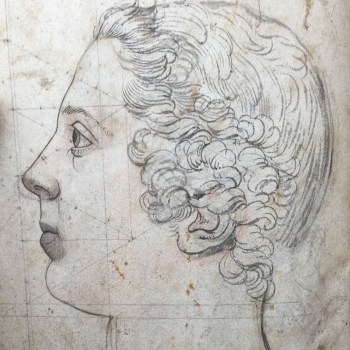
The second part of the talk deepens and complicates the first by focusing on the career of the talented draftsman Giles Hussey (1710–1788), who developed a mathematical approach to portraiture during the 1730s and 1740s. At the heart of Hussey’s method was the geometry of the equilateral triangle and the proportional relationships that it encompassed, including the ratios of musical consonances such as the octave (2:1), the perfect fourth (4:3), and the perfect fifth (3:2). Hussey’s work shows how the pursuit of mathematical approaches to artmaking could be productive while also entailing serious practical and theoretical difficulties, thereby shedding light on the role played by eighteenth-century artists (rather than ‘disinterested’ philosophers) as solvers of aesthetic problems.
Book tickets here»
Dominic Bate is a PhD candidate in the History of Art and Architecture at Brown University in Providence, Rhode Island, where he is writing a dissertation that examines the relationship between art and aesthetics, natural theology and practical mathematics in eighteenth-century Britain. Before coming to Brown, Dominic worked in the Department of Prints and Drawings at the British Museum, where he was involved in cataloguing the collection of portrait prints and British book illustrations. Dominic has BA and MA degrees in Art History from the Courtauld Institute of Art, and in the spring of 2022 he was a visiting student in the Department of History and Philosophy of Science at the University of Cambridge. His research has been supported by the Joukowsky Institute for Archaeology and the Ancient World at Brown and the Paul Mellon Center for Studies in British Art.
New Book | Looking for Longitude
From Liverpool UP:
Katy Barrett, Looking for Longitude: A Cultural History (Liverpool: Liverpool University Press, 2022), 304 pages, ISBN: 978-1802070538, £76 / $130.
 Why make a joke out of a niche and complex scientific problem? That is the question at the heart of this book, which unearths the rich and surprising history of trying to find longitude at sea in the eighteenth century. Not simply a history on water, this is the story of longitude on paper, of the discussions, satires, diagrams, engravings, novels, plays, poems, and social anxieties that shaped how people understood longitude in William Hogarth’s London. We start from a figure in one of Hogarth’s prints—a lunatic incarcerated in the madhouse of A Rake’s Progress in 1735—to unpick the visual, mental, and social concerns which entwined around the national concern to find a solution to longitude. Why does longitude appear in novels, smutty stories, political critiques, copyright cases, religious tracts, and dictionaries as much as in government papers? This sheds new light on the first government scientific funding body—the Board of Longitude—established to administer vast reward money for anyone who found a means of accurately measuring longitude at sea. Meet the cast of characters involved in the search for longitude, from famous novelists and artists, to almost unknown pamphleteers and inventors, and see how their interactions informed the fate of longitude’s most famous pursuer, the clockmaker John Harrison.
Dr Katy Barrett is an interdisciplinary curator, scholar, and writer focusing on interactions between art and science. Currently she works as Deputy Curator of Art and Head of Interpretation at the Houses of Parliament. She has previously worked as Curator of Art Collections at the Science Museum, London; Curator of Art, pre-1800, at Royal Museums Greenwich; and has held various posts in national and university museums. She has higher degrees in History of Art and History of Science and is active on social media as @SpoonsonTrays.
Call for Articles | Japonisme and Fashion
From the Call for Papers:
Japonisme and Fashion — Special Issue of the Journal of Japonisme, 2024
Edited by Elizabeth Emery and Mei Mei Rado
Articles due by 1 July 2023
Japanese garments and textiles have captured the European imagination since the seventeenth century, exerting particular influence on European and American fashion after the 1860s when artists such as Whistler, Tissot, and the Rossettis competed to acquire kimono from shops such as that of Emile and Louise Desoye at 220 rue de Rivoli in Paris. They promptly emulated Japanese motifs in their own artistic creations, such as Whistler’s Princesse du pays de la porcelaine (1864–65). From paintings, poetry, and music to clothing, costume design, and cosplay, artists and designers from around the world have continued to create new japoniste works inspired by Japanese fashion.
Building on recent interest on the worldwide impact of Japanese fashion (museum exhibits and publications by scholars such as Akiko Fukai), this special issue of the Journal of Japonisme, to be published in 2024, welcomes complete essays in English (translation from French may be possible; please enquire) dedicated to figures or movements from around the world that have taken Japanese garments, textiles, or patterns as inspiration for new artistic creations. Each submission should be no longer than 20 pages (including notes) and may include up to 12 images, which will appear in color online, but black and white in print. Authors are responsible for obtaining the relevant permissions. For information about format, submission, and peer review please consult the Author Instructions. Articles should be submitted by 1 July 2023 via Editorial Manager. For more information or questions, please contact submissionsJOJ@gmail.com.
The Journal of Japonisme accepts submissions dedicated to the worldwide reception of Japanese art and culture in history, visual culture including the history of art and design, the decorative arts, painting and the graphic arts, architecture, fashion, film, literature, aesthetics, art criticism, and music. Articles related to collectors of Japanese art, either specific museums or individuals, are also encouraged.
Call for Articles | Gastronomic Criticism
From the Appel à contribution:
La critique gastronomique : histoire, rhétorique, valeurs, institutions
Edited by Julia Csergo and Frédérique Desbuissons
Proposals due by 15 February 2023, with full texts due by 15 January 2024
Il s’agit de produire un volume de synthèse (reader) qui analyse, dans une perspective tant historique que contemporaine, le phénomène de la critique gastronomique : son émergence, ses relations avec la critique s’exerçant dans les autres domaines de la création, en s’attachant à ses fonctions, ses formes et sa rhétorique, aux valeurs qui la structurent, aux institutions, media et instances qui la légitiment, et à l’économie dans laquelle elle s’inscrit.
Plutôt qu’une approche monographique des figures célèbres de la gastronomie, nous aborderons la question à partir d’une grille d’analyse organisée selon les thématiques suivantes :
1. L’émergence du phénomène de la critique gastronomique : généralement datée du tournant des XVIIIe et XIXe siècles, en lien avec l’essor des commerces de bouche, puis des restaurants, elle connaît des développements inédits et des métamorphoses au cours des XXe et XXIe siècles. Ce chapitre vise à mieux définir sur cette période les quatre fonctions principales de la critique — informer, instruire, juger, promouvoir — telles qu’elles sont perceptibles dans le domaine spécifique de la gastronomie. L’objectif est de souligner ses liens avec la critique s’exerçant dans les autres domaines de la création, sa spécialisation et sa professionnalisation.
2. Les formes et les rhétoriques : ce chapitre portera sur les discours produits à travers la littérature, la philosophie, l’érudition, la chronique, le billet, etc. Il scrutera les postures auctoriales — qui parle ? de quel point de vue ? — autant qu’il interrogera l’existence d’éventuels mouvements ou styles à partir desquels les autres formes de critique ont pu structurer leurs propos. Il abordera aussi la place qu’y occupent les illustrations, la façon dont celles-ci contribuent aux fonctions dévolues à la critique afin de s’écarter du logocentrisme souvent associé à la gastronomie.
3. Les valeurs qui structurent la production et la diffusion de la critique : à partir de quels critères ou indicateurs — esthétiques, éthiques, sociaux, économiques, politiques — s’opèrent les jugements de goût, et plus largement les évaluations particulières ? Sont-elles toujours explicitées et justifiés ? Les valeurs généralement reconnues à l’art constituent-elles une grille d’analyse pertinente pour la critique gastronomique ? Qu’en est-il de l’indépendance dont elle revendique les vertus ? Entre mise en ordre et représentation du « bien manger » seront abordées les questions de genre, d’identité et de pouvoirs.
4. Institutions critiques : ce chapitre vise à analyser le rôle des clubs, sociétés, réseaux, médias dans la légitimation de la critique gastronomique. Le rôle des palmarès, ainsi que des transformations induites par les nouvelles technologies, réseaux sociaux, influenceurs, etc.
Les articles proposés, rédigés en français, devront contenir une part inédite de recherche, d’hypothèses ou de mises à jour ; ils ne sauraient reprendre la totalité d’un article déjà paru. La taille des articles sera d’environ 35 000 signes, notes comprises. Propositions et articles seront adressés conjointement à : csergo.julia@uqam.ca / frederique.desbuissons@univ-reims.fr
Calendrier
Soumission des propositions accompagnées d’une notice bio-bibliographique : 15 février 2023
Sélection des propositions par le Comité scientifique : 15 mars 2023
Remise des textes par les auteur·e·s pour double évaluation : 15 janvier 2024
Retours aux auteur·e·s : 15 mars 2024
Remise des textes définitifs : 30 juin 2024 Sortie du volume : automne 2024
Éditeur
Menu Fretin, Chartres
Éditrices
Julia Csergo (université du Québec à Montréal / Chaire de recherche du Canada en patrimoine urbain)
Frédérique Desbuissons (université de Reims Champagne-Ardenne / HiCSA)
Comité scientifique
Matthieu Aussudre (historien et critique indépendant, Paris)
Benedict Beaugé (auteur gastronomique, Paris)
Michael Garval (North Carolina State University, Raleigh)
Bertrand Marqueur (université de Strasbourg)
Catherine Méneux (université Paris 1 Panthéon-Sorbonne)
Laure Ménétrier (musée du vin de Champagne et d’Archéologie d’Épernay) Sidonie Naulin (Sciences Po Grenoble)
Denis Saillard (université Versailles Saint-Quentin-en-Yvelines)
Display | Print and Prejudice: Women Printmakers, 1700–1930
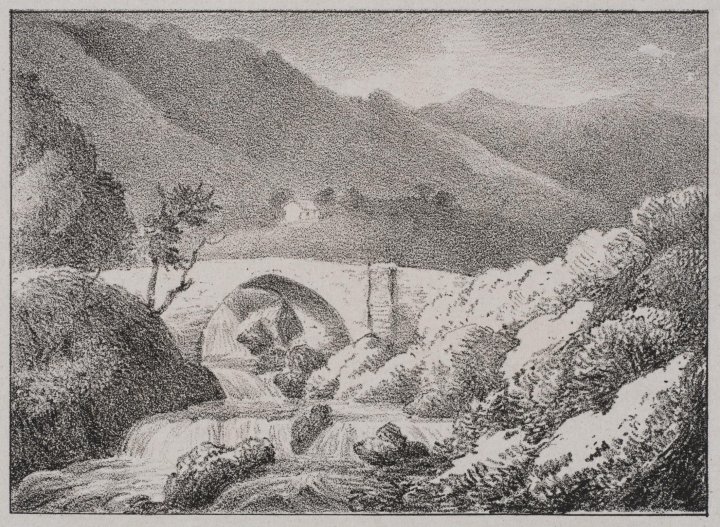
Dorothea Knighton (1780–1862), Landscape, early nineteenth century, lithograph, 6.4 × 9 cm
(London: V&A, E.343-2017)
◊ ◊ ◊ ◊ ◊
From the V&A:
Print and Prejudice: Women Printmakers, 1700–1930
Victoria & Albert Museum, 5 November 2022 — 1 May 2023
This display charts the development of women artists’ remarkable but overlooked engagement with printmaking from the 18th to early 20th centuries—from picturesque landscapes, to intimate portraits and vibrant botanical works.
Online Talk | Malcolm Baker on Canova’s Three Graces at the V&A

Antonio Canova, The Three Graces (detail), 1814–17 (London: V&A Museum, no. A.4-1994).
This evening (London time), from the V&A:
Malcolm Baker with Kira d’Alburquerque | Canova’s Three Graces and the V&A
Online and in-person, Victoria and Albert Museum, London, 19 January 2023, 7pm
Malcolm Baker joins V&A curator Kira d’Alburquerque for a look at Antonio Canova’s The Three Graces (1814–17) and the campaign to save the celebrated group in the early 1990s. Baker played a significant role in the acquisition of the work for the V&A nearly three decades ago. He joins Kira d’Alburquerque to discuss the campaign to “Save the Three Graces” and how attitudes toward Canova’s sculpture have changed. The talk will be held in-person and on Zoom. Online tickets are £5. If, as a ticket-holder, you have not received a link by noon on the day, contact membershipevents@vam.ac.uk.










 Enfilade
leave a comment