New Book | Adam Smith’s America
From Princeton UP:
Glory Liu, Adam Smith’s America: How a Scottish Philosopher Became an Icon of American Capitalism (Princeton: Princeton University Press, 2023), 384 pages, ISBN: 978-0691203812, £30 / $35.
 The unlikely story of how Americans canonized Adam Smith as the patron saint of free markets
Originally published in 1776, Adam Smith’s The Wealth of Nations was lauded by America’s founders as a landmark work of Enlightenment thinking about national wealth, statecraft, and moral virtue. Today, Smith is one of the most influential icons of economic thought in America. Glory Liu traces how generations of Americans have read, reinterpreted, and weaponized Smith’s ideas, revealing how his popular image as a champion of American-style capitalism and free markets is a historical invention.
Drawing on a trove of illuminating archival materials, Liu tells the story of how an unassuming Scottish philosopher captured the American imagination and played a leading role in shaping American economic and political ideas. She shows how Smith became known as the father of political economy in the nineteenth century and was firmly associated with free trade, and how, in the aftermath of the Great Depression, the Chicago School of Economics transformed him into the preeminent theorist of self-interest and the miracle of free markets. Liu explores how a new generation of political theorists and public intellectuals has sought to recover Smith’s original intentions and restore his reputation as a moral philosopher.
Charting the enduring fascination that this humble philosopher from Scotland has held for American readers over more than two centuries, Adam Smith’s America shows how Smith continues to be a vehicle for articulating perennial moral and political anxieties about modern capitalism.
Glory M. Liu is a college fellow in social studies at Harvard University. Her work has appeared in publications such as Modern Intellectual History, The Washington Post, and Aeon.
New Book | Adam Smith Reconsidered
From Princeton UP:
Paul Sagar, Adam Smith Reconsidered: History, Liberty, and the Foundations of Modern Politics (Princeton: Princeton University Press, 2022), 248 pages, ISBN: 978-0691210834, £28 / $35.
 Adam Smith has long been recognized as the father of modern economics. More recently, scholars have emphasized his standing as a moral philosopher—one who was prepared to critique markets as well as to praise them. But Smith’s contributions to political theory are still underappreciated and relatively neglected. In this bold, revisionary book, Paul Sagar argues that not only have the fundamentals of Smith’s political thought been widely misunderstood, but that once we understand them correctly, our estimations of Smith as economist and as moral philosopher must radically change.
Rather than seeing Smith either as the prophet of the free market, or as a moralist who thought the dangers of commerce lay primarily in the corrupting effects of trade, Sagar shows why Smith is more thoroughly a political thinker who made major contributions to the history of political thought. Smith, Sagar argues, saw war, not commerce, as the engine of political change and he was centrally concerned with the political, not moral, dimensions of—and threats to—commercial societies. In this light, the true contours and power of Smith’s foundational contributions to western political thought emerge as never before.
Offering major reinterpretations of Smith’s political, moral, and economic ideas, Adam Smith Reconsidered seeks to revolutionize how he is understood. In doing so, it recovers Smith’s original way of doing political theory, one rooted in the importance of history and the necessity of maintaining a realist sensibility, and from which we still have much to learn.
Paul Sagar is senior lecturer in political theory at King’s College London and the author of The Opinion of Mankind: Sociability and the Theory of the State from Hobbes to Smith (Princeton).
Adam Smith 300 in 2023
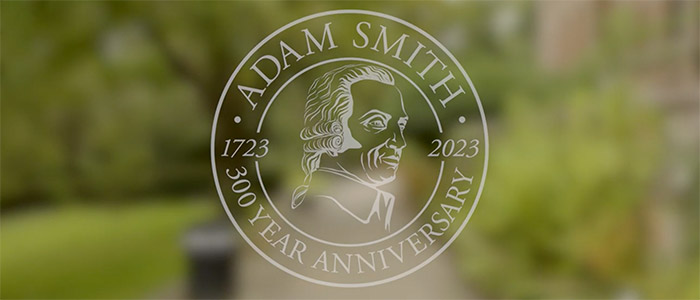
From the press release (23 November 2022) for Adam Smith 300 . . .
The University of Glasgow is marking the 300th anniversary of pioneering Scot Adam Smith (1723–1790) with a year-long celebration of his life, work, and influence.
The tercentenary commemoration of the ‘father of economics’ includes a host of events in Scotland and around the world, designed to inspire renewed discussion about Smith’s ideas. Smith’s work has had a lasting impact on the way the world considers economics, politics, and society more broadly. The planned programme of events aims to consider how his ideas from 300 years ago can help answer some of the biggest challenges we face today.
Throughout 2023 the University of Glasgow has a raft of programmes and events that will give academics, students, and the public new insights into his life and work. Highlights include:
• Tercentenary Week (5–10 June 2023)—a week-long series of activities, including talks and exhibitions at the University of Glasgow featuring scholars from the London School of Economics, the universities of Princeton and Harvard, and the University of Cambridge.
• An on-campus and virtual exhibition of significant and rare Smith-related artifacts—including letters, first edition books, and material from the University of Glasgow’s archives.
• The Adam Smith Tercentenary Global Lecture Series, featuring internationally renowned speakers from academia, business, and public policy.
• New research into Smith’s life and writings.
• The Royal Economic Society and Scottish Economic Society Joint Conference in April, featuring global academics reflecting upon Smith’s legacy.
Other activities involve a national student competition to re-design the front cover of The Wealth of Nations, online courses for adult learners, and new programmes to introduce high school to Adam Smith and his ideas. Universities from across the world, in North and South America, Asia, Africa, Europe, and Australia will be joining in the commemorations with their own events to mark the tercentenary.
Professor Sir Anton Muscatelli, Principal and Vice Chancellor of the University of Glasgow, said: “Adam Smith is one of our most famous alumni, and he left an indelible impact on the University of Glasgow, on the fields of economics and moral philosophy, and on the wider world. His studies and writings introduced new ideas, insights, and concepts that shaped our understanding of economics today but were revolutionary in their day. To mark the tercentenary of his birth we will see academics, students, and the public discuss his continued relevance at a series of events taking place in Glasgow and across the world. I look forward to taking part in the University’s commemoration of Adam Smith as we evaluate his legacy and consider how his thoughts and ideas from 300 years ago can still help us answer the greatest challenges of today.”
Adam Smith—born in Kirkcaldy, Fife, in June 1723—started his studies at the University of Glasgow aged 14. In 1740, he was awarded the Snell Scholarship, which is still in existence today, and left to study at Oxford. In 1751, Smith returned to Glasgow as a Professor of Logic, later becoming Professor of Moral Philosophy. While at Glasgow, Smith published the first edition of The Theory of Moral Sentiments in 1759, developing upon the principles and concepts explored in his lectures. Smith’s final connection with the University came in 1787 when he assumed the prominent position of Rector. He published arguably his most famous work The Wealth of Nations in 1776 and died in 1790.
Exhibition | The Sun King and the Prince of Orange

Adam Frans van der Meulen, Landscape with King Louis XIV at the Capture of Maastricht on 30 June 1673, 1673–1690, oil on canvas, 72 × 92 cm
(Venlo: Limburgs Museum, L24496)
◊ ◊ ◊ ◊ ◊
Opening this summer at the Limburg Museum in Venlo (65 km northeast of Maastricht). 2023 marks the 350th anniversary of the fall of Maastricht—which itself followed in the wake of the ‘Rampjaar’ (Disaster Year) of 1672. The museum was recently recognized with a 2022 International Design Award in graphic design for its campaign, “Limburgs Museum: Van ós / For Everybody,” by Total Design.
The Sun King and the Prince of Orange: Battle for the Meuse Valley
De Zonnekoning en Oranje: Slaags aan de Maas
Der Sonnenkönig und Oranien: Kämpfe an der Maas
Limburgs Museum, Venlo, 10 June 2023 — 7 January 2024
“I believe a spectacular event is going to unfold in front of our eyes.”
–King Louis XIV, shortly before the Siege of Maastricht
June 2023 will mark the 350th anniversary of the conquest of Maastricht by Louis XIV, the French Sun King. The city’s reputation as one of the best-fortified cities on the continent caused all of Europe to stand in disbelief at the end of the thirteen-day long military campaign. The victory was proudly showcased in the Hall of Mirrors in Versailles as well as on the Porte Saint-Denis in Paris. In 1676, the Prince of Orange’s attempt to reconquer the city for the Dutch Republic failed. As a result, French soldiers and administrators remained in Maastricht until 1679. What motives drove the actions of the two sovereigns? What did this region signify to them? And how did their actions affect the people? These questions lie at the heart of the grand exhibition The Sun King and the Prince of Orange: Battle for the Meuse Valley.
In collaboration with Service Historique de la Défense, Musée national des châteaux de Versailles et de Trianon, Rijksmuseum and Paleis het Loo.
Lecture | Matthew Keagle on Military Material Culture
From BGC:
Matthew Keagle, Military Material Culture
Bard Graduate Center, New York, 1 February 2023, 6.00pm

James Byers, Howitzer, Philadelphia, 1777 (Fort Ticonderoga Museum Collections; photo by Gavin Ashworth).
Military history and its related material culture elicit strong opinions. The objects of war shape the technologies, aesthetics, and ideologies of everyday life and reveal their own historiography. In this Alumni Spotlight Lecture, Fort Ticonderoga curator Matthew Keagle shares his experiences working in military material culture and the challenges and distinct opportunities this field offers for scholars and amateur historians.
Matthew Keagle has been involved in curation, exhibitions, research, and interpretation for historic sites and museums in Massachusetts, Rhode Island, Connecticut, New York, Delaware, Virginia, and North and South Carolina. He holds a BA from Cornell University, an MA in American material culture from the Winterthur Museum, and a PhD from Bard Graduate Center. Since joining Fort Ticonderoga in 2014, he has been developing exhibits, conducting research, and delivering programs that explore the eighteenth-century military experience. He has researched and lectured at collections and archives across the US, Canada, and Europe, with a particular focus on military dress in the eighteenth century.
Registration is available here»
Exhibition | A Japanese Bestiary
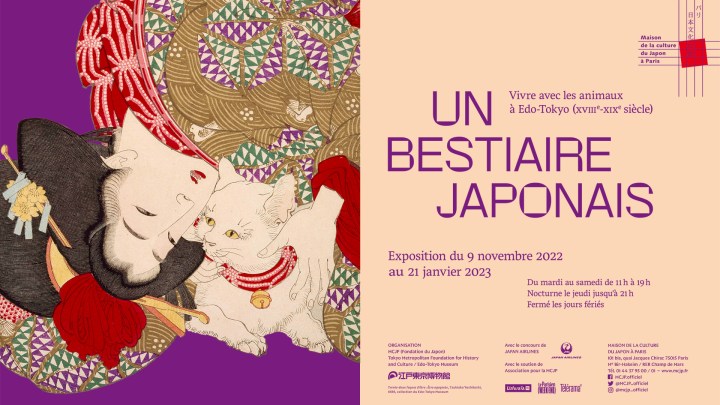
Co-organized with the Edo-Tokyo Museum, this exhibition brings together more than a hundred ukiyo-e prints, paintings, and everyday objects to explore the relationship between humans and animals in Japan during the eighteenth and nineteenth centuries.
Un bestiaire japonais: Vivre avec les animaux à Edo-Tokyo, XVIIIe–XIXe siècle
Maison de la culture du Japon, Paris, 9 November 2022 — 21 January 2023
La gentillesse avec laquelle les Japonais traitent les animaux surprend les premiers Occidentaux qui se rendent dans l’archipel. Les liens entre les humains et le monde animal sont cependant plus complexes comme en témoigne une remarquable réplique d’une paire de paravents de 1634 représentant un panorama détaillé d’Edo et de ses faubourgs. Outre des scènes avec le shogun poursuivant cerfs et sangliers, ou chassant au faucon, on y remarque des montreurs de singes, des chiens errants, des bœufs de labour, des chevaux sacrés…
Dans la section suivante sont présentés les différents rôles des animaux, en lien avec la vie de la noblesse guerrière, des paysans et des commerçants. L’établissement d’Edo comme capitale des guerriers explique une forte présence de chevaux militaires dans les premiers temps. Avec la paix durable, le nombre de chevaux de trait, soutien de la vie citadine, se met à croître. Les bœufs sont utilisés pour le transport des marchandises à Edo ainsi que pour le labour dans les zones rurales à l’extérieur de la ville. Les activités culturelles connaissent un essor important et on s’entoure volontiers d’animaux de compagnie : petits chiens et chats, rossignols et cailles, poissons rouges, ou encore grillons et criquets dont on apprécie le chant. Nombre d’estampes et d’ouvrages sur la façon de s’en occuper sont publiés.
Dans les zones périphériques d’Edo où vit une abondante faune sauvage, la noblesse guerrière pratique régulièrement la chasse. On chasse au faucon des grues, des oies et des canards. Organisées par le shogun, les grandes chasses au cerf visent les cervidés, sangliers, lièvres et faisans. Certains animaux sauvages sont associés à des croyances religieuses, tel le renard, connu pour être le messager d’Inari, dieu des moissons. Les habitants d’Edo, ville riche en collines, rivières, et ouverte sur la mer, vivent profondément en lien avec la nature.La vie des animaux sauvages est un élément familier, étroitement lié aux croyances religieuses et aux rites saisonniers.
À partir du début du XVIIe siècle, Edo s’urbanise rapidement et la population devient friande de nouvelles attractions. Des animaux rares, notamment les paons et perroquets provenant de Chine ou de Hollande, sont exposés dans des lieux spécifiques, ancêtres des zoos, avec des boutiques proposant nourriture et boissons. Très vite, la mode des animaux exotiques connaît un boom sans précédent. Avec l’entrée dans l’ère Meiji (1868–1912), période de modernisation et d’ouverture à l’Occident, le Japon construit des installations sur le modèle occidental, tels que zoos et hippodromes.
À l’époque Edo, la puissance financière nouvelle de la classe commerçante stimule la naissance d’une véritable culture citadine et le raffinement des objets du quotidien: les motifs décoratifs représentant des animaux évoluent vers une plus grande liberté de conception et des variations plus riches. Vers la fin du XIXe siècle, la symbolique des motifs animaliers commence à s’estomper et l’accent est mis de plus en plus sur le côté «kawaii» des animaux de compagnie.
Exhibition | Mr. Pergolesi’s Curious Things
Now on view at Cooper Hewitt–and please note the upcoming programming described below. . .
Mr. Pergolesi’s Curious Things: Ornament in 18th-Century Britain
Cooper Hewitt, Smithsonian Design Museum, New York City, 1 October 2022 — 29 January 2023
Curated by Julia Siemon

Michel Angelo Pergolesi, Ornament Design, Tripod and Roman Standards, 1776, pen and ink, brush and watercolor over graphite on laid paper; 48 × 34 cm (Cooper Hewitt, Smithsonian Design Museum; gift of an unknown donor, 1980-32-1443; photo by Matt Flynn).
Mr. Pergolesi’s Curious Things: Ornament in 18th-Century Britain showcases fanciful drawings and prints by Michel Angelo Pergolesi (died 1801), an Italian-born artist whose professional specialty, in his words, was “the ornaments of the ancients.” In the early 1760s, Pergolesi moved to London, where he helped popularize a neoclassical style that employed ornament inspired by artifacts from ancient Greece and Rome. Brilliantly hued watercolors from Cooper Hewitt’s collection highlight Pergolesi’s skill in transforming ancient relics—what he called “curious Things”—into lighthearted decorative motifs. Although his name is now largely forgotten, these rarely seen works call attention to Pergolesi’s legacy, to the Beaux-Arts neoclassical decoration of Cooper Hewitt’s historic mansion (built 1897–1902), and to the ways in which ornament of all kinds enlivens our built environment.
The exhibition is made possible with support from the Marks Family Foundation Endowment Fund. It was organized by Julia Siemon. Exhibition design is by Field Guide Architecture and Design with graphic design by Kelly Sung.
◊ ◊ ◊ ◊ ◊
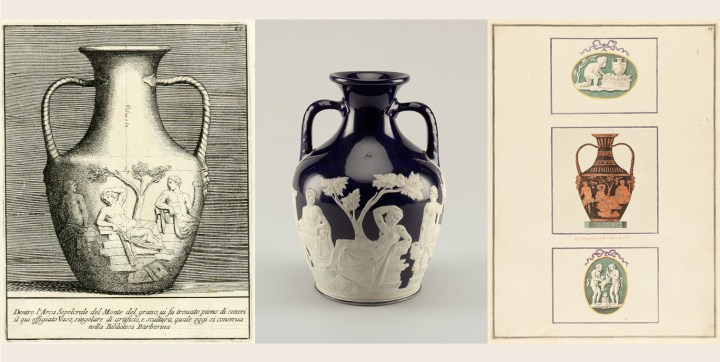
Left: Pietro Santi Bartoli, Gli antichi sepolcri, overo Mausolei Romani et Etruschi, trovati in Roma & in altri luoghi celebri…, Rome, 1697, plate 84 (Los Angeles: Getty Research Institute Library, 82-B2112). Middle: Copy of the Portland Vase, 1850–60, manufactured by Josiah Wedgwood and Sons, stoneware (Smithsonian Institution, Gift of Mrs. Frederick F. Thompson, 1915-30-1; photo by Matt Flynn). Right: Michel Angelo Pergolesi, Ornament Design with Portland Vase and Two Cameos, 1776, pen and ink, brush and watercolor over graphite on laid paper (Smithsonian Institution, Gift of Unknown Donor, 1980-32-1463; photo by Matt Flynn).
◊ ◊ ◊ ◊ ◊
The Antique in Print: The Classical Past and the Visual Arts in the Long 18th Century
Online, Wednesday, 18 January 2023, 1.00pm ET
Classical reliefs, sarcophagi, frescoes, coins, and gems were frequently copied and readapted by Renaissance artists from the 15th century onwards. Yet it was only in the age of the Enlightenment that a selection of them was canonized, illustrated, and diffused in Europe through antiquarian publications. Scholars and travelers on the Grand Tour viewed antiquity through the lens of these books. Their printed illustrations offered a range of images and symbolic references for artists, decorators, and architects whenever they wanted to quote the Antique in their creations. Join us as Dr. Adriano Aymonino explores how the print culture of the long 18th century shaped the visual and allegorical language of Neoclassicism. At the same time, he will contextualize Michel Angelo Pergolesi’s drawings and popular set of prints (Designs for Various Ornaments, 1777–1801). Dr. Julia Siemon, curator of Cooper Hewitt’s Mr. Pergolesi’s Curious Things: Ornament in 18th Century Britain will provide a brief overview of the exhibition at the start of the program.
The program will feature a lecture with a slideshow presentation followed by an audience Q&A hosted through Zoom, with the option to dial in as well. Details will be emailed upon registration. This program includes closed captioning. It will be recorded and available on Cooper Hewitt’s YouTube channel a week following the lecture. For general questions or if we can provide additional accessibility services or accommodations to support your participation in this program, please email CHEducation@si.edu or let us know when registering.
Adriano Aymonino is Director of Undergraduate Programmes in the Department of History of Art at the University of Buckingham and Programme Director for the MA in the Art Market and the History of Collecting. He has curated several exhibitions, such as Drawn from the Antique: Artists and the Classical Ideal, held at the Sir John Soane’s Museum in London in 2015. His book Enlightened Eclecticism was published by Yale University Press in June 2021 and has won the 2022 William MB Berger Prize for British Art History. He is currently working on a revised edition of Francis Haskell and Nicholas Penny’s Taste and the Antique (2023); and on a critical edition of Robert Adam’s Grand Tour correspondence, which will be hosted on the Sir John Soane’s Museum website (2024). He is also co-editor of the series Paper Worlds published by MIT Press and associate editor of the Journal of the History of Collections.
Julia Siemon is Assistant Curator of Paintings at the J. Paul Getty Museum. Prior to joining the Getty, she was Assistant Curator of Drawings, Prints, and Graphic Design at Cooper Hewitt, Smithsonian Design Museum, where she organized Mr. Pergolesi’s Curious Things: Ornament in 18th-Century Britain. Previously, as Assistant Research Curator in the Department of European Sculpture and Decorative Arts at The Metropolitan Museum of Art, she organized The Silver Caesars: A Renaissance Mystery (2017–18) and was editor and co-author of the related volume. Her other publications include contributions to The Medici: Portraits and Politics 1512–1570 (The Metropolitan Museum of Art, 2021) and A Royal Renaissance Treasure and its Afterlives: The Royal Clock Salt (British Museum Research Publications, 2021). She holds a PhD from Columbia University (2015), where she specialized in Italian Renaissance painting.
◊ ◊ ◊ ◊ ◊
Tour with Exhibition Curator Julia Siemon
Cooper Hewitt, New York, Friday, 20 January 2023, 1.30pm ET
In this guided tour with exhibition curator Julia Siemon, visitors will encounter fanciful drawings and prints by Michel Angelo Pergolesi, an Italian-born artist whose professional specialty, in his words, was “the ornaments of the ancients.” The tour is free with reserved museum admission; limited space is offered on a first-come basis.
New Book | Buddhist Art of Tibet: In Milarepa’s Footsteps
With postings, I typically aim for editorial invisibility, allowing the marketing materials of an exhibition or book to do the talking. In this case, however, I would also point readers to Erin Thompson’s review “Sex Tourism with Statues: Buddhist Art of Tibet: In Milarepa’s Footsteps Is a Cringe-worthy Display of ‘Spiritual Colonialism’,” Hyperallergic (3 January 2023). As an associate professor of art crime at John Jay College of Criminal Justice (CUNY), Thompson holds a JD from Columbia Law School and a PhD in art history from Columbia University (both 2010). Lots of interesting questions about lots of things; I can imagine using the review in class next time I teach my introduction to Chinese art. –CH
From Rizzoli:
Etienne Bock, Jean-Marc Falcombello, and Magali Jenny, Buddhist Art of Tibet: In Milarepa’s Footsteps, Symbolism and Spirituality (Paris: Flammarion, 2022), 288 pages, ISBN: 978-2080280947, $50.
 Fascinated by Buddhist art and Asian spirituality, Alain Bordier has spent more than forty years building a unique collection of religious objects from the Himalayas (Tibet, Nepal, and Bhutan). On display today at the Tibet Museum in the heart of the medieval city of Gruyères, Switzerland, some six hundred works offer visitors the rare opportunity to discover an endangered world heritage. This volume presents a general historic and artistic framework of Tibetan art through narratives, anecdotes, and commentary from Bordier on the different subjects and the collection itself. Beyond the artistic aspect, this work demonstrates the symbolism and spirituality that emerge from each object and offers an interpretation of the themes from a Buddhist viewpoint. The highlight of the book is the presentation of an unpublished manuscript retracing the life of Milarepa, the great eleventh-century Tibetan yogi, whose analysis provides an excellent introduction to the great Buddhist principles.
Etienne Bock is a specialist in Himalayan art and literature. Jean-Marc Falcombello is a cultural journalist and a disciple of Lama Teunsang, one of the oldest living Tibetan masters, for four decades. Magali Jenny is an ethnologist.
Note: The image used for the cover of the book is a Tibetan depiction of Milarepa, from the 18th century, pigment on cloth, 24 × 16 inches (Gruyères: Tibet Museum: Fondation Alain Bordier).
Exhibition | Weng Family Collection: Art Rocks

Scholar’s rock, Qing dynasty, stone (Boston: MFA, Gift of the Wan-go H. C. Weng Collection and the Weng family, in honor of Weng Tonghe).
◊ ◊ ◊ ◊ ◊
Now on view at the MFA Boston:
Weng Family Collection of Chinese Painting: Art Rocks
Museum of Fine Arts, Boston, 26 March 2022 — 27 November 2023
In China, rocks in their natural form are objects of great aesthetic appreciation. As far back as one thousand years ago, serious art collectors and critics acquired and competed for rocks with the same passion they afforded great works of painting and calligraphy.
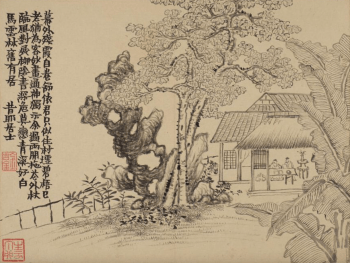
Jin Nong (1687–1764), Elegant Ink (Landscapes after Ancient Masters) / 龍梭墨妙畫冊 (金農), Qing dynasty, 1757, ink on paper, 27 × 35 cm (Boston: MFA, Gift of the Wan-go H. C. Weng Collection and the Weng family, in honor of Weng Tonghe, 2018.2828.1).
Rather than celebrating superficial beauty, collectors exalted imperfection for its expressive possibilities and sought rocks that were not symmetrical or smooth or pretty. They used terms like strange, weird, and awkward as complimentary descriptions of the rocks they most preferred. The humble rock became, like an abstract sculpture, a medium to explore forms and textures, and to express one’s inner being. In the minds of serious connoisseurs, rocks, as microcosms of mountains—or even the entire universe—were meditations on life itself.
From 2018 to 2021, Wan-go H. C. Weng (1918–2020) made the largest gift of Chinese paintings and calligraphy to the MFA in the institution’s history, comprising more than 390 objects acquired and passed down through six generations of his family. Rocks were integral to the Weng family’s art collection, as subjects of paintings and as art objects themselves.

Glass in the shape of a rock / 北京造湖石形料器, Qing dynasty, 18th century, 7 inches (17.8 cm) high (Boston: MFA, Gift of the Rosenblum Family, 2001.221).
This exhibition features more than 25 works from the gift as well as the MFA’s collection that explore how rock aesthetics have permeated architecture, landscape design, and painting styles in China for a millennium. Visitors can envision themselves in paintings of gardens where colossal rocks loom over a scholar’s studio, or scenes of fantastical caves where artists gaze in awe at mysterious rock formations. And rocks of all kind—large and small, weird and imperfect—are on view throughout the gallery, welcoming viewers to ponder, explore or, like the ancient poets, venerate.
This is the third in a series of three exhibitions celebrating the landmark donation made by Wan-go H. C. Weng, a longtime supporter of the MFA who, until he passed away in 2020 at the age of 102, devoted his life to the preservation, study, and promotion of China’s cultural heritage.
More information is available from Asian Art.
◊ ◊ ◊ ◊ ◊
Note (added 14 October 2023) — The posting was updated to include the extended run of the exhibition (from 3 May to 27 November).
Call for Collaborators | The Digital Piranesi

View of the Flavian Amphitheatre, called the Colosseum (Veduta dell’Anfiteatro Flavio detto il Colosseo), from Giovanni Battista Piranesi’s Opere, volume 1 of 29 (Paris: Firmin Didot, 1837–39). Piranesi’s original copper plates were used for this posthumously published collection; this specific print comes from a complete set of volumes at the University of South Carolina, home to The Digital Piranesi project.
◊ ◊ ◊ ◊ ◊
From the Call for Participants:
Essay Contributors for The Digital Piranesi
Applications due by 1 March 2023
 Digital art history, word-image studies, architectural history, and book history meet in The Digital Piranesi, a developing digital humanities project devoted to the complete works of Giambattista Piranesi (1720–1778). With funding from the Kress Foundation, six collaborators will be invited to contribute to the project. Following an introductory in-person workshop in Columbia, South Carolina, in late Summer 2023, regular virtual meetings through Summer 2024 will be dedicated to writing brief, impactful scholarly essays about each image in the first volume of his Roman Antiquities / Le Anthichità Romane (1756). Travel and accommodation will be supported by grant funds.
Each image of the first volume of the Roman Antiquities appears with original annotations and (in metadata) English translations here.
Please send a CV and one-page statement detailing qualifications, experience, and interest to Jeanne Britton at jbritton@mailbox.sc.edu by 1 March 2023. Inquiries are welcome.
The Digital Piranesi has received generous support from the NEH Division of Preservation and Access, the Kress Foundation, and, at the University of South Carolina, the Office of the Vice President for Research, the Center for Digital Humanities, the Magellan Scholar Program, the Maners-Pappas Endowment, the Humanities Collaborative, and the Irvin Department of Rare Books and Special Collections.










 Enfilade
leave a comment